@NTXISSA
Four Deadly Traps in Using
Information Security Frameworks
Doug Landoll
CEO
Lantego
April 25, 2015
www.lantego.com
(512) 633-8405
dlandoll@lantego.com
@NTXISSA
Session Agenda
• Framework Definition & Uses
• NIST 800-53 Framework Intro & Uses
• Four Traps of Frameworks
• Conclusion
@NTXISSA
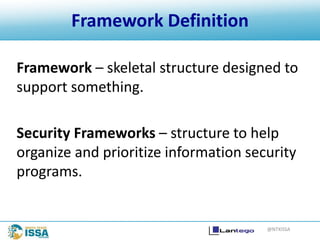
Framework – skeletal structure designed to
support something.
Security Frameworks – structure to help
organize and prioritize information security
programs.
Framework Definition
@NTXISSA
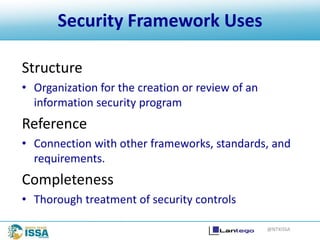
Structure
• Organization for the creation or review of an
information security program
Reference
• Connection with other frameworks, standards, and
requirements.
Completeness
• Thorough treatment of security controls
Security Framework Uses
@NTXISSA
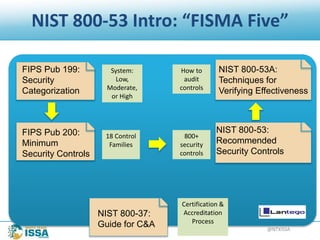
NIST 800-53 Intro: “FISMA Five”
FIPS Pub 199:
Security
Categorization
NIST 800-37:
Guide for C&A
FIPS Pub 200:
Minimum
Security Controls
NIST 800-53:
Recommended
Security Controls
NIST 800-53A:
Techniques for
Verifying Effectiveness
System:
Low,
Moderate,
or High
18 Control
Families
Certification &
Accreditation
Process
800+
security
controls
How to
audit
controls
@NTXISSA
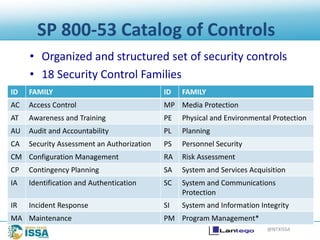
SP 800-53 Catalog of Controls
• Organized and structured set of security controls
• 18 Security Control Families
ID FAMILY ID FAMILY
AC Access Control MP Media Protection
AT Awareness and Training PE Physical and Environmental Protection
AU Audit and Accountability PL Planning
CA Security Assessment an Authorization PS Personnel Security
CM Configuration Management RA Risk Assessment
CP Contingency Planning SA System and Services Acquisition
IA Identification and Authentication SC System and Communications
Protection
IR Incident Response SI System and Information Integrity
MA Maintenance PM Program Management*
@NTXISSA
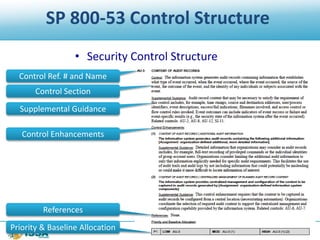
SP 800-53 Control Structure
• Security Control Structure
Control Ref. # and Name
Control Section
Supplemental Guidance
Control Enhancements
References
Priority & Baseline Allocation
@NTXISSA
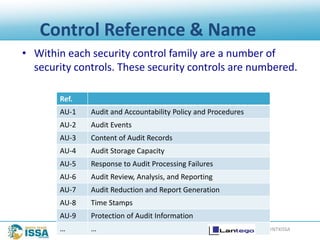
Control Reference & Name
• Within each security control family are a number of
security controls. These security controls are numbered.
Ref.
AU-1 Audit and Accountability Policy and Procedures
AU-2 Audit Events
AU-3 Content of Audit Records
AU-4 Audit Storage Capacity
AU-5 Response to Audit Processing Failures
AU-6 Audit Review, Analysis, and Reporting
AU-7 Audit Reduction and Report Generation
AU-8 Time Stamps
AU-9 Protection of Audit Information
… …
@NTXISSA
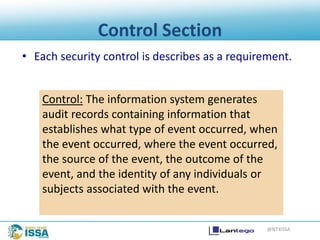
Control Section
• Each security control is describes as a requirement.
Control: The information system generates
audit records containing information that
establishes what type of event occurred, when
the event occurred, where the event occurred,
the source of the event, the outcome of the
event, and the identity of any individuals or
subjects associated with the event.
@NTXISSA
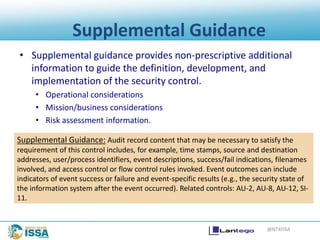
Supplemental Guidance
• Supplemental guidance provides non-prescriptive additional
information to guide the definition, development, and
implementation of the security control.
• Operational considerations
• Mission/business considerations
• Risk assessment information.
Supplemental Guidance: Audit record content that may be necessary to satisfy the
requirement of this control includes, for example, time stamps, source and destination
addresses, user/process identifiers, event descriptions, success/fail indications, filenames
involved, and access control or flow control rules invoked. Event outcomes can include
indicators of event success or failure and event-specific results (e.g., the security state of
the information system after the event occurred). Related controls: AU-2, AU-8, AU-12, SI-
11.
@NTXISSA
Control Enhancements
• Control enhancements provide statements of security capability to:
• Add function/specificity to the control, or
• Increase the strength of the control.
Control Enhancements:
(1) CONTENT OF AUDIT RECORDS | ADDITIONAL AUDIT INFORMATION
The information system generates audit records containing the following additional
information: [Assignment: organization-defined additional, more detailed information].
(2) CONTENT OF AUDIT RECORDS | CENTRALIZED MANAGEMENT OF PLANNED AUDIT
RECORD CONTENT
The information system provides centralized management and configuration of the
content to be captured in audit records generated by [Assignment: organization-defined
information system components].
@NTXISSA
References
• References section includes a list of applicable
documents relevant to the security control:
• federal laws,
• Executive Orders,
• directives,
• policies,
• regulations,
• standards, and
• guidelines
@NTXISSA
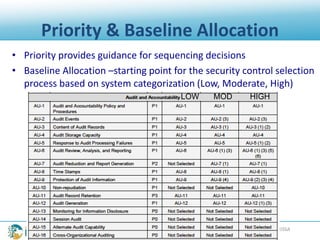
Priority & Baseline Allocation
• Priority provides guidance for sequencing decisions
• Baseline Allocation –starting point for the security control selection
process based on system categorization (Low, Moderate, High)
MOD HIGHLOW
@NTXISSA
Control Assignment
• Controls may be augmented through assignment and
selection options within control statements.
• Assignment: Organizationally defined
AU-2 AUDIT EVENTS
The organization:
…
(3) AUDIT EVENT | REVIEWS AND UPDATES
The organization reviews and updates the audited events
[Assignment: organization-defined frequency].
800-53
Example
@NTXISSA
Control Selection
• Controls may be augmented through assignment and
selection options within control statements.
• Selection: Organizationally defined
IA-3 DEVICE IDENTIFICATION AND AUTHENTICATION
Control: The information system uniquely identifies and authenticates [Assignment:
organizational defined specific and/or types of devices] before establishing a
[Selection (one or more): local, remote, network] connection.
800-53
Example
@NTXISSA
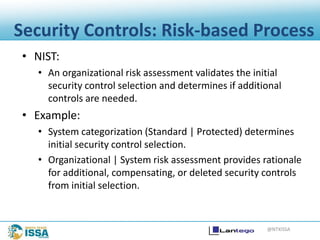
Security Controls: Risk-based Process
• NIST:
• An organizational risk assessment validates the initial
security control selection and determines if additional
controls are needed.
• Example:
• System categorization (Standard | Protected) determines
initial security control selection.
• Organizational | System risk assessment provides rationale
for additional, compensating, or deleted security controls
from initial selection.
@NTXISSA
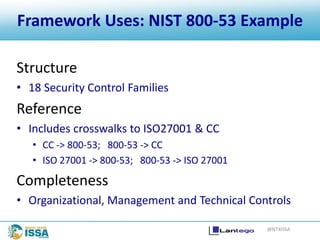
Structure
• 18 Security Control Families
Reference
• Includes crosswalks to ISO27001 & CC
• CC -> 800-53; 800-53 -> CC
• ISO 27001 -> 800-53; 800-53 -> ISO 27001
Completeness
• Organizational, Management and Technical Controls
Framework Uses: NIST 800-53 Example
@NTXISSA
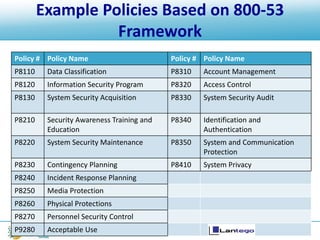
Policy # Policy Name Policy # Policy Name
P8110 Data Classification P8310 Account Management
P8120 Information Security Program P8320 Access Control
P8130 System Security Acquisition P8330 System Security Audit
P8210 Security Awareness Training and
Education
P8340 Identification and
Authentication
P8220 System Security Maintenance P8350 System and Communication
Protection
P8230 Contingency Planning P8410 System Privacy
P8240 Incident Response Planning
P8250 Media Protection
P8260 Physical Protections
P8270 Personnel Security Control
P9280 Acceptable Use
Example Policies Based on 800-53
Framework
@NTXISSA
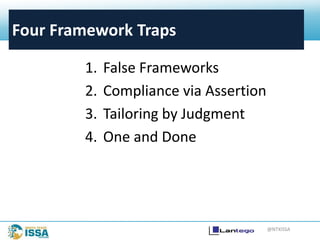
Four Framework Traps
1. False Frameworks
2. Compliance via Assertion
3. Tailoring by Judgment
4. One and Done
@NTXISSA
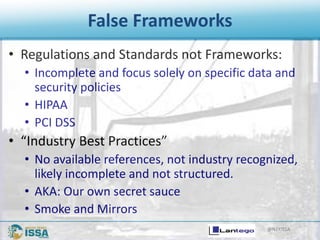
False Frameworks
• Regulations and Standards not Frameworks:
• Incomplete and focus solely on specific data and
security policies
• HIPAA
• PCI DSS
• “Industry Best Practices”
• No available references, not industry recognized,
likely incomplete and not structured.
• AKA: Our own secret sauce
• Smoke and Mirrors
@NTXISSA
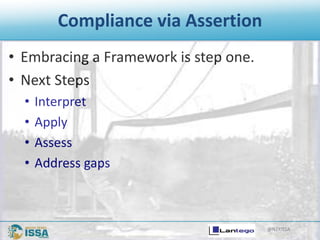
Compliance via Assertion
• Embracing a Framework is step one.
• Next Steps
• Interpret
• Apply
• Assess
• Address gaps
@NTXISSA
Tailoring by Judgment
• Frameworks are tailorable through an
exception process or a risk based process.
• Tailoring based on gaps, “judgment”, and
cost limits the benefits of a framework
@NTXISSA
One and Done
• A security program based on a framework will
require maintenance
• Frameworks get updates
• ISO 27001/2: Updated Sept 2013
• NIST 800-53: Updated April 2013
• COBIT 5: Updated 2012
• Other Updates
• References, Mappings, Business & Customer
Requirements
• Reassess regularly
@NTXISSA
Conclusions
• Determine appropriate framework for the
business
• Add requirements (these are not frameworks)
• Embrace the framework and its tailoring
process
• Beware framework traps
• It’s just a framework – there is a lot more
work to do.
@NTXISSA@NTXISSA
The Collin College Engineering Department
Collin College Student Chapter of the North Texas ISSA
North Texas ISSA (Information Systems Security Association)
NTX ISSA Cyber Security Conference – April 24-25, 2015 25
Thank you

NTXISSACSC2 - Four Deadly Traps in Using Information Security Frameworks by Doug Landoll

  • 1.
    @NTXISSA Four Deadly Trapsin Using Information Security Frameworks Doug Landoll CEO Lantego April 25, 2015 www.lantego.com (512) 633-8405 dlandoll@lantego.com
  • 2.
    @NTXISSA Session Agenda • FrameworkDefinition & Uses • NIST 800-53 Framework Intro & Uses • Four Traps of Frameworks • Conclusion
  • 3.
    @NTXISSA Framework – skeletalstructure designed to support something. Security Frameworks – structure to help organize and prioritize information security programs. Framework Definition
  • 4.
    @NTXISSA Structure • Organization forthe creation or review of an information security program Reference • Connection with other frameworks, standards, and requirements. Completeness • Thorough treatment of security controls Security Framework Uses
  • 5.
    @NTXISSA NIST 800-53 Intro:“FISMA Five” FIPS Pub 199: Security Categorization NIST 800-37: Guide for C&A FIPS Pub 200: Minimum Security Controls NIST 800-53: Recommended Security Controls NIST 800-53A: Techniques for Verifying Effectiveness System: Low, Moderate, or High 18 Control Families Certification & Accreditation Process 800+ security controls How to audit controls
  • 6.
    @NTXISSA SP 800-53 Catalogof Controls • Organized and structured set of security controls • 18 Security Control Families ID FAMILY ID FAMILY AC Access Control MP Media Protection AT Awareness and Training PE Physical and Environmental Protection AU Audit and Accountability PL Planning CA Security Assessment an Authorization PS Personnel Security CM Configuration Management RA Risk Assessment CP Contingency Planning SA System and Services Acquisition IA Identification and Authentication SC System and Communications Protection IR Incident Response SI System and Information Integrity MA Maintenance PM Program Management*
  • 7.
    @NTXISSA SP 800-53 ControlStructure • Security Control Structure Control Ref. # and Name Control Section Supplemental Guidance Control Enhancements References Priority & Baseline Allocation
  • 8.
    @NTXISSA Control Reference &Name • Within each security control family are a number of security controls. These security controls are numbered. Ref. AU-1 Audit and Accountability Policy and Procedures AU-2 Audit Events AU-3 Content of Audit Records AU-4 Audit Storage Capacity AU-5 Response to Audit Processing Failures AU-6 Audit Review, Analysis, and Reporting AU-7 Audit Reduction and Report Generation AU-8 Time Stamps AU-9 Protection of Audit Information … …
  • 9.
    @NTXISSA Control Section • Eachsecurity control is describes as a requirement. Control: The information system generates audit records containing information that establishes what type of event occurred, when the event occurred, where the event occurred, the source of the event, the outcome of the event, and the identity of any individuals or subjects associated with the event.
  • 10.
    @NTXISSA Supplemental Guidance • Supplementalguidance provides non-prescriptive additional information to guide the definition, development, and implementation of the security control. • Operational considerations • Mission/business considerations • Risk assessment information. Supplemental Guidance: Audit record content that may be necessary to satisfy the requirement of this control includes, for example, time stamps, source and destination addresses, user/process identifiers, event descriptions, success/fail indications, filenames involved, and access control or flow control rules invoked. Event outcomes can include indicators of event success or failure and event-specific results (e.g., the security state of the information system after the event occurred). Related controls: AU-2, AU-8, AU-12, SI- 11.
  • 11.
    @NTXISSA Control Enhancements • Controlenhancements provide statements of security capability to: • Add function/specificity to the control, or • Increase the strength of the control. Control Enhancements: (1) CONTENT OF AUDIT RECORDS | ADDITIONAL AUDIT INFORMATION The information system generates audit records containing the following additional information: [Assignment: organization-defined additional, more detailed information]. (2) CONTENT OF AUDIT RECORDS | CENTRALIZED MANAGEMENT OF PLANNED AUDIT RECORD CONTENT The information system provides centralized management and configuration of the content to be captured in audit records generated by [Assignment: organization-defined information system components].
  • 12.
    @NTXISSA References • References sectionincludes a list of applicable documents relevant to the security control: • federal laws, • Executive Orders, • directives, • policies, • regulations, • standards, and • guidelines
  • 13.
    @NTXISSA Priority & BaselineAllocation • Priority provides guidance for sequencing decisions • Baseline Allocation –starting point for the security control selection process based on system categorization (Low, Moderate, High) MOD HIGHLOW
  • 14.
    @NTXISSA Control Assignment • Controlsmay be augmented through assignment and selection options within control statements. • Assignment: Organizationally defined AU-2 AUDIT EVENTS The organization: … (3) AUDIT EVENT | REVIEWS AND UPDATES The organization reviews and updates the audited events [Assignment: organization-defined frequency]. 800-53 Example
  • 15.
    @NTXISSA Control Selection • Controlsmay be augmented through assignment and selection options within control statements. • Selection: Organizationally defined IA-3 DEVICE IDENTIFICATION AND AUTHENTICATION Control: The information system uniquely identifies and authenticates [Assignment: organizational defined specific and/or types of devices] before establishing a [Selection (one or more): local, remote, network] connection. 800-53 Example
  • 16.
    @NTXISSA Security Controls: Risk-basedProcess • NIST: • An organizational risk assessment validates the initial security control selection and determines if additional controls are needed. • Example: • System categorization (Standard | Protected) determines initial security control selection. • Organizational | System risk assessment provides rationale for additional, compensating, or deleted security controls from initial selection.
  • 17.
    @NTXISSA Structure • 18 SecurityControl Families Reference • Includes crosswalks to ISO27001 & CC • CC -> 800-53; 800-53 -> CC • ISO 27001 -> 800-53; 800-53 -> ISO 27001 Completeness • Organizational, Management and Technical Controls Framework Uses: NIST 800-53 Example
  • 18.
    @NTXISSA Policy # PolicyName Policy # Policy Name P8110 Data Classification P8310 Account Management P8120 Information Security Program P8320 Access Control P8130 System Security Acquisition P8330 System Security Audit P8210 Security Awareness Training and Education P8340 Identification and Authentication P8220 System Security Maintenance P8350 System and Communication Protection P8230 Contingency Planning P8410 System Privacy P8240 Incident Response Planning P8250 Media Protection P8260 Physical Protections P8270 Personnel Security Control P9280 Acceptable Use Example Policies Based on 800-53 Framework
  • 19.
    @NTXISSA Four Framework Traps 1.False Frameworks 2. Compliance via Assertion 3. Tailoring by Judgment 4. One and Done
  • 20.
    @NTXISSA False Frameworks • Regulationsand Standards not Frameworks: • Incomplete and focus solely on specific data and security policies • HIPAA • PCI DSS • “Industry Best Practices” • No available references, not industry recognized, likely incomplete and not structured. • AKA: Our own secret sauce • Smoke and Mirrors
  • 21.
    @NTXISSA Compliance via Assertion •Embracing a Framework is step one. • Next Steps • Interpret • Apply • Assess • Address gaps
  • 22.
    @NTXISSA Tailoring by Judgment •Frameworks are tailorable through an exception process or a risk based process. • Tailoring based on gaps, “judgment”, and cost limits the benefits of a framework
  • 23.
    @NTXISSA One and Done •A security program based on a framework will require maintenance • Frameworks get updates • ISO 27001/2: Updated Sept 2013 • NIST 800-53: Updated April 2013 • COBIT 5: Updated 2012 • Other Updates • References, Mappings, Business & Customer Requirements • Reassess regularly
  • 24.
    @NTXISSA Conclusions • Determine appropriateframework for the business • Add requirements (these are not frameworks) • Embrace the framework and its tailoring process • Beware framework traps • It’s just a framework – there is a lot more work to do.
  • 25.
    @NTXISSA@NTXISSA The Collin CollegeEngineering Department Collin College Student Chapter of the North Texas ISSA North Texas ISSA (Information Systems Security Association) NTX ISSA Cyber Security Conference – April 24-25, 2015 25 Thank you