THIS MATERIAL IS BASED UPON WORK
SUPPORTED BY THE NATIONAL SCIENCE
FOUNDATION UNDER GRANT NO. 1723635.
IT and Cyber
Wu He, PhD
Associate Professor
Department of Information Technology &
Decision Sciences
Old Dominion University
THIS MATERIAL IS BASED UPON WORK
SUPPORTED BY THE NATIONAL SCIENCE
FOUNDATION UNDER GRANT NO. 1723635.
What is Information Technology?
Information Technology is a set of tools that helps you work with
information and perform tasks related to information processing.
The term information technology implies that you are using
technology as a set of tools to work with information.
THIS MATERIAL IS BASED UPON WORK
SUPPORTED BY THE NATIONAL SCIENCE
FOUNDATION UNDER GRANT NO. 1723635.
What is Information Technology?
Information Technology (IT) describes any technology that helps to produce,
manipulate, store, communicate, and/or disseminate information
You can work with information in a variety of forms – text, image, sound, and
video.
IT typically involves Computer Technology and Communication Technology
THIS MATERIAL IS BASED UPON WORK
SUPPORTED BY THE NATIONAL SCIENCE
FOUNDATION UNDER GRANT NO. 1723635.
Information Security
Information security: protecting information (data) and
information systems from unauthorized access, use,
disclosure, disruption, modification, or destruction.
Information Security management is a process of
defining the security controls in order to protect the
information assets.
C.I.A. triangle
∙Confidentiality, integrity, and availability
∙Video: http://www.youtube.com/watch?v=j8FT9WqmuDY
THIS MATERIAL IS BASED UPON WORK
SUPPORTED BY THE NATIONAL SCIENCE
FOUNDATION UNDER GRANT NO. 1723635.
Information Security Fundamentals
• Necessary tools for information security:
policy, awareness, training, education,
technology
• Please read a summary at:
https://en.wikibooks.org/wiki/Fundamentals_of_Information_Systems_Security/Informati
on_Security_and_Risk_Management
THIS MATERIAL IS BASED UPON WORK
SUPPORTED BY THE NATIONAL SCIENCE
FOUNDATION UNDER GRANT NO. 1723635.
The Elements of Security
Vulnerability
It is a software, hardware, or procedural weakness that
may provide an attacker the open door he is looking for
to enter a computer or network and have unauthorized
access to resources within the environment.
Vulnerability characterizes the absence or weakness of
a safeguard that could be exploited.
E.g.: a service running on a server, unpatched
applications or operating system software, unrestricted
modem dial-in access, an open port on a firewall, lack
of physical security etc.
THIS MATERIAL IS BASED UPON WORK
SUPPORTED BY THE NATIONAL SCIENCE
FOUNDATION UNDER GRANT NO. 1723635.
Threat
Any potential danger to information or systems.
A threat is a possibility that someone (person, s/w)
would identify and exploit the vulnerability.
The entity that takes advantage of vulnerability is
referred to as a threat agent. E.g.: A threat agent
could be an intruder accessing the network through
a port on the firewall
THIS MATERIAL IS BASED UPON WORK
SUPPORTED BY THE NATIONAL SCIENCE
FOUNDATION UNDER GRANT NO. 1723635.
Risk
Risk is the likelihood of a threat agent taking advantage
of vulnerability and the corresponding business
impact.
Reducing vulnerability and/or threat reduces the risk.
E.g.: If a firewall has several ports open, there is a
higher likelihood that an intruder will use one to access
the network in an unauthorized method.
THIS MATERIAL IS BASED UPON WORK
SUPPORTED BY THE NATIONAL SCIENCE
FOUNDATION UNDER GRANT NO. 1723635.
Exposure
An exposure is an instance of being exposed to losses
from a threat agent.
Vulnerability exposes an organization to possible
damages.
E.g.:If password management is weak and password
rules are not enforced, the company is exposed to the
possibility of having users' passwords captured and
used in an unauthorized manner.
THIS MATERIAL IS BASED UPON WORK
SUPPORTED BY THE NATIONAL SCIENCE
FOUNDATION UNDER GRANT NO. 1723635.
Countermeasure or Safeguard
It is an application or a s/w configuration or h/w or a procedure that
mitigates the risk.
∙ E.g.: strong password management, a security guard, access control mechanisms
within an operating system, the implementation of basic input/output system (BIOS)
passwords, and security-awareness training.
THIS MATERIAL IS BASED UPON WORK
SUPPORTED BY THE NATIONAL SCIENCE
FOUNDATION UNDER GRANT NO. 1723635.
An Example: The Relation Between the
Security Elements
 If a company has antivirus software but does not keep the virus
signatures up-to-date, this is vulnerability. The company is
vulnerable to virus attacks.
 The threat is that a virus will show up in the environment and
disrupt productivity.
 The likelihood of a virus showing up in the environment and
causing damage is the risk.
 If a virus infiltrates the company's environment, then vulnerability
has been exploited and the company is exposed to loss.
 The countermeasures in this situation are to update the
signatures and install the antivirus software on all computers
THIS MATERIAL IS BASED UPON WORK
SUPPORTED BY THE NATIONAL SCIENCE
FOUNDATION UNDER GRANT NO. 1723635.
Approaches to Information Security
Implementation: Bottom-Up Approach
 The lower-end team comes up with a security
control or a program without proper management
support and direction.
 It is oft considered less effective as it lacks a
number of critical features:
Participant support
Organizational staying power
THIS MATERIAL IS BASED UPON WORK
SUPPORTED BY THE NATIONAL SCIENCE
FOUNDATION UNDER GRANT NO. 1723635.
Approaches to Information Security
Implementation: Top-Down Approach
The initiation, support, and direction comes from the top
management and work their way through middle management
and then to staff members.
Treated as the best approach but seems to based on the I get
paid more therefor I must know more about everything type of
mentality.
Ensures that the senior management who are ultimately
responsible for protecting the company assets is driving the
program.
THIS MATERIAL IS BASED UPON WORK
SUPPORTED BY THE NATIONAL SCIENCE
FOUNDATION UNDER GRANT NO. 1723635.
Three Types of Security Controls
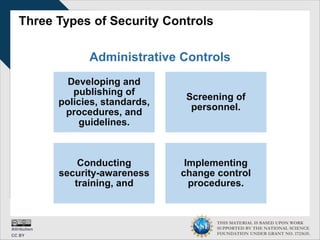
Administrative Controls
Developing and
publishing of
policies, standards,
procedures, and
guidelines.
Screening of
personnel.
Conducting
security-awareness
training, and
Implementing
change control
procedures.
THIS MATERIAL IS BASED UPON WORK
SUPPORTED BY THE NATIONAL SCIENCE
FOUNDATION UNDER GRANT NO. 1723635.
Three Types of Security Controls
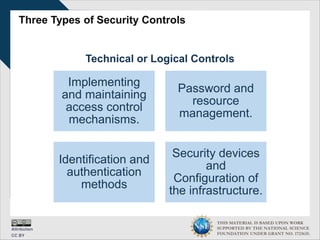
Technical or Logical Controls
Implementing
and maintaining
access control
mechanisms.
Password and
resource
management.
Identification and
authentication
methods
Security devices
and
Configuration of
the infrastructure.
THIS MATERIAL IS BASED UPON WORK
SUPPORTED BY THE NATIONAL SCIENCE
FOUNDATION UNDER GRANT NO. 1723635.
Three Types of Security Controls
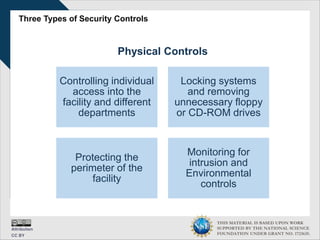
Physical Controls
Controlling individual
access into the
facility and different
departments
Locking systems
and removing
unnecessary floppy
or CD-ROM drives
Protecting the
perimeter of the
facility
Monitoring for
intrusion and
Environmental
controls
THIS MATERIAL IS BASED UPON WORK
SUPPORTED BY THE NATIONAL SCIENCE
FOUNDATION UNDER GRANT NO. 1723635.
Security Roles and Responsibilities
Levels of Responsibilities
Senior management and other levels of management
∙Understand the vision of the company, the business goals, and the
objectives.
Functional management
∙Understand how their individual departments work, what roles
individuals play within the company, and how security affects their
department directly.
Operational managers and staff. These layers are closer to the
actual operations of the company.
∙Know detailed information about the technical and procedural
requirements, the systems, and how the systems are used.
∙Understand how security mechanisms integrate into systems, how to
configure them, and how they affect daily productivity.
THIS MATERIAL IS BASED UPON WORK
SUPPORTED BY THE NATIONAL SCIENCE
FOUNDATION UNDER GRANT NO. 1723635.
Information Security Project Team
A number of individuals with experience in technical
and/or nontechnical areas:
Security policy developers
Risk assessment specialists
Information security officer
Systems administrators
Security Administrator
Security Analyst
Data Custodian
End users
THIS MATERIAL IS BASED UPON WORK
SUPPORTED BY THE NATIONAL SCIENCE
FOUNDATION UNDER GRANT NO. 1723635.
Responsibilities of the Information Security
Officer
• Communicate Risks to Executive Management
• Budget for Information Security Activities
• Ensure Development of Policies, Procedures, Baselines,
Standards, and Guidelines
• Develop and Provide Security Awareness Program
• Understand Business Objectives
• Maintain Awareness of Emerging Threats and
Vulnerabilities
• Evaluate Security Incidents and Response
• Develop Security Compliance Program
• Establish Security Metrics
• Participate in Management Meetings
• Ensure Compliance with Government Regulations
• Assist Internal and External Auditors
• Stay Abreast of Emerging Technologies
THIS MATERIAL IS BASED UPON WORK
SUPPORTED BY THE NATIONAL SCIENCE
FOUNDATION UNDER GRANT NO. 1723635.
CyberSecurity Awareness
http://www.youtube.com/watch?v=UIIY9AQSqbY&feature=endscreen&NR=1
THIS MATERIAL IS BASED UPON WORK
SUPPORTED BY THE NATIONAL SCIENCE
FOUNDATION UNDER GRANT NO. 1723635.
Importance of Cybersecurity Policy and Training
Organizations have been actively using security technologies - security can not
be achieved through technological tools alone.
People are often the weakest link in the security chain. A large percentage of
documented data breaches can be traced back to human error and employees’
misuse of IT assets.
A system is only as secure as the weakest link.
Effective cybersecurity in organizations depends on the compliance of security
policy of their employees.
THIS MATERIAL IS BASED UPON WORK
SUPPORTED BY THE NATIONAL SCIENCE
FOUNDATION UNDER GRANT NO. 1723635.
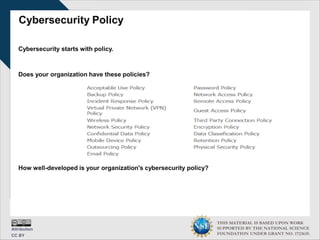
Cybersecurity Policy
Cybersecurity starts with policy.
Does your organization have these policies?
How well-developed is your organization's cybersecurity policy?
THIS MATERIAL IS BASED UPON WORK
SUPPORTED BY THE NATIONAL SCIENCE
FOUNDATION UNDER GRANT NO. 1723635.
Tips for Developing Cybersecurity Policy
Make your security policies easy to understand.
∙Many companies make ineffective attempts at teaching their
employees about company security policies
∙Work with instructional designers and technical writers to write a
security policy your employees will read (and follow)
∙Keep your security policy simple: each policy should be short
enough that people can read and interpret it within 10 minutes.
THIS MATERIAL IS BASED UPON WORK
SUPPORTED BY THE NATIONAL SCIENCE
FOUNDATION UNDER GRANT NO. 1723635.
Tips for Developing Cybersecurity Policy
Your cybersecurity policy should be reviewed and
updated every six to twelve months. At that point,
your organization's cybersecurity team should get
together to address any new issues that have
arisen, review and adjust the policies.
Engage your employees (at least one
representative) from each business unit in your
policy development efforts, assuring that
everyone's concerns are adequately met.
THIS MATERIAL IS BASED UPON WORK
SUPPORTED BY THE NATIONAL SCIENCE
FOUNDATION UNDER GRANT NO. 1723635.
Tips for Developing Cybersecurity Policy
Your policy must include consequences for noncompliance and an
oversight team that enforces these consequences
The cyber security policy should be included as part of the
employment agreement, and regular cyber security training should
be scheduled to make sure that employees understand the
cybersecurity policy.
Make your security policies available to everyone.
THIS MATERIAL IS BASED UPON WORK
SUPPORTED BY THE NATIONAL SCIENCE
FOUNDATION UNDER GRANT NO. 1723635.
Cybersecurity Training
Annual security training for employees is not enough today!
Similar to updating hardware or operating systems, organizations need to
conduct “people patching” - consistently update employees with the latest
security vulnerabilities and train them on how to recognize and avoid them.
THIS MATERIAL IS BASED UPON WORK
SUPPORTED BY THE NATIONAL SCIENCE
FOUNDATION UNDER GRANT NO. 1723635.
Cybersecurity Training: Effective
Practices
Perform "live fire" training exercises, in which
employees undergo a simulated attack specific to
their job.
∙An example of performing regular phishing tests:
- The IT team sends out a fake phishing email to all employees across the organization, and gauge how many people click on it.
- Then, break that data down by departments and types of messages, to tailor training to problem areas.
- If an employee clicks on a simulated phishing attempt, share the results with that person.
- Invite victims of the attack to share the lessons they learned with their peer groups
THIS MATERIAL IS BASED UPON WORK
SUPPORTED BY THE NATIONAL SCIENCE
FOUNDATION UNDER GRANT NO. 1723635.
Cybersecurity Training: Effective
Practices
Get buy in from the top: have line items in the annual budget for people,
hardware, and software
Develop a formal, documented plan for cybersecurity training that is reviewed
and updated often with the latest information on attack vectors and other risks
Cybersecurity training should continue throughout the year, specific to each
employee's job.
∙ All new hires including part-time employees go through security training from day one.
∙ Train the top management and IT staff too!
THIS MATERIAL IS BASED UPON WORK
SUPPORTED BY THE NATIONAL SCIENCE
FOUNDATION UNDER GRANT NO. 1723635.
Cybersecurity Training: Effective
Practices
Appoint a cybersecurity culture advocate in every department at the
organization. These advocates can act as an extension of the CISO and keep
employees trained and motivated.
Train employees to recognize different types of attacks
Reward employees that find malicious emails or malware, and share stories
about how employees helped thwart security issues
THIS MATERIAL IS BASED UPON WORK
SUPPORTED BY THE NATIONAL SCIENCE
FOUNDATION UNDER GRANT NO. 1723635.
Cybersecurity Training: Effective
Practices
Make security training more personal
-People are more open to ideas presented to them if
the ideas directly affect them
-Employees will care more if you educate them about
protecting themselves from cyber criminals, their kids
from predators and their families from fraud.
-“There are 10,000 phishing websites out there. Here
is how to best protect your family.”
THIS MATERIAL IS BASED UPON WORK
SUPPORTED BY THE NATIONAL SCIENCE
FOUNDATION UNDER GRANT NO. 1723635.
Cybersecurity Training: Effective
Practices
Regularly test your employees’ current security knowledge:
∙ Have a quiz that will test their actions in example situations
∙ Follow up with employees on their test results. Show every employee their results
and how each compares with the average.
∙ Constant reinforcement and affirmation of progress will encourage your employees
to remain vigilant
THIS MATERIAL IS BASED UPON WORK
SUPPORTED BY THE NATIONAL SCIENCE
FOUNDATION UNDER GRANT NO. 1723635.
Cybersecurity Training: Effective
Practices
Raise awareness of your policies on a
routine basis and use a combination of
methods to keep a fresh approach that
employees will notice
-Sending reminders and helpful hints in a weekly/monthly email
-Providing visual aids about the policy or helpful hints in the workplace
-Showing policy-related Banner messages that appear during login; rotate the policy
message each month
-If an incident happens, give your employees a heads-up as soon as possible

It and-cyber-module-2

  • 1.
    THIS MATERIAL ISBASED UPON WORK SUPPORTED BY THE NATIONAL SCIENCE FOUNDATION UNDER GRANT NO. 1723635. IT and Cyber Wu He, PhD Associate Professor Department of Information Technology & Decision Sciences Old Dominion University
  • 2.
    THIS MATERIAL ISBASED UPON WORK SUPPORTED BY THE NATIONAL SCIENCE FOUNDATION UNDER GRANT NO. 1723635. What is Information Technology? Information Technology is a set of tools that helps you work with information and perform tasks related to information processing. The term information technology implies that you are using technology as a set of tools to work with information.
  • 3.
    THIS MATERIAL ISBASED UPON WORK SUPPORTED BY THE NATIONAL SCIENCE FOUNDATION UNDER GRANT NO. 1723635. What is Information Technology? Information Technology (IT) describes any technology that helps to produce, manipulate, store, communicate, and/or disseminate information You can work with information in a variety of forms – text, image, sound, and video. IT typically involves Computer Technology and Communication Technology
  • 4.
    THIS MATERIAL ISBASED UPON WORK SUPPORTED BY THE NATIONAL SCIENCE FOUNDATION UNDER GRANT NO. 1723635. Information Security Information security: protecting information (data) and information systems from unauthorized access, use, disclosure, disruption, modification, or destruction. Information Security management is a process of defining the security controls in order to protect the information assets. C.I.A. triangle ∙Confidentiality, integrity, and availability ∙Video: http://www.youtube.com/watch?v=j8FT9WqmuDY
  • 5.
    THIS MATERIAL ISBASED UPON WORK SUPPORTED BY THE NATIONAL SCIENCE FOUNDATION UNDER GRANT NO. 1723635. Information Security Fundamentals • Necessary tools for information security: policy, awareness, training, education, technology • Please read a summary at: https://en.wikibooks.org/wiki/Fundamentals_of_Information_Systems_Security/Informati on_Security_and_Risk_Management
  • 6.
    THIS MATERIAL ISBASED UPON WORK SUPPORTED BY THE NATIONAL SCIENCE FOUNDATION UNDER GRANT NO. 1723635. The Elements of Security Vulnerability It is a software, hardware, or procedural weakness that may provide an attacker the open door he is looking for to enter a computer or network and have unauthorized access to resources within the environment. Vulnerability characterizes the absence or weakness of a safeguard that could be exploited. E.g.: a service running on a server, unpatched applications or operating system software, unrestricted modem dial-in access, an open port on a firewall, lack of physical security etc.
  • 7.
    THIS MATERIAL ISBASED UPON WORK SUPPORTED BY THE NATIONAL SCIENCE FOUNDATION UNDER GRANT NO. 1723635. Threat Any potential danger to information or systems. A threat is a possibility that someone (person, s/w) would identify and exploit the vulnerability. The entity that takes advantage of vulnerability is referred to as a threat agent. E.g.: A threat agent could be an intruder accessing the network through a port on the firewall
  • 8.
    THIS MATERIAL ISBASED UPON WORK SUPPORTED BY THE NATIONAL SCIENCE FOUNDATION UNDER GRANT NO. 1723635. Risk Risk is the likelihood of a threat agent taking advantage of vulnerability and the corresponding business impact. Reducing vulnerability and/or threat reduces the risk. E.g.: If a firewall has several ports open, there is a higher likelihood that an intruder will use one to access the network in an unauthorized method.
  • 9.
    THIS MATERIAL ISBASED UPON WORK SUPPORTED BY THE NATIONAL SCIENCE FOUNDATION UNDER GRANT NO. 1723635. Exposure An exposure is an instance of being exposed to losses from a threat agent. Vulnerability exposes an organization to possible damages. E.g.:If password management is weak and password rules are not enforced, the company is exposed to the possibility of having users' passwords captured and used in an unauthorized manner.
  • 10.
    THIS MATERIAL ISBASED UPON WORK SUPPORTED BY THE NATIONAL SCIENCE FOUNDATION UNDER GRANT NO. 1723635. Countermeasure or Safeguard It is an application or a s/w configuration or h/w or a procedure that mitigates the risk. ∙ E.g.: strong password management, a security guard, access control mechanisms within an operating system, the implementation of basic input/output system (BIOS) passwords, and security-awareness training.
  • 11.
    THIS MATERIAL ISBASED UPON WORK SUPPORTED BY THE NATIONAL SCIENCE FOUNDATION UNDER GRANT NO. 1723635. An Example: The Relation Between the Security Elements  If a company has antivirus software but does not keep the virus signatures up-to-date, this is vulnerability. The company is vulnerable to virus attacks.  The threat is that a virus will show up in the environment and disrupt productivity.  The likelihood of a virus showing up in the environment and causing damage is the risk.  If a virus infiltrates the company's environment, then vulnerability has been exploited and the company is exposed to loss.  The countermeasures in this situation are to update the signatures and install the antivirus software on all computers
  • 12.
    THIS MATERIAL ISBASED UPON WORK SUPPORTED BY THE NATIONAL SCIENCE FOUNDATION UNDER GRANT NO. 1723635. Approaches to Information Security Implementation: Bottom-Up Approach  The lower-end team comes up with a security control or a program without proper management support and direction.  It is oft considered less effective as it lacks a number of critical features: Participant support Organizational staying power
  • 13.
    THIS MATERIAL ISBASED UPON WORK SUPPORTED BY THE NATIONAL SCIENCE FOUNDATION UNDER GRANT NO. 1723635. Approaches to Information Security Implementation: Top-Down Approach The initiation, support, and direction comes from the top management and work their way through middle management and then to staff members. Treated as the best approach but seems to based on the I get paid more therefor I must know more about everything type of mentality. Ensures that the senior management who are ultimately responsible for protecting the company assets is driving the program.
  • 14.
    THIS MATERIAL ISBASED UPON WORK SUPPORTED BY THE NATIONAL SCIENCE FOUNDATION UNDER GRANT NO. 1723635. Three Types of Security Controls Administrative Controls Developing and publishing of policies, standards, procedures, and guidelines. Screening of personnel. Conducting security-awareness training, and Implementing change control procedures.
  • 15.
    THIS MATERIAL ISBASED UPON WORK SUPPORTED BY THE NATIONAL SCIENCE FOUNDATION UNDER GRANT NO. 1723635. Three Types of Security Controls Technical or Logical Controls Implementing and maintaining access control mechanisms. Password and resource management. Identification and authentication methods Security devices and Configuration of the infrastructure.
  • 16.
    THIS MATERIAL ISBASED UPON WORK SUPPORTED BY THE NATIONAL SCIENCE FOUNDATION UNDER GRANT NO. 1723635. Three Types of Security Controls Physical Controls Controlling individual access into the facility and different departments Locking systems and removing unnecessary floppy or CD-ROM drives Protecting the perimeter of the facility Monitoring for intrusion and Environmental controls
  • 17.
    THIS MATERIAL ISBASED UPON WORK SUPPORTED BY THE NATIONAL SCIENCE FOUNDATION UNDER GRANT NO. 1723635. Security Roles and Responsibilities Levels of Responsibilities Senior management and other levels of management ∙Understand the vision of the company, the business goals, and the objectives. Functional management ∙Understand how their individual departments work, what roles individuals play within the company, and how security affects their department directly. Operational managers and staff. These layers are closer to the actual operations of the company. ∙Know detailed information about the technical and procedural requirements, the systems, and how the systems are used. ∙Understand how security mechanisms integrate into systems, how to configure them, and how they affect daily productivity.
  • 18.
    THIS MATERIAL ISBASED UPON WORK SUPPORTED BY THE NATIONAL SCIENCE FOUNDATION UNDER GRANT NO. 1723635. Information Security Project Team A number of individuals with experience in technical and/or nontechnical areas: Security policy developers Risk assessment specialists Information security officer Systems administrators Security Administrator Security Analyst Data Custodian End users
  • 19.
    THIS MATERIAL ISBASED UPON WORK SUPPORTED BY THE NATIONAL SCIENCE FOUNDATION UNDER GRANT NO. 1723635. Responsibilities of the Information Security Officer • Communicate Risks to Executive Management • Budget for Information Security Activities • Ensure Development of Policies, Procedures, Baselines, Standards, and Guidelines • Develop and Provide Security Awareness Program • Understand Business Objectives • Maintain Awareness of Emerging Threats and Vulnerabilities • Evaluate Security Incidents and Response • Develop Security Compliance Program • Establish Security Metrics • Participate in Management Meetings • Ensure Compliance with Government Regulations • Assist Internal and External Auditors • Stay Abreast of Emerging Technologies
  • 20.
    THIS MATERIAL ISBASED UPON WORK SUPPORTED BY THE NATIONAL SCIENCE FOUNDATION UNDER GRANT NO. 1723635. CyberSecurity Awareness http://www.youtube.com/watch?v=UIIY9AQSqbY&feature=endscreen&NR=1
  • 21.
    THIS MATERIAL ISBASED UPON WORK SUPPORTED BY THE NATIONAL SCIENCE FOUNDATION UNDER GRANT NO. 1723635. Importance of Cybersecurity Policy and Training Organizations have been actively using security technologies - security can not be achieved through technological tools alone. People are often the weakest link in the security chain. A large percentage of documented data breaches can be traced back to human error and employees’ misuse of IT assets. A system is only as secure as the weakest link. Effective cybersecurity in organizations depends on the compliance of security policy of their employees.
  • 22.
    THIS MATERIAL ISBASED UPON WORK SUPPORTED BY THE NATIONAL SCIENCE FOUNDATION UNDER GRANT NO. 1723635. Cybersecurity Policy Cybersecurity starts with policy. Does your organization have these policies? How well-developed is your organization's cybersecurity policy?
  • 23.
    THIS MATERIAL ISBASED UPON WORK SUPPORTED BY THE NATIONAL SCIENCE FOUNDATION UNDER GRANT NO. 1723635. Tips for Developing Cybersecurity Policy Make your security policies easy to understand. ∙Many companies make ineffective attempts at teaching their employees about company security policies ∙Work with instructional designers and technical writers to write a security policy your employees will read (and follow) ∙Keep your security policy simple: each policy should be short enough that people can read and interpret it within 10 minutes.
  • 24.
    THIS MATERIAL ISBASED UPON WORK SUPPORTED BY THE NATIONAL SCIENCE FOUNDATION UNDER GRANT NO. 1723635. Tips for Developing Cybersecurity Policy Your cybersecurity policy should be reviewed and updated every six to twelve months. At that point, your organization's cybersecurity team should get together to address any new issues that have arisen, review and adjust the policies. Engage your employees (at least one representative) from each business unit in your policy development efforts, assuring that everyone's concerns are adequately met.
  • 25.
    THIS MATERIAL ISBASED UPON WORK SUPPORTED BY THE NATIONAL SCIENCE FOUNDATION UNDER GRANT NO. 1723635. Tips for Developing Cybersecurity Policy Your policy must include consequences for noncompliance and an oversight team that enforces these consequences The cyber security policy should be included as part of the employment agreement, and regular cyber security training should be scheduled to make sure that employees understand the cybersecurity policy. Make your security policies available to everyone.
  • 26.
    THIS MATERIAL ISBASED UPON WORK SUPPORTED BY THE NATIONAL SCIENCE FOUNDATION UNDER GRANT NO. 1723635. Cybersecurity Training Annual security training for employees is not enough today! Similar to updating hardware or operating systems, organizations need to conduct “people patching” - consistently update employees with the latest security vulnerabilities and train them on how to recognize and avoid them.
  • 27.
    THIS MATERIAL ISBASED UPON WORK SUPPORTED BY THE NATIONAL SCIENCE FOUNDATION UNDER GRANT NO. 1723635. Cybersecurity Training: Effective Practices Perform "live fire" training exercises, in which employees undergo a simulated attack specific to their job. ∙An example of performing regular phishing tests: - The IT team sends out a fake phishing email to all employees across the organization, and gauge how many people click on it. - Then, break that data down by departments and types of messages, to tailor training to problem areas. - If an employee clicks on a simulated phishing attempt, share the results with that person. - Invite victims of the attack to share the lessons they learned with their peer groups
  • 28.
    THIS MATERIAL ISBASED UPON WORK SUPPORTED BY THE NATIONAL SCIENCE FOUNDATION UNDER GRANT NO. 1723635. Cybersecurity Training: Effective Practices Get buy in from the top: have line items in the annual budget for people, hardware, and software Develop a formal, documented plan for cybersecurity training that is reviewed and updated often with the latest information on attack vectors and other risks Cybersecurity training should continue throughout the year, specific to each employee's job. ∙ All new hires including part-time employees go through security training from day one. ∙ Train the top management and IT staff too!
  • 29.
    THIS MATERIAL ISBASED UPON WORK SUPPORTED BY THE NATIONAL SCIENCE FOUNDATION UNDER GRANT NO. 1723635. Cybersecurity Training: Effective Practices Appoint a cybersecurity culture advocate in every department at the organization. These advocates can act as an extension of the CISO and keep employees trained and motivated. Train employees to recognize different types of attacks Reward employees that find malicious emails or malware, and share stories about how employees helped thwart security issues
  • 30.
    THIS MATERIAL ISBASED UPON WORK SUPPORTED BY THE NATIONAL SCIENCE FOUNDATION UNDER GRANT NO. 1723635. Cybersecurity Training: Effective Practices Make security training more personal -People are more open to ideas presented to them if the ideas directly affect them -Employees will care more if you educate them about protecting themselves from cyber criminals, their kids from predators and their families from fraud. -“There are 10,000 phishing websites out there. Here is how to best protect your family.”
  • 31.
    THIS MATERIAL ISBASED UPON WORK SUPPORTED BY THE NATIONAL SCIENCE FOUNDATION UNDER GRANT NO. 1723635. Cybersecurity Training: Effective Practices Regularly test your employees’ current security knowledge: ∙ Have a quiz that will test their actions in example situations ∙ Follow up with employees on their test results. Show every employee their results and how each compares with the average. ∙ Constant reinforcement and affirmation of progress will encourage your employees to remain vigilant
  • 32.
    THIS MATERIAL ISBASED UPON WORK SUPPORTED BY THE NATIONAL SCIENCE FOUNDATION UNDER GRANT NO. 1723635. Cybersecurity Training: Effective Practices Raise awareness of your policies on a routine basis and use a combination of methods to keep a fresh approach that employees will notice -Sending reminders and helpful hints in a weekly/monthly email -Providing visual aids about the policy or helpful hints in the workplace -Showing policy-related Banner messages that appear during login; rotate the policy message each month -If an incident happens, give your employees a heads-up as soon as possible