Dealing with Information Security, Risk
Management & Cyber Resilience
Donald Tabone
27/01/2015
2
Introductions
Introductions
• >19 years working in all areas of IT
• Former Associate Director, KPMG
• Former Lead Security Analyst & Architect for
American-based CCBill
• Lecturer on Information Security & Computer
Forensics, NCC
• >6 years PCI-DSS industry
• Information Security, Software Engineering,
IT & Telecoms Law
3
1. Why the need to think about it?
2. What exactly are we talking about?
3. How do we go about doing something
about it?
4. Is there a one-size-fits-all framework?
Brief Agenda
Brief Agenda
[Information Security]
4
IT Governance
Information Security?
• After an incident occurs?
• If budget permits?
• Because you are mandated to comply?
• Who possesses the knowledge within your company to advise?
• Is it even a priority or a concern?
• Is there any structure to your approach?
• Are you really prepared / in control?
[Information Security] is the preservation of
confidentiality, integrity and availability of
information.
But how do you really go about it within your business?
5
Establishing IT Governance
IT Governance..1/3
Source: http://www.isaca.org/Knowledge-Center/cobit/Documents/COBIT4.pdf
• IT is aligned with the business
• IT enables the business and
maximizes benefits
• IT resources are used
responsibly
• IT risks are managed
appropriately
[COBIT (4.1) Framework]
6
Establishing IT Governance
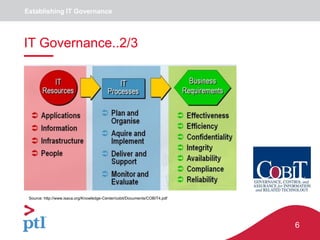
IT Governance..2/3
Source: http://www.isaca.org/Knowledge-Center/cobit/Documents/COBIT4.pdf
7
Establishing IT Governance
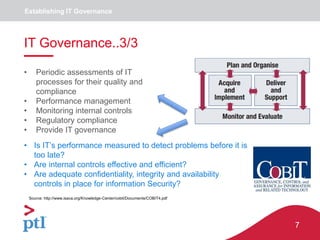
IT Governance..3/3
• Periodic assessments of IT
processes for their quality and
compliance
• Performance management
• Monitoring internal controls
• Regulatory compliance
• Provide IT governance
• Is IT’s performance measured to detect problems before it is
too late?
• Are internal controls effective and efficient?
• Are adequate confidentiality, integrity and availability
controls in place for information Security?
Source: http://www.isaca.org/Knowledge-Center/cobit/Documents/COBIT4.pdf
8
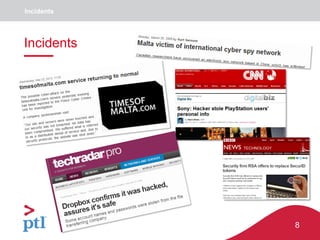
Incidents
Incidents
9
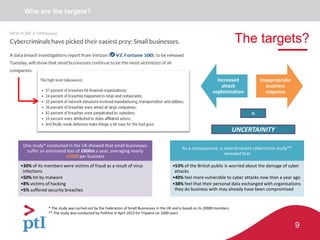
The targets?
Who are the targets?
* The study was carried out by the Federation of Small Businesses in the UK and is based on its 20000 members
** The study was conducted by PollOne in April 2013 for Tripwire on 1000 users
One study* conducted in the UK showed that small businesses
suffer an estimated loss of £800m a year, averaging nearly
£4000 per business
•30% of its members were victims of fraud as a result of virus
infections
•50% hit by malware
•8% victims of hacking
•5% suffered security breaches
As a consequence, a second recent cybercrime study**
revealed that
•53% of the British public is worried about the damage of cyber
attacks
•40% feel more vulnerable to cyber attacks now than a year ago
•38% feel that their personal data exchanged with organisations
they do business with may already have been compromised
Increased
attack
sophistication
Inappropriate
business
response
UNCERTAINITY
=
10
Meanwhile in a non-descript building
Should we be concerned?
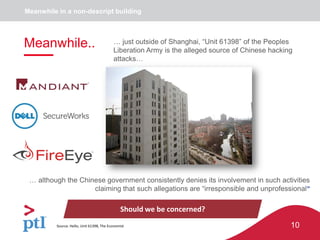
… although the Chinese government consistently denies its involvement in such activities
claiming that such allegations are “irresponsible and unprofessional”
Source: Hello, Unit 61398, The Economist
Meanwhile.. … just outside of Shanghai, “Unit 61398” of the Peoples
Liberation Army is the alleged source of Chinese hacking
attacks…
11
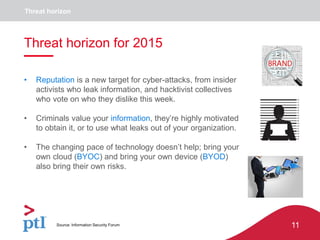
Threat horizon for 2015
Threat horizon
• Reputation is a new target for cyber-attacks, from insider
activists who leak information, and hacktivist collectives
who vote on who they dislike this week.
• Criminals value your information, they’re highly motivated
to obtain it, or to use what leaks out of your organization.
• The changing pace of technology doesn’t help; bring your
own cloud (BYOC) and bring your own device (BYOD)
also bring their own risks.
Source: Information Security Forum
12
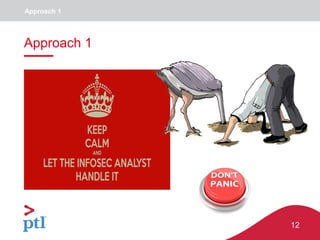
Approach 1
Approach 1
13
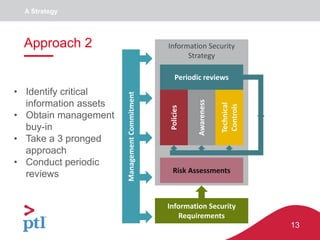
A Strategy
Information Security
Strategy
Awareness
Technical
Controls
Risk Assessments
Periodic reviews
Information Security
Requirements
Policies
ManagementCommitment
Information Security
Strategy
Technical
Controls
Risk Assessments
Information Security
Requirements
Policies
ManagementCommitment
Awareness
Periodic reviews
Information Security
Strategy
Awareness
Technical
Controls
Risk Assessments
Periodic reviews
Information Security
Requirements
Policies
ManagementCommitment
Information Security
Strategy
Awareness
Technical
Controls
Periodic reviews
Policies
Awareness
Technical
Controls
PoliciesRisk Assessments
• Identify critical
information assets
• Obtain management
buy-in
• Take a 3 pronged
approach
• Conduct periodic
reviews
Approach 2
14
Approach 3
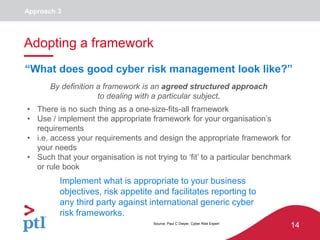
Adopting a framework
“What does good cyber risk management look like?”
By definition a framework is an agreed structured approach
to dealing with a particular subject.
• There is no such thing as a one-size-fits-all framework
• Use / implement the appropriate framework for your organisation’s
requirements
• i.e. access your requirements and design the appropriate framework for
your needs
• Such that your organisation is not trying to ‘fit’ to a particular benchmark
or rule book
Implement what is appropriate to your business
objectives, risk appetite and facilitates reporting to
any third party against international generic cyber
risk frameworks.
Source: Paul C Dwyer, Cyber Risk Expert
15
Approach 3
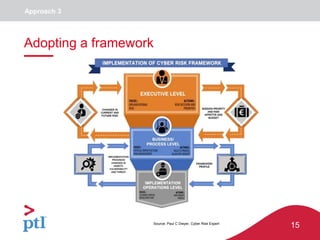
Adopting a framework
Source: Paul C Dwyer, Cyber Risk Expert
16
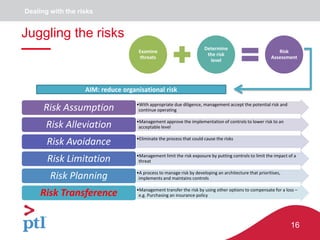
Examine
threats
Determine
the risk
level
Risk
Assessment
AIM: reduce organisational risk
•With appropriate due diligence, management accept the potential risk and
continue operatingRisk Assumption
•Management approve the implementation of controls to lower risk to an
acceptable levelRisk Alleviation
•Eliminate the process that could cause the risks
Risk Avoidance
•Management limit the risk exposure by putting controls to limit the impact of a
threatRisk Limitation
•A process to manage risk by developing an architecture that prioritises,
implements and maintains controlsRisk Planning
•Management transfer the risk by using other options to compensate for a loss –
e.g. Purchasing an insurance policyRisk Transference
Juggling the risks
Dealing with the risks
18
“ The ability of a system or a domain to withstand attacks or
failures and in such events to re-establish itself quickly ”
– Nigel Inkster, International Institute of Strategic Studies
Cyber
Resilience
3. Detection
1. Organizational Readiness
2. Situational awareness
4. Cyber defence
5. Mitigation and containment
6. Recovery
Six Point action plan
Becoming resilient
19
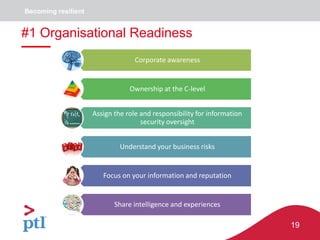
Corporate awareness
Ownership at the C-level
Assign the role and responsibility for information
security oversight
Understand your business risks
Focus on your information and reputation
Share intelligence and experiences
#1 Organisational Readiness
Becoming resilient
20
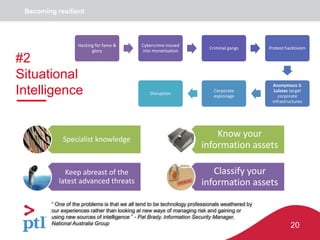
Specialist knowledge
Keep abreast of the
latest advanced threats
Hacking for fame &
glory
Cybercrime moved
into monetisation
Criminal gangs Protest hacktivism
Anonymous &
Lulzsec target
corporate
infrastructures
Corporate
espionage
Disruption
Know your
information assets
Classify your
information assets
“ One of the problems is that we all tend to be technology professionals weathered by
our experiences rather than looking at new ways of managing risk and gaining or
using new sources of intelligence ” - Pat Brady, Information Security Manager,
National Australia Group
#2
Situational
Intelligence
Becoming resilient
21
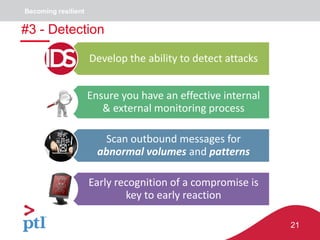
Develop the ability to detect attacks
Ensure you have an effective internal
& external monitoring process
Scan outbound messages for
abnormal volumes and patterns
Early recognition of a compromise is
key to early reaction
#3 - Detection
Becoming resilient
22
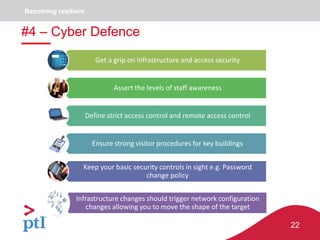
Get a grip on infrastructure and access security
Assert the levels of staff awareness
Define strict access control and remote access control
Ensure strong visitor procedures for key buildings
Keep your basic security controls in sight e.g. Password
change policy
Infrastructure changes should trigger network configuration
changes allowing you to move the shape of the target
#4 – Cyber Defence
Becoming resilient
23
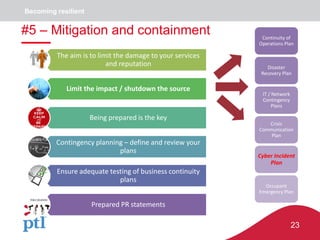
The aim is to limit the damage to your services
and reputation
Limit the impact / shutdown the source
Being prepared is the key
Contingency planning – define and review your
plans
Ensure adequate testing of business continuity
plans
Prepared PR statements
Continuity of
Operations Plan
Disaster
Recovery Plan
IT / Network
Contingency
Plans
Crisis
Communication
Plan
Cyber Incident
Plan
Occupant
Emergency Plan
#5 – Mitigation and containment
Becoming resilient
24
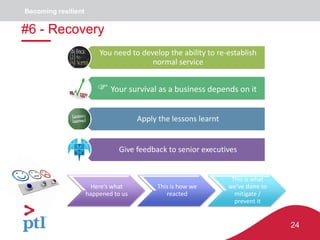
You need to develop the ability to re-establish
normal service
 Your survival as a business depends on it
Apply the lessons learnt
Give feedback to senior executives
Here’s what
happened to us
This is how we
reacted
This is what
we’ve done to
mitigate /
prevent it
#6 - Recovery
Becoming resilient
25
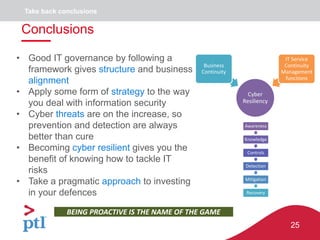
Cyber
Resiliency
Business
Continuity
IT Service
Continuity
Management
functions
BEING PROACTIVE IS THE NAME OF THE GAME
Awareness
Knowledge
Controls
Detection
Mitigation
Recovery
• Good IT governance by following a
framework gives structure and business
alignment
• Apply some form of strategy to the way
you deal with information security
• Cyber threats are on the increase, so
prevention and detection are always
better than cure
• Becoming cyber resilient gives you the
benefit of knowing how to tackle IT
risks
• Take a pragmatic approach to investing
in your defences
Conclusions
Take back conclusions
Thank you!
Donald Tabone
 dtabone@gmail.com
Nineteen Twenty Three, Valletta Road,
Marsa MRS 3000, Malta.
T. (+356) 2144 5566 E. info@ptl.com.mt | www.ptl.com.mt
IT & SECURITY EXPERTS

Dealing with Information Security, Risk Management & Cyber Resilience

  • 1.
    Dealing with InformationSecurity, Risk Management & Cyber Resilience Donald Tabone 27/01/2015
  • 2.
    2 Introductions Introductions • >19 yearsworking in all areas of IT • Former Associate Director, KPMG • Former Lead Security Analyst & Architect for American-based CCBill • Lecturer on Information Security & Computer Forensics, NCC • >6 years PCI-DSS industry • Information Security, Software Engineering, IT & Telecoms Law
  • 3.
    3 1. Why theneed to think about it? 2. What exactly are we talking about? 3. How do we go about doing something about it? 4. Is there a one-size-fits-all framework? Brief Agenda Brief Agenda [Information Security]
  • 4.
    4 IT Governance Information Security? •After an incident occurs? • If budget permits? • Because you are mandated to comply? • Who possesses the knowledge within your company to advise? • Is it even a priority or a concern? • Is there any structure to your approach? • Are you really prepared / in control? [Information Security] is the preservation of confidentiality, integrity and availability of information. But how do you really go about it within your business?
  • 5.
    5 Establishing IT Governance ITGovernance..1/3 Source: http://www.isaca.org/Knowledge-Center/cobit/Documents/COBIT4.pdf • IT is aligned with the business • IT enables the business and maximizes benefits • IT resources are used responsibly • IT risks are managed appropriately [COBIT (4.1) Framework]
  • 6.
    6 Establishing IT Governance ITGovernance..2/3 Source: http://www.isaca.org/Knowledge-Center/cobit/Documents/COBIT4.pdf
  • 7.
    7 Establishing IT Governance ITGovernance..3/3 • Periodic assessments of IT processes for their quality and compliance • Performance management • Monitoring internal controls • Regulatory compliance • Provide IT governance • Is IT’s performance measured to detect problems before it is too late? • Are internal controls effective and efficient? • Are adequate confidentiality, integrity and availability controls in place for information Security? Source: http://www.isaca.org/Knowledge-Center/cobit/Documents/COBIT4.pdf
  • 8.
  • 9.
    9 The targets? Who arethe targets? * The study was carried out by the Federation of Small Businesses in the UK and is based on its 20000 members ** The study was conducted by PollOne in April 2013 for Tripwire on 1000 users One study* conducted in the UK showed that small businesses suffer an estimated loss of £800m a year, averaging nearly £4000 per business •30% of its members were victims of fraud as a result of virus infections •50% hit by malware •8% victims of hacking •5% suffered security breaches As a consequence, a second recent cybercrime study** revealed that •53% of the British public is worried about the damage of cyber attacks •40% feel more vulnerable to cyber attacks now than a year ago •38% feel that their personal data exchanged with organisations they do business with may already have been compromised Increased attack sophistication Inappropriate business response UNCERTAINITY =
  • 10.
    10 Meanwhile in anon-descript building Should we be concerned? … although the Chinese government consistently denies its involvement in such activities claiming that such allegations are “irresponsible and unprofessional” Source: Hello, Unit 61398, The Economist Meanwhile.. … just outside of Shanghai, “Unit 61398” of the Peoples Liberation Army is the alleged source of Chinese hacking attacks…
  • 11.
    11 Threat horizon for2015 Threat horizon • Reputation is a new target for cyber-attacks, from insider activists who leak information, and hacktivist collectives who vote on who they dislike this week. • Criminals value your information, they’re highly motivated to obtain it, or to use what leaks out of your organization. • The changing pace of technology doesn’t help; bring your own cloud (BYOC) and bring your own device (BYOD) also bring their own risks. Source: Information Security Forum
  • 12.
  • 13.
    13 A Strategy Information Security Strategy Awareness Technical Controls RiskAssessments Periodic reviews Information Security Requirements Policies ManagementCommitment Information Security Strategy Technical Controls Risk Assessments Information Security Requirements Policies ManagementCommitment Awareness Periodic reviews Information Security Strategy Awareness Technical Controls Risk Assessments Periodic reviews Information Security Requirements Policies ManagementCommitment Information Security Strategy Awareness Technical Controls Periodic reviews Policies Awareness Technical Controls PoliciesRisk Assessments • Identify critical information assets • Obtain management buy-in • Take a 3 pronged approach • Conduct periodic reviews Approach 2
  • 14.
    14 Approach 3 Adopting aframework “What does good cyber risk management look like?” By definition a framework is an agreed structured approach to dealing with a particular subject. • There is no such thing as a one-size-fits-all framework • Use / implement the appropriate framework for your organisation’s requirements • i.e. access your requirements and design the appropriate framework for your needs • Such that your organisation is not trying to ‘fit’ to a particular benchmark or rule book Implement what is appropriate to your business objectives, risk appetite and facilitates reporting to any third party against international generic cyber risk frameworks. Source: Paul C Dwyer, Cyber Risk Expert
  • 15.
    15 Approach 3 Adopting aframework Source: Paul C Dwyer, Cyber Risk Expert
  • 16.
    16 Examine threats Determine the risk level Risk Assessment AIM: reduceorganisational risk •With appropriate due diligence, management accept the potential risk and continue operatingRisk Assumption •Management approve the implementation of controls to lower risk to an acceptable levelRisk Alleviation •Eliminate the process that could cause the risks Risk Avoidance •Management limit the risk exposure by putting controls to limit the impact of a threatRisk Limitation •A process to manage risk by developing an architecture that prioritises, implements and maintains controlsRisk Planning •Management transfer the risk by using other options to compensate for a loss – e.g. Purchasing an insurance policyRisk Transference Juggling the risks Dealing with the risks
  • 17.
    18 “ The abilityof a system or a domain to withstand attacks or failures and in such events to re-establish itself quickly ” – Nigel Inkster, International Institute of Strategic Studies Cyber Resilience 3. Detection 1. Organizational Readiness 2. Situational awareness 4. Cyber defence 5. Mitigation and containment 6. Recovery Six Point action plan Becoming resilient
  • 18.
    19 Corporate awareness Ownership atthe C-level Assign the role and responsibility for information security oversight Understand your business risks Focus on your information and reputation Share intelligence and experiences #1 Organisational Readiness Becoming resilient
  • 19.
    20 Specialist knowledge Keep abreastof the latest advanced threats Hacking for fame & glory Cybercrime moved into monetisation Criminal gangs Protest hacktivism Anonymous & Lulzsec target corporate infrastructures Corporate espionage Disruption Know your information assets Classify your information assets “ One of the problems is that we all tend to be technology professionals weathered by our experiences rather than looking at new ways of managing risk and gaining or using new sources of intelligence ” - Pat Brady, Information Security Manager, National Australia Group #2 Situational Intelligence Becoming resilient
  • 20.
    21 Develop the abilityto detect attacks Ensure you have an effective internal & external monitoring process Scan outbound messages for abnormal volumes and patterns Early recognition of a compromise is key to early reaction #3 - Detection Becoming resilient
  • 21.
    22 Get a gripon infrastructure and access security Assert the levels of staff awareness Define strict access control and remote access control Ensure strong visitor procedures for key buildings Keep your basic security controls in sight e.g. Password change policy Infrastructure changes should trigger network configuration changes allowing you to move the shape of the target #4 – Cyber Defence Becoming resilient
  • 22.
    23 The aim isto limit the damage to your services and reputation Limit the impact / shutdown the source Being prepared is the key Contingency planning – define and review your plans Ensure adequate testing of business continuity plans Prepared PR statements Continuity of Operations Plan Disaster Recovery Plan IT / Network Contingency Plans Crisis Communication Plan Cyber Incident Plan Occupant Emergency Plan #5 – Mitigation and containment Becoming resilient
  • 23.
    24 You need todevelop the ability to re-establish normal service  Your survival as a business depends on it Apply the lessons learnt Give feedback to senior executives Here’s what happened to us This is how we reacted This is what we’ve done to mitigate / prevent it #6 - Recovery Becoming resilient
  • 24.
    25 Cyber Resiliency Business Continuity IT Service Continuity Management functions BEING PROACTIVEIS THE NAME OF THE GAME Awareness Knowledge Controls Detection Mitigation Recovery • Good IT governance by following a framework gives structure and business alignment • Apply some form of strategy to the way you deal with information security • Cyber threats are on the increase, so prevention and detection are always better than cure • Becoming cyber resilient gives you the benefit of knowing how to tackle IT risks • Take a pragmatic approach to investing in your defences Conclusions Take back conclusions
  • 25.
  • 26.
    Nineteen Twenty Three,Valletta Road, Marsa MRS 3000, Malta. T. (+356) 2144 5566 E. info@ptl.com.mt | www.ptl.com.mt IT & SECURITY EXPERTS