Session ID:
Session Classification:
Ben Rothke, CISSP CISM
Wyndham Worldwide Corp.
WHAT HAPPENS IN VEGAS GOES ON
YOUTUBE: USING SOCIAL NETWORKS
SECURELY
STAR-107
Intermediate
About me…
 Ben Rothke, CISSP, CISM, CISA
 Manager - Information Security - Wyndham
Worldwide Corp.
 All content in this presentation reflect my views
exclusively and not that of Wyndham Worldwide
 Author - Computer Security: 20 Things Every
Employee Should Know (McGraw-Hill)
 Write the Security Reading Room blog
 https://365.rsaconference.com/blogs/securityreading
2
Agenda
 Overview of social networks
 Scary security risks associated with social
networks
 Social network security strategies
 Conclusion / Recommendations / Q&A
3
Overview of social
networks and the
associated security
and privacy
4
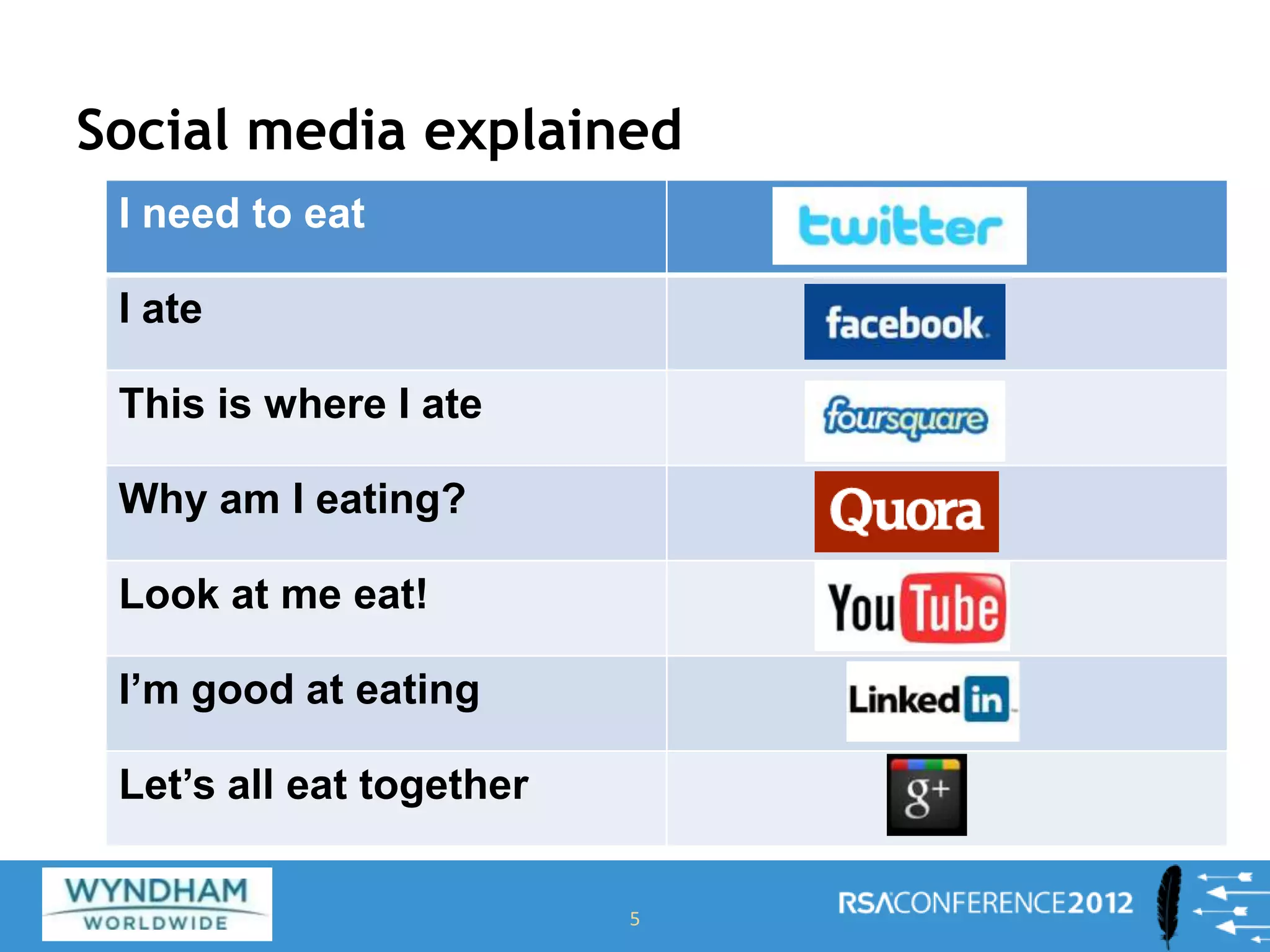
Social media explained
5
I need to eat
I ate
This is where I ate
Why am I eating?
Look at me eat!
I’m good at eating
Let’s all eat together
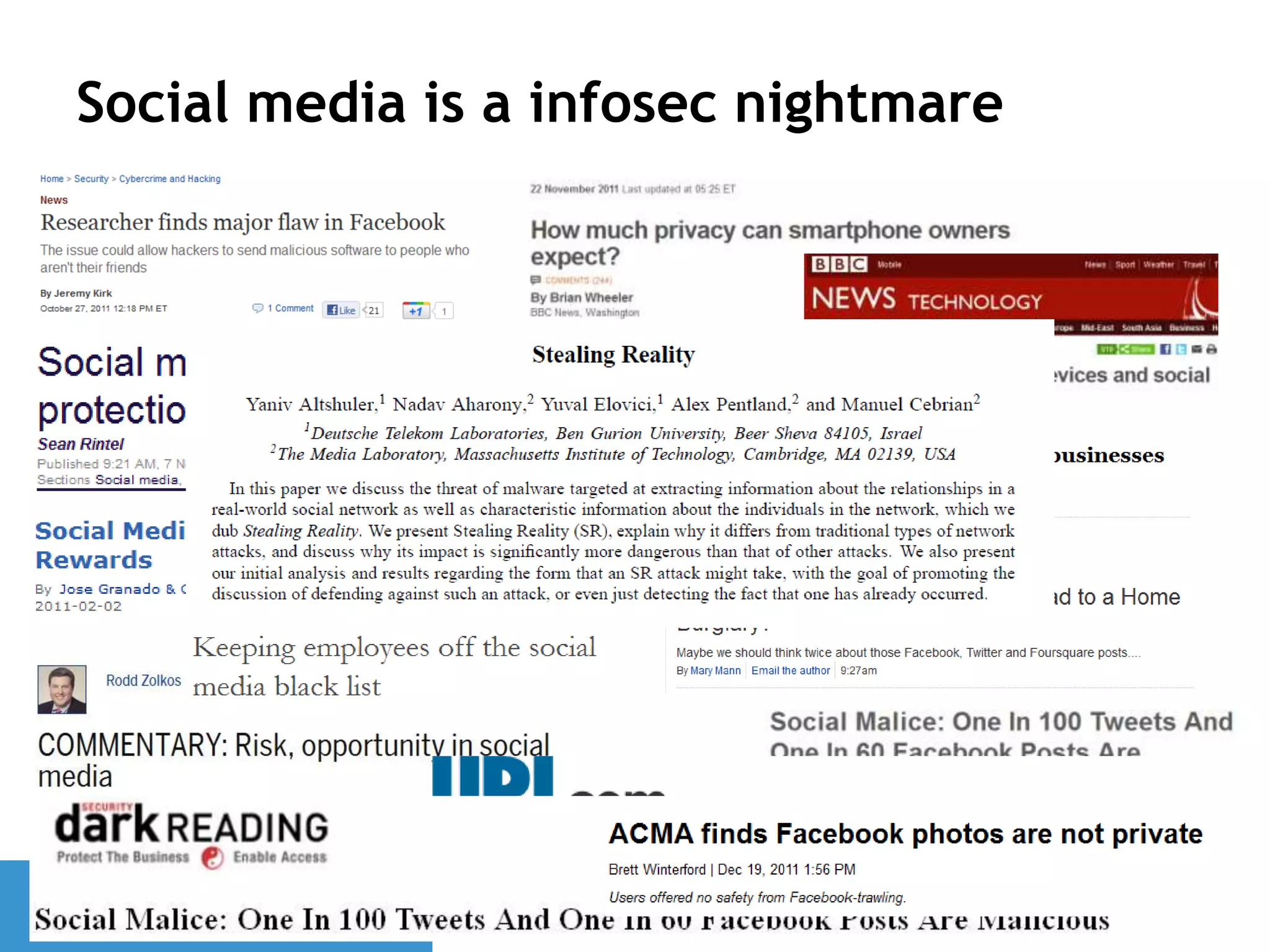
Social media is a infosec nightmare
6
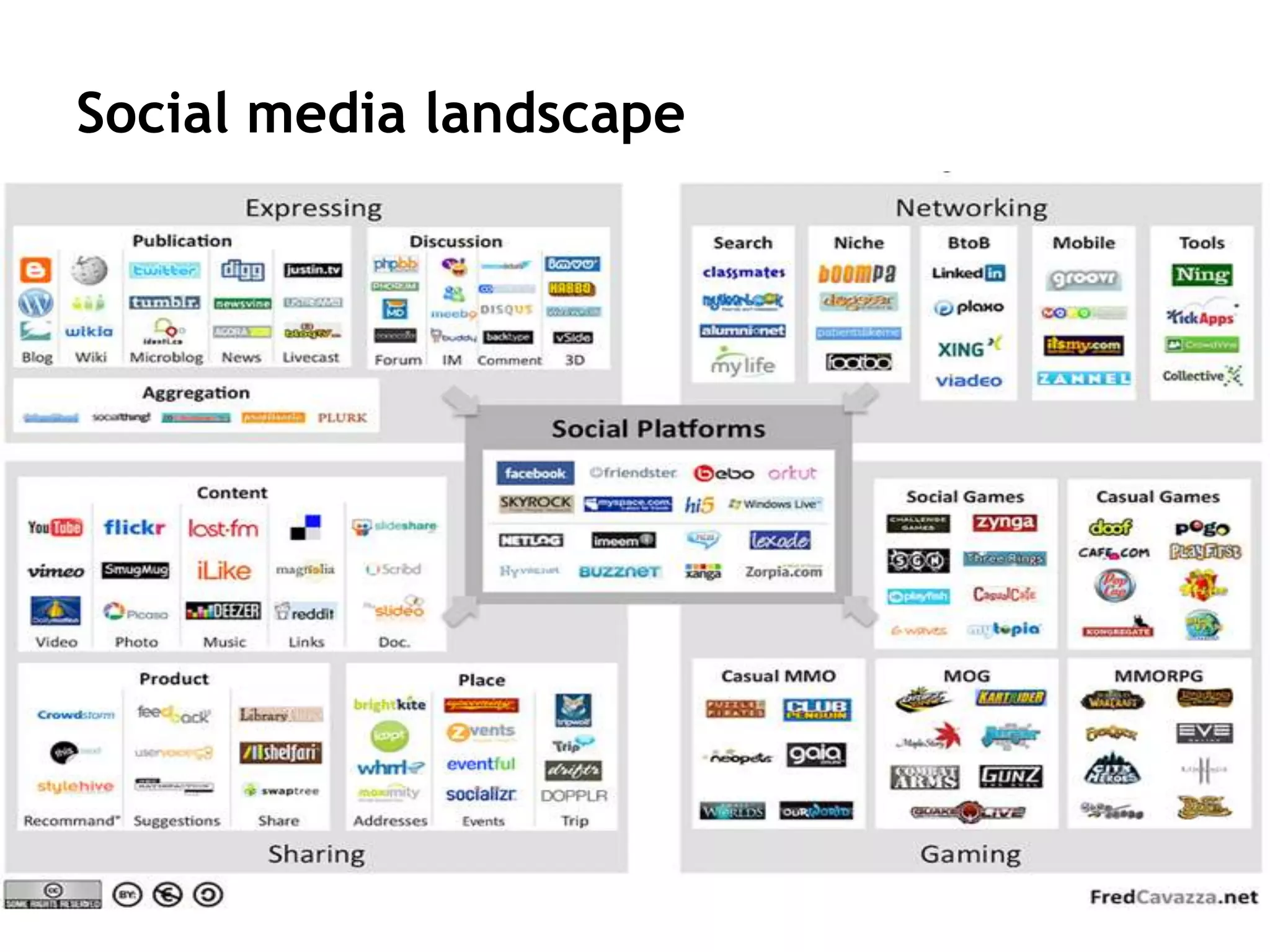
Social media landscape
7
Social networking security reality
 People will share huge amounts of highly
confidential personal & business information
with people they perceive to be legitimate
 Numerous legitimate security risks with allowing
uncontrolled access to social sites
 But…these risks can be mitigated via a
comprehensive security strategy
8
Blocking is futile
 Not only is resistance futile – it’s a negative
business decision
 Prepare a social networking strategy
 Have a realistic understanding of the risks and
benefits of social software
 Understand unique challenges and factor them
into on when and how to proceed
 Business and information security goal is the
secure use and enablement of social media
9
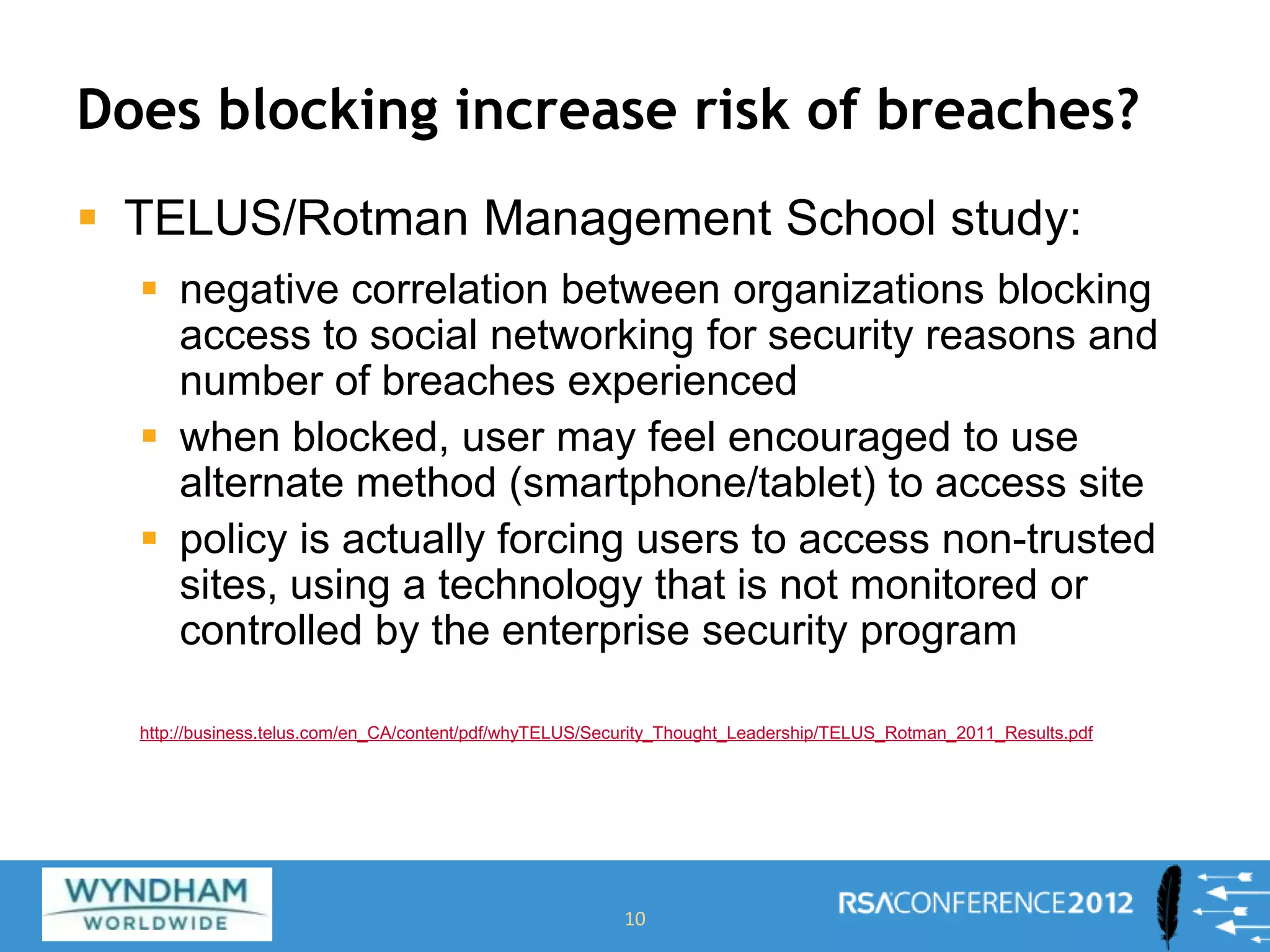
Does blocking increase risk of breaches?
 TELUS/Rotman Management School study:
 negative correlation between organizations blocking
access to social networking for security reasons and
number of breaches experienced
 when blocked, user may feel encouraged to use
alternate method (smartphone/tablet) to access site
 policy is actually forcing users to access non-trusted
sites, using a technology that is not monitored or
controlled by the enterprise security program
http://business.telus.com/en_CA/content/pdf/whyTELUS/Security_Thought_Leadership/TELUS_Rotman_2011_Results.pdf
10
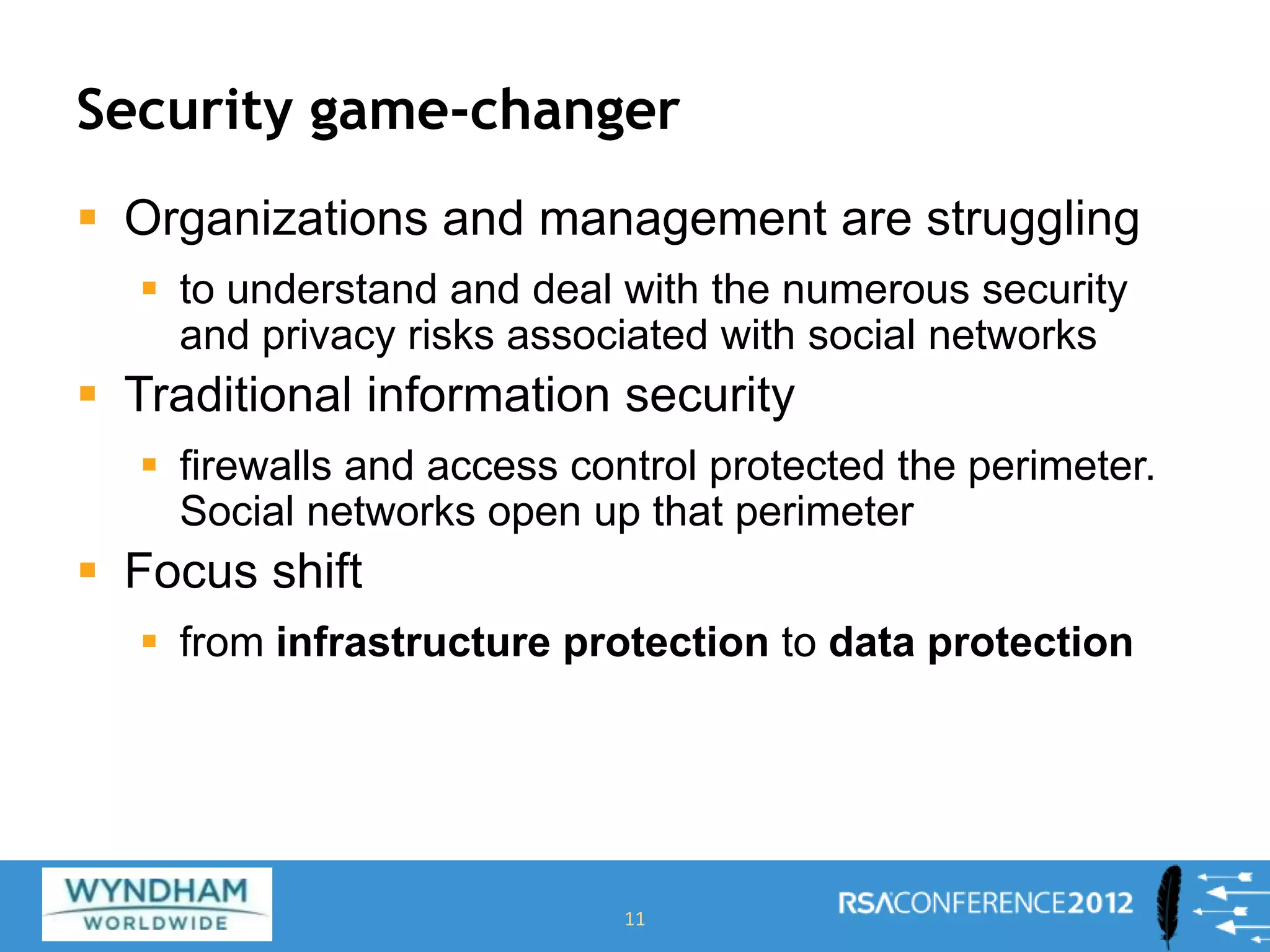
Security game-changer
 Organizations and management are struggling
 to understand and deal with the numerous security
and privacy risks associated with social networks
 Traditional information security
 firewalls and access control protected the perimeter.
Social networks open up that perimeter
 Focus shift
 from infrastructure protection to data protection
11
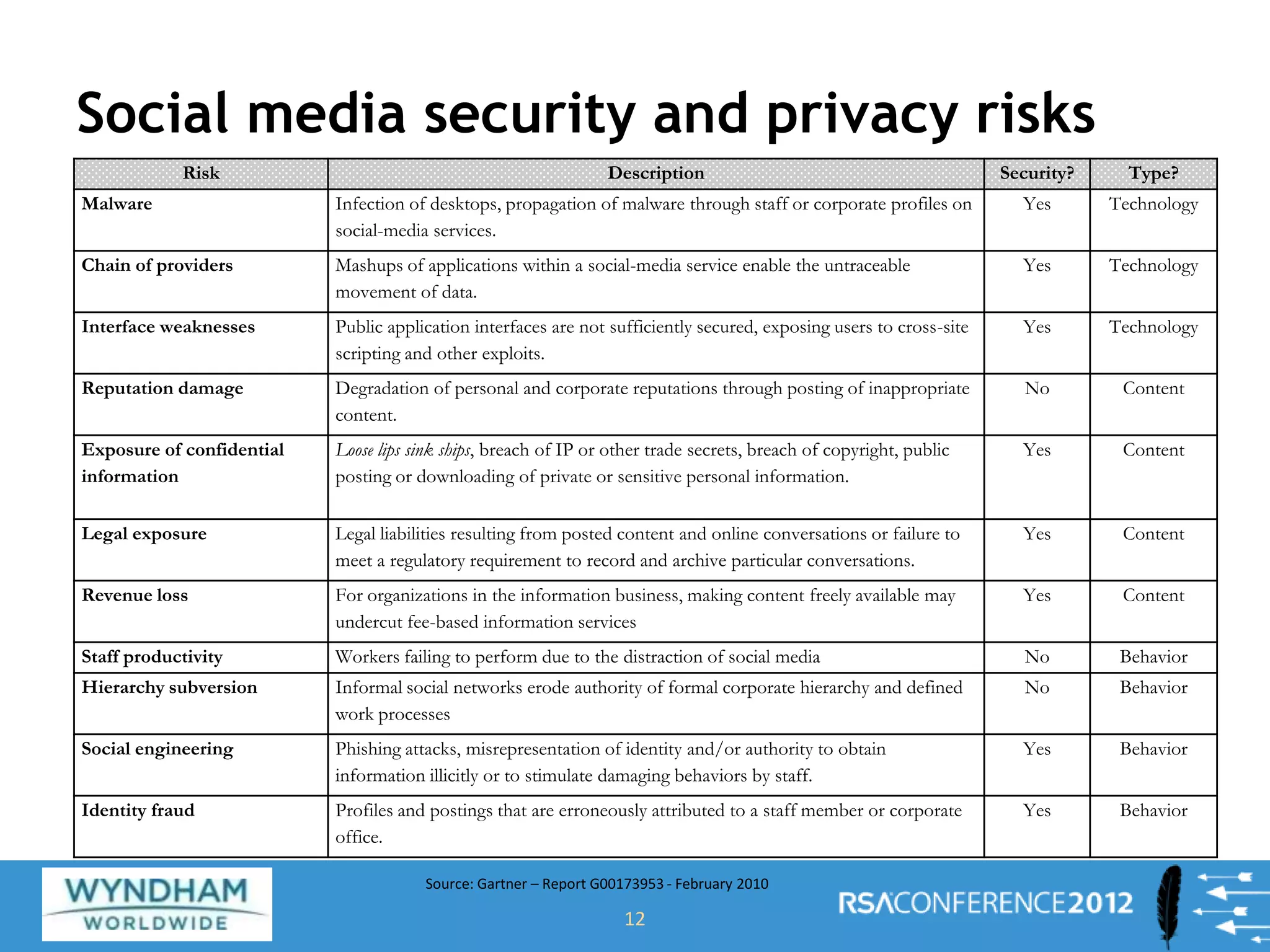
Social media security and privacy risks
12
Risk Description Security? Type?
Malware Infection of desktops, propagation of malware through staff or corporate profiles on
social-media services.
Yes Technology
Chain of providers Mashups of applications within a social-media service enable the untraceable
movement of data.
Yes Technology
Interface weaknesses Public application interfaces are not sufficiently secured, exposing users to cross-site
scripting and other exploits.
Yes Technology
Reputation damage Degradation of personal and corporate reputations through posting of inappropriate
content.
No Content
Exposure of confidential
information
Loose lips sink ships, breach of IP or other trade secrets, breach of copyright, public
posting or downloading of private or sensitive personal information.
Yes Content
Legal exposure Legal liabilities resulting from posted content and online conversations or failure to
meet a regulatory requirement to record and archive particular conversations.
Yes Content
Revenue loss For organizations in the information business, making content freely available may
undercut fee-based information services
Yes Content
Staff productivity Workers failing to perform due to the distraction of social media No Behavior
Hierarchy subversion Informal social networks erode authority of formal corporate hierarchy and defined
work processes
No Behavior
Social engineering Phishing attacks, misrepresentation of identity and/or authority to obtain
information illicitly or to stimulate damaging behaviors by staff.
Yes Behavior
Identity fraud Profiles and postings that are erroneously attributed to a staff member or corporate
office.
Yes Behavior
Source: Gartner – Report G00173953 - February 2010
Social media security and privacy risks
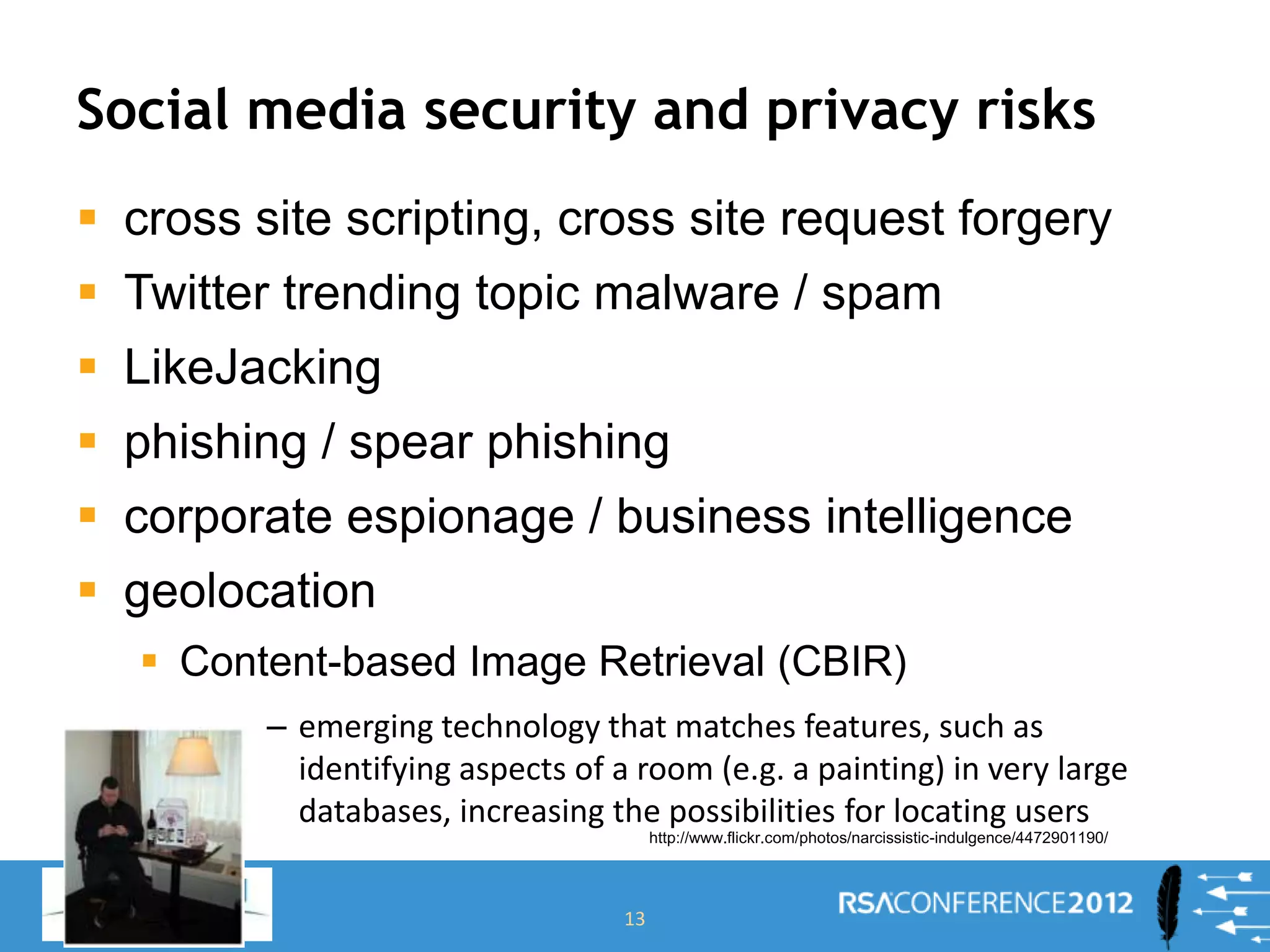
 cross site scripting, cross site request forgery
 Twitter trending topic malware / spam
 LikeJacking
 phishing / spear phishing
 corporate espionage / business intelligence
 geolocation
 Content-based Image Retrieval (CBIR)
– emerging technology that matches features, such as
identifying aspects of a room (e.g. a painting) in very large
databases, increasing the possibilities for locating users
13
http://www.flickr.com/photos/narcissistic-indulgence/4472901190/
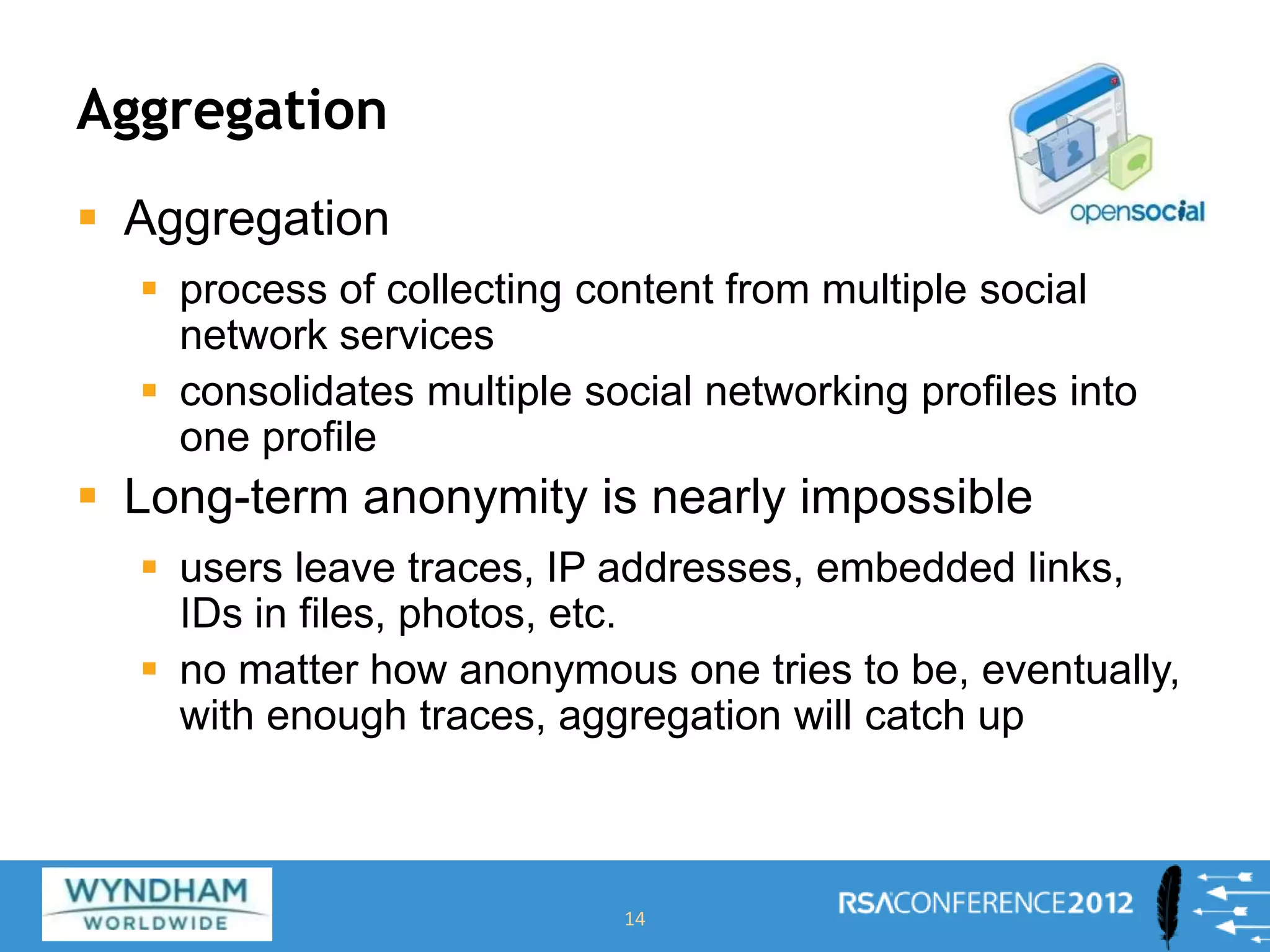
Aggregation
 Aggregation
 process of collecting content from multiple social
network services
 consolidates multiple social networking profiles into
one profile
 Long-term anonymity is nearly impossible
 users leave traces, IP addresses, embedded links,
IDs in files, photos, etc.
 no matter how anonymous one tries to be, eventually,
with enough traces, aggregation will catch up
14
Strategies and
action items for
enterprises to deal
with the security
and privacy risks of
social networks
15
Social media waits for no one…
 Especially information security
 Be proactive
 dedicated team to deal with social networks
 ability to identify all issues around social networks
 get involved and be engaged
 Be flexible
 social networking is moving fast
 too a rigid framework may be myopic
 social media in 2013 will be quite different than 2012
16
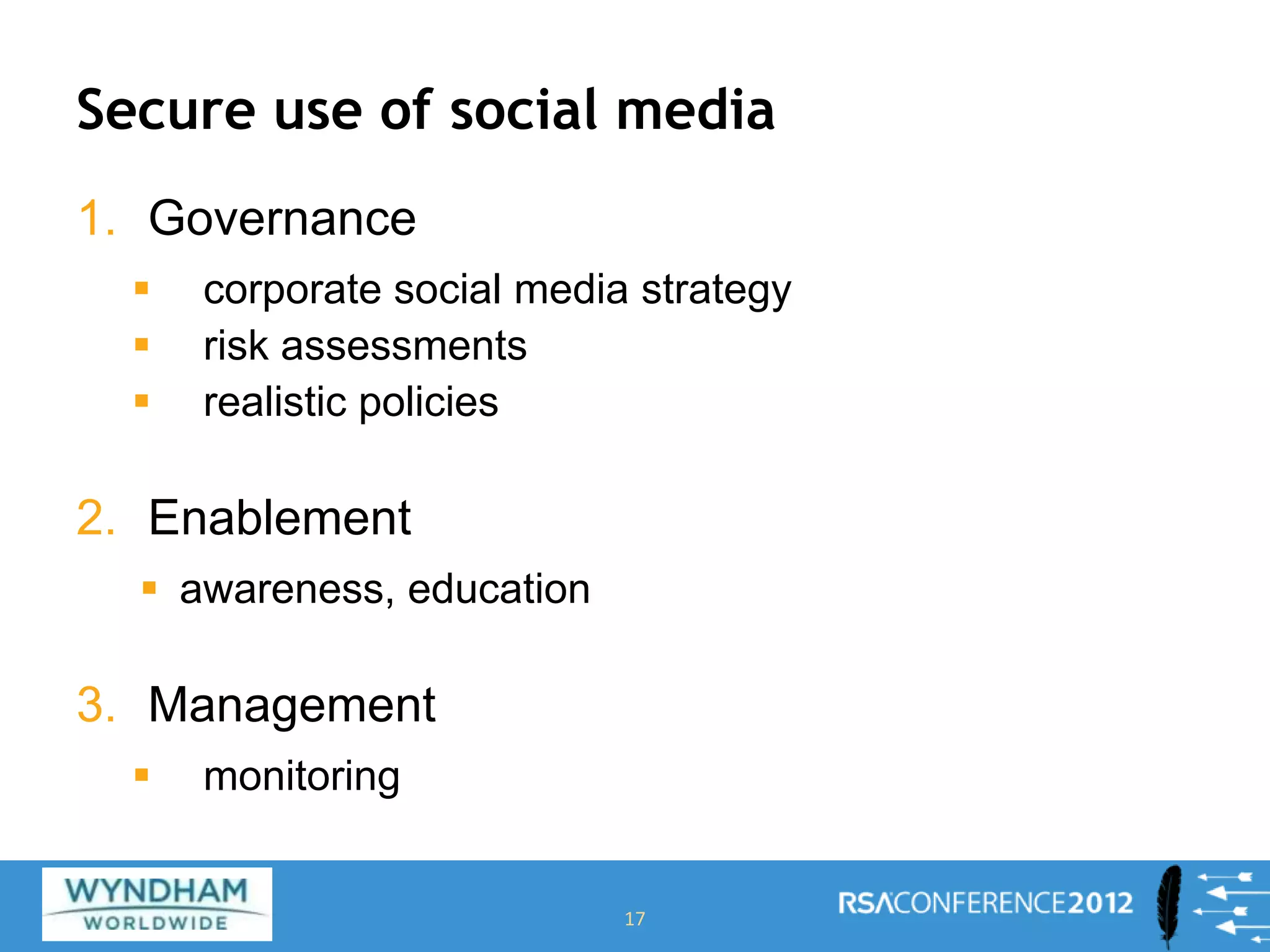
Secure use of social media
1. Governance
 corporate social media strategy
 risk assessments
 realistic policies
2. Enablement
 awareness, education
3. Management
 monitoring
17
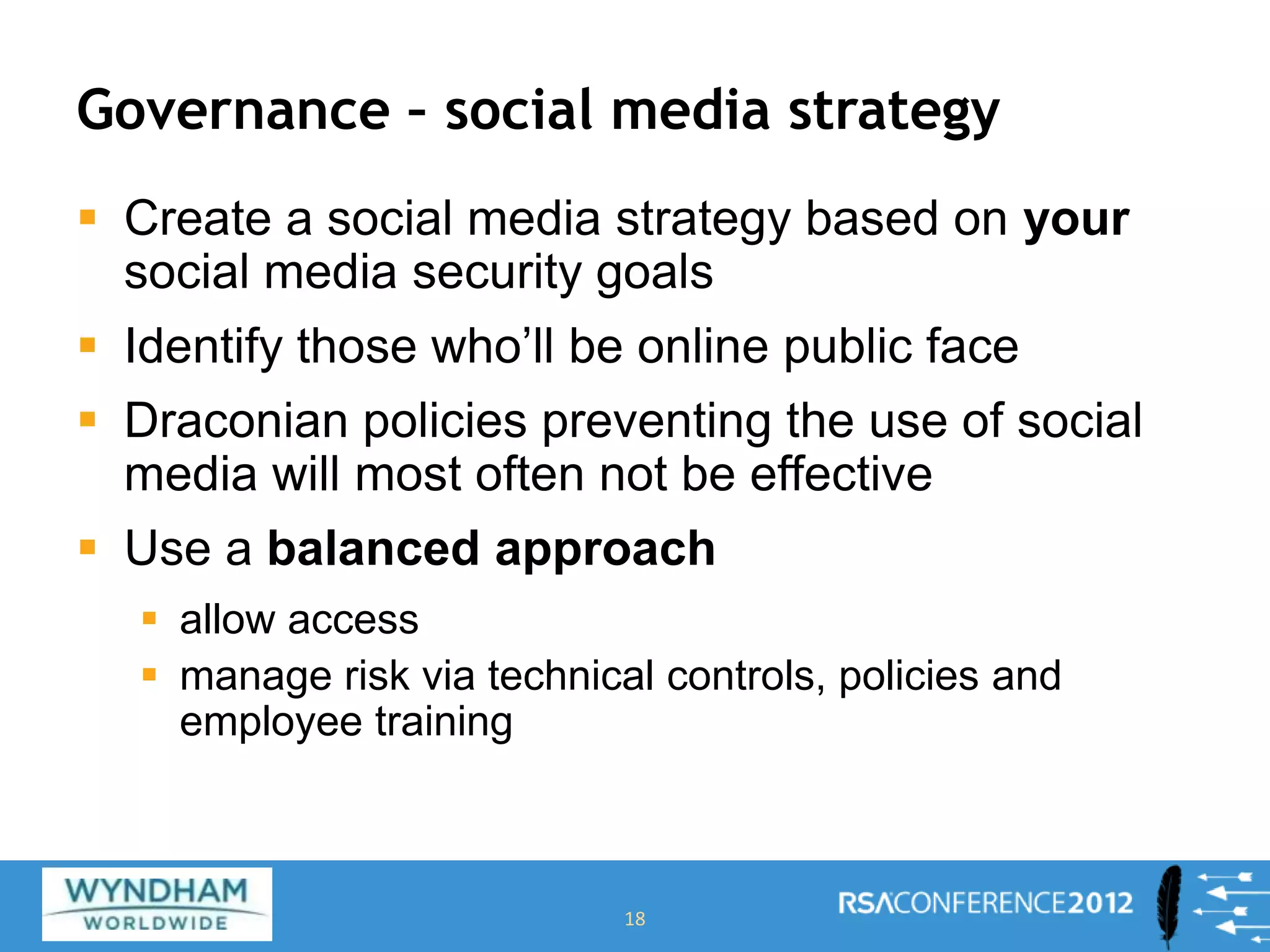
Governance – social media strategy
 Create a social media strategy based on your
social media security goals
 Identify those who’ll be online public face
 Draconian policies preventing the use of social
media will most often not be effective
 Use a balanced approach
 allow access
 manage risk via technical controls, policies and
employee training
18
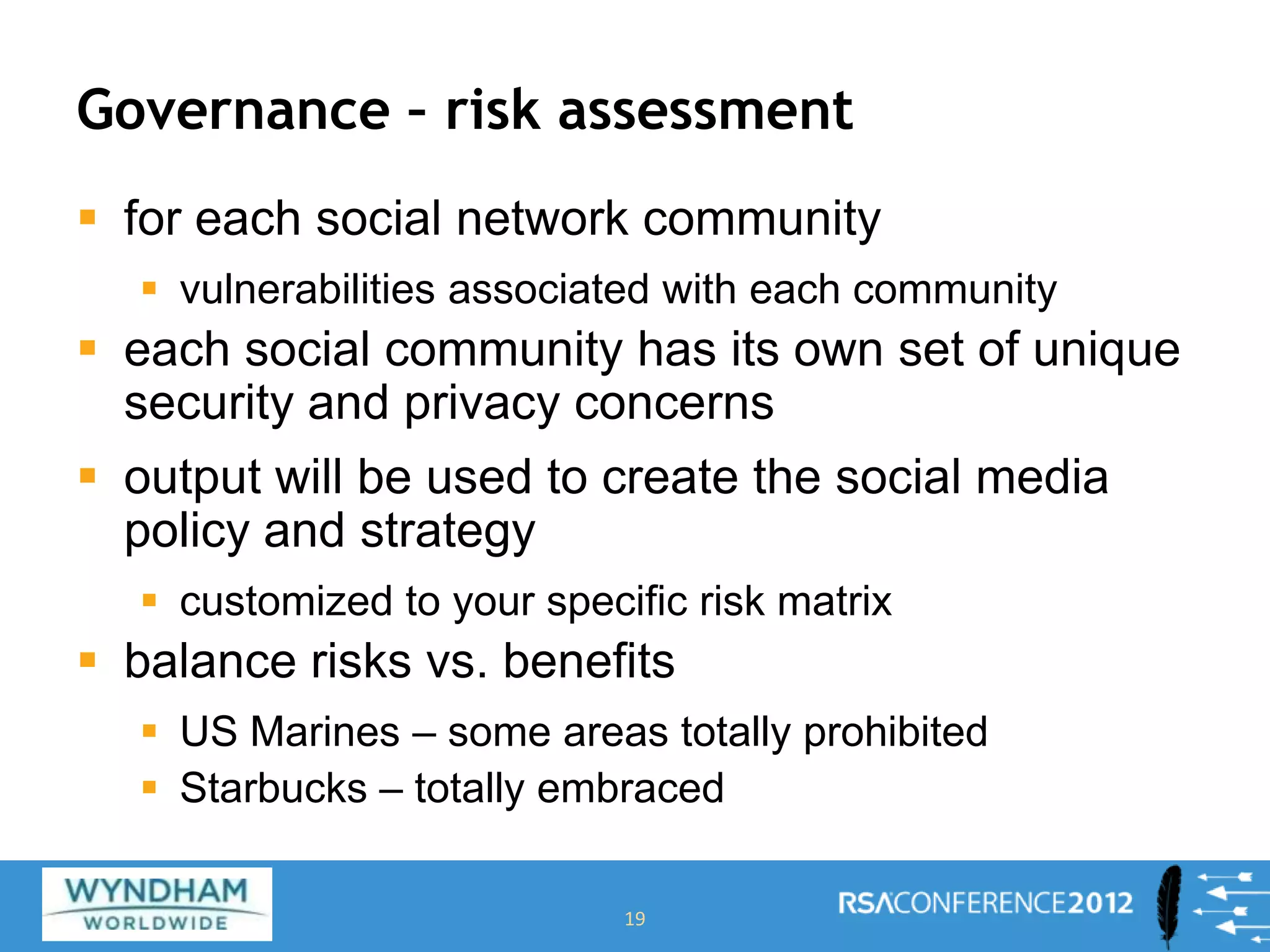
Governance – risk assessment
 for each social network community
 vulnerabilities associated with each community
 each social community has its own set of unique
security and privacy concerns
 output will be used to create the social media
policy and strategy
 customized to your specific risk matrix
 balance risks vs. benefits
 US Marines – some areas totally prohibited
 Starbucks – totally embraced
19
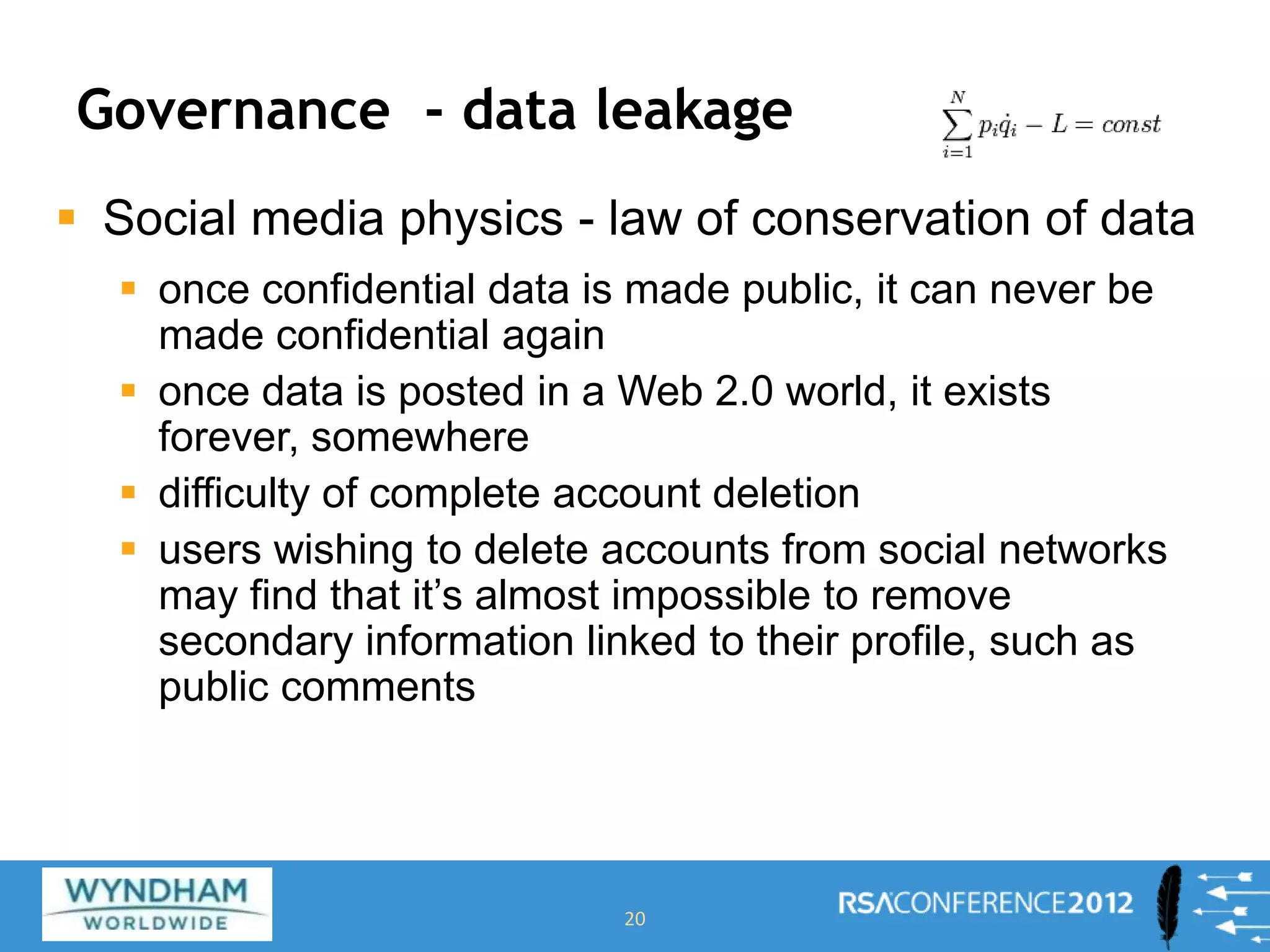
Governance - data leakage
 Social media physics - law of conservation of data
 once confidential data is made public, it can never be
made confidential again
 once data is posted in a Web 2.0 world, it exists
forever, somewhere
 difficulty of complete account deletion
 users wishing to delete accounts from social networks
may find that it’s almost impossible to remove
secondary information linked to their profile, such as
public comments
20
Governance – social media policy
 Social networking policy is a must
 even if it prohibits everything, you still need a policy
 Employees will do stupid things
 Rational, sensible use of social media services
 include photography and video
 don’t reference clients, customers, or partners
without obtaining their express permission
 Social Media Policy Database
 http://socialmediagovernance.com/policies.php
21
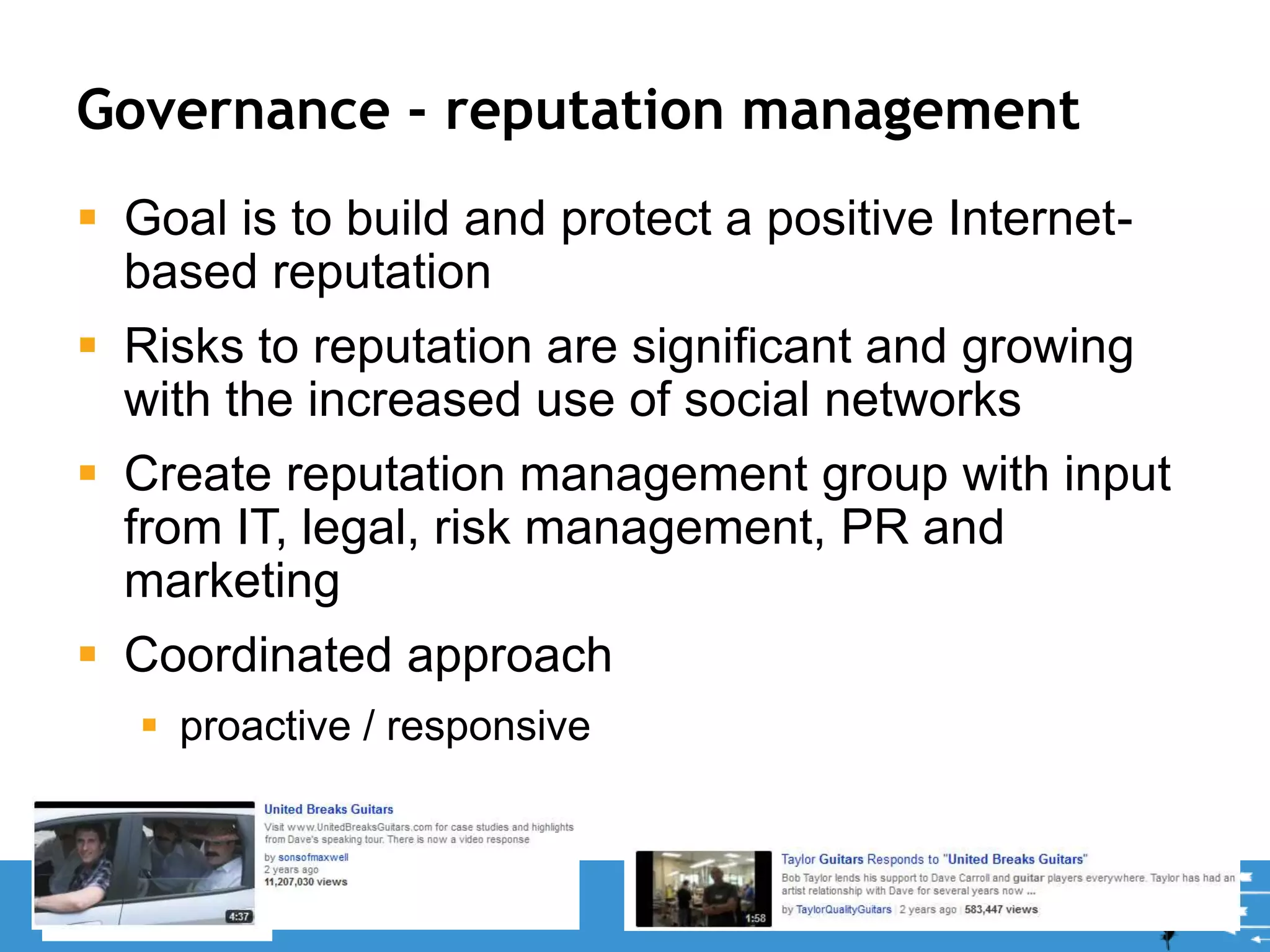
Governance - reputation management
 Goal is to build and protect a positive Internet-
based reputation
 Risks to reputation are significant and growing
with the increased use of social networks
 Create reputation management group with input
from IT, legal, risk management, PR and
marketing
 Coordinated approach
 proactive / responsive
22
23
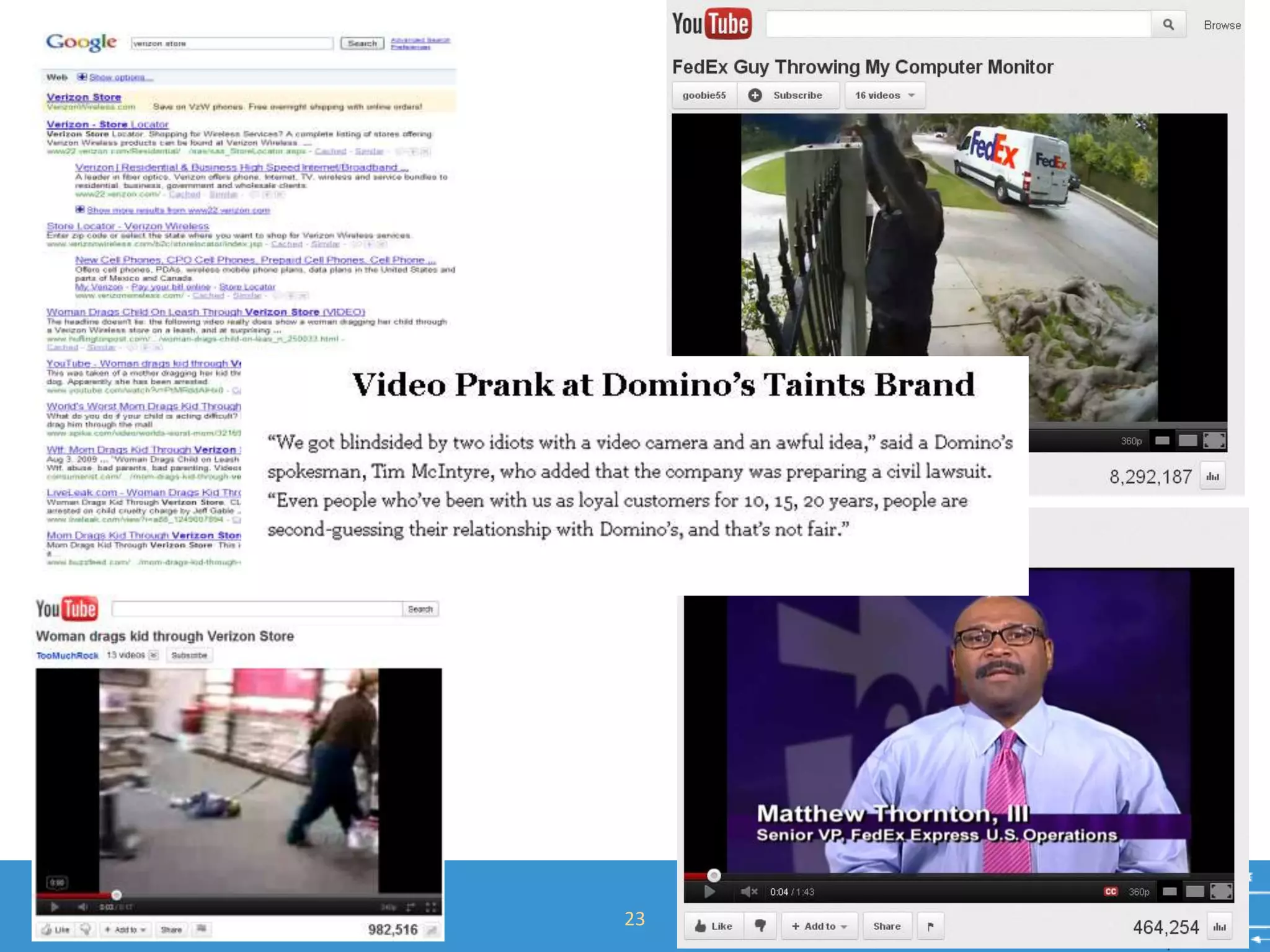
Governance - reputation management
 Traditional PR and legal responses to an
Internet-based negative reputation event can
cause more damage than doing nothing
 establish, follow and update protocols can make
social-media chaos less risky to enterprises
 Infosec coordinate activities with PR teams
 expand monitoring and supplement monitoring with
investigations and evidence collection processes
24
Enablement – awareness and education
 Social media is driven by social interactions
 Most significant risks are tied to the behavior of
staff when they are using social software
 Don't shun social media for fear of bad end-user
behavior
 Anticipate it and formulate a multilevel approach to
policies for effective governance
 3 C’s: clear, comprehensive, continuous
25
Awareness - How to get fired in 3 tweets
 Link social networking training to other related
training
 business ethics, standards of conduct, industry-
specific regulations
 Let employees know they can lose their job
 policy violation
 managers and executives - special responsibility
when blogging by virtue of their position
 too much time on social network sites
 perception that they are promoting themselves at the
expense of the company
26
Awareness - curb your enthusiasm
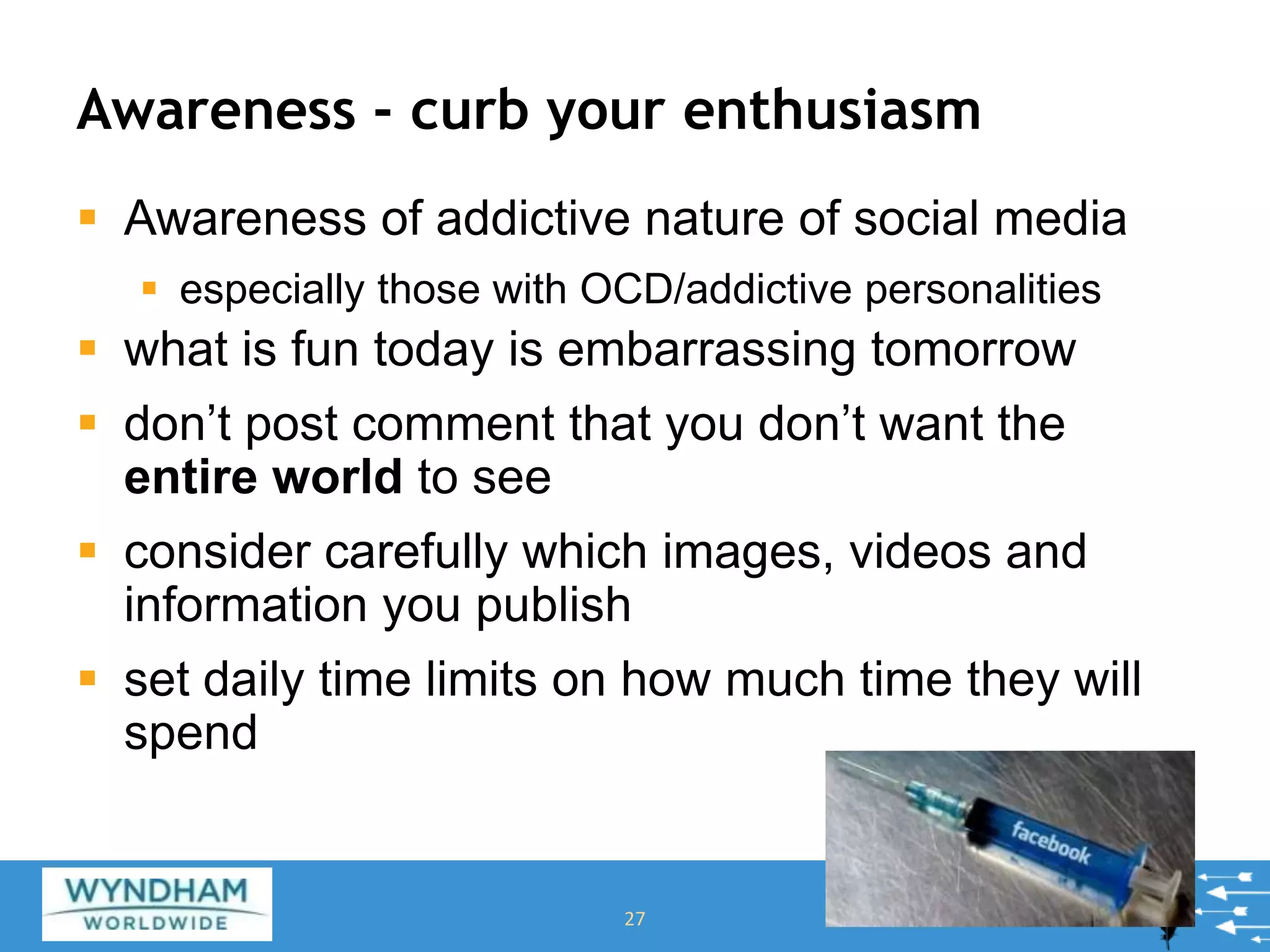
 Awareness of addictive nature of social media
 especially those with OCD/addictive personalities
 what is fun today is embarrassing tomorrow
 don’t post comment that you don’t want the
entire world to see
 consider carefully which images, videos and
information you publish
 set daily time limits on how much time they will
spend
27
Awareness - regulatory
 Regulatory compliance must be considered
 social networks present numerous scenarios which
weren’t foreseen when current legislation and data
protection laws were created
 regulatory framework governing social networks
should be reviewed and, where necessary, revised
 what specific laws/regulations/standards apply?
 all breach notice laws are relevant
 if customer or employee PII is posted, breach response plans
would likely need to be followed and notices would need to
be sent
28
Awareness – corporate guidelines
 Without guidelines, breaches are inevitable
 Excellent sources:
 Intel Social Media Guidelines
 IBM Social Computing Guidelines
 United States Air Force – New media guidelines
29
Management - monitoring
 Maintain control over content company owns
 monitor employee social networking participation
 significant risk of loss of IP protection if not monitored
 inappropriate use of enterprise content occurred?
 notify employee - explain how their actions violated policy
 control where and how corporate content is shared
externally
30
Management - monitoring
 Monitor social media content for
 inbound malware
 potentially libelous comments that are sent externally,
as well as trade secrets that might be referenced in
social media posts, potential regulatory violations,
breaches of ethical walls, etc.
 sexually harassing, racist or other inappropriate
content that might be sent internally.
 employee posts on every social media site that might
be used
31
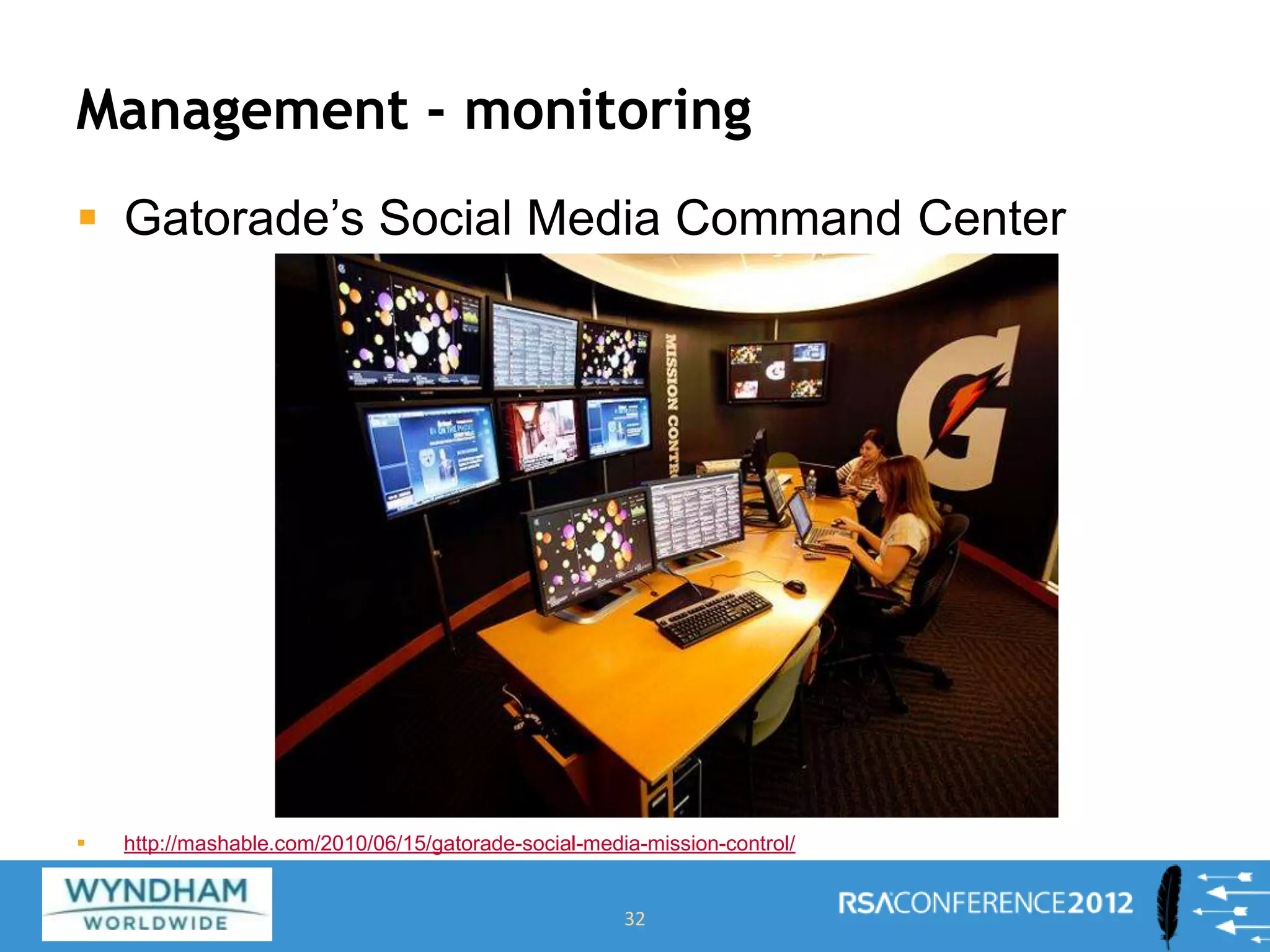
Management - monitoring
 Gatorade’s Social Media Command Center
 http://mashable.com/2010/06/15/gatorade-social-media-mission-control/
32
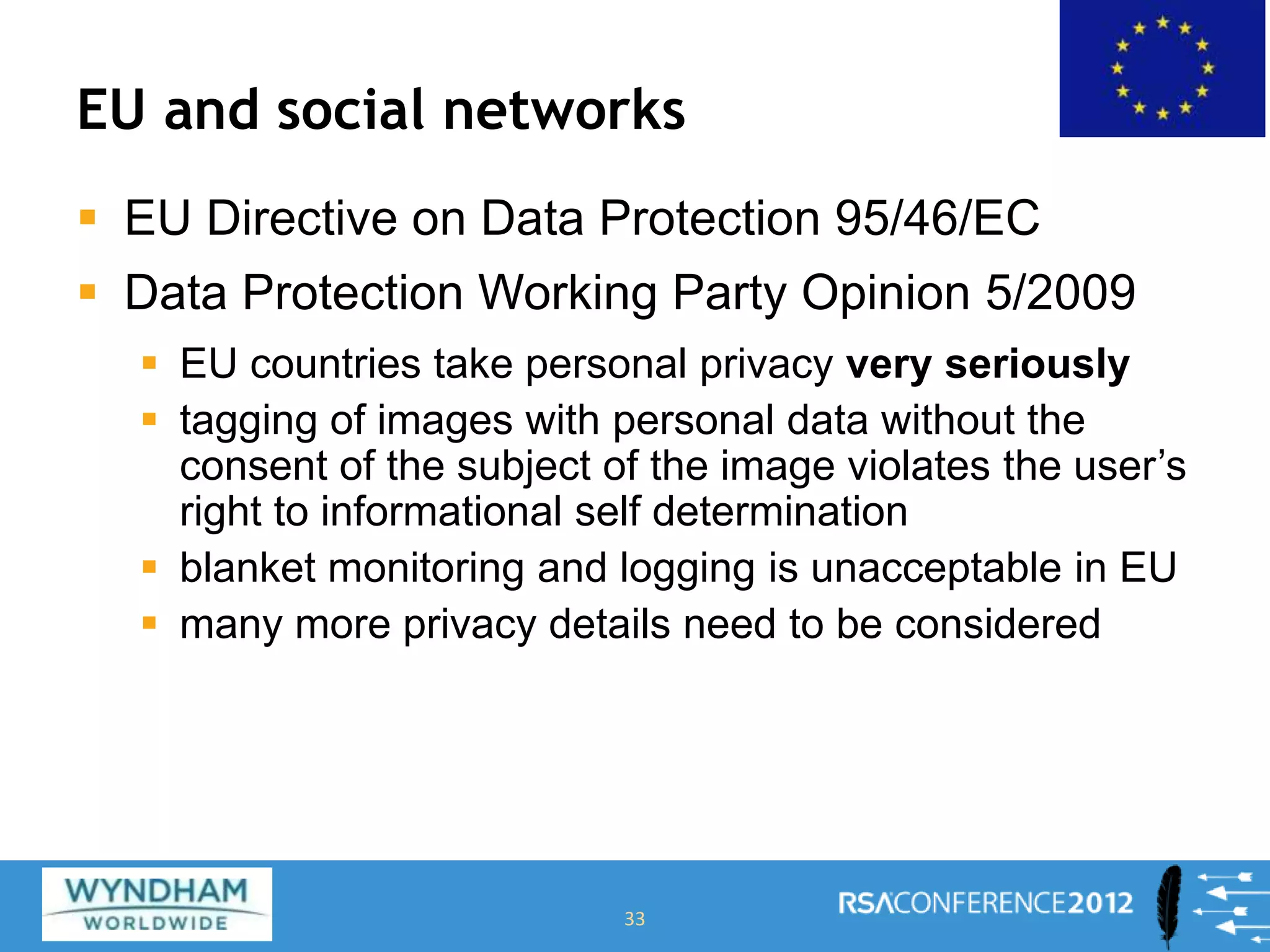
EU and social networks
 EU Directive on Data Protection 95/46/EC
 Data Protection Working Party Opinion 5/2009
 EU countries take personal privacy very seriously
 tagging of images with personal data without the
consent of the subject of the image violates the user’s
right to informational self determination
 blanket monitoring and logging is unacceptable in EU
 many more privacy details need to be considered
33
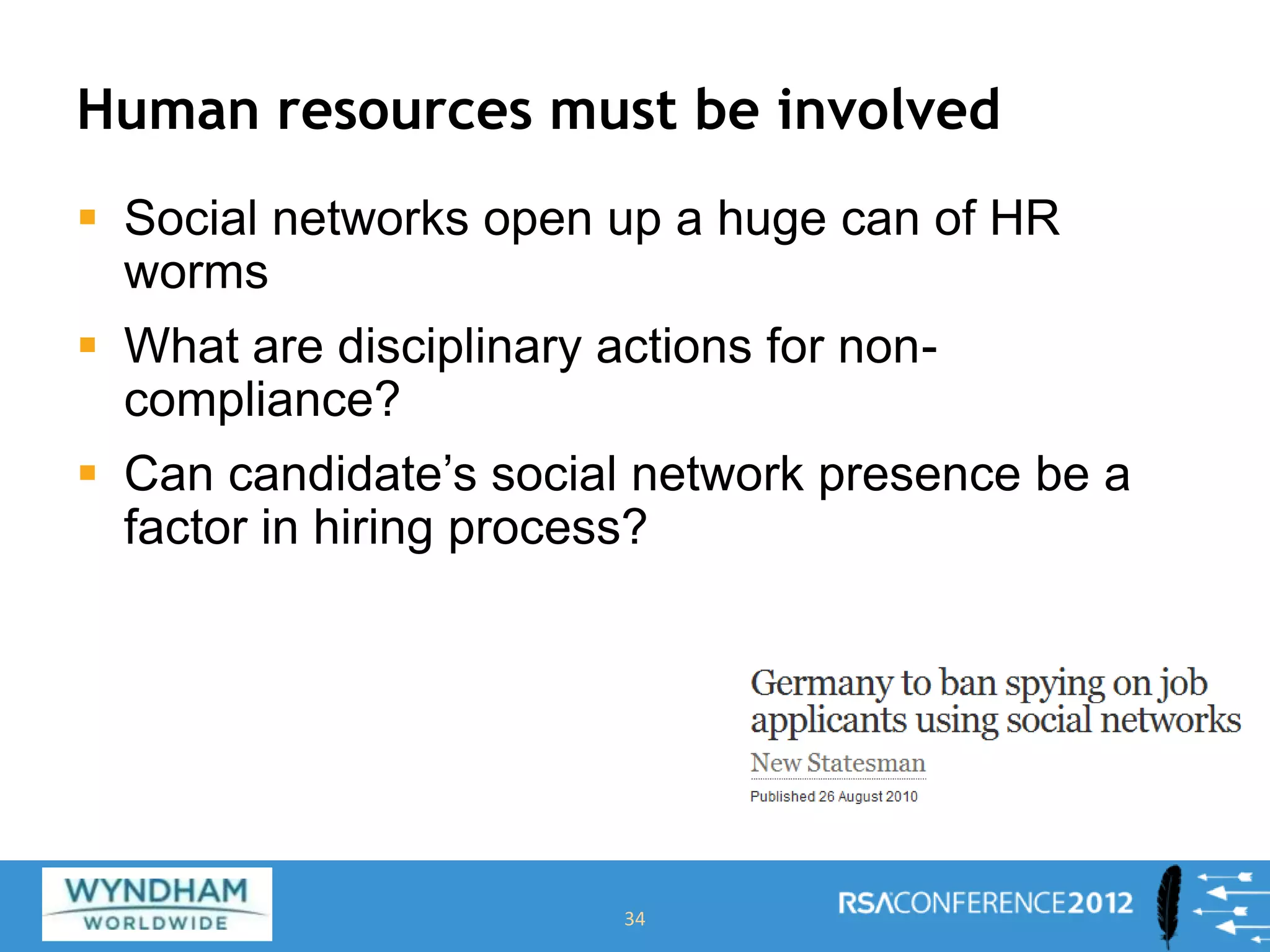
Human resources must be involved
 Social networks open up a huge can of HR
worms
 What are disciplinary actions for non-
compliance?
 Can candidate’s social network presence be a
factor in hiring process?
34
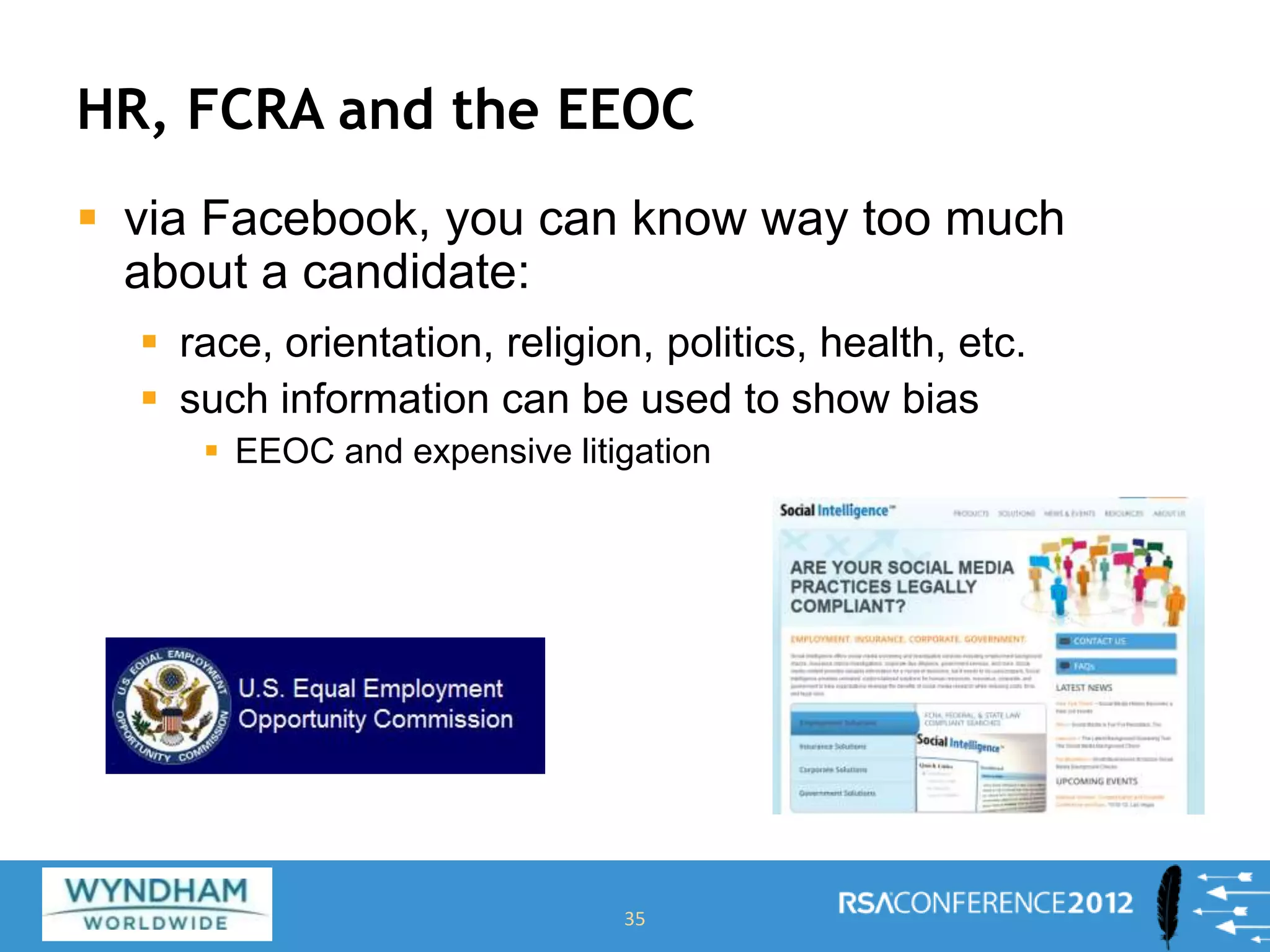
HR, FCRA and the EEOC
 via Facebook, you can know way too much
about a candidate:
 race, orientation, religion, politics, health, etc.
 such information can be used to show bias
 EEOC and expensive litigation
35
Social media hardware/software tools
36
 Archiving & compliance
 ActianceWorks, Arkovi, Socialware, Smarsh
 Content management
 Syncapse, Vitrue, Shoutlet, Hearsay Social, Context
Optional
 Monitoring & analytics
 Radian6 (Salesforce), Sysomos, PostRank (Google),
Alterian, Lithium Technologies, Collective Intellect,
Crimson Hexagon
References
 New Media and the Air Force
 Parents’ Guide to Facebook
 ENISA position papers
 Security Issues and Recommendations for Online Social
Networks
 Online as Soon as it Happens
 ISACA
 Social Media: Business Benefits and Security, Governance and
Assurance Perspectives
 Securing the Clicks Network Security in the Age of Social
Media
37
Apply
38
Apply
 understand how and why social media is used
 understand the risks you will face from not
managing social media security properly
 implement security and privacy policies focused
on the appropriate use of social media
 recognize social media security and privacy risks
and take a formal approach to mitigate them
39
Ben Rothke, CISSP CISA
Manager – Information Security
Wyndham Worldwide
Corporation
www.linkedin.com/in/benrothke
www.twitter.com/benrothke
www.slideshare.net/benrothke
40

Rothke rsa 2012 what happens in vegas goes on youtube using social networks securely

  • 1.
    Session ID: Session Classification: BenRothke, CISSP CISM Wyndham Worldwide Corp. WHAT HAPPENS IN VEGAS GOES ON YOUTUBE: USING SOCIAL NETWORKS SECURELY STAR-107 Intermediate
  • 2.
    About me…  BenRothke, CISSP, CISM, CISA  Manager - Information Security - Wyndham Worldwide Corp.  All content in this presentation reflect my views exclusively and not that of Wyndham Worldwide  Author - Computer Security: 20 Things Every Employee Should Know (McGraw-Hill)  Write the Security Reading Room blog  https://365.rsaconference.com/blogs/securityreading 2
  • 3.
    Agenda  Overview ofsocial networks  Scary security risks associated with social networks  Social network security strategies  Conclusion / Recommendations / Q&A 3
  • 4.
    Overview of social networksand the associated security and privacy 4
  • 5.
    Social media explained 5 Ineed to eat I ate This is where I ate Why am I eating? Look at me eat! I’m good at eating Let’s all eat together
  • 6.
    Social media isa infosec nightmare 6
  • 7.
  • 8.
    Social networking securityreality  People will share huge amounts of highly confidential personal & business information with people they perceive to be legitimate  Numerous legitimate security risks with allowing uncontrolled access to social sites  But…these risks can be mitigated via a comprehensive security strategy 8
  • 9.
    Blocking is futile Not only is resistance futile – it’s a negative business decision  Prepare a social networking strategy  Have a realistic understanding of the risks and benefits of social software  Understand unique challenges and factor them into on when and how to proceed  Business and information security goal is the secure use and enablement of social media 9
  • 10.
    Does blocking increaserisk of breaches?  TELUS/Rotman Management School study:  negative correlation between organizations blocking access to social networking for security reasons and number of breaches experienced  when blocked, user may feel encouraged to use alternate method (smartphone/tablet) to access site  policy is actually forcing users to access non-trusted sites, using a technology that is not monitored or controlled by the enterprise security program http://business.telus.com/en_CA/content/pdf/whyTELUS/Security_Thought_Leadership/TELUS_Rotman_2011_Results.pdf 10
  • 11.
    Security game-changer  Organizationsand management are struggling  to understand and deal with the numerous security and privacy risks associated with social networks  Traditional information security  firewalls and access control protected the perimeter. Social networks open up that perimeter  Focus shift  from infrastructure protection to data protection 11
  • 12.
    Social media securityand privacy risks 12 Risk Description Security? Type? Malware Infection of desktops, propagation of malware through staff or corporate profiles on social-media services. Yes Technology Chain of providers Mashups of applications within a social-media service enable the untraceable movement of data. Yes Technology Interface weaknesses Public application interfaces are not sufficiently secured, exposing users to cross-site scripting and other exploits. Yes Technology Reputation damage Degradation of personal and corporate reputations through posting of inappropriate content. No Content Exposure of confidential information Loose lips sink ships, breach of IP or other trade secrets, breach of copyright, public posting or downloading of private or sensitive personal information. Yes Content Legal exposure Legal liabilities resulting from posted content and online conversations or failure to meet a regulatory requirement to record and archive particular conversations. Yes Content Revenue loss For organizations in the information business, making content freely available may undercut fee-based information services Yes Content Staff productivity Workers failing to perform due to the distraction of social media No Behavior Hierarchy subversion Informal social networks erode authority of formal corporate hierarchy and defined work processes No Behavior Social engineering Phishing attacks, misrepresentation of identity and/or authority to obtain information illicitly or to stimulate damaging behaviors by staff. Yes Behavior Identity fraud Profiles and postings that are erroneously attributed to a staff member or corporate office. Yes Behavior Source: Gartner – Report G00173953 - February 2010
  • 13.
    Social media securityand privacy risks  cross site scripting, cross site request forgery  Twitter trending topic malware / spam  LikeJacking  phishing / spear phishing  corporate espionage / business intelligence  geolocation  Content-based Image Retrieval (CBIR) – emerging technology that matches features, such as identifying aspects of a room (e.g. a painting) in very large databases, increasing the possibilities for locating users 13 http://www.flickr.com/photos/narcissistic-indulgence/4472901190/
  • 14.
    Aggregation  Aggregation  processof collecting content from multiple social network services  consolidates multiple social networking profiles into one profile  Long-term anonymity is nearly impossible  users leave traces, IP addresses, embedded links, IDs in files, photos, etc.  no matter how anonymous one tries to be, eventually, with enough traces, aggregation will catch up 14
  • 15.
    Strategies and action itemsfor enterprises to deal with the security and privacy risks of social networks 15
  • 16.
    Social media waitsfor no one…  Especially information security  Be proactive  dedicated team to deal with social networks  ability to identify all issues around social networks  get involved and be engaged  Be flexible  social networking is moving fast  too a rigid framework may be myopic  social media in 2013 will be quite different than 2012 16
  • 17.
    Secure use ofsocial media 1. Governance  corporate social media strategy  risk assessments  realistic policies 2. Enablement  awareness, education 3. Management  monitoring 17
  • 18.
    Governance – socialmedia strategy  Create a social media strategy based on your social media security goals  Identify those who’ll be online public face  Draconian policies preventing the use of social media will most often not be effective  Use a balanced approach  allow access  manage risk via technical controls, policies and employee training 18
  • 19.
    Governance – riskassessment  for each social network community  vulnerabilities associated with each community  each social community has its own set of unique security and privacy concerns  output will be used to create the social media policy and strategy  customized to your specific risk matrix  balance risks vs. benefits  US Marines – some areas totally prohibited  Starbucks – totally embraced 19
  • 20.
    Governance - dataleakage  Social media physics - law of conservation of data  once confidential data is made public, it can never be made confidential again  once data is posted in a Web 2.0 world, it exists forever, somewhere  difficulty of complete account deletion  users wishing to delete accounts from social networks may find that it’s almost impossible to remove secondary information linked to their profile, such as public comments 20
  • 21.
    Governance – socialmedia policy  Social networking policy is a must  even if it prohibits everything, you still need a policy  Employees will do stupid things  Rational, sensible use of social media services  include photography and video  don’t reference clients, customers, or partners without obtaining their express permission  Social Media Policy Database  http://socialmediagovernance.com/policies.php 21
  • 22.
    Governance - reputationmanagement  Goal is to build and protect a positive Internet- based reputation  Risks to reputation are significant and growing with the increased use of social networks  Create reputation management group with input from IT, legal, risk management, PR and marketing  Coordinated approach  proactive / responsive 22
  • 23.
  • 24.
    Governance - reputationmanagement  Traditional PR and legal responses to an Internet-based negative reputation event can cause more damage than doing nothing  establish, follow and update protocols can make social-media chaos less risky to enterprises  Infosec coordinate activities with PR teams  expand monitoring and supplement monitoring with investigations and evidence collection processes 24
  • 25.
    Enablement – awarenessand education  Social media is driven by social interactions  Most significant risks are tied to the behavior of staff when they are using social software  Don't shun social media for fear of bad end-user behavior  Anticipate it and formulate a multilevel approach to policies for effective governance  3 C’s: clear, comprehensive, continuous 25
  • 26.
    Awareness - Howto get fired in 3 tweets  Link social networking training to other related training  business ethics, standards of conduct, industry- specific regulations  Let employees know they can lose their job  policy violation  managers and executives - special responsibility when blogging by virtue of their position  too much time on social network sites  perception that they are promoting themselves at the expense of the company 26
  • 27.
    Awareness - curbyour enthusiasm  Awareness of addictive nature of social media  especially those with OCD/addictive personalities  what is fun today is embarrassing tomorrow  don’t post comment that you don’t want the entire world to see  consider carefully which images, videos and information you publish  set daily time limits on how much time they will spend 27
  • 28.
    Awareness - regulatory Regulatory compliance must be considered  social networks present numerous scenarios which weren’t foreseen when current legislation and data protection laws were created  regulatory framework governing social networks should be reviewed and, where necessary, revised  what specific laws/regulations/standards apply?  all breach notice laws are relevant  if customer or employee PII is posted, breach response plans would likely need to be followed and notices would need to be sent 28
  • 29.
    Awareness – corporateguidelines  Without guidelines, breaches are inevitable  Excellent sources:  Intel Social Media Guidelines  IBM Social Computing Guidelines  United States Air Force – New media guidelines 29
  • 30.
    Management - monitoring Maintain control over content company owns  monitor employee social networking participation  significant risk of loss of IP protection if not monitored  inappropriate use of enterprise content occurred?  notify employee - explain how their actions violated policy  control where and how corporate content is shared externally 30
  • 31.
    Management - monitoring Monitor social media content for  inbound malware  potentially libelous comments that are sent externally, as well as trade secrets that might be referenced in social media posts, potential regulatory violations, breaches of ethical walls, etc.  sexually harassing, racist or other inappropriate content that might be sent internally.  employee posts on every social media site that might be used 31
  • 32.
    Management - monitoring Gatorade’s Social Media Command Center  http://mashable.com/2010/06/15/gatorade-social-media-mission-control/ 32
  • 33.
    EU and socialnetworks  EU Directive on Data Protection 95/46/EC  Data Protection Working Party Opinion 5/2009  EU countries take personal privacy very seriously  tagging of images with personal data without the consent of the subject of the image violates the user’s right to informational self determination  blanket monitoring and logging is unacceptable in EU  many more privacy details need to be considered 33
  • 34.
    Human resources mustbe involved  Social networks open up a huge can of HR worms  What are disciplinary actions for non- compliance?  Can candidate’s social network presence be a factor in hiring process? 34
  • 35.
    HR, FCRA andthe EEOC  via Facebook, you can know way too much about a candidate:  race, orientation, religion, politics, health, etc.  such information can be used to show bias  EEOC and expensive litigation 35
  • 36.
    Social media hardware/softwaretools 36  Archiving & compliance  ActianceWorks, Arkovi, Socialware, Smarsh  Content management  Syncapse, Vitrue, Shoutlet, Hearsay Social, Context Optional  Monitoring & analytics  Radian6 (Salesforce), Sysomos, PostRank (Google), Alterian, Lithium Technologies, Collective Intellect, Crimson Hexagon
  • 37.
    References  New Mediaand the Air Force  Parents’ Guide to Facebook  ENISA position papers  Security Issues and Recommendations for Online Social Networks  Online as Soon as it Happens  ISACA  Social Media: Business Benefits and Security, Governance and Assurance Perspectives  Securing the Clicks Network Security in the Age of Social Media 37
  • 38.
  • 39.
    Apply  understand howand why social media is used  understand the risks you will face from not managing social media security properly  implement security and privacy policies focused on the appropriate use of social media  recognize social media security and privacy risks and take a formal approach to mitigate them 39
  • 40.
    Ben Rothke, CISSPCISA Manager – Information Security Wyndham Worldwide Corporation www.linkedin.com/in/benrothke www.twitter.com/benrothke www.slideshare.net/benrothke 40