Cyber Security
Governance
www.icion-leadership.com
ICION 4th Annual Conference | Charles Lim, Msc., ECSA, ECSP, ECIH, CEH, CEI
Agenda
• About Honeynet
• Why Cyber Security Governance?
• Cyber Security Framework
• Framework Core
• Framework Profile
• Implementation Tiers
• Framework Profile
• Conclusion
About Honeynet
• Volunteer open source computer security
research organization since 1999 (US 501c3
non-profit)
• Mission: ¨learn the tools, tactics and motives
involved in computer and network attacks,
and share the lessons learned¨ -
http://www.honeynet.org
About Honeynet
• Share all of our tools, research and findings, at
no cost to the public – “Know Your Tools”
(KYT)
• “Know Your Enemy”(KYE) white papers
regularly published on current research topics
• Members release regular activity status reports
• Committed to open source and creative
commons
• Partially funded by sponsors, nothing to sell!
About Honeynet
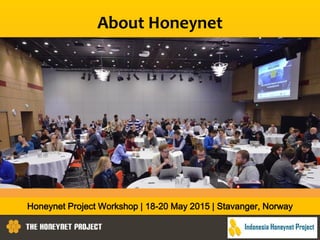
Honeynet Project Workshop | 18-20 May 2015 | Stavanger, Norway
About Honeynet
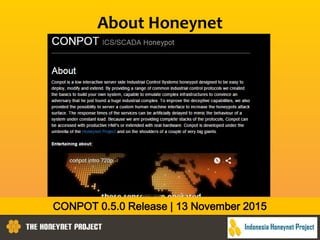
CONPOT 0.5.0 Release | 13 November 2015
About Honeynet
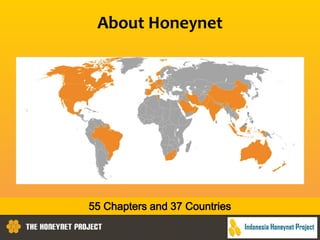
55 Chapters and 37 Countries
About Indonesia Honeynet Project
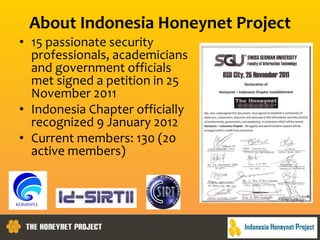
• 15 passionate security
professionals, academicians
and government officials
met signed a petition in 25
November 2011
• Indonesia Chapter officially
recognized 9 January 2012
• Current members: 130 (20
active members)
About Indonesia Honeynet Project
• Yearly Seminar and Workshop since 2012
• Focus on Security Awareness and Security
Research
• Honeynet communities: Jakarta, Semarang,
Surabaya, Yogya, Denpasar, Palembang,
Lampung
• Research Topics: Incident handling,
Vulnerability Analysis, Malware, Digital
Forensics, Penetration Testing, Threats
Intelligence
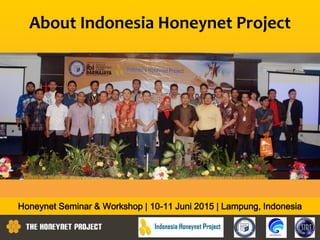
About Indonesia Honeynet Project
Honeynet Seminar & Workshop | 10-11 Juni 2015 | Lampung, Indonesia
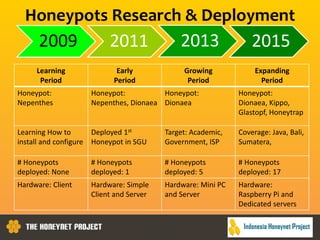
Honeypots Research & Deployment
2009 2011 2013 2015
Learning
Period
Early
Period
Growing
Period
Expanding
Period
Honeypot:
Nepenthes
Honeypot:
Nepenthes, Dionaea
Honeypot:
Dionaea
Honeypot:
Dionaea, Kippo,
Glastopf, Honeytrap
Learning How to
install and configure
Deployed 1st
Honeypot in SGU
Target: Academic,
Government, ISP
Coverage: Java, Bali,
Sumatera,
# Honeypots
deployed: None
# Honeypots
deployed: 1
# Honeypots
deployed: 5
# Honeypots
deployed: 17
Hardware: Client Hardware: Simple
Client and Server
Hardware: Mini PC
and Server
Hardware:
Raspberry Pi and
Dedicated servers
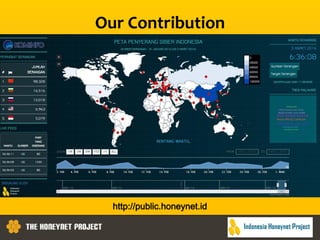
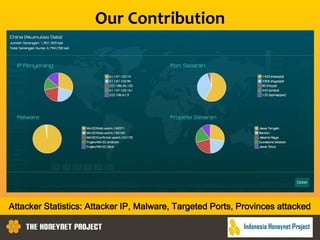
Our Contribution
http://public.honeynet.id
Our Contribution
Attacker Statistics: Attacker IP, Malware, Targeted Ports, Provinces attacked
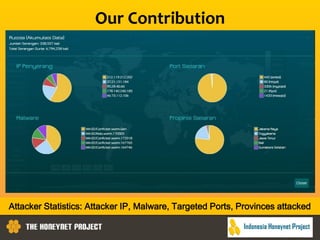
Our Contribution
Attacker Statistics: Attacker IP, Malware, Targeted Ports, Provinces attacked
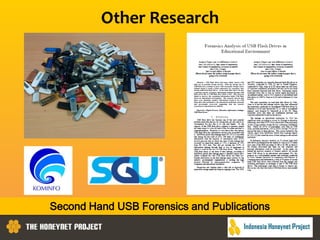
Other Research
Second Hand USB Forensics and Publications
Join Us
• Indonesia Honeynet Project
• idhoneynet
• http://www.honeynet.or.id
• http://groups.google.com/group/id-honeynet
Why Cyber Security Governance?
• We live in the interconnected world
• Constant security threats to individuals,
organizations, or countries
• Businesses continue to evolve to stay ahead
• Governing these threats to our
organizations is critical to survivability
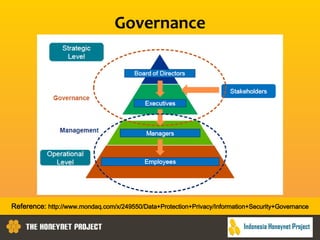
Governance
Reference: http://www.mondaq.com/x/249550/Data+Protection+Privacy/Information+Security+Governance
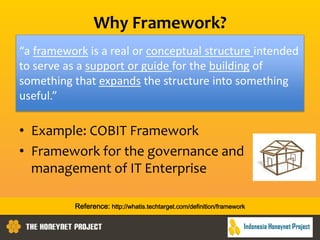
Why Framework?
• Example: COBIT Framework
• Framework for the governance and
management of IT Enterprise
“a framework is a real or conceptual structure intended
to serve as a support or guide for the building of
something that expands the structure into something
useful.”
Reference: http://whatis.techtarget.com/definition/framework
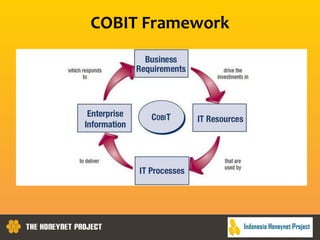
COBIT Framework
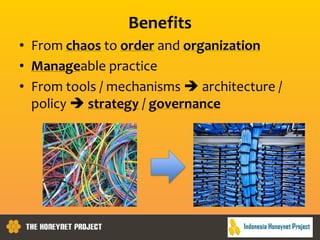
Benefits
• From chaos to order and organization
• Manageable practice
• From tools / mechanisms  architecture /
policy  strategy / governance
Cyber Security Framework
• Framework for Improving Critical Infrastructure Cybersecurity,
version 1.0, the National Institute of Standards and Technology
(NIST), February 12, 2014.
– A response to the President’s Executive Order 13636, “Improving
Critical Infrastructure Cybersecurity” on February 12, 2013.
• Critical infrastructure: “systems and assets, whether physical or
virtual, so vital to the United States that the incapacity or destruction
of such systems and assets would have a debilitating impact on
security, national economic security, national public health or safety,
or any combination of those matters.”
• a voluntary risk-based Cybersecurity Framework
– a set of industry standards and best practices to help
organizations manage cybersecurity risks
• The Framework is technology neutral
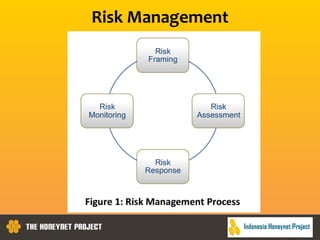
Risk Management
NIST Cyber Security Framework
• Three parts:
– The Framework Core
– The Framework Profile
– The Framework Implementation Tiers
• Framework Core
– A set of activities, outcomes, and informative
references
– Providing the detailed guidance for developing
individual organizational Profiles
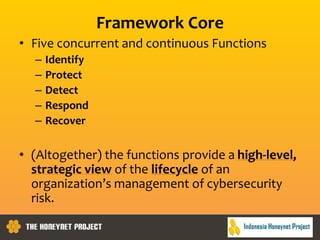
Framework Core
• Five concurrent and continuous Functions
– Identify
– Protect
– Detect
– Respond
– Recover
• (Altogether) the functions provide a high-level,
strategic view of the lifecycle of an
organization’s management of cybersecurity
risk.
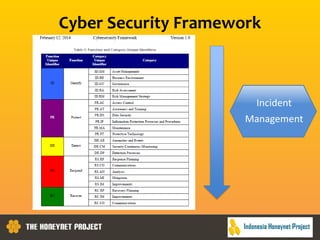
Cyber Security Framework
Incident
Management
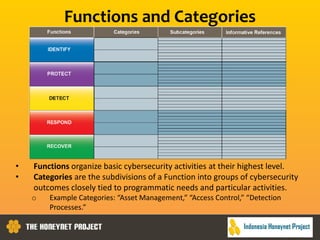
Functions and Categories
• Functions organize basic cybersecurity activities at their highest level.
• Categories are the subdivisions of a Function into groups of cybersecurity
outcomes closely tied to programmatic needs and particular activities.
o Example Categories: “Asset Management,” “Access Control,” “Detection
Processes.”
28
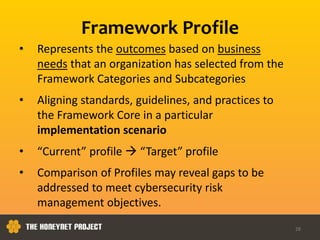
• Represents the outcomes based on business
needs that an organization has selected from the
Framework Categories and Subcategories
• Aligning standards, guidelines, and practices to
the Framework Core in a particular
implementation scenario
• “Current” profile  “Target” profile
• Comparison of Profiles may reveal gaps to be
addressed to meet cybersecurity risk
management objectives.
Framework Profile
29
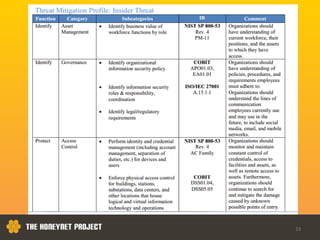
• The Framework document does not prescribe
Profile templates, allowing for flexibility in
implementation.
• Example profiles can be found:
http://www.nist.gov/itl/upload/discussion-draft_illustrative-
examples-082813.pdf
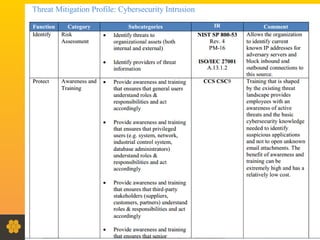
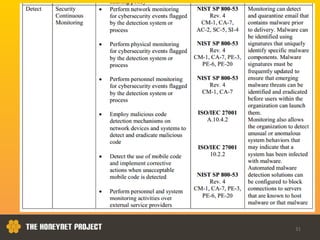
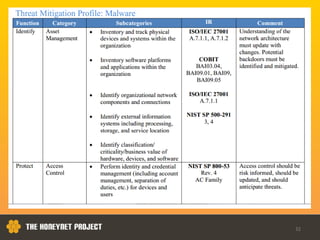
Example Profiles for Threat Mitigation:
1. Mitigating intrusions
2. Mitigating malware
3. Mitigating insider threats
Framework Profile
30
31
32
33
34
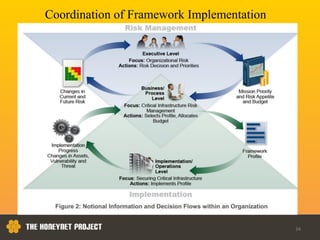
Coordination of Framework Implementation
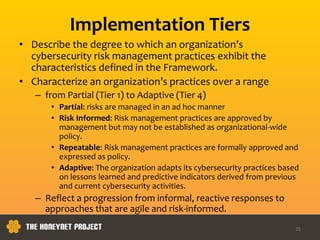
Implementation Tiers
• Describe the degree to which an organization’s
cybersecurity risk management practices exhibit the
characteristics defined in the Framework.
• Characterize an organization’s practices over a range
– from Partial (Tier 1) to Adaptive (Tier 4)
• Partial: risks are managed in an ad hoc manner
• Risk Informed: Risk management practices are approved by
management but may not be established as organizational-wide
policy.
• Repeatable: Risk management practices are formally approved and
expressed as policy.
• Adaptive: The organization adapts its cybersecurity practices based
on lessons learned and predictive indicators derived from previous
and current cybersecurity activities.
– Reflect a progression from informal, reactive responses to
approaches that are agile and risk-informed.
35
Challenges
• Governance begins at the top of the
organization  Executive need to lead
• Managing Cyber Security Challenges 
Managing Risk continuously
• Evolving Risks  Evolving Challenges
Thank you
Support the first cissp class training on 25 to 29 April 2016 in Jakarta www.indo-infosec.com
• Our ANNUAL ICION EVENT IN BALI
• www.icion-leadership.com
• Watch our last CISSP COMMUNITY VIDEO EVENT IN
PONDOH INDAH
• https://www.youtube.com/watch?v=fqUjXIlCcfM

ICION 2016 - Cyber Security Governance

  • 1.
    Cyber Security Governance www.icion-leadership.com ICION 4thAnnual Conference | Charles Lim, Msc., ECSA, ECSP, ECIH, CEH, CEI
  • 2.
    Agenda • About Honeynet •Why Cyber Security Governance? • Cyber Security Framework • Framework Core • Framework Profile • Implementation Tiers • Framework Profile • Conclusion
  • 3.
    About Honeynet • Volunteeropen source computer security research organization since 1999 (US 501c3 non-profit) • Mission: ¨learn the tools, tactics and motives involved in computer and network attacks, and share the lessons learned¨ - http://www.honeynet.org
  • 4.
    About Honeynet • Shareall of our tools, research and findings, at no cost to the public – “Know Your Tools” (KYT) • “Know Your Enemy”(KYE) white papers regularly published on current research topics • Members release regular activity status reports • Committed to open source and creative commons • Partially funded by sponsors, nothing to sell!
  • 5.
    About Honeynet Honeynet ProjectWorkshop | 18-20 May 2015 | Stavanger, Norway
  • 6.
    About Honeynet CONPOT 0.5.0Release | 13 November 2015
  • 7.
  • 8.
    About Indonesia HoneynetProject • 15 passionate security professionals, academicians and government officials met signed a petition in 25 November 2011 • Indonesia Chapter officially recognized 9 January 2012 • Current members: 130 (20 active members)
  • 9.
    About Indonesia HoneynetProject • Yearly Seminar and Workshop since 2012 • Focus on Security Awareness and Security Research • Honeynet communities: Jakarta, Semarang, Surabaya, Yogya, Denpasar, Palembang, Lampung • Research Topics: Incident handling, Vulnerability Analysis, Malware, Digital Forensics, Penetration Testing, Threats Intelligence
  • 10.
    About Indonesia HoneynetProject Honeynet Seminar & Workshop | 10-11 Juni 2015 | Lampung, Indonesia
  • 11.
    Honeypots Research &Deployment 2009 2011 2013 2015 Learning Period Early Period Growing Period Expanding Period Honeypot: Nepenthes Honeypot: Nepenthes, Dionaea Honeypot: Dionaea Honeypot: Dionaea, Kippo, Glastopf, Honeytrap Learning How to install and configure Deployed 1st Honeypot in SGU Target: Academic, Government, ISP Coverage: Java, Bali, Sumatera, # Honeypots deployed: None # Honeypots deployed: 1 # Honeypots deployed: 5 # Honeypots deployed: 17 Hardware: Client Hardware: Simple Client and Server Hardware: Mini PC and Server Hardware: Raspberry Pi and Dedicated servers
  • 12.
  • 13.
    Our Contribution Attacker Statistics:Attacker IP, Malware, Targeted Ports, Provinces attacked
  • 14.
    Our Contribution Attacker Statistics:Attacker IP, Malware, Targeted Ports, Provinces attacked
  • 15.
    Other Research Second HandUSB Forensics and Publications
  • 16.
    Join Us • IndonesiaHoneynet Project • idhoneynet • http://www.honeynet.or.id • http://groups.google.com/group/id-honeynet
  • 17.
    Why Cyber SecurityGovernance? • We live in the interconnected world • Constant security threats to individuals, organizations, or countries • Businesses continue to evolve to stay ahead • Governing these threats to our organizations is critical to survivability
  • 18.
  • 19.
    Why Framework? • Example:COBIT Framework • Framework for the governance and management of IT Enterprise “a framework is a real or conceptual structure intended to serve as a support or guide for the building of something that expands the structure into something useful.” Reference: http://whatis.techtarget.com/definition/framework
  • 20.
  • 21.
    Benefits • From chaosto order and organization • Manageable practice • From tools / mechanisms  architecture / policy  strategy / governance
  • 22.
    Cyber Security Framework •Framework for Improving Critical Infrastructure Cybersecurity, version 1.0, the National Institute of Standards and Technology (NIST), February 12, 2014. – A response to the President’s Executive Order 13636, “Improving Critical Infrastructure Cybersecurity” on February 12, 2013. • Critical infrastructure: “systems and assets, whether physical or virtual, so vital to the United States that the incapacity or destruction of such systems and assets would have a debilitating impact on security, national economic security, national public health or safety, or any combination of those matters.” • a voluntary risk-based Cybersecurity Framework – a set of industry standards and best practices to help organizations manage cybersecurity risks • The Framework is technology neutral
  • 23.
  • 24.
    NIST Cyber SecurityFramework • Three parts: – The Framework Core – The Framework Profile – The Framework Implementation Tiers • Framework Core – A set of activities, outcomes, and informative references – Providing the detailed guidance for developing individual organizational Profiles
  • 25.
    Framework Core • Fiveconcurrent and continuous Functions – Identify – Protect – Detect – Respond – Recover • (Altogether) the functions provide a high-level, strategic view of the lifecycle of an organization’s management of cybersecurity risk.
  • 26.
  • 27.
    Functions and Categories •Functions organize basic cybersecurity activities at their highest level. • Categories are the subdivisions of a Function into groups of cybersecurity outcomes closely tied to programmatic needs and particular activities. o Example Categories: “Asset Management,” “Access Control,” “Detection Processes.”
  • 28.
    28 • Represents theoutcomes based on business needs that an organization has selected from the Framework Categories and Subcategories • Aligning standards, guidelines, and practices to the Framework Core in a particular implementation scenario • “Current” profile  “Target” profile • Comparison of Profiles may reveal gaps to be addressed to meet cybersecurity risk management objectives. Framework Profile
  • 29.
    29 • The Frameworkdocument does not prescribe Profile templates, allowing for flexibility in implementation. • Example profiles can be found: http://www.nist.gov/itl/upload/discussion-draft_illustrative- examples-082813.pdf Example Profiles for Threat Mitigation: 1. Mitigating intrusions 2. Mitigating malware 3. Mitigating insider threats Framework Profile
  • 30.
  • 31.
  • 32.
  • 33.
  • 34.
  • 35.
    Implementation Tiers • Describethe degree to which an organization’s cybersecurity risk management practices exhibit the characteristics defined in the Framework. • Characterize an organization’s practices over a range – from Partial (Tier 1) to Adaptive (Tier 4) • Partial: risks are managed in an ad hoc manner • Risk Informed: Risk management practices are approved by management but may not be established as organizational-wide policy. • Repeatable: Risk management practices are formally approved and expressed as policy. • Adaptive: The organization adapts its cybersecurity practices based on lessons learned and predictive indicators derived from previous and current cybersecurity activities. – Reflect a progression from informal, reactive responses to approaches that are agile and risk-informed. 35
  • 36.
    Challenges • Governance beginsat the top of the organization  Executive need to lead • Managing Cyber Security Challenges  Managing Risk continuously • Evolving Risks  Evolving Challenges
  • 37.
    Thank you Support thefirst cissp class training on 25 to 29 April 2016 in Jakarta www.indo-infosec.com • Our ANNUAL ICION EVENT IN BALI • www.icion-leadership.com • Watch our last CISSP COMMUNITY VIDEO EVENT IN PONDOH INDAH • https://www.youtube.com/watch?v=fqUjXIlCcfM