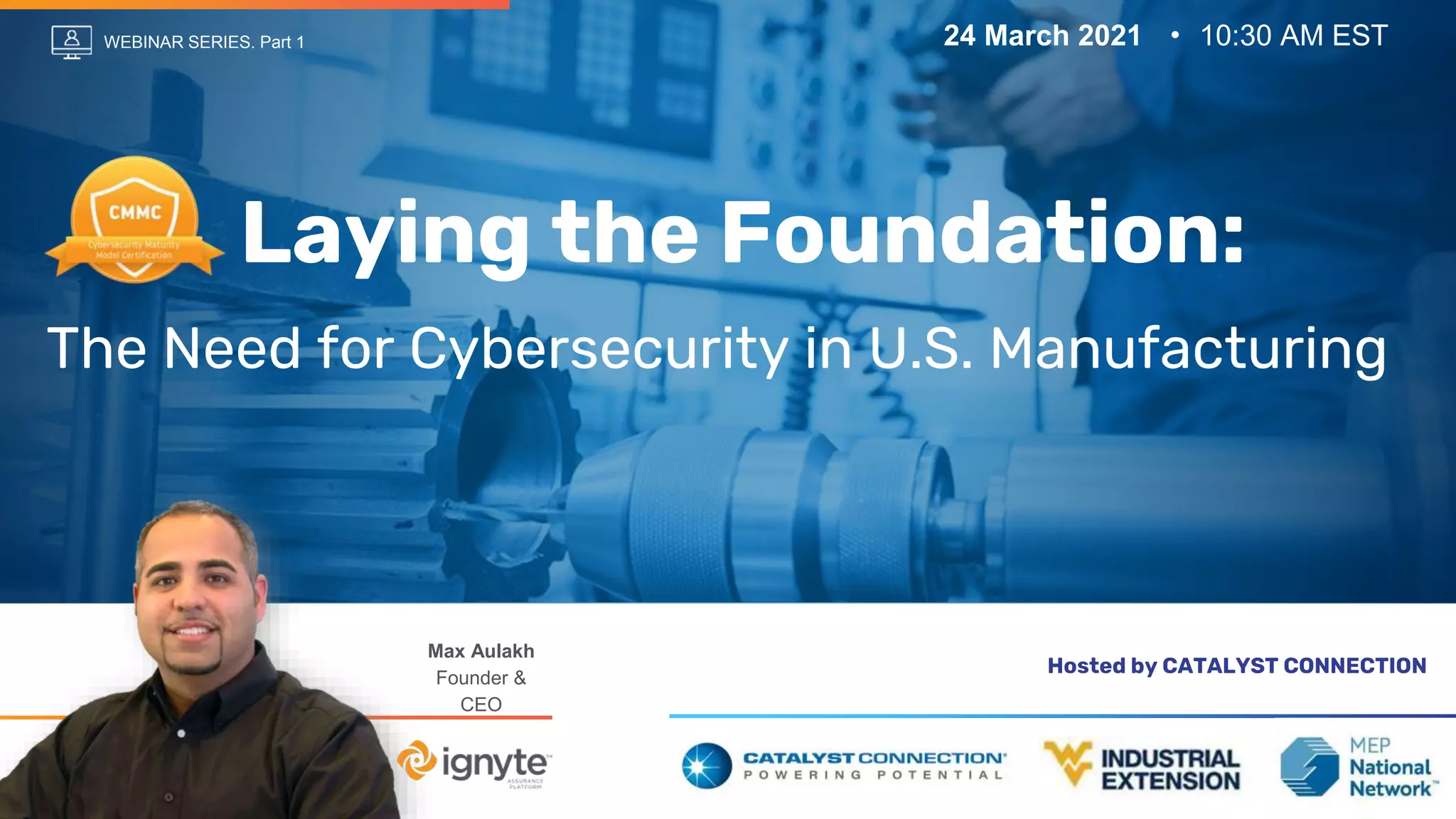
WEBINAR SERIES. Part 1 24 March 2021 10:30 AM EST
Hosted by CATALYST CONNECTION
Max Aulakh
Founder &
CEO
Laying the Foundation:
The Need for Cybersecurity in U.S. Manufacturing
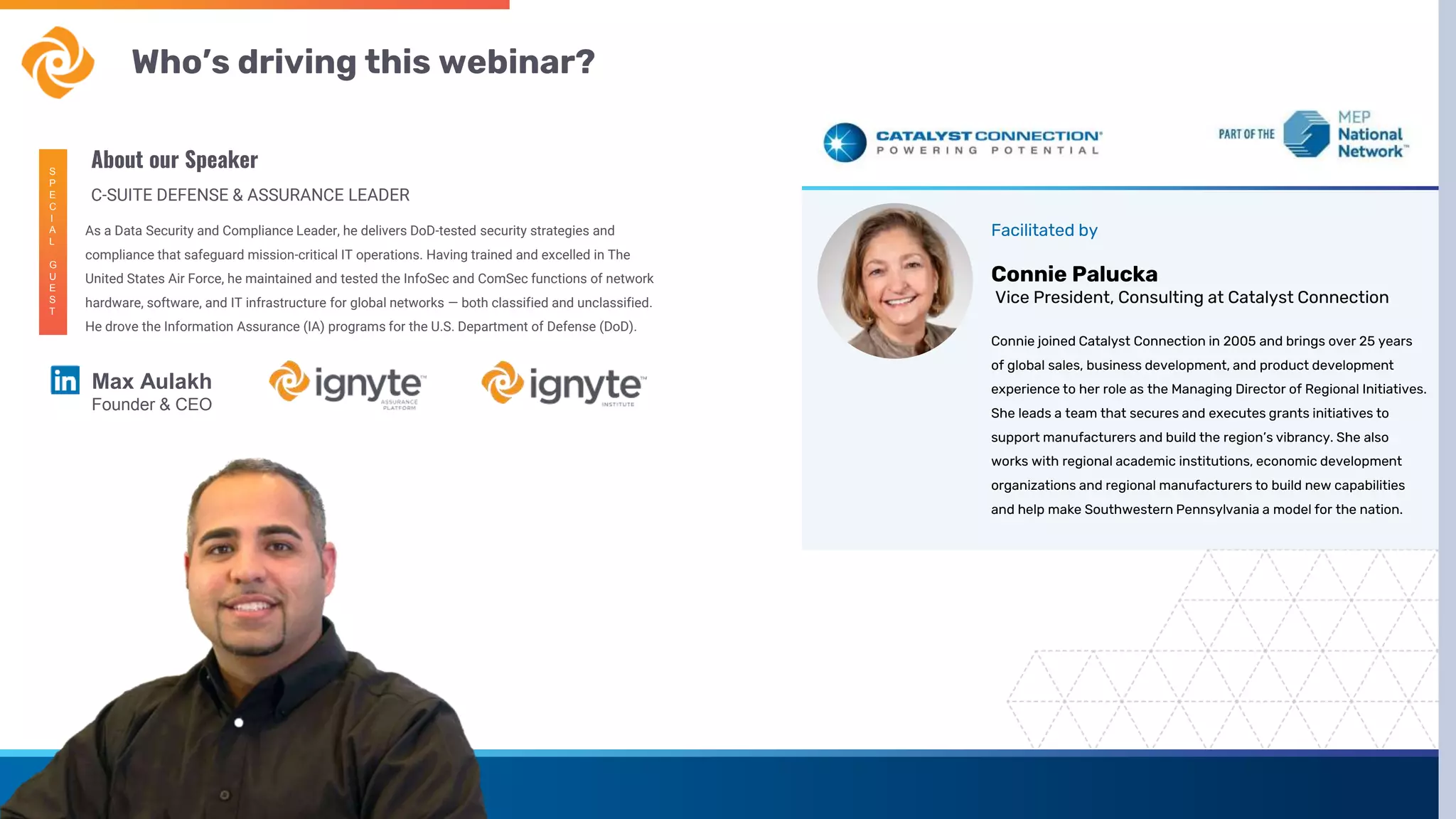
Who’s driving this webinar?
Max Aulakh
Founder & CEO
About our Speaker
C-SUITE DEFENSE & ASSURANCE LEADER
S
P
E
C
I
A
L
G
U
E
S
T
As a Data Security and Compliance Leader, he delivers DoD-tested security strategies and
compliance that safeguard mission-critical IT operations. Having trained and excelled in The
United States Air Force, he maintained and tested the InfoSec and ComSec functions of network
hardware, software, and IT infrastructure for global networks — both classified and unclassified.
He drove the Information Assurance (IA) programs for the U.S. Department of Defense (DoD).
Facilitated by
Connie Palucka
Vice President, Consulting at Catalyst Connection
Connie joined Catalyst Connection in 2005 and brings over 25 years
of global sales, business development, and product development
experience to her role as the Managing Director of Regional Initiatives.
She leads a team that secures and executes grants initiatives to
support manufacturers and build the region’s vibrancy. She also
works with regional academic institutions, economic development
organizations and regional manufacturers to build new capabilities
and help make Southwestern Pennsylvania a model for the nation.
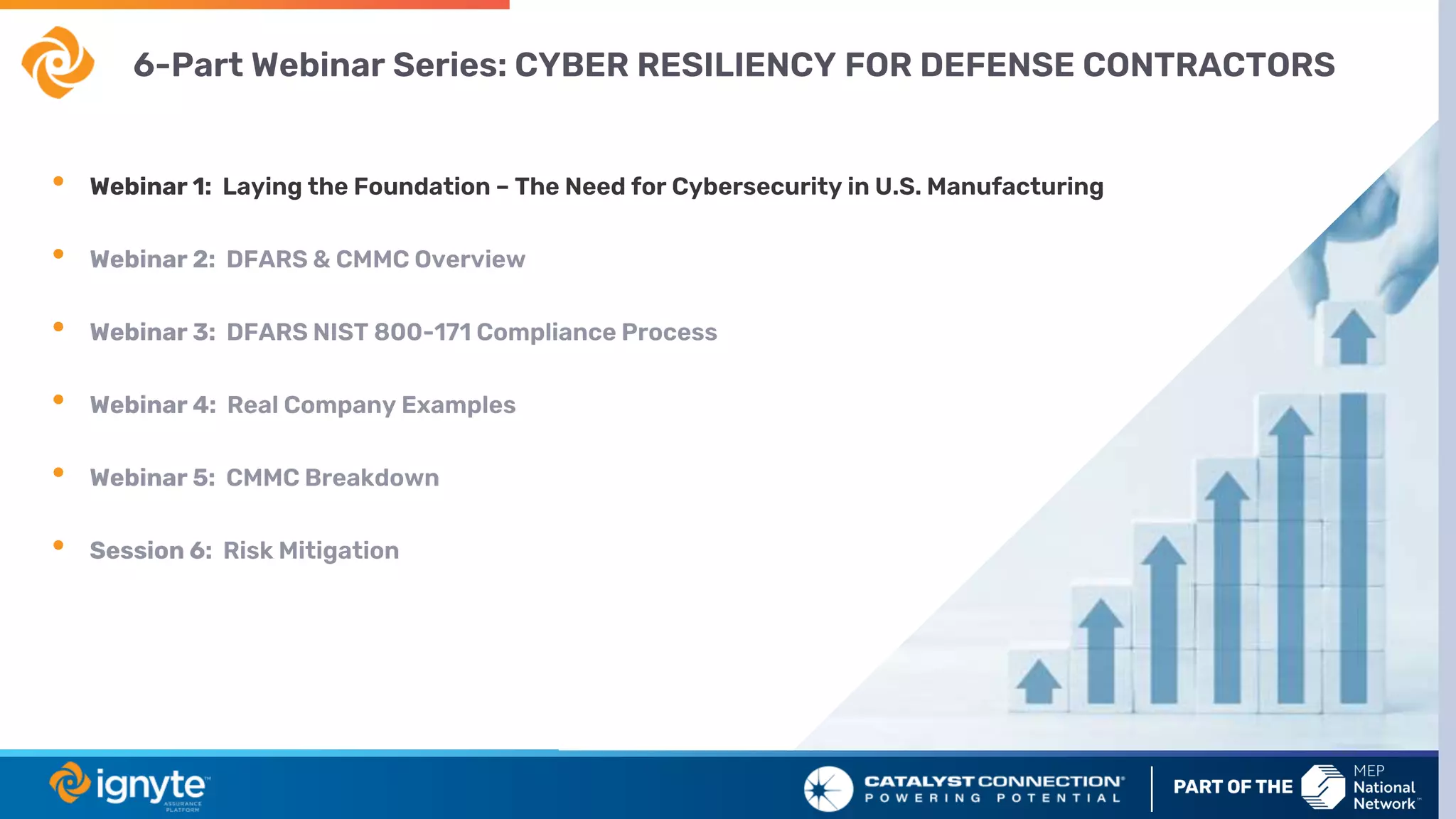
• Webinar 1: Laying the Foundation – The Need for Cybersecurity in U.S. Manufacturing
• Webinar 2: DFARS & CMMC Overview
• Webinar 3: DFARS NIST 800-171 Compliance Process
• Webinar 4: Real Company Examples
• Webinar 5: CMMC Breakdown
• Session 6: Risk Mitigation
6-Part Webinar Series: CYBER RESILIENCY FOR DEFENSE CONTRACTORS
Overview
• Reasons for Cybersecurity
• Impact on the US Manufacturing
• Modern Approach to Cyber Security
Reasons for Cybersecurity
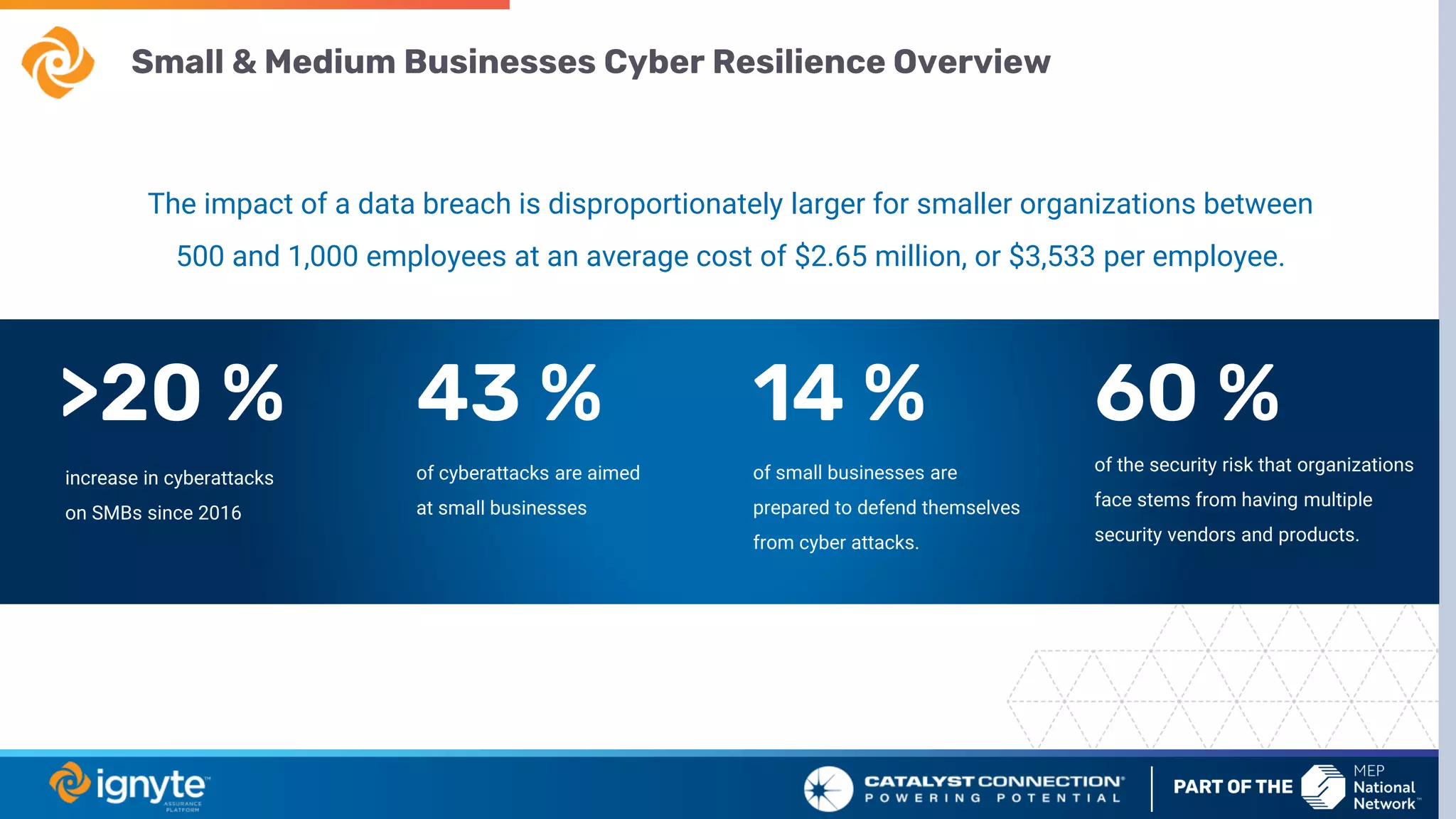
Small & Medium Businesses Cyber Resilience Overview
The impact of a data breach is disproportionately larger for smaller organizations between
500 and 1,000 employees at an average cost of $2.65 million, or $3,533 per employee.
>20 %
increase in cyberattacks
on SMBs since 2016
60 %
of the security risk that organizations
face stems from having multiple
security vendors and products.
43 %
of cyberattacks are aimed
at small businesses
of small businesses are
prepared to defend themselves
from cyber attacks.
14 %
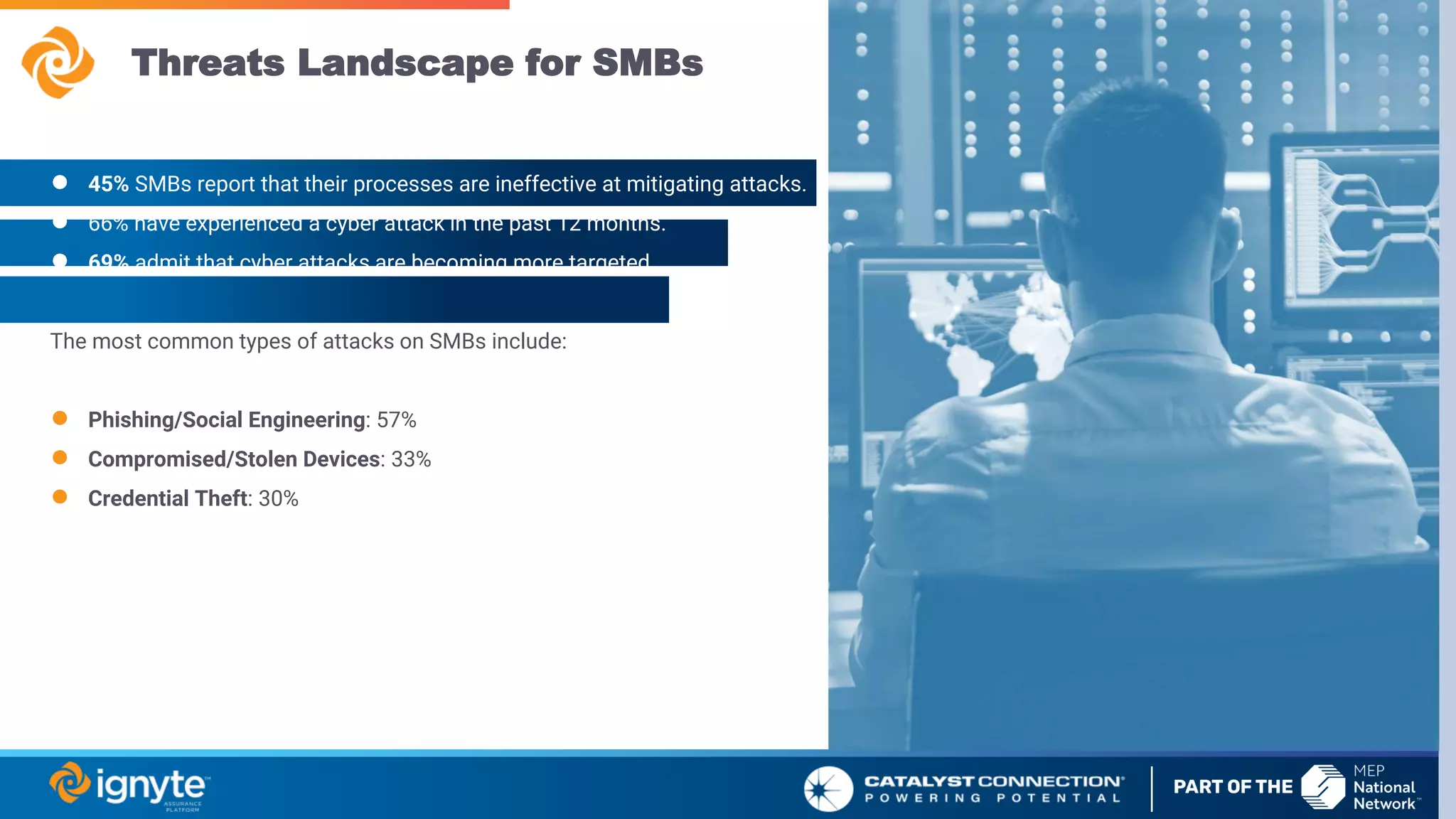
Threats Landscape for SMBs
● 45% SMBs report that their processes are ineffective at mitigating attacks.
● 66% have experienced a cyber attack in the past 12 months.
● 69% admit that cyber attacks are becoming more targeted.
The most common types of attacks on SMBs include:
● Phishing/Social Engineering: 57%
● Compromised/Stolen Devices: 33%
● Credential Theft: 30%
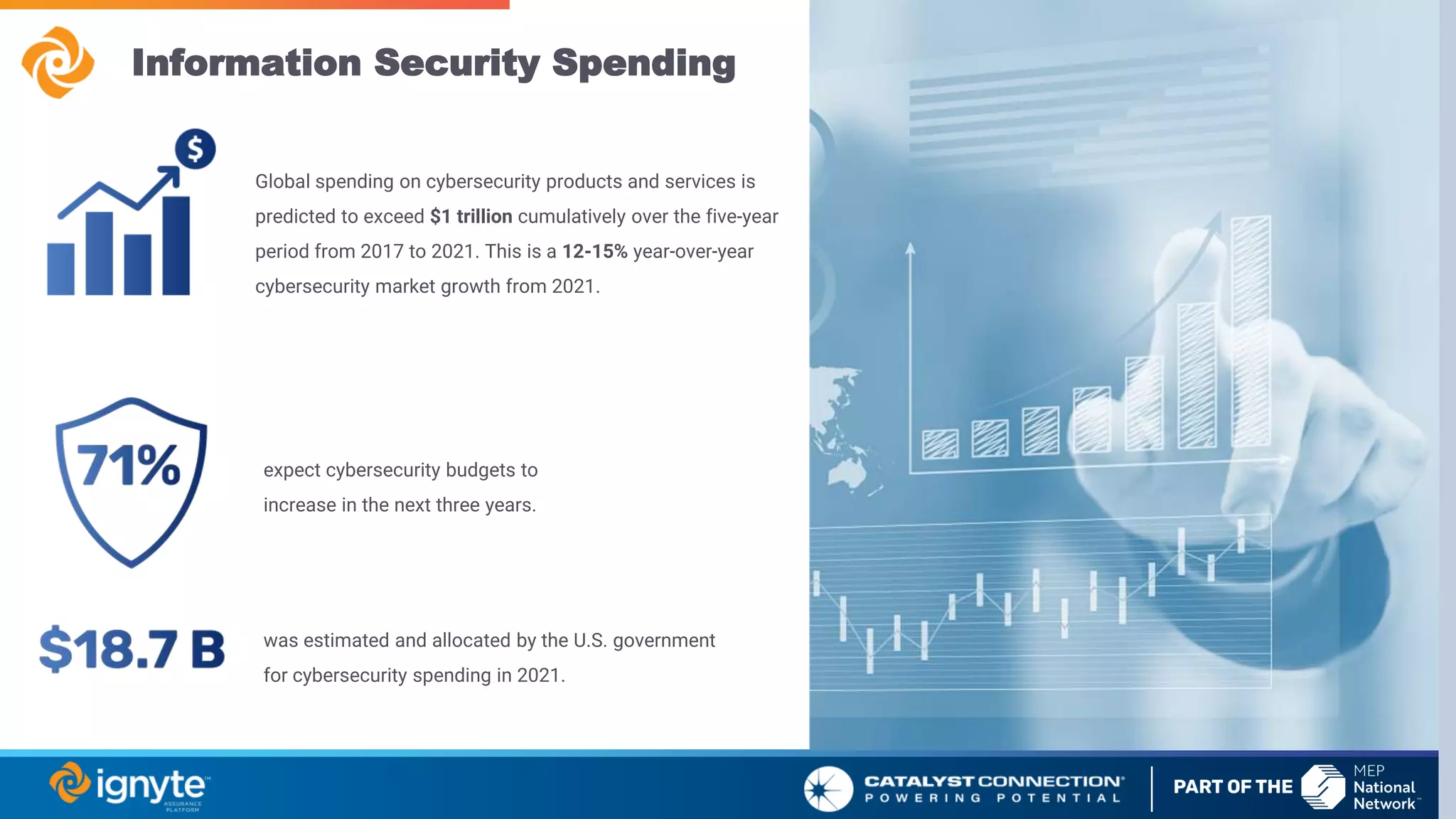
Information Security Spending
Global spending on cybersecurity products and services is
predicted to exceed $1 trillion cumulatively over the five-year
period from 2017 to 2021. This is a 12-15% year-over-year
cybersecurity market growth from 2021.
expect cybersecurity budgets to
increase in the next three years.
was estimated and allocated by the U.S. government
for cybersecurity spending in 2021.
Ransom Attacks
Ransomware attacks are growing more than 350% annually.
Ransomware attacks are becoming more prevalent as a concern.
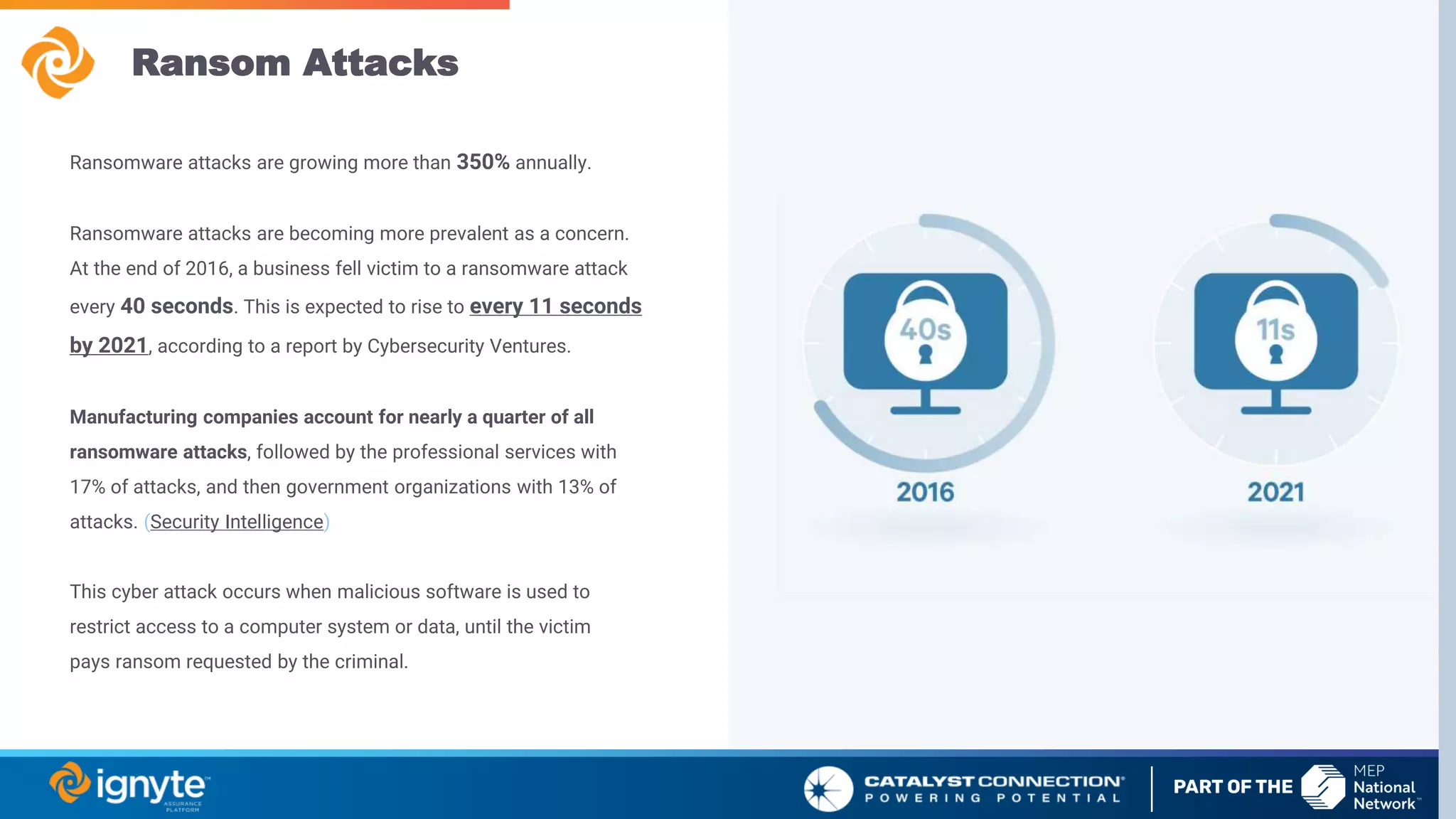
At the end of 2016, a business fell victim to a ransomware attack
every 40 seconds. This is expected to rise to every 11 seconds
by 2021, according to a report by Cybersecurity Ventures.
Manufacturing companies account for nearly a quarter of all
ransomware attacks, followed by the professional services with
17% of attacks, and then government organizations with 13% of
attacks. (Security Intelligence)
This cyber attack occurs when malicious software is used to
restrict access to a computer system or data, until the victim
pays ransom requested by the criminal.
Impact on the US Manufacturing
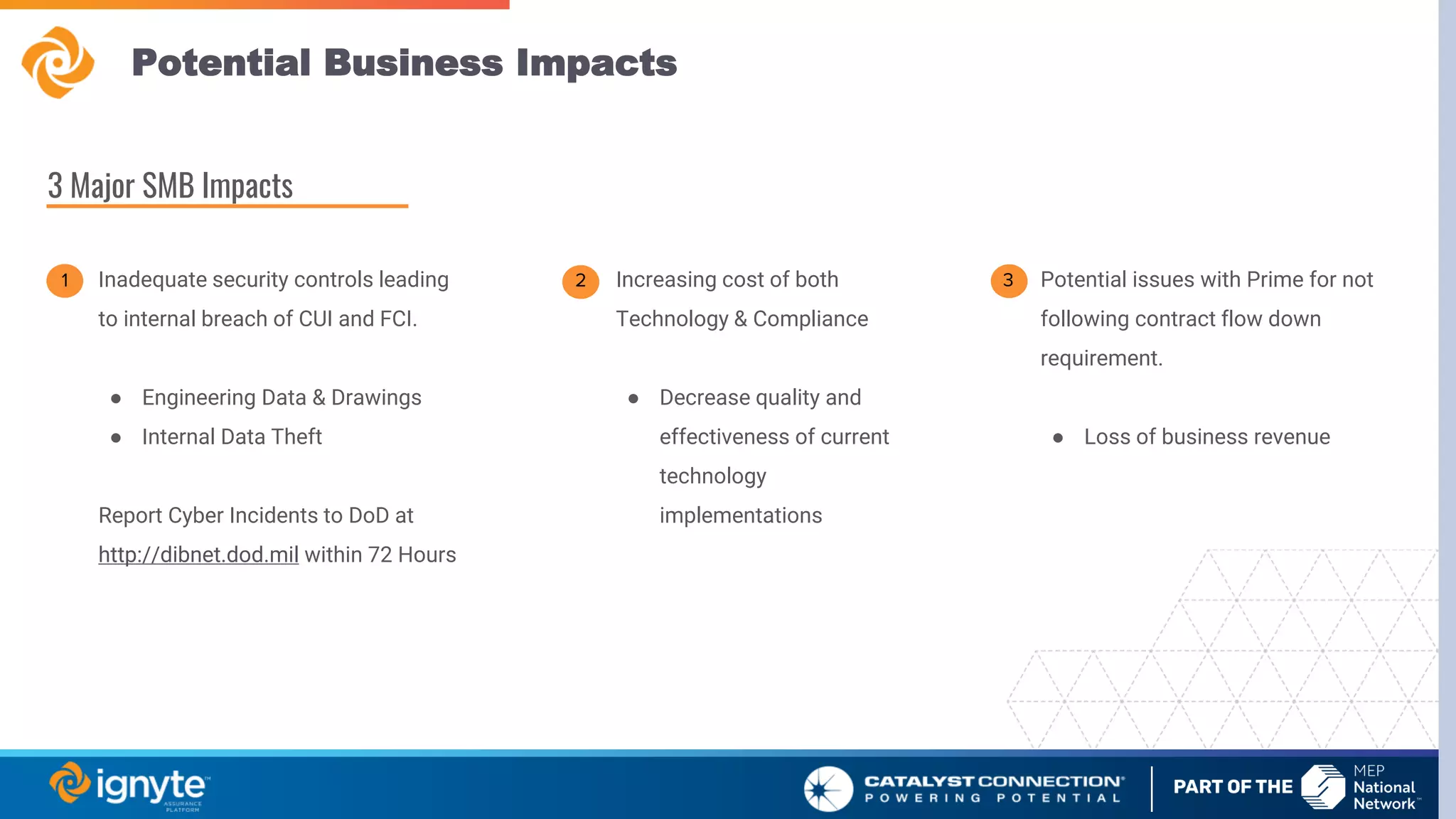
Potential Business Impacts
Inadequate security controls leading
to internal breach of CUI and FCI.
● Engineering Data & Drawings
● Internal Data Theft
Report Cyber Incidents to DoD at
http://dibnet.dod.mil within 72 Hours
Increasing cost of both
Technology & Compliance
● Decrease quality and
effectiveness of current
technology
implementations
Potential issues with Prime for not
following contract flow down
requirement.
● Loss of business revenue
3 Major SMB Impacts
1 3
2
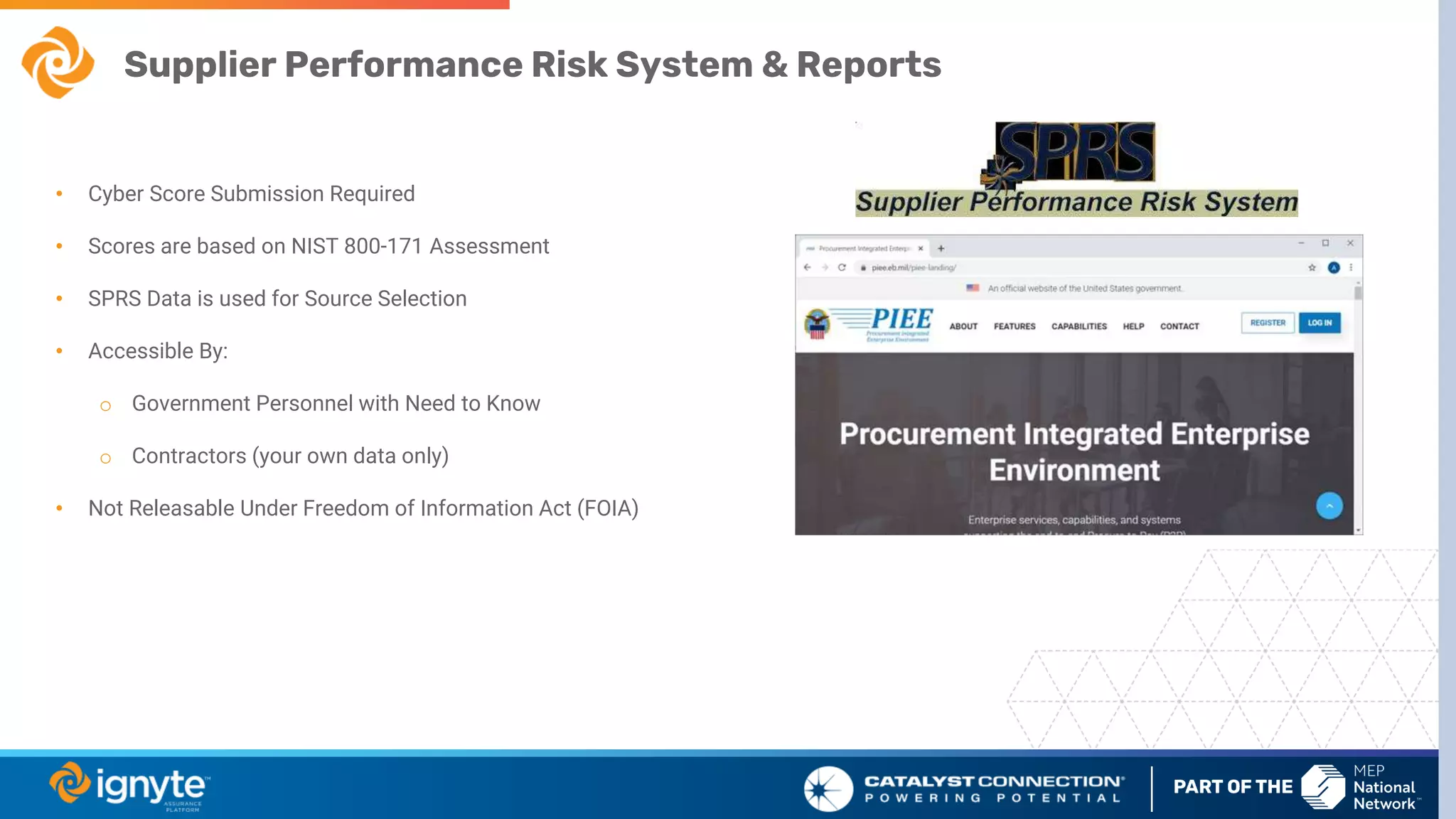
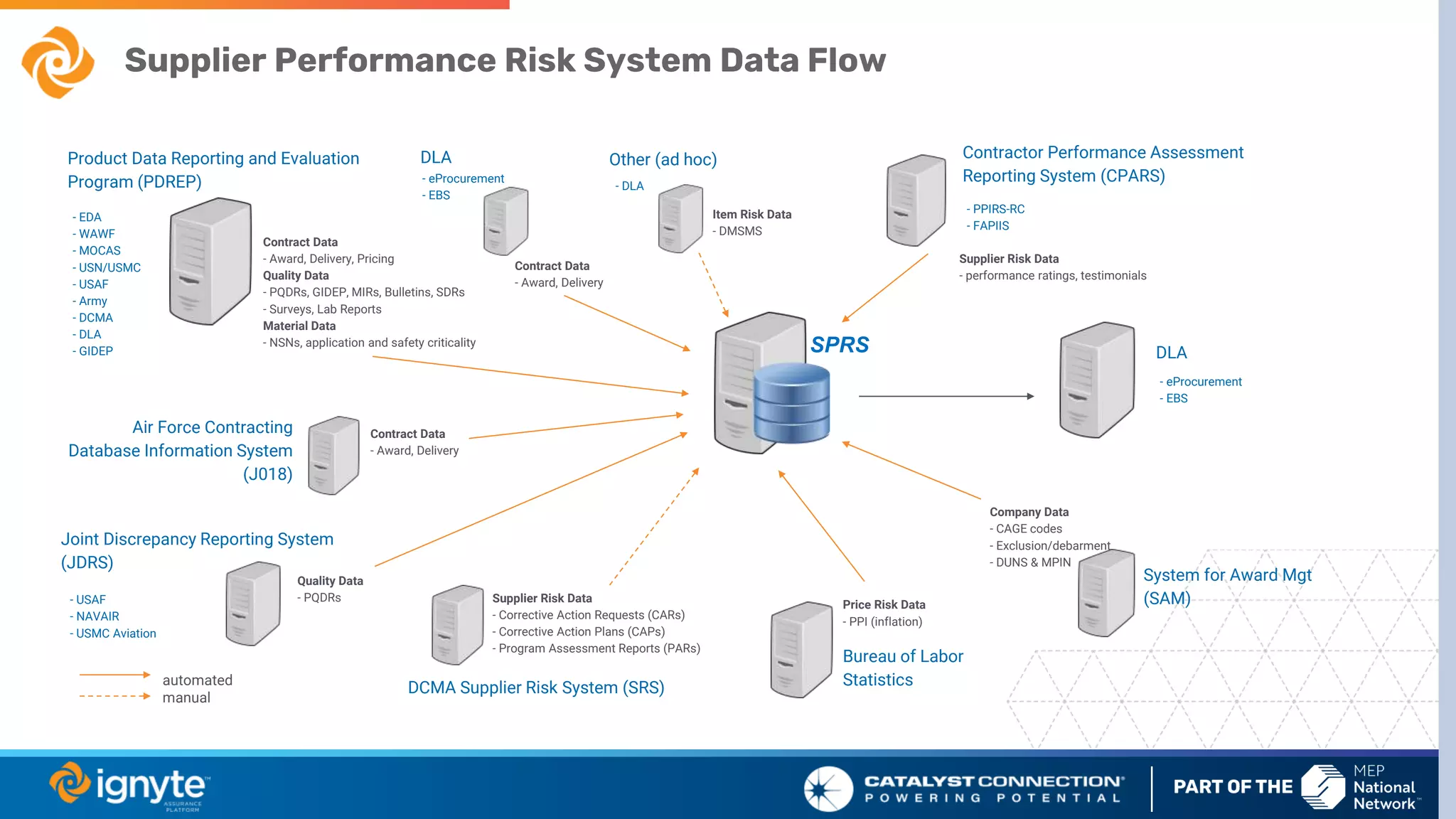
Supplier Performance Risk System & Reports
• Cyber Score Submission Required
• Scores are based on NIST 800-171 Assessment
• SPRS Data is used for Source Selection
• Accessible By:
o Government Personnel with Need to Know
o Contractors (your own data only)
• Not Releasable Under Freedom of Information Act (FOIA)
Product Data Reporting and Evaluation
Program (PDREP)
automated
manual
Air Force Contracting
Database Information System
(J018)
- EDA
- WAWF
- MOCAS
- USN/USMC
- USAF
- Army
- DCMA
- DLA
- GIDEP
- USAF
- NAVAIR
- USMC Aviation
Joint Discrepancy Reporting System
(JDRS)
Contractor Performance Assessment
Reporting System (CPARS)
- PPIRS-RC
- FAPIIS
Other (ad hoc)
- DLA
Contract Data
- Award, Delivery, Pricing
Quality Data
- PQDRs, GIDEP, MIRs, Bulletins, SDRs
- Surveys, Lab Reports
Material Data
- NSNs, application and safety criticality
Contract Data
- Award, Delivery
Quality Data
- PQDRs
DCMA Supplier Risk System (SRS)
Supplier Risk Data
- Corrective Action Requests (CARs)
- Corrective Action Plans (CAPs)
- Program Assessment Reports (PARs)
Bureau of Labor
Statistics
Contract Data
- Award, Delivery
System for Award Mgt
(SAM)
DLA
- eProcurement
- EBS
- eProcurement
- EBS
Price Risk Data
- PPI (inflation)
Company Data
- CAGE codes
- Exclusion/debarment
- DUNS & MPIN
Item Risk Data
- DMSMS
Supplier Risk Data
- performance ratings, testimonials
SPRS
Supplier Performance Risk System Data Flow
DLA
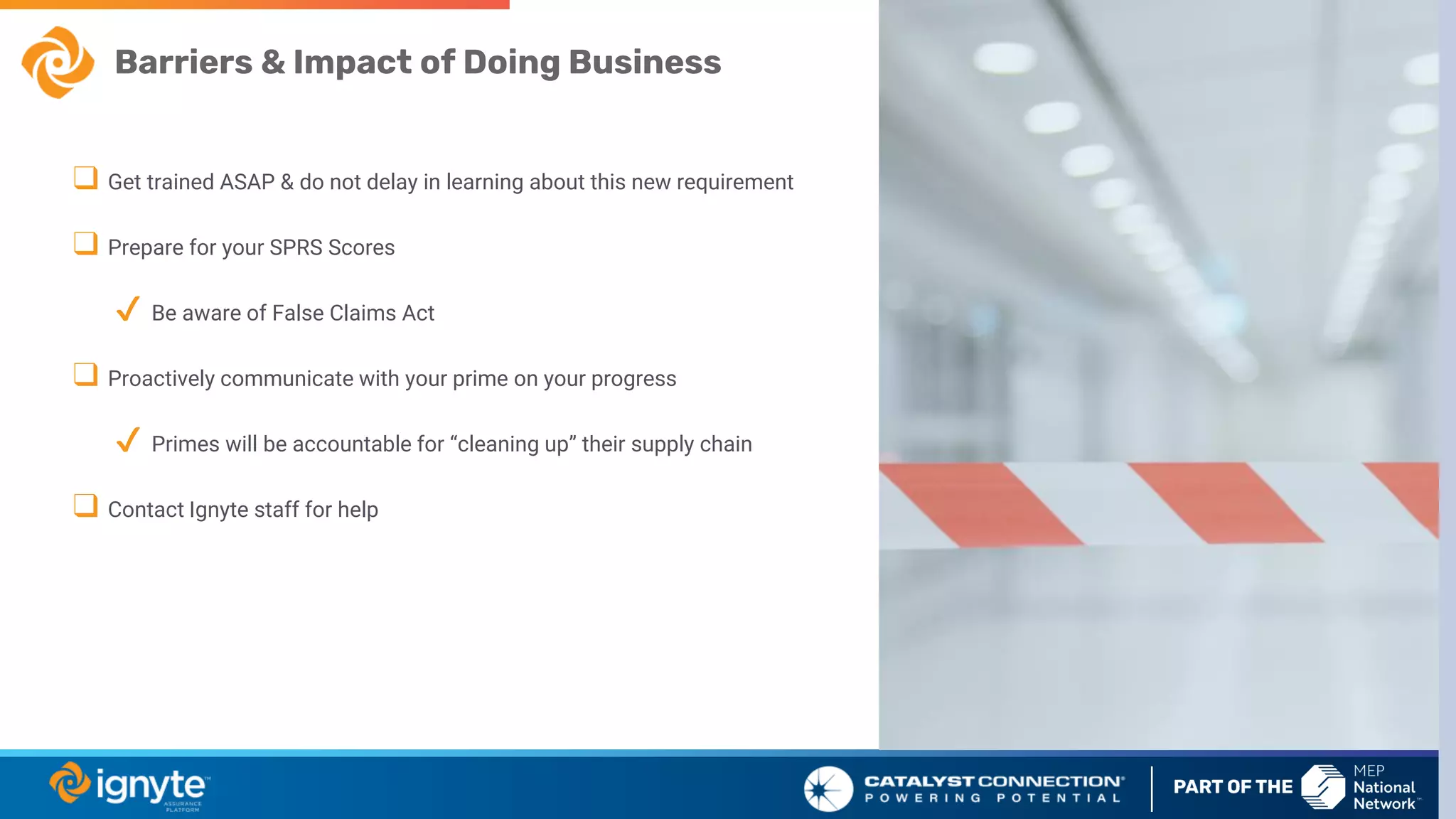
Barriers & Impact of Doing Business
❑ Get trained ASAP & do not delay in learning about this new requirement
❑ Prepare for your SPRS Scores
✔ Be aware of False Claims Act
❑ Proactively communicate with your prime on your progress
✔ Primes will be accountable for “cleaning up” their supply chain
❑ Contact Ignyte staff for help
Modern Approach to Cybersecurity
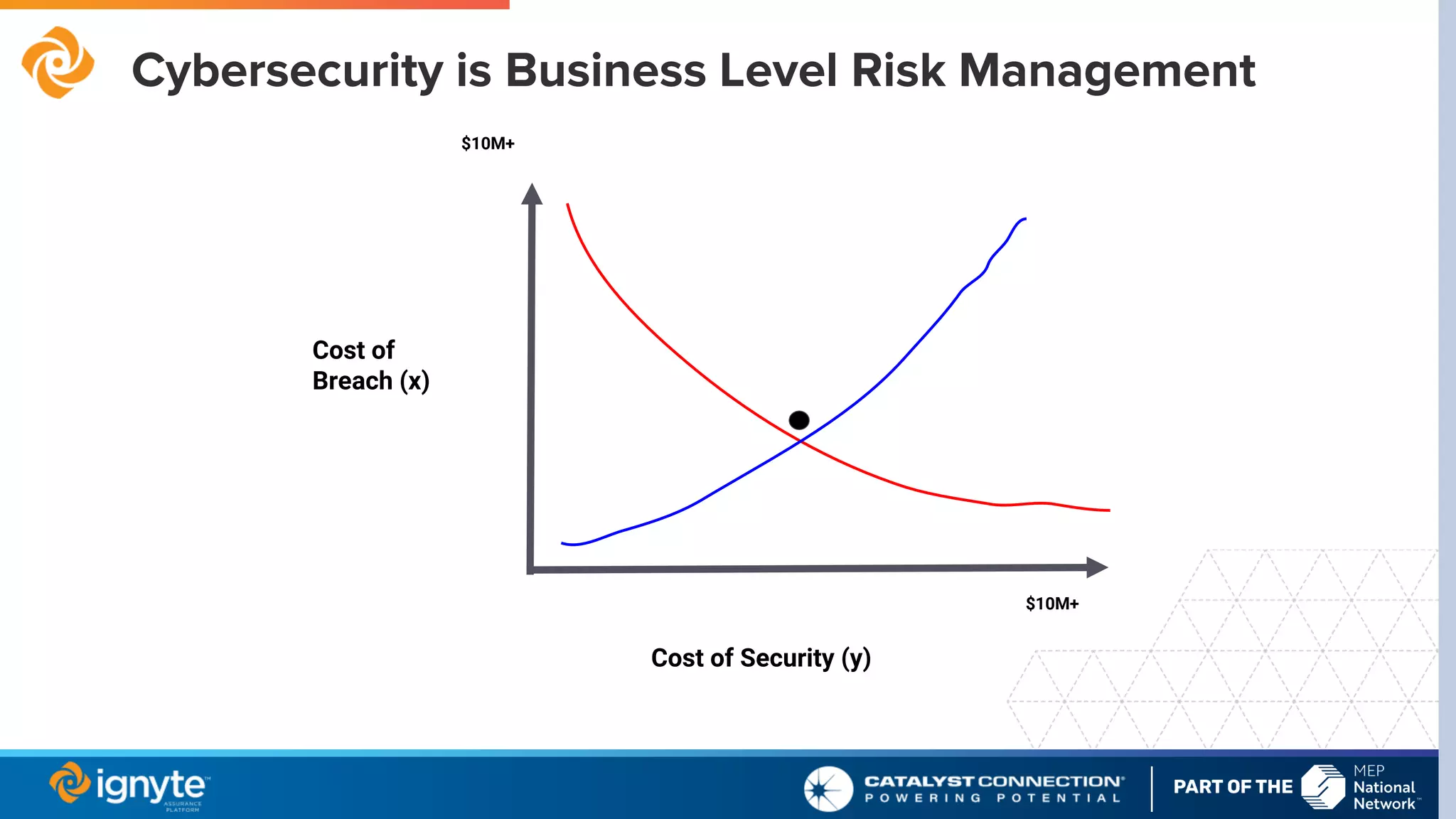
Cybersecurity is Business Level Risk Management
Cost of
Breach (x)
Cost of Security (y)
$10M+
$10M+
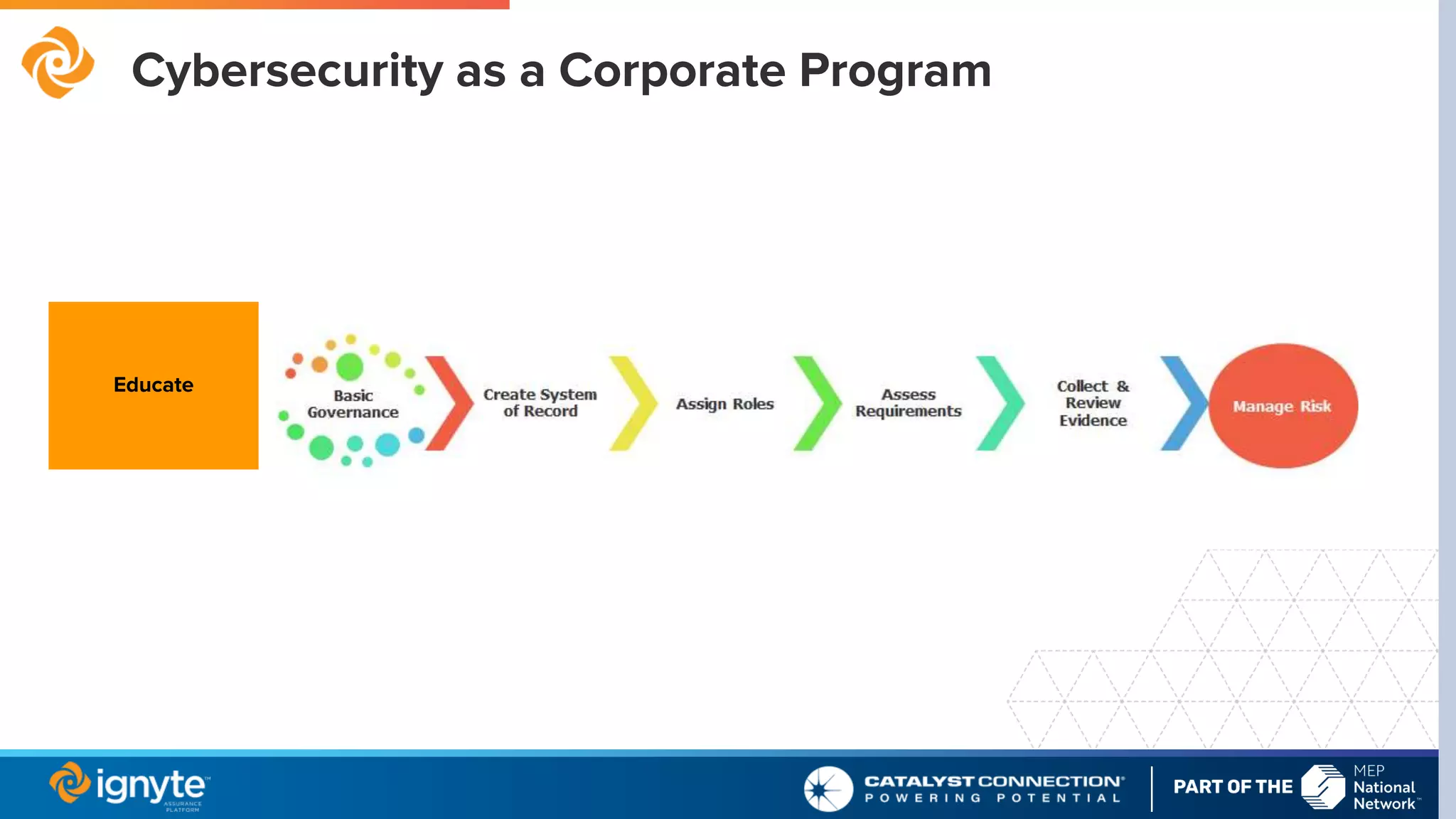
Cybersecurity as a Corporate Program
Educate
4
2
1
3
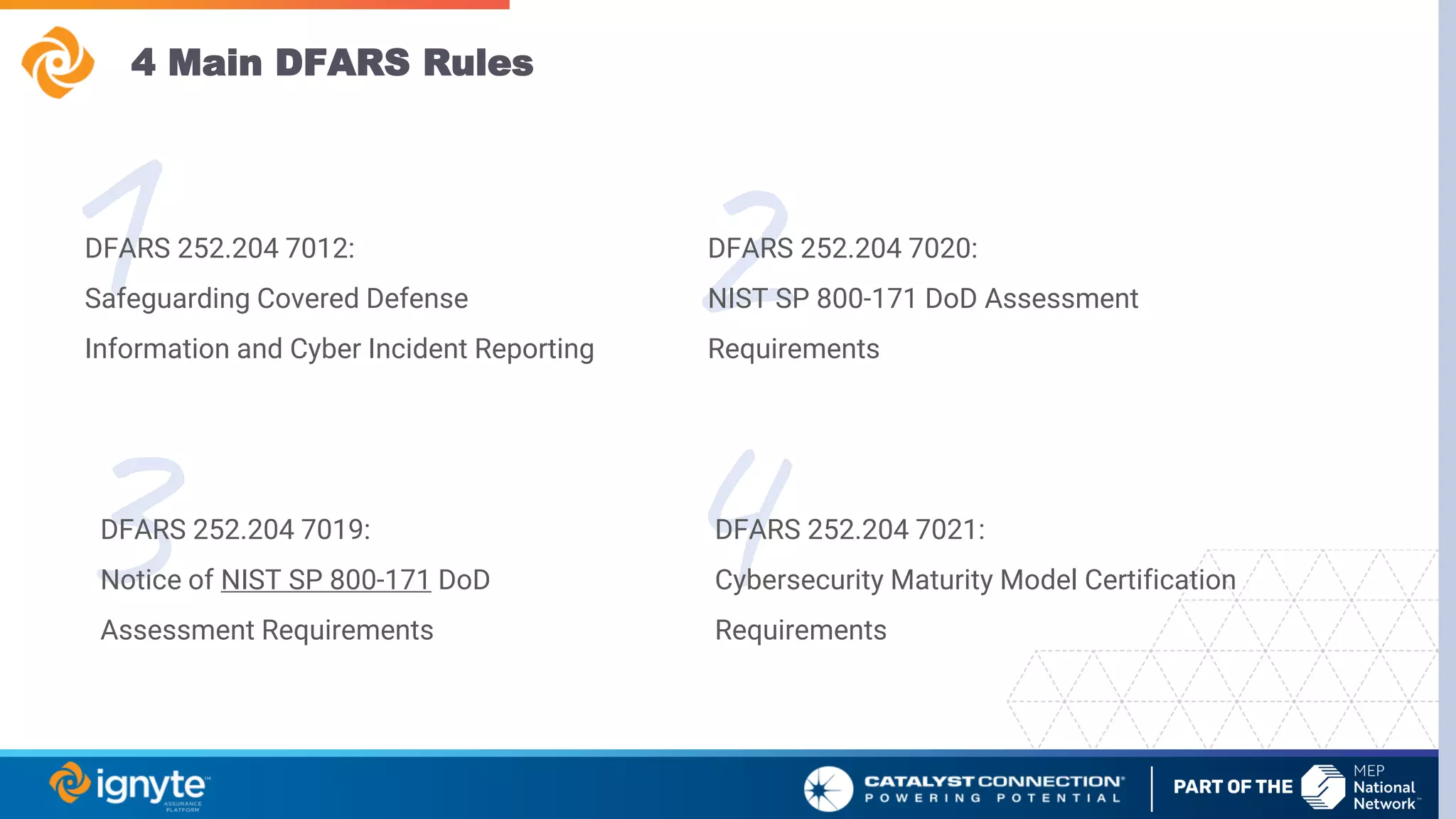
4 Main DFARS Rules
DFARS 252.204 7012:
Safeguarding Covered Defense
Information and Cyber Incident Reporting
DFARS 252.204 7020:
NIST SP 800-171 DoD Assessment
Requirements
DFARS 252.204 7019:
Notice of NIST SP 800-171 DoD
Assessment Requirements
DFARS 252.204 7021:
Cybersecurity Maturity Model Certification
Requirements
• In 2020, the Department of Defense (DoD) is launched the
Cybersecurity Maturity Model Certification framework, developed
to assess and improve the cybersecurity posture of its supply
chain at all tiers.
• The CMMC will help the DoD ensure that all suppliers and
vendors have the appropriate level of cybersecurity practices and
processes to ensure basic cyber hygiene, as well as protect
controlled unclassified information (CUI) that may reside on their
networks.
• This year, 10 – 15 DoD Requests for Information and/or contracts
will be issued with a CMMC requirement. Each contract will
affect 100 – 150 suppliers. Ultimately, the DoD will use the
required CMMC level in its “go / no go” decision related to
vendor consideration and approval.
CMMC: Cybersecurity Maturity
Model Certification
Understanding DFARS, NIST
800-171 and CMMC Relationship
Who needs to be DFARS compliant?
All DoD contractors that process, store or transmit Controlled
Unclassified Information (CUI) must meet DFARS minimum security
standards or risk losing their DoD contracts. Based on NIST Special
Publication 800-171, manufacturers must implement these security
controls through all levels of their supply chain.
Where is DFARS included?
DFARS clause 252.204-7012 is included in all solicitations and
contracts, including those using Federal Acquisition Regulation (FAR)
part 12 commercial item procedures, except for acquisitions solely for
commercially available off- the-shelf (COTS) items. The clause requires
contractors to apply the security requirements of NIST SP 800-171 to
“covered contractor information systems”.
Note: The CMMC was released by the DoD on 31 January 2020. The CMMC Accreditation Body members are working to
produce additional guidance to support the certification path. For now, Ignyte recommends implementing NIST 800-171.
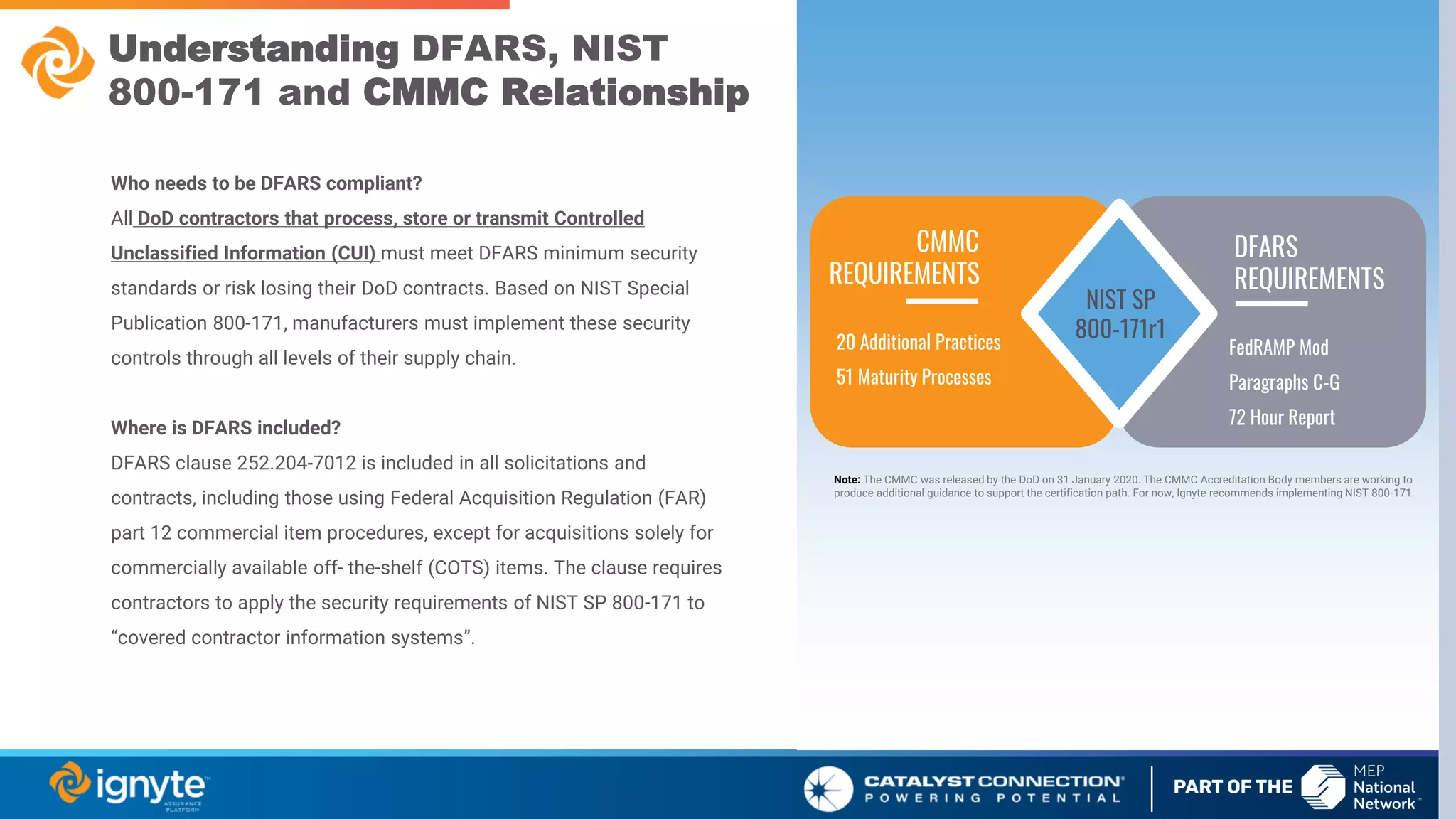
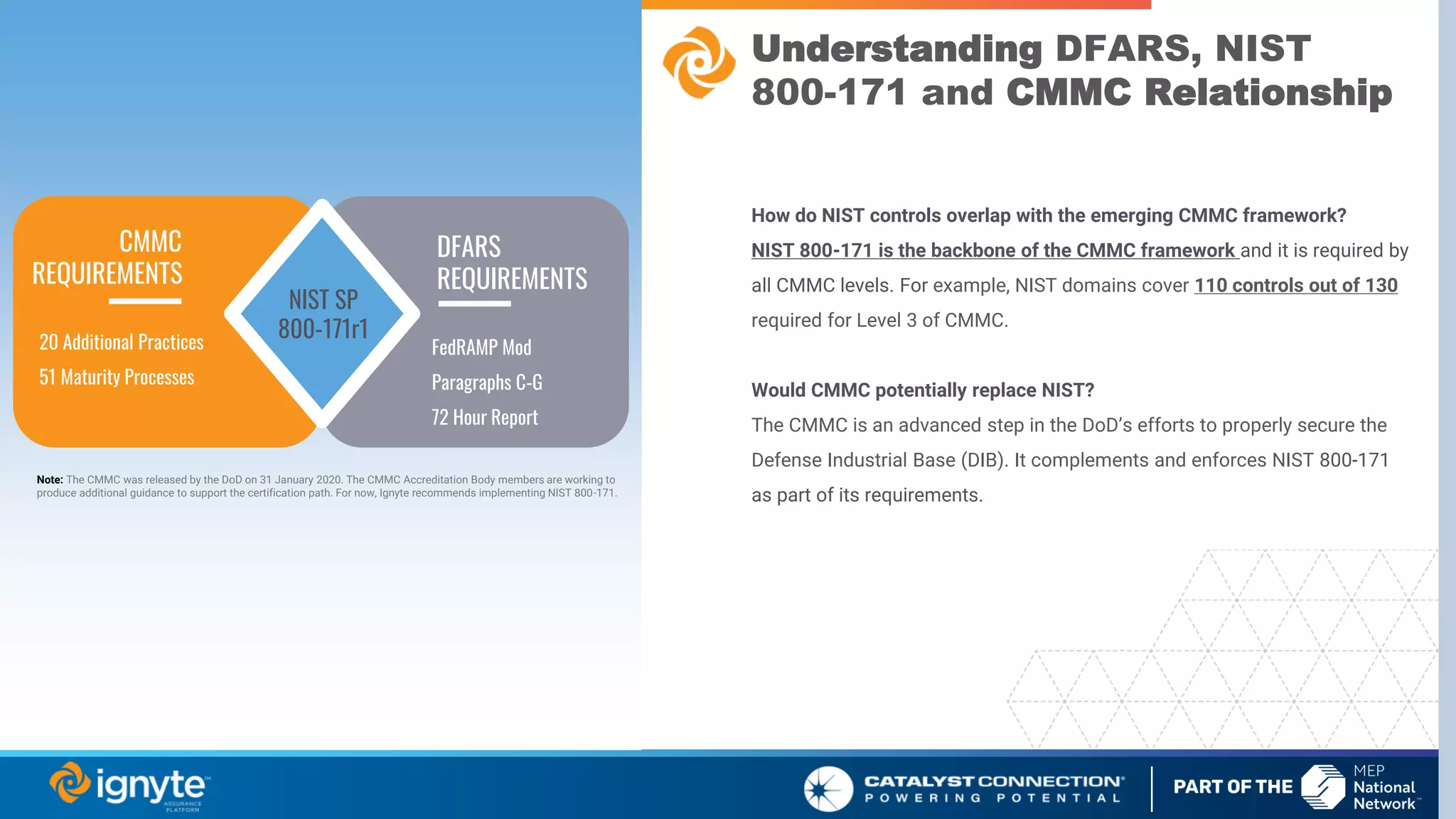
NIST SP
800-171r1
CMMC
REQUIREMENTS
20 Additional Practices
51 Maturity Processes
DFARS
REQUIREMENTS
FedRAMP Mod
Paragraphs C-G
72 Hour Report
Understanding DFARS, NIST
800-171 and CMMC Relationship
How do NIST controls overlap with the emerging CMMC framework?
NIST 800-171 is the backbone of the CMMC framework and it is required by
all CMMC levels. For example, NIST domains cover 110 controls out of 130
required for Level 3 of CMMC.
Would CMMC potentially replace NIST?
The CMMC is an advanced step in the DoD’s efforts to properly secure the
Defense Industrial Base (DIB). It complements and enforces NIST 800-171
as part of its requirements.
Note: The CMMC was released by the DoD on 31 January 2020. The CMMC Accreditation Body members are working to
produce additional guidance to support the certification path. For now, Ignyte recommends implementing NIST 800-171.
NIST SP
800-171r1
CMMC
REQUIREMENTS
20 Additional Practices
51 Maturity Processes
DFARS
REQUIREMENTS
FedRAMP Mod
Paragraphs C-G
72 Hour Report
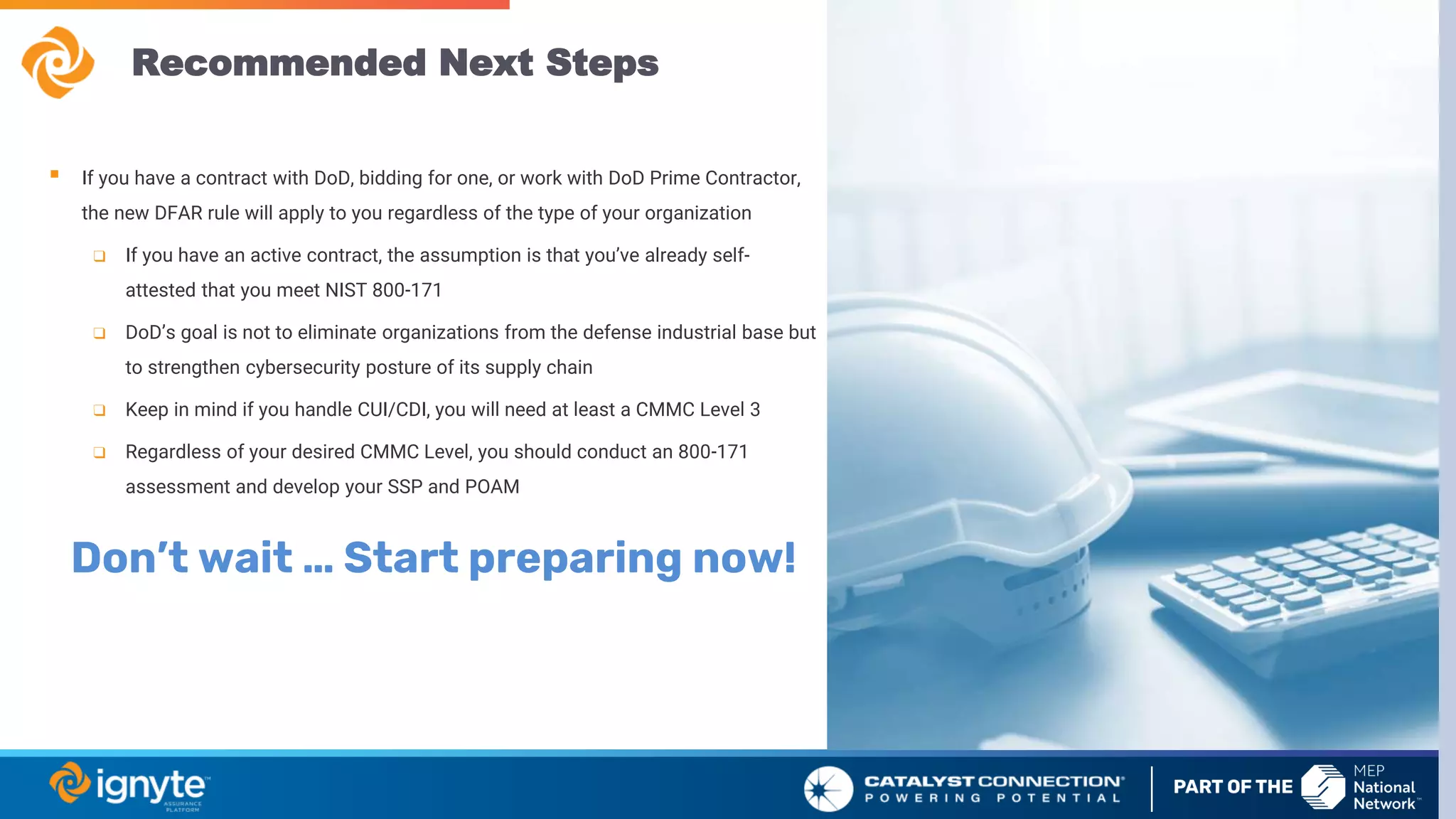
Recommended Next Steps
▪ If you have a contract with DoD, bidding for one, or work with DoD Prime Contractor,
the new DFAR rule will apply to you regardless of the type of your organization
❑ If you have an active contract, the assumption is that you’ve already self-
attested that you meet NIST 800-171
❑ DoD’s goal is not to eliminate organizations from the defense industrial base but
to strengthen cybersecurity posture of its supply chain
❑ Keep in mind if you handle CUI/CDI, you will need at least a CMMC Level 3
❑ Regardless of your desired CMMC Level, you should conduct an 800-171
assessment and develop your SSP and POAM
Don’t wait … Start preparing now!
Why the need for cybersecurity?
How and why threats are
impacting US Manufacturing?
What is new in cybersecurity?
Today’s Lessons Learned
1
2
3
Next Week
Session 2: CMMC Breakdown
What will we talk about?
1. What is Cybersecurity Maturity Model Certification (CMMC)?
2.Levels of CMMC framework and how to determine required level of compliance.
When:
April 21, 2021 at 10:30 AM EST
Where:
Same place. Please register for this webinar series here.
Questions?
Thank you!
Point of Contact
Connie Palucka
Vice President, Consulting
Max Aulakh, MBA, CISSP, PMP
Founder & CEO
Point of Contact
info@ignyteplatform.com cpalucka@catalystconnection.org

Laying the Foundation: The Need for Cybersecurity in U.S. Manufacturing

  • 1.
    WEBINAR SERIES. Part1 24 March 2021 10:30 AM EST Hosted by CATALYST CONNECTION Max Aulakh Founder & CEO Laying the Foundation: The Need for Cybersecurity in U.S. Manufacturing
  • 2.
    Who’s driving thiswebinar? Max Aulakh Founder & CEO About our Speaker C-SUITE DEFENSE & ASSURANCE LEADER S P E C I A L G U E S T As a Data Security and Compliance Leader, he delivers DoD-tested security strategies and compliance that safeguard mission-critical IT operations. Having trained and excelled in The United States Air Force, he maintained and tested the InfoSec and ComSec functions of network hardware, software, and IT infrastructure for global networks — both classified and unclassified. He drove the Information Assurance (IA) programs for the U.S. Department of Defense (DoD). Facilitated by Connie Palucka Vice President, Consulting at Catalyst Connection Connie joined Catalyst Connection in 2005 and brings over 25 years of global sales, business development, and product development experience to her role as the Managing Director of Regional Initiatives. She leads a team that secures and executes grants initiatives to support manufacturers and build the region’s vibrancy. She also works with regional academic institutions, economic development organizations and regional manufacturers to build new capabilities and help make Southwestern Pennsylvania a model for the nation.
  • 3.
    • Webinar 1:Laying the Foundation – The Need for Cybersecurity in U.S. Manufacturing • Webinar 2: DFARS & CMMC Overview • Webinar 3: DFARS NIST 800-171 Compliance Process • Webinar 4: Real Company Examples • Webinar 5: CMMC Breakdown • Session 6: Risk Mitigation 6-Part Webinar Series: CYBER RESILIENCY FOR DEFENSE CONTRACTORS
  • 4.
    Overview • Reasons forCybersecurity • Impact on the US Manufacturing • Modern Approach to Cyber Security
  • 5.
  • 6.
    Small & MediumBusinesses Cyber Resilience Overview The impact of a data breach is disproportionately larger for smaller organizations between 500 and 1,000 employees at an average cost of $2.65 million, or $3,533 per employee. >20 % increase in cyberattacks on SMBs since 2016 60 % of the security risk that organizations face stems from having multiple security vendors and products. 43 % of cyberattacks are aimed at small businesses of small businesses are prepared to defend themselves from cyber attacks. 14 %
  • 7.
    Threats Landscape forSMBs ● 45% SMBs report that their processes are ineffective at mitigating attacks. ● 66% have experienced a cyber attack in the past 12 months. ● 69% admit that cyber attacks are becoming more targeted. The most common types of attacks on SMBs include: ● Phishing/Social Engineering: 57% ● Compromised/Stolen Devices: 33% ● Credential Theft: 30%
  • 8.
    Information Security Spending Globalspending on cybersecurity products and services is predicted to exceed $1 trillion cumulatively over the five-year period from 2017 to 2021. This is a 12-15% year-over-year cybersecurity market growth from 2021. expect cybersecurity budgets to increase in the next three years. was estimated and allocated by the U.S. government for cybersecurity spending in 2021.
  • 9.
    Ransom Attacks Ransomware attacksare growing more than 350% annually. Ransomware attacks are becoming more prevalent as a concern. At the end of 2016, a business fell victim to a ransomware attack every 40 seconds. This is expected to rise to every 11 seconds by 2021, according to a report by Cybersecurity Ventures. Manufacturing companies account for nearly a quarter of all ransomware attacks, followed by the professional services with 17% of attacks, and then government organizations with 13% of attacks. (Security Intelligence) This cyber attack occurs when malicious software is used to restrict access to a computer system or data, until the victim pays ransom requested by the criminal.
  • 10.
    Impact on theUS Manufacturing
  • 11.
    Potential Business Impacts Inadequatesecurity controls leading to internal breach of CUI and FCI. ● Engineering Data & Drawings ● Internal Data Theft Report Cyber Incidents to DoD at http://dibnet.dod.mil within 72 Hours Increasing cost of both Technology & Compliance ● Decrease quality and effectiveness of current technology implementations Potential issues with Prime for not following contract flow down requirement. ● Loss of business revenue 3 Major SMB Impacts 1 3 2
  • 12.
    Supplier Performance RiskSystem & Reports • Cyber Score Submission Required • Scores are based on NIST 800-171 Assessment • SPRS Data is used for Source Selection • Accessible By: o Government Personnel with Need to Know o Contractors (your own data only) • Not Releasable Under Freedom of Information Act (FOIA)
  • 13.
    Product Data Reportingand Evaluation Program (PDREP) automated manual Air Force Contracting Database Information System (J018) - EDA - WAWF - MOCAS - USN/USMC - USAF - Army - DCMA - DLA - GIDEP - USAF - NAVAIR - USMC Aviation Joint Discrepancy Reporting System (JDRS) Contractor Performance Assessment Reporting System (CPARS) - PPIRS-RC - FAPIIS Other (ad hoc) - DLA Contract Data - Award, Delivery, Pricing Quality Data - PQDRs, GIDEP, MIRs, Bulletins, SDRs - Surveys, Lab Reports Material Data - NSNs, application and safety criticality Contract Data - Award, Delivery Quality Data - PQDRs DCMA Supplier Risk System (SRS) Supplier Risk Data - Corrective Action Requests (CARs) - Corrective Action Plans (CAPs) - Program Assessment Reports (PARs) Bureau of Labor Statistics Contract Data - Award, Delivery System for Award Mgt (SAM) DLA - eProcurement - EBS - eProcurement - EBS Price Risk Data - PPI (inflation) Company Data - CAGE codes - Exclusion/debarment - DUNS & MPIN Item Risk Data - DMSMS Supplier Risk Data - performance ratings, testimonials SPRS Supplier Performance Risk System Data Flow DLA
  • 14.
    Barriers & Impactof Doing Business ❑ Get trained ASAP & do not delay in learning about this new requirement ❑ Prepare for your SPRS Scores ✔ Be aware of False Claims Act ❑ Proactively communicate with your prime on your progress ✔ Primes will be accountable for “cleaning up” their supply chain ❑ Contact Ignyte staff for help
  • 15.
    Modern Approach toCybersecurity
  • 16.
    Cybersecurity is BusinessLevel Risk Management Cost of Breach (x) Cost of Security (y) $10M+ $10M+
  • 17.
    Cybersecurity as aCorporate Program Educate
  • 18.
    4 2 1 3 4 Main DFARSRules DFARS 252.204 7012: Safeguarding Covered Defense Information and Cyber Incident Reporting DFARS 252.204 7020: NIST SP 800-171 DoD Assessment Requirements DFARS 252.204 7019: Notice of NIST SP 800-171 DoD Assessment Requirements DFARS 252.204 7021: Cybersecurity Maturity Model Certification Requirements
  • 19.
    • In 2020,the Department of Defense (DoD) is launched the Cybersecurity Maturity Model Certification framework, developed to assess and improve the cybersecurity posture of its supply chain at all tiers. • The CMMC will help the DoD ensure that all suppliers and vendors have the appropriate level of cybersecurity practices and processes to ensure basic cyber hygiene, as well as protect controlled unclassified information (CUI) that may reside on their networks. • This year, 10 – 15 DoD Requests for Information and/or contracts will be issued with a CMMC requirement. Each contract will affect 100 – 150 suppliers. Ultimately, the DoD will use the required CMMC level in its “go / no go” decision related to vendor consideration and approval. CMMC: Cybersecurity Maturity Model Certification
  • 20.
    Understanding DFARS, NIST 800-171and CMMC Relationship Who needs to be DFARS compliant? All DoD contractors that process, store or transmit Controlled Unclassified Information (CUI) must meet DFARS minimum security standards or risk losing their DoD contracts. Based on NIST Special Publication 800-171, manufacturers must implement these security controls through all levels of their supply chain. Where is DFARS included? DFARS clause 252.204-7012 is included in all solicitations and contracts, including those using Federal Acquisition Regulation (FAR) part 12 commercial item procedures, except for acquisitions solely for commercially available off- the-shelf (COTS) items. The clause requires contractors to apply the security requirements of NIST SP 800-171 to “covered contractor information systems”. Note: The CMMC was released by the DoD on 31 January 2020. The CMMC Accreditation Body members are working to produce additional guidance to support the certification path. For now, Ignyte recommends implementing NIST 800-171. NIST SP 800-171r1 CMMC REQUIREMENTS 20 Additional Practices 51 Maturity Processes DFARS REQUIREMENTS FedRAMP Mod Paragraphs C-G 72 Hour Report
  • 21.
    Understanding DFARS, NIST 800-171and CMMC Relationship How do NIST controls overlap with the emerging CMMC framework? NIST 800-171 is the backbone of the CMMC framework and it is required by all CMMC levels. For example, NIST domains cover 110 controls out of 130 required for Level 3 of CMMC. Would CMMC potentially replace NIST? The CMMC is an advanced step in the DoD’s efforts to properly secure the Defense Industrial Base (DIB). It complements and enforces NIST 800-171 as part of its requirements. Note: The CMMC was released by the DoD on 31 January 2020. The CMMC Accreditation Body members are working to produce additional guidance to support the certification path. For now, Ignyte recommends implementing NIST 800-171. NIST SP 800-171r1 CMMC REQUIREMENTS 20 Additional Practices 51 Maturity Processes DFARS REQUIREMENTS FedRAMP Mod Paragraphs C-G 72 Hour Report
  • 22.
    Recommended Next Steps ▪If you have a contract with DoD, bidding for one, or work with DoD Prime Contractor, the new DFAR rule will apply to you regardless of the type of your organization ❑ If you have an active contract, the assumption is that you’ve already self- attested that you meet NIST 800-171 ❑ DoD’s goal is not to eliminate organizations from the defense industrial base but to strengthen cybersecurity posture of its supply chain ❑ Keep in mind if you handle CUI/CDI, you will need at least a CMMC Level 3 ❑ Regardless of your desired CMMC Level, you should conduct an 800-171 assessment and develop your SSP and POAM Don’t wait … Start preparing now!
  • 23.
    Why the needfor cybersecurity? How and why threats are impacting US Manufacturing? What is new in cybersecurity? Today’s Lessons Learned 1 2 3
  • 24.
  • 25.
    Session 2: CMMCBreakdown What will we talk about? 1. What is Cybersecurity Maturity Model Certification (CMMC)? 2.Levels of CMMC framework and how to determine required level of compliance. When: April 21, 2021 at 10:30 AM EST Where: Same place. Please register for this webinar series here.
  • 26.
    Questions? Thank you! Point ofContact Connie Palucka Vice President, Consulting Max Aulakh, MBA, CISSP, PMP Founder & CEO Point of Contact info@ignyteplatform.com cpalucka@catalystconnection.org