ASSIGNMENT ON
CULTIVATION PRACTICES OF
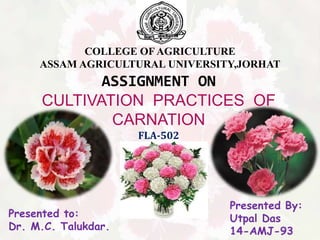
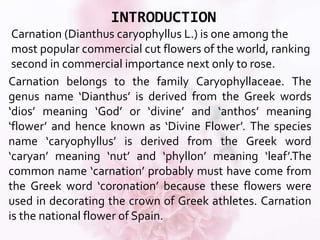
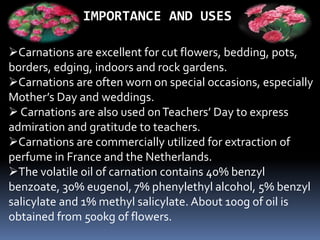
CARNATION
FLA-502
COLLEGE OFAGRICULTURE
ASSAM AGRICULTURAL UNIVERSITY,JORHAT
Presented to:
Dr. M.C. Talukdar.
Presented By:
Utpal Das
14-AMJ-93
INTRODUCTION
Carnation (Dianthus caryophyllus L.) is one among the
most popular commercial cut flowers of the world, ranking
second in commercial importance next only to rose.
Carnation belongs to the family Caryophyllaceae. The
genus name ‘Dianthus’ is derived from the Greek words
‘dios’ meaning ‘God’ or ‘divine’ and ‘anthos’ meaning
‘flower’ and hence known as ‘Divine Flower’. The species
name ‘caryophyllus’ is derived from the Greek word
‘caryan’ meaning ‘nut’ and ‘phyllon’ meaning ‘leaf’.The
common name ‘carnation’ probably must have come from
the Greek word ‘coronation’ because these flowers were
used in decorating the crown of Greek athletes. Carnation
is the national flower of Spain.
IMPORTANCE AND USES
Carnations are excellent for cut flowers, bedding, pots,
borders, edging, indoors and rock gardens.
Carnations are often worn on special occasions, especially
Mother’s Day and weddings.
 Carnations are also used onTeachers’ Day to express
admiration and gratitude to teachers.
Carnations are commercially utilized for extraction of
perfume in France and the Netherlands.
The volatile oil of carnation contains 40% benzyl
benzoate, 30% eugenol, 7% phenylethyl alcohol, 5% benzyl
salicylate and 1% methyl salicylate. About 100g of oil is
obtained from 500kg of flowers.
TherearethreemaintypesofgardenCarnation.
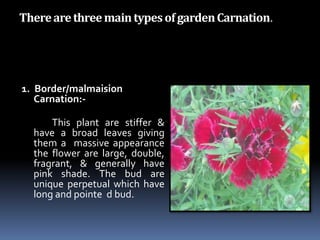
1. Border/malmaision
Carnation:-
This plant are stiffer &
have a broad leaves giving
them a massive appearance
the flower are large, double,
fragrant, & generally have
pink shade. The bud are
unique perpetual which have
long and pointe d bud.
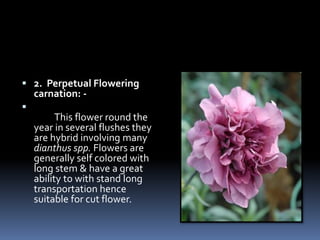
 2. Perpetual Flowering
carnation: -

This flower round the
year in several flushes they
are hybrid involving many
dianthus spp. Flowers are
generally self colored with
long stem & have a great
ability to with stand long
transportation hence
suitable for cut flower.
 3. Marguerite or Chabud:-

This annual carnation
have clove cented. Single
or double flower that
reproduce from seeds the
blooms are large with
fringed with petals, which
do not last very long after
harvest but flowers freely
for a large period & are
comperatively easier to
cultivate.
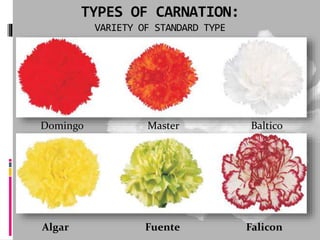
TYPES OF CARNATION:
VARIETY OF STANDARD TYPE
Domingo Master Baltico
Algar Fuente Falicon
VARIETY OF SPRAY TYPE
Aveiro Fancy Fuego Osiris
Celebration Abril Belen
SOIL
Sandy loam soils rich in organic matter
content with pH of 5.5-6.5 are most ideal for
carnation cultivation.
soil must be well drained because the crop is
highly susceptible to fusarium wilt.
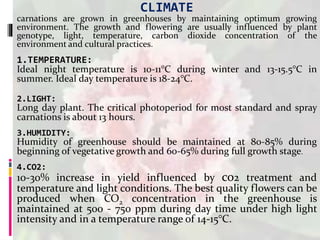
CLIMATE
carnations are grown in greenhouses by maintaining optimum growing
environment. The growth and flowering are usually influenced by plant
genotype, light, temperature, carbon dioxide concentration of the
environment and cultural practices.
1.TEMPERATURE:
Ideal night temperature is 10-11°C during winter and 13-15.5°C in
summer. Ideal day temperature is 18-24°C.
2.LIGHT:
Long day plant. The critical photoperiod for most standard and spray
carnations is about 13 hours.
3.HUMIDITY:
Humidity of greenhouse should be maintained at 80-85% during
beginning of vegetative growth and 60-65% during full growth stage.
4.CO2:
10-30% increase in yield influenced by co2 treatment and
temperature and light conditions. The best quality flowers can be
produced when CO2 concentration in the greenhouse is
maintained at 500 - 750 ppm during day time under high light
intensity and in a temperature range of 14-15°C.
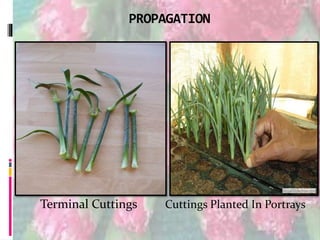
PROPAGATION
Terminal Cuttings Cuttings Planted In Portrays
Rooting of cuttings in protrays Rooted cuttings
BED PREPARATION
Basal fertilizer application Beds ready for planting
 The ideal bed width and height are 75 -100 cm and 30 - 45 cm
respectively. The bed length should not exceed 25 m. A path
width of 45 - 50 cm is ideal.
PLANTING
25 days old rooted cuttings Planting
Spacing : 15cm x 10cm / 15cm x 15cm / 15cm x 20cm
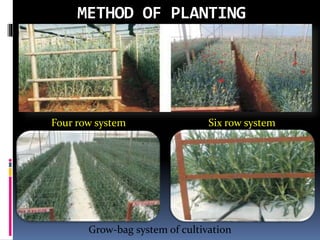
METHOD OF PLANTING
Four row system Six row system
Grow-bag system of cultivation
NUTRIENT MANAGEMENT
 Nitrogen 250g, P2o5 80g,
k2O200g, Ca 125g and Mg 40g
/m2/year in 20-40 splits at
fortnight intervals after three
weeks after planting , gives
quality flowers.
Applications of N (80-200ppm)
and K2O(200ppm) as fertigation
solution @200 liters
water/1000m2 area resulted in
better plant growth and flower
production.
WATER MANAGEMENT
Spraying of water through misting has to be
done for at least two weeks.
After 3 weeks of planting, drip irrigation has to
be adopted.
SPECIAL OPERATION
PINCHING
Single pinching in standard carnation
Pinch and a half (2 + 4 laterals) Pinch and a half (2 + 6 laterals)
Double pinch (8 laterals) Double pinch (16 laterals)
DISBUDDING
Removal of axillary/ lateral buds
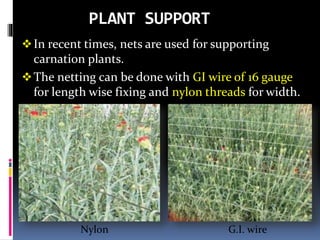
PLANT SUPPORT
In recent times, nets are used for supporting
carnation plants.
The netting can be done with GI wire of 16 gauge
for length wise fixing and nylon threads for width.
Nylon G.I. wire
PLANT PROTECTION
a.Pestmanagement
1.Red Spider Mite:-
Suck the sap, affected leaves turns pale and withered and
shows severe webbing. affected plants becomes stunted and
distorted.
Spray Dicofol @ 2 ml/l or Wettable sulphur @ 5g/lt.
Mite colony Nymphs and eggs Adult mite
2.Aphids:-
Suck the sap from the leaves of growing
plants leading to reduce plant vigour.
also transmit carnation ring spot and
carnation mosaic viruses.
Spraying the plants with
Thiomethoxam 1 ml/l or Imidacloprid
17.8 SL 0.1 g/l tr. Aphid
3.Thrips:-
Suck the sap from the leaves, causing
them to turn yellow and then patchy
white, often with black specks and
slight wrinkling.
Spray Dimethoate 30 EC @ 1
ml/l or Fenitrothion 50 EC @ 3.5 ml/l
Thrips infested flower
4.Bud Borer:-
Larvae feed on leaves, flower buds
and flowers.
Spray Novaluron @ 3 ml/lit
or Indoxacarp 14.5 SL @
1 ml /l or Fenitrothion 50 EC at
1.5ml/hl.
5.Nematodes:-
Nematodes cause reduced root
system, stunted shoot
growth and reduction in the number
of blooms.
Apply Furadan, Aldicarp or
Nemaphos @ 10gm/m2
A larva feeding on
flower bud
Infested root
B. Disease management
1.Fusarium wilt :-
Affected plants show foliage wilting, Rotting of the stem
below ground level .
Drenching the soil with Benomyl (0.1%) or Ridomil (0.2%)
. Biological control with Bacillus subtilis, Streptomyces sp,
Trichoderma viride and Pseudomonas fluorescens
Fusarium wilt affected plants Rotting of stem
3.Stem & Root rot:-
Show withering and yellowing of
foliage, leaf death, external
browning of stems and internal
browning at nodes.
Drenching with Benomyl
@ 2.5g/lit
2.Alternaria leaf spot:-
Pathogen causes spots on the
leaves and stems and the affected
leaves wither and die prematurely.
Foliar application of
Dithane M-45 @ 0.2% or
Carbendazim @ 0.1% controls the
disease.
Leaf spot In leaves & In flower bud
Phytopthora stem rot
4.Grey Mold:-
Affects the petals. Initially a wet
tan coloured blotch develops on
petal tips which spread rapidly to
produce a fluffy grey mould.
Benlate @ 0.1% controls
this disease.
5.Bacterial wilt
6.Bud rot
7.Rust
8.Black spot
Black spot
Grey mould
c. Physiological Disorders
1.Calyx Splitting:-
Irregular or fluctuating temperature
Closer spacing
low boron levels enhance calyx splitting
Spray borax @ 0.1% and place a rubber band around
the calyx of the flower which has started opening.
HARVESTING & YIELD:
Standard type flower harvested when their outer petals starts
to elongate outside calyx (paint brush stage).
 Spray type flower harvested with 2-3 open flowers on each
stem.
Standard type : 300-350 flowers/m2(8 -12 flowers/plant)
Spray type: 250 flowers/m2
Harvesting stage of Standard carnation and Spray carnation
POST HARVEST TECHNOLOGY
Stripping Bunching Packing
Harvesting Grading
PACKING
THANK YOU…

Carnation

  • 1.
    ASSIGNMENT ON CULTIVATION PRACTICESOF CARNATION FLA-502 COLLEGE OFAGRICULTURE ASSAM AGRICULTURAL UNIVERSITY,JORHAT Presented to: Dr. M.C. Talukdar. Presented By: Utpal Das 14-AMJ-93
  • 2.
    INTRODUCTION Carnation (Dianthus caryophyllusL.) is one among the most popular commercial cut flowers of the world, ranking second in commercial importance next only to rose. Carnation belongs to the family Caryophyllaceae. The genus name ‘Dianthus’ is derived from the Greek words ‘dios’ meaning ‘God’ or ‘divine’ and ‘anthos’ meaning ‘flower’ and hence known as ‘Divine Flower’. The species name ‘caryophyllus’ is derived from the Greek word ‘caryan’ meaning ‘nut’ and ‘phyllon’ meaning ‘leaf’.The common name ‘carnation’ probably must have come from the Greek word ‘coronation’ because these flowers were used in decorating the crown of Greek athletes. Carnation is the national flower of Spain.
  • 3.
    IMPORTANCE AND USES Carnationsare excellent for cut flowers, bedding, pots, borders, edging, indoors and rock gardens. Carnations are often worn on special occasions, especially Mother’s Day and weddings.  Carnations are also used onTeachers’ Day to express admiration and gratitude to teachers. Carnations are commercially utilized for extraction of perfume in France and the Netherlands. The volatile oil of carnation contains 40% benzyl benzoate, 30% eugenol, 7% phenylethyl alcohol, 5% benzyl salicylate and 1% methyl salicylate. About 100g of oil is obtained from 500kg of flowers.
  • 4.
    TherearethreemaintypesofgardenCarnation. 1. Border/malmaision Carnation:- This plantare stiffer & have a broad leaves giving them a massive appearance the flower are large, double, fragrant, & generally have pink shade. The bud are unique perpetual which have long and pointe d bud.
  • 5.
     2. PerpetualFlowering carnation: -  This flower round the year in several flushes they are hybrid involving many dianthus spp. Flowers are generally self colored with long stem & have a great ability to with stand long transportation hence suitable for cut flower.
  • 6.
     3. Margueriteor Chabud:-  This annual carnation have clove cented. Single or double flower that reproduce from seeds the blooms are large with fringed with petals, which do not last very long after harvest but flowers freely for a large period & are comperatively easier to cultivate.
  • 7.
    TYPES OF CARNATION: VARIETYOF STANDARD TYPE Domingo Master Baltico Algar Fuente Falicon
  • 8.
    VARIETY OF SPRAYTYPE Aveiro Fancy Fuego Osiris Celebration Abril Belen
  • 9.
    SOIL Sandy loam soilsrich in organic matter content with pH of 5.5-6.5 are most ideal for carnation cultivation. soil must be well drained because the crop is highly susceptible to fusarium wilt.
  • 10.
    CLIMATE carnations are grownin greenhouses by maintaining optimum growing environment. The growth and flowering are usually influenced by plant genotype, light, temperature, carbon dioxide concentration of the environment and cultural practices. 1.TEMPERATURE: Ideal night temperature is 10-11°C during winter and 13-15.5°C in summer. Ideal day temperature is 18-24°C. 2.LIGHT: Long day plant. The critical photoperiod for most standard and spray carnations is about 13 hours. 3.HUMIDITY: Humidity of greenhouse should be maintained at 80-85% during beginning of vegetative growth and 60-65% during full growth stage. 4.CO2: 10-30% increase in yield influenced by co2 treatment and temperature and light conditions. The best quality flowers can be produced when CO2 concentration in the greenhouse is maintained at 500 - 750 ppm during day time under high light intensity and in a temperature range of 14-15°C.
  • 11.
  • 12.
    Rooting of cuttingsin protrays Rooted cuttings
  • 13.
    BED PREPARATION Basal fertilizerapplication Beds ready for planting  The ideal bed width and height are 75 -100 cm and 30 - 45 cm respectively. The bed length should not exceed 25 m. A path width of 45 - 50 cm is ideal.
  • 14.
    PLANTING 25 days oldrooted cuttings Planting Spacing : 15cm x 10cm / 15cm x 15cm / 15cm x 20cm
  • 15.
    METHOD OF PLANTING Fourrow system Six row system Grow-bag system of cultivation
  • 16.
    NUTRIENT MANAGEMENT  Nitrogen250g, P2o5 80g, k2O200g, Ca 125g and Mg 40g /m2/year in 20-40 splits at fortnight intervals after three weeks after planting , gives quality flowers. Applications of N (80-200ppm) and K2O(200ppm) as fertigation solution @200 liters water/1000m2 area resulted in better plant growth and flower production.
  • 17.
    WATER MANAGEMENT Spraying ofwater through misting has to be done for at least two weeks. After 3 weeks of planting, drip irrigation has to be adopted.
  • 18.
  • 19.
    Pinch and ahalf (2 + 4 laterals) Pinch and a half (2 + 6 laterals) Double pinch (8 laterals) Double pinch (16 laterals)
  • 20.
  • 21.
    PLANT SUPPORT In recenttimes, nets are used for supporting carnation plants. The netting can be done with GI wire of 16 gauge for length wise fixing and nylon threads for width. Nylon G.I. wire
  • 22.
    PLANT PROTECTION a.Pestmanagement 1.Red SpiderMite:- Suck the sap, affected leaves turns pale and withered and shows severe webbing. affected plants becomes stunted and distorted. Spray Dicofol @ 2 ml/l or Wettable sulphur @ 5g/lt. Mite colony Nymphs and eggs Adult mite
  • 23.
    2.Aphids:- Suck the sapfrom the leaves of growing plants leading to reduce plant vigour. also transmit carnation ring spot and carnation mosaic viruses. Spraying the plants with Thiomethoxam 1 ml/l or Imidacloprid 17.8 SL 0.1 g/l tr. Aphid 3.Thrips:- Suck the sap from the leaves, causing them to turn yellow and then patchy white, often with black specks and slight wrinkling. Spray Dimethoate 30 EC @ 1 ml/l or Fenitrothion 50 EC @ 3.5 ml/l Thrips infested flower
  • 24.
    4.Bud Borer:- Larvae feedon leaves, flower buds and flowers. Spray Novaluron @ 3 ml/lit or Indoxacarp 14.5 SL @ 1 ml /l or Fenitrothion 50 EC at 1.5ml/hl. 5.Nematodes:- Nematodes cause reduced root system, stunted shoot growth and reduction in the number of blooms. Apply Furadan, Aldicarp or Nemaphos @ 10gm/m2 A larva feeding on flower bud Infested root
  • 25.
    B. Disease management 1.Fusariumwilt :- Affected plants show foliage wilting, Rotting of the stem below ground level . Drenching the soil with Benomyl (0.1%) or Ridomil (0.2%) . Biological control with Bacillus subtilis, Streptomyces sp, Trichoderma viride and Pseudomonas fluorescens Fusarium wilt affected plants Rotting of stem
  • 26.
    3.Stem & Rootrot:- Show withering and yellowing of foliage, leaf death, external browning of stems and internal browning at nodes. Drenching with Benomyl @ 2.5g/lit 2.Alternaria leaf spot:- Pathogen causes spots on the leaves and stems and the affected leaves wither and die prematurely. Foliar application of Dithane M-45 @ 0.2% or Carbendazim @ 0.1% controls the disease. Leaf spot In leaves & In flower bud Phytopthora stem rot
  • 27.
    4.Grey Mold:- Affects thepetals. Initially a wet tan coloured blotch develops on petal tips which spread rapidly to produce a fluffy grey mould. Benlate @ 0.1% controls this disease. 5.Bacterial wilt 6.Bud rot 7.Rust 8.Black spot Black spot Grey mould
  • 28.
    c. Physiological Disorders 1.CalyxSplitting:- Irregular or fluctuating temperature Closer spacing low boron levels enhance calyx splitting Spray borax @ 0.1% and place a rubber band around the calyx of the flower which has started opening.
  • 29.
    HARVESTING & YIELD: Standardtype flower harvested when their outer petals starts to elongate outside calyx (paint brush stage).  Spray type flower harvested with 2-3 open flowers on each stem. Standard type : 300-350 flowers/m2(8 -12 flowers/plant) Spray type: 250 flowers/m2 Harvesting stage of Standard carnation and Spray carnation
  • 30.
    POST HARVEST TECHNOLOGY StrippingBunching Packing Harvesting Grading
  • 31.
  • 33.