Anthurium
CONTENTS
1. INTRODUCTION
2. CHARACTERISTICS
3. SCIENTIFIC CLASSIFICATION
4. STRUCTURE OF ANTHURIUM
5. SOME KNOWLEDGE ABOUT FLOWER
6. CULTIVATION AND VARIETIES
7.USE OF ANTHURIUMS
8. ORIGIN
9.DISTRIBUTION
10. BOTANICAL DESCRIPTION
11. CLIMATE
12. PROPAGATION
13. LAND PREPARATION
14. MANURE
15.FERTILIZER
16. PLANTING
17. IRRIGATION
18. CULTURAL OPERATION
19. PLANT GROWTH REGUL
20. DISEASE
21. PESTS
22. PHYSIOLOGICAL DISORDERS
23. HARVESTING
24. POST HARVEST HANDLING
25. PACKAGING
26. STORAGE
27. GRADING
28. REFERENCES
INTRODUCTION
• Anthurium is originated in South America
(Columbia).
• It is used as cut flower, potted flowering and foliage
plant as well as for flower arrangements.
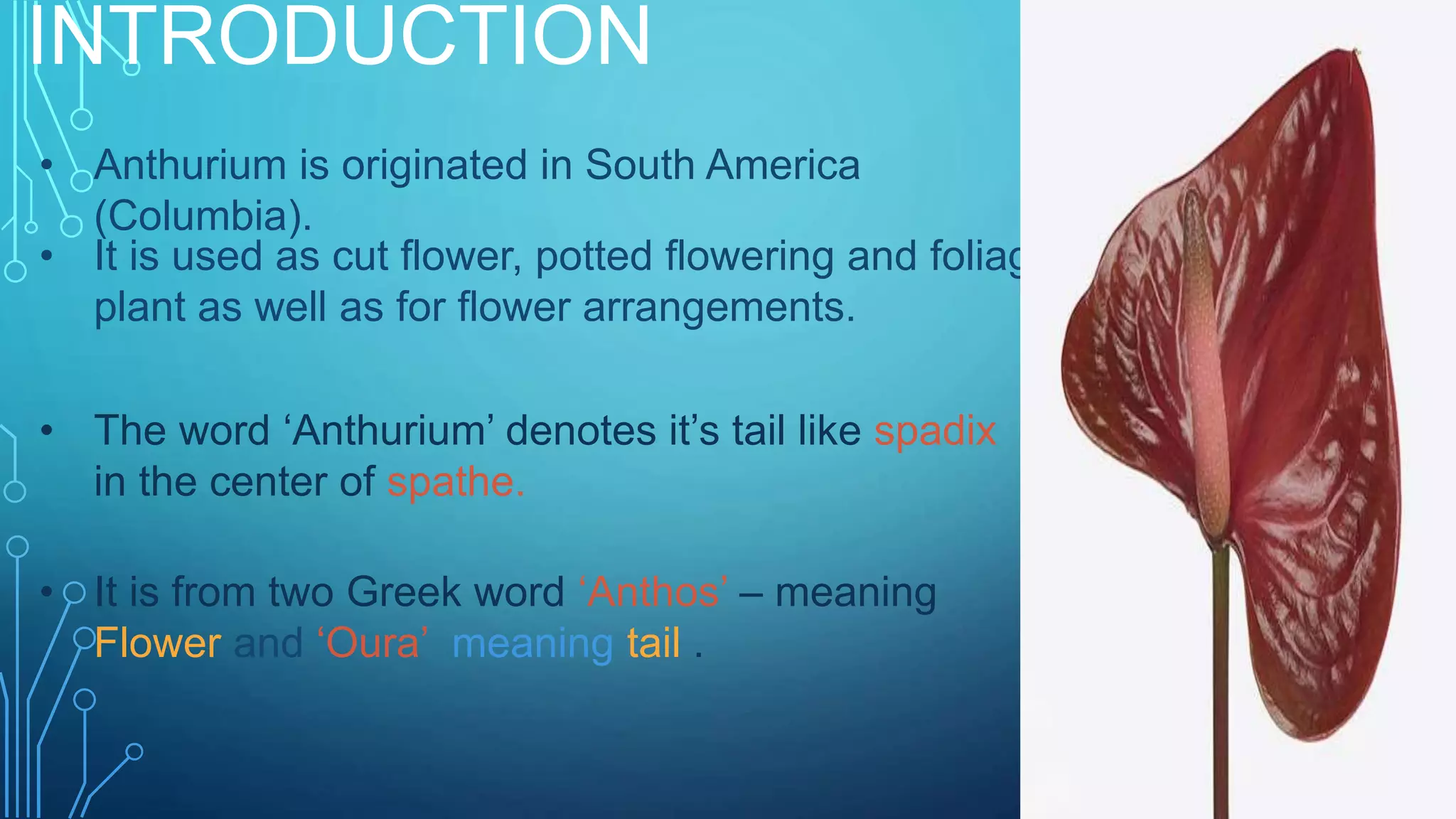
• The word ‘Anthurium’ denotes it’s tail like spadix
in the center of spathe.
• It is from two Greek word ‘Anthos’ – meaning
Flower and ‘Oura’ meaning tail .
• World trade is 2nd I.e just next to orchid’s
among the tropical Flowers.
• Cut flower are mainly produced at Coorg
in Karnataka, Kerala,Yercurd in Tamil
Nadu.
• Since the mid 1980’s its popularity has
increased dramatically and has now become a
popular addition to many foliage growers.
CHARACTERIST
ICS• Anthurium are semi – terrestrial and
perennial plants with creeping arborescent
stem .
• It is herbaceous plants.
• Leaves are large, carried on long
petioles and have a heart shaped
appearance.
• They are shiny and dark green with
tender leaves varying in colour from light
green to deep reddish brown.
• Anthurium blooms throughout the year,
one bloom arising from the axil of every
leaf.
• Ovary is 2 – celled with 1-2 ovules
and fruit are berry.
• The fruits develop from the flower on the
spadix.
• They juicy Barrie’s varying in colour,
usually containing two seeds.
• It is also known as Flamingo flower or
Flamingo lily, Tail flower,Laceleaf.
• It is a slow grower production only 8
leaves a year.
It is the National flower of Mauritius .
• The economic life span of anthurium is
around 6-8 years.
• The basic chromosome number of
anthurium is n= 15 and 16, 22.
• Commercial propagated micro propagation and
other method by cutting ,seed,division .
• Resistant to common disease and pests.
SCIENTIFIC
CLASSIFICATION
• Genus – Anthurium
schott• Species – About (1000) species
• Botanical Name – Anthurium
spp.• Family - Araceae
Anthurium spp
STRUCTURE OF ANTHURIUM
SOME KNOWLEDGE
ABOUT FLOWER
CULTIVATION/VARITIES
• The genus Anthurium consists
of 500-600 known species.
• But only three species are
suitable for cultivation.
• Anthurium andreanum
• A. scherzerianum
• A. crystallinum
Anthurium andreanum
• It has got wide range of colours from
white to deep red and is mainly due to
the hybridisation among the following
species.
• Anthurium andreanum
• Anthurium lindenianum
• Anthurium ornatum and Anthurium
nymphaefolium
• Anthurium scherzerianum
• It is native of Costa Rica and is known as “Flamingo
Flower” .• Floral axis is peculiar ly ( I.e. candle)
curved.
• It requires low temperature and is popular as a pot
plant.
OTHER SPECIES
NAME
• Anthurium crystallinum
• A. aemulum
• A. amnicola
• A. andicola
• A. grandifolium
• A. pentaphyllum
• A. hygrophyilum
• A. spathiphyllum
• A. clarinervium
VARIETY
USE OF ANTHURIUM
FLOWERS• Wedding decoration
• Event management – Birthday
Anniversary• Government sponsored conference
• Visit of VIP'S
• Corporate office decoration
• Star Hotels
• Home decoration
ORIGIN
• Anthurium is the native to the Colombia,
Peru,Central and South Africa.
• Most anthurium species are native of tropical rain
forest and are primarily epiphytic in nature.
DISTRIBUTION
• In Malaysia, anthurium is mostly grown
in Pahang (Cameron highlands)
• The Netherlands is the chief supplier
of anthurium in the Europe market.
• Hawaii covers 60% exports share of
Japan and rest of the west coast of the
USA.• Mauritius is one the important producer
of anthurium and it exports to Japan and
Italy.
• In India, anthurium is commercial grown in Kerala,
Karnataka, Tamil Nadu,West Bengal, Maharashtra, and
north east India.• Kerala is identified as the most desirable place for
growing anthurium.
BOTANICAL
DESCRIPTION• It is herbaceous,semi terrestrial and perennial.
• It is a slow grower producing only 8 leaves a
year.
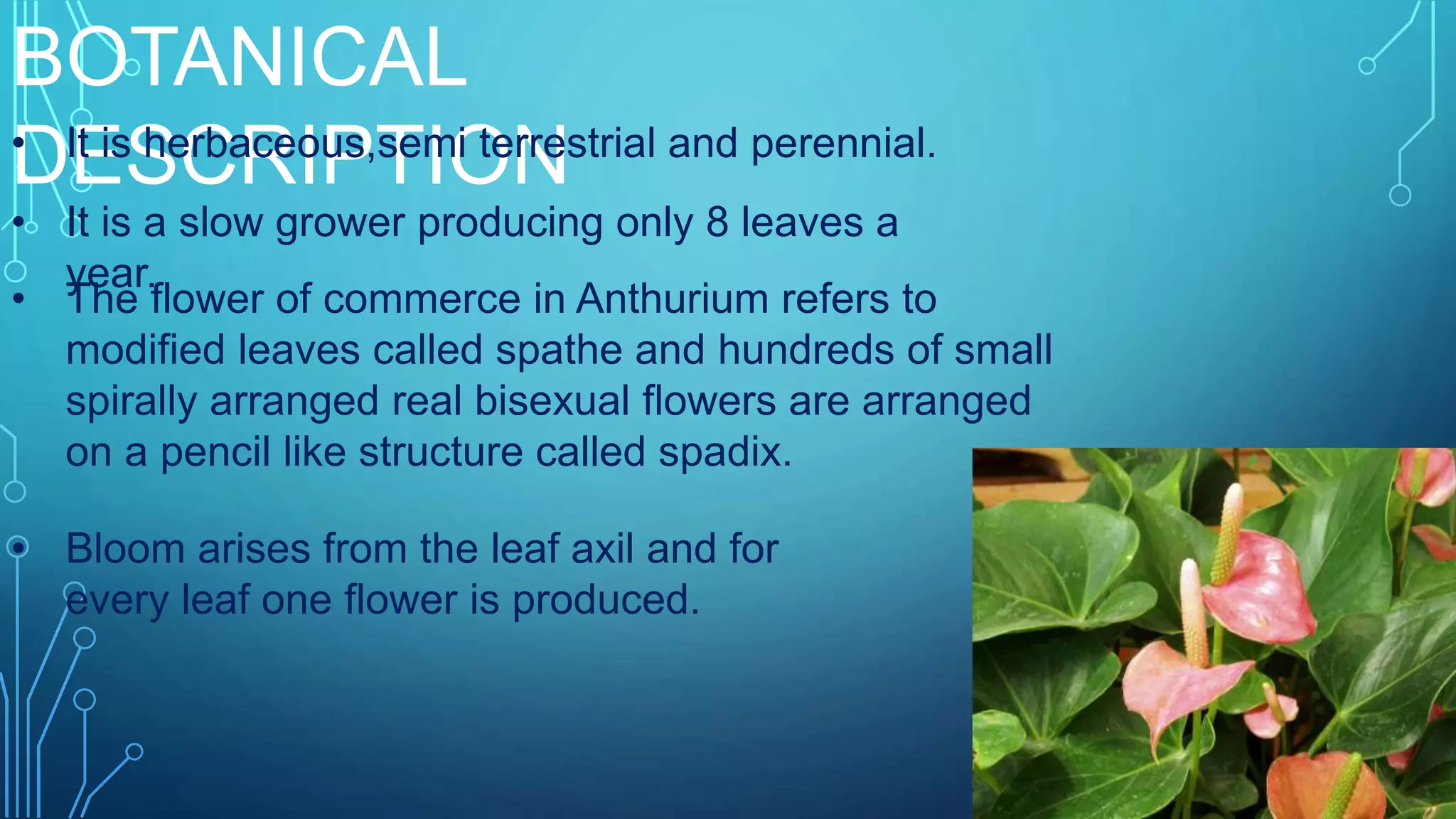
• The flower of commerce in Anthurium refers to
modified leaves called spathe and hundreds of small
spirally arranged real bisexual flowers are arranged
on a pencil like structure called spadix.
• Bloom arises from the leaf axil and for
every leaf one flower is produced.
CLIMATE
• Temperature is important factor
regulating the growth of the anthurium
plants.
• Anthurium thrive best with day
temperature of 25-28°C and night tempera
of 18-20°C.
• Temperature above 32°C may cause foliar
burning,faded flower colour and reduced
flower life.
• Optimum temperature for flower
development is 20°C.
Light-
• Generally, most anthurium types grow
well at light intensities from 1500 to
2500 foot candles.
• A. scherzerianum cultivars grow best at light
intensities between 1000 foot candles.
HUMIDITY-
• Relative humidity of 80% is ideal for
anthurium.
• A range of 70-75% influences the growth
of anthurium.
SOIL
• Soil influences the plants as it determines the pH and salinity level of
irrigation water.
• The optimum range of soil or media is from 5.5-6.0 .
• Locally available raw material such as compost,leaf mould, cattle
manure, coconut husk, tile pieces, sand and coir dust may be used
to prepare a suitable medium.
• High organic, well aerated medium with good water retention capacity
and drainage is used for growing anthurium.
• Raw material may be used in the proportion of leaf mould/compost
(half decayed), cattle manure and sand in 4:2:1, respectively.
• Coconut husk cut into 2.5 cm square pieces mixed with tile pieces at
a ratio of 1:1 or coir dust and sand at 1:1 may be used instead of
leaf mould and cattle manure.
PROPAGATION
• Anthuriums are generally propagated through seed,
division and cutting and micro propagation is employed
as commercial method for production of planting
material.
Seed -
DIVISION
DIVISION
MICROPROPAGATIO
N
LAND PREPARATION
• Bed culture is recommended for commercial
plantation rather than growing them in pots .
• Thus flay land is preferred for the construction of
beds.
• However,if land is sloppy, terracing should be
recommended prior to preparing beds.
• Beds should be dug 60-90cm deep and the bottom
overlaid with medium sizes pieces of tile or charcoal to
enhance drainage.
• The beds are then filled with the growing media
consisting of leaf mould, cattle manure and sand mixed
together as explained (in soil) above.
• Every year this media should be topped
up either with half decayed leaf mould
or the same mixture.
MANURE
• For better growth of the plants manuring with dried
cowdug lumps once in a month during the period
other than rainy season is followed.
• In rainy, season application of cowdug causes
excess of water retention thereby favouring
development of fungal growth and mould leading
to danger for plant survival.
• Therefore, in rainy season instead of
cowdug,powdered goatv manure is fortified with 2-3
g dolomite per pot.
FERTILIZERS
• Fertilization is done by means of foliar applications up
to age of four month.
• Fertilizer like NPK in ratio of 30:10:10 may be
sprayed at 0.05% as a foliar applications twice a
week.• In later stages it should be sprayed at 0.5% once a
week.
• When plants are one year old even 1% spray of
fertilizer (17:17:17 NPK) at fortnightly interval gives
better results.• Calcium.magnesium and sulphur are other important
elements required in anthuriums nutrition.
• Split application of nitrogen,phosphorus and potassium at 30,20 and
50 g/m square / year,3,6 and 9 months after planting increased
number of suckers, stalk lwnth, and width of spayhe, numbers of
flowers per plant, improved flower weight and gave early flowering.
PLANTING
• About 8-10 month old plants are planted at the
rate of 50,000 plants per ha.
• Plants can be spaced at 30×30 cm triangular
spacing leading to increase of 15% in plants in the
same land area.
• Plants may be prunned down to four leaves per
plant.
• Closer planting would required the continuous
maintenance of 3-4 leaves per plant at all times.
FOR POT
• Anthuriums are planted in earthen pots,
when grown at small scale.
• A pot size of 25-30 cm with two holes at
bottom is generally preferred.
• A study showed that the flower quality character
like spathe length, spathe width, spadix length
and flower stalk length improved when they
were grown under 75% of shade with the media
leaf mould and cocopeat.
FOR BED
• A bed of 1.20 m is appropriate with at
least 0.80 m wide path.
• The bed should have a good
drainage system with around 0.03%
.• The layer of growing media should be of
20cm.
• A wire is tied around the bed to
protect the flowers that can be
damaged when come along the path.
Prepare the bed Planted the plants
IRRIGATION
• Plants should be watered at least
twice daily.
• During peak summer 3-4 times spraying of
water may be required.
• Mist/overhead sprinkler irrigation is the best
for anthuriums.
• The method of irrigation generally practiced
are sprinkler or drip irrigation through which
fertilizer are also given.
• A thorough irrigation has to be given in the
morning.
• Irrigation in the afternoon should be timed in
such a way as to leave sufficient time for water
to evaporate so that plant will not be damp
during night hours.
CULTURAL
OPERATION1. Weeding-
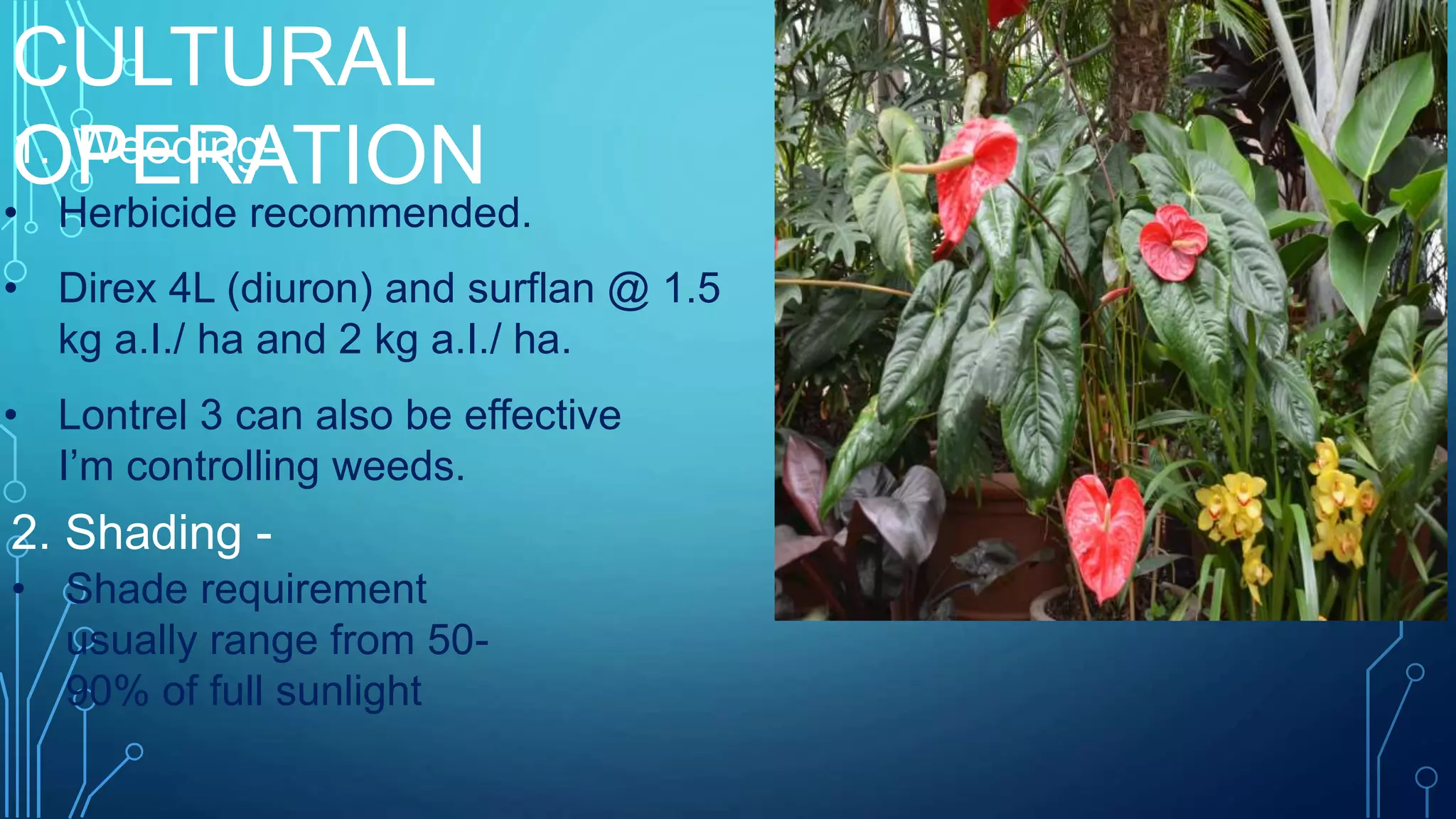
• Herbicide recommended.
• Direx 4L (diuron) and surflan @ 1.5
kg a.I./ ha and 2 kg a.I./ ha.
• Lontrel 3 can also be effective
I’m controlling weeds.
2. Shading -
• Shade requirement
usually range from 50-
90% of full sunlight
3. LEAF PRUNING
• Generally 3-5 leaves are maintained
per plant
4. REMOVE OF SUCKER
PLANT GROWTH
REGULATOR• Application of GA3 @ 1000 ppm
concentration induced branching in plants
• Pronounced effect of GA3 is also
observed in dloweing of anthuriums.
• Among the different treatment, monthly
application of benzyladenine(BA) @ 775
ppm from the second month after planting of
tissue culture produced more sucker, each
sucker having healthy, independent root and
shoot system.
DISEASES
1. Fungal
1.(a) Anthracnose:
• This disease is also known as black nose
or spadix rot caused by Colletotrichum
gleosporioides.
• This fungus primarily infects individual
flowers in the spadix.
• The spores of the fungus spread primarily by
splashing of rain and irrigation water.
• Insects, mites and other organism may
also spread the spores.
• Infection starts as tiny dark spots which
expand to triangular or other angular shapes .
• This fungus can also infect leaves, producing
elongated diamond shaped lesions.
Control-
• Indofil M-45 at 0.2%
• Captan (2.0 g/ l).
• Carbendazim( 1.0 g/l).
Powdery mildew-
• This disease is caused by Erysiphe communis.
• This disease was first time reported in
Germany.
Control-
• Benomyl(0.1%).
1.(3)- Leaf spot
• Leaf spot disease is caused by Septoria
anthurii.
• Leaf spot may occur under unfavorable
cultural conditions.
Control
• Carbileen( zineb) @ 3 g/ l
1.(4)- Root rot
• Root rot of anthurium, is incited by various fungi,
Phytophthora sp. Rhizoctonia sp. and Fusarium
sp.• Improper aeration leads to these disease.
Control
• Mancozeb(0.25%)
• Thiram(0.25%)
PEST
SAphids-
• Generally, anthurium plants are
affected by green (Myzus persicae).
• Aphids are light green, yellow or pink/
red in colour.
Control-
Dimethoate @ 2ml/l.
Mealy bugs-
• Mealy bugs appear on the lower surface
of leaves and roots.
• Honeydew and sooty mould may also
be present and infested plants starts
drying.
Control-
Dimethoate(0.2%).
Red spider mites
• Spider mites are very small, oval
shaped, spider like, white green
transparent insect.
Control-
• Kelthane(0.2%).
Thrips
• These insects also suck the sap from leaves
and cause mottling of the leaves and flowers.
Control
• Kelthane(0.1%).
Snail
• Anthurium plants are also
damaged by snails and slugs.
• They chew the root tips, damage the leaves
and buds.
Control
Metaldehyde
PHYSIOLOGICAL
DISORDERSFlower abortion, flower deformation and rosette
formation:
• In this disorder, the flower spadix aborts
and growth of the spathe is stunned and
stem of the flower is also short
Folder ears:
• The basal lobes of the flowers are not fully
unfolded in this disorder.
• The problem probably occurs during the early
stage.• There is no known solution.
• This physiological disorder is mainly dependent on
variety and not observed in all the cultivae of anthurium.
Sticking
• The flower does not open because the spathe is stuck as a
result of sticking.
• A low relative humidity seems to have a negative
effect.
Jamming
• It is a strong variety dependent characteristics but
more frequently occurs under arid conditions.
• The flower jams in the sheath, since this leaf is
wound very tightly around flower.
• Flowers that let loose of their own accord often
seem to have damage in the shape of cracks on the
underside of the spathe.
Cracks
• This disorder often occur at the sides of spathe.
• In their most serious form, both sides could be
damaged.• This has to do active growth during a period with ( temporarily)
higher relative humidity.
• Lower humidity during the night is effective to reduce cracks in
anthurium.
HARVESTING
• The maturity of the flowers for harvesting is
determined by the firmness of peduncle and the
degree of colour.
• Best time for harvest is when ⅓ to ⅔ of the flower on spike are open.
• Harvesting in morning time is
preferred.
POST HARVEST HANDLING
• After cutting above 3cm, stalks are dipped in water to prevent
dry out.• For distant markets the cut ends of each flower stem should be wrapped
with cotton pad soaked with water covered with wax paper or polythene
and secure tide.
PACKAGING
• Soft protection material is put in between the spathe
and spadix of flower with soaked cotton pads at the cut
ends.
• Foam plastics supports are provided box and
flowers are secured carefully with tape.
• The spathe a long with the spadix is then inserted in
to a polythene cover of appropriate size and there
after placed in cartons.
• Lining of cartons with polythene sheet and
moist paper insulation are necessary to
maintain proper humidity as well as to
prevent injuries to the flower
STORAGE
• Anthurium can easily be stored 13°C for 2-3 weeks
and will last 2-4 weeks In an arrangement.
• Exposure of the flowers to temperature below 13°C
causes the red flower to turn blue, dark red flowers
being most susceptible.
Vase life-
• Hydroxyquinoline resulted in additional bloom
opening of the flowers and also increase the vase
life.
GRADING
The federation of Dutch flower Auction grading
specification for class-1 flowers
• Absolute freshness.
• Pest and disease free.
• Fault free.
• Stalks must be straight and significant
firm to carry the inflorescence.
• Green petal margins are permitted.
REFERENCES
• V. Sundram (Text Book on Commercial
Flowers and Ornamental Gardening).
• A.K. Singh ( Flower Crops Cultivation and
Management).
Thanks

Athurium pptx (1)

  • 1.
  • 2.
    CONTENTS 1. INTRODUCTION 2. CHARACTERISTICS 3.SCIENTIFIC CLASSIFICATION 4. STRUCTURE OF ANTHURIUM 5. SOME KNOWLEDGE ABOUT FLOWER 6. CULTIVATION AND VARIETIES 7.USE OF ANTHURIUMS 8. ORIGIN 9.DISTRIBUTION 10. BOTANICAL DESCRIPTION 11. CLIMATE 12. PROPAGATION 13. LAND PREPARATION 14. MANURE 15.FERTILIZER 16. PLANTING 17. IRRIGATION 18. CULTURAL OPERATION 19. PLANT GROWTH REGUL
  • 3.
    20. DISEASE 21. PESTS 22.PHYSIOLOGICAL DISORDERS 23. HARVESTING 24. POST HARVEST HANDLING 25. PACKAGING 26. STORAGE 27. GRADING 28. REFERENCES
  • 4.
    INTRODUCTION • Anthurium isoriginated in South America (Columbia). • It is used as cut flower, potted flowering and foliage plant as well as for flower arrangements. • The word ‘Anthurium’ denotes it’s tail like spadix in the center of spathe. • It is from two Greek word ‘Anthos’ – meaning Flower and ‘Oura’ meaning tail .
  • 5.
    • World tradeis 2nd I.e just next to orchid’s among the tropical Flowers. • Cut flower are mainly produced at Coorg in Karnataka, Kerala,Yercurd in Tamil Nadu. • Since the mid 1980’s its popularity has increased dramatically and has now become a popular addition to many foliage growers.
  • 6.
    CHARACTERIST ICS• Anthurium aresemi – terrestrial and perennial plants with creeping arborescent stem . • It is herbaceous plants. • Leaves are large, carried on long petioles and have a heart shaped appearance. • They are shiny and dark green with tender leaves varying in colour from light green to deep reddish brown. • Anthurium blooms throughout the year, one bloom arising from the axil of every leaf.
  • 7.
    • Ovary is2 – celled with 1-2 ovules and fruit are berry. • The fruits develop from the flower on the spadix. • They juicy Barrie’s varying in colour, usually containing two seeds. • It is also known as Flamingo flower or Flamingo lily, Tail flower,Laceleaf. • It is a slow grower production only 8 leaves a year. It is the National flower of Mauritius . • The economic life span of anthurium is around 6-8 years.
  • 8.
    • The basicchromosome number of anthurium is n= 15 and 16, 22. • Commercial propagated micro propagation and other method by cutting ,seed,division . • Resistant to common disease and pests.
  • 9.
    SCIENTIFIC CLASSIFICATION • Genus –Anthurium schott• Species – About (1000) species • Botanical Name – Anthurium spp.• Family - Araceae Anthurium spp
  • 10.
  • 11.
  • 12.
    CULTIVATION/VARITIES • The genusAnthurium consists of 500-600 known species. • But only three species are suitable for cultivation. • Anthurium andreanum • A. scherzerianum • A. crystallinum
  • 13.
    Anthurium andreanum • Ithas got wide range of colours from white to deep red and is mainly due to the hybridisation among the following species. • Anthurium andreanum • Anthurium lindenianum • Anthurium ornatum and Anthurium nymphaefolium
  • 14.
    • Anthurium scherzerianum •It is native of Costa Rica and is known as “Flamingo Flower” .• Floral axis is peculiar ly ( I.e. candle) curved. • It requires low temperature and is popular as a pot plant.
  • 15.
    OTHER SPECIES NAME • Anthuriumcrystallinum • A. aemulum • A. amnicola • A. andicola • A. grandifolium • A. pentaphyllum • A. hygrophyilum • A. spathiphyllum • A. clarinervium
  • 16.
  • 18.
    USE OF ANTHURIUM FLOWERS•Wedding decoration • Event management – Birthday Anniversary• Government sponsored conference • Visit of VIP'S • Corporate office decoration • Star Hotels • Home decoration
  • 19.
    ORIGIN • Anthurium isthe native to the Colombia, Peru,Central and South Africa. • Most anthurium species are native of tropical rain forest and are primarily epiphytic in nature.
  • 20.
    DISTRIBUTION • In Malaysia,anthurium is mostly grown in Pahang (Cameron highlands) • The Netherlands is the chief supplier of anthurium in the Europe market. • Hawaii covers 60% exports share of Japan and rest of the west coast of the USA.• Mauritius is one the important producer of anthurium and it exports to Japan and Italy. • In India, anthurium is commercial grown in Kerala, Karnataka, Tamil Nadu,West Bengal, Maharashtra, and north east India.• Kerala is identified as the most desirable place for growing anthurium.
  • 21.
    BOTANICAL DESCRIPTION• It isherbaceous,semi terrestrial and perennial. • It is a slow grower producing only 8 leaves a year. • The flower of commerce in Anthurium refers to modified leaves called spathe and hundreds of small spirally arranged real bisexual flowers are arranged on a pencil like structure called spadix. • Bloom arises from the leaf axil and for every leaf one flower is produced.
  • 22.
    CLIMATE • Temperature isimportant factor regulating the growth of the anthurium plants. • Anthurium thrive best with day temperature of 25-28°C and night tempera of 18-20°C. • Temperature above 32°C may cause foliar burning,faded flower colour and reduced flower life. • Optimum temperature for flower development is 20°C.
  • 23.
    Light- • Generally, mostanthurium types grow well at light intensities from 1500 to 2500 foot candles. • A. scherzerianum cultivars grow best at light intensities between 1000 foot candles. HUMIDITY- • Relative humidity of 80% is ideal for anthurium. • A range of 70-75% influences the growth of anthurium.
  • 24.
    SOIL • Soil influencesthe plants as it determines the pH and salinity level of irrigation water. • The optimum range of soil or media is from 5.5-6.0 . • Locally available raw material such as compost,leaf mould, cattle manure, coconut husk, tile pieces, sand and coir dust may be used to prepare a suitable medium. • High organic, well aerated medium with good water retention capacity and drainage is used for growing anthurium. • Raw material may be used in the proportion of leaf mould/compost (half decayed), cattle manure and sand in 4:2:1, respectively. • Coconut husk cut into 2.5 cm square pieces mixed with tile pieces at a ratio of 1:1 or coir dust and sand at 1:1 may be used instead of leaf mould and cattle manure.
  • 25.
    PROPAGATION • Anthuriums aregenerally propagated through seed, division and cutting and micro propagation is employed as commercial method for production of planting material. Seed -
  • 26.
  • 28.
  • 29.
  • 30.
    LAND PREPARATION • Bedculture is recommended for commercial plantation rather than growing them in pots . • Thus flay land is preferred for the construction of beds. • However,if land is sloppy, terracing should be recommended prior to preparing beds. • Beds should be dug 60-90cm deep and the bottom overlaid with medium sizes pieces of tile or charcoal to enhance drainage. • The beds are then filled with the growing media consisting of leaf mould, cattle manure and sand mixed together as explained (in soil) above.
  • 31.
    • Every yearthis media should be topped up either with half decayed leaf mould or the same mixture.
  • 32.
    MANURE • For bettergrowth of the plants manuring with dried cowdug lumps once in a month during the period other than rainy season is followed. • In rainy, season application of cowdug causes excess of water retention thereby favouring development of fungal growth and mould leading to danger for plant survival. • Therefore, in rainy season instead of cowdug,powdered goatv manure is fortified with 2-3 g dolomite per pot.
  • 33.
    FERTILIZERS • Fertilization isdone by means of foliar applications up to age of four month. • Fertilizer like NPK in ratio of 30:10:10 may be sprayed at 0.05% as a foliar applications twice a week.• In later stages it should be sprayed at 0.5% once a week. • When plants are one year old even 1% spray of fertilizer (17:17:17 NPK) at fortnightly interval gives better results.• Calcium.magnesium and sulphur are other important elements required in anthuriums nutrition.
  • 34.
    • Split applicationof nitrogen,phosphorus and potassium at 30,20 and 50 g/m square / year,3,6 and 9 months after planting increased number of suckers, stalk lwnth, and width of spayhe, numbers of flowers per plant, improved flower weight and gave early flowering.
  • 35.
    PLANTING • About 8-10month old plants are planted at the rate of 50,000 plants per ha. • Plants can be spaced at 30×30 cm triangular spacing leading to increase of 15% in plants in the same land area. • Plants may be prunned down to four leaves per plant. • Closer planting would required the continuous maintenance of 3-4 leaves per plant at all times.
  • 36.
    FOR POT • Anthuriumsare planted in earthen pots, when grown at small scale. • A pot size of 25-30 cm with two holes at bottom is generally preferred. • A study showed that the flower quality character like spathe length, spathe width, spadix length and flower stalk length improved when they were grown under 75% of shade with the media leaf mould and cocopeat.
  • 37.
    FOR BED • Abed of 1.20 m is appropriate with at least 0.80 m wide path. • The bed should have a good drainage system with around 0.03% .• The layer of growing media should be of 20cm. • A wire is tied around the bed to protect the flowers that can be damaged when come along the path.
  • 38.
    Prepare the bedPlanted the plants
  • 40.
    IRRIGATION • Plants shouldbe watered at least twice daily. • During peak summer 3-4 times spraying of water may be required. • Mist/overhead sprinkler irrigation is the best for anthuriums. • The method of irrigation generally practiced are sprinkler or drip irrigation through which fertilizer are also given. • A thorough irrigation has to be given in the morning.
  • 41.
    • Irrigation inthe afternoon should be timed in such a way as to leave sufficient time for water to evaporate so that plant will not be damp during night hours.
  • 42.
    CULTURAL OPERATION1. Weeding- • Herbiciderecommended. • Direx 4L (diuron) and surflan @ 1.5 kg a.I./ ha and 2 kg a.I./ ha. • Lontrel 3 can also be effective I’m controlling weeds. 2. Shading - • Shade requirement usually range from 50- 90% of full sunlight
  • 43.
    3. LEAF PRUNING •Generally 3-5 leaves are maintained per plant
  • 44.
  • 45.
    PLANT GROWTH REGULATOR• Applicationof GA3 @ 1000 ppm concentration induced branching in plants • Pronounced effect of GA3 is also observed in dloweing of anthuriums. • Among the different treatment, monthly application of benzyladenine(BA) @ 775 ppm from the second month after planting of tissue culture produced more sucker, each sucker having healthy, independent root and shoot system.
  • 46.
    DISEASES 1. Fungal 1.(a) Anthracnose: •This disease is also known as black nose or spadix rot caused by Colletotrichum gleosporioides. • This fungus primarily infects individual flowers in the spadix. • The spores of the fungus spread primarily by splashing of rain and irrigation water. • Insects, mites and other organism may also spread the spores.
  • 47.
    • Infection startsas tiny dark spots which expand to triangular or other angular shapes . • This fungus can also infect leaves, producing elongated diamond shaped lesions. Control- • Indofil M-45 at 0.2% • Captan (2.0 g/ l). • Carbendazim( 1.0 g/l).
  • 48.
    Powdery mildew- • Thisdisease is caused by Erysiphe communis. • This disease was first time reported in Germany. Control- • Benomyl(0.1%).
  • 49.
    1.(3)- Leaf spot •Leaf spot disease is caused by Septoria anthurii. • Leaf spot may occur under unfavorable cultural conditions. Control • Carbileen( zineb) @ 3 g/ l
  • 50.
    1.(4)- Root rot •Root rot of anthurium, is incited by various fungi, Phytophthora sp. Rhizoctonia sp. and Fusarium sp.• Improper aeration leads to these disease. Control • Mancozeb(0.25%) • Thiram(0.25%)
  • 51.
    PEST SAphids- • Generally, anthuriumplants are affected by green (Myzus persicae). • Aphids are light green, yellow or pink/ red in colour. Control- Dimethoate @ 2ml/l.
  • 52.
    Mealy bugs- • Mealybugs appear on the lower surface of leaves and roots. • Honeydew and sooty mould may also be present and infested plants starts drying. Control- Dimethoate(0.2%).
  • 53.
    Red spider mites •Spider mites are very small, oval shaped, spider like, white green transparent insect. Control- • Kelthane(0.2%).
  • 54.
    Thrips • These insectsalso suck the sap from leaves and cause mottling of the leaves and flowers. Control • Kelthane(0.1%).
  • 55.
    Snail • Anthurium plantsare also damaged by snails and slugs. • They chew the root tips, damage the leaves and buds. Control Metaldehyde
  • 56.
    PHYSIOLOGICAL DISORDERSFlower abortion, flowerdeformation and rosette formation: • In this disorder, the flower spadix aborts and growth of the spathe is stunned and stem of the flower is also short Folder ears: • The basal lobes of the flowers are not fully unfolded in this disorder. • The problem probably occurs during the early stage.• There is no known solution. • This physiological disorder is mainly dependent on variety and not observed in all the cultivae of anthurium.
  • 57.
    Sticking • The flowerdoes not open because the spathe is stuck as a result of sticking. • A low relative humidity seems to have a negative effect.
  • 58.
    Jamming • It isa strong variety dependent characteristics but more frequently occurs under arid conditions. • The flower jams in the sheath, since this leaf is wound very tightly around flower. • Flowers that let loose of their own accord often seem to have damage in the shape of cracks on the underside of the spathe.
  • 59.
    Cracks • This disorderoften occur at the sides of spathe. • In their most serious form, both sides could be damaged.• This has to do active growth during a period with ( temporarily) higher relative humidity. • Lower humidity during the night is effective to reduce cracks in anthurium.
  • 60.
    HARVESTING • The maturityof the flowers for harvesting is determined by the firmness of peduncle and the degree of colour. • Best time for harvest is when ⅓ to ⅔ of the flower on spike are open. • Harvesting in morning time is preferred.
  • 61.
    POST HARVEST HANDLING •After cutting above 3cm, stalks are dipped in water to prevent dry out.• For distant markets the cut ends of each flower stem should be wrapped with cotton pad soaked with water covered with wax paper or polythene and secure tide.
  • 62.
    PACKAGING • Soft protectionmaterial is put in between the spathe and spadix of flower with soaked cotton pads at the cut ends. • Foam plastics supports are provided box and flowers are secured carefully with tape. • The spathe a long with the spadix is then inserted in to a polythene cover of appropriate size and there after placed in cartons. • Lining of cartons with polythene sheet and moist paper insulation are necessary to maintain proper humidity as well as to prevent injuries to the flower
  • 64.
    STORAGE • Anthurium caneasily be stored 13°C for 2-3 weeks and will last 2-4 weeks In an arrangement. • Exposure of the flowers to temperature below 13°C causes the red flower to turn blue, dark red flowers being most susceptible. Vase life- • Hydroxyquinoline resulted in additional bloom opening of the flowers and also increase the vase life.
  • 65.
    GRADING The federation ofDutch flower Auction grading specification for class-1 flowers • Absolute freshness. • Pest and disease free. • Fault free. • Stalks must be straight and significant firm to carry the inflorescence. • Green petal margins are permitted.
  • 67.
    REFERENCES • V. Sundram(Text Book on Commercial Flowers and Ornamental Gardening). • A.K. Singh ( Flower Crops Cultivation and Management).
  • 68.