Definition  of Rings and Examples  By: John Wilson Calalo and Daryl Sacay
A ring is a none empty set R equipped with two operations that satisfy the following axioms. For all a, b, c,  є  R:
1. If a  є  R and b  є  R, then a+b  є  R  [closure for addition] 2. a + (b + c) = (a + b) + c [associative addition] 3. a + b = b + a [commutative addition] 4. There is an element O R  in R such that  a + O R  = a O R   + a for every a  є  R [additive identity or zero element]
5. For each a  є  R, the equation a + x = O R   has a solution in R. 6. If a  є  R and b  є  R, then ab  є  R. [closure for multiplication] 7. A (bc) = (ab) c [associative multiplication] 8. A (b + c) = ab + ac and (a + b) c = ac + bc [distributive laws]
Commutative Ring is a ring R that satisfies this axiom: • ab = ba for all a, b  [commutative multiplication]
Example: The set of integers Z, with the usual addition and multiplication, is a commutative ring with identity.
Let E be the set of even integers with the usual addition and multiplication
The set of odd integers with the usual addition and multiplication is not a ring.
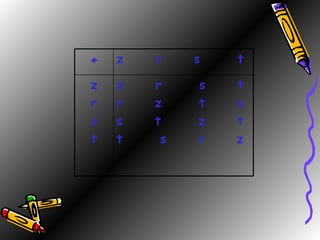
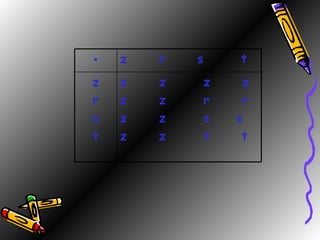
The set T= {r, s, t, z} equipped w/ the addition and multiplication defined by the following tables is a ring.
z  r  s  t r  z  t  s s  t  z  t t  s  r  z  z r s t z  r  s  t +
z  z  z  z z  z  r  r z  z  s  s z  z  t  t  z r s t z  r  s  t •
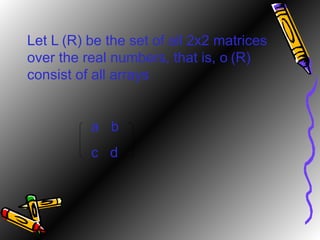
Let    (R) be the set of all 2x2 matrices over the real numbers, that is,    (R) consist of all arrays a  b c  d
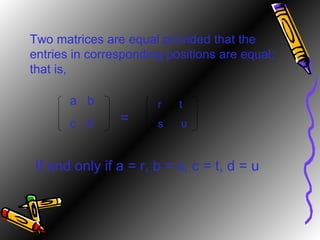
Two matrices are equal provided that the entries in corresponding positions are equal; that is, a  b c  d = r  t s  u If and only if a = r, b = s, c = t, d = u
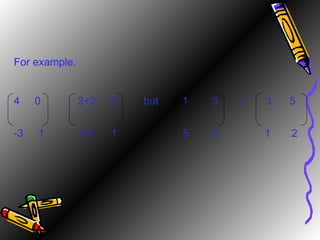
For example, 4  0 2+2  0  but  1  3  ≠  3  5   -3  1 1-4  1   5  2   1  2
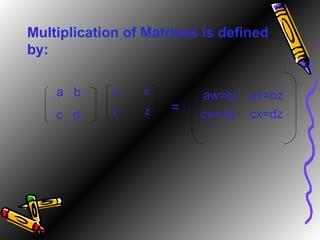
Multiplication of Matrices is defined by: a  b c  d = w  x y  z aw=by  ax=bz cw=dy  cx=dz
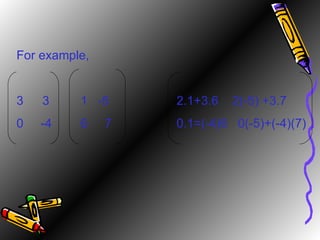
For example, 3 1  -5 2.1+3.6  2(-5) +3.7 0  -4 6  7 0.1=(-4)6  0(-5)+(-4)(7)
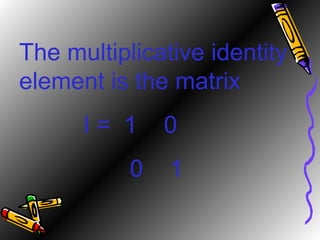
The multiplicative identity element is the matrix I =  1  0   0  1
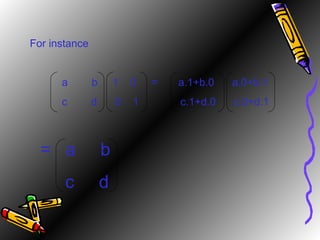
For instance a  b  1  0  =  a.1+b.0  a.0+b.1 c  d  0  1  c.1+d.0  c.0+d.1 =  a  b c  d
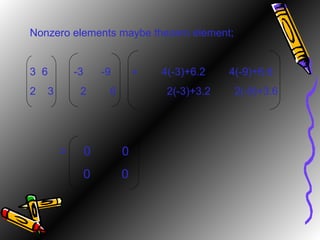
Nonzero elements maybe thezero element; 6   -3  -9  =  4(-3)+6.2  4(-9)+6.6 2  3  2  6  2(-3)+3.2  2(-9)+3.6 =  0  0 0  0

Daryl

  • 1.
    Definition ofRings and Examples By: John Wilson Calalo and Daryl Sacay
  • 2.
    A ring isa none empty set R equipped with two operations that satisfy the following axioms. For all a, b, c, є R:
  • 3.
    1. If a є R and b є R, then a+b є R [closure for addition] 2. a + (b + c) = (a + b) + c [associative addition] 3. a + b = b + a [commutative addition] 4. There is an element O R in R such that a + O R = a O R + a for every a є R [additive identity or zero element]
  • 4.
    5. For eacha є R, the equation a + x = O R has a solution in R. 6. If a є R and b є R, then ab є R. [closure for multiplication] 7. A (bc) = (ab) c [associative multiplication] 8. A (b + c) = ab + ac and (a + b) c = ac + bc [distributive laws]
  • 5.
    Commutative Ring isa ring R that satisfies this axiom: • ab = ba for all a, b [commutative multiplication]
  • 6.
    Example: The setof integers Z, with the usual addition and multiplication, is a commutative ring with identity.
  • 7.
    Let E bethe set of even integers with the usual addition and multiplication
  • 8.
    The set ofodd integers with the usual addition and multiplication is not a ring.
  • 9.
    The set T={r, s, t, z} equipped w/ the addition and multiplication defined by the following tables is a ring.
  • 10.
    z r s t r z t s s t z t t s r z z r s t z r s t +
  • 11.
    z z z z z z r r z z s s z z t t z r s t z r s t •
  • 12.
    Let  (R) be the set of all 2x2 matrices over the real numbers, that is,  (R) consist of all arrays a b c d
  • 13.
    Two matrices areequal provided that the entries in corresponding positions are equal; that is, a b c d = r t s u If and only if a = r, b = s, c = t, d = u
  • 14.
    For example, 4 0 2+2 0 but 1 3 ≠ 3 5 -3 1 1-4 1 5 2 1 2
  • 15.
    Multiplication of Matricesis defined by: a b c d = w x y z aw=by ax=bz cw=dy cx=dz
  • 16.
    For example, 31 -5 2.1+3.6 2(-5) +3.7 0 -4 6 7 0.1=(-4)6 0(-5)+(-4)(7)
  • 17.
    The multiplicative identityelement is the matrix I = 1 0 0 1
  • 18.
    For instance a b 1 0 = a.1+b.0 a.0+b.1 c d 0 1 c.1+d.0 c.0+d.1 = a b c d
  • 19.
    Nonzero elements maybethezero element; 6 -3 -9 = 4(-3)+6.2 4(-9)+6.6 2 3 2 6 2(-3)+3.2 2(-9)+3.6 = 0 0 0 0