ROOTS OF POLYNOMIALSBAIRSTOW METHODDANIEL FERNANDO RODRIGUEZ
A method for calculating roots of polynomials can calculate peer (conjugated in the case of complex roots).Unlike Newton, calculate complex roots without having to make calculations with complex numbers. It is based on the synthetic division of the polynomial Pn (x) by the quadratic (x2 - rx - s).Bairstow Method
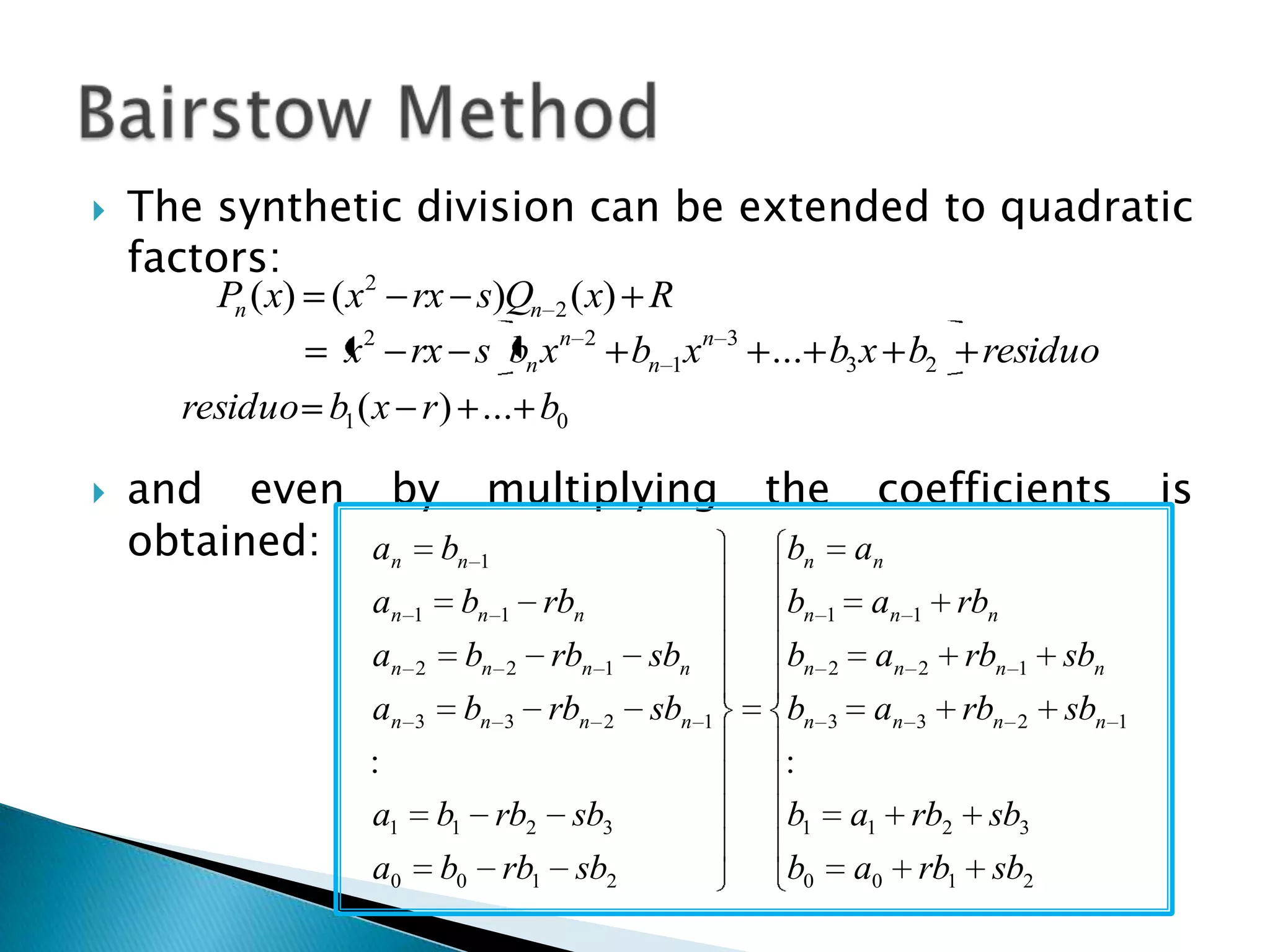
The synthetic division can be extended to quadratic factors:and even by multiplying the coefficients is obtained:Bairstow Method
We want to find the values of r and s that make b1 and b0 equal to zero since, in this case, the factor divided exactly quadratic polynomial. The first method works by taking an initial approximation (r0, s0) and generate approximations (rk, sk) getting better using an iterative procedure until the remainder of division by the quadratic polynomial (x2 - rkx - sk) is zero. The iterative procedure of calculation is based on the fact that both b1 and b0 are functions of r and s.Bairstow Method
In developing b1 (rk, sk) and b0 (rk, sk) in Taylor series around the point (r *, s *), we obtain:It takes (r *, s *) as the point where the residue is zero and Δr = r * - rk, Δs = s * - sk. Then:Bairstow Method
Bairstow showed that the required partial derivatives can be obtained from the bi by a second synthetic division between factor (x2 - r0x - s0) in the same way that the bi are obtained from the ai. The calculation is:Bairstow Method
Thus, the system of equations can be writtenBairstow Method
Calculation of approximate error:When tolerance is reached estimated coefficientsrand s is used to calculate the roots:Bairstow Method
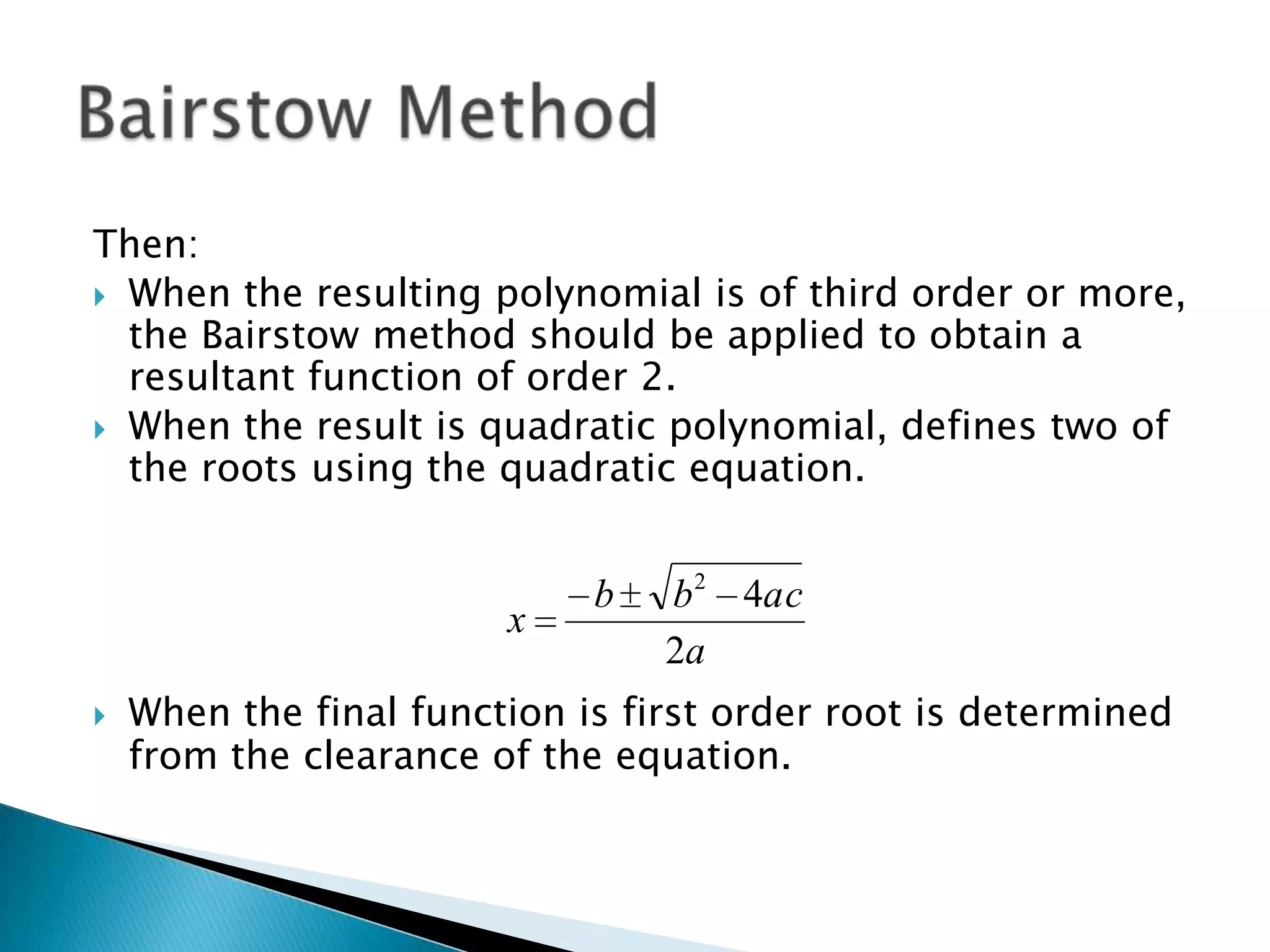
Then:When the resulting polynomial is of third order or more, the Bairstow method should be applied to obtain a resultant function of order 2.When the result is quadratic polynomial, defines two of the roots using the quadratic equation.When the final function is first order root is determined from the clearance of the equation.Bairstow Method
CHAPRA, Steven C. y CANALE, Raymond P.: Métodos Numéricos para Ingenieros. McGraw Hill 2002.http://ocw.mit.edu/OcwWeb/MathematicsPPTX EDUARDO CARRILLO, PHD.Bibliography

Roots of polynomials

  • 1.
    ROOTS OF POLYNOMIALSBAIRSTOWMETHODDANIEL FERNANDO RODRIGUEZ
  • 2.
    A method forcalculating roots of polynomials can calculate peer (conjugated in the case of complex roots).Unlike Newton, calculate complex roots without having to make calculations with complex numbers. It is based on the synthetic division of the polynomial Pn (x) by the quadratic (x2 - rx - s).Bairstow Method
  • 3.
    The synthetic divisioncan be extended to quadratic factors:and even by multiplying the coefficients is obtained:Bairstow Method
  • 4.
    We want tofind the values of r and s that make b1 and b0 equal to zero since, in this case, the factor divided exactly quadratic polynomial. The first method works by taking an initial approximation (r0, s0) and generate approximations (rk, sk) getting better using an iterative procedure until the remainder of division by the quadratic polynomial (x2 - rkx - sk) is zero. The iterative procedure of calculation is based on the fact that both b1 and b0 are functions of r and s.Bairstow Method
  • 5.
    In developing b1(rk, sk) and b0 (rk, sk) in Taylor series around the point (r *, s *), we obtain:It takes (r *, s *) as the point where the residue is zero and Δr = r * - rk, Δs = s * - sk. Then:Bairstow Method
  • 6.
    Bairstow showed thatthe required partial derivatives can be obtained from the bi by a second synthetic division between factor (x2 - r0x - s0) in the same way that the bi are obtained from the ai. The calculation is:Bairstow Method
  • 7.
    Thus, the systemof equations can be writtenBairstow Method
  • 8.
    Calculation of approximateerror:When tolerance is reached estimated coefficientsrand s is used to calculate the roots:Bairstow Method
  • 9.
    Then:When the resultingpolynomial is of third order or more, the Bairstow method should be applied to obtain a resultant function of order 2.When the result is quadratic polynomial, defines two of the roots using the quadratic equation.When the final function is first order root is determined from the clearance of the equation.Bairstow Method
  • 10.
    CHAPRA, Steven C.y CANALE, Raymond P.: Métodos Numéricos para Ingenieros. McGraw Hill 2002.http://ocw.mit.edu/OcwWeb/MathematicsPPTX EDUARDO CARRILLO, PHD.Bibliography