OBTURATION
OBTURATION
TECHNIQUES
TECHNIQUES
DEFINITION:
Obturation is defined as three-dimensional
filling of the entire root canal system as
close to the cemento-dentinal junction as
possible.
HISTORICAL PERSPECTIVES :
A large variety of filling materials have been used
through the years. Some of the materials used in the
early days were:
► Pigeon droppings
► Plaster of Paris
► Asbestos
► Bamboo
► Wooden pegs
► Feathers
Before 1800 root canal filling was limited to
gold. Subsequent obturation with various
metals, oxychloride of zinc paraffin and
amalgam resulted in varying degrees of success
and satisfaction. Dental history also indicates
the use of iridoplatinum as filling materials.
History of solid core filling materials:
The first solid core filling materials were used
unintentionally. They were the endodontic
instruments that separated within the canal.
Gutta-percha had been used to fill canals as early
1830.
In 1847 Hill developed the first Gutta-percha root
canal filling material known as “Hills stopping”.
Bowman popularized Gutta-percha in 1867.
Silver points were introduced in endodontics in
1930’s. Later, they fell to disuse because of their
corrosion potential.
OBJECTIVES OF OBTURATION:
 Substitution of an inert filling in the space
previously occupied by the pulp tissue.
 To eliminate all avenues of leakage from the
oral cavity or the periradicular tissues into the
root canal system (i.e. to attain a three dimensional
fluid impervious seal apically, laterally and
coronally within the confines of the root canal
system).
 To seal within the system any irritants that
cannot be fully removed during canal cleaning and
shaping procedures.
 To adequately seal iatrogenic causes such as
perforations, ledges and zipped apices.
 To attain a radiographic appearance of a dense
three dimensional filling which extends as close
as possible to the cemento dentinal junction
without gross over extension or under filling in the
presence of a patent canal.
Radiographically:
 Obturated root canal should reflect a shape that
is approximately the same shape as the root
morphology.
 Shape of the obturated canal should reflect a
continuously tapering funnel preparation
without excess removal of tooth structure at
any level of the canal system.
Importance:
To achieve a 3-D seal of root canal
system, but it is dependent on the quality
of the canal cleaning and shaping and
skill of the clinician.
OBTURATING MATERIALS:
CLASSIFICATION OF ROOT CANAL FILLING
MATERIALS:
(by Grossman)
 Plastics
 Solids
 Cements
 Pastes
Requirements for an ideal root canal filling material:
GROSSMAN 1940:
GROSSMAN 1940:
 Easily introduced
Easily introduced
♦ Seal laterally as well as apically
Seal laterally as well as apically
♦ Not shrink after being inserted
Not shrink after being inserted
♦ Impervious to moisture
Impervious to moisture
♦ Bacteriostatic or at least not encourage bacterial growth
Bacteriostatic or at least not encourage bacterial growth
♦ Radiopaque
Radiopaque
♦ Not stain tooth
Not stain tooth
♦ Not irritate periradicular tissues
Not irritate periradicular tissues
♦ Sterile or sterilizable
Sterile or sterilizable
♦ Easily removed
Easily removed
SOLID - CORE MATERIALS :
METAL CORE MATERIALS:
SILVER CONES:
Silver point Technique:
These have been used to fill root canals since 1930.
Pure silver molded into a conical shape.
They are round in cross section.
STAINLESS STEEL FILES:
Originally suggested by Sampeck in 1961.
 Used to fill fine, tortuous canals.
 Heavily calcified dilacerated narrow canals.
 Used instead of silver cones.
OTHER METAL CORE MATERIALS:
 Gold (by Grove)
 Iridioplatinum
 Tantalum
 Titanium (by Messing)
 Amalgam
SEMI SOLID-CORE MATERIALS:
PLASTIC CORE MATERIALS:
GUTTA PERCHA:
The word ‘Gutta Percha’ is an English derived
word from the Malay origin “Getah Pertja”
meaning ‘strings of sticky plant juices’.
• Getah – sap
• Pertja – strips of cloth
SOURCE:
 Trees indigenous to the Malay archipelago
Scientifically called ‘PALAQUIUM GUTTA
BAIL’
 Belongs to the SAPODILLA FAMILY
NATURAL GUTTA PERCHA:
is the Alpha phase crystalline form which is-
• More linear in structure
• More stable
• This is subjected to a boiling process and then
cooled.
• The rate at which it is cooled determines the
phase formed.
• When cooled at a slower rate of 0.5 C the low
molecular weight alpha phase is formed.
• When cooled at room temperature the higher
molecular weight beta phase is formed.
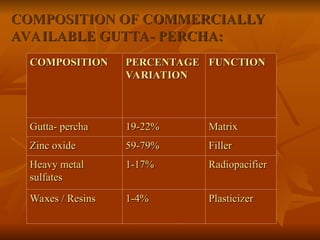
COMPOSITION OF COMMERCIALLY
AVAILABLE GUTTA- PERCHA:
COMPOSITION
COMPOSITION PERCENTAGE
PERCENTAGE
VARIATION
VARIATION
FUNCTION
FUNCTION
Gutta- percha
Gutta- percha 19-22%
19-22% Matrix
Matrix
Zinc oxide
Zinc oxide 59-79%
59-79% Filler
Filler
Heavy metal
Heavy metal
sulfates
sulfates
1-17%
1-17% Radiopacifier
Radiopacifier
Waxes / Resins
Waxes / Resins 1-4%
1-4% Plasticizer
Plasticizer
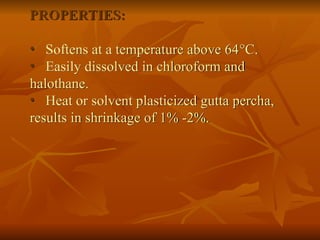
PROPERTIES:
• Softens at a temperature above 64C.
• Easily dissolved in chloroform and
halothane.
• Heat or solvent plasticized gutta percha,
results in shrinkage of 1% -2%.
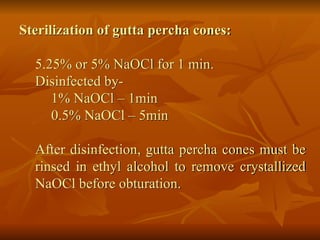
Sterilization of gutta percha cones:
5.25% or 5% NaOCl for 1 min.
Disinfected by-
1% NaOCl – 1min
0.5% NaOCl – 5min
After disinfection, gutta percha cones must be
rinsed in ethyl alcohol to remove crystallized
NaOCl before obturation.
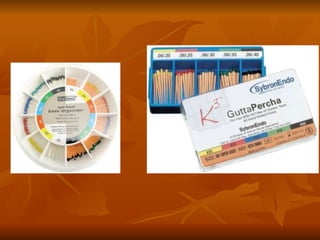
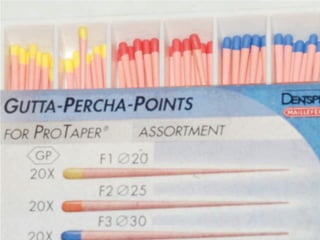
Core points:
 Sizing based on similar size and taper as
standardized endodontic files.
 Used as master cones.
ADVANTAGES OF GUTTA PERCHA:
COMPACTIBILITY
Adapts to the root canal walls
BIOLOGICALLY INERT
least reactive
minimal toxicity
minimal tissue irritability
least allergenic
well tolerated by periradicular tissues
DIMENSIONAL STABILITY
BECOMES PLASTIC WHEN WARMED
HAS KNOWN SOLVENTS
Chloroform
Xylol
DOES NOT DISCOLOUR THE TOOTH
IT IS RADIOPAQUE
DISADVANTAGES OF GUTTA PERCHA
 Undergoes shrinkage when plasticized.
 Does not possess adhesive qualities.
 Lack of rigidity.
 Undergoes vertical distortion during compaction.
 Needs a definite apical constriction / stop.
ENDODONTIC SEALERS
REQUIREMENTS FOR AN IDEAL ROOT CANAL
SEALER
GROSSMAN’S REQUIREMENTS (1958)
• Tacky when mixed – to provide good adhesion between it and
the canal when set
• Make a hermetic seal
• Radiopaque – so that it can be visualized in the radiograph
ADDITIONAL REQUIREMENTS
• Not provoke an immune response in periradicular tissue
• Neither mutagenic nor carcinogenic
Functions of sealers
• Serves as a filler for canal irregularities and minor
discrepancies between the root canal wall and core filling
material
• To obturate the lateral canals
• Acts as lubricant
• Enhances the possible attainment of an impervious seal
• Can assist in microbial control of root canal walls or in
tubules
• For radiopacity
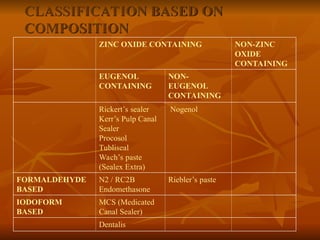
CLASSIFICATION BASED ON
COMPOSITION
ZINC OXIDE CONTAINING NON-ZINC
OXIDE
CONTAINING
EUGENOL
CONTAINING
NON-
EUGENOL
CONTAINING
Rickert’s sealer
Kerr’s Pulp Canal
Sealer
Procosol
Tubliseal
Wach’s paste
(Sealex Extra)
Nogenol
FORMALDEHYDE
BASED
N2 / RC2B
Endomethasone
Riebler’s paste
IODOFORM
BASED
MCS (Medicated
Canal Sealer)
Dentalis
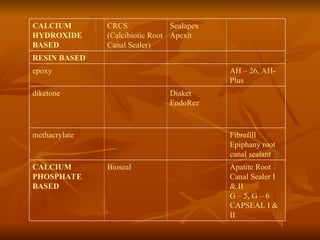
CALCIUM
HYDROXIDE
BASED
CRCS
(Calcibiotic Root
Canal Sealer)
Sealapex
Apexit
RESIN BASED
epoxy AH – 26, AH-
Plus
diketone Diaket
EndoRez
methacrylate Fibrefill
Epiphany root
canal sealant
CALCIUM
PHOSPHATE
BASED
Bioseal Apatite Root
Canal Sealer I
& II
G – 5, G – 6
CAPSEAL I &
II
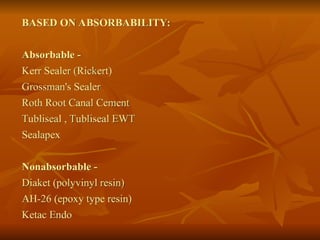
BASED ON ABSORBABILITY:
Absorbable -
Kerr Sealer (Rickert)
Grossman's Sealer
Roth Root Canal Cement
Tubliseal , Tubliseal EWT
Sealapex
Nonabsorbable -
Diaket (polyvinyl resin)
AH-26 (epoxy type resin)
Ketac Endo
GUTTA PERCHA BASED SEALERS
CHLOROPERCHA
[chloroform + gutta percha]
Not adhesive
Increased shrinkage
Decreased radiopacity
Chloroform – potential carcinogen
EUCAPERCHA
eucalyptol
gutta percha
CALLAHAN-
JOHNSTON TECHNIQUE
[DIFFUSION TECHNIQUE]
Chloroform + rosin
gutta percha
KLOROPERKA N- Ø
chloroform + resin + zinc oxide
gutta percha
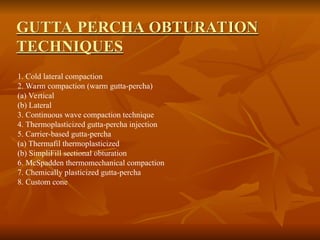
GUTTA PERCHA OBTURATION
TECHNIQUES
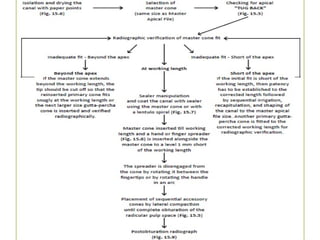
1. Cold lateral compaction
2. Warm compaction (warm gutta-percha)
(a) Vertical
(b) Lateral
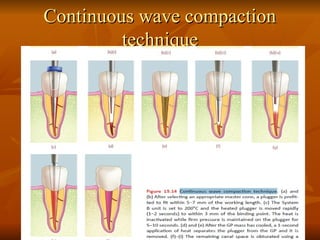
3. Continuous wave compaction technique
4. Thermoplasticized gutta-percha injection
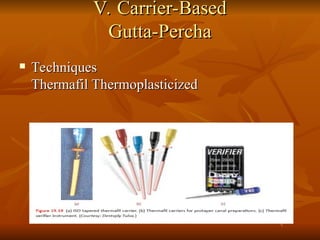
5. Carrier-based gutta-percha
(a) Thermafil thermoplasticized
(b) SimpliFill sectional obturation
6. McSpadden thermomechanical compaction
7. Chemically plasticized gutta-percha
8. Custom cone
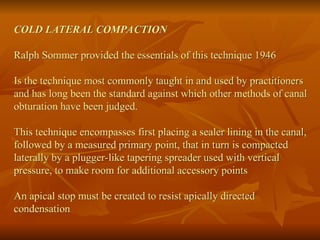
COLD LATERAL COMPACTION
Ralph Sommer provided the essentials of this technique 1946
Is the technique most commonly taught in and used by practitioners
and has long been the standard against which other methods of canal
obturation have been judged.
This technique encompasses first placing a sealer lining in the canal,
followed by a measured primary point, that in turn is compacted
laterally by a plugger-like tapering spreader used with vertical
pressure, to make room for additional accessory points
An apical stop must be created to resist apically directed
condensation
Spreader Size Determination.
fit the spreader to reach to within 1.0 to 2.0 mm of the true
working length and to match the taper of the preparation.
Therefore, a spreader of the same apical instrument size or one
size larger is chosen so that it reaches to within 1.0 to 2.0 mm
but will not penetrate the apical orifice.
Advantages
Simplicity & ease
Speed
Disadvantage
Does not achieve a dense homogenous mass
Filling of lateral and accessory canals not achieved
Cannot adapt to canal wall irregularities
Chances of stress development and fracture
1.5kg – 5kg
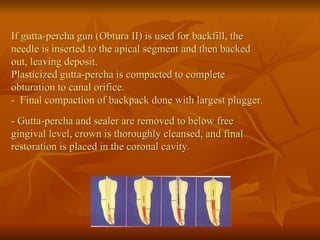
If gutta-percha gun (Obtura II) is used for backfill, the
needle is inserted to the apical segment and then backed
out, leaving deposit.
Plasticized gutta-percha is compacted to complete
obturation to canal orifice.
- Final compaction of backpack done with largest plugger.
- Gutta-percha and sealer are removed to below free
gingival level, crown is thoroughly cleansed, and final
restoration is placed in the coronal cavity.
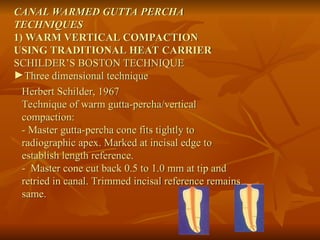
CANAL WARMED GUTTA PERCHA
TECHNIQUES
1) WARM VERTICAL COMPACTION
USING TRADITIONAL HEAT CARRIER
SCHILDER’S BOSTON TECHNIQUE
►Three dimensional technique
Herbert Schilder, 1967
Technique of warm gutta-percha/vertical
compaction:
- Master gutta-percha cone fits tightly to
radiographic apex. Marked at incisal edge to
establish length reference.
- Master cone cut back 0.5 to 1.0 mm at tip and
retried in canal. Trimmed incisal reference remains
same.
CHEMICALLY PLASTICIZED GUTTA PERCHA
TECHNIQUE
The principal solvent used in this technique is chloroform. It
is preferred because it is more volatile than other solvents,
and no solvent adhering to the cone is desired during
condensation.
Other solvents such as eucalyptol, halothane, xylene,
methylchloroform and rectified white turpentine have been
evaluated as substitutes for chloroform.
II. Warm COMPACTION Method
(Warm Gutta-Percha)
(Warm Gutta-Percha)
 A. Warm Vertical Compaction
A. Warm Vertical Compaction
 Principle
Principle
 The warm vertical condensation or “warm
The warm vertical condensation or “warm
guttapercha”
guttapercha”
 technique of filling root canals was introduced
technique of filling root canals was introduced
 by
by Schilder
Schilder with the objective of filling the
with the objective of filling the
 main root canal as well as lateral and
main root canal as well as lateral and
accessory
accessory
 Using heated pluggers, one applies pressure
Using heated pluggers, one applies pressure
 in a vertical direction to the heat-softened
in a vertical direction to the heat-softened
guttapercha
guttapercha
 and thereby causes it to flow and to fill the
and thereby causes it to flow and to fill the
 entire lumen of the canal
entire lumen of the canal
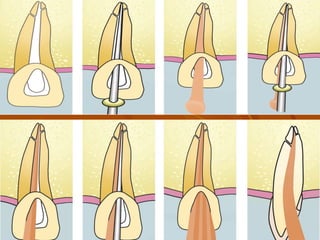
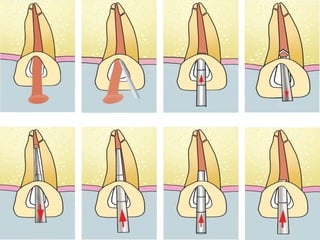
 Warm vertical compaction technique:
Warm vertical compaction technique:
 Master cone adaptation in the prepared root
Master cone adaptation in the prepared root
canal.
canal.
 Severing of the coronal portion of the master
Severing of the coronal portion of the master
cone with a heated instrument.
 Compaction of the master cone.
Compaction of the master cone.
 Sequential segments removed with the heat
Sequential segments removed with the heat
carrier followed by compaction. (f)–(h) Once
the apical third is reached, the canal is
backfilled with heated segments of gutta-percha
followed by compaction with suitable pluggers.
B. Warm Lateral Compaction
 This technique provides the advantages inherent to thermoplastic
This technique provides the advantages inherent to thermoplastic
techniques as well as length control during obturation
 The technique involves
The technique involves
 placement of the master cone and lateral compaction using heat
placement of the master cone and lateral compaction using heat
carriers such as
carriers such as Endotec II tips
Endotec II tips(Medidenta) and
(Medidenta) and EndoTwinn tips
EndoTwinn tips
(Hu-Friedy).
(Hu-Friedy).
 The device is placed beside the master coneand activated
The device is placed beside the master coneand activated
followed by placement of an
 unheated spreader in the space previously occupied
unheated spreader in the space previously occupied
 by the heat carrier. Accessory cones are then
by the heat carrier. Accessory cones are then
 placed and the process repeated until the canal.
placed and the process repeated until the canal.
unheated spreader in the space previously
occupied
by the heat carrier.
Accessory cones are then
placed and the process repeated until the
canal is filled.
Continuous wave compaction
technique
technique
V. Carrier-Based
V. Carrier-Based
Gutta-Percha
Gutta-Percha
 Techniques
Techniques
Thermafil Thermoplasticized
CONCLUSION:
The quality of obturation has a great role to play in the success of
endodontics.Percolation of periradicular exudate into the
incompletely filled canal can be attributed to the major cause for
root canal failure.
It has been recognised for decades that the ideal end result in root
canal therapy would be closure of apical and lateral foramina with
reparative cementum. This permits re-establishment of a complete
attachment apparatus and precludes future failure caused by
pulpo-periodontal fluid exchange and invasion of bacteria.
OBTURATION TECHNIQUES ,methods, types and uses

OBTURATION TECHNIQUES ,methods, types and uses

  • 1.
  • 2.
    DEFINITION: Obturation is definedas three-dimensional filling of the entire root canal system as close to the cemento-dentinal junction as possible.
  • 3.
    HISTORICAL PERSPECTIVES : Alarge variety of filling materials have been used through the years. Some of the materials used in the early days were: ► Pigeon droppings ► Plaster of Paris ► Asbestos ► Bamboo ► Wooden pegs ► Feathers
  • 4.
    Before 1800 rootcanal filling was limited to gold. Subsequent obturation with various metals, oxychloride of zinc paraffin and amalgam resulted in varying degrees of success and satisfaction. Dental history also indicates the use of iridoplatinum as filling materials. History of solid core filling materials: The first solid core filling materials were used unintentionally. They were the endodontic instruments that separated within the canal.
  • 5.
    Gutta-percha had beenused to fill canals as early 1830. In 1847 Hill developed the first Gutta-percha root canal filling material known as “Hills stopping”. Bowman popularized Gutta-percha in 1867. Silver points were introduced in endodontics in 1930’s. Later, they fell to disuse because of their corrosion potential.
  • 6.
    OBJECTIVES OF OBTURATION: Substitution of an inert filling in the space previously occupied by the pulp tissue.  To eliminate all avenues of leakage from the oral cavity or the periradicular tissues into the root canal system (i.e. to attain a three dimensional fluid impervious seal apically, laterally and coronally within the confines of the root canal system).
  • 7.
     To sealwithin the system any irritants that cannot be fully removed during canal cleaning and shaping procedures.  To adequately seal iatrogenic causes such as perforations, ledges and zipped apices.
  • 8.
     To attaina radiographic appearance of a dense three dimensional filling which extends as close as possible to the cemento dentinal junction without gross over extension or under filling in the presence of a patent canal. Radiographically:
  • 9.
     Obturated rootcanal should reflect a shape that is approximately the same shape as the root morphology.  Shape of the obturated canal should reflect a continuously tapering funnel preparation without excess removal of tooth structure at any level of the canal system.
  • 10.
    Importance: To achieve a3-D seal of root canal system, but it is dependent on the quality of the canal cleaning and shaping and skill of the clinician.
  • 11.
    OBTURATING MATERIALS: CLASSIFICATION OFROOT CANAL FILLING MATERIALS: (by Grossman)  Plastics  Solids  Cements  Pastes
  • 12.
    Requirements for anideal root canal filling material: Requirements for an ideal root canal filling material: GROSSMAN 1940: GROSSMAN 1940:  Easily introduced Easily introduced ♦ Seal laterally as well as apically Seal laterally as well as apically ♦ Not shrink after being inserted Not shrink after being inserted ♦ Impervious to moisture Impervious to moisture ♦ Bacteriostatic or at least not encourage bacterial growth Bacteriostatic or at least not encourage bacterial growth ♦ Radiopaque Radiopaque ♦ Not stain tooth Not stain tooth ♦ Not irritate periradicular tissues Not irritate periradicular tissues ♦ Sterile or sterilizable Sterile or sterilizable ♦ Easily removed Easily removed
  • 13.
    SOLID - COREMATERIALS : METAL CORE MATERIALS: SILVER CONES: Silver point Technique: These have been used to fill root canals since 1930. Pure silver molded into a conical shape. They are round in cross section.
  • 14.
    STAINLESS STEEL FILES: Originallysuggested by Sampeck in 1961.  Used to fill fine, tortuous canals.  Heavily calcified dilacerated narrow canals.  Used instead of silver cones.
  • 15.
    OTHER METAL COREMATERIALS:  Gold (by Grove)  Iridioplatinum  Tantalum  Titanium (by Messing)  Amalgam
  • 16.
    SEMI SOLID-CORE MATERIALS: PLASTICCORE MATERIALS: GUTTA PERCHA: The word ‘Gutta Percha’ is an English derived word from the Malay origin “Getah Pertja” meaning ‘strings of sticky plant juices’. • Getah – sap • Pertja – strips of cloth
  • 17.
    SOURCE:  Trees indigenousto the Malay archipelago Scientifically called ‘PALAQUIUM GUTTA BAIL’  Belongs to the SAPODILLA FAMILY
  • 18.
    NATURAL GUTTA PERCHA: isthe Alpha phase crystalline form which is- • More linear in structure • More stable • This is subjected to a boiling process and then cooled. • The rate at which it is cooled determines the phase formed. • When cooled at a slower rate of 0.5 C the low molecular weight alpha phase is formed. • When cooled at room temperature the higher molecular weight beta phase is formed.
  • 19.
    COMPOSITION OF COMMERCIALLY AVAILABLEGUTTA- PERCHA: COMPOSITION COMPOSITION PERCENTAGE PERCENTAGE VARIATION VARIATION FUNCTION FUNCTION Gutta- percha Gutta- percha 19-22% 19-22% Matrix Matrix Zinc oxide Zinc oxide 59-79% 59-79% Filler Filler Heavy metal Heavy metal sulfates sulfates 1-17% 1-17% Radiopacifier Radiopacifier Waxes / Resins Waxes / Resins 1-4% 1-4% Plasticizer Plasticizer
  • 20.
    PROPERTIES: • Softens ata temperature above 64C. • Easily dissolved in chloroform and halothane. • Heat or solvent plasticized gutta percha, results in shrinkage of 1% -2%.
  • 21.
    Sterilization of guttapercha cones: 5.25% or 5% NaOCl for 1 min. Disinfected by- 1% NaOCl – 1min 0.5% NaOCl – 5min After disinfection, gutta percha cones must be rinsed in ethyl alcohol to remove crystallized NaOCl before obturation.
  • 22.
    Core points:  Sizingbased on similar size and taper as standardized endodontic files.  Used as master cones.
  • 25.
    ADVANTAGES OF GUTTAPERCHA: COMPACTIBILITY Adapts to the root canal walls BIOLOGICALLY INERT least reactive minimal toxicity minimal tissue irritability least allergenic well tolerated by periradicular tissues DIMENSIONAL STABILITY BECOMES PLASTIC WHEN WARMED HAS KNOWN SOLVENTS Chloroform Xylol DOES NOT DISCOLOUR THE TOOTH IT IS RADIOPAQUE
  • 26.
    DISADVANTAGES OF GUTTAPERCHA  Undergoes shrinkage when plasticized.  Does not possess adhesive qualities.  Lack of rigidity.  Undergoes vertical distortion during compaction.  Needs a definite apical constriction / stop.
  • 27.
    ENDODONTIC SEALERS REQUIREMENTS FORAN IDEAL ROOT CANAL SEALER GROSSMAN’S REQUIREMENTS (1958) • Tacky when mixed – to provide good adhesion between it and the canal when set • Make a hermetic seal • Radiopaque – so that it can be visualized in the radiograph
  • 28.
    ADDITIONAL REQUIREMENTS • Notprovoke an immune response in periradicular tissue • Neither mutagenic nor carcinogenic Functions of sealers • Serves as a filler for canal irregularities and minor discrepancies between the root canal wall and core filling material • To obturate the lateral canals • Acts as lubricant • Enhances the possible attainment of an impervious seal • Can assist in microbial control of root canal walls or in tubules • For radiopacity
  • 29.
    CLASSIFICATION BASED ON COMPOSITION ZINCOXIDE CONTAINING NON-ZINC OXIDE CONTAINING EUGENOL CONTAINING NON- EUGENOL CONTAINING Rickert’s sealer Kerr’s Pulp Canal Sealer Procosol Tubliseal Wach’s paste (Sealex Extra) Nogenol FORMALDEHYDE BASED N2 / RC2B Endomethasone Riebler’s paste IODOFORM BASED MCS (Medicated Canal Sealer) Dentalis
  • 30.
    CALCIUM HYDROXIDE BASED CRCS (Calcibiotic Root Canal Sealer) Sealapex Apexit RESINBASED epoxy AH – 26, AH- Plus diketone Diaket EndoRez methacrylate Fibrefill Epiphany root canal sealant CALCIUM PHOSPHATE BASED Bioseal Apatite Root Canal Sealer I & II G – 5, G – 6 CAPSEAL I & II
  • 31.
    BASED ON ABSORBABILITY: Absorbable- Kerr Sealer (Rickert) Grossman's Sealer Roth Root Canal Cement Tubliseal , Tubliseal EWT Sealapex Nonabsorbable - Diaket (polyvinyl resin) AH-26 (epoxy type resin) Ketac Endo
  • 32.
    GUTTA PERCHA BASEDSEALERS CHLOROPERCHA [chloroform + gutta percha] Not adhesive Increased shrinkage Decreased radiopacity Chloroform – potential carcinogen EUCAPERCHA eucalyptol gutta percha CALLAHAN- JOHNSTON TECHNIQUE [DIFFUSION TECHNIQUE] Chloroform + rosin gutta percha KLOROPERKA N- Ø chloroform + resin + zinc oxide gutta percha
  • 33.
    GUTTA PERCHA OBTURATION TECHNIQUES 1.Cold lateral compaction 2. Warm compaction (warm gutta-percha) (a) Vertical (b) Lateral 3. Continuous wave compaction technique 4. Thermoplasticized gutta-percha injection 5. Carrier-based gutta-percha (a) Thermafil thermoplasticized (b) SimpliFill sectional obturation 6. McSpadden thermomechanical compaction 7. Chemically plasticized gutta-percha 8. Custom cone
  • 34.
    COLD LATERAL COMPACTION RalphSommer provided the essentials of this technique 1946 Is the technique most commonly taught in and used by practitioners and has long been the standard against which other methods of canal obturation have been judged. This technique encompasses first placing a sealer lining in the canal, followed by a measured primary point, that in turn is compacted laterally by a plugger-like tapering spreader used with vertical pressure, to make room for additional accessory points An apical stop must be created to resist apically directed condensation
  • 35.
    Spreader Size Determination. fitthe spreader to reach to within 1.0 to 2.0 mm of the true working length and to match the taper of the preparation. Therefore, a spreader of the same apical instrument size or one size larger is chosen so that it reaches to within 1.0 to 2.0 mm but will not penetrate the apical orifice.
  • 36.
    Advantages Simplicity & ease Speed Disadvantage Doesnot achieve a dense homogenous mass Filling of lateral and accessory canals not achieved Cannot adapt to canal wall irregularities Chances of stress development and fracture 1.5kg – 5kg
  • 38.
    If gutta-percha gun(Obtura II) is used for backfill, the needle is inserted to the apical segment and then backed out, leaving deposit. Plasticized gutta-percha is compacted to complete obturation to canal orifice. - Final compaction of backpack done with largest plugger. - Gutta-percha and sealer are removed to below free gingival level, crown is thoroughly cleansed, and final restoration is placed in the coronal cavity.
  • 39.
    CANAL WARMED GUTTAPERCHA TECHNIQUES 1) WARM VERTICAL COMPACTION USING TRADITIONAL HEAT CARRIER SCHILDER’S BOSTON TECHNIQUE ►Three dimensional technique Herbert Schilder, 1967 Technique of warm gutta-percha/vertical compaction: - Master gutta-percha cone fits tightly to radiographic apex. Marked at incisal edge to establish length reference. - Master cone cut back 0.5 to 1.0 mm at tip and retried in canal. Trimmed incisal reference remains same.
  • 41.
    CHEMICALLY PLASTICIZED GUTTAPERCHA TECHNIQUE The principal solvent used in this technique is chloroform. It is preferred because it is more volatile than other solvents, and no solvent adhering to the cone is desired during condensation. Other solvents such as eucalyptol, halothane, xylene, methylchloroform and rectified white turpentine have been evaluated as substitutes for chloroform.
  • 42.
    II. Warm COMPACTIONMethod II. Warm COMPACTION Method (Warm Gutta-Percha) (Warm Gutta-Percha)  A. Warm Vertical Compaction A. Warm Vertical Compaction  Principle Principle  The warm vertical condensation or “warm The warm vertical condensation or “warm guttapercha” guttapercha”  technique of filling root canals was introduced technique of filling root canals was introduced  by by Schilder Schilder with the objective of filling the with the objective of filling the  main root canal as well as lateral and main root canal as well as lateral and accessory accessory
  • 43.
     Using heatedpluggers, one applies pressure Using heated pluggers, one applies pressure  in a vertical direction to the heat-softened in a vertical direction to the heat-softened guttapercha guttapercha  and thereby causes it to flow and to fill the and thereby causes it to flow and to fill the  entire lumen of the canal entire lumen of the canal
  • 44.
     Warm verticalcompaction technique: Warm vertical compaction technique:  Master cone adaptation in the prepared root Master cone adaptation in the prepared root canal. canal.  Severing of the coronal portion of the master Severing of the coronal portion of the master cone with a heated instrument. cone with a heated instrument.  Compaction of the master cone. Compaction of the master cone.  Sequential segments removed with the heat Sequential segments removed with the heat carrier followed by compaction. (f)–(h) Once carrier followed by compaction. (f)–(h) Once the apical third is reached, the canal is the apical third is reached, the canal is backfilled with heated segments of gutta-percha backfilled with heated segments of gutta-percha followed by compaction with suitable pluggers. followed by compaction with suitable pluggers.
  • 46.
    B. Warm LateralCompaction B. Warm Lateral Compaction  This technique provides the advantages inherent to thermoplastic This technique provides the advantages inherent to thermoplastic techniques as well as length control during obturation techniques as well as length control during obturation  The technique involves The technique involves  placement of the master cone and lateral compaction using heat placement of the master cone and lateral compaction using heat carriers such as carriers such as Endotec II tips Endotec II tips(Medidenta) and (Medidenta) and EndoTwinn tips EndoTwinn tips (Hu-Friedy). (Hu-Friedy).  The device is placed beside the master coneand activated The device is placed beside the master coneand activated followed by placement of an followed by placement of an  unheated spreader in the space previously occupied unheated spreader in the space previously occupied  by the heat carrier. Accessory cones are then by the heat carrier. Accessory cones are then  placed and the process repeated until the canal. placed and the process repeated until the canal.
  • 47.
    unheated spreader inthe space previously occupied by the heat carrier. Accessory cones are then placed and the process repeated until the canal is filled.
  • 48.
    Continuous wave compaction Continuouswave compaction technique technique
  • 49.
    V. Carrier-Based V. Carrier-Based Gutta-Percha Gutta-Percha Techniques Techniques Thermafil Thermoplasticized Thermafil Thermoplasticized
  • 50.
    CONCLUSION: The quality ofobturation has a great role to play in the success of endodontics.Percolation of periradicular exudate into the incompletely filled canal can be attributed to the major cause for root canal failure. It has been recognised for decades that the ideal end result in root canal therapy would be closure of apical and lateral foramina with reparative cementum. This permits re-establishment of a complete attachment apparatus and precludes future failure caused by pulpo-periodontal fluid exchange and invasion of bacteria.