OBTURATING MATERIALS
• INTRODUCTION
• RATIONALE FOR OBTURATION
• OBJECTIVES OF OBTURATION
• CLASSIFICATION OF ROOT CANAL FILLING MATERIALS
• REQUIREMENTS OF IDEAL OBTURATING MATERIAL
• SOLID – CORE MATERIALS
• IDEAL REQUIREMENTS OF SEALER
• CLASSIFICATION OF SEALERS
• OBTURATION TECHNIQUES
• CONCLUSION
INTRODUCTION
Obturation is the final step in endodontic treatment and it involves
complete obliteration of the radicular space with an inert material.
Success in pulp space therapy is by sealing the apical and coronal areas of
potential leakage after meticulous cleaning and shaping.
However the pulp space system consists of fins, lateral and accessory canals
which are difficult to obturate using traditional techniques.
Approximately 60% of all endodontic treatment fails due to incomplete
obturation, thus the development of obturation materials & techniques has
gained more importance than ever.
• Substitution of an inert filling in the space previously occupied by the pulp
tissue
• To eliminate all avenues of leakage from the oral cavity or the periradicular
tissues into the root canal system (i.e. to attain a three dimensional fluid
impervious seal apicaly, laterally and coronally within the confines of the
root canal system)
Mid 1960’s Hermetic seal Grossman
1970’s-1980’s Three dimensional filling Schilder 1967
1980’s Fluid impervious seal Ramsey 1982
• To seal within the system any irritants that cannot be fully removed during
canal cleaning and shaping procedures
• To adequately seal iatrogenic causes such perforations, ledges and zipped
apices
OBJECTIVES OF OBTURATION
Radiographically
– To attain a radiographic appearance of a dense three
dimensional filling which extends as close as possible to
the cemento dentinal junction without gross over
extension or under filling in the presence of a patent canal
– Obturated root canal should reflect a shape that is
approximately the same shape as the root morphology
– Shape of the obturated canal should reflect a continuously
tapering funnel preparation without excess removal of
tooth structure at any level of the canal system
Grossman
• SOLID – CORE MATERIALS
– Metals
– Plastics
– Cements/pastes
• SEALERS
– Plastics
– Cements
– Pastes
CLASSIFICATION OF ROOT CANAL
FILLING MATERIALS
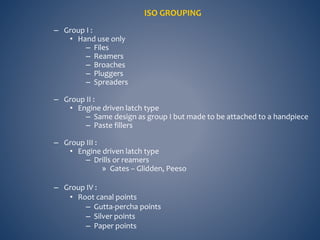
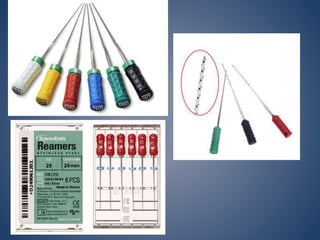
ISO GROUPING
– Group I :
• Hand use only
– Files
– Reamers
– Broaches
– Pluggers
– Spreaders
– Group II :
• Engine driven latch type
– Same design as group I but made to be attached to a handpiece
– Paste fillers
– Group III :
• Engine driven latch type
– Drills or reamers
» Gates – Glidden, Peeso
– Group IV :
• Root canal points
– Gutta-percha points
– Silver points
– Paper points
REQUISITES FOR IDEAL PULP SPACE FILLING MATERIALS
Grossman (1940)
1. Easily introduced in pulp space
2. Seals laterally and apically
3. Not shrinkable
4. Impervious to moisture
5. Bacteriostatic
6. Radiopaque
7. Should not stain tooth
8. Should not irritate peri-radicular tissues.
9. Should be sterile or be easily/quickly sterilized
10.Must be easy to remove if necessary
• Introduced by Elmer A. Jasper in 1933
• Pure silver molded in a conical shape
• Canal preparation
– Tapered converging walls
• Advantage
– Stiffer than gutta-percha
– Easier to insert in very narrow/ fine tortuous canals
• Disadvantages
– Poor lateral seal - cannot conform to the pulp space
– Corrosion of silver cones due to
• Presence of small amounts of other trace metals (e.g. 0.1% to 0.2% of copper
and nickel)
• Presence of metal restorations or posts in the tooth
• Loss of integrity of coronal restoration and exposure to saliva
• Canal irrigants
SILVER CONES
SOLID-CORE MATERIALS
METAL CORE MATERIALS
– Cannot independently seal root canal – cementing medium required
– Higher failure rates
– Difficulty in retrieving cones in case of retreatment
– Corrosion products
• Toxic
• Localized argyria/ tattoo
INDICATIONS
Mature teeth with small or well calcified round tapered canals
• Maxillary first premolar with 2 or 3 canals
• Buccal roots of maxillary molars
• Mesial roots of mandibular molars
CONTRA- INDICATIONS
• Youngsters
• Anterior teeth
• Single canal premolars
• Large single canals in molars
• Originally suggested by Sampeck in 1961
• Used to fill
– Fine, tortuous canals
– Heavily calcified dilacerated narrow canals
• Used instead of silver cones
• Advantages
– More rigid than silver cones
– Inserted into a canal with greater ease
– Less susceptible to corrosion
• Disadvantages
– Cannot independently seal the root canal, needs a cementing medium
– Excess sealer collects in the flutes of the instrument rather than being forced
against canal walls
STAINLESS STEEL FILES
• Gold (by Grove)
• Iridioplatinum
• Tantalum
• Titanium (by Messing)
• Amalgam
OTHER METAL CORE MATERIALS
DISADVANTAGES OF METAL CORE MATERIALS
• Require an absolutely circular canal preparation
• Often bind in one or two places of the root canal wall, giving a false
sense of fit
• Radiographically are deceptive because they give a dense appearance
to the root canal fill
• Corrode when in contact with either periradicular tissue fluids or oral
fluids, the corrosions products are highly cytotoxic
• Cannot obturate the canal system three dimensionally, requires a
sealer
GUTTA PERCHA IS AN ISOMER OF NATURAL
RUBBER AND THE NATURAL CHEMICAL
FORM OF GUTTA-PERCHA IS TRANS-1,4-
POLYISOPRENE.
PLASTIC CORE MATERIALS
CHEMISTRY
1,4, - POLYISOPRENE
TRANS FORM
CIS FORM
GUTTA PERCHA
NATURAL RUBBER
~ 60% CRYSTALLINE FORM LARGELY AMORPHOUS FORM
-Harder
-Less elastic
-Brittle
NATURAL GUTTA PERCHA
Alpha phase crystalline form
More linear structure
More stable
Undergoes a heating
process to allow inclusion
of the other elements -
mastication
Alpha phase molten melt
Cooled at a rate of 0.50C
Normal cooling
Beta phase
heated
540C to 600C
High molecular weight Low molecular weight
heated
420C to 490C
Boiled
(Processed form)
PHASES OF GUTTA PERCHA
ALPHA PHASE
• Natural tree product
• Low molecular weight polymer
• Lower melting point
• Low viscosity
• Increased stickiness
• Less shrinkage (2.2%)
• Newer products
– Thermafil
BETA PHASE
• Processed form
• High molecular weight polymer
• Higher melting point
• Higher viscosity
• Reduced stickiness
• More shrinkage (2.6%)
• Most commercial forms
Bunn 1942
First to suggest the existence of 3 crystalline forms:
Alpha Beta Gamma
Fisher D. 1953
Confirmed Bunn’s prediction of 3 crystalline forms of trans 1, 4 poly
isoprene
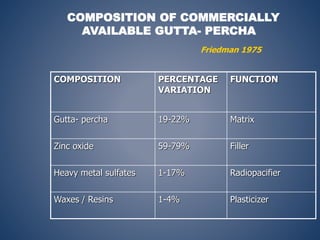
COMPOSITION OF COMMERCIALLY
AVAILABLE GUTTA- PERCHA
COMPOSITION PERCENTAGE
VARIATION
FUNCTION
Gutta- percha 19-22% Matrix
Zinc oxide 59-79% Filler
Heavy metal sulfates 1-17% Radiopacifier
Waxes / Resins 1-4% Plasticizer
Friedman 1975
• Softens at a temperature above 64C
• Easily dissolved in chloroform and halothane
• Heat or solvent plasticized gutta percha, results in shrinkage of 1% -2%
– Dental gutta percha when heated from 37o to 80oC and then cooled to 37oC
there is a net loss of about 1.4% in volume relative to precycle volume at 37oC
Schilder H. 1985
• 1mm thick gutta- percha has a radiopacity corresponding to 6.44 mm Al
• AGING (by Sorin and Oliet)
– Gutta percha oxidizes and becomes brittle when exposed to light and air
– Prevention
• Store in a cool dry place
– Rejuvenation
• Immersing cone in hot water (55C) for 1-2 sec and immediately immersing
in cold tap water (22oC) for 5-10 sec
PROPERTIES
• STERILIZATION OF GUTTA PERCHA CONES
– 5.25% or 5% NaOCl for 1 min
– Disinfected by
• 1% NaOCl – 1min
• 0.5% NaOCl – 5min
– After disinfection, gutta percha cones must be rinsed in ethyl alcohol to
remove crystallized NaOCl before obturation
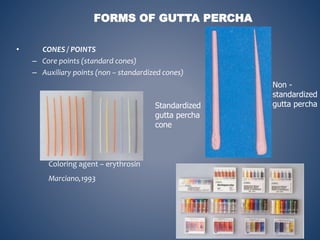
• CONES / POINTS
– Core points (standard cones)
– Auxiliary points (non – standardized cones)
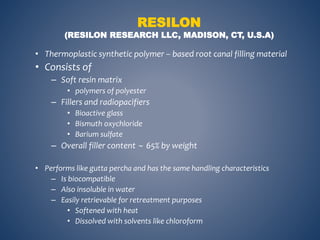
FORMS OF GUTTA PERCHA
Standardized
gutta percha
cone
Non -
standardized
gutta percha
Coloring agent – erythrosin
Marciano,1993
• Core points
– Sizing based on similar size and taper
as standardized endodontic files
– Used as master cones
ENDO GAUGE
or
GUTTA GAUGE
– Larger tolerance ( 0.05mm)
than endodontic files (±0.02mm)
• Auxiliary points
– Have a larger taper pointed tip
– Tolerance is  0.05 mm
– Length -  30mm  2mm
– Used as
• Accessory points during lateral compaction
• Master cones in warm vertical compaction and variable tapered preparation
• Greater taper gutta percha points
• GUTTA PERCHA PELLETS / BARS
– For use in thermoplasticized gutta
percha
– e.g. Obtura system
• SYRINGES
– As low viscosity gutta percha
– to be coated on carriers
– e.g. AlphaSeal, SuccessFil
• PRE COATED CORE CARRIER GUTTA PERCHA
– Stainless steel, titanium or plastic carrier
precoated with alpha phase gutta percha
– e.g. Thermafil
• GUTTA PERCHA SEALERS
– Dissolving gutta percha in chloroform / eucalyptol
– e.g. chloropercha, eucapercha
• ANTIBACTERIAL GUTTA PERCHA CONES
– IODOFORM CONTAINING GUTTA PERCHA
• MGP or MEDICATED GUTTA PERCHA (Lone Star Technologies, U.S.A)
• Developed by H. Martin, T.R. Martin – 1999
• Contains 10% iodoform
• Remains inert until it comes in contact with tissue fluids that activate the
free iodine
• Antimicrobial activity against
– Streptococcus viridans, sanguis
– Staphylococcus aureus
– Bacteroides fragilis
• To be used with MCS (Medicated Canal Sealer), a Z0E sealer that also
contains 10% iodoform
CALCIUM HYDROXIDE CONTAINING GUTTA PERCHA
- CALCIUM HYDROXID
- CALCIUM HYDROXID PLUS
(Roeko, Germany)
- HYGENIC CALCIUM HYDROXIDE POINTS
• Have a high percentage (40-60%) of calcium hydroxide
in a matrix of bio-inert gutta percha
• USES
– as an intra-canal medicament
– for treatment of root resorption
• ISO standard sizes
• Colour: light brown
Length: 28 mm long
• ROEKO's Calcium Hydroxid PLUS Points
– greater release of Ca(OH)2
– more effective over longer period
CHLORHEXIDINE – IMPREGNATED GP
ROEKO ACTIV POINTS (Roeko, Langenau,
Germany)
• Gutta percha matrix embedded
with 5% chlorhexidine diacetate
• For use as an intracanal medication
– temporary root canal filling
– prevention of reinfection
• ISO shaped points
• Radiopaque
Advantage
– Ease of introduction - It is firm for easy application yet flexible to follow
the curves of the canal.
– Ease of removal - It can easily be removed with tweezers or a probe even
after 3 weeks
– The stability of Activ point is not affected by the release of CHX in moisture
– No residue is left in the canal
• COMPACTIBILITY
– Adapts to the root canal walls
• BIOLOGICALLY INERT
– least reactive
– minimal toxicity
– minimal tissue irritability
– least allergenic
– well tolerated by periradicular
tissues
• DIMENSIONAL STABILITY
• BECOMES PLASTIC WHEN WARMED
• HAS KNOWN SOLVENTS
– Chloroform
– Xylol
• DOES NOT DISCOLOUR THE TOOTH
• IT IS RADIOPAQUE
ADVANTAGES OF GP
• UNDERGOES SHRINKAGE WHEN
PLASTICIZED
• DOES NOT POSSESS ADHESIVE
QUALITIES
• LACK OF RIGIDITY
• UNDERGOES VERTICAL
DISTORTION DURING COMPACTION
– Needs a definite apical
constriction / stop
DISADVANTAGES
RESILON
(RESILON RESEARCH LLC, MADISON, CT, U.S.A)
• Thermoplastic synthetic polymer – based root canal filling material
• Consists of
– Soft resin matrix
• polymers of polyester
– Fillers and radiopacifiers
• Bioactive glass
• Bismuth oxychloride
• Barium sulfate
– Overall filler content  65% by weight
• Performs like gutta percha and has the same handling characteristics
– Is biocompatible
– Also insoluble in water
– Easily retrievable for retreatment purposes
• Softened with heat
• Dissolved with solvents like chloroform
• Available as
– Master cones
• in all ISO sizes
• 0.04,0.06 taper
– Accessory cones – in different sizes
– Pellets – used for backfill in warm
thermoplasticized techniques
• Can be used for both warm and cold obturation
techniques
• Can be thermoplasticized, but at a lower temperature
– With the Obtura gun
• Reduce the temperature by 20degrees (i.e.
approx. 150 -170oC)
Unlike gutta percha
– It is white in colour
– More radiopaque
– Slightly stiffer
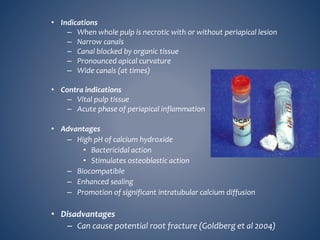
Resilon points and pellet
Gutta percha
points and pellet
It is used in conjunction with
– SELF – ETCHING PRIMER
• EPIPHANY PRIMER
(Pentron Clinical Technologies)
– SEALER
• EPIPHANY ROOT CANAL
SEALANT
(Pentron Clinical Technologies)
– Dual curable resin – based sealer
Advantages
– Adheres to the sealer
– Excellent sealing capability due to
creation of a “monobloc” which
adheres to the dentin walls
– Resists leakage six times more
– Strengthens the root by approximately
20%
– Provides an immediate coronal seal
– Shrinks only 0.5% when heated
• Is a polymer of hydroxy- ethyl- methacrylate (i.e., poly – HEMA)
– Is a hydrophilic acrylic resin
• Undergoes polymerization in an aqueous environment
– self polymerizing, rapid setting (10 minutes)
– Radiopaque
• Injected into root canal using a special syringe and needle, that allows
placement in thin and/or curved canals
HYDRON
CEMENT/PASTE FILLS
• Disadvantages
– Concerns of tissue toxicity by the unset material
– Lack of homogeneity
– Questionable ability to seal the root canal system
– Clinical use – proved unsatisfactory
ENDOCAL 10 (BIOCALEX 6.9)
( BIODENT, MONTREAL, QUEBEC)
• Calcium oxide material
• The French Paste
• CALCIUM OXIDE EXPANSION TECHNIQUE
• OCALEXIQUE ROOT CANAL THERAPY
• Used mainly in European countries for more than
30 years
• Used as the sole obturating material
– Method for treating infected and purulent
pulp
– More recently introduced because of
concern of cross reactivity to gutta percha
in individuals allergic to latex
• Expands on setting – “MATERIAL MIGRATION”
• Indications
– When whole pulp is necrotic with or without periapical lesion
– Narrow canals
– Canal blocked by organic tissue
– Pronounced apical curvature
– Wide canals (at times)
• Contra indications
– Vital pulp tissue
– Acute phase of periapical inflammation
• Advantages
– High pH of calcium hydroxide
• Bactericidal action
• Stimulates osteoblastic action
– Biocompatible
– Enhanced sealing
– Promotion of significant intratubular calcium diffusion
• Disadvantages
– Can cause potential root fracture (Goldberg et al 2004)
RESORCINOL – FORMALDEHYDE (RF) RESIN
THERAPY (RUSSIAN RED CEMENT)
• Unique method of endodontic therapy in Eastern Europe,
Russia, China
• Available as FOREDENT (Dental A S, Czech Republic)
• Consists of
– Formaldehyde / alcohol - liquid
– Resorcinol - powder
– Sodium hydroxide – catalyst
– Zinc oxide / barium sulfate – radiopacity (optional)
• Assumed that pulp tissue will be fixed and bacteria destroyed apical to the level
of the resin placement. Hence canals are frequently not instrumented or
obturated to their full length
• When 10% sodium hydroxide is added to the mixture, polymerization occurs
• Forms a “brick – hard red” material that has no known solvent
• DISADVANTAGES
– Retreatment is difficult
– Contains 2 potentially toxic
components
• Formaldehyde
• Resorcinol
– Not radiopaque
– Resorcinol discolors tooth
structure
• From pink to deep burgundy
• Darker colors when more
resorcinol is added to the paste
• By Mahmoud Torabinejad in 1993
• Available as ProRoot MTA (Dentsply)
– Gray MTA
– Off- white MTA
• Both formulas are
– 75% Portland cement
– 20% Bismuth oxide
– 5% gypsum
• Mainly used for obturation of apical third - Open apex cases
• Powder consists of fine, hydrophilic particles
– in the presence of water creates a colloidal gel solidifying within 4 hours – 7hours
• Water: Powder ratio of 1:3
– increased water: powder mixing ratios could account for increased solubility and
porosity of the material Fridland et al 2003
• Properties
– Good sealing ability
– Extremely biocompatible
– Histologically - Induction of osteoid like material
– Low cyotoxicity
– Has a much longer working time - In moist environment sets in about 7 hrs
MINERAL TRIOXIDE AGGREGATE
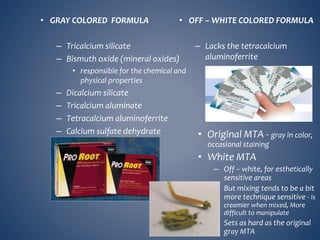
• GRAY COLORED FORMULA
– Tricalcium silicate
– Bismuth oxide (mineral oxides)
• responsible for the chemical and
physical properties
– Dicalcium silicate
– Tricalcium aluminate
– Tetracalcium aluminoferrite
– Calcium sulfate dehydrate
• OFF – WHITE COLORED FORMULA
– Lacks the tetracalcium
aluminoferrite
• Original MTA - gray in color,
occasional staining
• White MTA
– Off – white, for esthetically
sensitive areas
– But mixing tends to be a bit
more technique sensitive - Is
creamier when mixed, More
difficult to manipulate
– Sets as hard as the original
gray MTA
Matt et al 2004
– Gray MTA demonstrated significantly less leakage than white MTA
• Probably the elimination of tetracalcium aluminoferrite – responsible for
altered properties of the material
• Perhaps slight volumetric shrinkage occurred with the white product that
accounts for the increased leakage
– Two – step technique showed significantly less leakage than one –step
• showed periradicular healing similar to teeth with fresh MTA placed as a root
- end filling material
– 5mm thick barrier was significantly harder than 2mm barrier: regardless
of type of MTA or number of steps
– The thickness of the MTA barrier demonstrated no significant statistical
difference in microleakage (dye penetration)
• Active Biosilicate technology
• Composition –
• Powder
Tri-calcium Silicate (C3S) Main core material
Di-calcium Silicate (C2S) Second core material
Calcium Carbonate and Oxide Filler
Iron Oxide Shade
Zirconium Oxide Radiopacifier
• Liquid
Calcium chloride Accelerator
Hydrosoluble polymer Water reducing agents
• Indication - repair of perforations or resorptions, apexification, root-end filling
• Advantages –
highly biocompatible
easy to handle
Reduced S.T. – 9-12 mins
Bioactive – able to promote mineralization
BIODENTINE
• 2 calcium phosphate powders
– Acidic – dicalcium phosphate dihydrate / anhydrous dicalcium phosphate
– Basic – Tetracalcium phosphate
• When mixed with water sets into a hardened mass - hydroxyapatite
• Sets within 5 minutes
• By adding glycerin to the mixture
– Setting time can be extended
– Can be extruded from a 19 gauge needle
• Final set cement
– Nearly all-crystalline material
– As radiopaque as bone
– Nearly insoluble in water, saliva and blood
– Readily soluble in strong acids
– Has a porosity that is in direct ratio to the amount of solvent (water) used
CALCIUM – PHOSPHATE CEMENT
• Toxicity – from components of some paste that either leach out of the paste
or are in contact with the periradicular tissues
• Porosities in paste fills
• Most pastes resorb in time resulting in leakage, percolation and strong
possibility of ultimate endodontic failure
• Systemic recovery of certain components in blood samples and various vital
organs
• Antigenic chemical components – causing immunologic response
• Apical control of pastes fills is all but impossible especially when no apical
stop is present or a root perforation exists
DISADVANTAGES OF PASTE FILLS
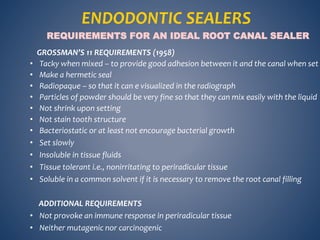
GROSSMAN’S 11 REQUIREMENTS (1958)
• Tacky when mixed – to provide good adhesion between it and the canal when set
• Make a hermetic seal
• Radiopaque – so that it can e visualized in the radiograph
• Particles of powder should be very fine so that they can mix easily with the liquid
• Not shrink upon setting
• Not stain tooth structure
• Bacteriostatic or at least not encourage bacterial growth
• Set slowly
• Insoluble in tissue fluids
• Tissue tolerant i.e., nonirritating to periradicular tissue
• Soluble in a common solvent if it is necessary to remove the root canal filling
ADDITIONAL REQUIREMENTS
• Not provoke an immune response in periradicular tissue
• Neither mutagenic nor carcinogenic
REQUIREMENTS FOR AN IDEAL ROOT CANAL SEALER
ENDODONTIC SEALERS
Functions of sealers
• Serves as a filler for canal irregularities and minor discrepancies
between the root canal wall and core filling material
• To obturate the lateral canals
• Acts as lubricant
• Enhances the possible attainment of an impervious seal
• Can assist in microbial control of root canal walls or in tubules
• For radiopacity
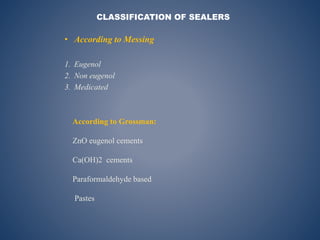
• According to Messing
1. Eugenol
2. Non eugenol
3. Medicated
CLASSIFICATION OF SEALERS
According to Grossman:
ZnO eugenol cements
Ca(OH)2 cements
Paraformaldehyde based
Pastes
BASED ON ABSORBABILITY
Absorbable
• Kerr Sealer (Rickert)
• Grossman's Sealer
• Roth Root Canal Cement
• Tubliseal , Tubliseal EWT
• Sealapex
Non-absorbable
• Diaket (polyvinyl resin)
• AH-26 (epoxy type resin)
• Ketac Endo
• Setting time, dimensional stability and solubility and disintegration tests
are conducted at a temperature of 37±10C and a relative humidity of not
less than 95% in addition to bench testing at room temperature and
humidity
• Working time
– is required to be within ±10% of that claimed by the manufacturer when placed
under a load of 120 g for 10 min, 210 ± 5 seconds after the commencement of
mixing
• Flow
– The material should show a disc diameter of at least 25mm when placed under
a load of 120 g for 10 min, 210 ± 5 seconds after the commencement of mixing
• Film Thickness
– Film thickness of a root canal sealer should not exceed 50mm when placed
under a load of 15 kg for 10 min, 210 ± 5 seconds after the commencement of
mixing
REQUIREMENTS FOR PHYSICAL PROPERTIES OF
ENDODONTIC SEALING MATERIALS ACCORDING
TO ADA SPECIFICATION NO. 57
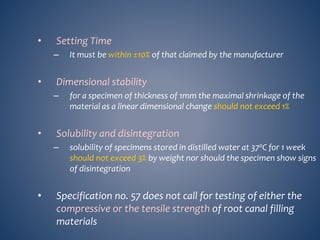
• Setting Time
– It must be within ±10% of that claimed by the manufacturer
• Dimensional stability
– for a specimen of thickness of 1mm the maximal shrinkage of the
material as a linear dimensional change should not exceed 1%
• Solubility and disintegration
– solubility of specimens stored in distilled water at 370C for 1 week
should not exceed 3% by weight nor should the specimen show signs
of disintegration
• Specification no. 57 does not call for testing of either the
compressive or the tensile strength of root canal filling
materials
CHLOROPERCHA
[chloroform + gutta percha]
• Not adhesive
• Increased shrinkage
• Decreased radiopacity
• Chloroform – potential
carcinogen
CALLAHAN-
JOHNSTON
TECHNIQUE
[DIFFUSION
TECHNIQUE]
Chloroform + rosin
gutta percha
KLOROPERKA N- Ø
chloroform + resin +
zinc oxide
gutta percha
EUCAPERCHA
eucalyptol
gutta percha
GUTTA PERCHA BASED SEALERS
• Is a premixed sealer
• Made by mixing white gutta-percha with chloroform
– Gutta – percha – 9.0
– Chloroform – 91.0
• Allows gutta – percha to fit better in the canal
• Disadvantages
– Has no adhesive properties
– 1mm of chloropercha has radiodensity of 1.2 – 2.7mm of Aluminium
– Shrinkage because of evaporation of chloroform
– Technique is very sensitive to proper manipulations
– Chloroform
• Concerns about toxicity and carcinogenicity
• Known hepatotoxin
CHLOROPERCHA
KERR PULP CANAL SEALER (Sybron Endo / Kerr; Orange, CA)
• Developed in 1931 as RICKERT’S SEALER
• Developed as an alternative to gutta percha based sealers
• Composition
– POWDER
Zinc oxide 34.0 – 41.2
Silver 25.0 – 30.0
Oleoresins
(White resins) 30.0 – 16.0
Thymol iodide 11.0 – 12.8
– LIQUID
Oil of Cloves 78.0 – 80.0
Canada balsam 20.0 – 22.0
ZINC OXIDE EUGENOL SEALERS
PROPERTIES
• Has germicidal and adhesive properties
• Is radiopaque
• Has severe staining properties because of silver content
– discoloration of teeth
• Powder : liquid ratio – 1:1
• Has average tissue toxicity
• Is resorbed from periapical tissues over time
• Has rapid setting time in high heat / humid conditions
• Now available in 2 versions
– Regular Pulp Canal Sealer – regular set
– Pulp Canal Sealer EWT – extended working time
• Pulp Canal Sealer EWT
– Working time – 6 hours
– Used with heated gutta percha technique
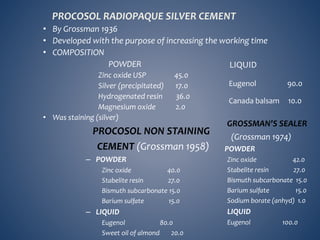
PROCOSOL RADIOPAQUE SILVER CEMENT
• By Grossman 1936
• Developed with the purpose of increasing the working time
• COMPOSITION
POWDER
Zinc oxide USP 45.0
Silver (precipitated) 17.0
Hydrogenated resin 36.0
Magnesium oxide 2.0
• Was staining (silver)
LIQUID
Eugenol 90.0
Canada balsam 10.0
PROCOSOL NON STAINING
CEMENT (Grossman 1958)
– POWDER
Zinc oxide 40.0
Stabelite resin 27.0
Bismuth subcarbonate 15.0
Barium sulfate 15.0
– LIQUID
Eugenol 80.0
Sweet oil of almond 20.0
GROSSMAN’S SEALER
(Grossman 1974)
POWDER
Zinc oxide 42.0
Stabelite resin 27.0
Bismuth subcarbonate 15.0
Barium sulfate 15.0
Sodium borate (anhyd) 1.0
LIQUID
Eugenol 100.0
– Factors affecting setting time
• Quality of the ZnO
• Quality of the eugenol (oxidized and brown  sets too rapidly)
• Mixing technique
• Amount of humidity in atmosphere
• Temperature and dryness of mixing slab and spatula
• pH of the resin used
• Amount of sodium borate
– Spatulation time – a minute per drop of liquid
– Proper consistency
• Smooth creamy mix
• String out test
– Should string out at least an inch before breaking
• Drop test
– Suspended mix should cling to the inverted spatula blade for 10 – 15
sec before dropping
• ADVANTAGES
– Good sealing potential because of small volumetric change on setting
– Resorbs gradually if extruded apically
– Reversible inhibitory effect on nerve tissue
• DISADVANTAGES
– Is a weak unstable material
– Decomposed by water through a continuous loss of eugenol
– Not a good choice for retrofillings
TUBLI – SEAL (Kerr Dental)
• Developed in 1961 because of staining of Kerr’s Pulp Canal Sealer
• 2 paste system
• COMPOSITION
– BASE
Zinc oxide 59.0 – 57.4
Oleoresins 18.5 – 21.25
Bismuth trioxide 7.5
Thymol iodide 5.0 – 3.75
Oils and waxes 10.0 – 10.1
– CATALYST
Eugenol
Polymerized resin
Annidalin
• PROPERTIES
– Non staining sealer, white in colour
– Quick and easy to mix
– Expands on setting
– Good radiopacity
– Extremely lubricating – allows maximal compaction and packing
– Appears to be irritating to periapical tissue
– Rapid set (<30 min) especially in presence of moisture
WACH’S CEMENT (Roth’s Pharmacy, Chicago)
• COMPOSITION
– POWDER
Zinc oxide 61.0 – 61.4
Calcium phosphate tribasic 12.0 – 12.2
Bismuth subnitrate 21.0 – 21.4
Bismuth subiodide 2.0 – 21.4
Magnesium oxide (heavy) 4.0 – 3.1
– LIQUID
Canada balsam 74.0 – 76.9
Oil of clove USP 22.0 – 23.1
Eucalyptol 2.0
Beechwood creosote 2.0
[Because of known toxicity, beechwood creosote was removed later]
• Presently sold as SEALEX EXTRA
PROPERTIES
– Smooth consistency without a heavy body
– Liquid to powder ratio can be varied for thinner / thicker mix
– Odour of liquid – unpleasant
– Complete healing of periapical region if extruded
NOGENOL (G – C America)
• Zinc oxide – non eugenol based sealer
• Developed to overcome the irritating quality of eugenol
• Product is an outgrowth of a non – eugenol periodontal pack
• COMPOSITION
– BASE
Zinc oxide
Barium sulfate
– ACCELERATOR
Hydrogenated rosin
Methyl abietate
Lauric acid
Chlorothymol
Salicylic acid
• PROPERTIES
– Less irritating to the tissue
– Expands on setting and may improve the sealing efficiency with time
N2 (Agsa, Locarno, Switzerland)
• Term coined by Angelo Sargenti
– To describe the second nerve
– To coincide the color of the filling material
(red) to the color of the pulp
• Formaldehyde containing ZnOE sealer
• Introduced by Sargenti and Ritcher in 1954
• Used as a core filling material
– Also known as ‘Sargenti technique’
• Used as a sealer
– Seals well with a core
• American counterpart - RC2B
RESIN BASED SEALERS
EUGENOL BASED RESIN SEALERS
PROPERTIES:
– N2 is very toxic
– Causes a coagulations necrosis of the tissues in less than 3 days
• Tissues altered to such an extent cannot undergo repair
– Irreversibly inhibit nerve tissue
– Loses substantial volume when exposed to fluid (Para formaldehyde)
– Also absorbs more than 2% of fluid during the 1st week in situ
DIAKET (3M /Espe, Seefeld, Ger)
• By Schmidt in 1951
• Polyketone compound
• Modified zinc oxide cement
• Widely used in Europe either with gutta
percha or alone as a paste fill material
COMPOSITION
– POWDER
• Zinc oxide
• Bismuth phosphate
– LIQUID
• 2,2’ Dihydroxy – 5,5’ dichlorodiphenye methane
• Proprionylacetophenone (B-diketone)
• Triethanolamine
• Caproic acid
• Copolymers of vinylacetate, vinyl chloride and vinyl isobutyl ether
PROPERTIES
– Powder: Liquid ratio – 1:2
– Very tacky material- difficult to manipulate
– Good adhesion
– Sets quickly in the root canal at room temperature
– Good volume stability
– Low solubility
– Superior tensile strength
– Is highly toxic and causes extensive tissue necrosis
– Irritation is long lasting
– Has a greater tendency towards fibrous encapsulation if extruded
AH-26 (Dentsply/ deTrey, Zurich)
• COMPOSITION
– POWDER
Silver powder 10.0
Bismuth oxide (radiopacity) 60.0
Hexamethylene tetramine 25.0
Titanium oxide 5.0
– LIQUID
Bis- phenol diglycidyl ether 100.0
EPOXY BASED SEALERS
PROPERTIES
Has good handling characteristics
Can be warmed on a glass slab over an alcohol flame to decrease viscosity
Has strong adhesive properties - seals well
Contracts slightly while hardening
Once set has one of the lowest toxicities and is well tolerated by periapical
tissues
AH Plus:
AH Plus is a two-component paste: root canal sealer based on epoxy- amine
resin chemistry.
This easy-to-mix sealer adapts closely to the walls of the prepared root canal
and provides minimal shrinkage upon setting as well as outstanding longterm
dimensional stability and sealing properties.
Composition:
AH Plus Paste A:
BADGE
Calcium tungstate
Zirconium oxide
Silica
Iron oxide pigments
AH Plus Paste B:
Adamantane amine
(N,N-dibenzoyl-5-oxanonane-diamine-I.9-
TCD-diamine)
Silica
Silicone oil
• The working time is at minimum 4 hours at 23 0c
• The setting time is at minimum 8 hours at 37 °c
Advantages:
1. Excellent biocompatibility
2. User-friendly handling and application
3. Optimal working time and easier removal
4. Outstanding physical properties
5. Excellent radiopacity
6. Suitable for all root canal obturation techniques.
Adverse reactions:
• With sealers containing epoxy resins,
the following adverse
reactions were reported:
•Reversible acute inflammation of the
oral mucosa after contact
with the unset paste.
•In individual cases, local and systemic
allergic reactions have been
reported.
AH-26
• Powder-liquid system
• When freshly prepared releases small
amounts of formaldehyde
– Antibacterial
– Toxic
• Staining
• Film thickness-39µ
– good flow
• Sets slowly in 24-36 hours
• Good radiopacity
– 1mm of AH-26 equals 6.66mm of Al
• Is not sensitive to moisture and has low
solubility
• Also available as Therma Seal
AH-PLUS
• Paste –paste system
• Less toxic
• New amines added to maintain the
natural colour of the tooth
• Half the film thicknesses
– Better flow
• Shorter setting time of 8 hours
• Increased radiopacity
• Has half the solubility of AH-26
• Therma Seal Plus /Top Seal
AH-26 AH-PLUS
ENDO REZ (Ultradent Products, South Jordan, UT)
• Hydrophilic, chemical set material
• Supplied in a Two-Spense mixing and delivery syringe
• COMPOSITION
– Zinc oxide
– Barium sulfate
– Resins
– Pigments
– In a matrix of urethane dimethacrylate resin
METHACRYLATE BASED SEALERS
PROPERTIES
– Has radiopacity similar to gutta percha cones
– Does not compromise the use of dentin bonding agents
FIBREFILL ROOT CANAL SEALANT
• Its composition resembles that of dentin-bonding agents
• COMPOSITION
– Mixture of UDMA, PEGDMA, HDDMA and BIS-GMA resins
– Treated barium borosilicate glasses
– Barium sulfate
– Silica
– Calcium hydroxide
– Calcium phosphates
– Stabilizers
– Pigments
– Benzoyl peroxide
• Used in combination with a self - cured primer (Fibrefill Primer
A&B)
EPIPHANY ROOT CANAL SEALANT
• Is a dual-curing, hydrophilic resin sealer
• Used with Resilon core materials
• Dispensed from a double barrel, auto-mix syringe
Composition
– Resin matrix
• Mixture of Bis GMA
• Ethoxylated Bis GMA
• UDMA
• Hydrophilic difunctional methacrylates
– Fillers
• Calcium hydroxide
• Barium sulfate
• Barium glass
• Silica
– Total filler content
• 70% by weight
• Properties
– bonds to both the Epiphany Primer and Resilon obturating material
– can be light cured for an immediate coronal seal
– self cures apically in 25 minutes
– shrinks 2-3% on polymerization
– highly radiopaque
– easy to remove
– Resorbable
– non-mutagenic
– non-cytotoxic
– Biocompatible
– less irritating than epoxy resin or ZOE sealers
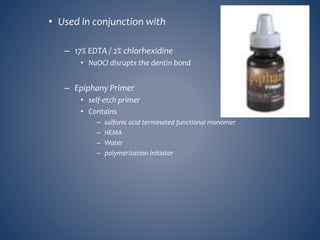
• Used in conjunction with
– 17% EDTA / 2% chlorhexidine
• NaOCl disrupts the dentin bond
– Epiphany Primer
• self-etch primer
• Contains
– sulfonic acid terminated functional monomer
– HEMA
– Water
– polymerization initiator
SEALAPEX
( Sybron Endo/ Kerr, Orange, CA)
• Basically a zinc oxide based calcium
hydroxide containing polymeric resin root
canal sealer
• Available as 2 tubes-2 paste system
• COMPOSITION
– BASE
Zinc oxide
Calcium hydroxide
Butyl benzene
Sulfonamide
Zinc stearate
– CATALYST
Barium sulfate
Titanium dioxide
Isobutyl salicylate ( proprietary resin)
Aerocil R972
CALCIUM HYDROXIDE SEALERS
• Also available in 2 forms
– SEALAPEX REGULAR
– SELAPEX EWT
• PROPERTIES
– Has poor cohesive strength
– Easily disintegrate in the tissue and causes chronic inflammation
– Claims of therapeutic effect
– Takes a long time to set
– Absorbs more water (may be due to its porosity) and expands
while setting
CRCS (CALCIBIOTIC ROOT CANAL SEALER)
• Zinc oxide eugenol / eucalyptol sealer to which calcium hydroxide has been
added
• COMPOSITION
– POWDER
• Zinc oxide
• Calcium hydroxide
• Barium sulfate
• Bismuth subcarbonate
• Hydrogenated resin ester
PROPERTIES
– Takes 3 days to set fully in dry/ humid environment in-vitro
– Therapeutic effect
– Has poor cohesive strength
– Quite stable, shows very little water sorption
– Causes chronic inflammation if extruded peri-apically
– Easily disintegrate in the tissue
LIQUID
Eugenol
Euclayptol
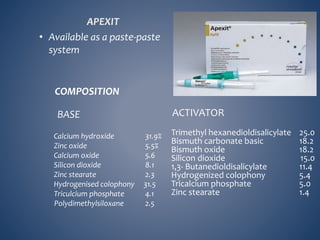
APEXIT
• Available as a paste-paste
system
ACTIVATOR
Trimethyl hexanedioldisalicylate 25.0
Bismuth carbonate basic 18.2
Bismuth oxide 18.2
Silicon dioxide 15.0
1,3- Butanedioldisalicylate 11.4
Hydrogenized colophony 5.4
Tricalcium phosphate 5.0
Zinc stearate 1.4
COMPOSITION
BASE
Calcium hydroxide 31.9%
Zinc oxide 5.5%
Calcium oxide 5.6
Silicon dioxide 8.1
Zinc stearate 2.3
Hydrogenised colophony 31.5
Triculcium phosphate 4.1
Polydimethylsiloxane 2.5
APATITE ROOT SEALER Type I
– POWDER
• - Tricalcium phosphate
• Hydroxyapatite
– LIQUID
• Polyacrylic acid Water
APATITE ROOT SEALER Type II
– POWDER
• - Tricalcium phosphate
• Hydroxygapatite
• Iodoform
– LIQUID
• Polyacrylic acid
• Water
APATITE ROOT SEALER
COMPOSITION
CALCIUM PHOSPHATE BASED SEALERS
BIOSEAL
• Hydroxyapatite containing eugenol sealer
• COMPOSITION
– POWDER
• Hydroxyapatite 60%
• Barium sulfate 20%
• Iodothymol 4.2%
• Resin 16.4%
– LIQUID
• Eugenol
– Powder is supplied in capsules
• Hydroxyapatite has no adverse effect in sealing ability
KETAC-ENDO
• Introduced by Ray & Seltzer in
1991
• PROPERTIES
– Film thickness-22 microns
– Exhibits modified working
and setting times
– Technically less demanding
– No shrinkage upon setting
– Radiopaque
GLASS IONOMER SEALERS
• Superior adaptation to canal walls (dentin bonding property)
makes root resistant to fracture has inherent potential of
providing a more stable apical seal
• Polyacrylic acid may chelate with zinc oxide of gutta percha cones
by forming salt bridges
• CHARLES Q LEE, 1997
– Absence of chemical bonding to gutta percha cones
– Gutta percha surface altered by etching effect
– More of a mechanical /physical phenomenon
• FRIEDMAN, 1995
– Teeth filled with a single cone leaked more than laterally condensed
gutta percha
– No known solvent- difficult to remove
– Good biocompatibility in bone and tissue
– Extruded sealer is highly resistant to resorption by tissue
fluids and becomes an implant in the periapical tissues
ENDOMETHASONE
• Formulation very similar to N2
• Pink antiseptic powder mixed
with engenol
FORMALDEHYDE CONTAINING SEALERS
COMPOSITION
– POWDER
• Zinc oxide 100.0
• Bismuth subnitrate 100.0
• Dexamethasone 0.01
• Hydrocortisone acetate 1.60
• Thymol iodide 25.00
• Paraformaldehyde 2.20
– LIQUID
• Eugenol
SPAD
• Advertised as a one-visit non-irritant radiopaque filling and sealer
• Bakelite type resin
• COMPOSITION
– POWDER
• Phenyl mercuric borate 0.16
• Calcium hydroxide 0.94
• Hydrocoxtisone acetate 2.00
• Paraformaldehyde 4.70
• Titanium oxide 6.30
• Barium sulfate 13.00
• Zinc oxide 72.90
– LIQUID L
• Glycerine 13.00g
• Formaldehyde 87.00 g
– LIQUID L .D
• Hydrochloric acid 20.00
• Resorcinol 25.00
• Glycerine 55.00
• Recommended for pulpotomies in deciduous teeth
• Also used as a root-filling paste
• S.T. - 24 hours during which small quantities of formaldehyde gas are released
RIEBLER’S PASTE
• Resin type of sealer containing formaldehyde
• COMPOSITION
– POWDER
• Zinc oxide
• Formaldehyde (polymerized)
• Barlum sulfate
• Phenol
– LIQUID
• Formaldehyde.
• Sulphuric acid.
• Ammonia.
• Glycerin.
LEE ENDOFILL
• Injectable silicone resin
• Reported to be non-irritant to tissues and stable
• Paste is a distinctive pale pink colour
• Sets to a rubbery solid similar to gutta percha
• Has a low viscosity prior to setting- which allows good adaptation
• Setting time can be adjusted from 10-60 min
• Can be used to directly fill the canal (paste filler) using a precision
syringe
• Can also be used as a sealer with gutta percha
SILICONE BASED SEALERS
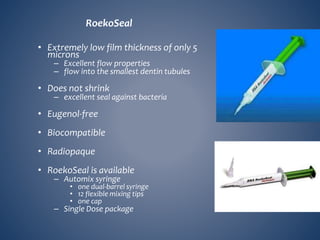
RoekoSeal
• Extremely low film thickness of only 5
microns
– Excellent flow properties
– flow into the smallest dentin tubules
• Does not shrink
– excellent seal against bacteria
• Eugenol-free
• Biocompatible
• Radiopaque
• RoekoSeal is available
– Automix syringe
• one dual-barrel syringe
• 12 flexible mixing tips
• one cap
– Single Dose package
• Composed of –
Zirconium Oxide
Calcium silicate
Calcium Phosphate monobasic
Calcium Hydroxide
Filling & thickening agents
BC Sealer & BC Obturation Kit
Available in premixed syringe
calibrated with intracanal tips
Properties –
As a hydrophilic sealer it utilizes moisture within the canal to complete the setting
reaction
Does not shrink on setting
Biocompatible
Antimicrobial
Bioactive
ENDOSEQUENCE BC SYSTEM
Factors to be considered in selection of sealers
• These are determined by the need for each case
– Amount of lubrication that is needed
– Working time anticipated
– Temperature of core materials
– Irritating potential of sealer, if it escapes into peri-apcial tissues
– Choice of intra canal irrigants and medicaments
– Antimicrobial action
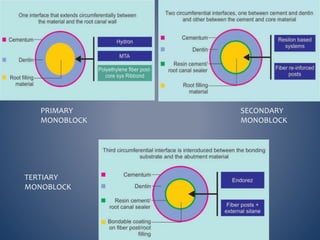
• Monoblock concept means the creation of a solid,
bonded, continuous material from one dentin wall of the
canal to the other. Monoblock phenomenon strengthens
the root by approximately 20%.
• Classification ( based on number of interfaces present
between core filling material and bonding substrate):
• Primary: In this, obturation is completely done with
core material, as en masse materials. Example: use of
Hydron, MTA, BioGutta
• Secondary: These have two circumferential interfaces,
one between sealer and the primed dentin and other
between the sealer and core material . Eample: resilon-
based system.
• Tertiary: In this, conventional gutta-percha surface is
coated with resin which bonds with the sealer, which
further bonds to canal walls. So, there are three
circumferential interfaces
MONOBLOCK
CONCEPT
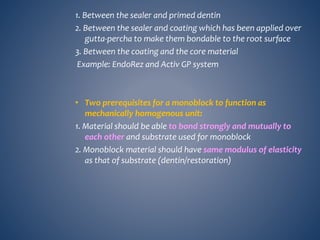
1. Between the sealer and primed dentin
2. Between the sealer and coating which has been applied over
gutta-percha to make them bondable to the root surface
3. Between the coating and the core material
Example: EndoRez and Activ GP system
• Two prerequisites for a monoblock to function as
mechanically homogenous unit:
1. Material should be able to bond strongly and mutually to
each other and substrate used for monoblock
2. Monoblock material should have same modulus of elasticity
as that of substrate (dentin/restoration)
PRIMARY
MONOBLOCK
SECONDARY
MONOBLOCK
TERTIARY
MONOBLOCK
During the past 15 years, great efforts have been made to enhance the
manipulative properties of gutta-percha by thermoplastcizing or thermo
softening it.
It is important to realize that no filling material will be effective without
thorough cleaning & shaping.
There is no single material that fulfills all the criteria but success is more if
they are used with proper case selection.
One should remember that there is no material that guarantees a ‘leak proof
canal’.
CONCLUSION

OBTURATING MATERIALS.pptx

  • 1.
  • 2.
    • INTRODUCTION • RATIONALEFOR OBTURATION • OBJECTIVES OF OBTURATION • CLASSIFICATION OF ROOT CANAL FILLING MATERIALS • REQUIREMENTS OF IDEAL OBTURATING MATERIAL • SOLID – CORE MATERIALS • IDEAL REQUIREMENTS OF SEALER • CLASSIFICATION OF SEALERS • OBTURATION TECHNIQUES • CONCLUSION
  • 3.
    INTRODUCTION Obturation is thefinal step in endodontic treatment and it involves complete obliteration of the radicular space with an inert material. Success in pulp space therapy is by sealing the apical and coronal areas of potential leakage after meticulous cleaning and shaping. However the pulp space system consists of fins, lateral and accessory canals which are difficult to obturate using traditional techniques. Approximately 60% of all endodontic treatment fails due to incomplete obturation, thus the development of obturation materials & techniques has gained more importance than ever.
  • 4.
    • Substitution ofan inert filling in the space previously occupied by the pulp tissue • To eliminate all avenues of leakage from the oral cavity or the periradicular tissues into the root canal system (i.e. to attain a three dimensional fluid impervious seal apicaly, laterally and coronally within the confines of the root canal system) Mid 1960’s Hermetic seal Grossman 1970’s-1980’s Three dimensional filling Schilder 1967 1980’s Fluid impervious seal Ramsey 1982 • To seal within the system any irritants that cannot be fully removed during canal cleaning and shaping procedures • To adequately seal iatrogenic causes such perforations, ledges and zipped apices OBJECTIVES OF OBTURATION
  • 5.
    Radiographically – To attaina radiographic appearance of a dense three dimensional filling which extends as close as possible to the cemento dentinal junction without gross over extension or under filling in the presence of a patent canal – Obturated root canal should reflect a shape that is approximately the same shape as the root morphology – Shape of the obturated canal should reflect a continuously tapering funnel preparation without excess removal of tooth structure at any level of the canal system
  • 6.
    Grossman • SOLID –CORE MATERIALS – Metals – Plastics – Cements/pastes • SEALERS – Plastics – Cements – Pastes CLASSIFICATION OF ROOT CANAL FILLING MATERIALS
  • 7.
    ISO GROUPING – GroupI : • Hand use only – Files – Reamers – Broaches – Pluggers – Spreaders – Group II : • Engine driven latch type – Same design as group I but made to be attached to a handpiece – Paste fillers – Group III : • Engine driven latch type – Drills or reamers » Gates – Glidden, Peeso – Group IV : • Root canal points – Gutta-percha points – Silver points – Paper points
  • 10.
    REQUISITES FOR IDEALPULP SPACE FILLING MATERIALS Grossman (1940) 1. Easily introduced in pulp space 2. Seals laterally and apically 3. Not shrinkable 4. Impervious to moisture 5. Bacteriostatic 6. Radiopaque 7. Should not stain tooth 8. Should not irritate peri-radicular tissues. 9. Should be sterile or be easily/quickly sterilized 10.Must be easy to remove if necessary
  • 11.
    • Introduced byElmer A. Jasper in 1933 • Pure silver molded in a conical shape • Canal preparation – Tapered converging walls • Advantage – Stiffer than gutta-percha – Easier to insert in very narrow/ fine tortuous canals • Disadvantages – Poor lateral seal - cannot conform to the pulp space – Corrosion of silver cones due to • Presence of small amounts of other trace metals (e.g. 0.1% to 0.2% of copper and nickel) • Presence of metal restorations or posts in the tooth • Loss of integrity of coronal restoration and exposure to saliva • Canal irrigants SILVER CONES SOLID-CORE MATERIALS METAL CORE MATERIALS
  • 12.
    – Cannot independentlyseal root canal – cementing medium required – Higher failure rates – Difficulty in retrieving cones in case of retreatment – Corrosion products • Toxic • Localized argyria/ tattoo INDICATIONS Mature teeth with small or well calcified round tapered canals • Maxillary first premolar with 2 or 3 canals • Buccal roots of maxillary molars • Mesial roots of mandibular molars CONTRA- INDICATIONS • Youngsters • Anterior teeth • Single canal premolars • Large single canals in molars
  • 13.
    • Originally suggestedby Sampeck in 1961 • Used to fill – Fine, tortuous canals – Heavily calcified dilacerated narrow canals • Used instead of silver cones • Advantages – More rigid than silver cones – Inserted into a canal with greater ease – Less susceptible to corrosion • Disadvantages – Cannot independently seal the root canal, needs a cementing medium – Excess sealer collects in the flutes of the instrument rather than being forced against canal walls STAINLESS STEEL FILES
  • 14.
    • Gold (byGrove) • Iridioplatinum • Tantalum • Titanium (by Messing) • Amalgam OTHER METAL CORE MATERIALS DISADVANTAGES OF METAL CORE MATERIALS • Require an absolutely circular canal preparation • Often bind in one or two places of the root canal wall, giving a false sense of fit • Radiographically are deceptive because they give a dense appearance to the root canal fill • Corrode when in contact with either periradicular tissue fluids or oral fluids, the corrosions products are highly cytotoxic • Cannot obturate the canal system three dimensionally, requires a sealer
  • 15.
    GUTTA PERCHA ISAN ISOMER OF NATURAL RUBBER AND THE NATURAL CHEMICAL FORM OF GUTTA-PERCHA IS TRANS-1,4- POLYISOPRENE. PLASTIC CORE MATERIALS CHEMISTRY 1,4, - POLYISOPRENE TRANS FORM CIS FORM GUTTA PERCHA NATURAL RUBBER ~ 60% CRYSTALLINE FORM LARGELY AMORPHOUS FORM -Harder -Less elastic -Brittle
  • 16.
    NATURAL GUTTA PERCHA Alphaphase crystalline form More linear structure More stable Undergoes a heating process to allow inclusion of the other elements - mastication Alpha phase molten melt Cooled at a rate of 0.50C Normal cooling Beta phase heated 540C to 600C High molecular weight Low molecular weight heated 420C to 490C Boiled (Processed form)
  • 17.
    PHASES OF GUTTAPERCHA ALPHA PHASE • Natural tree product • Low molecular weight polymer • Lower melting point • Low viscosity • Increased stickiness • Less shrinkage (2.2%) • Newer products – Thermafil BETA PHASE • Processed form • High molecular weight polymer • Higher melting point • Higher viscosity • Reduced stickiness • More shrinkage (2.6%) • Most commercial forms Bunn 1942 First to suggest the existence of 3 crystalline forms: Alpha Beta Gamma Fisher D. 1953 Confirmed Bunn’s prediction of 3 crystalline forms of trans 1, 4 poly isoprene
  • 18.
    COMPOSITION OF COMMERCIALLY AVAILABLEGUTTA- PERCHA COMPOSITION PERCENTAGE VARIATION FUNCTION Gutta- percha 19-22% Matrix Zinc oxide 59-79% Filler Heavy metal sulfates 1-17% Radiopacifier Waxes / Resins 1-4% Plasticizer Friedman 1975
  • 19.
    • Softens ata temperature above 64C • Easily dissolved in chloroform and halothane • Heat or solvent plasticized gutta percha, results in shrinkage of 1% -2% – Dental gutta percha when heated from 37o to 80oC and then cooled to 37oC there is a net loss of about 1.4% in volume relative to precycle volume at 37oC Schilder H. 1985 • 1mm thick gutta- percha has a radiopacity corresponding to 6.44 mm Al • AGING (by Sorin and Oliet) – Gutta percha oxidizes and becomes brittle when exposed to light and air – Prevention • Store in a cool dry place – Rejuvenation • Immersing cone in hot water (55C) for 1-2 sec and immediately immersing in cold tap water (22oC) for 5-10 sec PROPERTIES
  • 20.
    • STERILIZATION OFGUTTA PERCHA CONES – 5.25% or 5% NaOCl for 1 min – Disinfected by • 1% NaOCl – 1min • 0.5% NaOCl – 5min – After disinfection, gutta percha cones must be rinsed in ethyl alcohol to remove crystallized NaOCl before obturation
  • 21.
    • CONES /POINTS – Core points (standard cones) – Auxiliary points (non – standardized cones) FORMS OF GUTTA PERCHA Standardized gutta percha cone Non - standardized gutta percha Coloring agent – erythrosin Marciano,1993
  • 22.
    • Core points –Sizing based on similar size and taper as standardized endodontic files – Used as master cones ENDO GAUGE or GUTTA GAUGE – Larger tolerance ( 0.05mm) than endodontic files (±0.02mm)
  • 23.
    • Auxiliary points –Have a larger taper pointed tip – Tolerance is  0.05 mm – Length -  30mm  2mm – Used as • Accessory points during lateral compaction • Master cones in warm vertical compaction and variable tapered preparation • Greater taper gutta percha points
  • 24.
    • GUTTA PERCHAPELLETS / BARS – For use in thermoplasticized gutta percha – e.g. Obtura system • SYRINGES – As low viscosity gutta percha – to be coated on carriers – e.g. AlphaSeal, SuccessFil • PRE COATED CORE CARRIER GUTTA PERCHA – Stainless steel, titanium or plastic carrier precoated with alpha phase gutta percha – e.g. Thermafil • GUTTA PERCHA SEALERS – Dissolving gutta percha in chloroform / eucalyptol – e.g. chloropercha, eucapercha
  • 25.
    • ANTIBACTERIAL GUTTAPERCHA CONES – IODOFORM CONTAINING GUTTA PERCHA • MGP or MEDICATED GUTTA PERCHA (Lone Star Technologies, U.S.A) • Developed by H. Martin, T.R. Martin – 1999 • Contains 10% iodoform • Remains inert until it comes in contact with tissue fluids that activate the free iodine • Antimicrobial activity against – Streptococcus viridans, sanguis – Staphylococcus aureus – Bacteroides fragilis • To be used with MCS (Medicated Canal Sealer), a Z0E sealer that also contains 10% iodoform
  • 26.
    CALCIUM HYDROXIDE CONTAININGGUTTA PERCHA - CALCIUM HYDROXID - CALCIUM HYDROXID PLUS (Roeko, Germany) - HYGENIC CALCIUM HYDROXIDE POINTS • Have a high percentage (40-60%) of calcium hydroxide in a matrix of bio-inert gutta percha • USES – as an intra-canal medicament – for treatment of root resorption • ISO standard sizes • Colour: light brown Length: 28 mm long • ROEKO's Calcium Hydroxid PLUS Points – greater release of Ca(OH)2 – more effective over longer period
  • 27.
    CHLORHEXIDINE – IMPREGNATEDGP ROEKO ACTIV POINTS (Roeko, Langenau, Germany) • Gutta percha matrix embedded with 5% chlorhexidine diacetate • For use as an intracanal medication – temporary root canal filling – prevention of reinfection • ISO shaped points • Radiopaque Advantage – Ease of introduction - It is firm for easy application yet flexible to follow the curves of the canal. – Ease of removal - It can easily be removed with tweezers or a probe even after 3 weeks – The stability of Activ point is not affected by the release of CHX in moisture – No residue is left in the canal
  • 28.
    • COMPACTIBILITY – Adaptsto the root canal walls • BIOLOGICALLY INERT – least reactive – minimal toxicity – minimal tissue irritability – least allergenic – well tolerated by periradicular tissues • DIMENSIONAL STABILITY • BECOMES PLASTIC WHEN WARMED • HAS KNOWN SOLVENTS – Chloroform – Xylol • DOES NOT DISCOLOUR THE TOOTH • IT IS RADIOPAQUE ADVANTAGES OF GP • UNDERGOES SHRINKAGE WHEN PLASTICIZED • DOES NOT POSSESS ADHESIVE QUALITIES • LACK OF RIGIDITY • UNDERGOES VERTICAL DISTORTION DURING COMPACTION – Needs a definite apical constriction / stop DISADVANTAGES
  • 29.
    RESILON (RESILON RESEARCH LLC,MADISON, CT, U.S.A) • Thermoplastic synthetic polymer – based root canal filling material • Consists of – Soft resin matrix • polymers of polyester – Fillers and radiopacifiers • Bioactive glass • Bismuth oxychloride • Barium sulfate – Overall filler content  65% by weight • Performs like gutta percha and has the same handling characteristics – Is biocompatible – Also insoluble in water – Easily retrievable for retreatment purposes • Softened with heat • Dissolved with solvents like chloroform
  • 30.
    • Available as –Master cones • in all ISO sizes • 0.04,0.06 taper – Accessory cones – in different sizes – Pellets – used for backfill in warm thermoplasticized techniques • Can be used for both warm and cold obturation techniques • Can be thermoplasticized, but at a lower temperature – With the Obtura gun • Reduce the temperature by 20degrees (i.e. approx. 150 -170oC)
  • 31.
    Unlike gutta percha –It is white in colour – More radiopaque – Slightly stiffer Resilon points and pellet Gutta percha points and pellet It is used in conjunction with – SELF – ETCHING PRIMER • EPIPHANY PRIMER (Pentron Clinical Technologies) – SEALER • EPIPHANY ROOT CANAL SEALANT (Pentron Clinical Technologies) – Dual curable resin – based sealer
  • 32.
    Advantages – Adheres tothe sealer – Excellent sealing capability due to creation of a “monobloc” which adheres to the dentin walls – Resists leakage six times more – Strengthens the root by approximately 20% – Provides an immediate coronal seal – Shrinks only 0.5% when heated
  • 33.
    • Is apolymer of hydroxy- ethyl- methacrylate (i.e., poly – HEMA) – Is a hydrophilic acrylic resin • Undergoes polymerization in an aqueous environment – self polymerizing, rapid setting (10 minutes) – Radiopaque • Injected into root canal using a special syringe and needle, that allows placement in thin and/or curved canals HYDRON CEMENT/PASTE FILLS • Disadvantages – Concerns of tissue toxicity by the unset material – Lack of homogeneity – Questionable ability to seal the root canal system – Clinical use – proved unsatisfactory
  • 34.
    ENDOCAL 10 (BIOCALEX6.9) ( BIODENT, MONTREAL, QUEBEC) • Calcium oxide material • The French Paste • CALCIUM OXIDE EXPANSION TECHNIQUE • OCALEXIQUE ROOT CANAL THERAPY • Used mainly in European countries for more than 30 years • Used as the sole obturating material – Method for treating infected and purulent pulp – More recently introduced because of concern of cross reactivity to gutta percha in individuals allergic to latex • Expands on setting – “MATERIAL MIGRATION”
  • 35.
    • Indications – Whenwhole pulp is necrotic with or without periapical lesion – Narrow canals – Canal blocked by organic tissue – Pronounced apical curvature – Wide canals (at times) • Contra indications – Vital pulp tissue – Acute phase of periapical inflammation • Advantages – High pH of calcium hydroxide • Bactericidal action • Stimulates osteoblastic action – Biocompatible – Enhanced sealing – Promotion of significant intratubular calcium diffusion • Disadvantages – Can cause potential root fracture (Goldberg et al 2004)
  • 36.
    RESORCINOL – FORMALDEHYDE(RF) RESIN THERAPY (RUSSIAN RED CEMENT) • Unique method of endodontic therapy in Eastern Europe, Russia, China • Available as FOREDENT (Dental A S, Czech Republic) • Consists of – Formaldehyde / alcohol - liquid – Resorcinol - powder – Sodium hydroxide – catalyst – Zinc oxide / barium sulfate – radiopacity (optional) • Assumed that pulp tissue will be fixed and bacteria destroyed apical to the level of the resin placement. Hence canals are frequently not instrumented or obturated to their full length • When 10% sodium hydroxide is added to the mixture, polymerization occurs • Forms a “brick – hard red” material that has no known solvent
  • 37.
    • DISADVANTAGES – Retreatmentis difficult – Contains 2 potentially toxic components • Formaldehyde • Resorcinol – Not radiopaque – Resorcinol discolors tooth structure • From pink to deep burgundy • Darker colors when more resorcinol is added to the paste
  • 38.
    • By MahmoudTorabinejad in 1993 • Available as ProRoot MTA (Dentsply) – Gray MTA – Off- white MTA • Both formulas are – 75% Portland cement – 20% Bismuth oxide – 5% gypsum • Mainly used for obturation of apical third - Open apex cases • Powder consists of fine, hydrophilic particles – in the presence of water creates a colloidal gel solidifying within 4 hours – 7hours • Water: Powder ratio of 1:3 – increased water: powder mixing ratios could account for increased solubility and porosity of the material Fridland et al 2003 • Properties – Good sealing ability – Extremely biocompatible – Histologically - Induction of osteoid like material – Low cyotoxicity – Has a much longer working time - In moist environment sets in about 7 hrs MINERAL TRIOXIDE AGGREGATE
  • 39.
    • GRAY COLOREDFORMULA – Tricalcium silicate – Bismuth oxide (mineral oxides) • responsible for the chemical and physical properties – Dicalcium silicate – Tricalcium aluminate – Tetracalcium aluminoferrite – Calcium sulfate dehydrate • OFF – WHITE COLORED FORMULA – Lacks the tetracalcium aluminoferrite • Original MTA - gray in color, occasional staining • White MTA – Off – white, for esthetically sensitive areas – But mixing tends to be a bit more technique sensitive - Is creamier when mixed, More difficult to manipulate – Sets as hard as the original gray MTA
  • 40.
    Matt et al2004 – Gray MTA demonstrated significantly less leakage than white MTA • Probably the elimination of tetracalcium aluminoferrite – responsible for altered properties of the material • Perhaps slight volumetric shrinkage occurred with the white product that accounts for the increased leakage – Two – step technique showed significantly less leakage than one –step • showed periradicular healing similar to teeth with fresh MTA placed as a root - end filling material – 5mm thick barrier was significantly harder than 2mm barrier: regardless of type of MTA or number of steps – The thickness of the MTA barrier demonstrated no significant statistical difference in microleakage (dye penetration)
  • 41.
    • Active Biosilicatetechnology • Composition – • Powder Tri-calcium Silicate (C3S) Main core material Di-calcium Silicate (C2S) Second core material Calcium Carbonate and Oxide Filler Iron Oxide Shade Zirconium Oxide Radiopacifier • Liquid Calcium chloride Accelerator Hydrosoluble polymer Water reducing agents • Indication - repair of perforations or resorptions, apexification, root-end filling • Advantages – highly biocompatible easy to handle Reduced S.T. – 9-12 mins Bioactive – able to promote mineralization BIODENTINE
  • 42.
    • 2 calciumphosphate powders – Acidic – dicalcium phosphate dihydrate / anhydrous dicalcium phosphate – Basic – Tetracalcium phosphate • When mixed with water sets into a hardened mass - hydroxyapatite • Sets within 5 minutes • By adding glycerin to the mixture – Setting time can be extended – Can be extruded from a 19 gauge needle • Final set cement – Nearly all-crystalline material – As radiopaque as bone – Nearly insoluble in water, saliva and blood – Readily soluble in strong acids – Has a porosity that is in direct ratio to the amount of solvent (water) used CALCIUM – PHOSPHATE CEMENT
  • 43.
    • Toxicity –from components of some paste that either leach out of the paste or are in contact with the periradicular tissues • Porosities in paste fills • Most pastes resorb in time resulting in leakage, percolation and strong possibility of ultimate endodontic failure • Systemic recovery of certain components in blood samples and various vital organs • Antigenic chemical components – causing immunologic response • Apical control of pastes fills is all but impossible especially when no apical stop is present or a root perforation exists DISADVANTAGES OF PASTE FILLS
  • 44.
    GROSSMAN’S 11 REQUIREMENTS(1958) • Tacky when mixed – to provide good adhesion between it and the canal when set • Make a hermetic seal • Radiopaque – so that it can e visualized in the radiograph • Particles of powder should be very fine so that they can mix easily with the liquid • Not shrink upon setting • Not stain tooth structure • Bacteriostatic or at least not encourage bacterial growth • Set slowly • Insoluble in tissue fluids • Tissue tolerant i.e., nonirritating to periradicular tissue • Soluble in a common solvent if it is necessary to remove the root canal filling ADDITIONAL REQUIREMENTS • Not provoke an immune response in periradicular tissue • Neither mutagenic nor carcinogenic REQUIREMENTS FOR AN IDEAL ROOT CANAL SEALER ENDODONTIC SEALERS
  • 45.
    Functions of sealers •Serves as a filler for canal irregularities and minor discrepancies between the root canal wall and core filling material • To obturate the lateral canals • Acts as lubricant • Enhances the possible attainment of an impervious seal • Can assist in microbial control of root canal walls or in tubules • For radiopacity
  • 46.
    • According toMessing 1. Eugenol 2. Non eugenol 3. Medicated CLASSIFICATION OF SEALERS According to Grossman: ZnO eugenol cements Ca(OH)2 cements Paraformaldehyde based Pastes
  • 47.
    BASED ON ABSORBABILITY Absorbable •Kerr Sealer (Rickert) • Grossman's Sealer • Roth Root Canal Cement • Tubliseal , Tubliseal EWT • Sealapex Non-absorbable • Diaket (polyvinyl resin) • AH-26 (epoxy type resin) • Ketac Endo
  • 48.
    • Setting time,dimensional stability and solubility and disintegration tests are conducted at a temperature of 37±10C and a relative humidity of not less than 95% in addition to bench testing at room temperature and humidity • Working time – is required to be within ±10% of that claimed by the manufacturer when placed under a load of 120 g for 10 min, 210 ± 5 seconds after the commencement of mixing • Flow – The material should show a disc diameter of at least 25mm when placed under a load of 120 g for 10 min, 210 ± 5 seconds after the commencement of mixing • Film Thickness – Film thickness of a root canal sealer should not exceed 50mm when placed under a load of 15 kg for 10 min, 210 ± 5 seconds after the commencement of mixing REQUIREMENTS FOR PHYSICAL PROPERTIES OF ENDODONTIC SEALING MATERIALS ACCORDING TO ADA SPECIFICATION NO. 57
  • 49.
    • Setting Time –It must be within ±10% of that claimed by the manufacturer • Dimensional stability – for a specimen of thickness of 1mm the maximal shrinkage of the material as a linear dimensional change should not exceed 1% • Solubility and disintegration – solubility of specimens stored in distilled water at 370C for 1 week should not exceed 3% by weight nor should the specimen show signs of disintegration • Specification no. 57 does not call for testing of either the compressive or the tensile strength of root canal filling materials
  • 50.
    CHLOROPERCHA [chloroform + guttapercha] • Not adhesive • Increased shrinkage • Decreased radiopacity • Chloroform – potential carcinogen CALLAHAN- JOHNSTON TECHNIQUE [DIFFUSION TECHNIQUE] Chloroform + rosin gutta percha KLOROPERKA N- Ø chloroform + resin + zinc oxide gutta percha EUCAPERCHA eucalyptol gutta percha GUTTA PERCHA BASED SEALERS
  • 51.
    • Is apremixed sealer • Made by mixing white gutta-percha with chloroform – Gutta – percha – 9.0 – Chloroform – 91.0 • Allows gutta – percha to fit better in the canal • Disadvantages – Has no adhesive properties – 1mm of chloropercha has radiodensity of 1.2 – 2.7mm of Aluminium – Shrinkage because of evaporation of chloroform – Technique is very sensitive to proper manipulations – Chloroform • Concerns about toxicity and carcinogenicity • Known hepatotoxin CHLOROPERCHA
  • 52.
    KERR PULP CANALSEALER (Sybron Endo / Kerr; Orange, CA) • Developed in 1931 as RICKERT’S SEALER • Developed as an alternative to gutta percha based sealers • Composition – POWDER Zinc oxide 34.0 – 41.2 Silver 25.0 – 30.0 Oleoresins (White resins) 30.0 – 16.0 Thymol iodide 11.0 – 12.8 – LIQUID Oil of Cloves 78.0 – 80.0 Canada balsam 20.0 – 22.0 ZINC OXIDE EUGENOL SEALERS
  • 53.
    PROPERTIES • Has germicidaland adhesive properties • Is radiopaque • Has severe staining properties because of silver content – discoloration of teeth • Powder : liquid ratio – 1:1 • Has average tissue toxicity • Is resorbed from periapical tissues over time • Has rapid setting time in high heat / humid conditions • Now available in 2 versions – Regular Pulp Canal Sealer – regular set – Pulp Canal Sealer EWT – extended working time • Pulp Canal Sealer EWT – Working time – 6 hours – Used with heated gutta percha technique
  • 54.
    PROCOSOL RADIOPAQUE SILVERCEMENT • By Grossman 1936 • Developed with the purpose of increasing the working time • COMPOSITION POWDER Zinc oxide USP 45.0 Silver (precipitated) 17.0 Hydrogenated resin 36.0 Magnesium oxide 2.0 • Was staining (silver) LIQUID Eugenol 90.0 Canada balsam 10.0 PROCOSOL NON STAINING CEMENT (Grossman 1958) – POWDER Zinc oxide 40.0 Stabelite resin 27.0 Bismuth subcarbonate 15.0 Barium sulfate 15.0 – LIQUID Eugenol 80.0 Sweet oil of almond 20.0 GROSSMAN’S SEALER (Grossman 1974) POWDER Zinc oxide 42.0 Stabelite resin 27.0 Bismuth subcarbonate 15.0 Barium sulfate 15.0 Sodium borate (anhyd) 1.0 LIQUID Eugenol 100.0
  • 55.
    – Factors affectingsetting time • Quality of the ZnO • Quality of the eugenol (oxidized and brown  sets too rapidly) • Mixing technique • Amount of humidity in atmosphere • Temperature and dryness of mixing slab and spatula • pH of the resin used • Amount of sodium borate – Spatulation time – a minute per drop of liquid – Proper consistency • Smooth creamy mix • String out test – Should string out at least an inch before breaking • Drop test – Suspended mix should cling to the inverted spatula blade for 10 – 15 sec before dropping
  • 56.
    • ADVANTAGES – Goodsealing potential because of small volumetric change on setting – Resorbs gradually if extruded apically – Reversible inhibitory effect on nerve tissue • DISADVANTAGES – Is a weak unstable material – Decomposed by water through a continuous loss of eugenol – Not a good choice for retrofillings
  • 57.
    TUBLI – SEAL(Kerr Dental) • Developed in 1961 because of staining of Kerr’s Pulp Canal Sealer • 2 paste system • COMPOSITION – BASE Zinc oxide 59.0 – 57.4 Oleoresins 18.5 – 21.25 Bismuth trioxide 7.5 Thymol iodide 5.0 – 3.75 Oils and waxes 10.0 – 10.1 – CATALYST Eugenol Polymerized resin Annidalin
  • 58.
    • PROPERTIES – Nonstaining sealer, white in colour – Quick and easy to mix – Expands on setting – Good radiopacity – Extremely lubricating – allows maximal compaction and packing – Appears to be irritating to periapical tissue – Rapid set (<30 min) especially in presence of moisture
  • 59.
    WACH’S CEMENT (Roth’sPharmacy, Chicago) • COMPOSITION – POWDER Zinc oxide 61.0 – 61.4 Calcium phosphate tribasic 12.0 – 12.2 Bismuth subnitrate 21.0 – 21.4 Bismuth subiodide 2.0 – 21.4 Magnesium oxide (heavy) 4.0 – 3.1 – LIQUID Canada balsam 74.0 – 76.9 Oil of clove USP 22.0 – 23.1 Eucalyptol 2.0 Beechwood creosote 2.0 [Because of known toxicity, beechwood creosote was removed later] • Presently sold as SEALEX EXTRA PROPERTIES – Smooth consistency without a heavy body – Liquid to powder ratio can be varied for thinner / thicker mix – Odour of liquid – unpleasant – Complete healing of periapical region if extruded
  • 60.
    NOGENOL (G –C America) • Zinc oxide – non eugenol based sealer • Developed to overcome the irritating quality of eugenol • Product is an outgrowth of a non – eugenol periodontal pack • COMPOSITION – BASE Zinc oxide Barium sulfate – ACCELERATOR Hydrogenated rosin Methyl abietate Lauric acid Chlorothymol Salicylic acid • PROPERTIES – Less irritating to the tissue – Expands on setting and may improve the sealing efficiency with time
  • 61.
    N2 (Agsa, Locarno,Switzerland) • Term coined by Angelo Sargenti – To describe the second nerve – To coincide the color of the filling material (red) to the color of the pulp • Formaldehyde containing ZnOE sealer • Introduced by Sargenti and Ritcher in 1954 • Used as a core filling material – Also known as ‘Sargenti technique’ • Used as a sealer – Seals well with a core • American counterpart - RC2B RESIN BASED SEALERS EUGENOL BASED RESIN SEALERS
  • 62.
    PROPERTIES: – N2 isvery toxic – Causes a coagulations necrosis of the tissues in less than 3 days • Tissues altered to such an extent cannot undergo repair – Irreversibly inhibit nerve tissue – Loses substantial volume when exposed to fluid (Para formaldehyde) – Also absorbs more than 2% of fluid during the 1st week in situ
  • 63.
    DIAKET (3M /Espe,Seefeld, Ger) • By Schmidt in 1951 • Polyketone compound • Modified zinc oxide cement • Widely used in Europe either with gutta percha or alone as a paste fill material COMPOSITION – POWDER • Zinc oxide • Bismuth phosphate – LIQUID • 2,2’ Dihydroxy – 5,5’ dichlorodiphenye methane • Proprionylacetophenone (B-diketone) • Triethanolamine • Caproic acid • Copolymers of vinylacetate, vinyl chloride and vinyl isobutyl ether
  • 64.
    PROPERTIES – Powder: Liquidratio – 1:2 – Very tacky material- difficult to manipulate – Good adhesion – Sets quickly in the root canal at room temperature – Good volume stability – Low solubility – Superior tensile strength – Is highly toxic and causes extensive tissue necrosis – Irritation is long lasting – Has a greater tendency towards fibrous encapsulation if extruded
  • 65.
    AH-26 (Dentsply/ deTrey,Zurich) • COMPOSITION – POWDER Silver powder 10.0 Bismuth oxide (radiopacity) 60.0 Hexamethylene tetramine 25.0 Titanium oxide 5.0 – LIQUID Bis- phenol diglycidyl ether 100.0 EPOXY BASED SEALERS PROPERTIES Has good handling characteristics Can be warmed on a glass slab over an alcohol flame to decrease viscosity Has strong adhesive properties - seals well Contracts slightly while hardening Once set has one of the lowest toxicities and is well tolerated by periapical tissues
  • 66.
    AH Plus: AH Plusis a two-component paste: root canal sealer based on epoxy- amine resin chemistry. This easy-to-mix sealer adapts closely to the walls of the prepared root canal and provides minimal shrinkage upon setting as well as outstanding longterm dimensional stability and sealing properties. Composition: AH Plus Paste A: BADGE Calcium tungstate Zirconium oxide Silica Iron oxide pigments AH Plus Paste B: Adamantane amine (N,N-dibenzoyl-5-oxanonane-diamine-I.9- TCD-diamine) Silica Silicone oil
  • 67.
    • The workingtime is at minimum 4 hours at 23 0c • The setting time is at minimum 8 hours at 37 °c Advantages: 1. Excellent biocompatibility 2. User-friendly handling and application 3. Optimal working time and easier removal 4. Outstanding physical properties 5. Excellent radiopacity 6. Suitable for all root canal obturation techniques.
  • 68.
    Adverse reactions: • Withsealers containing epoxy resins, the following adverse reactions were reported: •Reversible acute inflammation of the oral mucosa after contact with the unset paste. •In individual cases, local and systemic allergic reactions have been reported.
  • 69.
    AH-26 • Powder-liquid system •When freshly prepared releases small amounts of formaldehyde – Antibacterial – Toxic • Staining • Film thickness-39µ – good flow • Sets slowly in 24-36 hours • Good radiopacity – 1mm of AH-26 equals 6.66mm of Al • Is not sensitive to moisture and has low solubility • Also available as Therma Seal AH-PLUS • Paste –paste system • Less toxic • New amines added to maintain the natural colour of the tooth • Half the film thicknesses – Better flow • Shorter setting time of 8 hours • Increased radiopacity • Has half the solubility of AH-26 • Therma Seal Plus /Top Seal
  • 70.
  • 71.
    ENDO REZ (UltradentProducts, South Jordan, UT) • Hydrophilic, chemical set material • Supplied in a Two-Spense mixing and delivery syringe • COMPOSITION – Zinc oxide – Barium sulfate – Resins – Pigments – In a matrix of urethane dimethacrylate resin METHACRYLATE BASED SEALERS PROPERTIES – Has radiopacity similar to gutta percha cones – Does not compromise the use of dentin bonding agents
  • 72.
    FIBREFILL ROOT CANALSEALANT • Its composition resembles that of dentin-bonding agents • COMPOSITION – Mixture of UDMA, PEGDMA, HDDMA and BIS-GMA resins – Treated barium borosilicate glasses – Barium sulfate – Silica – Calcium hydroxide – Calcium phosphates – Stabilizers – Pigments – Benzoyl peroxide • Used in combination with a self - cured primer (Fibrefill Primer A&B)
  • 73.
    EPIPHANY ROOT CANALSEALANT • Is a dual-curing, hydrophilic resin sealer • Used with Resilon core materials • Dispensed from a double barrel, auto-mix syringe Composition – Resin matrix • Mixture of Bis GMA • Ethoxylated Bis GMA • UDMA • Hydrophilic difunctional methacrylates – Fillers • Calcium hydroxide • Barium sulfate • Barium glass • Silica – Total filler content • 70% by weight
  • 74.
    • Properties – bondsto both the Epiphany Primer and Resilon obturating material – can be light cured for an immediate coronal seal – self cures apically in 25 minutes – shrinks 2-3% on polymerization – highly radiopaque – easy to remove – Resorbable – non-mutagenic – non-cytotoxic – Biocompatible – less irritating than epoxy resin or ZOE sealers
  • 75.
    • Used inconjunction with – 17% EDTA / 2% chlorhexidine • NaOCl disrupts the dentin bond – Epiphany Primer • self-etch primer • Contains – sulfonic acid terminated functional monomer – HEMA – Water – polymerization initiator
  • 76.
    SEALAPEX ( Sybron Endo/Kerr, Orange, CA) • Basically a zinc oxide based calcium hydroxide containing polymeric resin root canal sealer • Available as 2 tubes-2 paste system • COMPOSITION – BASE Zinc oxide Calcium hydroxide Butyl benzene Sulfonamide Zinc stearate – CATALYST Barium sulfate Titanium dioxide Isobutyl salicylate ( proprietary resin) Aerocil R972 CALCIUM HYDROXIDE SEALERS
  • 77.
    • Also availablein 2 forms – SEALAPEX REGULAR – SELAPEX EWT • PROPERTIES – Has poor cohesive strength – Easily disintegrate in the tissue and causes chronic inflammation – Claims of therapeutic effect – Takes a long time to set – Absorbs more water (may be due to its porosity) and expands while setting
  • 78.
    CRCS (CALCIBIOTIC ROOTCANAL SEALER) • Zinc oxide eugenol / eucalyptol sealer to which calcium hydroxide has been added • COMPOSITION – POWDER • Zinc oxide • Calcium hydroxide • Barium sulfate • Bismuth subcarbonate • Hydrogenated resin ester PROPERTIES – Takes 3 days to set fully in dry/ humid environment in-vitro – Therapeutic effect – Has poor cohesive strength – Quite stable, shows very little water sorption – Causes chronic inflammation if extruded peri-apically – Easily disintegrate in the tissue LIQUID Eugenol Euclayptol
  • 79.
    APEXIT • Available asa paste-paste system ACTIVATOR Trimethyl hexanedioldisalicylate 25.0 Bismuth carbonate basic 18.2 Bismuth oxide 18.2 Silicon dioxide 15.0 1,3- Butanedioldisalicylate 11.4 Hydrogenized colophony 5.4 Tricalcium phosphate 5.0 Zinc stearate 1.4 COMPOSITION BASE Calcium hydroxide 31.9% Zinc oxide 5.5% Calcium oxide 5.6 Silicon dioxide 8.1 Zinc stearate 2.3 Hydrogenised colophony 31.5 Triculcium phosphate 4.1 Polydimethylsiloxane 2.5
  • 80.
    APATITE ROOT SEALERType I – POWDER • - Tricalcium phosphate • Hydroxyapatite – LIQUID • Polyacrylic acid Water APATITE ROOT SEALER Type II – POWDER • - Tricalcium phosphate • Hydroxygapatite • Iodoform – LIQUID • Polyacrylic acid • Water APATITE ROOT SEALER COMPOSITION CALCIUM PHOSPHATE BASED SEALERS
  • 81.
    BIOSEAL • Hydroxyapatite containingeugenol sealer • COMPOSITION – POWDER • Hydroxyapatite 60% • Barium sulfate 20% • Iodothymol 4.2% • Resin 16.4% – LIQUID • Eugenol – Powder is supplied in capsules • Hydroxyapatite has no adverse effect in sealing ability
  • 82.
    KETAC-ENDO • Introduced byRay & Seltzer in 1991 • PROPERTIES – Film thickness-22 microns – Exhibits modified working and setting times – Technically less demanding – No shrinkage upon setting – Radiopaque GLASS IONOMER SEALERS • Superior adaptation to canal walls (dentin bonding property) makes root resistant to fracture has inherent potential of providing a more stable apical seal • Polyacrylic acid may chelate with zinc oxide of gutta percha cones by forming salt bridges
  • 83.
    • CHARLES QLEE, 1997 – Absence of chemical bonding to gutta percha cones – Gutta percha surface altered by etching effect – More of a mechanical /physical phenomenon • FRIEDMAN, 1995 – Teeth filled with a single cone leaked more than laterally condensed gutta percha – No known solvent- difficult to remove – Good biocompatibility in bone and tissue – Extruded sealer is highly resistant to resorption by tissue fluids and becomes an implant in the periapical tissues
  • 84.
    ENDOMETHASONE • Formulation verysimilar to N2 • Pink antiseptic powder mixed with engenol FORMALDEHYDE CONTAINING SEALERS COMPOSITION – POWDER • Zinc oxide 100.0 • Bismuth subnitrate 100.0 • Dexamethasone 0.01 • Hydrocortisone acetate 1.60 • Thymol iodide 25.00 • Paraformaldehyde 2.20 – LIQUID • Eugenol
  • 85.
    SPAD • Advertised asa one-visit non-irritant radiopaque filling and sealer • Bakelite type resin • COMPOSITION – POWDER • Phenyl mercuric borate 0.16 • Calcium hydroxide 0.94 • Hydrocoxtisone acetate 2.00 • Paraformaldehyde 4.70 • Titanium oxide 6.30 • Barium sulfate 13.00 • Zinc oxide 72.90 – LIQUID L • Glycerine 13.00g • Formaldehyde 87.00 g – LIQUID L .D • Hydrochloric acid 20.00 • Resorcinol 25.00 • Glycerine 55.00 • Recommended for pulpotomies in deciduous teeth • Also used as a root-filling paste • S.T. - 24 hours during which small quantities of formaldehyde gas are released
  • 86.
    RIEBLER’S PASTE • Resintype of sealer containing formaldehyde • COMPOSITION – POWDER • Zinc oxide • Formaldehyde (polymerized) • Barlum sulfate • Phenol – LIQUID • Formaldehyde. • Sulphuric acid. • Ammonia. • Glycerin.
  • 87.
    LEE ENDOFILL • Injectablesilicone resin • Reported to be non-irritant to tissues and stable • Paste is a distinctive pale pink colour • Sets to a rubbery solid similar to gutta percha • Has a low viscosity prior to setting- which allows good adaptation • Setting time can be adjusted from 10-60 min • Can be used to directly fill the canal (paste filler) using a precision syringe • Can also be used as a sealer with gutta percha SILICONE BASED SEALERS
  • 88.
    RoekoSeal • Extremely lowfilm thickness of only 5 microns – Excellent flow properties – flow into the smallest dentin tubules • Does not shrink – excellent seal against bacteria • Eugenol-free • Biocompatible • Radiopaque • RoekoSeal is available – Automix syringe • one dual-barrel syringe • 12 flexible mixing tips • one cap – Single Dose package
  • 89.
    • Composed of– Zirconium Oxide Calcium silicate Calcium Phosphate monobasic Calcium Hydroxide Filling & thickening agents BC Sealer & BC Obturation Kit Available in premixed syringe calibrated with intracanal tips Properties – As a hydrophilic sealer it utilizes moisture within the canal to complete the setting reaction Does not shrink on setting Biocompatible Antimicrobial Bioactive ENDOSEQUENCE BC SYSTEM
  • 90.
    Factors to beconsidered in selection of sealers • These are determined by the need for each case – Amount of lubrication that is needed – Working time anticipated – Temperature of core materials – Irritating potential of sealer, if it escapes into peri-apcial tissues – Choice of intra canal irrigants and medicaments – Antimicrobial action
  • 91.
    • Monoblock conceptmeans the creation of a solid, bonded, continuous material from one dentin wall of the canal to the other. Monoblock phenomenon strengthens the root by approximately 20%. • Classification ( based on number of interfaces present between core filling material and bonding substrate): • Primary: In this, obturation is completely done with core material, as en masse materials. Example: use of Hydron, MTA, BioGutta • Secondary: These have two circumferential interfaces, one between sealer and the primed dentin and other between the sealer and core material . Eample: resilon- based system. • Tertiary: In this, conventional gutta-percha surface is coated with resin which bonds with the sealer, which further bonds to canal walls. So, there are three circumferential interfaces MONOBLOCK CONCEPT
  • 92.
    1. Between thesealer and primed dentin 2. Between the sealer and coating which has been applied over gutta-percha to make them bondable to the root surface 3. Between the coating and the core material Example: EndoRez and Activ GP system • Two prerequisites for a monoblock to function as mechanically homogenous unit: 1. Material should be able to bond strongly and mutually to each other and substrate used for monoblock 2. Monoblock material should have same modulus of elasticity as that of substrate (dentin/restoration)
  • 93.
  • 94.
    During the past15 years, great efforts have been made to enhance the manipulative properties of gutta-percha by thermoplastcizing or thermo softening it. It is important to realize that no filling material will be effective without thorough cleaning & shaping. There is no single material that fulfills all the criteria but success is more if they are used with proper case selection. One should remember that there is no material that guarantees a ‘leak proof canal’. CONCLUSION