ROMANTICISM
                      1775 – 1830:
•   American Revolution
•   emergence of the United States
•   French Revolution
•   Napoleon
•   spread of democratic and egalitarian ideals
    throughout Europe and America
•   Sentiment of national identity
•   Industrial revolution
(1)

• In contrast to the rational order, regularity, and
  generalization that were said to characterize
  neoclassical art, the Romantic, largely
  suggested the irregular, picturesque, wild, and
  distant as it was associated with the literature
  and art of the middle ages (gothic). [ . . .] it was
  also concerned, in a new and vital way, with the
  concrete and directly familiar.
• (2) Idealistic, empirical, historical and
  psychological
In 1798 the word “Romantic” was used by the German
     critics Friedrich and August Wilhelm von Schlegel

• The Romantic refuses to recognize
  restraints in subject matter or form and so
  is free to represent the abnormal,
  grotesque, and monstrous and to mingle
  standpoints, genres, modes of expression
  ( such as philosophy and poetry) and
  even the separate arts in a single work.
(9)
• Friedrich Von Schiller: the poet in the modern world does
  not depict nature for its own sake but to convey the
  “ideal.”
•   Étalage du moi =display of the self” = in a teleological sense )


• Use of names for the emotions, together with
  descriptions of emotional states, and a tendency through
  not so much to sequence of logical argument or of
  narration but rather the evolution and turn of feeling.
Immanuel Kant / from Critique of Judgment (1790)

(504) Judgment in general is the ability to think
  the particular as contained under the universal.
  If the universal (the rule, principle, law) is given,
  then judgment, which subsumes the particular
  under it, is determinative as transcendental
  judgment it states a priori the conditions that
  must be met for subsumption under the
  universal to be possible.
(504)

• What is merely subjective in the presentation of
  an object, i.e., what constitutes its reference to
  the subject and not to the object, is its aesthetic
  character; but whatever in it serves, or can be
  used, to determine the object is its logical
  validity. In the cognition of an object of sense
  these two references [to the subject and to the
  object ] occur together.
• That subjective feature of a presentation of
  which cannot at all become an element of
  cognition is the pleasure and displeasure
  connected with that presentation.
European Romantics:
• Germany: Johann Georg Hamann, Johann Wolfgang
  von Goethe, Friedrich Schiller, Immanuel Kant, Johann
  Gottlieb Fichte, Friedrich Schelling
• Britain: William Wordsworth, Samuel Taylor Coleridge,
  William Blake, John Keats
• French: Victor Hugo and Stendhal
• Russia: Alexander Pushkin
• America: Washington Irving, James Fenimore Cooper,
  Edgar Allan Poe, Nathaniel Hawthorne, H. D. Thoreau,
  R. W. Emerson, Walt Whitman, Emily Dickonson,
  Herman Melville
Influence of European Romanticism on
                      American Writing
•   Early 19th century
•   Moral enthusiasm
•   Faith in the value of individualism
•   Intuitive perception
•   Nature as source of goodness and human society is
    source of corruption
•   American politics, philosophy and art
•   It appealed to the revolutionary spirit, nationalism
•   Breaking the ties with Puritanism, opposing Calvinism
    and rationalism
•   Emergence of Transcendentalism in New England
Transcendentalism:
• (15)German Idealism: In the philosophy of
  Kant “transcendental” refers to the a priori
  element in experience – that is, the way in
  which the mind determines and orders its
  own contents through its own laws – and
  the term “transcendent” refers to ideas,
  such as freedom of will, God, and
  immortality that cannot be objects of
  knowledge.
(15) Transcendentalism is the belief in the existence of a timeless realm of
      being beyond the shifting, sensory world of common experience.


• Neoplatonism

• (17)Plato and Descartes:
• According to Descartes, reality is comprised of three
  principles or substances – matter, mind, and God –
• Dualism of matter and mind = the real and the ideal
• (17-18) ORGANICISM: It abandons these dualisms by
  conceiving the cosmos (reality) as a process rather than
  as a substance, an activity in which the material world,
  the mental or ideal, and the Divine mutually involve or
  interpenetrate each other.
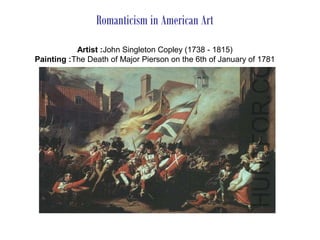
Romanticism in American Art
           Artist :John Singleton Copley (1738 - 1815)
Painting :The Death of Major Pierson on the 6th of January of 1781
Artist :John Singleton Copley (copley15.jpg)
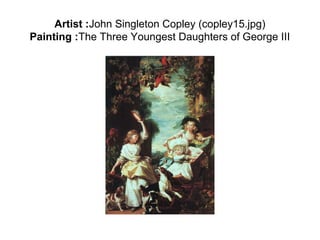
Painting :The Three Youngest Daughters of George III
Artist :John Singleton Copley (copley16.jpg)
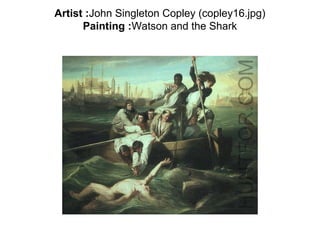
      Painting :Watson and the Shark
Artist :Emanuel Gottlieb Leutze (1907 -1954)
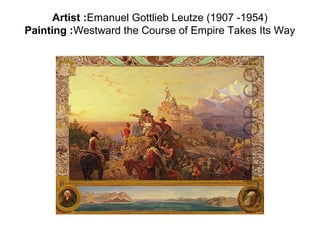
Painting :Westward the Course of Empire Takes Its Way
Artist :Emanuel Gottlieb Leutze (leutze9.jpg)
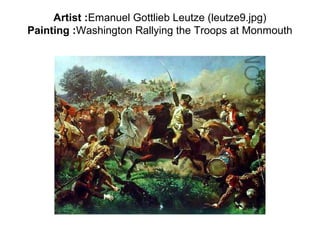
Painting :Washington Rallying the Troops at Monmouth
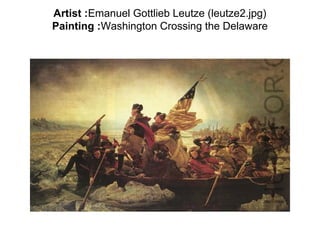
Artist :Emanuel Gottlieb Leutze (leutze2.jpg)
Painting :Washington Crossing the Delaware
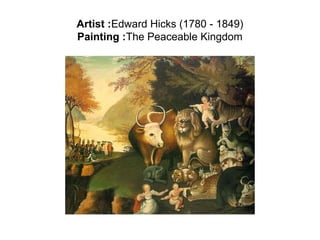
Artist :Edward Hicks (1780 - 1849)
Painting :The Peaceable Kingdom
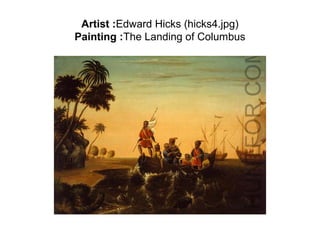
Artist :Edward Hicks (hicks4.jpg)
Painting :The Landing of Columbus
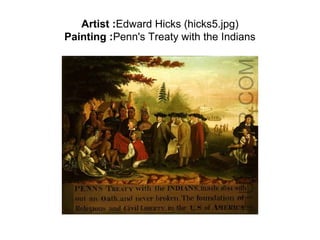
Artist :Edward Hicks (hicks5.jpg)
Painting :Penn's Treaty with the Indians
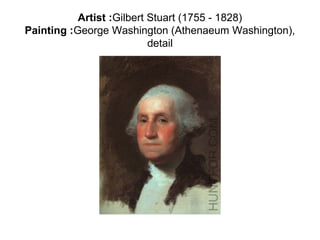
Artist :Gilbert Stuart (1755 - 1828)
Painting :George Washington (Athenaeum Washington),
                           detail
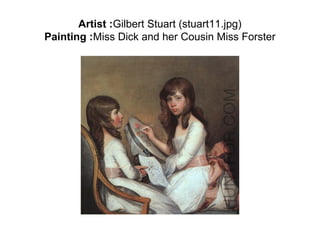
Artist :Gilbert Stuart (stuart11.jpg)
Painting :Miss Dick and her Cousin Miss Forster
The Hudson River School:

• Hudson River School (1835 - 1870)
  Hudson River School was the first American school of
  landscape painting active from 1835-1870. The subjects
  of their art were romantic spectacles from the Hudson
  River Valley and upstate New York. The artist Thomas
  Cole is synonymous with this region and first leader of
  the group. Other famous artists of the group are George
  Caleb Bingham, Asher B. Durand, Thomas Moran,
  Albert Bierstadt, Frederic Edwin Church, George Inness,
  John Frederic Kensett, Martin Johnson Heade...
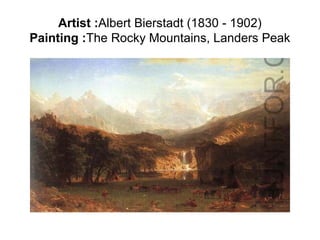
Artist :Albert Bierstadt (1830 - 1902)
Painting :The Rocky Mountains, Landers Peak
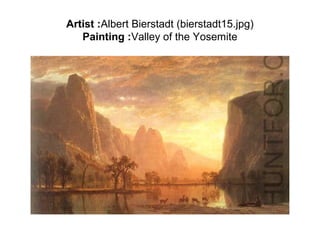
Artist :Albert Bierstadt (bierstadt15.jpg)
   Painting :Valley of the Yosemite
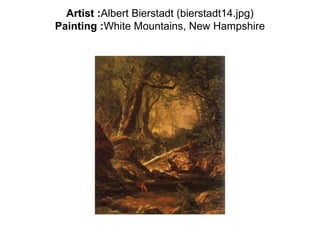
Artist :Albert Bierstadt (bierstadt14.jpg)
Painting :White Mountains, New Hampshire
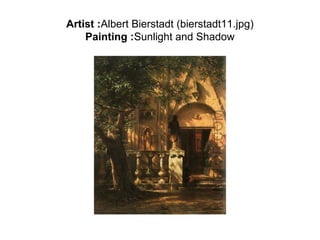
Artist :Albert Bierstadt (bierstadt11.jpg)
    Painting :Sunlight and Shadow

Romanticism in american art

  • 1.
    ROMANTICISM 1775 – 1830: • American Revolution • emergence of the United States • French Revolution • Napoleon • spread of democratic and egalitarian ideals throughout Europe and America • Sentiment of national identity • Industrial revolution
  • 2.
    (1) • In contrastto the rational order, regularity, and generalization that were said to characterize neoclassical art, the Romantic, largely suggested the irregular, picturesque, wild, and distant as it was associated with the literature and art of the middle ages (gothic). [ . . .] it was also concerned, in a new and vital way, with the concrete and directly familiar. • (2) Idealistic, empirical, historical and psychological
  • 3.
    In 1798 theword “Romantic” was used by the German critics Friedrich and August Wilhelm von Schlegel • The Romantic refuses to recognize restraints in subject matter or form and so is free to represent the abnormal, grotesque, and monstrous and to mingle standpoints, genres, modes of expression ( such as philosophy and poetry) and even the separate arts in a single work.
  • 4.
    (9) • Friedrich VonSchiller: the poet in the modern world does not depict nature for its own sake but to convey the “ideal.” • Étalage du moi =display of the self” = in a teleological sense ) • Use of names for the emotions, together with descriptions of emotional states, and a tendency through not so much to sequence of logical argument or of narration but rather the evolution and turn of feeling.
  • 5.
    Immanuel Kant /from Critique of Judgment (1790) (504) Judgment in general is the ability to think the particular as contained under the universal. If the universal (the rule, principle, law) is given, then judgment, which subsumes the particular under it, is determinative as transcendental judgment it states a priori the conditions that must be met for subsumption under the universal to be possible.
  • 6.
    (504) • What ismerely subjective in the presentation of an object, i.e., what constitutes its reference to the subject and not to the object, is its aesthetic character; but whatever in it serves, or can be used, to determine the object is its logical validity. In the cognition of an object of sense these two references [to the subject and to the object ] occur together. • That subjective feature of a presentation of which cannot at all become an element of cognition is the pleasure and displeasure connected with that presentation.
  • 7.
    European Romantics: • Germany:Johann Georg Hamann, Johann Wolfgang von Goethe, Friedrich Schiller, Immanuel Kant, Johann Gottlieb Fichte, Friedrich Schelling • Britain: William Wordsworth, Samuel Taylor Coleridge, William Blake, John Keats • French: Victor Hugo and Stendhal • Russia: Alexander Pushkin • America: Washington Irving, James Fenimore Cooper, Edgar Allan Poe, Nathaniel Hawthorne, H. D. Thoreau, R. W. Emerson, Walt Whitman, Emily Dickonson, Herman Melville
  • 8.
    Influence of EuropeanRomanticism on American Writing • Early 19th century • Moral enthusiasm • Faith in the value of individualism • Intuitive perception • Nature as source of goodness and human society is source of corruption • American politics, philosophy and art • It appealed to the revolutionary spirit, nationalism • Breaking the ties with Puritanism, opposing Calvinism and rationalism • Emergence of Transcendentalism in New England
  • 9.
    Transcendentalism: • (15)German Idealism:In the philosophy of Kant “transcendental” refers to the a priori element in experience – that is, the way in which the mind determines and orders its own contents through its own laws – and the term “transcendent” refers to ideas, such as freedom of will, God, and immortality that cannot be objects of knowledge.
  • 10.
    (15) Transcendentalism isthe belief in the existence of a timeless realm of being beyond the shifting, sensory world of common experience. • Neoplatonism • (17)Plato and Descartes: • According to Descartes, reality is comprised of three principles or substances – matter, mind, and God – • Dualism of matter and mind = the real and the ideal • (17-18) ORGANICISM: It abandons these dualisms by conceiving the cosmos (reality) as a process rather than as a substance, an activity in which the material world, the mental or ideal, and the Divine mutually involve or interpenetrate each other.
  • 11.
    Romanticism in AmericanArt Artist :John Singleton Copley (1738 - 1815) Painting :The Death of Major Pierson on the 6th of January of 1781
  • 12.
    Artist :John SingletonCopley (copley15.jpg) Painting :The Three Youngest Daughters of George III
  • 13.
    Artist :John SingletonCopley (copley16.jpg) Painting :Watson and the Shark
  • 14.
    Artist :Emanuel GottliebLeutze (1907 -1954) Painting :Westward the Course of Empire Takes Its Way
  • 15.
    Artist :Emanuel GottliebLeutze (leutze9.jpg) Painting :Washington Rallying the Troops at Monmouth
  • 16.
    Artist :Emanuel GottliebLeutze (leutze2.jpg) Painting :Washington Crossing the Delaware
  • 17.
    Artist :Edward Hicks(1780 - 1849) Painting :The Peaceable Kingdom
  • 18.
    Artist :Edward Hicks(hicks4.jpg) Painting :The Landing of Columbus
  • 19.
    Artist :Edward Hicks(hicks5.jpg) Painting :Penn's Treaty with the Indians
  • 20.
    Artist :Gilbert Stuart(1755 - 1828) Painting :George Washington (Athenaeum Washington), detail
  • 21.
    Artist :Gilbert Stuart(stuart11.jpg) Painting :Miss Dick and her Cousin Miss Forster
  • 22.
    The Hudson RiverSchool: • Hudson River School (1835 - 1870) Hudson River School was the first American school of landscape painting active from 1835-1870. The subjects of their art were romantic spectacles from the Hudson River Valley and upstate New York. The artist Thomas Cole is synonymous with this region and first leader of the group. Other famous artists of the group are George Caleb Bingham, Asher B. Durand, Thomas Moran, Albert Bierstadt, Frederic Edwin Church, George Inness, John Frederic Kensett, Martin Johnson Heade...
  • 23.
    Artist :Albert Bierstadt(1830 - 1902) Painting :The Rocky Mountains, Landers Peak
  • 24.
    Artist :Albert Bierstadt(bierstadt15.jpg) Painting :Valley of the Yosemite
  • 25.
    Artist :Albert Bierstadt(bierstadt14.jpg) Painting :White Mountains, New Hampshire
  • 26.
    Artist :Albert Bierstadt(bierstadt11.jpg) Painting :Sunlight and Shadow

Editor's Notes

  • #2 Perkins, David. English Romantic Writers . NY: Harcourt Brace College Publishers, 1995.
  • #3 Perkins, David. English Romantic Writers . NY: Harcourt Brace College Publishers, 1995. Perkins, David. English Romantic Writers . NY: Harcourt Brace College Publishers, 1995. Perkins, David. English Romantic Writers . NY: Harcourt Brace College Publishers, 1995.
  • #4 Perkins, David. English Romantic Writers . NY: Harcourt Brace College Publishers, 1995.
  • #5 Perkins, David. English Romantic Writers . NY: Harcourt Brace College Publishers, 1995.
  • #6 Leitch, Vincent B. (ed). The Norton Anthology of Theory and Criticism. NY: W.W. Norton & Company, 2001. 504 -582
  • #7 Leitch, Vincent B. (ed). The Norton Anthology of Theory and Criticism. NY: W.W. Norton & Company, 2001. 504 -582
  • #8 Perkins, David. English Romantic Writers . NY: Harcourt Brace College Publishers, 1995.
  • #9 Perkins, David. English Romantic Writers . NY: Harcourt Brace College Publishers, 1995.
  • #10 Perkins, David. English Romantic Writers . NY: Harcourt Brace College Publishers, 1995.
  • #11 Perkins, David. English Romantic Writers . NY: Harcourt Brace College Publishers, 1995.