Prepared By: Monica San Juan
Romantic Period
(1820-1860)
Originated in Germany, but
quickly spread to England,
France, and beyond America,
around 1820
Romantic
ideas
Art as an
inspiration
Art as
spiritual
Art as aesthetic
dimension of
nature and
metaphors of
organic growth
Art
expresses
universal
truth
Self-awareness as Theme
Self and nature were one
Self-awareness is a mode of
knowledge opening up the
universe
Self-realization
Self-expression
Self-reliance
Transcendentalism Movement
The doctrine of self-reliance and
individualism developed through
the belief in the identification of
the individual soul and God.
Transcendentalism
Movement
a reaction against 18th-century
rationalism
a manifestation of the general
humanitarian trend of 19th-
century thought
based on a fundamental belief
in the unity of the world and
God
Intimately connected with
Concord, a small new England
village 32 km. west of Boston
Transcendentalism Movement
Concord
- first island settlement of the original
Massachusetts Bay Colony
- site of the first battle of the America
Revolution
Concord Hymn
- Ralph Waldo’s poem
commemorating the battle
Transcendentalism Movement
By the rude bridge that arched
the flood
Their flag to April’s breeze
unfurled,
Here once the embattled farmers
stood
And fired the shot heard round
the world.
Concord Hymn
Published a magazine “The Dial”
edited by Margaret Fuller and
Emerson
Transcendentalism Movement
Abolitionist
Insisted on individual differences
(unique viewpoint of individual)
American writers often saw
themselves as lonely explorers
outside society and convention.
Transcendentalists
Ralph Waldo Emerson
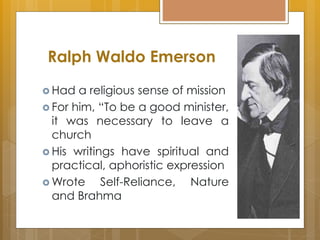
 Had a religious sense of mission
 For him, “To be a good minister,
it was necessary to leave a
church
 His writings have spiritual and
practical, aphoristic expression
 Wrote Self-Reliance, Nature
and Brahma
Ralph Waldo Emerson
“Brahma”
If the red slayer think he slay
Or the slain think he is slain,
They know not well the subtle ways
I keep, and pass, and turn again.
Far or forgot to me is near
Shadow and sunlight are the same;
The vanished gods to me appear;
And one to me are shame and fame.
Ralph Waldo Emerson
“Brahma”
They reckon ill who leave me out;
When me they fly, I am the wings;
I am the doubter and the doubt,
And I the hymn the Brahmin sings
The strong gods pine for my
abode,
And pine in vain the sacred Seven,
But thou, meek lover of the good!
Find me, and turn thy back on
heaven.
Ralph Waldo Emerson “Self-Reliance”
“Ne te quaesiveris extra.”
“Man is his own star; and the soul that can
Render an honest and a perfect man,
Commands all light, all influence, all fate;
Nothing to him falls early or too late.
Our acts our angels are, or good or ill,
Our fatal shadows that walk by us still.”
Epilogue to Beaumont and Fletcher’s Honest
Man’s Fortune
Cast the bantling on the rocks,
Suckle him with the she-wolf’s teat;
Wintered with the hawk and fox,
Power and speed be hands and feet.
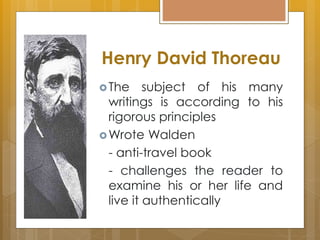
Henry David Thoreau
The subject of his many
writings is according to his
rigorous principles
Wrote Walden
- anti-travel book
- challenges the reader to
examine his or her life and
live it authentically
Henry David Thoreau
“Civil Disobedience”
Wrote poems such as crossing
Brooklyn Ferry, Out of the Cradle
Endlessly Rocking, and when Lilacs
Last in the Dooryard Bloom’d
Wrote essays such as Democratic
Vistas and Gilded Age
Walt Whitman
(1819-1892)
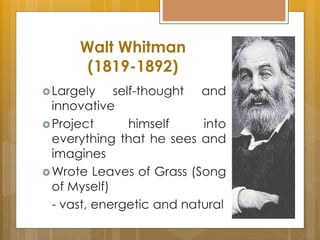
Walt Whitman
(1819-1892)
Largely self-thought and
innovative
Project himself into
everything that he sees and
imagines
Wrote Leaves of Grass (Song
of Myself)
- vast, energetic and natural
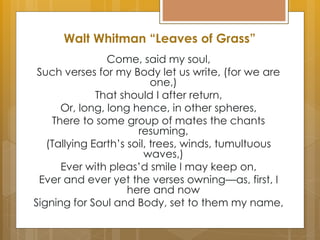
Walt Whitman “Leaves of Grass”
Come, said my soul,
Such verses for my Body let us write, (for we are
one,)
That should I after return,
Or, long, long hence, in other spheres,
There to some group of mates the chants
resuming,
(Tallying Earth’s soil, trees, winds, tumultuous
waves,)
Ever with pleas’d smile I may keep on,
Ever and ever yet the verses owning—as, first, I
here and now
Signing for Soul and Body, set to them my name,
The Brahmin Poets
writings of the Brahmin poets fused
American and European traditions
and sought to create a continuity of
shared Atlantic experience
Retarded the growth of a distinctive
American consciousness
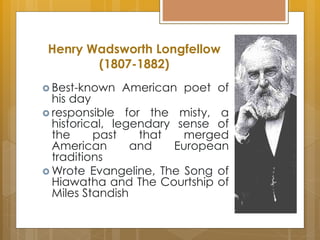
Henry Wadsworth Longfellow
(1807-1882)
 Best-known American poet of
his day
 responsible for the misty, a
historical, legendary sense of
the past that merged
American and European
traditions
 Wrote Evangeline, The Song of
Hiawatha and The Courtship of
Miles Standish
James Russell Lowell
(1819-1891)
Respected critic and educator
Editor of Atlantic
Wrote A Fable for critic
Liberal reformer, abolitionist and
supporter of women’s suffrage and
laws ending child labor
Wrote Biglow Papers, Big Series
Oliver Wendell Holmes
(1809-1894)
His work is marked by refreshing
versatility
Encompasses humorous essays
Wrote The Autocrat of the Breakfast
Table, Elsie Venner (novel), Ralph
Waldo Emerson (biography), The
Deacon’s Masterpiece (verse), The
Chambered Nautilus (philosophical),
and Old Ironsides (patriotic)
John Greenleaf Whittier
(1807-1892)
Ardent abolitionist
Respected for anti-slavery poems
such as Ichabod
His writings have sharp images, simple
constructions and ballad-like
tetrameter couplets
His best work was Snow Bound
Margaret Fuller
(1810-1850)
Outstanding essayist, a activist and a
social reformer
Wrote “Woman in the Nineteenth
Century”
- earliest and most American
exploration of women’s role in the
society
Stresses the importance of self-
dependence
Emily Dickinson
(1830-1886)
 Loved nature and found deep
inspiration in the birds, animals
and plants
 Most solitary literary figure of
her time
 Have imagistic style in writings
 Combines concrete things with
abstract ideas
Emily Dickinson
(1830-1886)
Explores the dark and hidden part
Her poetry exhibits great intelligence
and agonizing paradox
Her poems usually known by the
numbers assigned to them
Has 1775 poems
Emily Dickinson’s 288
I’m Nobody! Who are you?
Are you — Nobody — Too?
Then there’s a pair of us?
Don’t tell! they’d advertise — you
know!
How dreary — to be — Somebody!
How public — like a Frog —
To tell one’s name — the livelong
June —
To an admiring Bog!
Nathaniel Hawthorne
(1804-1864)
Wrote Scarlet Letter (classic
portrayal of Puritan America)
Hawthorne’s gentle style,
remote historical setting, and
ambiguity softened his grim
themes and contented the
general public
Nathaniel Hawthorne
(1804-1864)
Wrote The House of the Sven Gables,
The Blithedale Romance, (criticized
the society), Marble Faun
Wrote short stories such as The
Minister’s Black Veil, Young Goodman
Brown, and My Kinsman, Major
Malineux
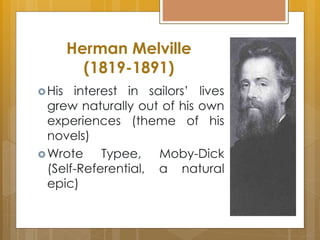
Herman Melville
(1819-1891)
His interest in sailors’ lives
grew naturally out of his own
experiences (theme of his
novels)
Wrote Typee, Moby-Dick
(Self-Referential, a natural
epic)
Themes of death-in-life, especially
being buried alive or returning like a
vampire from the grave, appear in
many of his works
Examples are The Premature Burial,
Ligeia, The Cask of Amontillado, and
The Fall of the House of Usher
His best-known poem is The Raven
Edgar Allan Poe
(1809-1949)
Harriet Beecher Stowe
(1811-1896)
Wrote Life Among the Lowly
and Uncle’s Tom Cabin
(attacked slavery precisely
because it violated domestic
values)
Edgar Allan Poe
(1809-1949)
Many of his stories prefigure
the genres of science fiction,
horror, and fantasy so
popular today.
Poe believed that
strangeness was an essential
ingredient of beauty, and his
writing is often exotic.
Reference
 Outline of English American Literature

Romanticism

  • 1.
  • 2.
    Romantic Period (1820-1860) Originated inGermany, but quickly spread to England, France, and beyond America, around 1820
  • 3.
    Romantic ideas Art as an inspiration Artas spiritual Art as aesthetic dimension of nature and metaphors of organic growth Art expresses universal truth
  • 4.
    Self-awareness as Theme Selfand nature were one Self-awareness is a mode of knowledge opening up the universe Self-realization Self-expression Self-reliance
  • 6.
    Transcendentalism Movement The doctrineof self-reliance and individualism developed through the belief in the identification of the individual soul and God.
  • 7.
    Transcendentalism Movement a reaction against18th-century rationalism a manifestation of the general humanitarian trend of 19th- century thought based on a fundamental belief in the unity of the world and God
  • 8.
    Intimately connected with Concord,a small new England village 32 km. west of Boston Transcendentalism Movement
  • 9.
    Concord - first islandsettlement of the original Massachusetts Bay Colony - site of the first battle of the America Revolution Concord Hymn - Ralph Waldo’s poem commemorating the battle Transcendentalism Movement
  • 10.
    By the rudebridge that arched the flood Their flag to April’s breeze unfurled, Here once the embattled farmers stood And fired the shot heard round the world. Concord Hymn
  • 11.
    Published a magazine“The Dial” edited by Margaret Fuller and Emerson Transcendentalism Movement
  • 12.
    Abolitionist Insisted on individualdifferences (unique viewpoint of individual) American writers often saw themselves as lonely explorers outside society and convention. Transcendentalists
  • 14.
    Ralph Waldo Emerson Had a religious sense of mission  For him, “To be a good minister, it was necessary to leave a church  His writings have spiritual and practical, aphoristic expression  Wrote Self-Reliance, Nature and Brahma
  • 15.
    Ralph Waldo Emerson “Brahma” Ifthe red slayer think he slay Or the slain think he is slain, They know not well the subtle ways I keep, and pass, and turn again. Far or forgot to me is near Shadow and sunlight are the same; The vanished gods to me appear; And one to me are shame and fame.
  • 16.
    Ralph Waldo Emerson “Brahma” Theyreckon ill who leave me out; When me they fly, I am the wings; I am the doubter and the doubt, And I the hymn the Brahmin sings The strong gods pine for my abode, And pine in vain the sacred Seven, But thou, meek lover of the good! Find me, and turn thy back on heaven.
  • 17.
    Ralph Waldo Emerson“Self-Reliance” “Ne te quaesiveris extra.” “Man is his own star; and the soul that can Render an honest and a perfect man, Commands all light, all influence, all fate; Nothing to him falls early or too late. Our acts our angels are, or good or ill, Our fatal shadows that walk by us still.” Epilogue to Beaumont and Fletcher’s Honest Man’s Fortune Cast the bantling on the rocks, Suckle him with the she-wolf’s teat; Wintered with the hawk and fox, Power and speed be hands and feet.
  • 18.
    Henry David Thoreau Thesubject of his many writings is according to his rigorous principles Wrote Walden - anti-travel book - challenges the reader to examine his or her life and live it authentically
  • 19.
  • 20.
    Wrote poems suchas crossing Brooklyn Ferry, Out of the Cradle Endlessly Rocking, and when Lilacs Last in the Dooryard Bloom’d Wrote essays such as Democratic Vistas and Gilded Age Walt Whitman (1819-1892)
  • 21.
    Walt Whitman (1819-1892) Largely self-thoughtand innovative Project himself into everything that he sees and imagines Wrote Leaves of Grass (Song of Myself) - vast, energetic and natural
  • 22.
    Walt Whitman “Leavesof Grass” Come, said my soul, Such verses for my Body let us write, (for we are one,) That should I after return, Or, long, long hence, in other spheres, There to some group of mates the chants resuming, (Tallying Earth’s soil, trees, winds, tumultuous waves,) Ever with pleas’d smile I may keep on, Ever and ever yet the verses owning—as, first, I here and now Signing for Soul and Body, set to them my name,
  • 24.
    The Brahmin Poets writingsof the Brahmin poets fused American and European traditions and sought to create a continuity of shared Atlantic experience Retarded the growth of a distinctive American consciousness
  • 25.
    Henry Wadsworth Longfellow (1807-1882) Best-known American poet of his day  responsible for the misty, a historical, legendary sense of the past that merged American and European traditions  Wrote Evangeline, The Song of Hiawatha and The Courtship of Miles Standish
  • 26.
    James Russell Lowell (1819-1891) Respectedcritic and educator Editor of Atlantic Wrote A Fable for critic Liberal reformer, abolitionist and supporter of women’s suffrage and laws ending child labor Wrote Biglow Papers, Big Series
  • 27.
    Oliver Wendell Holmes (1809-1894) Hiswork is marked by refreshing versatility Encompasses humorous essays Wrote The Autocrat of the Breakfast Table, Elsie Venner (novel), Ralph Waldo Emerson (biography), The Deacon’s Masterpiece (verse), The Chambered Nautilus (philosophical), and Old Ironsides (patriotic)
  • 28.
    John Greenleaf Whittier (1807-1892) Ardentabolitionist Respected for anti-slavery poems such as Ichabod His writings have sharp images, simple constructions and ballad-like tetrameter couplets His best work was Snow Bound
  • 29.
    Margaret Fuller (1810-1850) Outstanding essayist,a activist and a social reformer Wrote “Woman in the Nineteenth Century” - earliest and most American exploration of women’s role in the society Stresses the importance of self- dependence
  • 31.
    Emily Dickinson (1830-1886)  Lovednature and found deep inspiration in the birds, animals and plants  Most solitary literary figure of her time  Have imagistic style in writings  Combines concrete things with abstract ideas
  • 32.
    Emily Dickinson (1830-1886) Explores thedark and hidden part Her poetry exhibits great intelligence and agonizing paradox Her poems usually known by the numbers assigned to them Has 1775 poems
  • 33.
    Emily Dickinson’s 288 I’mNobody! Who are you? Are you — Nobody — Too? Then there’s a pair of us? Don’t tell! they’d advertise — you know! How dreary — to be — Somebody! How public — like a Frog — To tell one’s name — the livelong June — To an admiring Bog!
  • 35.
    Nathaniel Hawthorne (1804-1864) Wrote ScarletLetter (classic portrayal of Puritan America) Hawthorne’s gentle style, remote historical setting, and ambiguity softened his grim themes and contented the general public
  • 36.
    Nathaniel Hawthorne (1804-1864) Wrote TheHouse of the Sven Gables, The Blithedale Romance, (criticized the society), Marble Faun Wrote short stories such as The Minister’s Black Veil, Young Goodman Brown, and My Kinsman, Major Malineux
  • 37.
    Herman Melville (1819-1891) His interestin sailors’ lives grew naturally out of his own experiences (theme of his novels) Wrote Typee, Moby-Dick (Self-Referential, a natural epic)
  • 38.
    Themes of death-in-life,especially being buried alive or returning like a vampire from the grave, appear in many of his works Examples are The Premature Burial, Ligeia, The Cask of Amontillado, and The Fall of the House of Usher His best-known poem is The Raven Edgar Allan Poe (1809-1949)
  • 39.
    Harriet Beecher Stowe (1811-1896) WroteLife Among the Lowly and Uncle’s Tom Cabin (attacked slavery precisely because it violated domestic values)
  • 40.
    Edgar Allan Poe (1809-1949) Manyof his stories prefigure the genres of science fiction, horror, and fantasy so popular today. Poe believed that strangeness was an essential ingredient of beauty, and his writing is often exotic.
  • 41.
    Reference  Outline ofEnglish American Literature