AMERICAN LITERATURE
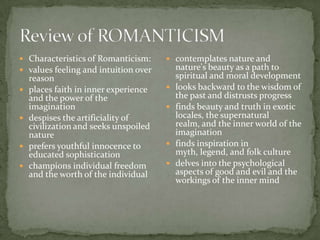
 Characteristics of Romanticism:       contemplates nature and
 values feeling and intuition over        nature's beauty as a path to
    reason                                 spiritual and moral development
   places faith in inner experience      looks backward to the wisdom of
    and the power of the                   the past and distrusts progress
    imagination                           finds beauty and truth in exotic
   despises the artificiality of          locales, the supernatural
    civilization and seeks unspoiled       realm, and the inner world of the
    nature                                 imagination
   prefers youthful innocence to         finds inspiration in
    educated sophistication                myth, legend, and folk culture
   champions individual freedom          delves into the psychological
    and the worth of the individual        aspects of good and evil and the
                                           workings of the inner mind
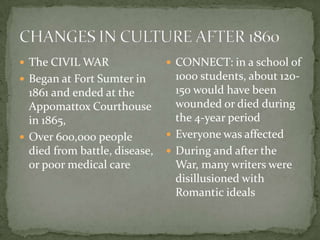
 The CIVIL WAR                 CONNECT: in a school of
 Began at Fort Sumter in        1000 students, about 120-
  1861 and ended at the          150 would have been
  Appomattox Courthouse          wounded or died during
  in 1865,                       the 4-year period
 Over 600,000 people           Everyone was affected
  died from battle, disease,    During and after the
  or poor medical care           War, many writers were
                                 disillusioned with
                                 Romantic ideals
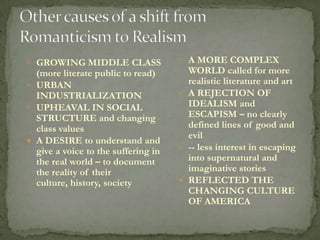
 GROWING MIDDLE CLASS                A MORE COMPLEX
  (more literate public to read)       WORLD called for more
 URBAN                                realistic literature and art
  INDUSTRIALIZATION                   A REJECTION OF
 UPHEAVAL IN SOCIAL                   IDEALISM and
  STRUCTURE and changing               ESCAPISM – no clearly
  class values                         defined lines of good and
                                       evil
 A DESIRE to understand and
  give a voice to the suffering in    -- less interest in escaping
  the real world – to document         into supernatural and
  the reality of their                 imaginative stories
  culture, history, society           REFLECTED THE
                                       CHANGING CULTURE
                                       OF AMERICA
 THE SWELL OF             The prominence of
  IMMIGRANTS in the         PSYCHOLOGY and the
  latter half of the 19th   theories of Sigmund
  century, which led to a   Freud
  larger lower class and   Publication of Charles
  INCREASED POVERTY         Darwin’s Origin of the
  IN THE CITIES             Species
 PESSIMISM in the         A growing literacy and
  wake of Reconstruction    interest in fiction and
  and                       journalism
 CIVIL RIGHTS ISSUES
 An attempt to be a true and faithful representation of
  reality
 VERISIMILITUDE
   It comes from Latin verum meaning truth
    and similis meaning similar
   An attempt to present a semblance of truth, to be true or
    real
 Subject matter—ordinary people and events;
 Purpose—Verisimilitude, the truthful
  representation of life;
 Point of View—omniscient and objective
 Characters—middle class (class is important)
 Plot de-emphasized
   Focus on everyday life
   Complex ethical choices often the subject
   Events are made to seem the inevitable result of
   characters’ choices
 Use of the vernacular – or real language .
  The language usually reflects social class,
  educational background, culture
 Events will usually be plausible, believable
 Often an emphasis on the psychological
  turmoil or nature of the character
 Setting is important – characters are
  connected to place and time, other
  characters
 Humans control their destinies
   characters act on their environment
    rather than simply reacting to it.
 Slice-of-life technique
   often ends without traditional formal
    closure, leaving much untold to
    suggest man’s limited ability to make
    sense of his life.
 Prominent from 1865-1895.


 Coincided with Realism and sharing many of the same
 traits.

 Focuses on physical setting / landscape , putting
 fictional characters into a real settings
 Very specific details about the environment and how
  the characters interact with that setting (Twain’s Huck
  Finn)
 the more specific they become with details of settings,
  the stronger and more believable the characters
  become – this allows the writer to tie in universal
  themes and values held by the character that were
  caused by the setting they are in to a certain region
  (eg. the South, the West)
 Characters are often STOCK or
  STEREOTYPES
 Use of dialect, or language specific to a
  particular region or setting
 Uses details that describe local food, living
  conditions, dress, architecture, transportati
  on, etc.
 Narrator-- an educated observer from
  the world beyond who’s often
  deceived
 Plot—nothing much happens,
 revolves around the community
 and its rituals
 Dislike of change, nostalgia for an
  always-past Golden Age;
 Triumphant trickster or trickster
  tricked;
 Tall tale-tradition, conflicts
  described humorously, larger than
  life
Definition: A literature that depicts social
 problems and views humans as victims of
 larger biological, psychological and social
 and economic forces.
NATURE or ENVIRONMENT determines
 fate of a character
   Scientific determinism
   Psychological determinism
   Historical determinism
 Man has no direct control over who or what
  he is. His fate is determined by outside
  forces that can be discovered through
  scientific inquiry;
 Humans respond to environmental forces
  and internal stresses and drives, none of
  which can be fully controlled or understood
   People are driven by fundamental urges like fear,
    hunger, sex
   The world is a “competitive jungle,”
 Man is a victim of his inner and
 subconscious self (Freud).
 Man is fundamentally an animal,
  without free will;
 Governed by determinism
  External and internal forces,
   environment or heredity control
   behavior;
 Characters have compensating
 humanistic values which affirm life;
  Struggle for life becomes heroic and
   affirms human dignity
 Pessimistic view of human
 capabilities—life is a trap
 Realism, Regionalism, and Naturalism
  are intertwined and connected.
 Their influence has dominated most
  literature created since 1920, though
  the movement itself is dated to roughly
  that point.
 They are truly American modes of
  writing.

Realism regionalism naturalism background

  • 1.
  • 2.
     Characteristics ofRomanticism:  contemplates nature and  values feeling and intuition over nature's beauty as a path to reason spiritual and moral development  places faith in inner experience  looks backward to the wisdom of and the power of the the past and distrusts progress imagination  finds beauty and truth in exotic  despises the artificiality of locales, the supernatural civilization and seeks unspoiled realm, and the inner world of the nature imagination  prefers youthful innocence to  finds inspiration in educated sophistication myth, legend, and folk culture  champions individual freedom  delves into the psychological and the worth of the individual aspects of good and evil and the workings of the inner mind
  • 3.
     The CIVILWAR  CONNECT: in a school of  Began at Fort Sumter in 1000 students, about 120- 1861 and ended at the 150 would have been Appomattox Courthouse wounded or died during in 1865, the 4-year period  Over 600,000 people  Everyone was affected died from battle, disease,  During and after the or poor medical care War, many writers were disillusioned with Romantic ideals
  • 4.
     GROWING MIDDLECLASS  A MORE COMPLEX (more literate public to read) WORLD called for more  URBAN realistic literature and art INDUSTRIALIZATION  A REJECTION OF  UPHEAVAL IN SOCIAL IDEALISM and STRUCTURE and changing ESCAPISM – no clearly class values defined lines of good and evil  A DESIRE to understand and give a voice to the suffering in  -- less interest in escaping the real world – to document into supernatural and the reality of their imaginative stories culture, history, society  REFLECTED THE CHANGING CULTURE OF AMERICA
  • 5.
     THE SWELLOF  The prominence of IMMIGRANTS in the PSYCHOLOGY and the latter half of the 19th theories of Sigmund century, which led to a Freud larger lower class and  Publication of Charles INCREASED POVERTY Darwin’s Origin of the IN THE CITIES Species  PESSIMISM in the  A growing literacy and wake of Reconstruction interest in fiction and and journalism  CIVIL RIGHTS ISSUES
  • 6.
     An attemptto be a true and faithful representation of reality  VERISIMILITUDE  It comes from Latin verum meaning truth and similis meaning similar  An attempt to present a semblance of truth, to be true or real
  • 7.
     Subject matter—ordinarypeople and events;  Purpose—Verisimilitude, the truthful representation of life;  Point of View—omniscient and objective  Characters—middle class (class is important)  Plot de-emphasized  Focus on everyday life  Complex ethical choices often the subject  Events are made to seem the inevitable result of characters’ choices
  • 8.
     Use ofthe vernacular – or real language . The language usually reflects social class, educational background, culture  Events will usually be plausible, believable  Often an emphasis on the psychological turmoil or nature of the character  Setting is important – characters are connected to place and time, other characters
  • 9.
     Humans controltheir destinies  characters act on their environment rather than simply reacting to it.  Slice-of-life technique  often ends without traditional formal closure, leaving much untold to suggest man’s limited ability to make sense of his life.
  • 10.
     Prominent from1865-1895.  Coincided with Realism and sharing many of the same traits.  Focuses on physical setting / landscape , putting fictional characters into a real settings
  • 11.
     Very specificdetails about the environment and how the characters interact with that setting (Twain’s Huck Finn)  the more specific they become with details of settings, the stronger and more believable the characters become – this allows the writer to tie in universal themes and values held by the character that were caused by the setting they are in to a certain region (eg. the South, the West)
  • 12.
     Characters areoften STOCK or STEREOTYPES  Use of dialect, or language specific to a particular region or setting  Uses details that describe local food, living conditions, dress, architecture, transportati on, etc.
  • 13.
     Narrator-- aneducated observer from the world beyond who’s often deceived  Plot—nothing much happens, revolves around the community and its rituals
  • 14.
     Dislike ofchange, nostalgia for an always-past Golden Age;  Triumphant trickster or trickster tricked;  Tall tale-tradition, conflicts described humorously, larger than life
  • 15.
    Definition: A literaturethat depicts social problems and views humans as victims of larger biological, psychological and social and economic forces. NATURE or ENVIRONMENT determines fate of a character  Scientific determinism  Psychological determinism  Historical determinism
  • 16.
     Man hasno direct control over who or what he is. His fate is determined by outside forces that can be discovered through scientific inquiry;  Humans respond to environmental forces and internal stresses and drives, none of which can be fully controlled or understood  People are driven by fundamental urges like fear, hunger, sex  The world is a “competitive jungle,”
  • 17.
     Man isa victim of his inner and subconscious self (Freud).
  • 18.
     Man isfundamentally an animal, without free will;  Governed by determinism  External and internal forces, environment or heredity control behavior;  Characters have compensating humanistic values which affirm life;  Struggle for life becomes heroic and affirms human dignity  Pessimistic view of human capabilities—life is a trap
  • 19.
     Realism, Regionalism,and Naturalism are intertwined and connected.  Their influence has dominated most literature created since 1920, though the movement itself is dated to roughly that point.  They are truly American modes of writing.