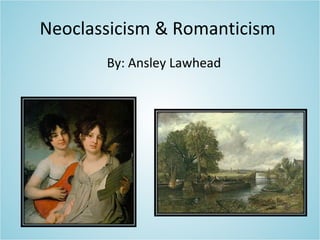
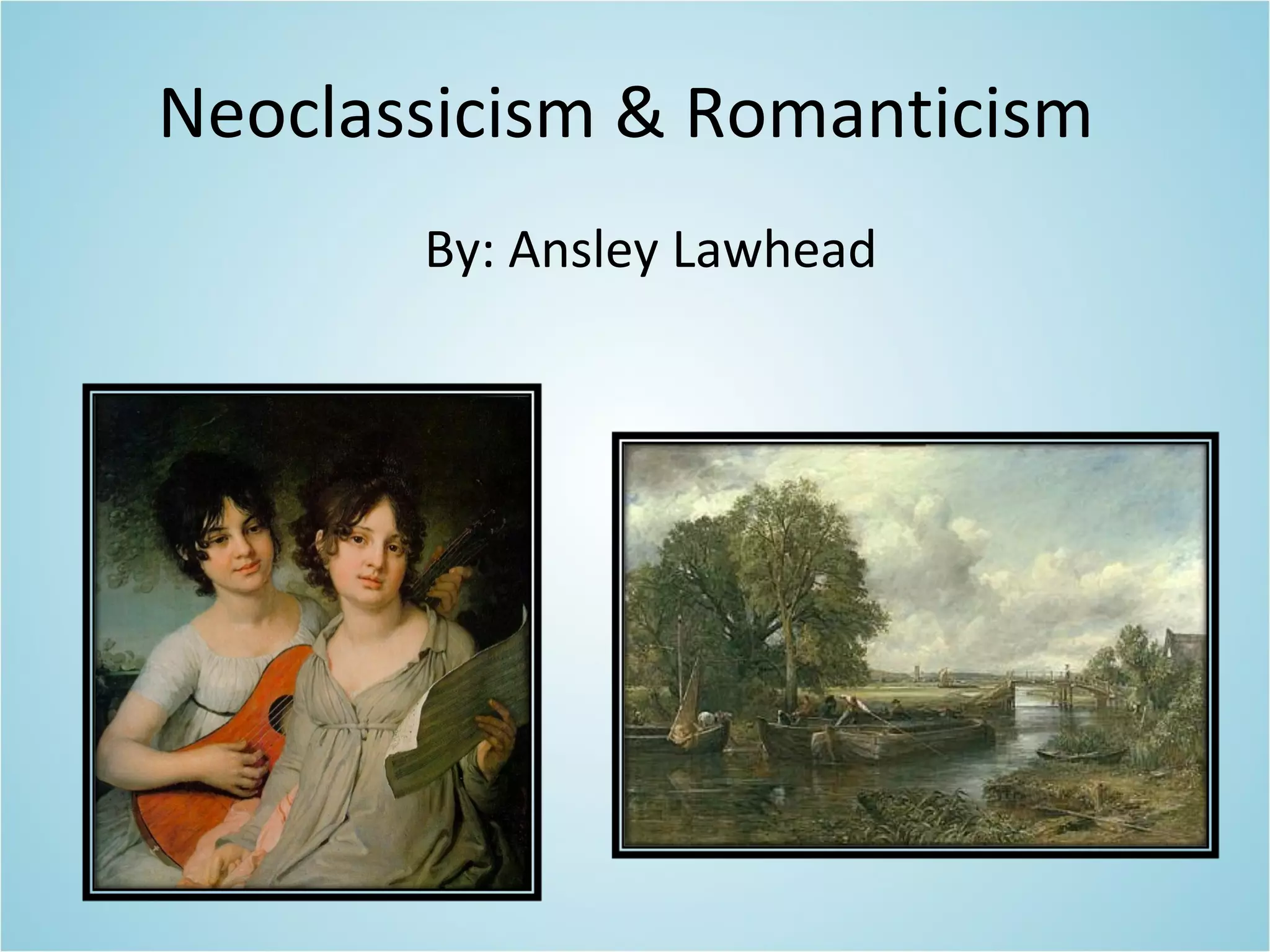
Neoclassicism & Romanticism
By: Ansley Lawhead
Neoclassicism Beginnings
• late 18th
& early 19th
century
• In France, this “True Style” was a reaction
against Rococo levity.
• Style adopted by the leaders of the French
Revolution.
• Became most closely associated with the
revolutionary movements of the period.
Neoclassicism Characteristics
• Associations with heroic subject matter
• Formal clarity
• Impression of stability & solidity
• References to Athenian democracy and
Roman Republic.
Jacques-Louis David
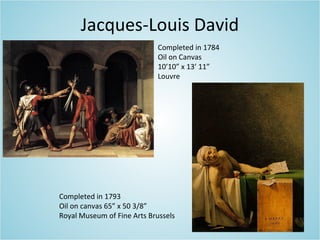
• Leading Neoclassical painter
• Appealed to republican sentiments associated
with Classical antiquity.
• Famous Works:
– Oath of the Horatii
– Death of Marat
Jacques-Louis David
Completed in 1784
Oil on Canvas
10’10” x 13’ 11”
Louvre
Completed in 1793
Oil on canvas 65” x 50 3/8”
Royal Museum of Fine Arts Brussels
Napoleon and the Arts
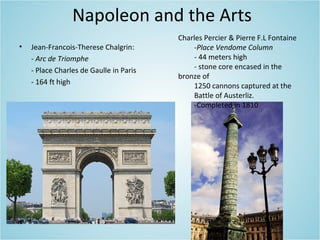
• Jean-Francois-Therese Chalgrin:
- Arc de Triomphe
- Place Charles de Gaulle in Paris
- 164 ft high
Charles Percier & Pierre F.L Fontaine
-Place Vendome Column
- 44 meters high
- stone core encased in the
bronze of
1250 cannons captured at the
Battle of Austerliz.
-Completed in 1810
Napoleon and the Arts II
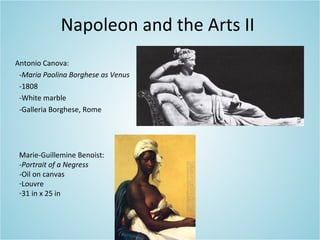
Antonio Canova:
-Maria Paolina Borghese as Venus
-1808
-White marble
-Galleria Borghese, Rome
Marie-Guillemine Benoist:
-Portrait of a Negress
-Oil on canvas
-Louvre
-31 in x 25 in
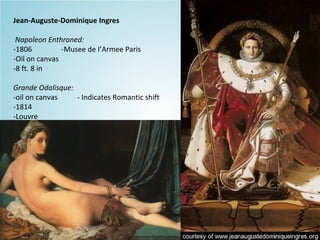
Jean-Auguste-Dominique Ingres
Napoleon Enthroned:
-1806 -Musee de I’Armee Paris
-Oil on canvas
-8 ft. 8 in
Grande Odalisque:
-oil on canvas - Indicates Romantic shift
-1814
-Louvre
Neoclassicism in America
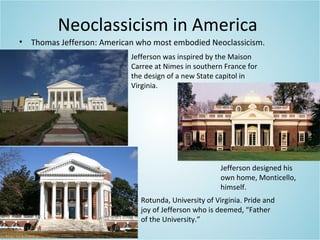
• Thomas Jefferson: American who most embodied Neoclassicism.
Jefferson designed his
own home, Monticello,
himself.
Jefferson was inspired by the Maison
Carree at Nimes in southern France for
the design of a new State capitol in
Virginia.
Rotunda, University of Virginia. Pride and
joy of Jefferson who is deemed, “Father
of the University.”
Romantic Era Beginnings
• The term “Romantic” is derived from the Romance
languages (French, Italian, Spanish, Portuguese, &
Romanian) & from medieval tales of chivalry & adventure
written in those languages.
• The era is an artistic, literary, & intellectual movement that
originated in the 2nd half of the 18th
century in Western
Europe.
• Reaction to the Industrial Revolution.
• Revolt against aristocratic social & political norms of the
Age of Enlightenment.
• Response against the scientific rationalization of nature.
Romanticism characteristics
• Embodied most strongly in the visual arts, music, and
literature.
• Legitimized individual imagination as a critical
authority---brought freedom from classical notions of
form in art.
• Nostalgic for the past & believes in idealistic
participation in current events.
• Strong emphasis placed on intuition, imagination, and
feeling.
• The mind = site of mysterious, unexplained, & possibly
dangerous phenomena.
Romantic Visual Arts
• Artists used their works for highlighting
national identity & exoticism.
• Most Romantic artists painted landscapes that
usually showed nationalism or exoticism
through adventure of far-away places.
• Nature used to convey emotions.
Romantic Arts
• Artists found the natural world less a model of
perfection and more a source of mysterious
powers.
• Painters painted from many supernatural
texts & stories.
• Known as a time of surging emotions. For
example, the supernatural represented love &
fear was portrayed through demons.
Romantic Painters
• William Blake: Engraver, painter, & poet.
• Theodore Gericault: Committed to social justice
& interested in human psychology.
• Eugene Delacroix: Most prominent figure in
French Romantic painting.
• Francisco de Goya y Lucientes: Leading Spanish
painter of the late 18th
& early 19th
centuries.
Obvious support intellectual & political freedom.
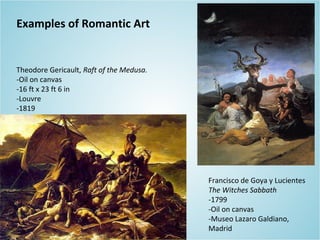
Theodore Gericault, Raft of the Medusa.
-Oil on canvas
-16 ft x 23 ft 6 in
-Louvre
-1819
Francisco de Goya y Lucientes
The Witches Sabbath
-1799
-Oil on canvas
-Museo Lazaro Galdiano,
Madrid
Examples of Romantic Art
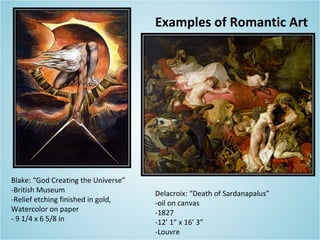
Blake: “God Creating the Universe”
-British Museum
-Relief etching finished in gold,
Watercolor on paper
- 9 1/4 x 6 5/8 in
Delacroix: “Death of Sardanapalus”
-oil on canvas
-1827
-12’ 1” x 16’ 3”
-Louvre
Examples of Romantic Art
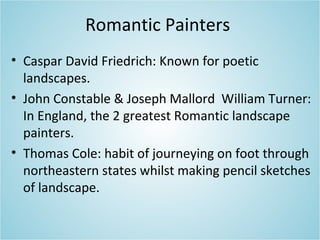
Romantic Painters
• Caspar David Friedrich: Known for poetic
landscapes.
• John Constable & Joseph Mallord William Turner:
In England, the 2 greatest Romantic landscape
painters.
• Thomas Cole: habit of journeying on foot through
northeastern states whilst making pencil sketches
of landscape.
Examples of Romantic Art
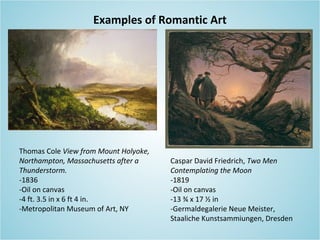
Thomas Cole View from Mount Holyoke,
Northampton, Massachusetts after a
Thunderstorm.
-1836
-Oil on canvas
-4 ft. 3.5 in x 6 ft 4 in.
-Metropolitan Museum of Art, NY
Caspar David Friedrich, Two Men
Contemplating the Moon
-1819
-Oil on canvas
-13 ¾ x 17 ½ in
-Germaldegalerie Neue Meister,
Staaliche Kunstsammiungen, Dresden
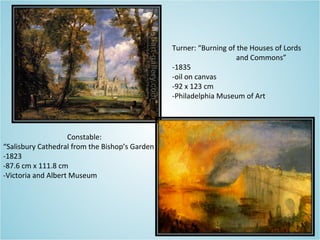
Constable:
“Salisbury Cathedral from the Bishop’s Garden
-1823
-87.6 cm x 111.8 cm
-Victoria and Albert Museum
Turner: “Burning of the Houses of Lords
and Commons”
-1835
-oil on canvas
-92 x 123 cm
-Philadelphia Museum of Art

Romantics.neoclassics

  • 1.
  • 2.
    Neoclassicism Beginnings • late18th & early 19th century • In France, this “True Style” was a reaction against Rococo levity. • Style adopted by the leaders of the French Revolution. • Became most closely associated with the revolutionary movements of the period.
  • 3.
    Neoclassicism Characteristics • Associationswith heroic subject matter • Formal clarity • Impression of stability & solidity • References to Athenian democracy and Roman Republic.
  • 4.
    Jacques-Louis David • LeadingNeoclassical painter • Appealed to republican sentiments associated with Classical antiquity. • Famous Works: – Oath of the Horatii – Death of Marat
  • 5.
    Jacques-Louis David Completed in1784 Oil on Canvas 10’10” x 13’ 11” Louvre Completed in 1793 Oil on canvas 65” x 50 3/8” Royal Museum of Fine Arts Brussels
  • 6.
    Napoleon and theArts • Jean-Francois-Therese Chalgrin: - Arc de Triomphe - Place Charles de Gaulle in Paris - 164 ft high Charles Percier & Pierre F.L Fontaine -Place Vendome Column - 44 meters high - stone core encased in the bronze of 1250 cannons captured at the Battle of Austerliz. -Completed in 1810
  • 7.
    Napoleon and theArts II Antonio Canova: -Maria Paolina Borghese as Venus -1808 -White marble -Galleria Borghese, Rome Marie-Guillemine Benoist: -Portrait of a Negress -Oil on canvas -Louvre -31 in x 25 in
  • 8.
    Jean-Auguste-Dominique Ingres Napoleon Enthroned: -1806-Musee de I’Armee Paris -Oil on canvas -8 ft. 8 in Grande Odalisque: -oil on canvas - Indicates Romantic shift -1814 -Louvre
  • 9.
    Neoclassicism in America •Thomas Jefferson: American who most embodied Neoclassicism. Jefferson designed his own home, Monticello, himself. Jefferson was inspired by the Maison Carree at Nimes in southern France for the design of a new State capitol in Virginia. Rotunda, University of Virginia. Pride and joy of Jefferson who is deemed, “Father of the University.”
  • 10.
    Romantic Era Beginnings •The term “Romantic” is derived from the Romance languages (French, Italian, Spanish, Portuguese, & Romanian) & from medieval tales of chivalry & adventure written in those languages. • The era is an artistic, literary, & intellectual movement that originated in the 2nd half of the 18th century in Western Europe. • Reaction to the Industrial Revolution. • Revolt against aristocratic social & political norms of the Age of Enlightenment. • Response against the scientific rationalization of nature.
  • 11.
    Romanticism characteristics • Embodiedmost strongly in the visual arts, music, and literature. • Legitimized individual imagination as a critical authority---brought freedom from classical notions of form in art. • Nostalgic for the past & believes in idealistic participation in current events. • Strong emphasis placed on intuition, imagination, and feeling. • The mind = site of mysterious, unexplained, & possibly dangerous phenomena.
  • 12.
    Romantic Visual Arts •Artists used their works for highlighting national identity & exoticism. • Most Romantic artists painted landscapes that usually showed nationalism or exoticism through adventure of far-away places. • Nature used to convey emotions.
  • 13.
    Romantic Arts • Artistsfound the natural world less a model of perfection and more a source of mysterious powers. • Painters painted from many supernatural texts & stories. • Known as a time of surging emotions. For example, the supernatural represented love & fear was portrayed through demons.
  • 14.
    Romantic Painters • WilliamBlake: Engraver, painter, & poet. • Theodore Gericault: Committed to social justice & interested in human psychology. • Eugene Delacroix: Most prominent figure in French Romantic painting. • Francisco de Goya y Lucientes: Leading Spanish painter of the late 18th & early 19th centuries. Obvious support intellectual & political freedom.
  • 15.
    Theodore Gericault, Raftof the Medusa. -Oil on canvas -16 ft x 23 ft 6 in -Louvre -1819 Francisco de Goya y Lucientes The Witches Sabbath -1799 -Oil on canvas -Museo Lazaro Galdiano, Madrid Examples of Romantic Art
  • 16.
    Blake: “God Creatingthe Universe” -British Museum -Relief etching finished in gold, Watercolor on paper - 9 1/4 x 6 5/8 in Delacroix: “Death of Sardanapalus” -oil on canvas -1827 -12’ 1” x 16’ 3” -Louvre Examples of Romantic Art
  • 17.
    Romantic Painters • CasparDavid Friedrich: Known for poetic landscapes. • John Constable & Joseph Mallord William Turner: In England, the 2 greatest Romantic landscape painters. • Thomas Cole: habit of journeying on foot through northeastern states whilst making pencil sketches of landscape.
  • 18.
    Examples of RomanticArt Thomas Cole View from Mount Holyoke, Northampton, Massachusetts after a Thunderstorm. -1836 -Oil on canvas -4 ft. 3.5 in x 6 ft 4 in. -Metropolitan Museum of Art, NY Caspar David Friedrich, Two Men Contemplating the Moon -1819 -Oil on canvas -13 ¾ x 17 ½ in -Germaldegalerie Neue Meister, Staaliche Kunstsammiungen, Dresden
  • 19.
    Constable: “Salisbury Cathedral fromthe Bishop’s Garden -1823 -87.6 cm x 111.8 cm -Victoria and Albert Museum Turner: “Burning of the Houses of Lords and Commons” -1835 -oil on canvas -92 x 123 cm -Philadelphia Museum of Art