Megan Casilla
Jyzette Alex Hermitanio
Nam Seo Hui
Lovely Pamela Serran
Faith Obinarrio
Romanticism Defined
• Romanticism does not refer to ‘love’ as a
subject matter, rather it is an international
and philosophical movement that redefined
the fundamental ways of how man thought
about themselves and their surroundings.
• F.O Matthiessen termed the American
Romanticism as ‘American Renaissance’
• British Romanticism is similar to American
Romanticism. British Romanticism is the
parent of the American literary movement
but differences between the two is easily
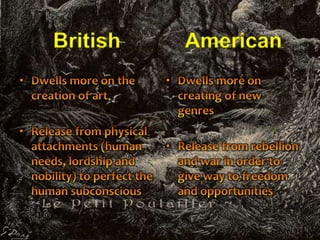
distinguished.
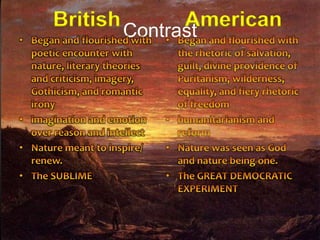
British Contrast
American
British

American
• Father of American Romanticism
• The importance of expressive art for the
individual and the society:

“For all men live by truth, and stand in need
of expression the man is only half of himself,
the other half is his expression.”
• Romanticism was introduced by German artists.
• There is nothing romantic about romanticism
• They are artistic movement that gave way to the
opening of literary history for new movements
• Romanticism is a movement that revolts against
Neoclassicism
• Romanticism dwells on man and nature; they
celebrate the function of the intuition and the
imagination, the metaphysical, revolutionary,
individualism and the spontaneous rather than
reason and morals, objectivity, traditional, social
conformity and control.
• Emotional Intensity. The heart and the mind
lead the writer into writing a good piece of
literature.

• Common Man as the hero. Literary pieces of
this time concentrate more on putting the
real flawed man into an extraordinary— if
not out of the ordinary— situation.
• Nature as a source of spirituality and
knowledge. American romanticism sees
nature as the source of intellect and
knowledge.

• Self-idealism, honor and integrity. This gave
way to the first-person poetry. The poetic
speaker became less of a character but more
of a direct observation of the poet. In some
occasions, the artist became the hero of the
piece.
• Macabre, irrational, Mysterious Universe. It
is through intense emotions from the
unknown that human nature is emphasized.
• American frontier expansion allowed for
expansion and freedom. It is in the
expansion of British colonials to the west.
• Uncharted land invoked spirit of optimism.
This seemingly vast and limitless land owned
my colonials gave them the opportunity to
expand more across the horizon.
• New cultures and perspectives brought by
immigration. Britons, Irish, Danish, etc. also
moved to America.
• Industrial growth in the north separates
agrarian south. Industrial Revolution that
left the rest of Latin American in economic
progress.
• Search for new spiritual roots . The culture
of the Natives began to play an impact on
the literature of the time.
• Industrial growth in the north separates
agrarian south. Industrial Revolution that
left the rest of Latin American in economic
progress.
• Search for new spiritual roots . The culture
of the Natives began to play an impact on
the literature of the time.
• James Fenimore Cooper - Last
of the Mohicans, Red Rover
• Emily Dickinson - Because I
Could Not Stop for Death,
Wild Nights! Wild Nights!
• Ralph Waldo Emerson Nature, The Conduct of Life
• Margaret Fuller - Woman in
the Nineteenth Century,
Papers on Literature and Art
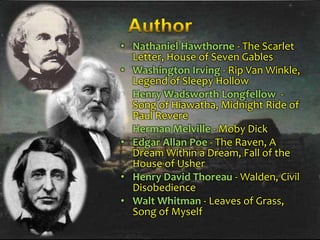
• Nathaniel Hawthorne - The Scarlet
Letter, House of Seven Gables
• Washington Irving - Rip Van Winkle,
Legend of Sleepy Hollow
• Henry Wadsworth Longfellow Song of Hiawatha, Midnight Ride of
Paul Revere
• Herman Melville - Moby Dick
• Edgar Allan Poe - The Raven, A
Dream Within a Dream, Fall of the
House of Usher
• Henry David Thoreau - Walden, Civil
Disobedience
• Walt Whitman - Leaves of Grass,
Song of Myself
• Herman Melville - Moby Dick
• Edgar Allan Poe - The Raven, A
Dream Within a Dream, Fall of the
House of Usher
• Henry David Thoreau - Walden,
Civil Disobedience
• Walt Whitman - Leaves of Grass,
Song of Myself
Source
Unpublished material copyright © 1997 by Dr.
Brad Strickland, Department of
English, Gainesville College, Gainesville, GA 305
03 (USA).
Permission is granted to reproduce, distribute,
or alter this material for educational purposes.

American romanticism

  • 1.
    Megan Casilla Jyzette AlexHermitanio Nam Seo Hui Lovely Pamela Serran Faith Obinarrio
  • 2.
    Romanticism Defined • Romanticismdoes not refer to ‘love’ as a subject matter, rather it is an international and philosophical movement that redefined the fundamental ways of how man thought about themselves and their surroundings. • F.O Matthiessen termed the American Romanticism as ‘American Renaissance’
  • 3.
    • British Romanticismis similar to American Romanticism. British Romanticism is the parent of the American literary movement but differences between the two is easily distinguished.
  • 4.
  • 5.
  • 6.
    • Father ofAmerican Romanticism • The importance of expressive art for the individual and the society: “For all men live by truth, and stand in need of expression the man is only half of himself, the other half is his expression.”
  • 7.
    • Romanticism wasintroduced by German artists. • There is nothing romantic about romanticism • They are artistic movement that gave way to the opening of literary history for new movements • Romanticism is a movement that revolts against Neoclassicism • Romanticism dwells on man and nature; they celebrate the function of the intuition and the imagination, the metaphysical, revolutionary, individualism and the spontaneous rather than reason and morals, objectivity, traditional, social conformity and control.
  • 8.
    • Emotional Intensity.The heart and the mind lead the writer into writing a good piece of literature. • Common Man as the hero. Literary pieces of this time concentrate more on putting the real flawed man into an extraordinary— if not out of the ordinary— situation.
  • 9.
    • Nature asa source of spirituality and knowledge. American romanticism sees nature as the source of intellect and knowledge. • Self-idealism, honor and integrity. This gave way to the first-person poetry. The poetic speaker became less of a character but more of a direct observation of the poet. In some occasions, the artist became the hero of the piece.
  • 10.
    • Macabre, irrational,Mysterious Universe. It is through intense emotions from the unknown that human nature is emphasized.
  • 11.
    • American frontierexpansion allowed for expansion and freedom. It is in the expansion of British colonials to the west. • Uncharted land invoked spirit of optimism. This seemingly vast and limitless land owned my colonials gave them the opportunity to expand more across the horizon. • New cultures and perspectives brought by immigration. Britons, Irish, Danish, etc. also moved to America.
  • 12.
    • Industrial growthin the north separates agrarian south. Industrial Revolution that left the rest of Latin American in economic progress. • Search for new spiritual roots . The culture of the Natives began to play an impact on the literature of the time.
  • 13.
    • Industrial growthin the north separates agrarian south. Industrial Revolution that left the rest of Latin American in economic progress. • Search for new spiritual roots . The culture of the Natives began to play an impact on the literature of the time.
  • 14.
    • James FenimoreCooper - Last of the Mohicans, Red Rover • Emily Dickinson - Because I Could Not Stop for Death, Wild Nights! Wild Nights! • Ralph Waldo Emerson Nature, The Conduct of Life • Margaret Fuller - Woman in the Nineteenth Century, Papers on Literature and Art
  • 15.
    • Nathaniel Hawthorne- The Scarlet Letter, House of Seven Gables • Washington Irving - Rip Van Winkle, Legend of Sleepy Hollow • Henry Wadsworth Longfellow Song of Hiawatha, Midnight Ride of Paul Revere • Herman Melville - Moby Dick • Edgar Allan Poe - The Raven, A Dream Within a Dream, Fall of the House of Usher • Henry David Thoreau - Walden, Civil Disobedience • Walt Whitman - Leaves of Grass, Song of Myself
  • 16.
    • Herman Melville- Moby Dick • Edgar Allan Poe - The Raven, A Dream Within a Dream, Fall of the House of Usher • Henry David Thoreau - Walden, Civil Disobedience • Walt Whitman - Leaves of Grass, Song of Myself
  • 17.
    Source Unpublished material copyright© 1997 by Dr. Brad Strickland, Department of English, Gainesville College, Gainesville, GA 305 03 (USA). Permission is granted to reproduce, distribute, or alter this material for educational purposes.