American Romantic Period
Transcendentalism and Dark Romanticism
Romantic Period
The American Romantic
period, which lasted from
about 1820-1860, was a
movement where literature
focused on intuition,
imagination, and
individualism.
Romantic Period
Characteristics:
 Imagination
 Individuality
 Nature as a source of spirituality
 Looking to the past for wisdom
 Seeing the common man as a hero
Romantic Period
Washington Irving
 Biography
 Works
 Style
Washington Irving
Washington Irving was the first American
author who found success both in Europe
and in America.
Washington Irving
Biography:
 Born April 3, 1783;
 Grows up in Manhattan, New York;
 Moves to Tarrytown, New York (at
the age of 15);
 Goes to Europe (at the age of 17);
 Meets Sir Walter Scott.
Washington Irving
Works:
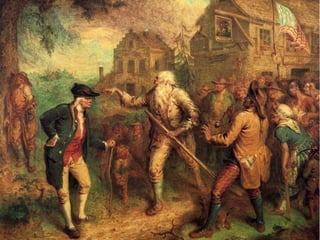
 The Sketch Book
'The Legend of Sleepy Hollow' and 'Rip
Van Winkle;
 Tales of a Traveler
'The Devil and Tom Walker;‘
Washington Irving had a great sense of
humor, which transcended into his
writings.
Washington Irving
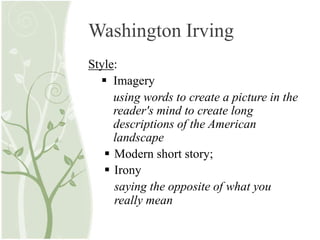
Style:
 Imagery
using words to create a picture in the
reader's mind to create long
descriptions of the American
landscape
 Modern short story;
 Irony
saying the opposite of what you
really mean
Question Time
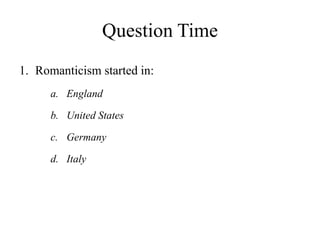
1. Romanticism started in:
a. England
b. United States
c. Germany
d. Italy
Question Time
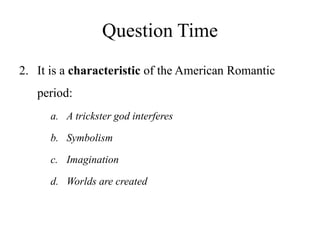
2. It is a characteristic of the American Romantic
period:
a. A trickster god interferes
b. Symbolism
c. Imagination
d. Worlds are created
Question Time
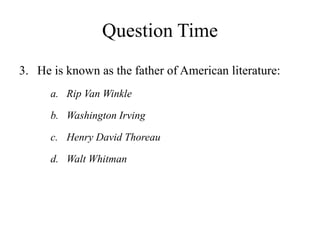
3. He is known as the father of American literature:
a. Rip Van Winkle
b. Washington Irving
c. Henry David Thoreau
d. Walt Whitman
Question Time
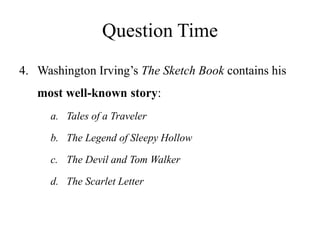
4. Washington Irving’s The Sketch Book contains his
most well-known story:
a. Tales of a Traveler
b. The Legend of Sleepy Hollow
c. The Devil and Tom Walker
d. The Scarlet Letter
Question Time
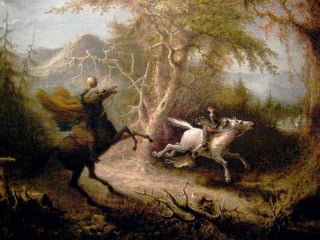
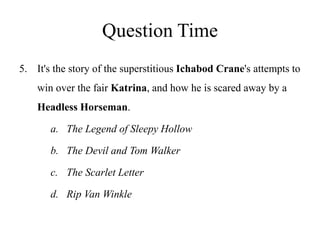
5. It's the story of the superstitious Ichabod Crane's attempts to
win over the fair Katrina, and how he is scared away by a
Headless Horseman.
a. The Legend of Sleepy Hollow
b. The Devil and Tom Walker
c. The Scarlet Letter
d. Rip Van Winkle
Transcendentalism
Transcendentalism was an American
literary and philosophical movement that
lasted from the 1820s to the 1850s.
Transcendentalism
Beliefs:
 The 'Eternal One'
Every individual carries the universe
within himself and is entitled to his
own personal relationship with
spirituality.
Transcendentalism
Beliefs:
 Intuitive Thought
Intuition should have precedence over
conscious thought. Intuition is the most
fundamental form of knowledge.
Transcendentalism
Beliefs:
 Imagination
Imagination allows a person to
transcend himself, to consider things
anew.
Transcendentalism
Transcendentalism encouraged man to
look closely at the world, to look closely
at himself, and to be radically honest
about what he sees.
Transcendentalism
Ralph Waldo Emerson
Henry David Thoreau
Walt Whitman
Emily Dickinson
Ralph Waldo Emerson
‘Self-Reliance’
 Individualism
Every thought and action should be
independent and authentic. Individuals
must be free to pursue their personal
goals and desires.
Ralph Waldo Emerson
‘Self-Reliance’
 Nonconformity
People must think for themselves and
resist the pressure to conform to
prevailing ideas or practices.
Ralph Waldo Emerson
‘Self-Reliance’
 Intuition
Intuition is the most fundamental form
of knowledge. Intuition is direct
knowledge; all other knowledge is
secondhand.
Henry David Thoreau
‘Civil Disobedience’
Henry David Thoreau's essay Civil
Disobedience, published in 1849, has
influenced civil rights leaders from President
John F. Kennedy to Gandhi to Martin Luther
King, Jr.
Henry David Thoreau
‘Civil Disobedience’
He encouraged Americans to avoid
supporting immoral government spending by
not paying taxes, even if that action landed
them in jail.
Emily Dickinson
 19th-century American poet;
 Wrote over 1,000 poems;
 Focused on death, immortality and
nature;
 Her poems rarely had titles.
Question Time
1. It is a movement, a reaction against 18th-century
rationalism:
a. Modernism
b. Puritan Writing
c. Realism
d. Transcendentalism
Question Time
2. Transcendentalist doctrines found their greatest
literary advocates in _____ and Thoreau.
a. Jefferson
b. Emerson
c. Freneau
d. Smith
Question Time
3. Transcendentalists recognized ______ as the
“highest power of the soul”.
a. intuition
b. logic
c. the senses
d. thinking
Question Time
4. Famous female transcendentalist:
a. Anne Bradstreet
b. Emily Dickinson
c. Sylvia Plath
d. Mary Jane Watson
Question Time
5. Thoreau’s greatest essay that has influenced civil
rights leaders around the world:
a. Everything You Need
b. Creation and Truth
c. Civil Disobedience
d. Patience
Dark Romanticism
 American Renaissance
 Explosion of uniquely American
literature
 1840-1860
 American literary masterpieces
 Subgenres: the Dark Romantics and
the Transcendentalists.
Dark Romanticism
Characteristics:
 Lots of creepy symbols
 Horrific themes
 Psychological effects of guilt and sin
Dark Romanticism
Characteristics:
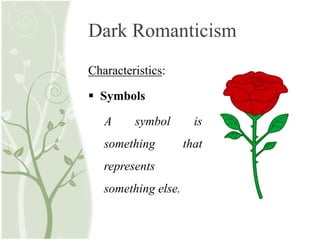
 Symbols
A symbol is
something that
represents
something else.
Dark Romanticism
Edgar Allan Poe's poem ‘The
Raven’
 In that poem, the raven is a
symbol for death and
hopelessness as it sits and
watches the narrator, who is
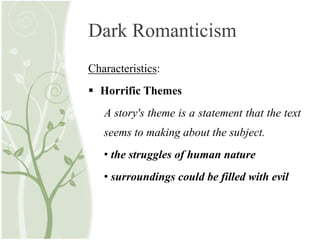
slowly going mad.
Dark Romanticism
Characteristics:
 Horrific Themes
A story's theme is a statement that the text
seems to making about the subject.
• the struggles of human nature
• surroundings could be filled with evil
Dark Romanticism
Characteristics:
 Psychological effects of guilt and sin
Dark Romanticism
Nathaniel Hawthorne’s The Scarlet Letter
 Hawthorne tells the story of a minister
whose affair with a married woman
sends him into a guilt-ridden self-
punishment, and ultimately death.
Dark Romanticism
The result of Dark Romantics is a
collection of short stories, poems, and
novels that forced Americans to see that
evil was lurking in us all.
Question Time
1. Movement that started during the last years of the
American Romantic Period:
a. Realism
b. Transcendentalism
c. Dark Romanticism
d. Modernism
Question Time
2. It is not a characteristic of Dark Romanticism:
a. Lots of Creepy Symbols
b. Imagination
c. Horrific Themes
d. Psychological Effects
Question Time
3. During the Romanticism, __________ and _______
were two strong subgenres:
a. Thinkers and Believers
b. Transcendentalism and Realism
c. Transcendentalists and Dark Romantics
d. Puritans and Dark Romantics
Question Time
4. Poe’s best-known poem, in his own lifetime:
a. What Can You Do?
b. Rip Van Winkle
c. The Raven
d. True Love
Question Time
5. It tells the story of a minister whose affair with a
married woman ultimately sends him to death:
a. Sin and Truth
b. Love Story
c. The Raven
d. The Scarlet Letter

American Literature: Romanticism