US history survey

        May 8, 2012
1850s crises – steps toward
  Civil War, 1861 - 1865
announcements
• paper # 2 due Tuesday 22 May.
• 1 – 2 pages, typed, double spaced. No emails.
• write an autobiography describing how the
  Civil War affects your life.
• do internet research, & write an original essay.
• choose
  – race, gender, age, class, enslaved or free.
  – state(s) in which you live.
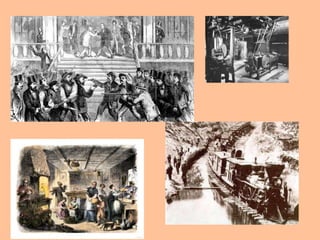
1850s crises
• compromises of 1850 did not resolve the issue
  of extension of slavery into territories.
• political parties no longer national, but
  increasingly sectional.
• Republican party founded, all Northerners.
• N & S attitudes hardening, compromises less
  possible.
• violence – Kansas & elsewhere.
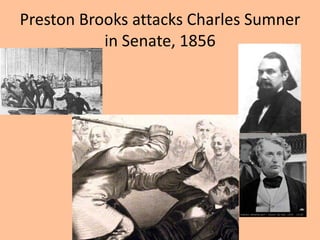
Preston Brooks attacks Charles Sumner
           in Senate, 1856
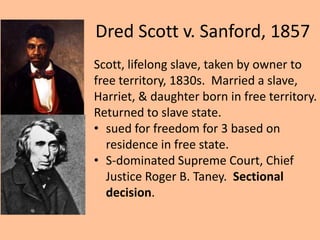
Dred Scott v. Sanford, 1857
Scott, lifelong slave, taken by owner to
free territory, 1830s. Married a slave,
Harriet, & daughter born in free territory.
Returned to slave state.
• sued for freedom for 3 based on
   residence in free state.
• S-dominated Supreme Court, Chief
   Justice Roger B. Taney. Sectional
   decision.
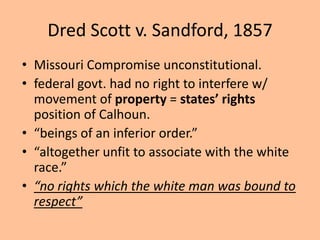
Dred Scott v. Sandford, 1857
• Missouri Compromise unconstitutional.
• federal govt. had no right to interfere w/
  movement of property = states’ rights
  position of Calhoun.
• “beings of an inferior order.”
• “altogether unfit to associate with the white
  race.”
• “no rights which the white man was bound to
  respect”
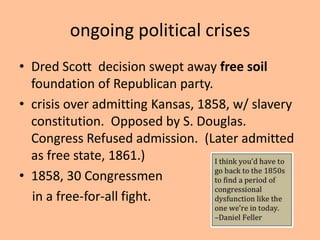
ongoing political crises
• Dred Scott decision swept away free soil
  foundation of Republican party.
• crisis over admitting Kansas, 1858, w/ slavery
  constitution. Opposed by S. Douglas.
  Congress Refused admission. (Later admitted
  as free state, 1861.)
• 1858, 30 Congressmen
  in a free-for-all fight.
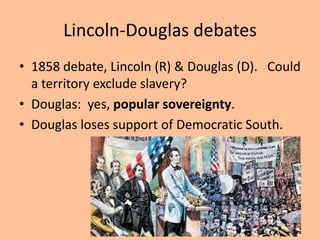
Lincoln-Douglas debates
• 1858 debate, Lincoln (R) & Douglas (D). Could
  a territory exclude slavery?
• Douglas: yes, popular sovereignty.
• Douglas loses support of Democratic South.
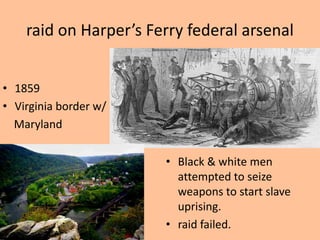
raid on Harper’s Ferry federal arsenal


• 1859
• Virginia border w/
  Maryland


                       • Black & white men
                         attempted to seize
                         weapons to start slave
                         uprising.
                       • raid failed.
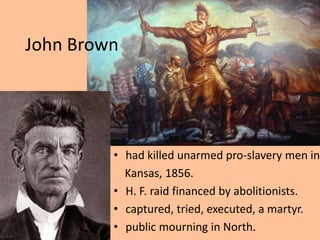
John Brown


         • had killed unarmed pro-slavery men in
           Kansas, 1856.
         • H. F. raid financed by abolitionists.
         • captured, tried, executed, a martyr.
         • public mourning in North.
1860
• presidential election, 11/1860. Democrats
  split. Republicans nominated Lincoln. 2nd
  highest turnout in election ever.
• Southern governors called state conventions.
• South Carolina seceded, 12/1860, followed by
  6 other deep south states.
• Lincoln would not compromise on extension
  of slavery. Moderate in response to secession.
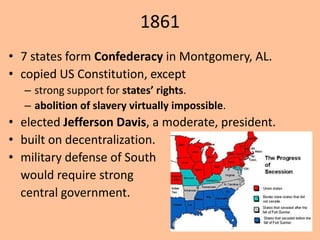
1861
• 7 states form Confederacy in Montgomery, AL.
• copied US Constitution, except
  – strong support for states’ rights.
  – abolition of slavery virtually impossible.
• elected Jefferson Davis, a moderate, president.
• built on decentralization.
• military defense of South
  would require strong
  central government.
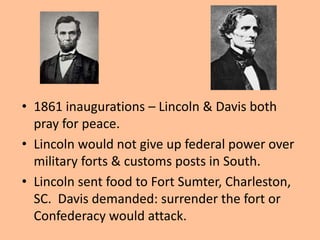
• 1861 inaugurations – Lincoln & Davis both
  pray for peace.
• Lincoln would not give up federal power over
  military forts & customs posts in South.
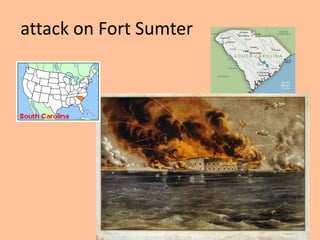
• Lincoln sent food to Fort Sumter, Charleston,
  SC. Davis demanded: surrender the fort or
  Confederacy would attack.
attack on Fort Sumter
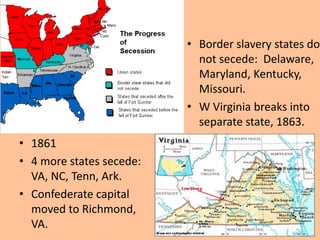
• Border slavery states do
                            not secede: Delaware,
                            Maryland, Kentucky,
                            Missouri.
                          • W Virginia breaks into
                            separate state, 1863.
• 1861
• 4 more states secede:
  VA, NC, Tenn, Ark.
• Confederate capital
  moved to Richmond,
  VA.
armies created
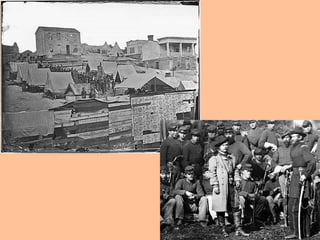
• before Ft. Sumter, Confederacy calls for 100,000
  volunteers.
• after Ft. Sumter, Lincoln calls for 75,000 state
  militiamen to serve in federal army; no Blacks.
• few expected a long or serious war.
• North: larger, richer, more industrialized.
• South: fighting in self-defense, more experienced
  military, able to continue economy w/ slave labor.
• Robert E. Lee offered command of both sides.
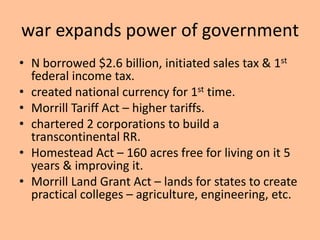
war expands power of government
• N borrowed $2.6 billion, initiated sales tax & 1st
  federal income tax.
• created national currency for 1st time.
• Morrill Tariff Act – higher tariffs.
• chartered 2 corporations to build a
  transcontinental RR.
• Homestead Act – 160 acres free for living on it 5
  years & improving it.
• Morrill Land Grant Act – lands for states to create
  practical colleges – agriculture, engineering, etc.
Europe?
• North tried to ensure Britain & France didn’t
  recognize Confederacy.
• Confederacy believed cotton was king.
• Europe stayed out & found other sources for
  cotton.

• N naval blockade eventually successful in
  keeping supplies from reaching South.
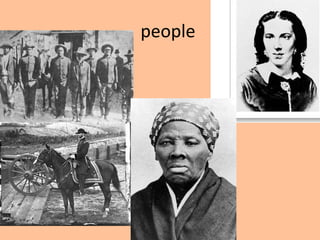
people
draft = compulsory labor
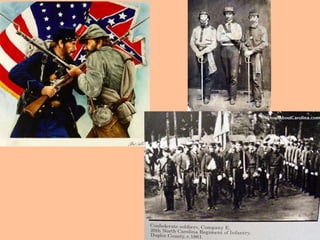
• Confederate draft began April 1862 – 1st draft
  law in America, white men 18 – 35.
• unpopular because denied rights of individual
  man.
• owners of more than 20 slaves exempt.
• rich could hire a replacement instead of
  serving in military.
• “a rich man’s war, but a poor man’s fight.”
Union draft, March, 1863
• well-to-do Northern white men could buy
  their way out of being drafted by paying $300.
• working-class white men had to serve.
• working class anger.
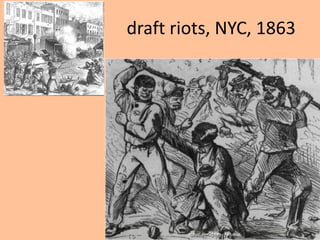
• 3 days of rioting NYC, 1863, resulted in at least
  120 civilian deaths, 11 lynchings of African
  Americans, & substantial property damage.
  Focused on African Americans.
draft riots, NYC, 1863
women
• procurement & supply – both sides.
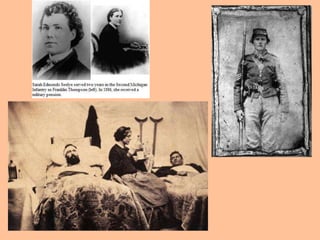
• soldiers in disguise – both sides.
• nurses (previously not respectable).
• organizers – more in Union, more experienced
  in organizations.
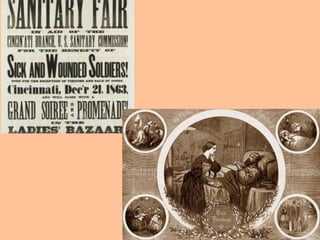
• US Sanitary Commission – N women, supplied
  funds, food, clothes, medicine, quilts.
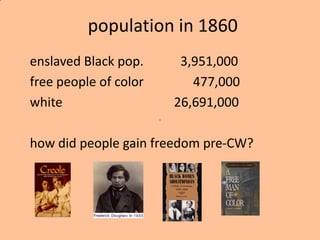
population in 1860
enslaved Black pop.     3,951,000
free people of color      477,000
white                  26,691,000

how did people gain freedom pre-CW?
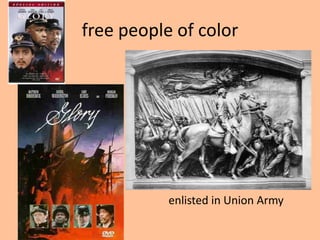
free people of color


           enlisted in Union Army
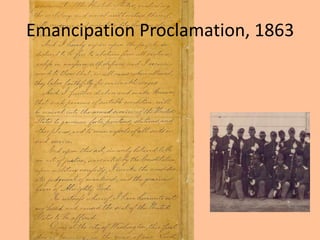
Emancipation Proclamation, 1863
what happened to enslaved people
          during Civil War?
• some men forced to serve in Confederate
  Army, usually as domestic workers. No guns!
• numerous enslaved men escaped to & joined
  Union forces when they came nearby.
• slaves waged a general strike: stopped
  working, produced only for their own needs.
• general strike undermined Confederate Army,
  leading to Union victory.
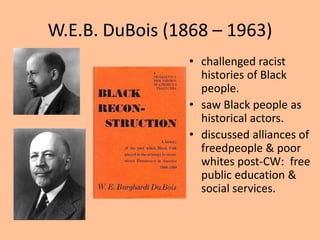
W.E.B. DuBois (1868 – 1963)
                 • challenged racist
                   histories of Black
                   people.
                 • saw Black people as
                   historical actors.
                 • discussed alliances of
                   freedpeople & poor
                   whites post-CW: free
                   public education &
                   social services.
announcements
• paper # 2 due Tuesday 22 May.
• 1 – 2 pages, typed, double spaced. No emails.
• write an autobiography describing how the
  Civil War affects your life.
• do internet research, & write an original essay.
• choose
  – race, gender, age, class, enslaved or free.
  – state(s) in which you live.
Dokuz Eylul Conference
• Being a Woman: Awareness & Liberalization.
• Wed, May 9 – Fri May 11, Dokuz Eylul
  Rectorate in Alsancak.
• free for students.
• I’m speaking at a plenary session, Fri, 9:30.
  “From Awareness to Action, from
  Liberalization to Liberation.”
reading assignment for May 15
• Out of Many
  – Lincoln’s Emancipation Proclamation, 207 – 208.
  – African American soldier, 212.
  – Lincoln’s Gettysburg Address, 214 – 215.

Us history 8th May, 2012

  • 1.
    US history survey May 8, 2012 1850s crises – steps toward Civil War, 1861 - 1865
  • 2.
    announcements • paper #2 due Tuesday 22 May. • 1 – 2 pages, typed, double spaced. No emails. • write an autobiography describing how the Civil War affects your life. • do internet research, & write an original essay. • choose – race, gender, age, class, enslaved or free. – state(s) in which you live.
  • 3.
    1850s crises • compromisesof 1850 did not resolve the issue of extension of slavery into territories. • political parties no longer national, but increasingly sectional. • Republican party founded, all Northerners. • N & S attitudes hardening, compromises less possible. • violence – Kansas & elsewhere.
  • 6.
    Preston Brooks attacksCharles Sumner in Senate, 1856
  • 7.
    Dred Scott v.Sanford, 1857 Scott, lifelong slave, taken by owner to free territory, 1830s. Married a slave, Harriet, & daughter born in free territory. Returned to slave state. • sued for freedom for 3 based on residence in free state. • S-dominated Supreme Court, Chief Justice Roger B. Taney. Sectional decision.
  • 8.
    Dred Scott v.Sandford, 1857 • Missouri Compromise unconstitutional. • federal govt. had no right to interfere w/ movement of property = states’ rights position of Calhoun. • “beings of an inferior order.” • “altogether unfit to associate with the white race.” • “no rights which the white man was bound to respect”
  • 9.
    ongoing political crises •Dred Scott decision swept away free soil foundation of Republican party. • crisis over admitting Kansas, 1858, w/ slavery constitution. Opposed by S. Douglas. Congress Refused admission. (Later admitted as free state, 1861.) • 1858, 30 Congressmen in a free-for-all fight.
  • 10.
    Lincoln-Douglas debates • 1858debate, Lincoln (R) & Douglas (D). Could a territory exclude slavery? • Douglas: yes, popular sovereignty. • Douglas loses support of Democratic South.
  • 11.
    raid on Harper’sFerry federal arsenal • 1859 • Virginia border w/ Maryland • Black & white men attempted to seize weapons to start slave uprising. • raid failed.
  • 12.
    John Brown • had killed unarmed pro-slavery men in Kansas, 1856. • H. F. raid financed by abolitionists. • captured, tried, executed, a martyr. • public mourning in North.
  • 13.
    1860 • presidential election,11/1860. Democrats split. Republicans nominated Lincoln. 2nd highest turnout in election ever. • Southern governors called state conventions. • South Carolina seceded, 12/1860, followed by 6 other deep south states. • Lincoln would not compromise on extension of slavery. Moderate in response to secession.
  • 14.
    1861 • 7 statesform Confederacy in Montgomery, AL. • copied US Constitution, except – strong support for states’ rights. – abolition of slavery virtually impossible. • elected Jefferson Davis, a moderate, president. • built on decentralization. • military defense of South would require strong central government.
  • 15.
    • 1861 inaugurations– Lincoln & Davis both pray for peace. • Lincoln would not give up federal power over military forts & customs posts in South. • Lincoln sent food to Fort Sumter, Charleston, SC. Davis demanded: surrender the fort or Confederacy would attack.
  • 16.
  • 17.
    • Border slaverystates do not secede: Delaware, Maryland, Kentucky, Missouri. • W Virginia breaks into separate state, 1863. • 1861 • 4 more states secede: VA, NC, Tenn, Ark. • Confederate capital moved to Richmond, VA.
  • 18.
    armies created • beforeFt. Sumter, Confederacy calls for 100,000 volunteers. • after Ft. Sumter, Lincoln calls for 75,000 state militiamen to serve in federal army; no Blacks. • few expected a long or serious war. • North: larger, richer, more industrialized. • South: fighting in self-defense, more experienced military, able to continue economy w/ slave labor. • Robert E. Lee offered command of both sides.
  • 20.
    war expands powerof government • N borrowed $2.6 billion, initiated sales tax & 1st federal income tax. • created national currency for 1st time. • Morrill Tariff Act – higher tariffs. • chartered 2 corporations to build a transcontinental RR. • Homestead Act – 160 acres free for living on it 5 years & improving it. • Morrill Land Grant Act – lands for states to create practical colleges – agriculture, engineering, etc.
  • 21.
    Europe? • North triedto ensure Britain & France didn’t recognize Confederacy. • Confederacy believed cotton was king. • Europe stayed out & found other sources for cotton. • N naval blockade eventually successful in keeping supplies from reaching South.
  • 22.
  • 24.
    draft = compulsorylabor • Confederate draft began April 1862 – 1st draft law in America, white men 18 – 35. • unpopular because denied rights of individual man. • owners of more than 20 slaves exempt. • rich could hire a replacement instead of serving in military. • “a rich man’s war, but a poor man’s fight.”
  • 25.
    Union draft, March,1863 • well-to-do Northern white men could buy their way out of being drafted by paying $300. • working-class white men had to serve. • working class anger. • 3 days of rioting NYC, 1863, resulted in at least 120 civilian deaths, 11 lynchings of African Americans, & substantial property damage. Focused on African Americans.
  • 26.
  • 27.
    women • procurement &supply – both sides. • soldiers in disguise – both sides. • nurses (previously not respectable). • organizers – more in Union, more experienced in organizations. • US Sanitary Commission – N women, supplied funds, food, clothes, medicine, quilts.
  • 30.
    population in 1860 enslavedBlack pop. 3,951,000 free people of color 477,000 white 26,691,000 how did people gain freedom pre-CW?
  • 31.
    free people ofcolor enlisted in Union Army
  • 32.
  • 33.
    what happened toenslaved people during Civil War? • some men forced to serve in Confederate Army, usually as domestic workers. No guns! • numerous enslaved men escaped to & joined Union forces when they came nearby. • slaves waged a general strike: stopped working, produced only for their own needs. • general strike undermined Confederate Army, leading to Union victory.
  • 34.
    W.E.B. DuBois (1868– 1963) • challenged racist histories of Black people. • saw Black people as historical actors. • discussed alliances of freedpeople & poor whites post-CW: free public education & social services.
  • 35.
    announcements • paper #2 due Tuesday 22 May. • 1 – 2 pages, typed, double spaced. No emails. • write an autobiography describing how the Civil War affects your life. • do internet research, & write an original essay. • choose – race, gender, age, class, enslaved or free. – state(s) in which you live.
  • 36.
    Dokuz Eylul Conference •Being a Woman: Awareness & Liberalization. • Wed, May 9 – Fri May 11, Dokuz Eylul Rectorate in Alsancak. • free for students. • I’m speaking at a plenary session, Fri, 9:30. “From Awareness to Action, from Liberalization to Liberation.”
  • 37.
    reading assignment forMay 15 • Out of Many – Lincoln’s Emancipation Proclamation, 207 – 208. – African American soldier, 212. – Lincoln’s Gettysburg Address, 214 – 215.

Editor's Notes

  • #5 http://media.web.britannica.com/eb-media/65/70765-004-41AFB7FC.jpg – Kansas clash over slavery.http://www.smithsonianlegacies.si.edu/photos/154.jpghttp://static.ddmcdn.com/gif/old-railroads-016a.jpghttp://viciousbabushka.typepad.com/.a/6a010536b72a74970b01539383f5f5970b-800wi
  • #6 http://miratrinity.files.wordpress.com/2011/11/congo-square.jpg – NO -- now Louis Armstrong Square, site of Jazz Fest. http://t1.gstatic.com/images?q=tbn:ANd9GcQoqiOW-8VOsBxoqvS2VViQ0a6Ry7_kwFMd9yS5RUEl-EDlIJT4brP51aNg – Calif. Gold rush 2 free Black men. Same image also athttp://www.america101.us/gold_rush/cultures_files/shapeimage_2.pnghttp://1.bp.blogspot.com/-mX3Qi00S5eU/TcPAlN1DAaI/AAAAAAAAF_I/M0V1Oi1Bg1w/s1600/Cotton%2Bpickers%2Boverseer%2Bon%2Bhoresback.jpg
  • #7 http://scienceblogs.com/gregladen/upload/2009/09/a_word_about_civility_joe_wils/Why_b_civil_when_u_have_a_stick.jpghttp://www.bluegrayreview.com/wp-content/uploads/2010/11/LMKeitt.jpghttp://www.digitalhistory.uh.edu/daybyday/images/Charles_Sumner.jpg
  • #10 http://davidbrin.files.wordpress.com/2012/01/feller.jpg
  • #11 http://media.smithsonianmag.com/images/facethenation_sept08_631.jpg
  • #12 http://media.smithsonianmag.com/images/John-Brown-raid-Harpers-Ferry-631.jpghttp://www.javins.com/Harpers2rivers.jpg
  • #13 http://www.onthisdeity.com/wp-content/uploads/2010/10/hf-john-brown.jpghttp://hd.housedivided.dickinson.edu/files/images/HD_brownJtopics.jpg
  • #15 http://www.ushistory.org/us/images/00000525.jpg
  • #17 http://www.loc.gov/exhibits/treasures/images/at0042b.1s.jpg
  • #18 http://dburgin.tripod.com/secede.gifhttp://www.christmasih.org/images/edit_va_large_map.gif
  • #20 http://foramericandream.com/wp-content/uploads/2012/03/civil-war-soldiers.jpghttp://www.awesomestories.com/images/user/9d51c941ae.gif
  • #23 http://www.blackpast.org/files/blackpast_images/people_Seminole_Negro_Scouts.jpghttp://rlv.zcache.com/boyd_belle_confederate_spy_civil_war_postcard-p239090753096669366trdg_400.jpghttp://www.acsu.buffalo.edu/~bpg2/Underground%20Railroad/3zHarriet_Tubman.jpghttp://www.gpb.org/files/ga_civil_war02.jpg
  • #24 http://research.surnames.com/images/civil_war_soldiers.jpghttp://bentley.umich.edu/research/genealogy/cw/images/bl003711JP2.jpg – U Michigan students in army. http://shoutaboutcarolina.files.wordpress.com/2011/03/civil-war-1861-confederate-soldiers-company-e-20th-north-carolina-infantry.jpg
  • #27 http://upload.wikimedia.org/wikipedia/commons/thumb/8/8e/New_York_Draft_Riots_-_fighting.jpg/300px-New_York_Draft_Riots_-_fighting.jpghttp://3.bp.blogspot.com/-Pz-40sZKgCY/TeIj_eW18nI/AAAAAAAAGz8/Vj5hnBRJSUc/s1600/NY%2B1863_Draft_Riots_01.jpg
  • #29 http://4.bp.blogspot.com/_QjRD1qokf6E/TEhzw9Hmh8I/AAAAAAAACk8/D8dNTMI85R4/s640/70020-main_Full.jpghttp://americancivilwar.com/women/sarah_seelye.jpghttp://www.civilwarsignals.org/pages/articles/women1.jpg – “disguised female federal soldier.”
  • #30 http://www.ohiocivilwar150.org/omeka/files/display/1254/square_thumbnailhttp://cosmicamerica.com/wp-content/uploads/2011/07/herioinessm.jpg
  • #32 http://people.virginia.edu/~sfr/enam312/gaudens.jpghttp://t2.gstatic.com/images?q=tbn:ANd9GcRNC614ZwopylFXYhHu1e5Cp60_JxUrAaHUzp-qNJZEH53RCdNsYvLf0PGehttp://www.movieprop.com/tvandmovie/reviews/glory.jpg
  • #35 http://www.americaslibrary.gov/assets/aa/dubois/aa_dubois_subj_m.jpghttp://www.lucidcafe.com/library/96feb/96febgifs/dubois.gifhttp://rpmedia.ask.com/ts?u=/wikipedia/en/thumb/2/27/BlackReconstruction.JPG/150px-BlackReconstruction.JPG