American Romanticism 1800-1860 L.Ruckel American Literature
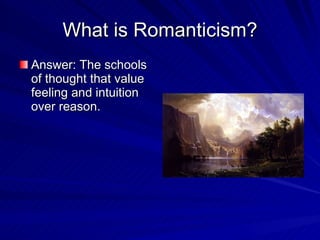
What is Romanticism? Answer: The schools of thought that value feeling and intuition over reason.
The Beginning: Romanticism started in Germany in the second half of the 18 th  century. It was a reaction to rationalism and the Industrial Revolution. Imagination, feelings, and wild nature were more valuable than reason and logic especially when it cam to art. Poetry vs. science
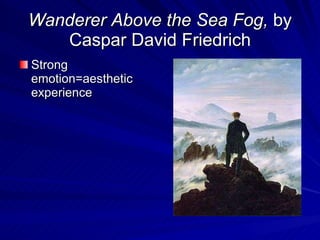
Wanderer Above the Sea Fog,  by Caspar David Friedrich Strong emotion=aesthetic experience
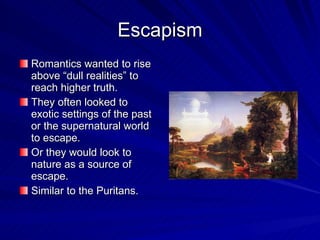
Escapism Romantics wanted to rise above “dull realities” to reach higher truth. They often looked to exotic settings of the past or the supernatural world to escape. Or they would look to nature as a source of escape. Similar to the Puritans.
The American Voice Would American writers continue to imitate the Europeans or develop their own style? American novels used the wilderness of the west to create a unique style. James Fenimore Cooper was one of the first American novelists. He wrote  The Last of the Mohicans.
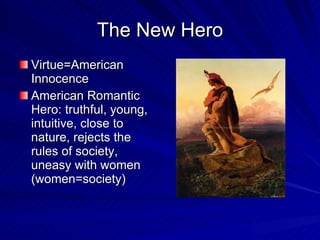
The New Hero Virtue=American Innocence American Romantic Hero: truthful, young, intuitive, close to nature, rejects the rules of society, uneasy with women (women=society)
Romantic Poetry Stuck with English themes, meter, and imagery. Wanted to prove Europeans wrong about Americans. Fireside Poets: Henry Wadsworth Longfellow, John Greenleaf Whittier, Oliver Wendell Holmes, and James Russell Lowell They were somewhat short sighted.
Transcendentalists Transcendental-the idea that in determining the ultimate reality of God, the universe, the self, and other important matters, one must transcend the everyday human experience in the physical world. Lead by Ralph Waldo Emerson. They were idealists, but in a broader, more practical sense. They were working towards perfection.
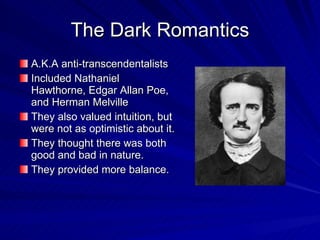
The Dark Romantics A.K.A anti-transcendentalists Included Nathaniel Hawthorne, Edgar Allan Poe, and Herman Melville They also valued intuition, but were not as optimistic about it.  They thought there was both good and bad in nature. They provided more balance.

American romanticism

  • 1.
    American Romanticism 1800-1860L.Ruckel American Literature
  • 2.
    What is Romanticism?Answer: The schools of thought that value feeling and intuition over reason.
  • 3.
    The Beginning: Romanticismstarted in Germany in the second half of the 18 th century. It was a reaction to rationalism and the Industrial Revolution. Imagination, feelings, and wild nature were more valuable than reason and logic especially when it cam to art. Poetry vs. science
  • 4.
    Wanderer Above theSea Fog, by Caspar David Friedrich Strong emotion=aesthetic experience
  • 5.
    Escapism Romantics wantedto rise above “dull realities” to reach higher truth. They often looked to exotic settings of the past or the supernatural world to escape. Or they would look to nature as a source of escape. Similar to the Puritans.
  • 6.
    The American VoiceWould American writers continue to imitate the Europeans or develop their own style? American novels used the wilderness of the west to create a unique style. James Fenimore Cooper was one of the first American novelists. He wrote The Last of the Mohicans.
  • 7.
    The New HeroVirtue=American Innocence American Romantic Hero: truthful, young, intuitive, close to nature, rejects the rules of society, uneasy with women (women=society)
  • 8.
    Romantic Poetry Stuckwith English themes, meter, and imagery. Wanted to prove Europeans wrong about Americans. Fireside Poets: Henry Wadsworth Longfellow, John Greenleaf Whittier, Oliver Wendell Holmes, and James Russell Lowell They were somewhat short sighted.
  • 9.
    Transcendentalists Transcendental-the ideathat in determining the ultimate reality of God, the universe, the self, and other important matters, one must transcend the everyday human experience in the physical world. Lead by Ralph Waldo Emerson. They were idealists, but in a broader, more practical sense. They were working towards perfection.
  • 10.
    The Dark RomanticsA.K.A anti-transcendentalists Included Nathaniel Hawthorne, Edgar Allan Poe, and Herman Melville They also valued intuition, but were not as optimistic about it. They thought there was both good and bad in nature. They provided more balance.