US history survey

    May 15, 2012
  Civil War battles
  aftermath of war
announcements
• final class: Tuesday, May 22.

• paper # 2 due Tuesday, May 22.

• I added 10 points to all midterm exams.

• final exam: Tuesday, May 29, noon. Eat first
  or bring a snack with you.
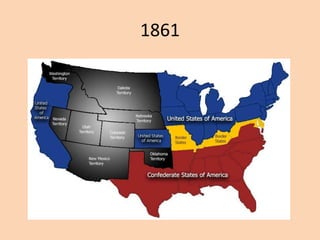
1861
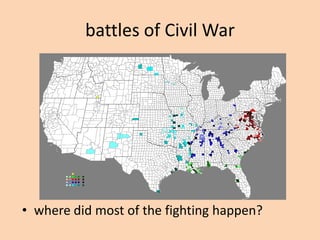
battles of Civil War


• where did most of the fighting happen?
fighting 1861 – 1863
• Lincoln thought one battle would defeat S & war
  would end.
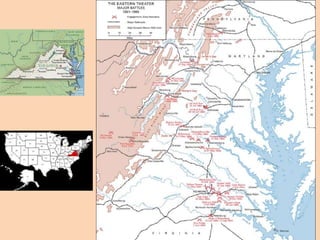
• fighting in N Virginia; N goal to capture
  Richmond, Confederate capital.
• neither side strong enough to win; both sides too
  strong to be defeated.
• N strategy: control Mississippi River & blockade S
  by ocean.
• N seized islands of N & S Carolina & captured
  New Orleans.
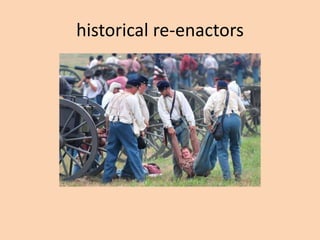
historical re-enactors
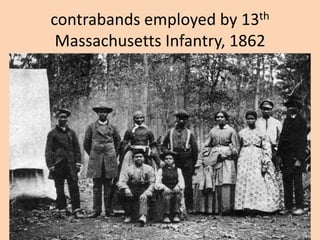
fugitive slaves = “contrabands”
• slaves fled to Union armies when they
  reached their areas.
• slave owner demanded return, but union
  commander refused, said they were
  “contrabands of war.”
• built fortifications, cooked, did other work.
• Contraband Relief Association, Washington,
  DC, founded by Elizabeth Keckley, ex-slave,
  seamstress to Mary Todd Lincoln.
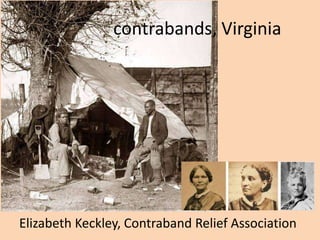
contrabands, Virginia


Elizabeth Keckley, Contraband Relief Association
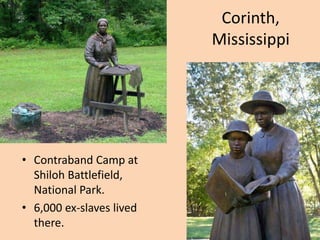
Corinth,
                          Mississippi


• Contraband Camp at
  Shiloh Battlefield,
  National Park.
• 6,000 ex-slaves lived
  there.
contrabands employed by 13th
 Massachusetts Infantry, 1862
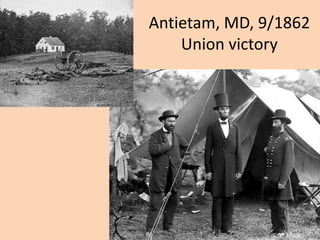
Antietam, MD, 9/1862
    Union victory
Emancipation Proclamation
• after Antietam victory, Lincoln stated, unless
  rebellious states returned to Union by 1/1/1863,
  he would declare their slaves free.
• “If I could save the Union w/o freeing any slave, I
  would do it. If I could save it by freeing all the
  slaves, I would do it. If I could free some & leave
  others alone, I would also do that.”
• freed only slaves in areas of rebellion, not areas
  Union controlled or in border states.
• recruited Black soldiers for 1st time.
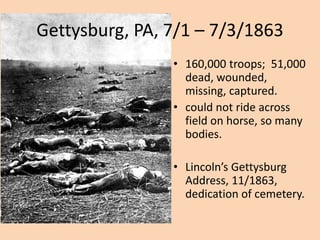
Gettysburg, PA, 7/1 – 7/3/1863
                • 160,000 troops; 51,000
                  dead, wounded,
                  missing, captured.
                • could not ride across
                  field on horse, so many
                  bodies.

                • Lincoln’s Gettysburg
                  Address, 11/1863,
                  dedication of cemetery.
1864
• Sherman captures Atlanta.
• Lincoln wins re-election.
• voters supported his new policy of
  unconditional surrender – no negotiated
  peace.
• war continued.
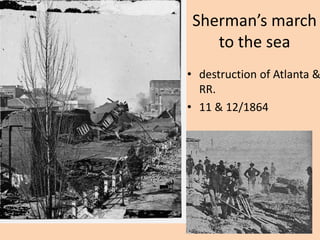
Sherman’s march
    to the sea
• destruction of Atlanta &
  RR.
• 11 & 12/1864
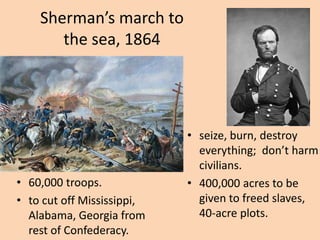
Sherman’s march to
       the sea, 1864


                            • seize, burn, destroy
                              everything; don’t harm
                              civilians.
• 60,000 troops.            • 400,000 acres to be
• to cut off Mississippi,     given to freed slaves,
  Alabama, Georgia from       40-acre plots.
  rest of Confederacy.
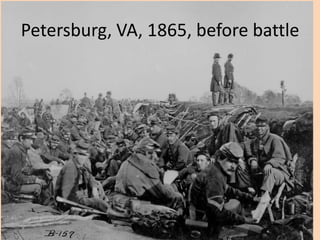
Petersburg, VA, 1865, before battle
soldiers’ daily lives
• volunteers w/ little       • by end, Confederate
  military training.           troops starving.
• marched w/ 50 – 60         • Confederacy considered
  pound packs.                 arming slaves near end.
• disease, hunger.           • “If slaves make good
• 1/9 Confederates & 1/7       soldiers, our whole
  Union soldiers deserted.     theory of slavery is
  Also AWOL.                   wrong. (Confederate
• early in the war,            Congressman).
  fraternization between
  battles.
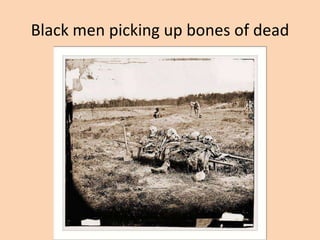
Black men picking up bones of dead
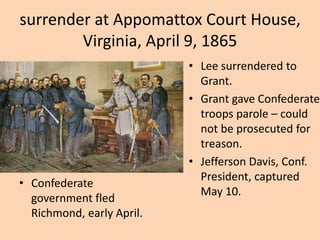
surrender at Appomattox Court House,
        Virginia, April 9, 1865
                           • Lee surrendered to
                             Grant.
                           • Grant gave Confederate
                             troops parole – could
                             not be prosecuted for
                             treason.
                           • Jefferson Davis, Conf.
                             President, captured
• Confederate
                             May 10.
  government fled
  Richmond, early April.
enormous death toll of war – N & S
• improved weapons, but generals still relied on
  old military doctrine of massed infantry
  offensives (learned at West Point).
• medical ignorance – gangrene (infected wounds)
  & disease (smallpox, dysentery, typhoid,
  pneumonia, malaria).
• unprepared for health & supply needs.
• Andersonville, GA – Confederate prison camp for
  Union soldiers. 100 died daily, summer 1864.
620,000 military deaths =
            2% of population
• equal to total fatalities of Revolution, War of
  1812, Mexican War, Spanish-American War,
  WW I & II, & Korean War combined.
• 1/5 white S men of military age died; 3 times
  rate of N men.
• 2.1 million N & 880,000 S soldiers = 3 million
  combatants.
• American Rev. – largest army was 30,000.
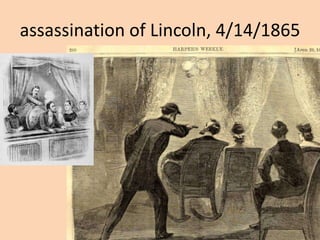
assassination of Lincoln, 4/14/1865
plans for Reconstruction
• Lincoln wanted to bring seceded states back to
  Union asap (as soon as possible).
• respect private property (except slavery).
• full pardon if swear oath of allegiance.
• 10% Plan – once 10% swore allegiance, could
  establish state government & ask to return.
• Congress disagreed; Lincoln vetoed 50% plan.
• Freedmen’s Bureau established 1865.
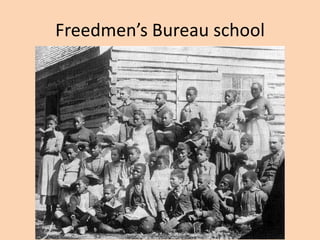
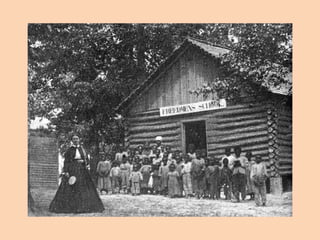
Freedmen’s Bureau school
Freedmen’s Bureau, 3/1865
• food, clothing, fuel to destitute.
• managed abandoned lands.
• could lease 40 acres abandoned or confiscated
  land to freed slaves or white Unionists.

• 13th Amendment passed & ratified, 12/1865.
• abolished slavery.
plans change –
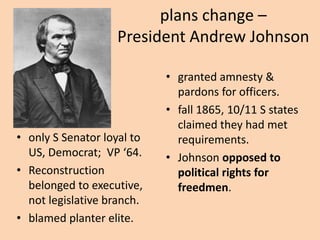
                   President Andrew Johnson

                            • granted amnesty &
                              pardons for officers.
                            • fall 1865, 10/11 S states
                              claimed they had met
• only S Senator loyal to     requirements.
  US, Democrat; VP ‘64.     • Johnson opposed to
• Reconstruction              political rights for
  belonged to executive,      freedmen.
  not legislative branch.
• blamed planter elite.
Radical Republicans
• federal govt. should remake S society, especially civil
  rights & suffrage for freedmen.
• S states passed Black codes, 1865, to restrict freedom
  & keep as close to slavery as possible.
• Civil Rights Bill, 1866 – citizenship & rights of citizens
  for Black people.
• enlarged Freedmen’s Bureau to schools & courts.
• Congress overrode Johnson’s veto of both.
• 14th Amendment – citizenship & due process of law
  cannot be denied based on previous condition of
  servitude.
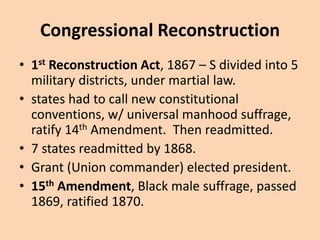
Congressional Reconstruction
• 1st Reconstruction Act, 1867 – S divided into 5
  military districts, under martial law.
• states had to call new constitutional
  conventions, w/ universal manhood suffrage,
  ratify 14th Amendment. Then readmitted.
• 7 states readmitted by 1868.
• Grant (Union commander) elected president.
• 15th Amendment, Black male suffrage, passed
  1869, ratified 1870.
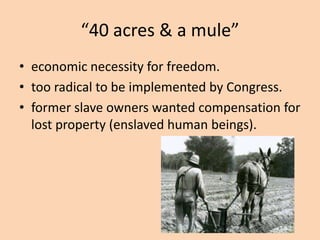
“40 acres & a mule”
• economic necessity for freedom.
• too radical to be implemented by Congress.
• former slave owners wanted compensation for
  lost property (enslaved human beings).
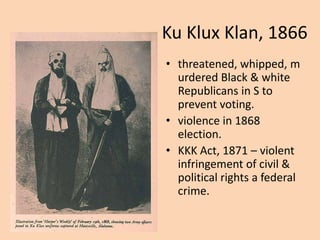
Ku Klux Klan, 1866
• threatened, whipped, m
  urdered Black & white
  Republicans in S to
  prevent voting.
• violence in 1868
  election.
• KKK Act, 1871 – violent
  infringement of civil &
  political rights a federal
  crime.
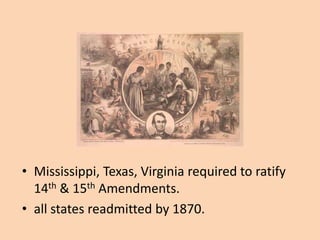
• Mississippi, Texas, Virginia required to ratify
  14th & 15th Amendments.
• all states readmitted by 1870.
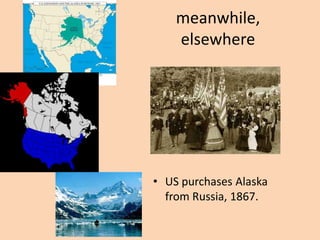
meanwhile,
    elsewhere


• US purchases Alaska
  from Russia, 1867.
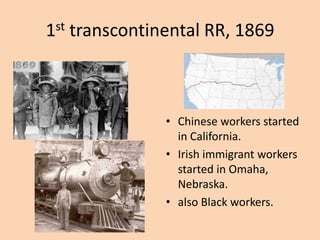
1st transcontinental RR, 1869


               • Chinese workers started
                 in California.
               • Irish immigrant workers
                 started in Omaha,
                 Nebraska.
               • also Black workers.
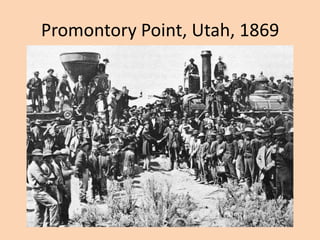
Promontory Point, Utah, 1869
announcements
• final class: Tuesday, May 22.

• paper # 2 due Tuesday, May 22.

• I added 10 points to all midterm exams.

• final exam: Tuesday, May 29, noon. Eat first
  or bring a snack with you.

Us history survey.051512

  • 1.
    US history survey May 15, 2012 Civil War battles aftermath of war
  • 2.
    announcements • final class:Tuesday, May 22. • paper # 2 due Tuesday, May 22. • I added 10 points to all midterm exams. • final exam: Tuesday, May 29, noon. Eat first or bring a snack with you.
  • 3.
  • 4.
    battles of CivilWar • where did most of the fighting happen?
  • 7.
    fighting 1861 –1863 • Lincoln thought one battle would defeat S & war would end. • fighting in N Virginia; N goal to capture Richmond, Confederate capital. • neither side strong enough to win; both sides too strong to be defeated. • N strategy: control Mississippi River & blockade S by ocean. • N seized islands of N & S Carolina & captured New Orleans.
  • 8.
  • 9.
    fugitive slaves =“contrabands” • slaves fled to Union armies when they reached their areas. • slave owner demanded return, but union commander refused, said they were “contrabands of war.” • built fortifications, cooked, did other work. • Contraband Relief Association, Washington, DC, founded by Elizabeth Keckley, ex-slave, seamstress to Mary Todd Lincoln.
  • 10.
    contrabands, Virginia Elizabeth Keckley,Contraband Relief Association
  • 11.
    Corinth, Mississippi • Contraband Camp at Shiloh Battlefield, National Park. • 6,000 ex-slaves lived there.
  • 12.
    contrabands employed by13th Massachusetts Infantry, 1862
  • 13.
    Antietam, MD, 9/1862 Union victory
  • 14.
    Emancipation Proclamation • afterAntietam victory, Lincoln stated, unless rebellious states returned to Union by 1/1/1863, he would declare their slaves free. • “If I could save the Union w/o freeing any slave, I would do it. If I could save it by freeing all the slaves, I would do it. If I could free some & leave others alone, I would also do that.” • freed only slaves in areas of rebellion, not areas Union controlled or in border states. • recruited Black soldiers for 1st time.
  • 15.
    Gettysburg, PA, 7/1– 7/3/1863 • 160,000 troops; 51,000 dead, wounded, missing, captured. • could not ride across field on horse, so many bodies. • Lincoln’s Gettysburg Address, 11/1863, dedication of cemetery.
  • 16.
    1864 • Sherman capturesAtlanta. • Lincoln wins re-election. • voters supported his new policy of unconditional surrender – no negotiated peace. • war continued.
  • 17.
    Sherman’s march to the sea • destruction of Atlanta & RR. • 11 & 12/1864
  • 18.
    Sherman’s march to the sea, 1864 • seize, burn, destroy everything; don’t harm civilians. • 60,000 troops. • 400,000 acres to be • to cut off Mississippi, given to freed slaves, Alabama, Georgia from 40-acre plots. rest of Confederacy.
  • 19.
    Petersburg, VA, 1865,before battle
  • 20.
    soldiers’ daily lives •volunteers w/ little • by end, Confederate military training. troops starving. • marched w/ 50 – 60 • Confederacy considered pound packs. arming slaves near end. • disease, hunger. • “If slaves make good • 1/9 Confederates & 1/7 soldiers, our whole Union soldiers deserted. theory of slavery is Also AWOL. wrong. (Confederate • early in the war, Congressman). fraternization between battles.
  • 21.
    Black men pickingup bones of dead
  • 22.
    surrender at AppomattoxCourt House, Virginia, April 9, 1865 • Lee surrendered to Grant. • Grant gave Confederate troops parole – could not be prosecuted for treason. • Jefferson Davis, Conf. President, captured • Confederate May 10. government fled Richmond, early April.
  • 23.
    enormous death tollof war – N & S • improved weapons, but generals still relied on old military doctrine of massed infantry offensives (learned at West Point). • medical ignorance – gangrene (infected wounds) & disease (smallpox, dysentery, typhoid, pneumonia, malaria). • unprepared for health & supply needs. • Andersonville, GA – Confederate prison camp for Union soldiers. 100 died daily, summer 1864.
  • 24.
    620,000 military deaths= 2% of population • equal to total fatalities of Revolution, War of 1812, Mexican War, Spanish-American War, WW I & II, & Korean War combined. • 1/5 white S men of military age died; 3 times rate of N men. • 2.1 million N & 880,000 S soldiers = 3 million combatants. • American Rev. – largest army was 30,000.
  • 25.
  • 26.
    plans for Reconstruction •Lincoln wanted to bring seceded states back to Union asap (as soon as possible). • respect private property (except slavery). • full pardon if swear oath of allegiance. • 10% Plan – once 10% swore allegiance, could establish state government & ask to return. • Congress disagreed; Lincoln vetoed 50% plan. • Freedmen’s Bureau established 1865.
  • 27.
  • 29.
    Freedmen’s Bureau, 3/1865 •food, clothing, fuel to destitute. • managed abandoned lands. • could lease 40 acres abandoned or confiscated land to freed slaves or white Unionists. • 13th Amendment passed & ratified, 12/1865. • abolished slavery.
  • 30.
    plans change – President Andrew Johnson • granted amnesty & pardons for officers. • fall 1865, 10/11 S states claimed they had met • only S Senator loyal to requirements. US, Democrat; VP ‘64. • Johnson opposed to • Reconstruction political rights for belonged to executive, freedmen. not legislative branch. • blamed planter elite.
  • 31.
    Radical Republicans • federalgovt. should remake S society, especially civil rights & suffrage for freedmen. • S states passed Black codes, 1865, to restrict freedom & keep as close to slavery as possible. • Civil Rights Bill, 1866 – citizenship & rights of citizens for Black people. • enlarged Freedmen’s Bureau to schools & courts. • Congress overrode Johnson’s veto of both. • 14th Amendment – citizenship & due process of law cannot be denied based on previous condition of servitude.
  • 32.
    Congressional Reconstruction • 1stReconstruction Act, 1867 – S divided into 5 military districts, under martial law. • states had to call new constitutional conventions, w/ universal manhood suffrage, ratify 14th Amendment. Then readmitted. • 7 states readmitted by 1868. • Grant (Union commander) elected president. • 15th Amendment, Black male suffrage, passed 1869, ratified 1870.
  • 33.
    “40 acres &a mule” • economic necessity for freedom. • too radical to be implemented by Congress. • former slave owners wanted compensation for lost property (enslaved human beings).
  • 34.
    Ku Klux Klan,1866 • threatened, whipped, m urdered Black & white Republicans in S to prevent voting. • violence in 1868 election. • KKK Act, 1871 – violent infringement of civil & political rights a federal crime.
  • 35.
    • Mississippi, Texas,Virginia required to ratify 14th & 15th Amendments. • all states readmitted by 1870.
  • 36.
    meanwhile, elsewhere • US purchases Alaska from Russia, 1867.
  • 37.
    1st transcontinental RR,1869 • Chinese workers started in California. • Irish immigrant workers started in Omaha, Nebraska. • also Black workers.
  • 38.
  • 39.
    announcements • final class:Tuesday, May 22. • paper # 2 due Tuesday, May 22. • I added 10 points to all midterm exams. • final exam: Tuesday, May 29, noon. Eat first or bring a snack with you.

Editor's Notes

  • #4 http://www.whiteheaddna.com/miltry_recs/cvlwar/images/map1861.jpg
  • #5 http://upload.wikimedia.org/wikipedia/en/a/a1/American_Civil_War_Battles_by_Theater,_Year,_no_legend.pnghttp://upload.wikimedia.org/wikipedia/commons/thumb/7/7c/American_Civil_War_Battles_by_Theater,_Year.png/550px-American_Civil_War_Battles_by_Theater,_Year.png
  • #6 http://www.history.army.mil/books/AMH-V1/Map22.jpghttp://wwp.greenwichmeantime.com/images/usa/virginia.jpg
  • #7 http://themarginalized.files.wordpress.com/2011/04/bull-run1.jpg – picnicking at 1st Battle of Bull Run/Manassas, 1861
  • #9 http://ph.cdn.photos.upi.com/collection/n2/upi/5454/1582dc9f1c48c3dbe08f3e23a9216ba6/Reenactment-of-the-Battle-of-Bull-Run_5_1.jpg
  • #11 http://www.old-picture.com/civil-war/pictures/Contrabands.jpg – Virginia, 1863, contrabands – camp cooks in Culpeper.http://1.bp.blogspot.com/_SRQCmma-Gmc/SuIScLGYV0I/AAAAAAAAAU8/9GiBeVTJC-M/s400/Joan+Gage+Keckley+Collage.jpg
  • #12 http://www.offbeattravel.com/civil-war.jpghttp://www.nps.gov/shil/planyourvisit/images/Reading.jpg
  • #13 http://www.latinamericanstudies.org/slavery/contrabands-3.jpg – Virginia, 1862, employed by 13th Mass. Infantry.
  • #14 http://www.old-picture.com/lincoln-antietam.jpghttp://0.tqn.com/d/history1800s/1/0/f/6/-/-/dunker-church-antietam.jpg
  • #16 http://freepages.history.rootsweb.ancestry.com/~historyofmarlborough/gettysburg.jpghttp://www.civilwar.org/battlefields/gettysburg.html?tab=facts
  • #18 http://www.learnnc.org/lp/media/uploads/2009/07/atlanta_ruins.jpg – Sherman’s march to the sea
  • #19 http://media.web.britannica.com/eb-media/79/106879-004-67E45097.jpghttp://www.wired.com/images_blogs/thisdayintech/2010/11/gen_sherman_250x.jpg
  • #20 http://www.archives.gov/research/military/civil-war/photos/images/civil-war-115.jpg --
  • #22 http://www.flickr.com/photos/oldeyankee/2720150028/ -- Black men picking up bones of dead, c. 1865
  • #23 http://media-1.web.britannica.com/eb-media/35/93035-004-E1A56FF0.jpg
  • #25 Faust, This Republic of Suffering.
  • #26 http://mitchellarchives.com/wp-content/uploads/2007/11/booth-lincoln-hw-shooting-lincoln.jpghttp://iml.jou.ufl.edu/projects/fall05/csmith/drawing.jpg
  • #28 http://www.kawvalley.k12.ks.us/schools/rjh/marneyg/05_history-projects/05_flinnr_school.jpg
  • #29 http://jackiewhiting.net/ap/Reconstruction/freedmens_school.jpg
  • #31 http://www.jhm2053.com/jhm007001.jpg
  • #35 http://cti.itc.virginia.edu/~hius202/images/lecture02/kkk1.jpg
  • #36 http://shs.westport.k12.ct.us/jwb/AP/Images/Emacipate.jpg
  • #37 http://images.opentip.com/thumbs/UMP/UMP-3011927_280_280.jpghttp://alaskadayfestival.org/images/castlehill.jpg
  • #38 http://apa.si.edu/ongoldmountain/gallery2/Pictures2/2RAILROA_12.jpghttp://cdn.dipity.com/uploads/events/f155a45d431ab943389c3f07382f4075_1M.png
  • #39 http://www.tcrr.com/Golden-Spike-wiki.jpg