

The Spirit of the Age
e  A sense of(1790-1850)
              a shared vision among the
  Romantics.


e  Early support of the French Revolution.


e  Rise of the individual  alienation.


e  Dehumanization of industrialization.


  Radical poetics / politics  an obsession
  with violent change.
A Growing Distrust of
               Reason
                             Early
Enlightenment                 19c          Romanticis
Society is good, curbing                           m
                                         Civilization corrupts!
violent impulses!


     e  The essence of human experience is subjective
        and emotional.
     e  Human knowledge is a puny thing compared to
        other great historical forces.
     e  “Individual rights” are dangerous efforts at
        selfishness  the community is more important.
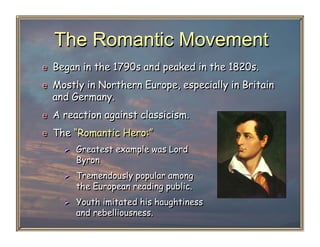
The Romantic Movement
e  Began in the 1790s and peaked in the 1820s.
e  Mostly in Northern Europe, especially in Britain
  and Germany.
e  A reaction against classicism.

e  The “Romantic Hero:”
      Greatest example was Lord
       Byron
      Tremendously popular among
       the European reading public.
      Youth imitated his haughtiness
       and rebelliousness.
Characteristics of
        Romanticism
The Engaged & Enraged
 Artist:
    The artist apart from society.

    The artist as social critic/revolutionary.

    The artist as genius.
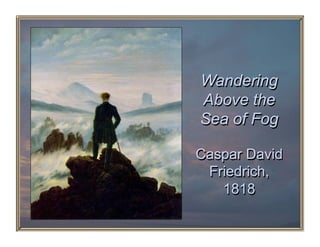
Wandering
Above the
Sea of Fog

Caspar David
 Friedrich,
   1818
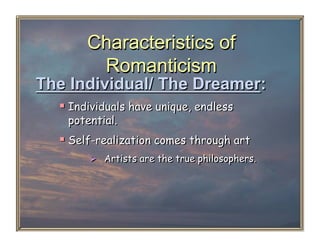
Characteristics of
        Romanticism
The Individual/ The Dreamer:
    Individuals have unique, endless
   potential.
    Self-realization comes through art
          Artists are the true philosophers.
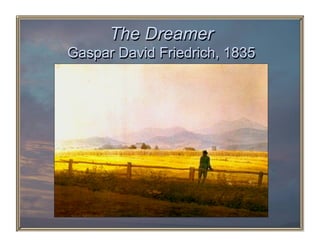
The Dreamer
Gaspar David Friedrich, 1835
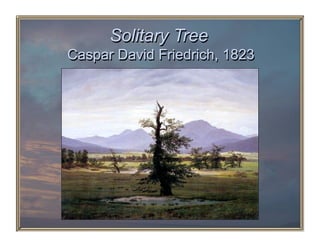
Solitary Tree
Caspar David Friedrich, 1823
Characteristics of
     Romanticism
Glorification of Nature:
    Peaceful, restorative qualities [an
    escape from industrialization and
    the dehumanization it creates].
    Awesome, powerful, horrifying
    aspects of nature.
        Indifferent to the fate of humans.
        Overwhelming power of nature.
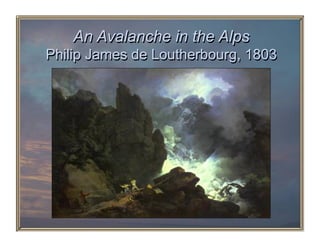
An Avalanche in the Alps
Philip James de Loutherbourg, 1803
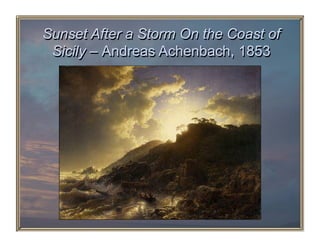
Sunset After a Storm On the Coast of
 Sicily – Andreas Achenbach, 1853
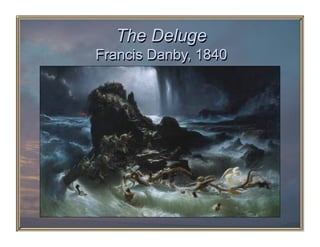
The Deluge
Francis Danby, 1840
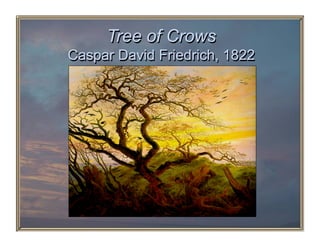
Tree of Crows
Caspar David Friedrich, 1822
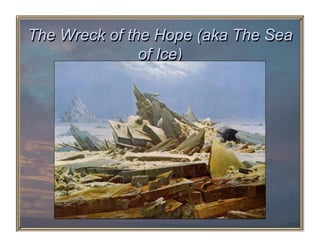
The Wreck of the Hope (aka The Sea
               of Ice)
    Caspar David Friedrich, 1821
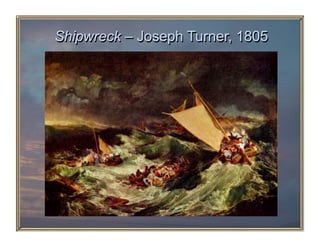
Shipwreck – Joseph Turner, 1805
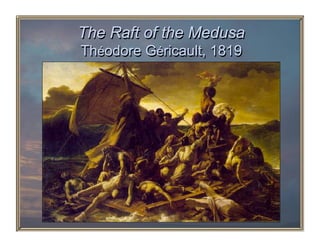
The Raft of the Medusa
Théodore Géricault, 1819
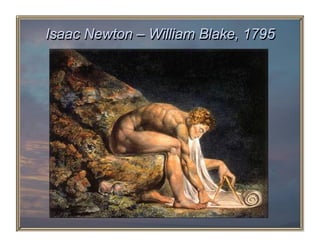
Isaac Newton – William Blake, 1795
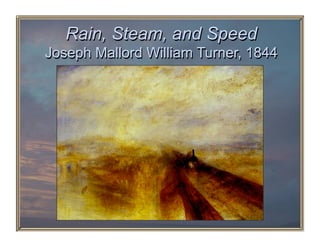
Rain, Steam, and Speed
Joseph Mallord William Turner, 1844
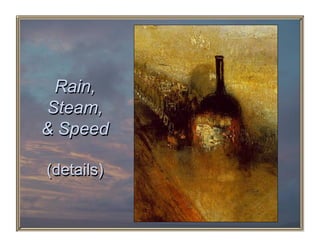
Rain,
 Steam,
& Speed

(details)
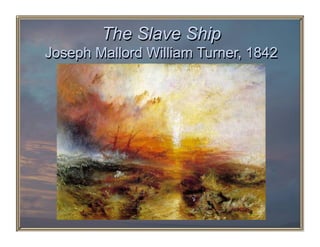
The Slave Ship
Joseph Mallord William Turner, 1842
The
 Slave
 Ship

(details)
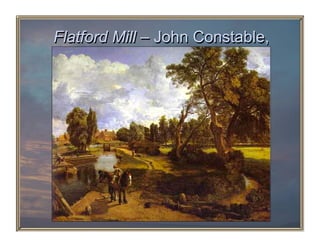
Flatford Mill – John Constable,
              1817
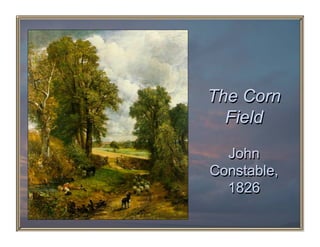
The Corn
  Field

  John
Constable,
  1826
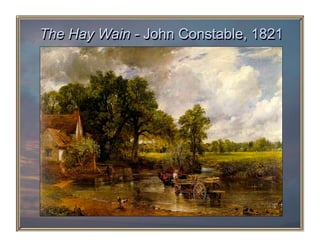
The Hay Wain - John Constable, 1821
Characteristics of
      Romanticism
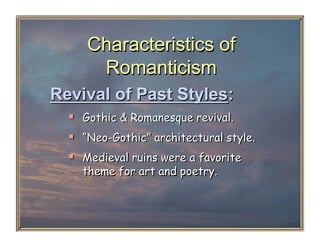
Revival of Past Styles:
    Gothic & Romanesque revival.
    “Neo-Gothic” architectural style.
    Medieval ruins were a favorite
    theme for art and poetry.
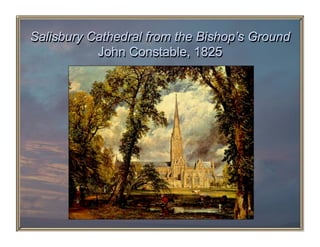
Salisbury Cathedral from the Bishop’s Ground
           John Constable, 1825
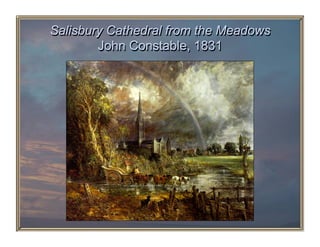
Salisbury Cathedral from the Meadows
        John Constable, 1831
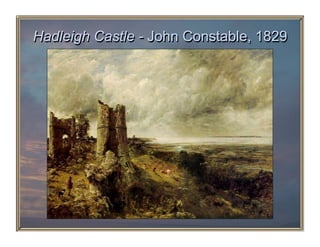
Hadleigh Castle - John Constable, 1829
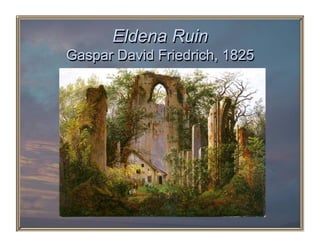
Eldena Ruin
Gaspar David Friedrich, 1825
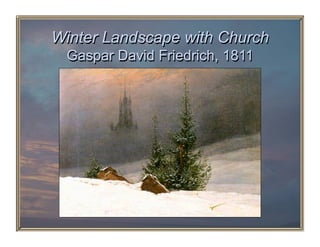
Winter Landscape with Church
 Gaspar David Friedrich, 1811
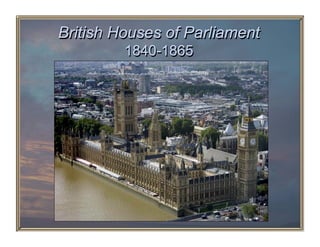
British Houses of Parliament
         1840-1865
Characteristics of
     Romanticism
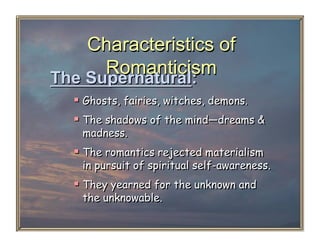
The Supernatural:
    Ghosts, fairies, witches, demons.
    The shadows of the mind—dreams &
   madness.
    The romantics rejected materialism
   in pursuit of spiritual self-awareness.
    They yearned for the unknown and
   the unknowable.
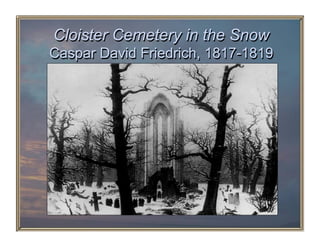
Cloister Cemetery in the Snow
Caspar David Friedrich, 1817-1819
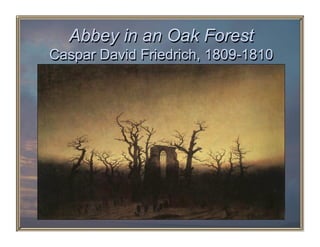
Abbey in an Oak Forest
Caspar David Friedrich, 1809-1810
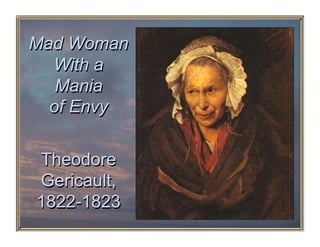
Mad Woman
  With a
   Mania
  of Envy


Theodore
Gericault,
1822-1823
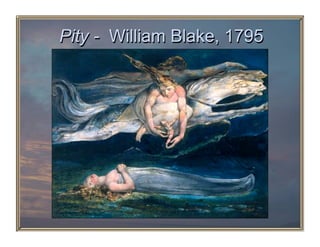
Pity - William Blake, 1795
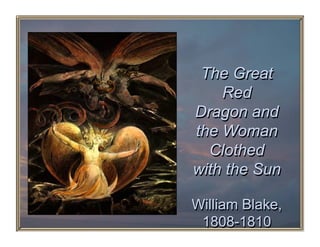
The Great
    Red
Dragon and
the Woman
  Clothed
with the Sun

William Blake,
 1808-1810
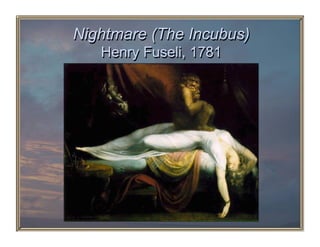
Nightmare (The Incubus)
   Henry Fuseli, 1781
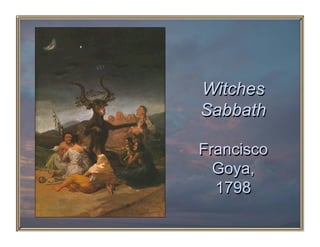
Witches
Sabbath

Francisco
  Goya,
  1798
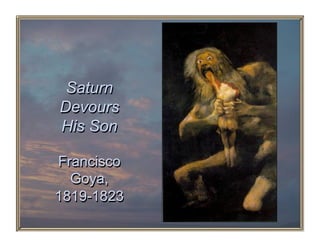
Saturn
Devours
His Son

Francisco
  Goya,
1819-1823
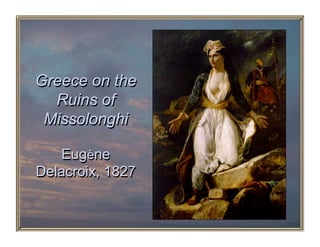
Greece on the
  Ruins of
 Missolonghi

    Eugène
Delacroix, 1827
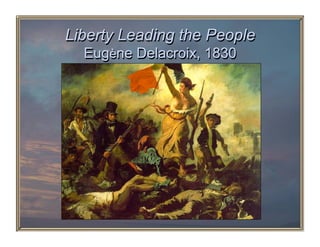
Liberty Leading the People
  Eugène Delacroix, 1830
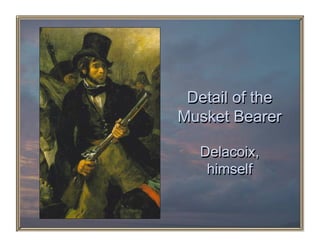
Detail of the
Musket Bearer

   Delacoix,
    himself
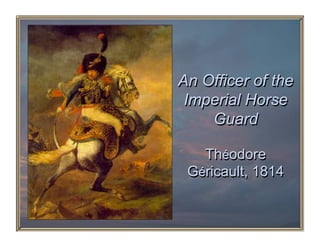
An Officer of the
 Imperial Horse
    Guard

   Théodore
 Géricault, 1814
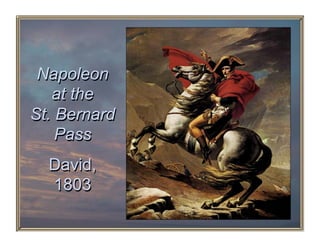
Napoleon
   at the
St. Bernard
    Pass
  David,
  1803
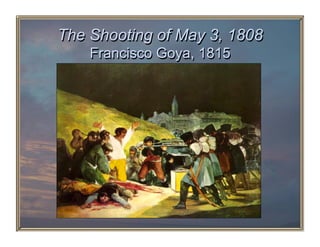
The Shooting of May 3, 1808
    Francisco Goya, 1815
Characteristics of
      Romanticism
Exoticism:
    The sexy “other.”
    A sense of escape from reality.
    A psychological/moral justification
    of imperialism?
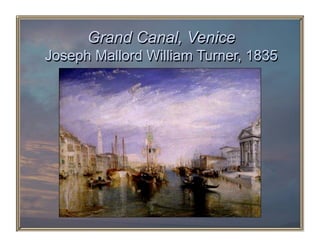
Grand Canal, Venice
Joseph Mallord William Turner, 1835
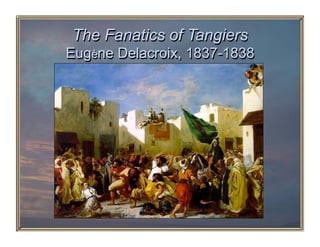
The Fanatics of Tangiers
Eugène Delacroix, 1837-1838
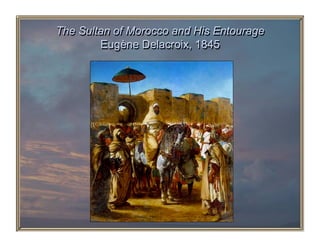
The Sultan of Morocco and His Entourage
        Eugène Delacroix, 1845
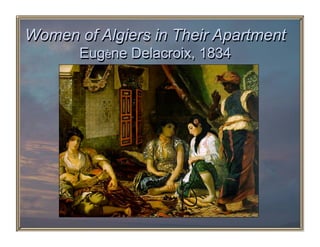
Women of Algiers in Their Apartment
       Eugène Delacroix, 1834
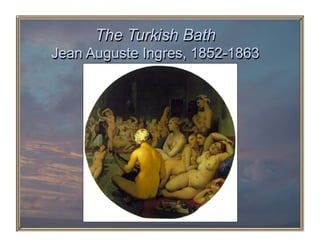
The Turkish Bath
Jean Auguste Ingres, 1852-1863
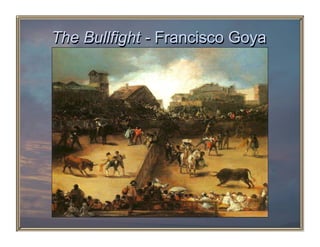
The Bullfight - Francisco Goya
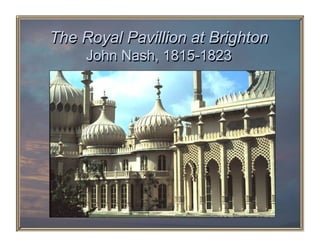
The Royal Pavillion at Brighton
     John Nash, 1815-1823
God as the Architect - William Blake,
                                1794
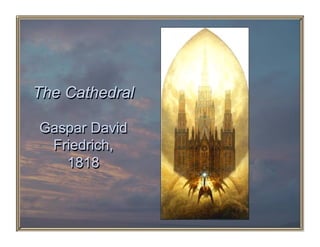
The Cathedral

Gaspar David
 Friedrich,
   1818
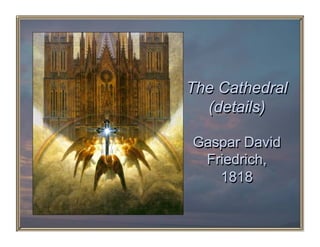
The Cathedral
  (details)

Gaspar David
 Friedrich,
   1818
The Political Implications
e  Romanticism could reinforce the greatest
  themes of political liberalism or political
  conservatism.

e  Contributed to growing nationalist
  movements.
      The concepts of the Volk and the
       Volkgeist.
      The uniqueness of cultures was
       emphasized.

Romanticism