US history survey

      May 22, 2012
        final class
Reconstruction (continued)
announcements
• paper # 2 due today, Tuesday, May 22.

• late papers will be accepted until Tuesday,
  May 29, but points will be deducted. No
  emails!

• final exam: Tuesday, May 29, noon. Eat first,
  or bring a snack with you.
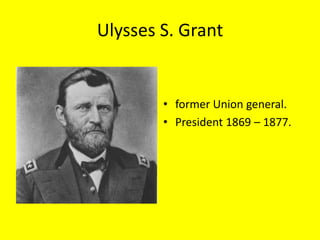
Ulysses S. Grant


        • former Union general.
        • President 1869 – 1877.
enfranchisement – 15th Amendment
• women’s rights advocates, former abolitionists
  (both men and women), disagreed about who
  should be enfranchised.
• 14th Amendment introduced the word “male”
  into Constitution for 1st time.
• split between those favoring Black men’s vote
  first & those who wanted women’s suffrage at
  same time.
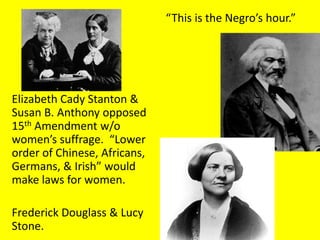
“This is the Negro’s hour.”


Elizabeth Cady Stanton &
Susan B. Anthony opposed
15th Amendment w/o
women’s suffrage. “Lower
order of Chinese, Africans,
Germans, & Irish” would
make laws for women.

Frederick Douglass & Lucy
Stone.
women’s rights advocates
• split into 2 organizations, both working for
  women’s suffrage.
• not reunited until 1890.
• women’s suffrage as a constitutional amendment
  didn’t happen until 1920 (19th Amendment).
• women’s organizations also worked on marriage
  & divorce laws, unequal pay, property rights.
• defeat of radical reconstruction & expanded
  citizenship meant there was little support for
  women’s suffrage.
freedom for former slaves
• ability to move. Some freedpeople moved
  into cities & to Black Belt, in search of
  community.
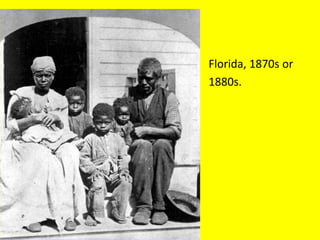
• family strengthened – searched for family
  members; made decisions about whether/
  when women & children worked.
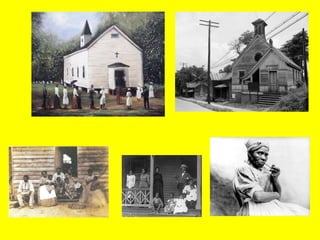
• churches & family – central institutions of
  Black communities.
• schools – thirst for education & knowledge.
Florida, 1870s or
1880s.
work
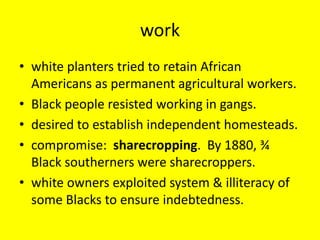
• white planters tried to retain African
  Americans as permanent agricultural workers.
• Black people resisted working in gangs.
• desired to establish independent homesteads.
• compromise: sharecropping. By 1880, ¾
  Black southerners were sharecroppers.
• white owners exploited system & illiteracy of
  some Blacks to ensure indebtedness.
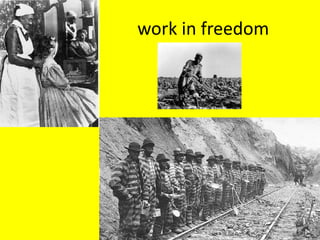
work in freedom
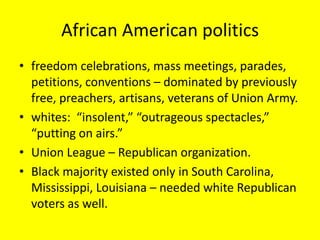
African American politics
• freedom celebrations, mass meetings, parades,
  petitions, conventions – dominated by previously
  free, preachers, artisans, veterans of Union Army.
• whites: “insolent,” “outrageous spectacles,”
  “putting on airs.”
• Union League – Republican organization.
• Black majority existed only in South Carolina,
  Mississippi, Louisiana – needed white Republican
  voters as well.
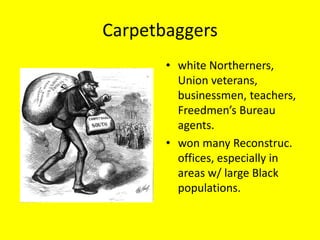
Carpetbaggers
       • white Northerners,
         Union veterans,
         businessmen, teachers,
         Freedmen’s Bureau
         agents.
       • won many Reconstruc.
         offices, especially in
         areas w/ large Black
         populations.
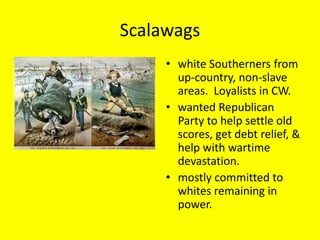
Scalawags
     • white Southerners from
       up-country, non-slave
       areas. Loyalists in CW.
     • wanted Republican
       Party to help settle old
       scores, get debt relief, &
       help with wartime
       devastation.
     • mostly committed to
       whites remaining in
       power.
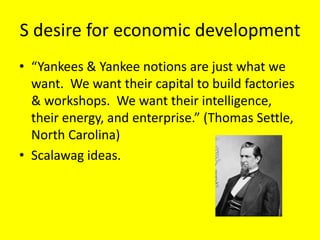
S desire for economic development
• “Yankees & Yankee notions are just what we
  want. We want their capital to build factories
  & workshops. We want their intelligence,
  their energy, and enterprise.” (Thomas Settle,
  North Carolina)
• Scalawag ideas.
what S states accomplished
• Republicans dominated 10 S constitutional
  conventions, 1867 – 1869.
• 258/1027 constitutional delegates were AfAm.
• expanded democracy – improved situation of
  poor whites as well as Blacks.
  – guaranteed political & civil rights for Blacks.
  – abolished property qualifcatns. for voting & juries.
  – abolished imprisonment for debt.
• created 1st state-funded systems of education.
• more than 600 Black state legislators post-CW.
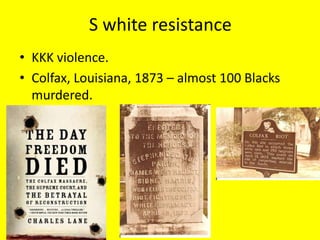
S white resistance
• KKK violence.
• Colfax, Louisiana, 1873 – almost 100 Blacks
  murdered.
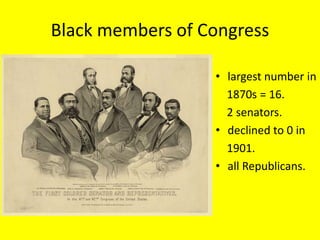
Black members of Congress

                  • largest number in
                    1870s = 16.
                    2 senators.
                  • declined to 0 in
                    1901.
                  • all Republicans.
“redemption”
• S Democrats “redeemed” S states.
• results: created obstacles to Black voting, put
  more stringent controls on plantation labor,
  cut social services.
• Supreme Court decisions curtailed protection
  of Black civil rights.
• end of federal attempts to protect Black civil
  rights until mid-20th century.
Reconstruction results for South
• unable to attract much investment from N or
  Europe, so little industrialization.
• S declined into poorest agricultural region in
  country.
• increased cotton dependency – King Cotton.
• changed from diversified local farming to
  market-oriented production of cotton.
• cotton prices declined – competition from
  Egypt & India.
Reconstruction results for North
• industrial boom of war years continued.
• 3 million immigrants, 1860 – 1880; all settled
  in N & W.
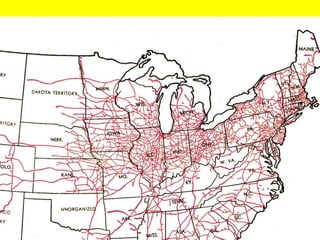
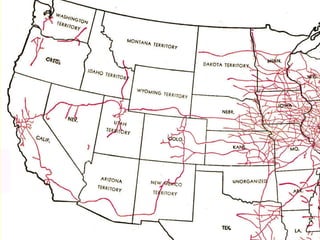
• railroads continued to expand to more than all
  the rest of the world’s RRs combined.
• RR companies were first big businesses.
• Republican Party increasingly identified with
  interests of business.
election of 1876
• Democrats expected to win presidency.
• fraud, intimidation, disputed votes.
• an electoral commission created to resolve it
  voted strictly on party lines.
• compromise: Rutherford Hayes (R) became
  president.
  – more money for S internal improvements.
  – a Southerner in Hayes’ cabinet.
  – non-interference in South – “home rule.”
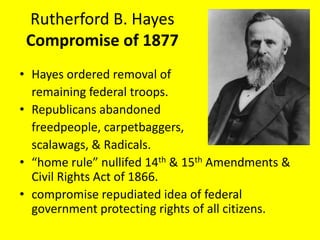
Rutherford B. Hayes
 Compromise of 1877
• Hayes ordered removal of
  remaining federal troops.
• Republicans abandoned
  freedpeople, carpetbaggers,
  scalawags, & Radicals.
• “home rule” nullifed 14th & 15th Amendments &
  Civil Rights Act of 1866.
• compromise repudiated idea of federal
  government protecting rights of all citizens.
and at the same time….
• mining & oil refining, as well as RR, become
  big businesses.
• Depression of 1873.
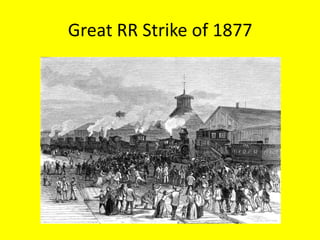
• Great RR strike of 1877.
• struggle between capital & labor replaced the
  “southern question” as main political issue.
Great RR Strike of 1877
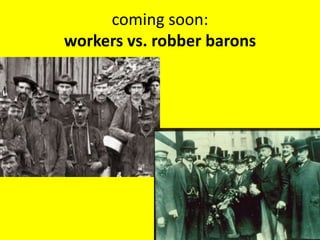
coming soon:
workers vs. robber barons
aftermath of Civil War
• Is political freedom meaningful without
  economic freedom?
  – propertied independence.
  – self-ownership & right to compete in labor
    market.
• Reconstruction solidified separation of
  political & economic spheres.
• old idea of economy autonomy as essence of
  freedom became idea of radicals only.
announcements
• paper # 2 due today, Tuesday, May 22.

• late papers will be accepted until Tuesday,
  May 29, but points will be deducted. No
  emails!

• final exam: Tuesday, May 29, noon. Eat first,
  or bring a snack with you.
It’s been great! See you in the USA.

Us hıstory.052212

  • 1.
    US history survey May 22, 2012 final class Reconstruction (continued)
  • 2.
    announcements • paper #2 due today, Tuesday, May 22. • late papers will be accepted until Tuesday, May 29, but points will be deducted. No emails! • final exam: Tuesday, May 29, noon. Eat first, or bring a snack with you.
  • 3.
    Ulysses S. Grant • former Union general. • President 1869 – 1877.
  • 4.
    enfranchisement – 15thAmendment • women’s rights advocates, former abolitionists (both men and women), disagreed about who should be enfranchised. • 14th Amendment introduced the word “male” into Constitution for 1st time. • split between those favoring Black men’s vote first & those who wanted women’s suffrage at same time.
  • 5.
    “This is theNegro’s hour.” Elizabeth Cady Stanton & Susan B. Anthony opposed 15th Amendment w/o women’s suffrage. “Lower order of Chinese, Africans, Germans, & Irish” would make laws for women. Frederick Douglass & Lucy Stone.
  • 6.
    women’s rights advocates •split into 2 organizations, both working for women’s suffrage. • not reunited until 1890. • women’s suffrage as a constitutional amendment didn’t happen until 1920 (19th Amendment). • women’s organizations also worked on marriage & divorce laws, unequal pay, property rights. • defeat of radical reconstruction & expanded citizenship meant there was little support for women’s suffrage.
  • 7.
    freedom for formerslaves • ability to move. Some freedpeople moved into cities & to Black Belt, in search of community. • family strengthened – searched for family members; made decisions about whether/ when women & children worked. • churches & family – central institutions of Black communities. • schools – thirst for education & knowledge.
  • 9.
  • 10.
    work • white planterstried to retain African Americans as permanent agricultural workers. • Black people resisted working in gangs. • desired to establish independent homesteads. • compromise: sharecropping. By 1880, ¾ Black southerners were sharecroppers. • white owners exploited system & illiteracy of some Blacks to ensure indebtedness.
  • 11.
  • 12.
    African American politics •freedom celebrations, mass meetings, parades, petitions, conventions – dominated by previously free, preachers, artisans, veterans of Union Army. • whites: “insolent,” “outrageous spectacles,” “putting on airs.” • Union League – Republican organization. • Black majority existed only in South Carolina, Mississippi, Louisiana – needed white Republican voters as well.
  • 13.
    Carpetbaggers • white Northerners, Union veterans, businessmen, teachers, Freedmen’s Bureau agents. • won many Reconstruc. offices, especially in areas w/ large Black populations.
  • 14.
    Scalawags • white Southerners from up-country, non-slave areas. Loyalists in CW. • wanted Republican Party to help settle old scores, get debt relief, & help with wartime devastation. • mostly committed to whites remaining in power.
  • 15.
    S desire foreconomic development • “Yankees & Yankee notions are just what we want. We want their capital to build factories & workshops. We want their intelligence, their energy, and enterprise.” (Thomas Settle, North Carolina) • Scalawag ideas.
  • 16.
    what S statesaccomplished • Republicans dominated 10 S constitutional conventions, 1867 – 1869. • 258/1027 constitutional delegates were AfAm. • expanded democracy – improved situation of poor whites as well as Blacks. – guaranteed political & civil rights for Blacks. – abolished property qualifcatns. for voting & juries. – abolished imprisonment for debt. • created 1st state-funded systems of education. • more than 600 Black state legislators post-CW.
  • 17.
    S white resistance •KKK violence. • Colfax, Louisiana, 1873 – almost 100 Blacks murdered.
  • 18.
    Black members ofCongress • largest number in 1870s = 16. 2 senators. • declined to 0 in 1901. • all Republicans.
  • 19.
    “redemption” • S Democrats“redeemed” S states. • results: created obstacles to Black voting, put more stringent controls on plantation labor, cut social services. • Supreme Court decisions curtailed protection of Black civil rights. • end of federal attempts to protect Black civil rights until mid-20th century.
  • 20.
    Reconstruction results forSouth • unable to attract much investment from N or Europe, so little industrialization. • S declined into poorest agricultural region in country. • increased cotton dependency – King Cotton. • changed from diversified local farming to market-oriented production of cotton. • cotton prices declined – competition from Egypt & India.
  • 21.
    Reconstruction results forNorth • industrial boom of war years continued. • 3 million immigrants, 1860 – 1880; all settled in N & W. • railroads continued to expand to more than all the rest of the world’s RRs combined. • RR companies were first big businesses. • Republican Party increasingly identified with interests of business.
  • 24.
    election of 1876 •Democrats expected to win presidency. • fraud, intimidation, disputed votes. • an electoral commission created to resolve it voted strictly on party lines. • compromise: Rutherford Hayes (R) became president. – more money for S internal improvements. – a Southerner in Hayes’ cabinet. – non-interference in South – “home rule.”
  • 25.
    Rutherford B. Hayes Compromise of 1877 • Hayes ordered removal of remaining federal troops. • Republicans abandoned freedpeople, carpetbaggers, scalawags, & Radicals. • “home rule” nullifed 14th & 15th Amendments & Civil Rights Act of 1866. • compromise repudiated idea of federal government protecting rights of all citizens.
  • 26.
    and at thesame time…. • mining & oil refining, as well as RR, become big businesses. • Depression of 1873. • Great RR strike of 1877. • struggle between capital & labor replaced the “southern question” as main political issue.
  • 27.
  • 28.
  • 29.
    aftermath of CivilWar • Is political freedom meaningful without economic freedom? – propertied independence. – self-ownership & right to compete in labor market. • Reconstruction solidified separation of political & economic spheres. • old idea of economy autonomy as essence of freedom became idea of radicals only.
  • 30.
    announcements • paper #2 due today, Tuesday, May 22. • late papers will be accepted until Tuesday, May 29, but points will be deducted. No emails! • final exam: Tuesday, May 29, noon. Eat first, or bring a snack with you.
  • 31.
    It’s been great!See you in the USA.

Editor's Notes

  • #6 http://ecssba.rutgers.edu/images/ecssba.gifhttp://www.oberlin.edu/external/EOG/OYTT-images/10LucyStone1847.jpeghttp://www.historyguy.com/civilwar/douglass_frederick.jpg
  • #9 http://www.theafricanamericanlectionary.org/images/church09.jpghttp://cache2.artprintimages.com/lrg/26/2697/1QSUD00Z.jpghttp://farm5.staticflickr.com/4008/5140393503_9c51b0baf2.jpghttp://mrvalenzuela.com/wp-content/uploads/2011/05/African-American-family-in-South-300x213.pnghttp://www.austinchronicle.com/binary/8556/food_feature-33477.jpeg
  • #10 http://30.media.tumblr.com/tumblr_m2a23t4TNe1qfet8co1_1280.jpg
  • #12 http://t1.gstatic.com/images?q=tbn:ANd9GcR4KrMuOJ5aQdVuu5CzOSWwN8NcGgU8tsxkmrEEnZl3-3c2oZSQHPyJnGiAQwhttp://urbanhabitat.org/files/images/14-1_Page_43_Image_0001.jpghttp://likeawhisper.files.wordpress.com/2009/02/janeandrebecca1.jpg
  • #14 http://media-2.web.britannica.com/eb-media/06/7106-004-F7394EDB.jpg
  • #15 http://3.bp.blogspot.com/-KkxRNY9JmC4/ToDTtjWuM7I/AAAAAAAAANY/0ioQteKmdFw/s1600/govtcartt.bmp
  • #16 http://upload.wikimedia.org/wikipedia/commons/thumb/4/40/Thomas_Settle_judge_-_Brady-Handy.jpg/200px-Thomas_Settle_judge_-_Brady-Handy.jpg
  • #18 http://3.bp.blogspot.com/__zYu2MdAxIk/R_z11cWvFHI/AAAAAAAAAH4/72122xVXzqk/s320/Colfax-Riot-Marker.jpghttp://2.bp.blogspot.com/__zYu2MdAxIk/R_zx1MWvFGI/AAAAAAAAAHw/uF4fPaatxBo/s400/Colfax-Riot-Marker-2-002.jpg
  • #19 http://whgbetc.com/mind/reconstruction_congress.jpghttp://baic.house.gov/member-profiles/
  • #23 http://users.humboldt.edu/ogayle/Hist%20111%20Images/RR1880.jpg
  • #24 http://users.humboldt.edu/ogayle/Hist%20111%20Images/RR1880.jpg
  • #28 http://www.martinsburgroundhouse.com/Great_Railroad_Strike_of_1877__2.jpg
  • #29 http://i.ytimg.com/vi/2UFr3HrM0jk/0.jpghttp://i158.photobucket.com/albums/t106/OnlyObvious/Reaganomics/robber_barons_500.jpg
  • #32 http://0.tqn.com/d/geography/1/0/9/H/usa3.jpg