EQUIPMENTS FOR LARGE
SCALE MANUFACTURE FOR
PARENTRAL PRODUCTS
PRESENTED BY
:
KUMAR SATYAM
• 2271010017

GUIDED BY
• Dr. S. SANGEETHA
1
EQUIPMENTS
The following equipments as per schedule- M has been
recommended

a. Manufacturing area:
 Storage equipment for ampoules , vials & closures
 Washing and drying equipments
 Dustproof storage cabinet
 Water still
 Mixing and preparation tanks or other containers
 Mixing equipments
 Filtering equipments hot air sterilizer
2
b) Aseptic filling and sealing rooms:
 Benches for filling and sealing
 Bacteriological filters
 Filling and sealing unit under laminar flow work
station
c) General Room :
 Inspection table
 Leak testing table
 Labeling and packing benches
 Storage of equipment including cold storage and
refrigerators (if necessary)
3
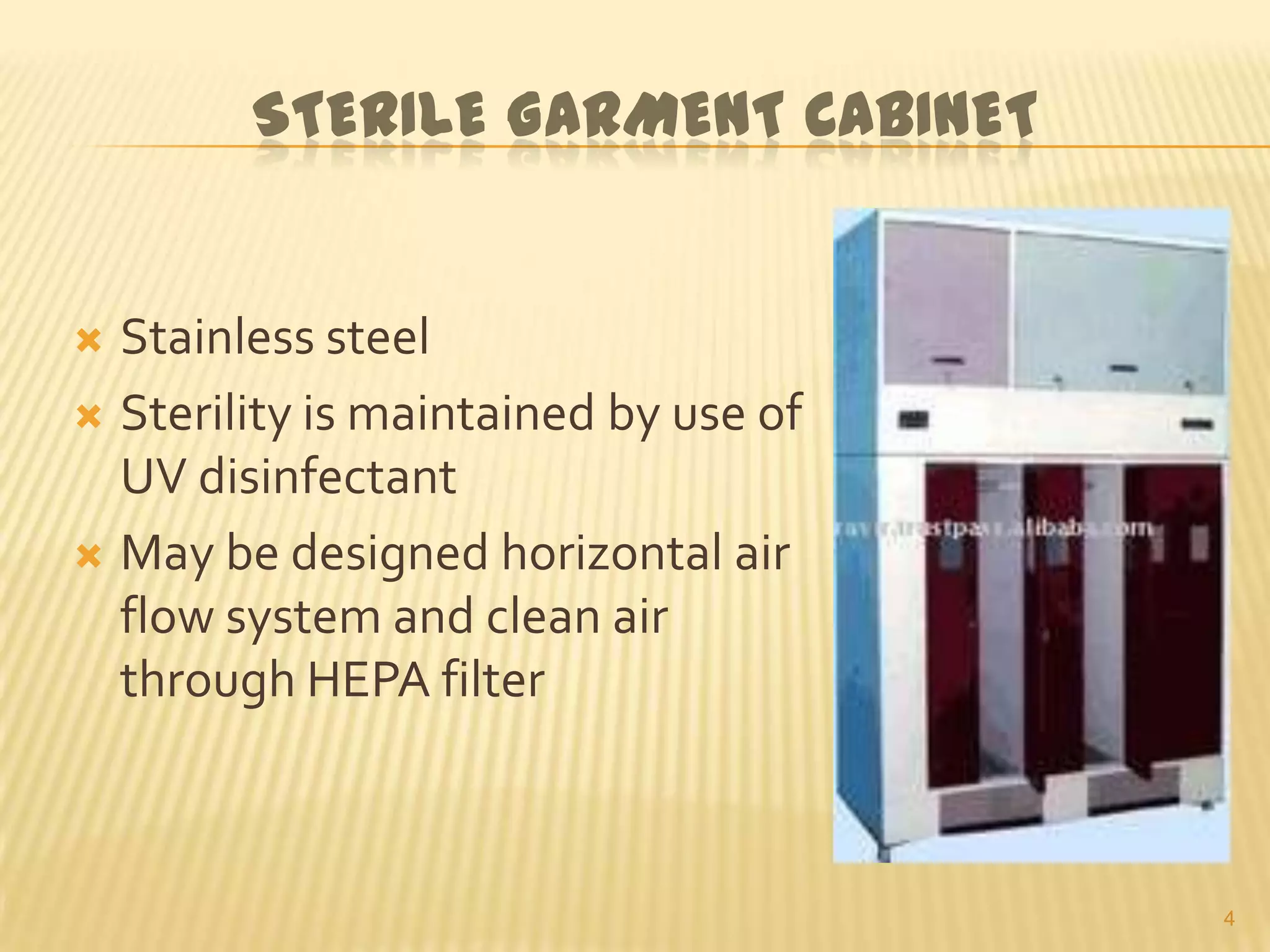
STERILE GARMENT CABINET

Stainless steel
 Sterility is maintained by use of
UV disinfectant
 May be designed horizontal air
flow system and clean air
through HEPA filter


4
HEPA FILTER








HEPA filters can remove at least 99.97% of airborne
particles 0.3 µm in diameter.
HEPA filters are composed of a mat of randomly arranged
fibers.
Key factors affecting function are fiber density and
diameter, and filter thickness.
The air space between HEPA filter is much greater than
0.3µm. The common assumption that a HEPA filter acts
like a sieve where particles smaller than the largest
opening can pass through is incorrect.
5
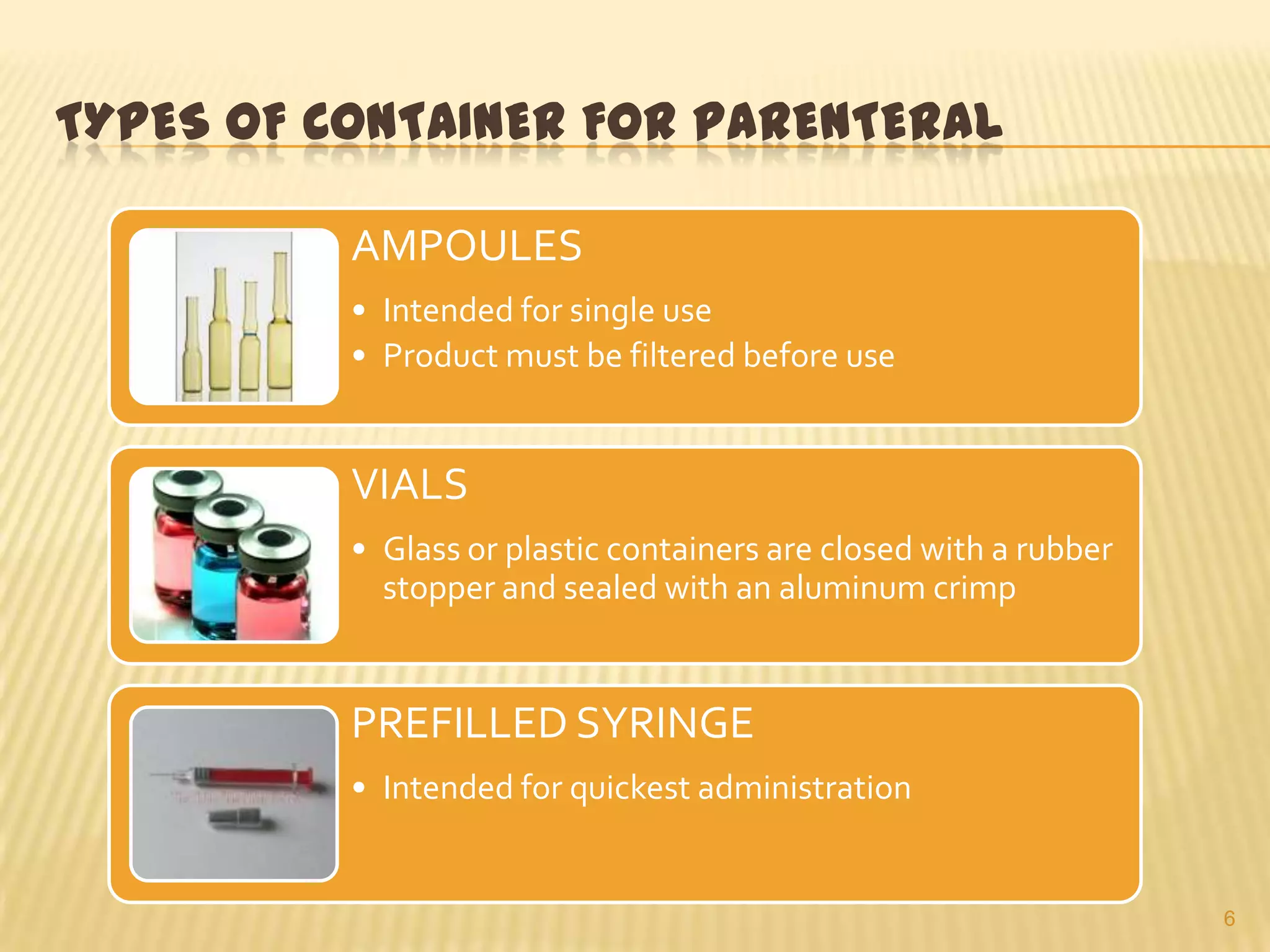
TYPES OF CONTAINER FOR PARENTERAL
AMPOULES
• Intended for single use
• Product must be filtered before use

VIALS
• Glass or plastic containers are closed with a rubber
stopper and sealed with an aluminum crimp

PREFILLED SYRINGE
• Intended for quickest administration

6
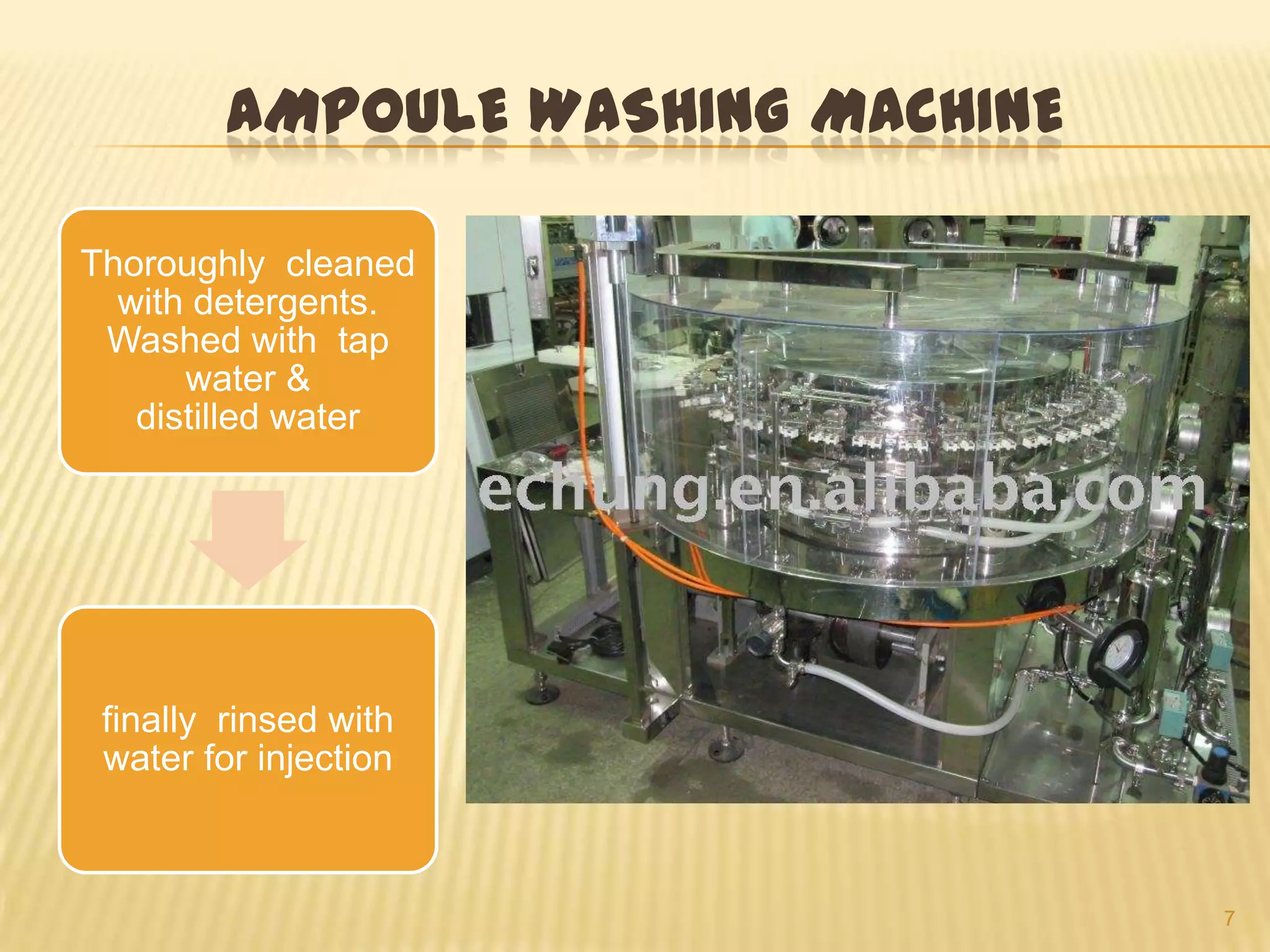
AMPOULE WASHING MACHINE
Thoroughly cleaned
with detergents.
Washed with tap
water &
distilled water

finally rinsed with
water for injection

7
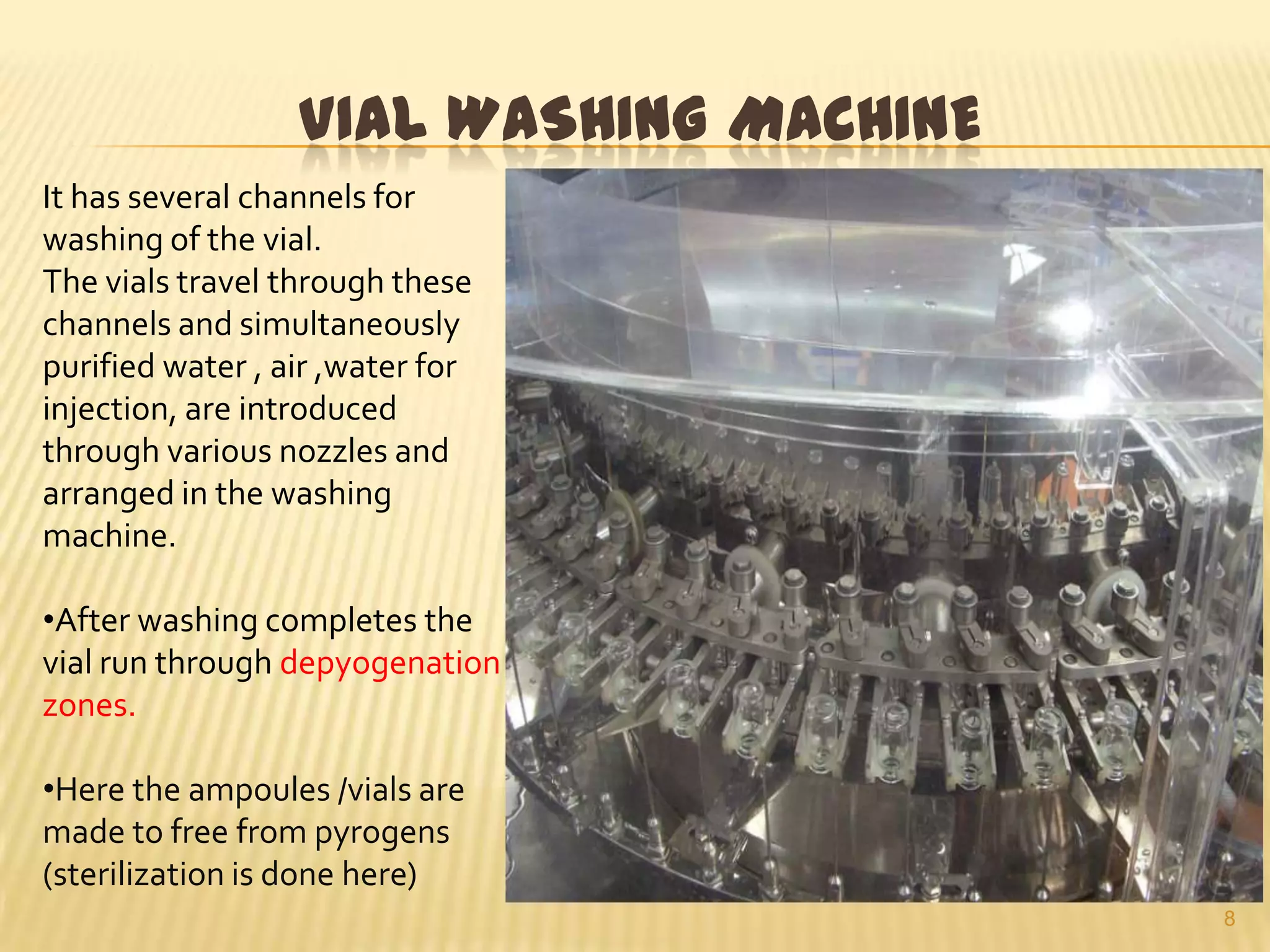
VIAL WASHING MACHINE
It has several channels for
washing of the vial.
The vials travel through these
channels and simultaneously
purified water , air ,water for
injection, are introduced
through various nozzles and
arranged in the washing
machine.
•After washing completes the
vial run through depyogenation
zones.
•Here the ampoules /vials are
made to free from pyrogens
(sterilization is done here)
8
FILLING MACHINE
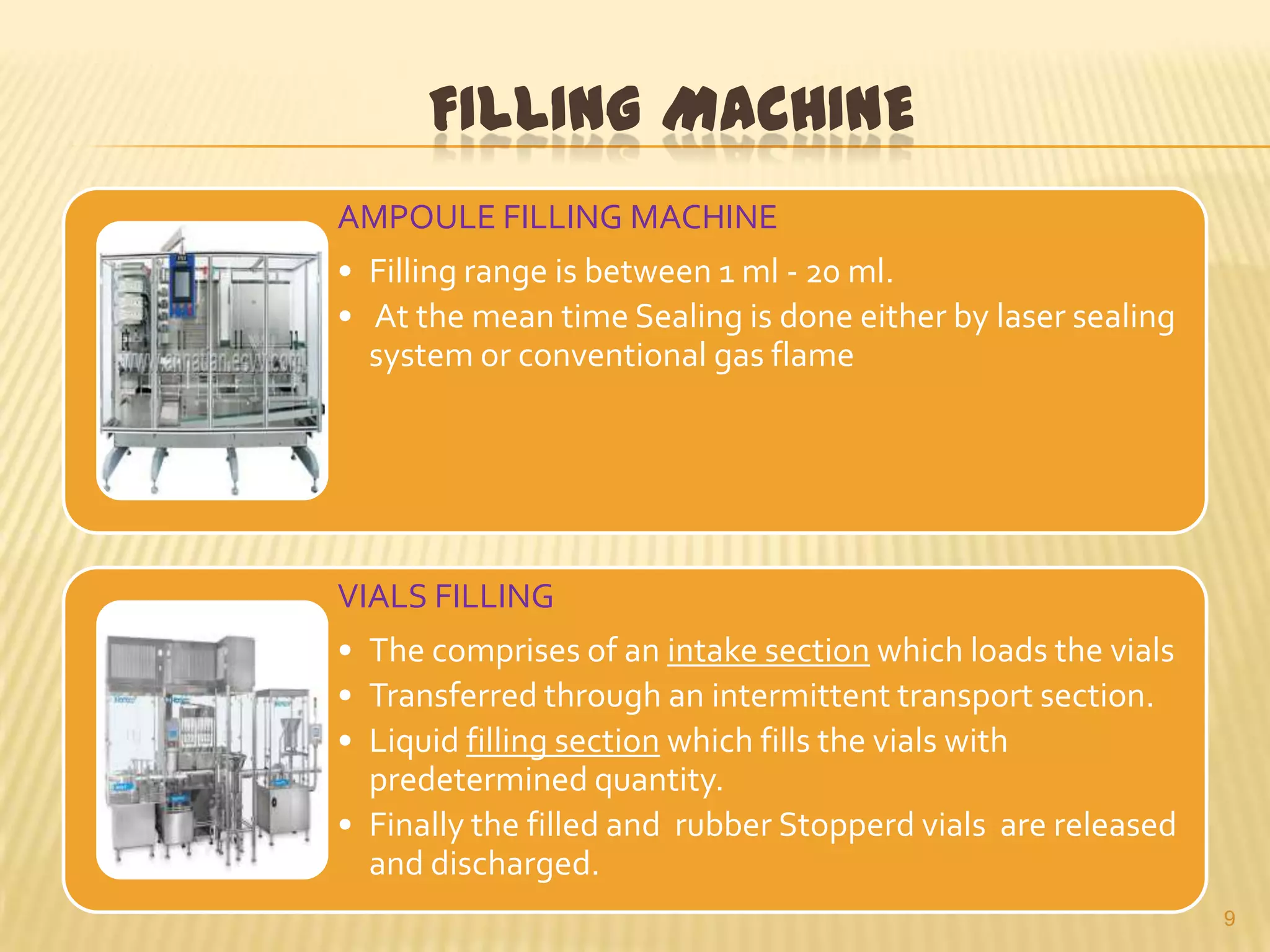
AMPOULE FILLING MACHINE
• Filling range is between 1 ml - 20 ml.
• At the mean time Sealing is done either by laser sealing
system or conventional gas flame

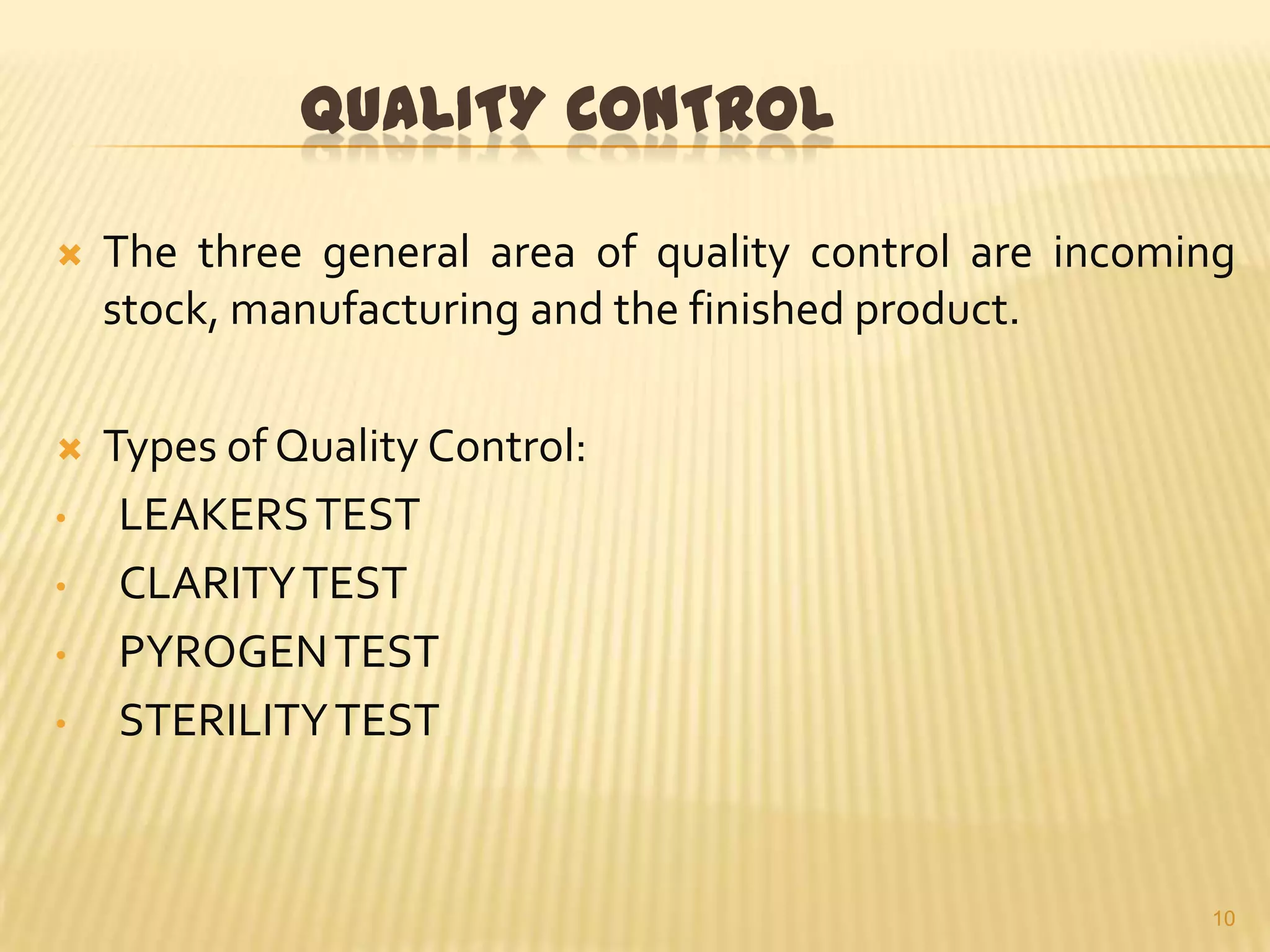
VIALS FILLING
• The comprises of an intake section which loads the vials
• Transferred through an intermittent transport section.
• Liquid filling section which fills the vials with
predetermined quantity.
• Finally the filled and rubber Stopperd vials are released
and discharged.
9
QUALITY CONTROL


The three general area of quality control are incoming
stock, manufacturing and the finished product.



Types of Quality Control:
LEAKERS TEST
CLARITY TEST
PYROGEN TEST
STERILITY TEST

•

•
•
•

10
LEAKERS TEST
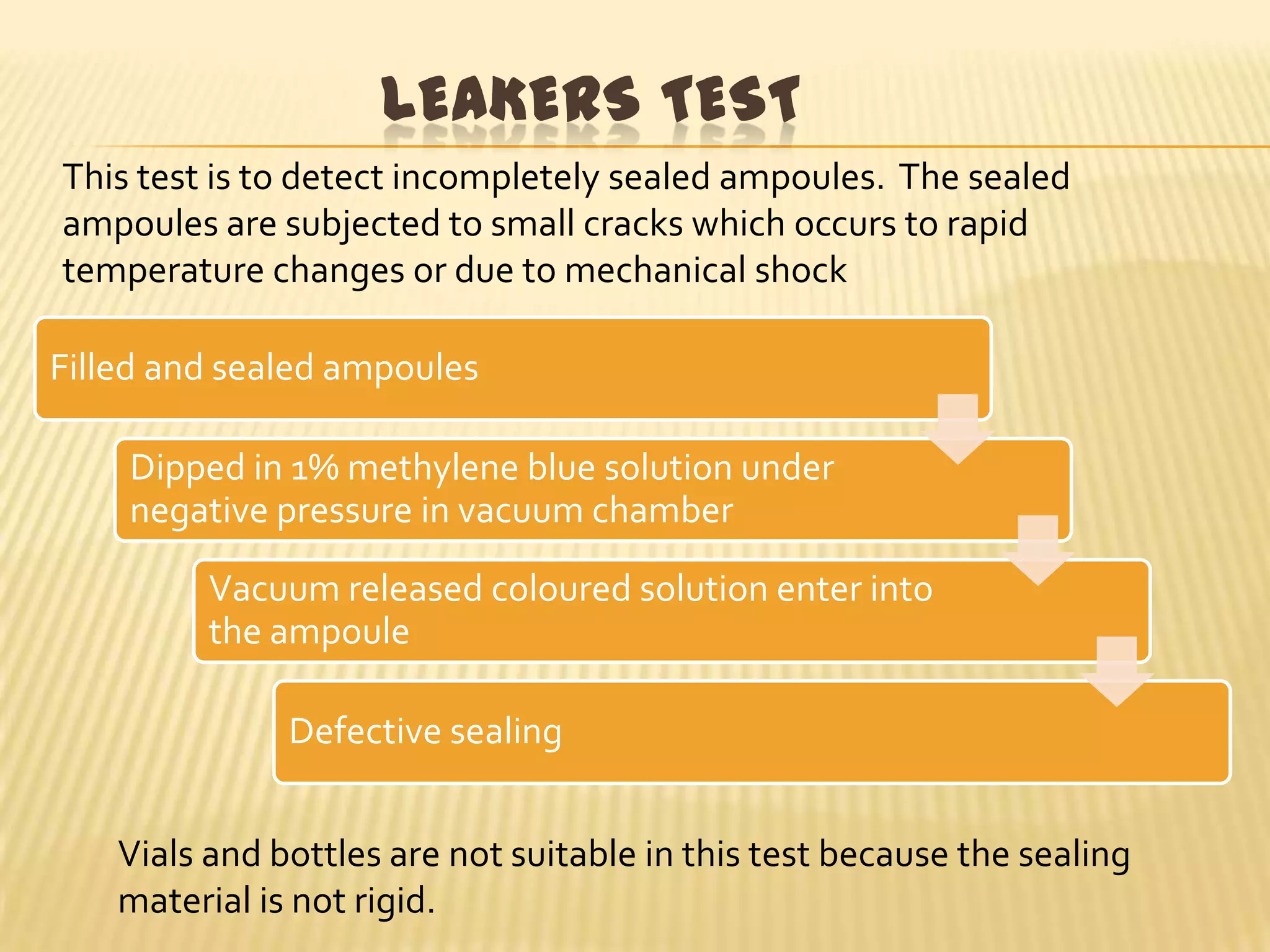
This test is to detect incompletely sealed ampoules. The sealed
ampoules are subjected to small cracks which occurs to rapid
temperature changes or due to mechanical shock
Filled and sealed ampoules
Dipped in 1% methylene blue solution under
negative pressure in vacuum chamber

Vacuum released coloured solution enter into
the ampoule
Defective sealing
Vials and bottles are not suitable in this test because the sealing
material is not rigid.
CLARITY TEST















A clear having a high polish conveys product is of exceptional quality and
purity.
Practically impossible to prepare sterile product perfectly free from
visible particulate matter(size 30-40 µm).
Quality control departments responsibility – to detect and discard
unclean products.
USP states that good pharmaceutical practice requires that all containers
be visually inspected and that any with visible particles may be discarded.
For large volume infusions,the USP has established a limit of 50 particles
of 10 µm and larger and five particles of 25 µm and larger per ml.
Visual inspection of products containers usually done by individual human
inspection of each externally clean container under a good light and
viewed against a black and white background.
Contents set in motion with a swirling action.
Instrumental method of evaluation of particles utilizes principles of light
scattering, light absorbtion and electrical resistance for particle count and
size distribution.
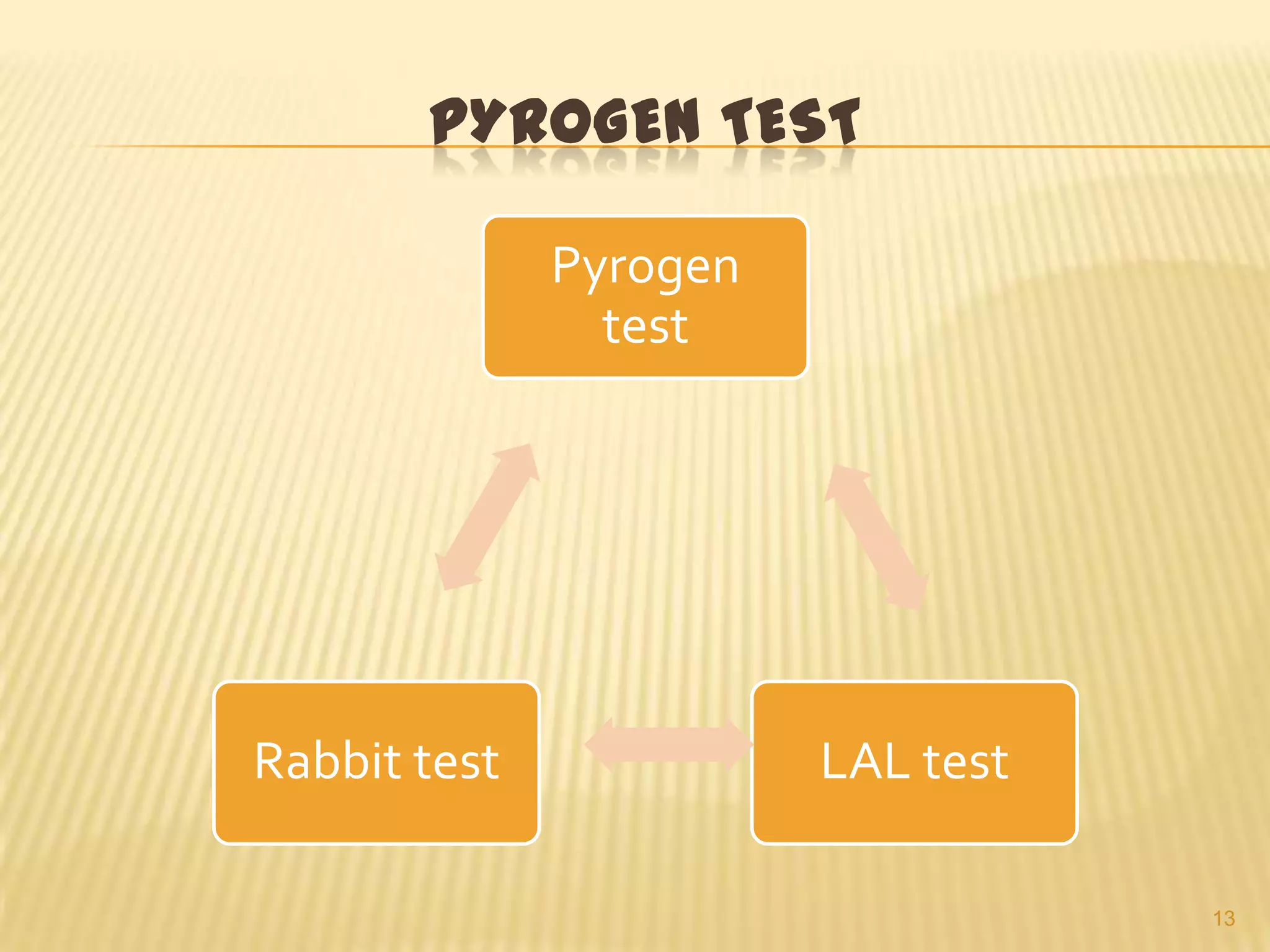
PYROGEN TEST
Pyrogen
test

Rabbit test

LAL test
13
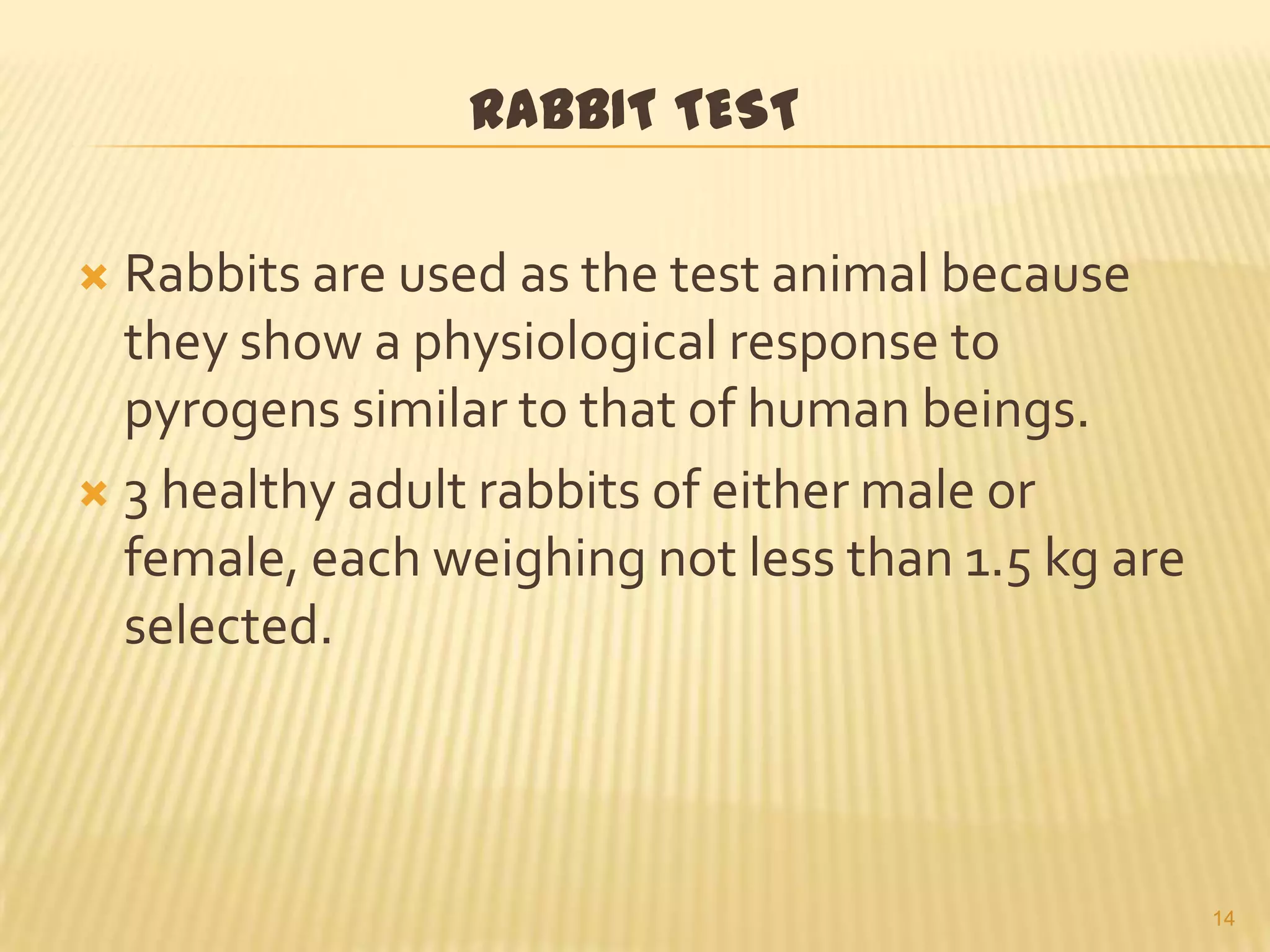
RABBIT TEST
Rabbits are used as the test animal because
they show a physiological response to
pyrogens similar to that of human beings.
 3 healthy adult rabbits of either male or
female, each weighing not less than 1.5 kg are
selected.


14
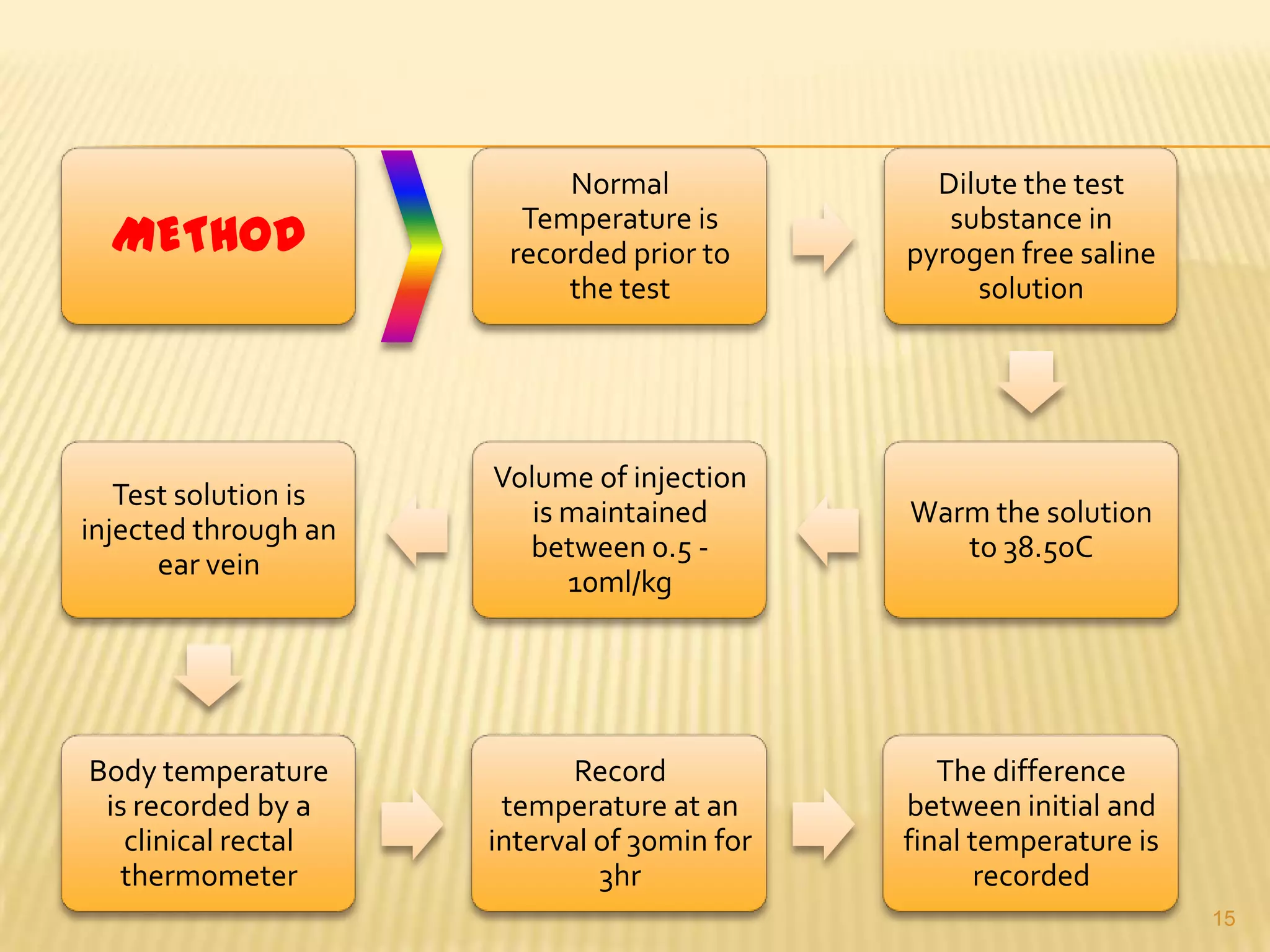
METHOD

Normal
Temperature is
recorded prior to
the test

Dilute the test
substance in
pyrogen free saline
solution

Test solution is
injected through an
ear vein

Volume of injection
is maintained
between 0.5 10ml/kg

Warm the solution
to 38.5oC

Body temperature
is recorded by a
clinical rectal
thermometer

Record
temperature at an
interval of 30min for
3hr

The difference
between initial and
final temperature is
recorded
15
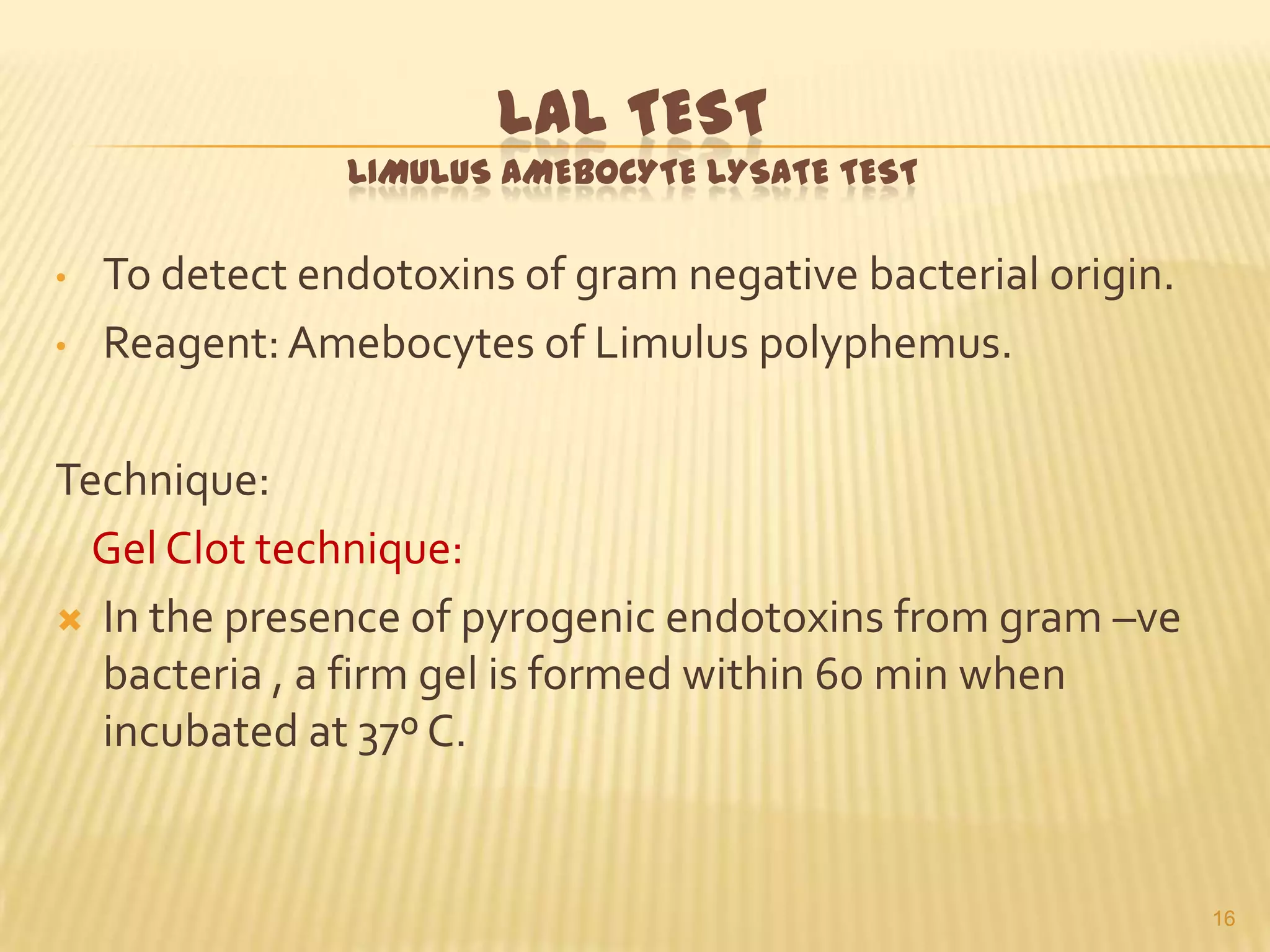
LAL TEST
LIMULUS AMEBOCYTE LYSATE TEST
•

•

To detect endotoxins of gram negative bacterial origin.
Reagent: Amebocytes of Limulus polyphemus.

Technique:
Gel Clot technique:
 In the presence of pyrogenic endotoxins from gram –ve
bacteria , a firm gel is formed within 60 min when
incubated at 37º C.

16
METHOD


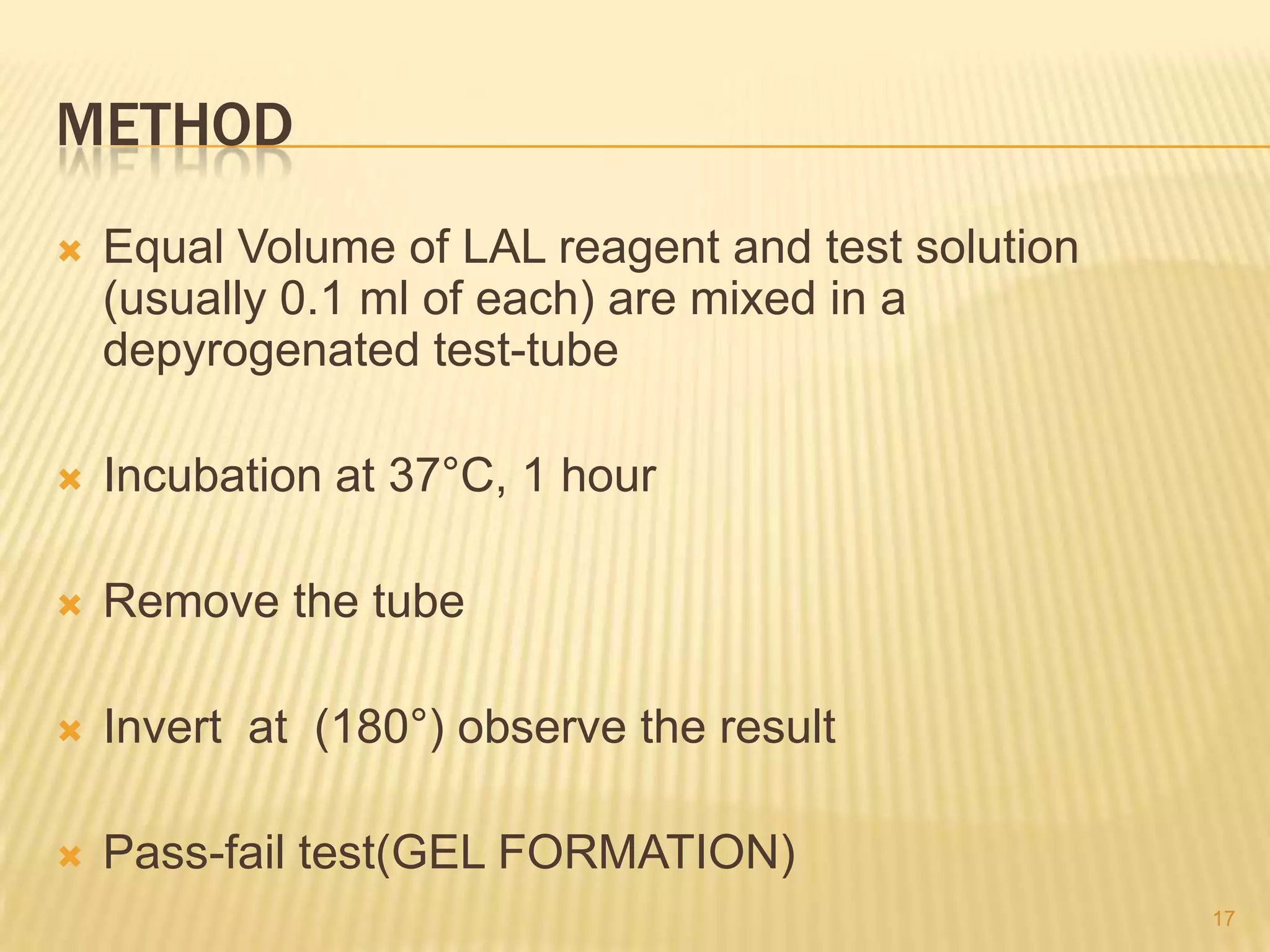
Equal Volume of LAL reagent and test solution
(usually 0.1 ml of each) are mixed in a
depyrogenated test-tube



Incubation at 37°C, 1 hour



Remove the tube



Invert at (180°) observe the result



Pass-fail test(GEL FORMATION)
17
STERILITY TEST
It is a procedure carried out to detect confirm absence of any
viable form of microbes in product.
Principle: sterlity testing only shows that organisms capable of
growing in selected conditions are absent from the fraction of
batch that has been tested. If the microorganism are present
in the product can be indicated by a turbidity in the clear
medium.
Objective of Sterility Testing:
 For validation of sterilization process
 To prevent issue of contaminated product in market
 To check presence of microorganism in preparation which are
sterile
18
REFERENCE:

INDUSTRIAL PHARMACY
• Leon Lachman
• Herbert A. Lieberman

WWW.PHARMAMACHINE.COM
• www.authorstream.com
• PHARMALES.CO.IN
19
20

equipment for large scale paretral and quality control

  • 1.
    EQUIPMENTS FOR LARGE SCALEMANUFACTURE FOR PARENTRAL PRODUCTS PRESENTED BY : KUMAR SATYAM • 2271010017 GUIDED BY • Dr. S. SANGEETHA 1
  • 2.
    EQUIPMENTS The following equipmentsas per schedule- M has been recommended a. Manufacturing area:  Storage equipment for ampoules , vials & closures  Washing and drying equipments  Dustproof storage cabinet  Water still  Mixing and preparation tanks or other containers  Mixing equipments  Filtering equipments hot air sterilizer 2
  • 3.
    b) Aseptic fillingand sealing rooms:  Benches for filling and sealing  Bacteriological filters  Filling and sealing unit under laminar flow work station c) General Room :  Inspection table  Leak testing table  Labeling and packing benches  Storage of equipment including cold storage and refrigerators (if necessary) 3
  • 4.
    STERILE GARMENT CABINET Stainlesssteel  Sterility is maintained by use of UV disinfectant  May be designed horizontal air flow system and clean air through HEPA filter  4
  • 5.
    HEPA FILTER     HEPA filterscan remove at least 99.97% of airborne particles 0.3 µm in diameter. HEPA filters are composed of a mat of randomly arranged fibers. Key factors affecting function are fiber density and diameter, and filter thickness. The air space between HEPA filter is much greater than 0.3µm. The common assumption that a HEPA filter acts like a sieve where particles smaller than the largest opening can pass through is incorrect. 5
  • 6.
    TYPES OF CONTAINERFOR PARENTERAL AMPOULES • Intended for single use • Product must be filtered before use VIALS • Glass or plastic containers are closed with a rubber stopper and sealed with an aluminum crimp PREFILLED SYRINGE • Intended for quickest administration 6
  • 7.
    AMPOULE WASHING MACHINE Thoroughlycleaned with detergents. Washed with tap water & distilled water finally rinsed with water for injection 7
  • 8.
    VIAL WASHING MACHINE Ithas several channels for washing of the vial. The vials travel through these channels and simultaneously purified water , air ,water for injection, are introduced through various nozzles and arranged in the washing machine. •After washing completes the vial run through depyogenation zones. •Here the ampoules /vials are made to free from pyrogens (sterilization is done here) 8
  • 9.
    FILLING MACHINE AMPOULE FILLINGMACHINE • Filling range is between 1 ml - 20 ml. • At the mean time Sealing is done either by laser sealing system or conventional gas flame VIALS FILLING • The comprises of an intake section which loads the vials • Transferred through an intermittent transport section. • Liquid filling section which fills the vials with predetermined quantity. • Finally the filled and rubber Stopperd vials are released and discharged. 9
  • 10.
    QUALITY CONTROL  The threegeneral area of quality control are incoming stock, manufacturing and the finished product.  Types of Quality Control: LEAKERS TEST CLARITY TEST PYROGEN TEST STERILITY TEST • • • • 10
  • 11.
    LEAKERS TEST This testis to detect incompletely sealed ampoules. The sealed ampoules are subjected to small cracks which occurs to rapid temperature changes or due to mechanical shock Filled and sealed ampoules Dipped in 1% methylene blue solution under negative pressure in vacuum chamber Vacuum released coloured solution enter into the ampoule Defective sealing Vials and bottles are not suitable in this test because the sealing material is not rigid.
  • 12.
    CLARITY TEST         A clearhaving a high polish conveys product is of exceptional quality and purity. Practically impossible to prepare sterile product perfectly free from visible particulate matter(size 30-40 µm). Quality control departments responsibility – to detect and discard unclean products. USP states that good pharmaceutical practice requires that all containers be visually inspected and that any with visible particles may be discarded. For large volume infusions,the USP has established a limit of 50 particles of 10 µm and larger and five particles of 25 µm and larger per ml. Visual inspection of products containers usually done by individual human inspection of each externally clean container under a good light and viewed against a black and white background. Contents set in motion with a swirling action. Instrumental method of evaluation of particles utilizes principles of light scattering, light absorbtion and electrical resistance for particle count and size distribution.
  • 13.
  • 14.
    RABBIT TEST Rabbits areused as the test animal because they show a physiological response to pyrogens similar to that of human beings.  3 healthy adult rabbits of either male or female, each weighing not less than 1.5 kg are selected.  14
  • 15.
    METHOD Normal Temperature is recorded priorto the test Dilute the test substance in pyrogen free saline solution Test solution is injected through an ear vein Volume of injection is maintained between 0.5 10ml/kg Warm the solution to 38.5oC Body temperature is recorded by a clinical rectal thermometer Record temperature at an interval of 30min for 3hr The difference between initial and final temperature is recorded 15
  • 16.
    LAL TEST LIMULUS AMEBOCYTELYSATE TEST • • To detect endotoxins of gram negative bacterial origin. Reagent: Amebocytes of Limulus polyphemus. Technique: Gel Clot technique:  In the presence of pyrogenic endotoxins from gram –ve bacteria , a firm gel is formed within 60 min when incubated at 37º C. 16
  • 17.
    METHOD  Equal Volume ofLAL reagent and test solution (usually 0.1 ml of each) are mixed in a depyrogenated test-tube  Incubation at 37°C, 1 hour  Remove the tube  Invert at (180°) observe the result  Pass-fail test(GEL FORMATION) 17
  • 18.
    STERILITY TEST It isa procedure carried out to detect confirm absence of any viable form of microbes in product. Principle: sterlity testing only shows that organisms capable of growing in selected conditions are absent from the fraction of batch that has been tested. If the microorganism are present in the product can be indicated by a turbidity in the clear medium. Objective of Sterility Testing:  For validation of sterilization process  To prevent issue of contaminated product in market  To check presence of microorganism in preparation which are sterile 18
  • 19.
    REFERENCE: INDUSTRIAL PHARMACY • LeonLachman • Herbert A. Lieberman WWW.PHARMAMACHINE.COM • www.authorstream.com • PHARMALES.CO.IN 19
  • 20.