Pilot plant Scale up
General considerations
for solids
PREPARED BY
A. :CHANDANA
A.DIKSHITHA
A.SHEKAR
B.S.VARSHITHA
B.KUSUMAANJALI
GEETHANJALI COLLEGE OF PHARMACY
Under Guidance :
P.Nagachandrika
M.Pharmacy (Ph.D)
Research scholar
INTRODUCTION
Pilot plant:
Defning prototype ed as part of pharmaceutical industry where lab scale
formula is transformed into viable product by the development of liable
practical procedure for manufacture
Scale up :
The art of design of prototype using the data obtained from pilot plant model
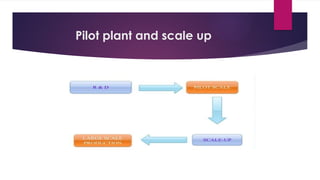
Pilot plant and scale up
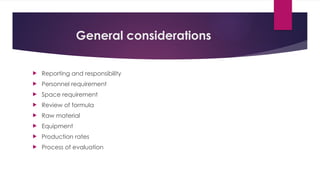
General considerations
 Reporting and responsibility
 Personnel requirement
 Space requirement
 Review of formula
 Raw material
 Equipment
 Production rates
 Process of evaluation
General considerations for solids
Stages of production of tablets:
1. Material handling
2.Dry blending
3. Granulation
4. Drying
5. Reduction of particle size
6.Blending
7.Dry blending
8. Direct compression
9. Slugging (Dry granulation)
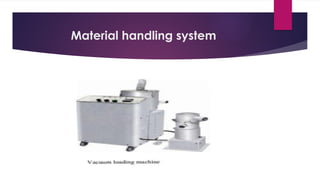
Material handling system
• In lab: materials scooped, dumped or poured by hand may work well for small
or intermediate scale productions
•Large scale productions: mechanical means necessary
• There should be no cross contamination
• More sophisticated methods of handling materials such as vacuum loading systems,
metering pumps, screw feed system.
• If a system is used to transfer materials for more than one product steps must be taken to
prevent cross contamination.
Material handling system
Dry blending
• Inappropriate blending at this stage results in discrete portion of the batch being either high or low in potency
• Measurement should be taken to ensure that all ingredients are free from lumps and agglomerates, for these
reasons screening and /or milling of the ingredients usually makes the process more reliable and reproducible
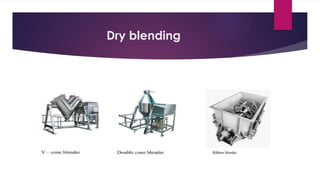
Equipments used for blending are:-
> V-blender
> Double cone blender
> Ribbon blender
> Bin blender
> Orbiting screw blender and high intensity mixers
•The blending will be optimized by following parameters
a. Time of blending
b. Blender loading
c. Size of blender
Dry blending
Granulation
Granulation is a process by which the small particles are converted into large agglomerates
called granules.
• Purpose for granulation:-
• To impart good flow properties to the material
• To increase the apparent density of powders.
• To uniform the particle size distribution.
• Uniform dispersion of active ingredient.
Types:-
• Wet granulation
• Dry granulation(slugging)
• Dry compaction
Granularity
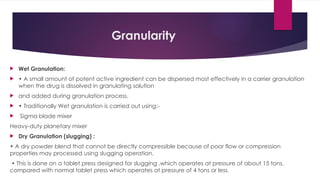
 Wet Granulation:
 • A small amount of potent active ingredient can be dispersed most effectively in a carrier granulation
when the drug is dissolved in granulating solution
 and added during granulation process.
 • Traditionally Wet granulation is carried out using:-
 Sigma blade mixer
Heavy-duty planetary mixer
 Dry Granulation (slugging) :
• A dry powder blend that cannot be directly compressible because of poor flow or compression
properties may processed using slugging operation.
• This is done on a tablet press designed for slugging ,which operates at pressure of about 15 tons,
compared with normal tablet press which operates at pressure of 4 tons or less.
Granularity
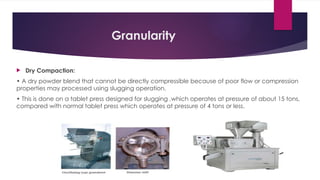
 Dry Compaction:
• A dry powder blend that cannot be directly compressible because of poor flow or compression
properties may processed using slugging operation.
• This is done on a tablet press designed for slugging ,which operates at pressure of about 15 tons,
compared with normal tablet press which operates at pressure of 4 tons or less.
Drying
For drying purpose mainly two methods were used-
• Hot air oven
• Fluidized bed dryer
Hot air oven:-
• Most conventional method of drying a granulation to be circulating hot air oven, which is heated by either steam
or electricity in which granules are spread on a paper-lined trays on rack track
• Tray is kept inside the oven where evaporative drying occurs.
• Factors to be considered for scale up- Airflow, air temperature and depth of granulation on trays.
• If granulation bed is too deep or too dense then
drying will be inefficient.
• Drying time at specified temperatures and airflow
rates must be established for each product.
Drying
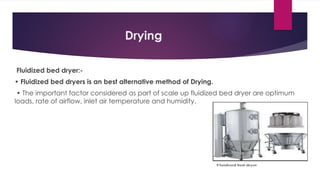
Fluidized bed dryer:-
• Fluidized bed dryers is an best alternative method of Drying.
• The important factor considered as part of scale up fluidized bed dryer are optimum
loads, rate of airflow, inlet air temperature and humidity.
Reduction of particle size
• Compression factors that may be affected by the particle size distribution are flow ability,
compressibility, uniformity of tablet weight, content uniformity, tablet hardness and tablet color
uniformity.
• First step in this process is to determine the particle size distribution of granulation using a series of
stacked sieves of decreasing mesh openings.
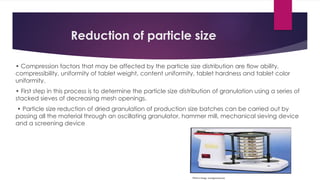
• Particle size reduction of dried granulation of production size batches can be carried out by
passing all the material through an oscillating granulator, hammer mill, mechanical sieving device
and a screening device
Blending and Compression
• Type of blending equipment often differs from that using in laboratory
• In any blending operation, both segregation and mixing occur simultaneously are a
function of particle size, shape, hardness, and density, and of the dynamics of the mixing
action
• Particle abrasion is more likely to occur when high-shear mixers with spiral screws or
blades are used. When a low dose active ingredient is to be blended it may be
sandwiched between two portions of directly compressible excipients to avoid loss to the
surface of the blender
Tablet coating
Pan and fluidized coating:
> Optimum tablet load
Operating tablet bed temperature
> Drying airflow rate and temperature
> Solution application rate
> Size and shape of the nozzle aperture (for airless sprayer) > Atomizing air pressure and liquid flow rate
Pan coating:
> Fix and variable operating parameters
Other parameters – pan loading (Kg), Solid content of coating suspension (%w/w), spray gun
dynamics, drying air(cfm), Inlet air temperature (°C), Gun to tablet bed distance, Coating system spray
rate (g/min), atomizing air pressure(psi, bar), Pan speed, number of spraying guns 38
Table coating
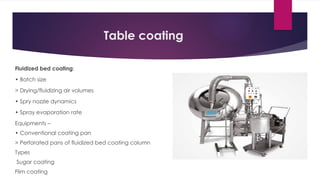
Fluidized bed coating:
• Batch size
> Drying/fluidizing air volumes
• Spry nozzle dynamics
• Spray evaporation rate
Equipments –
• Conventional coating pan
> Perforated pans of fluidized bed coating column
Types
Sugar coating
Flim coating
Reference
 http://www.iraup.com/about.php
 https://en.wikipedia.org/wiki/ General
considerations
THANK YOU

pilot plant scale up for solids general considerationations

  • 1.
    Pilot plant Scaleup General considerations for solids PREPARED BY A. :CHANDANA A.DIKSHITHA A.SHEKAR B.S.VARSHITHA B.KUSUMAANJALI GEETHANJALI COLLEGE OF PHARMACY Under Guidance : P.Nagachandrika M.Pharmacy (Ph.D) Research scholar
  • 2.
    INTRODUCTION Pilot plant: Defning prototypeed as part of pharmaceutical industry where lab scale formula is transformed into viable product by the development of liable practical procedure for manufacture Scale up : The art of design of prototype using the data obtained from pilot plant model
  • 3.
  • 4.
    General considerations  Reportingand responsibility  Personnel requirement  Space requirement  Review of formula  Raw material  Equipment  Production rates  Process of evaluation
  • 5.
    General considerations forsolids Stages of production of tablets: 1. Material handling 2.Dry blending 3. Granulation 4. Drying 5. Reduction of particle size 6.Blending 7.Dry blending 8. Direct compression 9. Slugging (Dry granulation)
  • 6.
    Material handling system •In lab: materials scooped, dumped or poured by hand may work well for small or intermediate scale productions •Large scale productions: mechanical means necessary • There should be no cross contamination • More sophisticated methods of handling materials such as vacuum loading systems, metering pumps, screw feed system. • If a system is used to transfer materials for more than one product steps must be taken to prevent cross contamination.
  • 7.
  • 8.
    Dry blending • Inappropriateblending at this stage results in discrete portion of the batch being either high or low in potency • Measurement should be taken to ensure that all ingredients are free from lumps and agglomerates, for these reasons screening and /or milling of the ingredients usually makes the process more reliable and reproducible Equipments used for blending are:- > V-blender > Double cone blender > Ribbon blender > Bin blender > Orbiting screw blender and high intensity mixers •The blending will be optimized by following parameters a. Time of blending b. Blender loading c. Size of blender
  • 9.
  • 10.
    Granulation Granulation is aprocess by which the small particles are converted into large agglomerates called granules. • Purpose for granulation:- • To impart good flow properties to the material • To increase the apparent density of powders. • To uniform the particle size distribution. • Uniform dispersion of active ingredient. Types:- • Wet granulation • Dry granulation(slugging) • Dry compaction
  • 11.
    Granularity  Wet Granulation: • A small amount of potent active ingredient can be dispersed most effectively in a carrier granulation when the drug is dissolved in granulating solution  and added during granulation process.  • Traditionally Wet granulation is carried out using:-  Sigma blade mixer Heavy-duty planetary mixer  Dry Granulation (slugging) : • A dry powder blend that cannot be directly compressible because of poor flow or compression properties may processed using slugging operation. • This is done on a tablet press designed for slugging ,which operates at pressure of about 15 tons, compared with normal tablet press which operates at pressure of 4 tons or less.
  • 12.
    Granularity  Dry Compaction: •A dry powder blend that cannot be directly compressible because of poor flow or compression properties may processed using slugging operation. • This is done on a tablet press designed for slugging ,which operates at pressure of about 15 tons, compared with normal tablet press which operates at pressure of 4 tons or less.
  • 13.
    Drying For drying purposemainly two methods were used- • Hot air oven • Fluidized bed dryer Hot air oven:- • Most conventional method of drying a granulation to be circulating hot air oven, which is heated by either steam or electricity in which granules are spread on a paper-lined trays on rack track • Tray is kept inside the oven where evaporative drying occurs. • Factors to be considered for scale up- Airflow, air temperature and depth of granulation on trays. • If granulation bed is too deep or too dense then drying will be inefficient. • Drying time at specified temperatures and airflow rates must be established for each product.
  • 14.
    Drying Fluidized bed dryer:- •Fluidized bed dryers is an best alternative method of Drying. • The important factor considered as part of scale up fluidized bed dryer are optimum loads, rate of airflow, inlet air temperature and humidity.
  • 15.
    Reduction of particlesize • Compression factors that may be affected by the particle size distribution are flow ability, compressibility, uniformity of tablet weight, content uniformity, tablet hardness and tablet color uniformity. • First step in this process is to determine the particle size distribution of granulation using a series of stacked sieves of decreasing mesh openings. • Particle size reduction of dried granulation of production size batches can be carried out by passing all the material through an oscillating granulator, hammer mill, mechanical sieving device and a screening device
  • 16.
    Blending and Compression •Type of blending equipment often differs from that using in laboratory • In any blending operation, both segregation and mixing occur simultaneously are a function of particle size, shape, hardness, and density, and of the dynamics of the mixing action • Particle abrasion is more likely to occur when high-shear mixers with spiral screws or blades are used. When a low dose active ingredient is to be blended it may be sandwiched between two portions of directly compressible excipients to avoid loss to the surface of the blender
  • 17.
    Tablet coating Pan andfluidized coating: > Optimum tablet load Operating tablet bed temperature > Drying airflow rate and temperature > Solution application rate > Size and shape of the nozzle aperture (for airless sprayer) > Atomizing air pressure and liquid flow rate Pan coating: > Fix and variable operating parameters Other parameters – pan loading (Kg), Solid content of coating suspension (%w/w), spray gun dynamics, drying air(cfm), Inlet air temperature (°C), Gun to tablet bed distance, Coating system spray rate (g/min), atomizing air pressure(psi, bar), Pan speed, number of spraying guns 38
  • 18.
    Table coating Fluidized bedcoating: • Batch size > Drying/fluidizing air volumes • Spry nozzle dynamics • Spray evaporation rate Equipments – • Conventional coating pan > Perforated pans of fluidized bed coating column Types Sugar coating Flim coating
  • 19.
  • 20.