Robust Fuzzy Output Feedback
Controller for Affine Nonlinear
Systems via T–S Fuzzy Bilinear
Model: CSTR Benchmark
By M. Hamdy, I. Hamdan
Presentation by Mostafa Shokrian Zeini

Important Questions:
- What is a T-S fuzzy bilinear model? And why do we have to use bilinear
model of systems?
- How to design a robust fuzzy controller based on PDC for stabilizing the
T-S fuzzy bilinear model with disturbance?
- Why do we use an output feedback controller instead of a state feedback
one?
- What are the conditions on the control parameters and how to derive
them?
2

The T-S fuzzy model is a popular adopted fuzzy
model.
- it has good capability to describe a nonlinear system.
- it can accurately approximate the given nonlinear
systems with fewer rules than other types of fuzzy
models.
Because
3
T-S Fuzzy Bilinear Model

However
• Most of the existing results focus on the stability
analysis and synthesis based on T-S fuzzy model with
linear local model.
when a nonlinear system cannot be adequately approximated by
linear model, but bilinear model, we have to use another
modelling approach.
4
T-S Fuzzy Bilinear Model

A bilinear system is expressed as follows:
𝑥 = 𝐴𝑥 + 𝐵 + 𝑁𝑥 𝑢(𝑡)
bilinear systems involve products of state and control.
means that they are linear in state and linear in control, but
not jointly linear in state and control.
Obviously
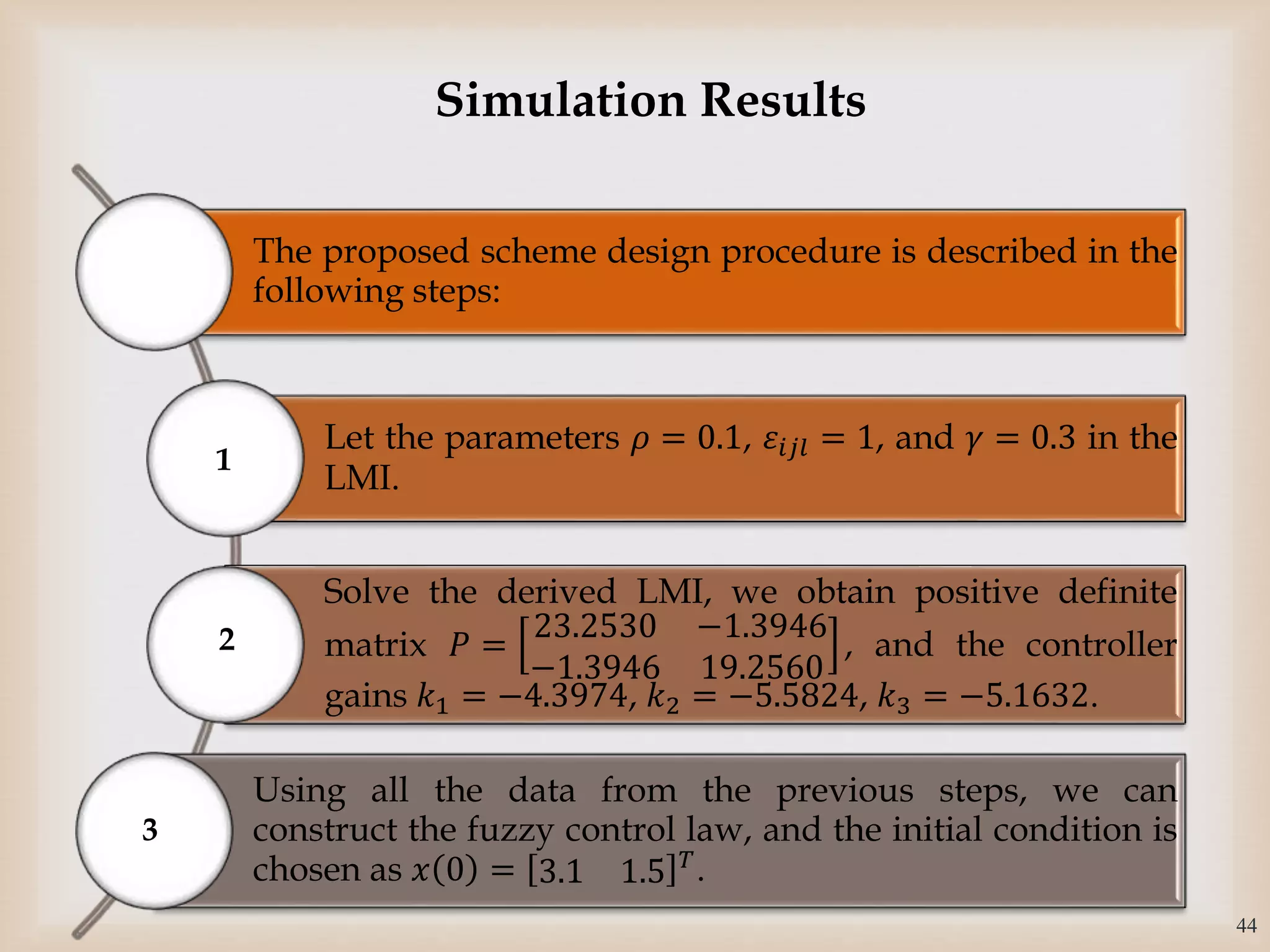
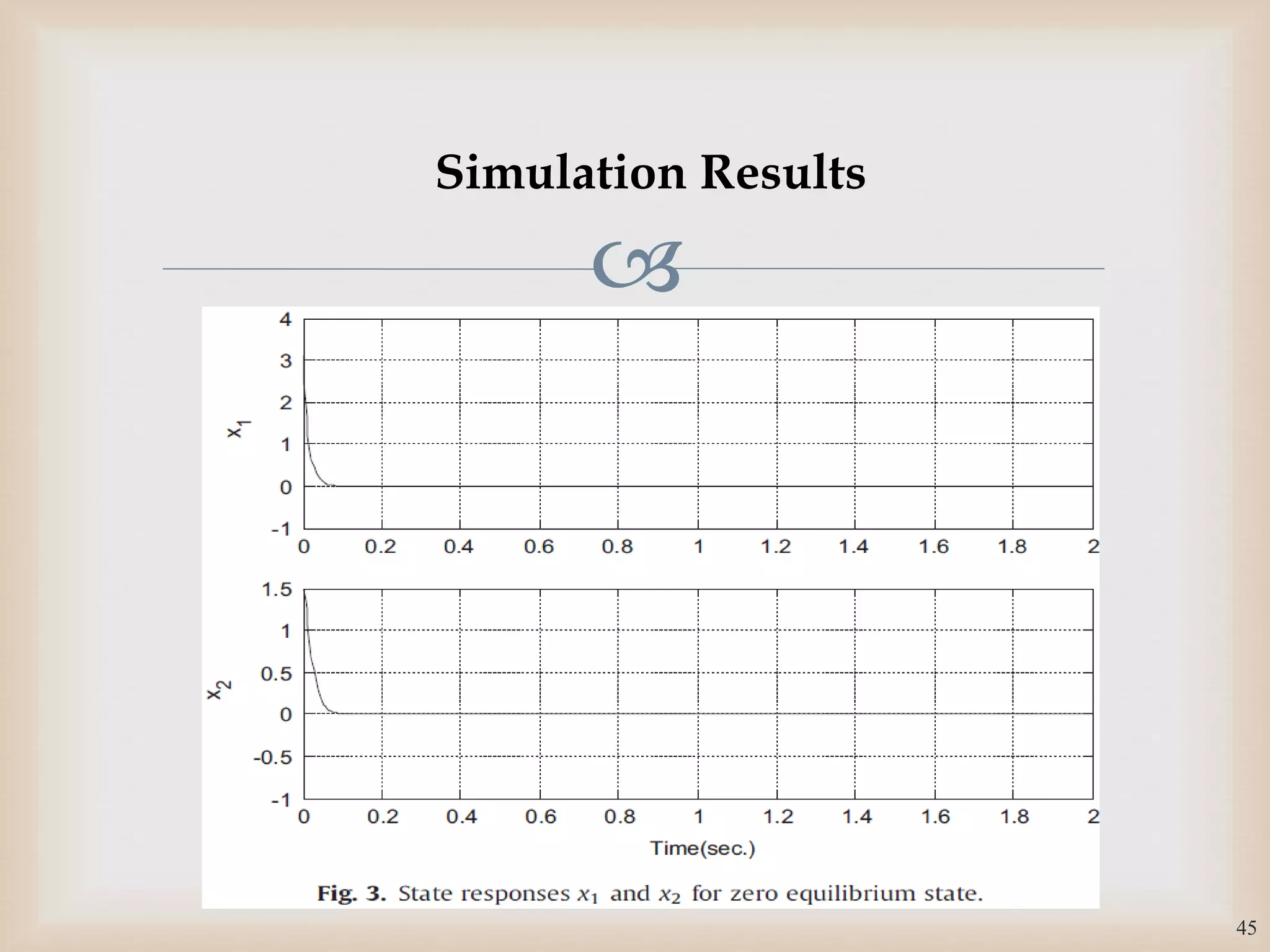
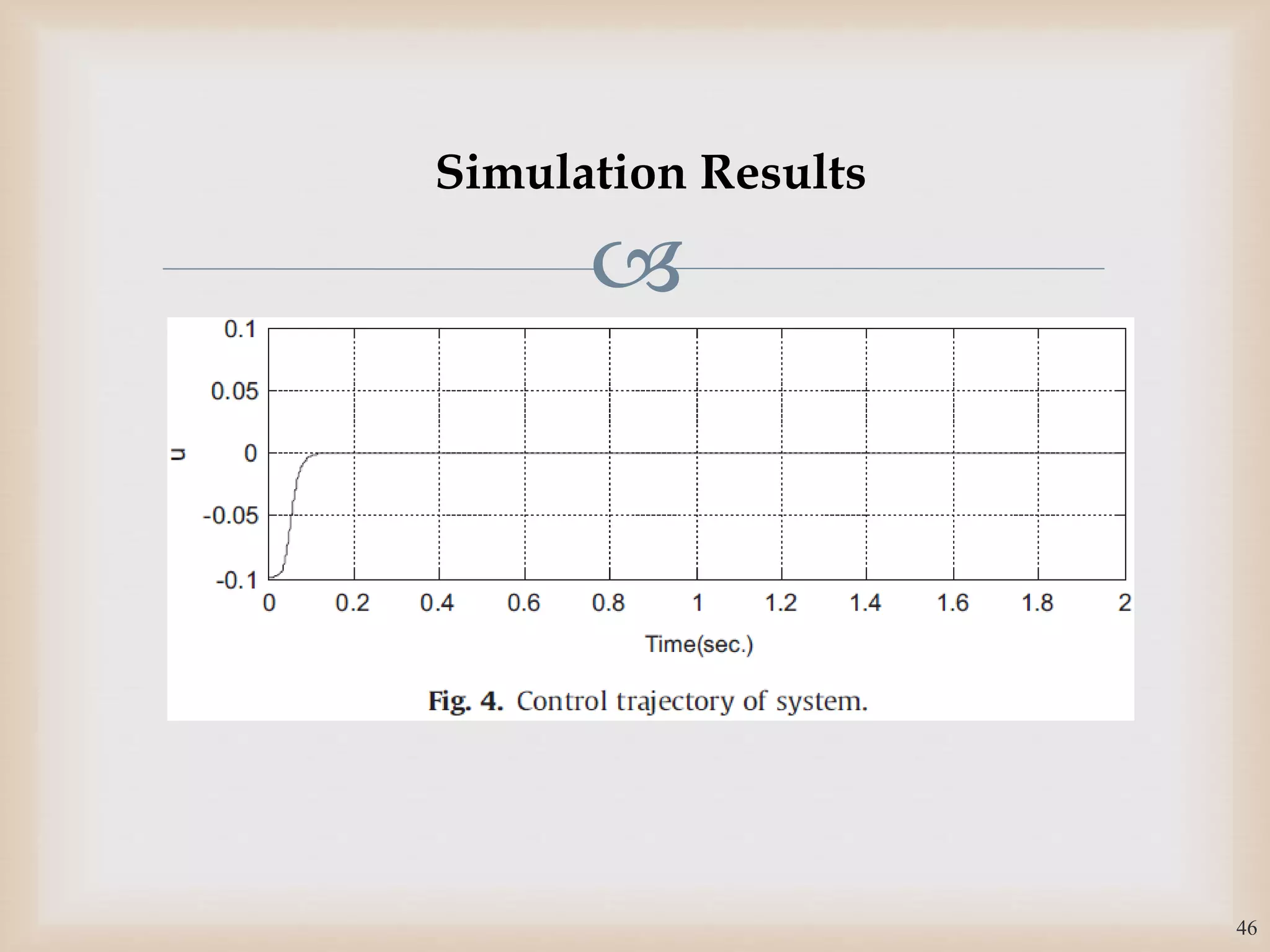
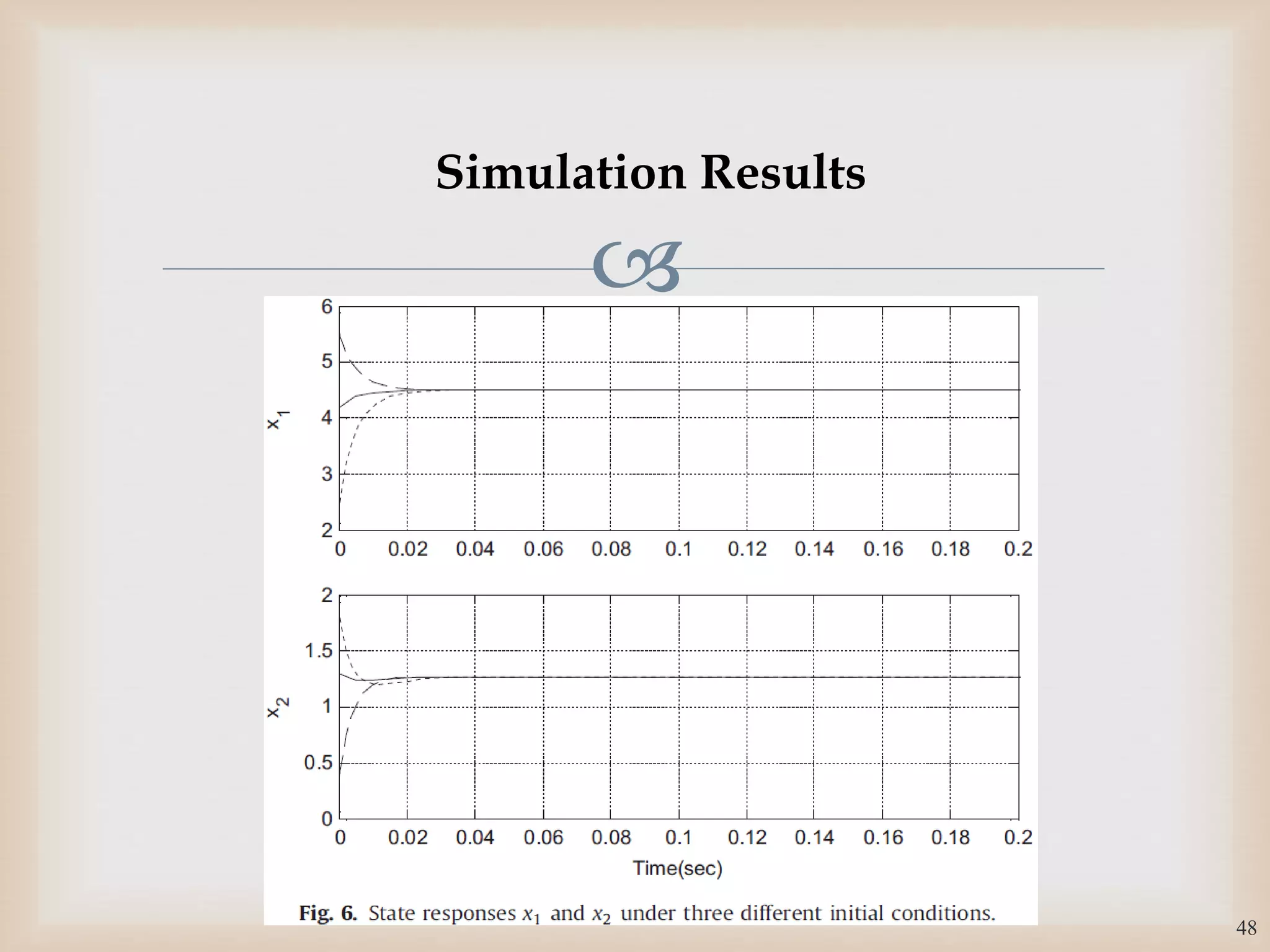
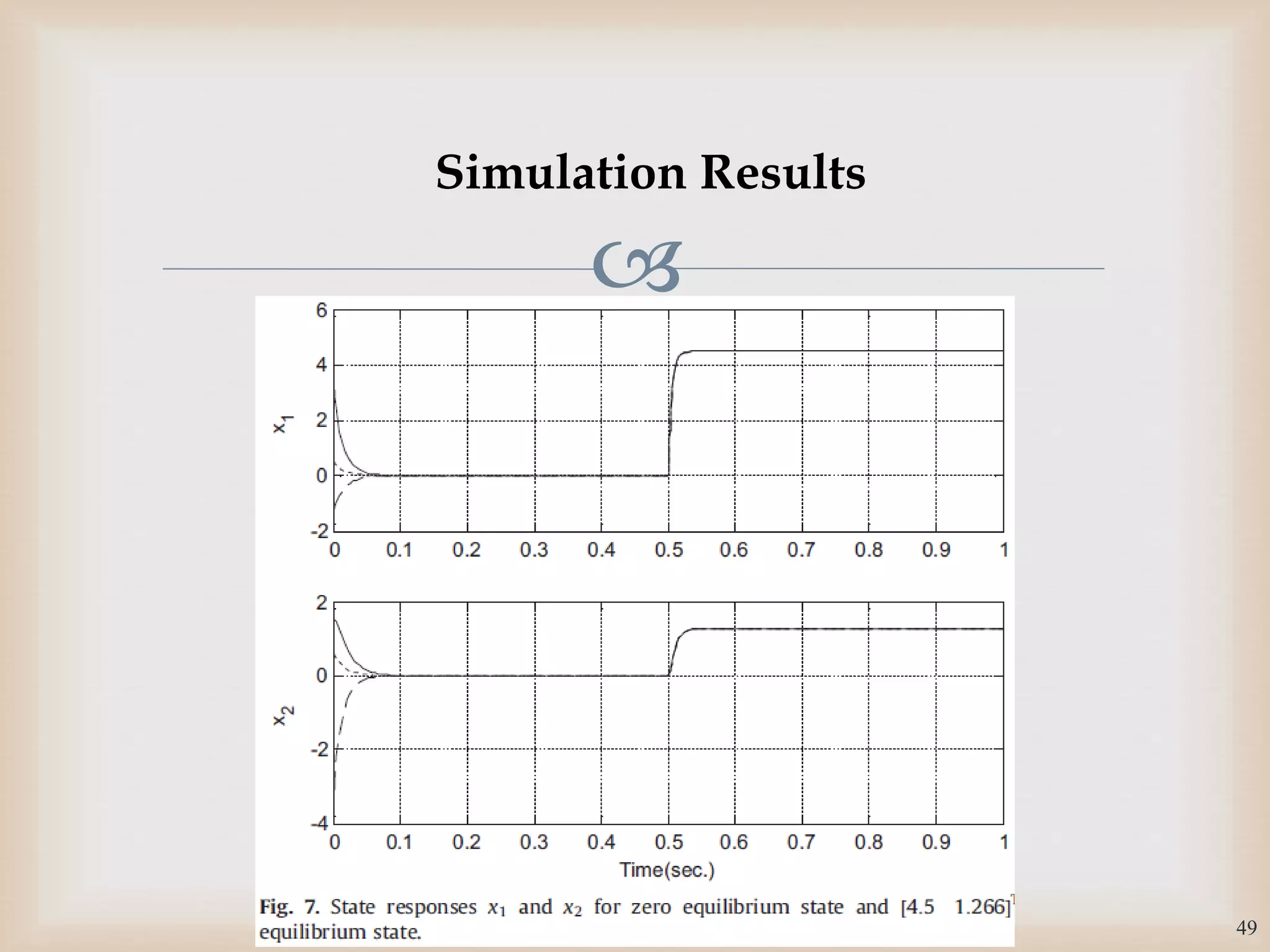
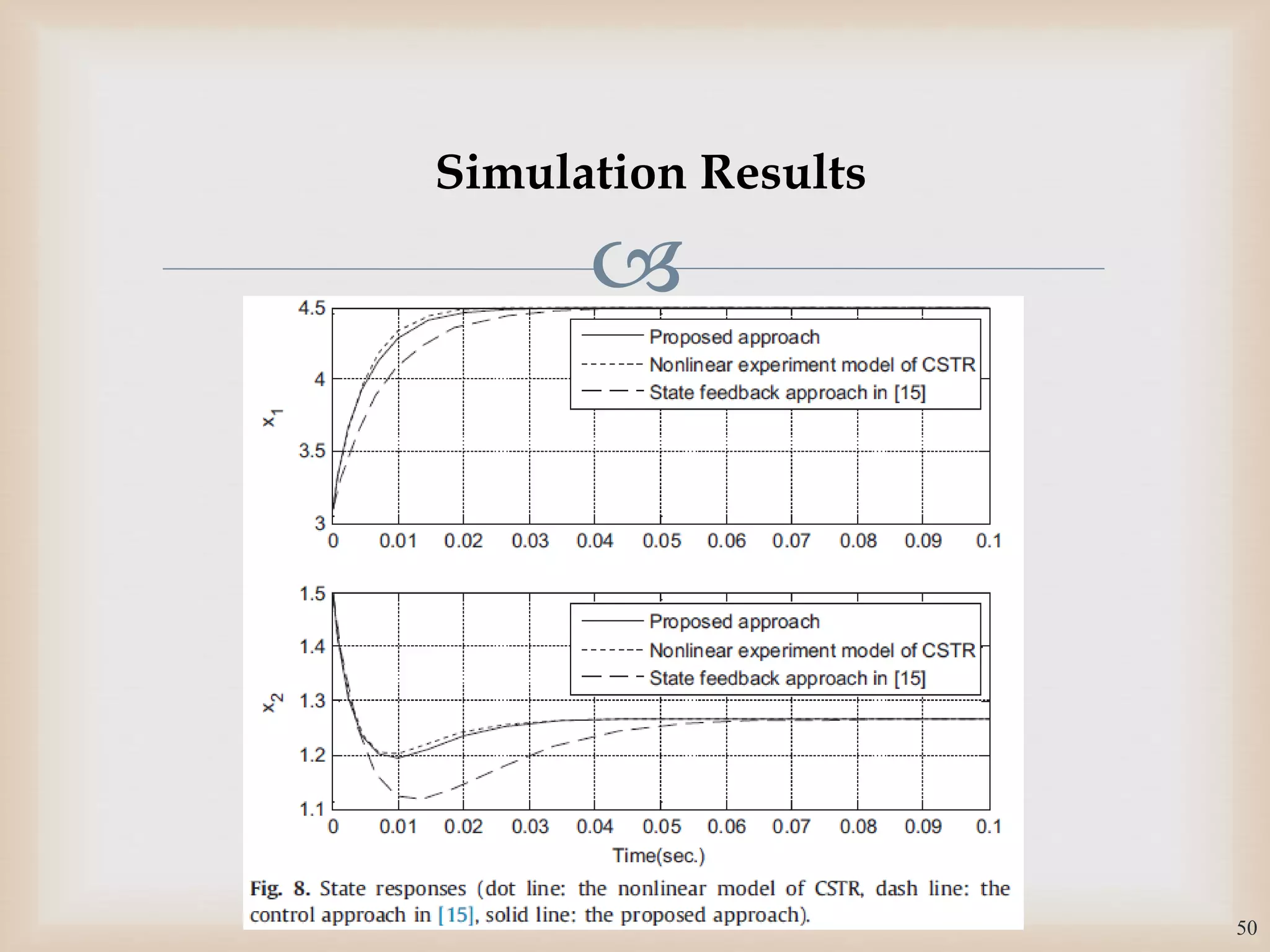
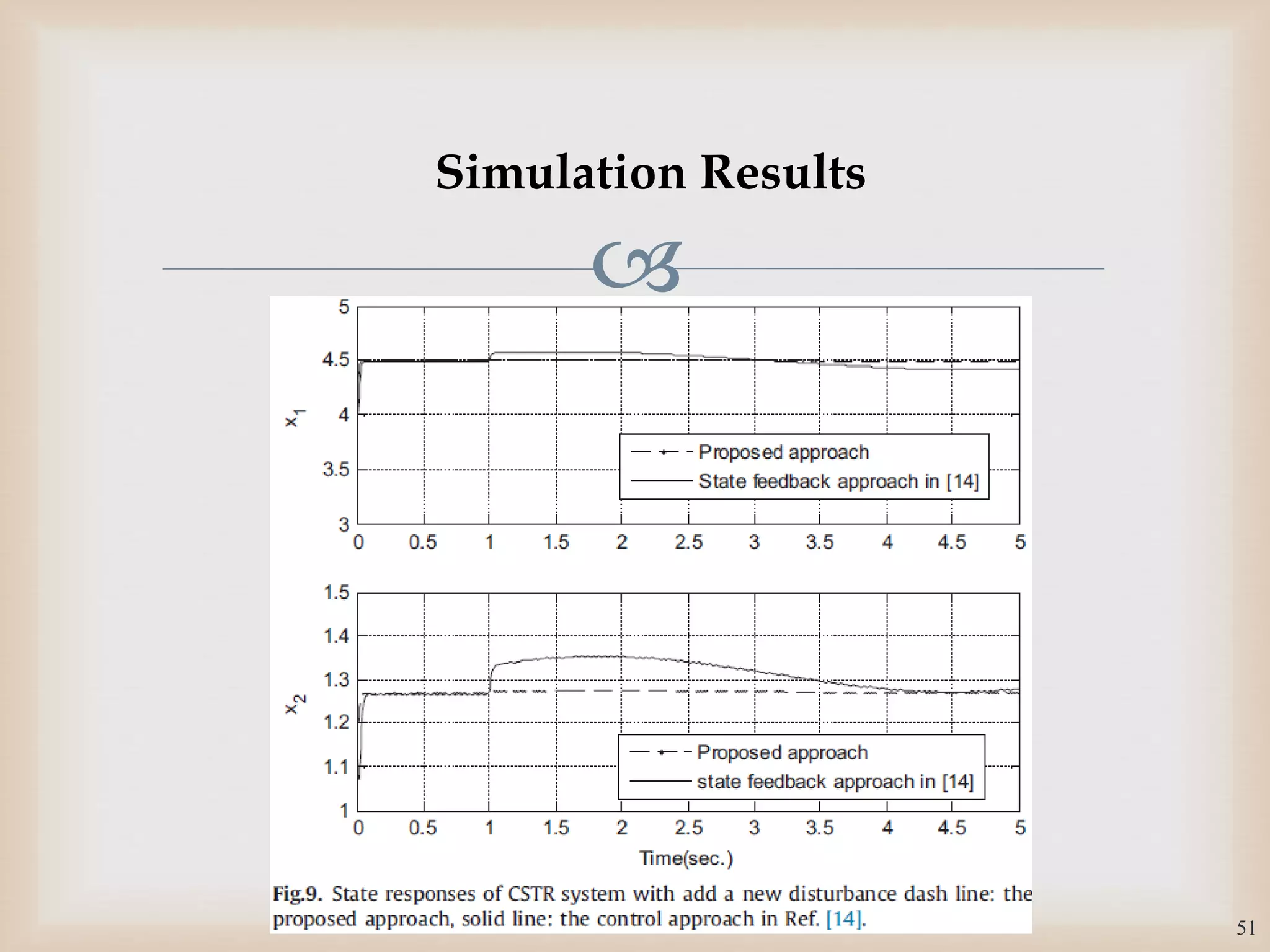
5
T-S Fuzzy Bilinear Model
Which

Bilinear systems naturally represent many physical
and biological processes.
a bilinear model can obviously represent the dynamics
of a nonlinear system more accurately than a linear
one.
Also
6
T-S Fuzzy Bilinear Model

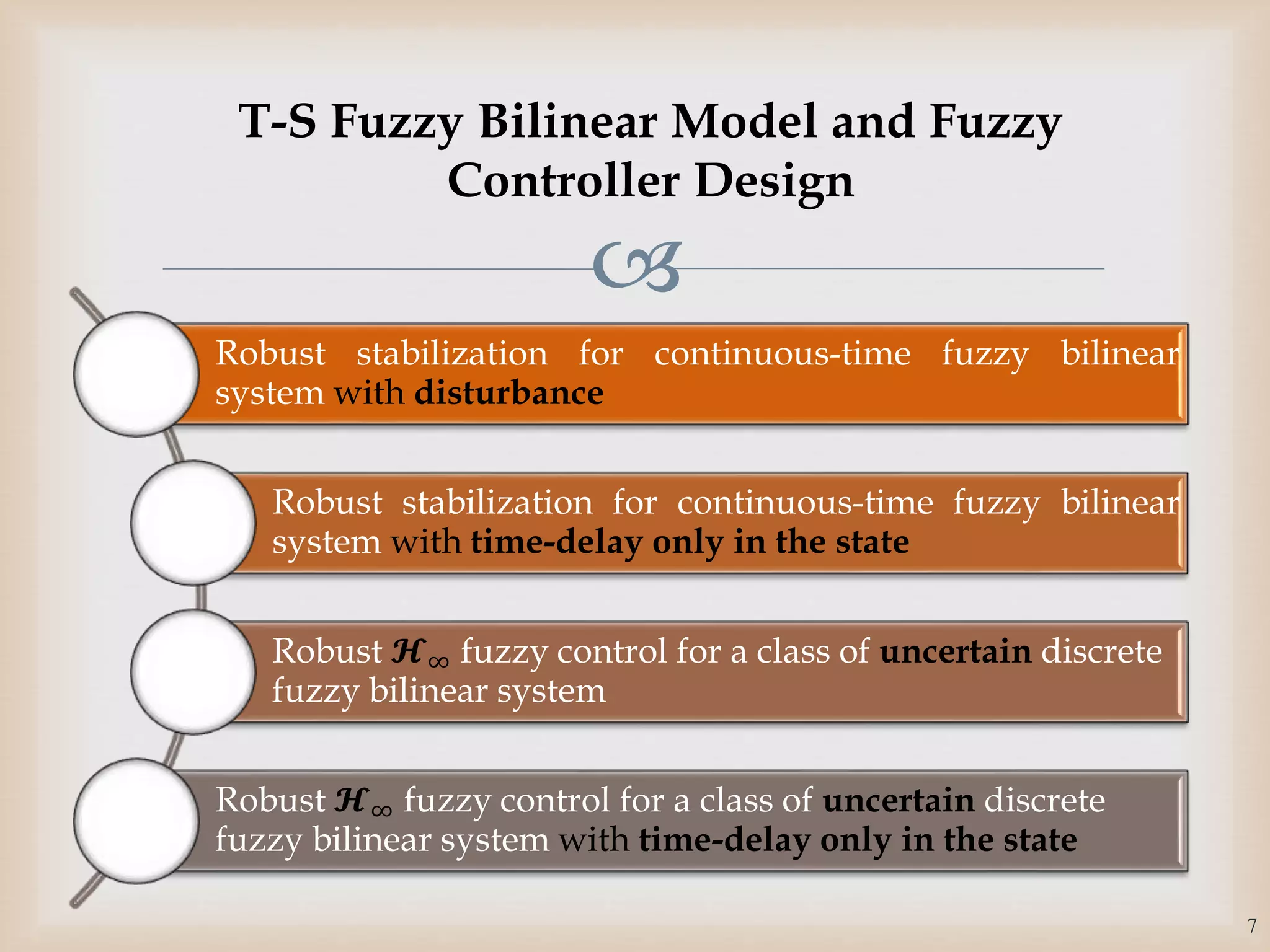
Robust stabilization for continuous-time fuzzy bilinear
system with disturbance
Robust stabilization for continuous-time fuzzy bilinear
system with time-delay only in the state
Robust 𝓗∞ fuzzy control for a class of uncertain discrete
fuzzy bilinear system
Robust 𝓗∞ fuzzy control for a class of uncertain discrete
fuzzy bilinear system with time-delay only in the state
7
T-S Fuzzy Bilinear Model and Fuzzy
Controller Design

All the results were obtained based on
either state feedback controller or
observer-based controller.
8
T-S Fuzzy Bilinear Model and Fuzzy
Controller Design

in many practical control problems, the physical state variable of
systems is partially or fully unavailable for measurement
Since the state variable is not accessible for sensing devices
and transducers are not available or very expensive:
9
Output Feedback Controller

In such cases, the scheme of output
feedback controller is very important and
must be used when the system states are
not completely available for feedback.
10
Output Feedback Controller

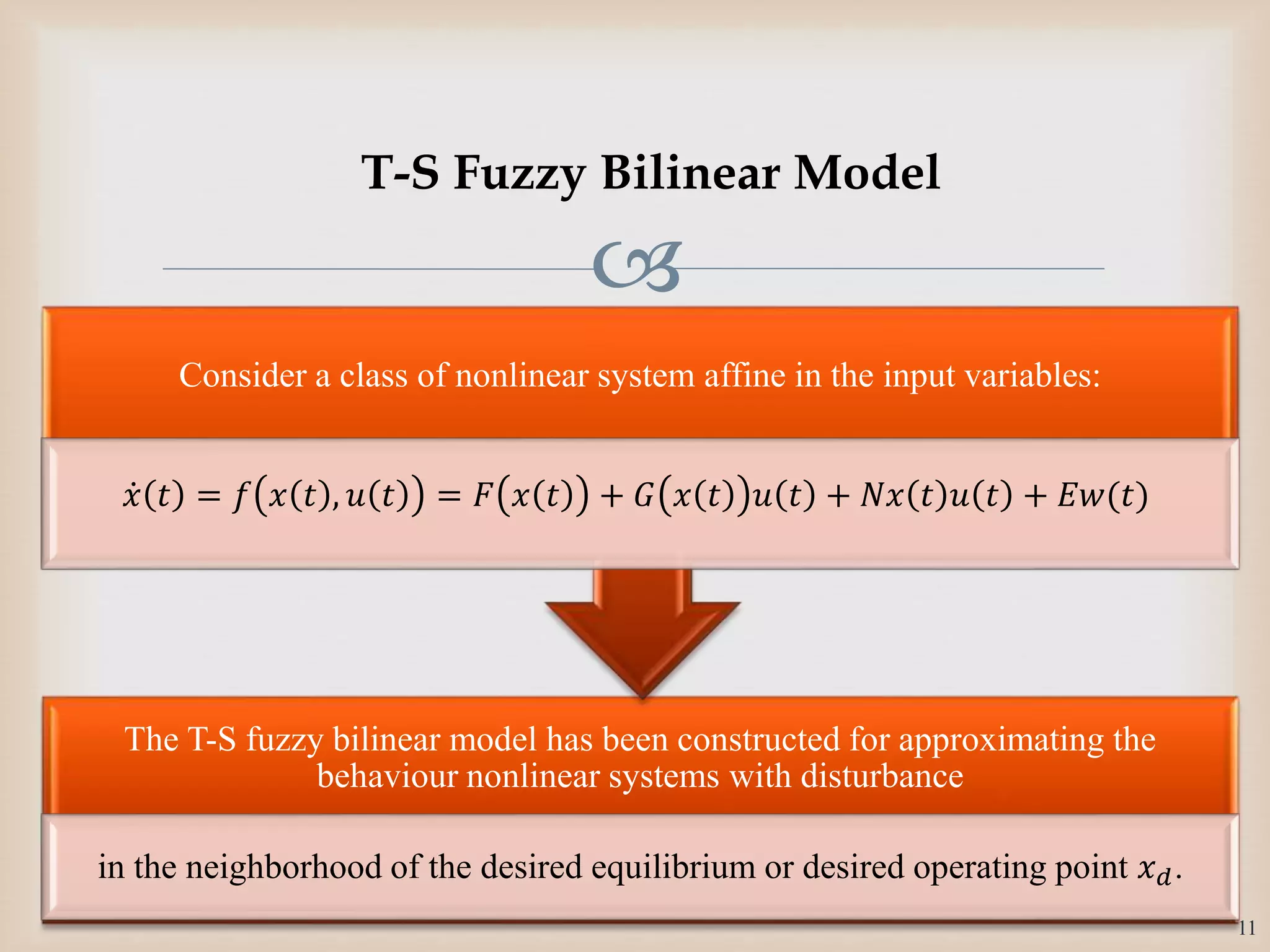
T-S Fuzzy Bilinear Model
The T-S fuzzy bilinear model has been constructed for approximating the
behaviour nonlinear systems with disturbance
in the neighborhood of the desired equilibrium or desired operating point 𝑥 𝑑.
Consider a class of nonlinear system affine in the input variables:
𝑥 𝑡 = 𝑓 𝑥 𝑡 , 𝑢 𝑡 = 𝐹 𝑥 𝑡 + 𝐺 𝑥 𝑡 𝑢 𝑡 + 𝑁𝑥 𝑡 𝑢 𝑡 + 𝐸𝑤(𝑡)
11

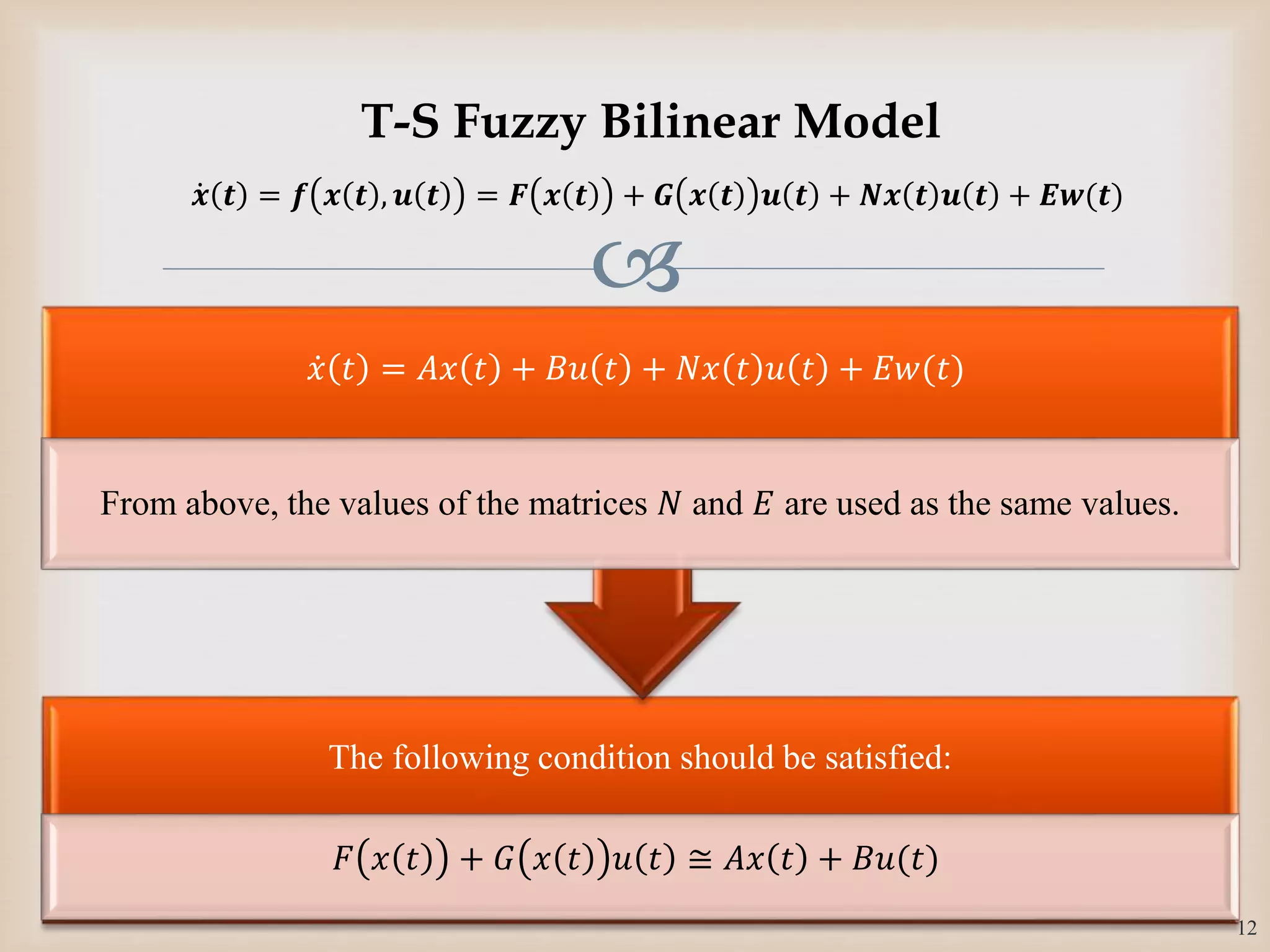
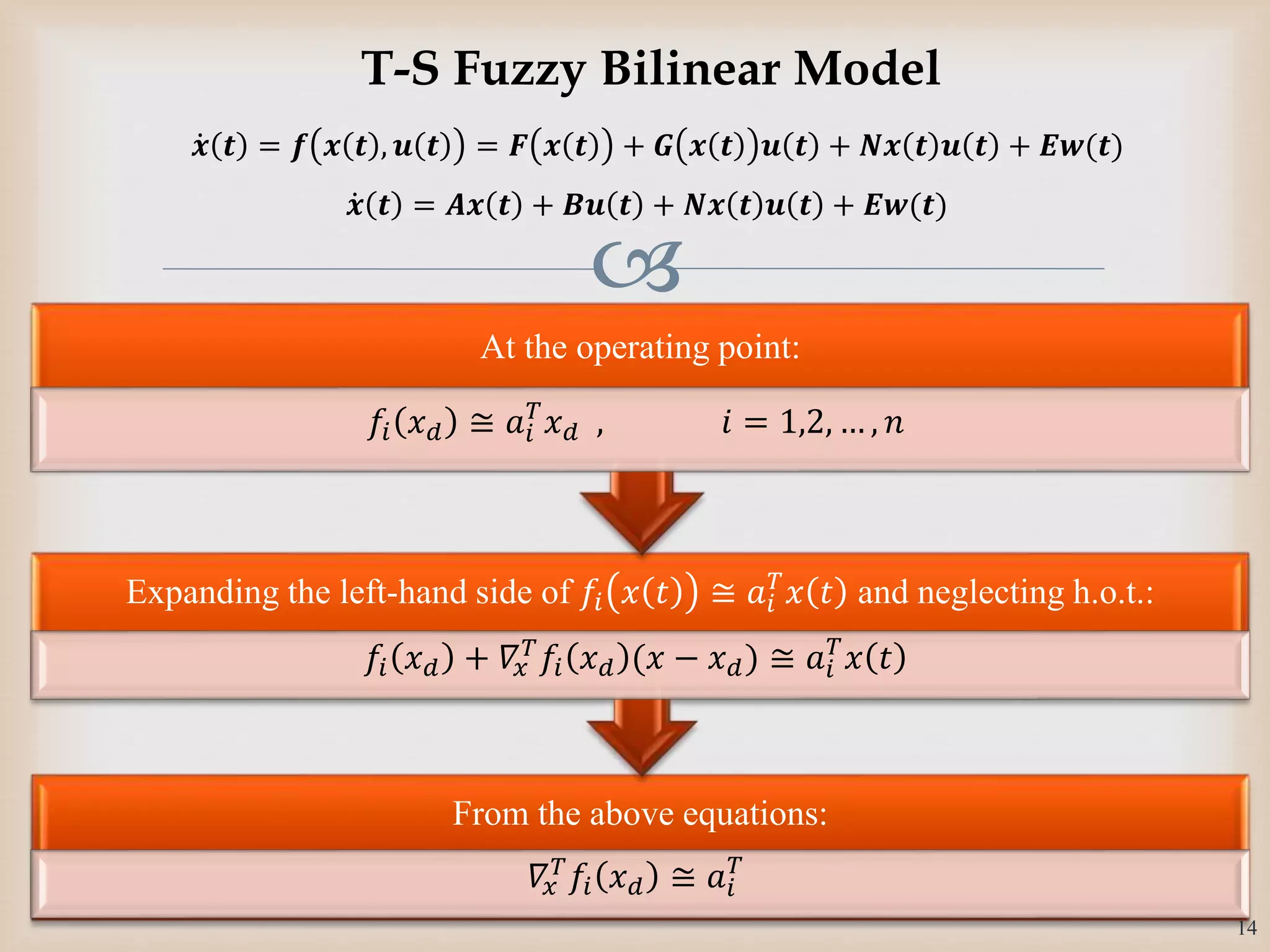
The following condition should be satisfied:
𝐹 𝑥 𝑡 + 𝐺 𝑥 𝑡 𝑢 𝑡 ≅ 𝐴𝑥 𝑡 + 𝐵𝑢(𝑡)
𝑥 𝑡 = 𝐴𝑥 𝑡 + 𝐵𝑢 𝑡 + 𝑁𝑥 𝑡 𝑢 𝑡 + 𝐸𝑤(𝑡)
From above, the values of the matrices 𝑁 and 𝐸 are used as the same values.
12
T-S Fuzzy Bilinear Model
𝒙 𝒕 = 𝒇 𝒙 𝒕 , 𝒖 𝒕 = 𝑭 𝒙 𝒕 + 𝑮 𝒙 𝒕 𝒖 𝒕 + 𝑵𝒙 𝒕 𝒖 𝒕 + 𝑬𝒘(𝒕)

Let 𝑎𝑖
𝑇
be the 𝑖th row of the matrix 𝐴 and 𝑓𝑖 be the 𝑖th component of 𝐹:
𝑓𝑖 𝑥 𝑡 ≅ 𝑎𝑖
𝑇
𝑥 𝑡 , 𝑖 = 1,2, … , 𝑛
The matrix 𝐵 has been deduced as the same value from affine nonlinear system.
The matrix 𝐴 has been changed in each desired equilibrium point.
Thus, constant matrices 𝐴 and 𝐵 should be find such that in a neighborhood of 𝑥 𝑑:
𝐹 𝑥 = 𝐴𝑥 , 𝐹 𝑥 𝑑 = 𝐴𝑥 𝑑 ; 𝐺 𝑥 𝑢 𝑡 = 𝐵𝑢 𝑡 , 𝐺 𝑥 𝑑 = 𝐵
13
T-S Fuzzy Bilinear Model
𝒙 𝒕 = 𝒇 𝒙 𝒕 , 𝒖 𝒕 = 𝑭 𝒙 𝒕 + 𝑮 𝒙 𝒕 𝒖 𝒕 + 𝑵𝒙 𝒕 𝒖 𝒕 + 𝑬𝒘(𝒕)
𝒙 𝒕 = 𝑨𝒙 𝒕 + 𝑩𝒖 𝒕 + 𝑵𝒙 𝒕 𝒖 𝒕 + 𝑬𝒘(𝒕)

From the above equations:
𝛻𝑥
𝑇 𝑓𝑖 𝑥 𝑑 ≅ 𝑎𝑖
𝑇
Expanding the left-hand side of 𝑓𝑖 𝑥 𝑡 ≅ 𝑎𝑖
𝑇
𝑥 𝑡 and neglecting h.o.t.:
𝑓𝑖 𝑥 𝑑 + 𝛻𝑥
𝑇 𝑓𝑖 𝑥 𝑑 (𝑥 − 𝑥 𝑑) ≅ 𝑎𝑖
𝑇
𝑥 𝑡
At the operating point:
𝑓𝑖 𝑥 𝑑 ≅ 𝑎𝑖
𝑇
𝑥 𝑑 , 𝑖 = 1,2, … , 𝑛
14
T-S Fuzzy Bilinear Model
𝒙 𝒕 = 𝒇 𝒙 𝒕 , 𝒖 𝒕 = 𝑭 𝒙 𝒕 + 𝑮 𝒙 𝒕 𝒖 𝒕 + 𝑵𝒙 𝒕 𝒖 𝒕 + 𝑬𝒘(𝒕)
𝒙 𝒕 = 𝑨𝒙 𝒕 + 𝑩𝒖 𝒕 + 𝑵𝒙 𝒕 𝒖 𝒕 + 𝑬𝒘(𝒕)

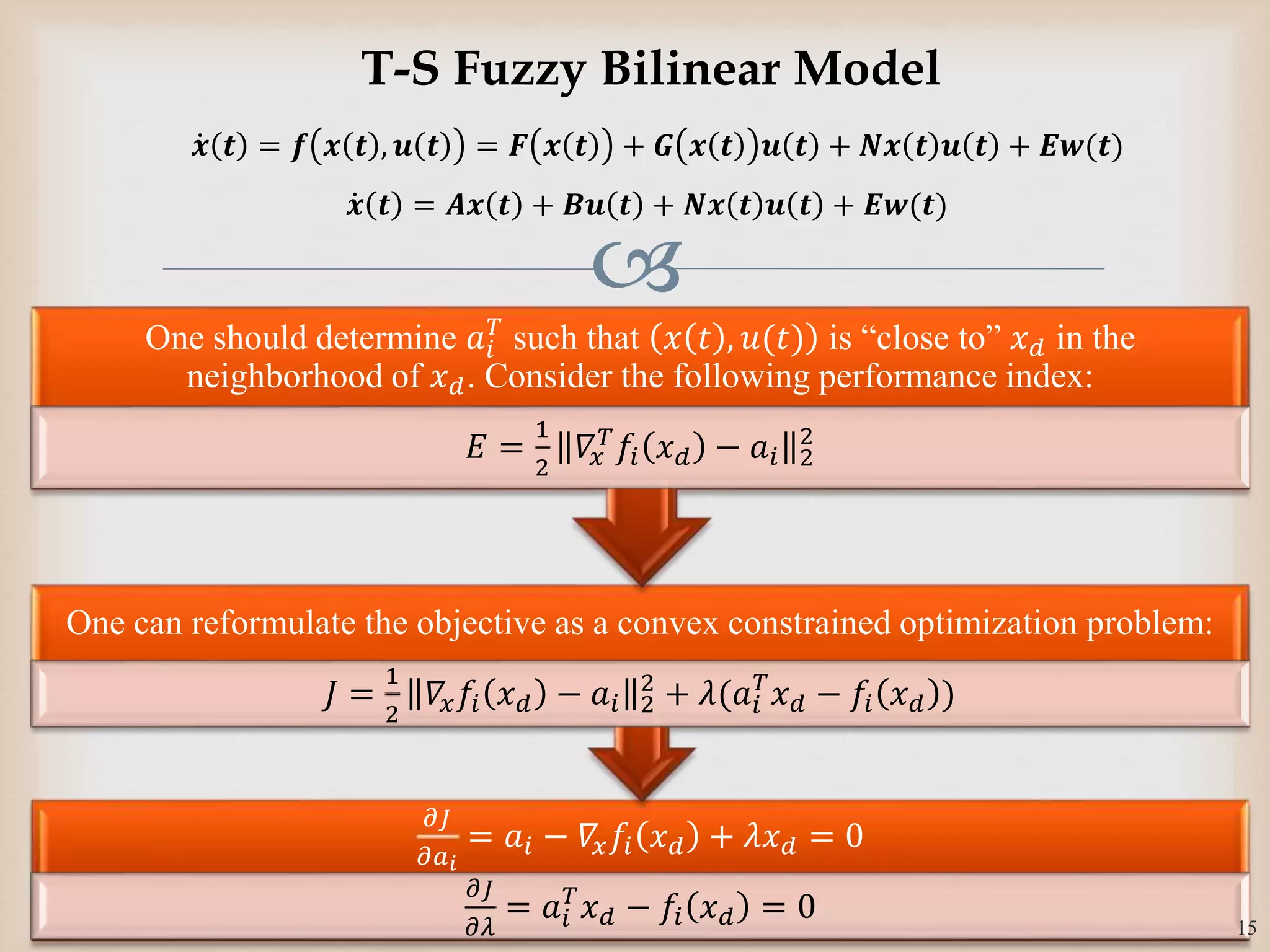
𝜕𝐽
𝜕𝑎 𝑖
= 𝑎𝑖 − 𝛻𝑥 𝑓𝑖 𝑥 𝑑 + 𝜆𝑥 𝑑 = 0
𝜕𝐽
𝜕𝜆
= 𝑎𝑖
𝑇
𝑥 𝑑 − 𝑓𝑖 𝑥 𝑑 = 0
One can reformulate the objective as a convex constrained optimization problem:
𝐽 =
1
2
𝛻𝑥 𝑓𝑖 𝑥 𝑑 − 𝑎𝑖 2
2
+ 𝜆(𝑎𝑖
𝑇
𝑥 𝑑 − 𝑓𝑖 𝑥 𝑑 )
One should determine 𝑎𝑖
𝑇
such that 𝑥 𝑡 , 𝑢(𝑡) is “close to” 𝑥 𝑑 in the
neighborhood of 𝑥 𝑑. Consider the following performance index:
𝐸 =
1
2
𝛻𝑥
𝑇 𝑓𝑖 𝑥 𝑑 − 𝑎𝑖 2
2
15
T-S Fuzzy Bilinear Model
𝒙 𝒕 = 𝒇 𝒙 𝒕 , 𝒖 𝒕 = 𝑭 𝒙 𝒕 + 𝑮 𝒙 𝒕 𝒖 𝒕 + 𝑵𝒙 𝒕 𝒖 𝒕 + 𝑬𝒘(𝒕)
𝒙 𝒕 = 𝑨𝒙 𝒕 + 𝑩𝒖 𝒕 + 𝑵𝒙 𝒕 𝒖 𝒕 + 𝑬𝒘(𝒕)

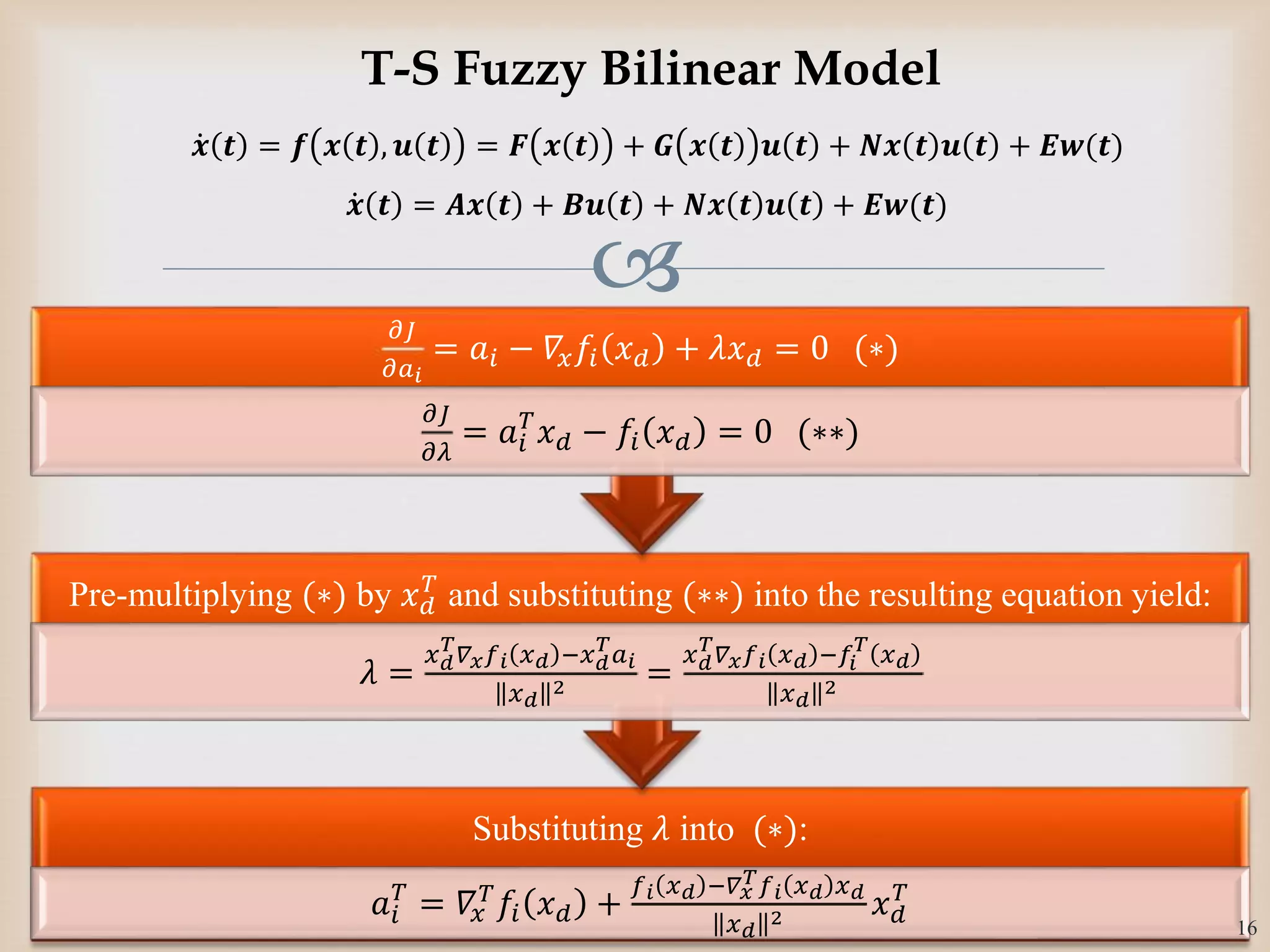
Substituting 𝜆 into (∗):
𝑎𝑖
𝑇
= 𝛻𝑥
𝑇 𝑓𝑖 𝑥 𝑑 +
𝑓 𝑖 𝑥 𝑑 −𝛻 𝑥
𝑇 𝑓 𝑖 𝑥 𝑑 𝑥 𝑑
𝑥 𝑑
2 𝑥 𝑑
𝑇
Pre-multiplying (∗) by 𝑥 𝑑
𝑇
and substituting (∗∗) into the resulting equation yield:
𝜆 =
𝑥 𝑑
𝑇
𝛻 𝑥 𝑓 𝑖 𝑥 𝑑 −𝑥 𝑑
𝑇
𝑎 𝑖
𝑥 𝑑
2 =
𝑥 𝑑
𝑇
𝛻 𝑥 𝑓 𝑖 𝑥 𝑑 −𝑓𝑖
𝑇
𝑥 𝑑
𝑥 𝑑
2
𝜕𝐽
𝜕𝑎 𝑖
= 𝑎𝑖 − 𝛻𝑥 𝑓𝑖 𝑥 𝑑 + 𝜆𝑥 𝑑 = 0 (∗)
𝜕𝐽
𝜕𝜆
= 𝑎𝑖
𝑇
𝑥 𝑑 − 𝑓𝑖 𝑥 𝑑 = 0 (∗∗)
16
T-S Fuzzy Bilinear Model
𝒙 𝒕 = 𝒇 𝒙 𝒕 , 𝒖 𝒕 = 𝑭 𝒙 𝒕 + 𝑮 𝒙 𝒕 𝒖 𝒕 + 𝑵𝒙 𝒕 𝒖 𝒕 + 𝑬𝒘(𝒕)
𝒙 𝒕 = 𝑨𝒙 𝒕 + 𝑩𝒖 𝒕 + 𝑵𝒙 𝒕 𝒖 𝒕 + 𝑬𝒘(𝒕)

This completes the construction of matrices
𝐴, 𝐵, 𝑁, and 𝐸 in each desired equilibrium
point for T-S fuzzy bilinear model from
affine nonlinear system with disturbance.
17
T-S Fuzzy Bilinear Model
𝒙 𝒕 = 𝒇 𝒙 𝒕 , 𝒖 𝒕 = 𝑭 𝒙 𝒕 + 𝑮 𝒙 𝒕 𝒖 𝒕 + 𝑵𝒙 𝒕 𝒖 𝒕 + 𝑬𝒘(𝒕)
𝒙 𝒕 = 𝑨𝒙 𝒕 + 𝑩𝒖 𝒕 + 𝑵𝒙 𝒕 𝒖 𝒕 + 𝑬𝒘(𝒕)

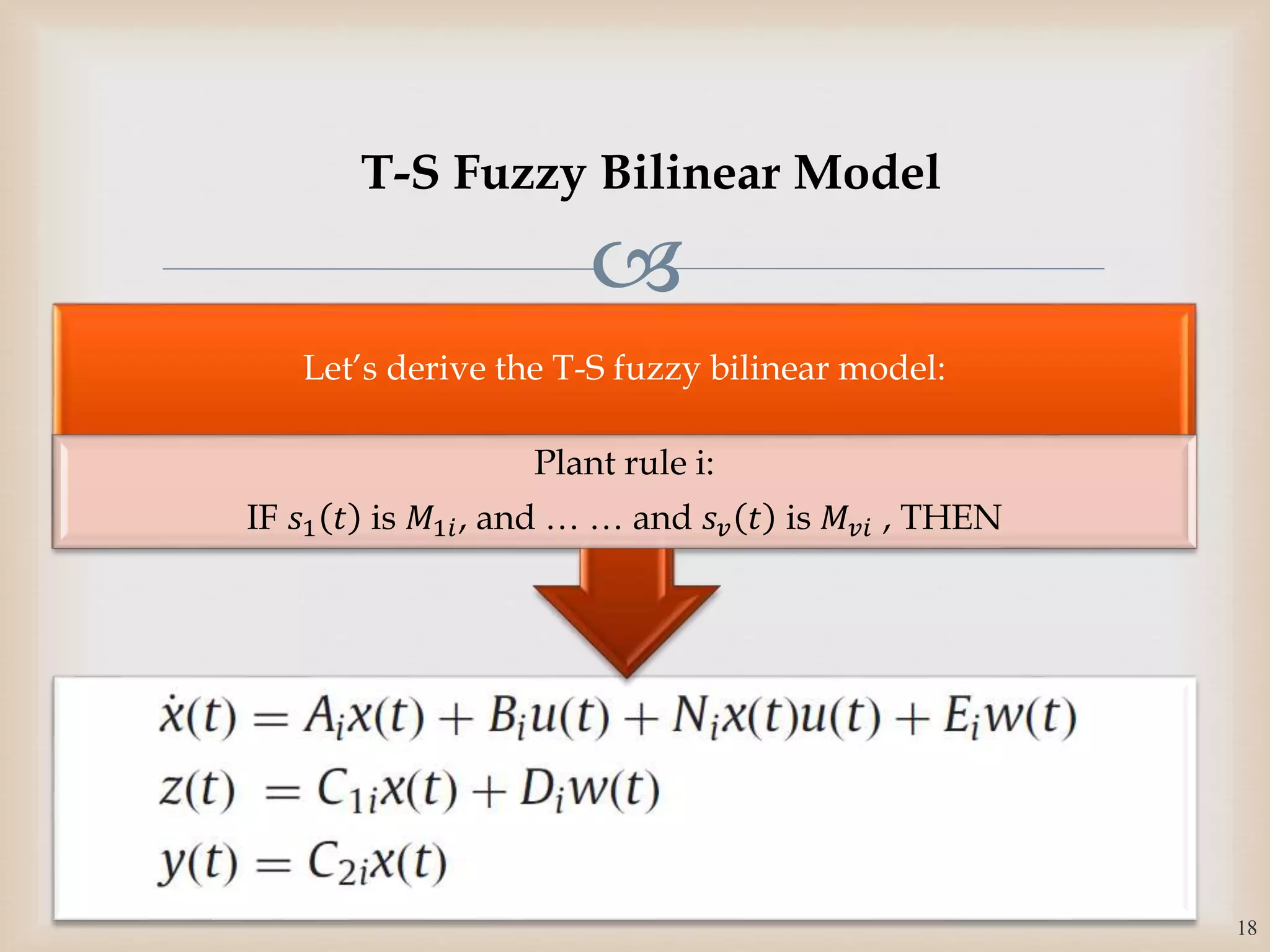
Let’s derive the T-S fuzzy bilinear model:
Plant rule i:
IF 𝑠1 𝑡 is 𝑀1𝑖, and … … and 𝑠 𝑣 𝑡 is 𝑀𝑣𝑖 , THEN
18
T-S Fuzzy Bilinear Model

By using singleton fuzzifier, product inference and center-average
defuzzifier, then:
the T-S fuzzy bilinear model is described by the following global
model:
19
T-S Fuzzy Bilinear Model

20
T-S Fuzzy Bilinear Model

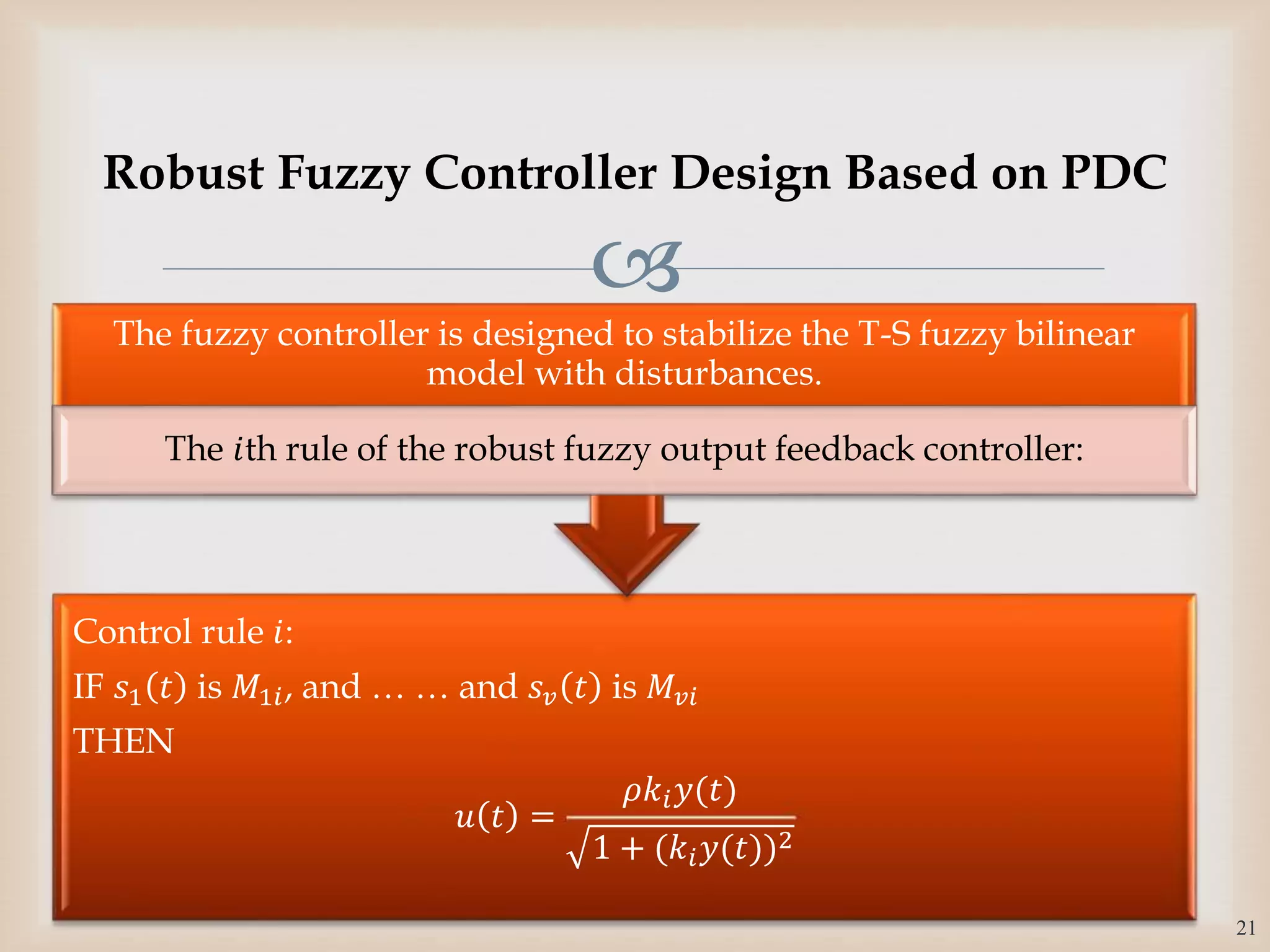
Control rule 𝑖:
IF 𝑠1 𝑡 is 𝑀1𝑖, and … … and 𝑠 𝑣 𝑡 is 𝑀𝑣𝑖
THEN
𝑢 𝑡 =
𝜌𝑘𝑖 𝑦(𝑡)
1 + (𝑘𝑖 𝑦(𝑡))2
The fuzzy controller is designed to stabilize the T-S fuzzy bilinear
model with disturbances.
The 𝑖th rule of the robust fuzzy output feedback controller:
21
Robust Fuzzy Controller Design Based on PDC

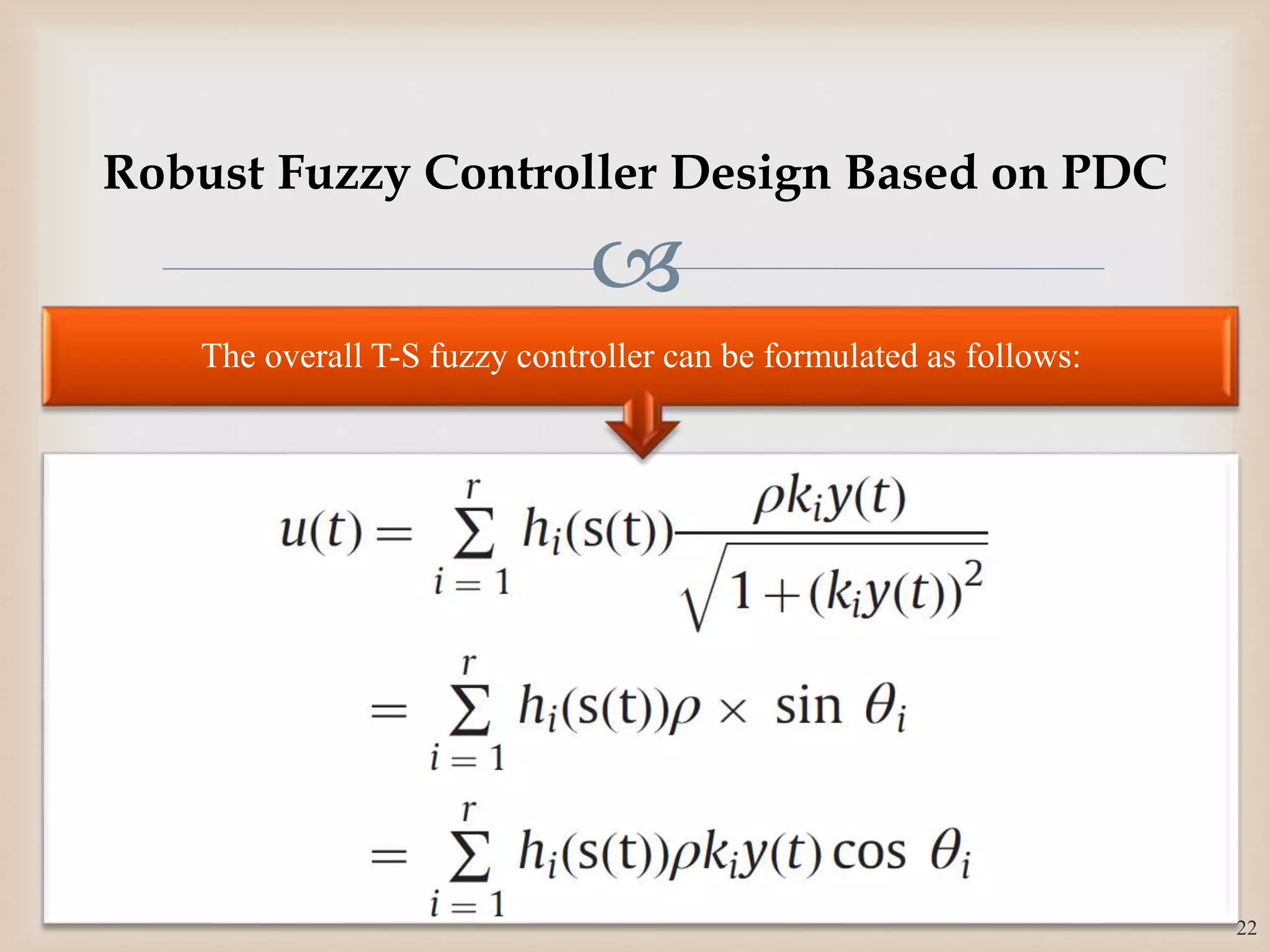
The overall T-S fuzzy controller can be formulated as follows:
22
Robust Fuzzy Controller Design Based on PDC

𝜃𝑖 ∈ [−
𝜋
2
,
𝜋
2
], 𝑘𝑖 ∈ 𝑅 is a scalar to be determined by LMI
conditions and 𝜌 > 0 is an arbitrary designed scalar, 𝑖
= 1,2, … , 𝑟.
where
23
Robust Fuzzy Controller Design Based on PDC

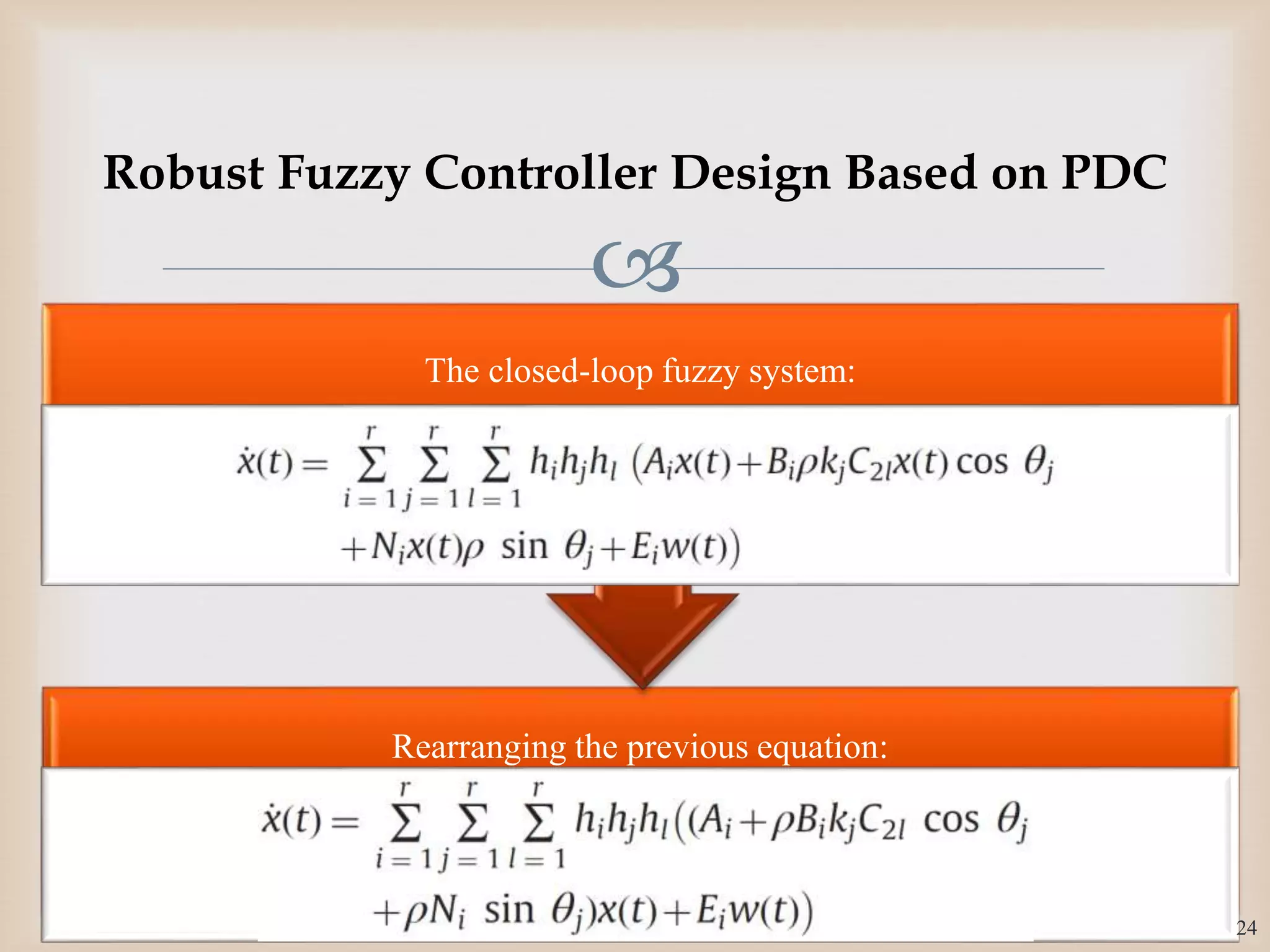
Rearranging the previous equation:
The closed-loop fuzzy system:
24
Robust Fuzzy Controller Design Based on PDC

We introduce the following performance criterion with its
control objectives:
𝐽 = 0
∞
𝑧(𝑡) 𝑇
𝑧 𝑡 − 𝛾2
𝑤(𝑡) 𝑇
𝑤(𝑡) 𝑑𝑡
When 𝑤 𝑡 = 0, the resulting of the closed-loop system
is asymptotically stable.
For 𝛾 > 0, and 𝑥 0 = 0, the controlled output 𝑧 𝑡 of the
closed-loop system satisfies 𝑧(𝑡) 2 < 𝛾 𝑤(𝑡) 2 for all non-
zero 𝑤 𝑡 ∈ 𝐿2[0, ∞].
i
25
Robust 𝓗∞ Fuzzy Output Feedback Controller
ii

26
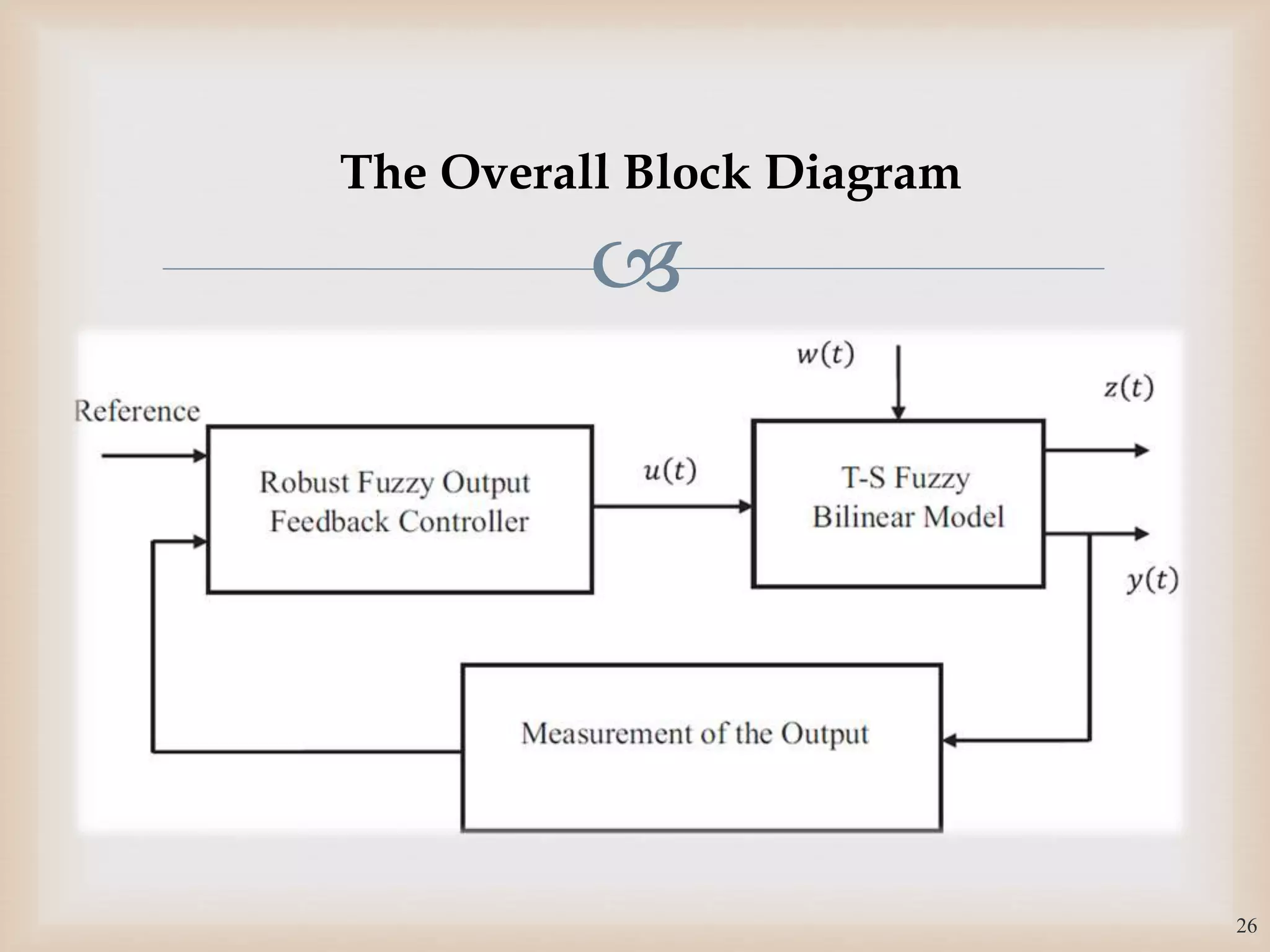
The Overall Block Diagram

The Stability Analysis and LMI Conditions
The proposed control law should be designed such
that to guarantee the asymptotic stability of the closed-
loop system.
The following stability analysis is carried out to
determine the LMI conditions on control parameters.
27
So

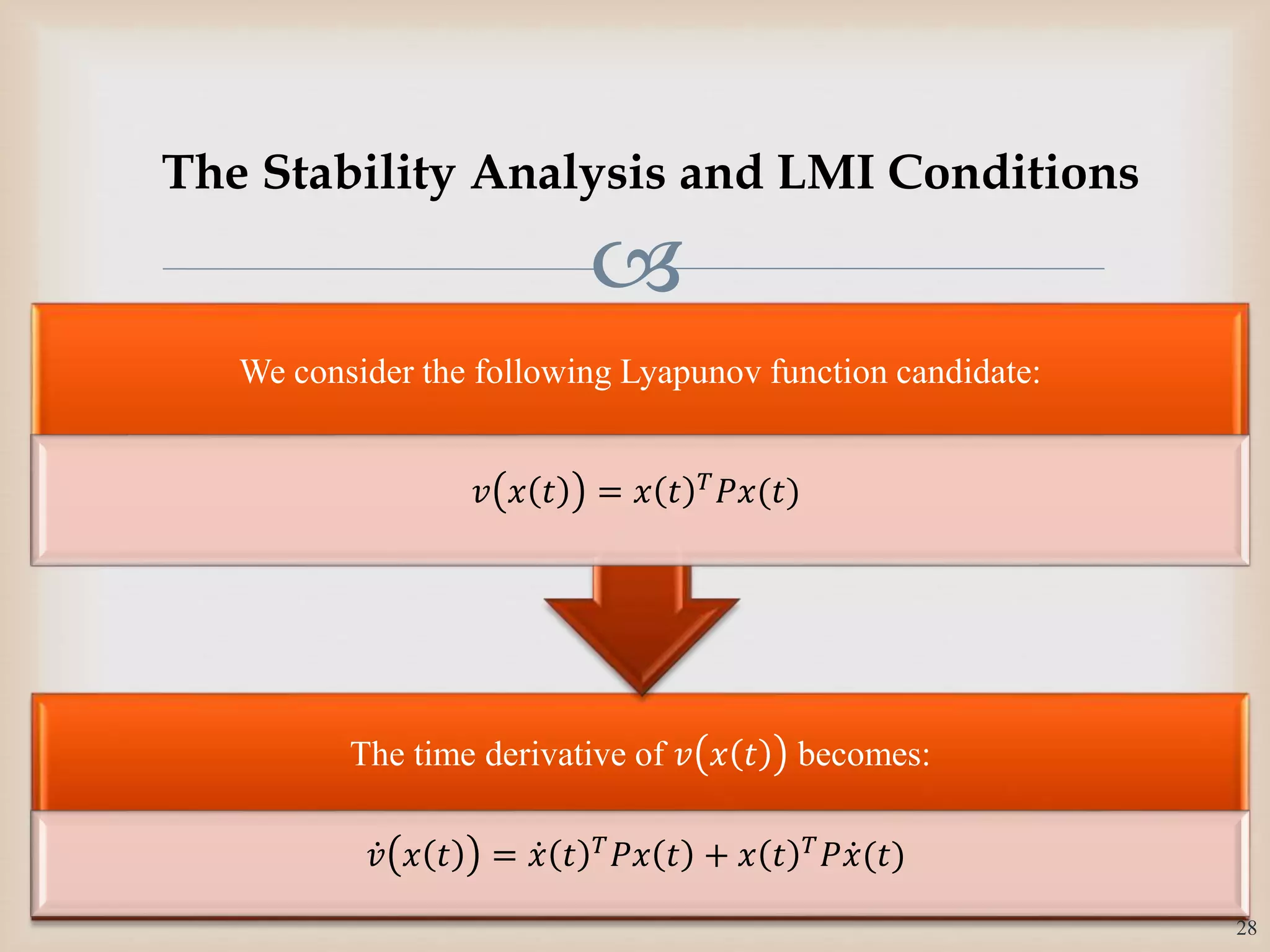
The time derivative of 𝑣 𝑥 𝑡 becomes:
𝑣 𝑥 𝑡 = 𝑥 𝑡 𝑇
𝑃𝑥 𝑡 + 𝑥 𝑡 𝑇
𝑃 𝑥(𝑡)
We consider the following Lyapunov function candidate:
𝑣 𝑥 𝑡 = 𝑥 𝑡 𝑇 𝑃𝑥(𝑡)
28
The Stability Analysis and LMI Conditions

By substituting the closed-loop system into the previous equation:
29
The Stability Analysis and LMI Conditions

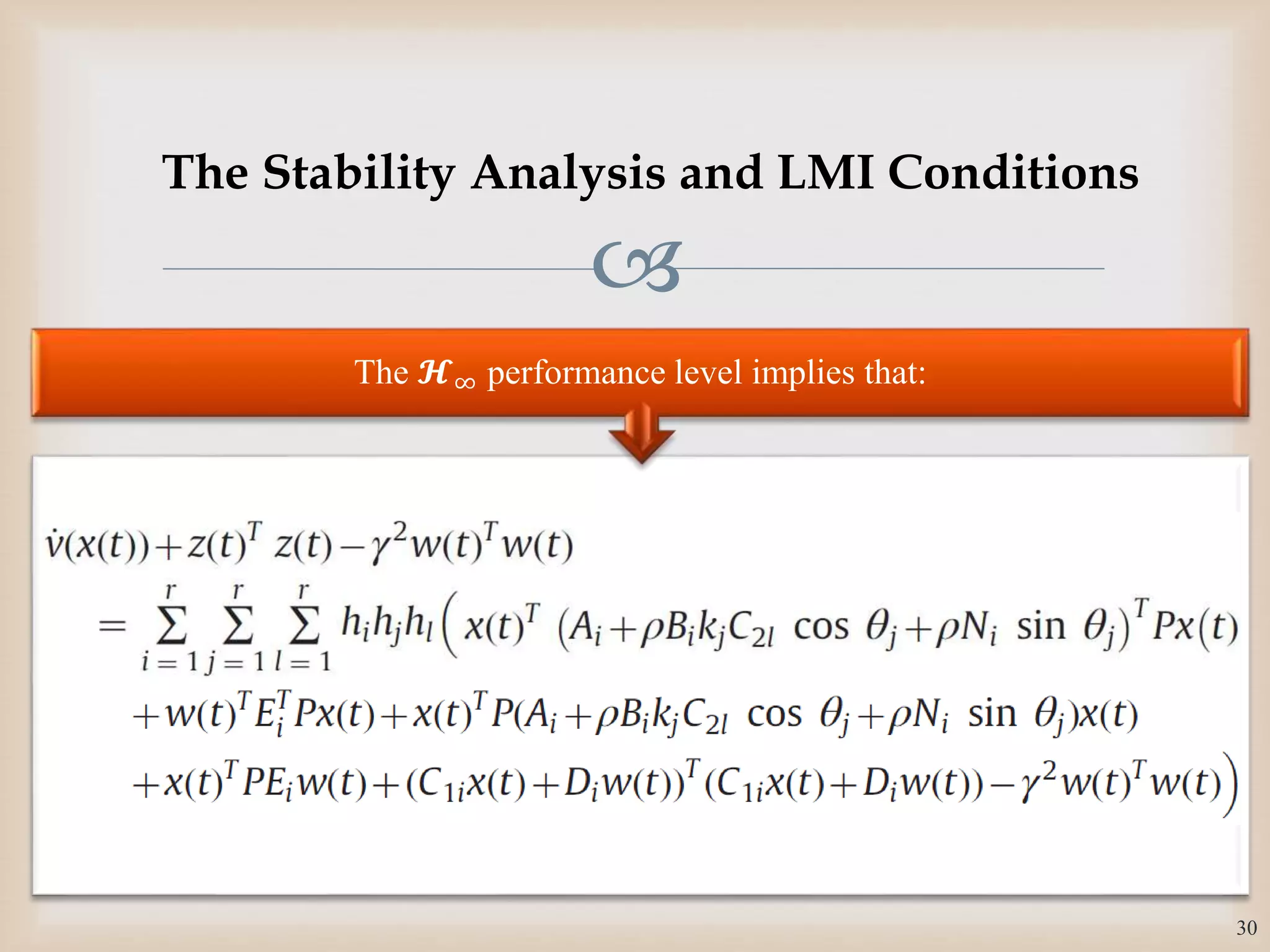
The 𝓗∞ performance level implies that:
30
The Stability Analysis and LMI Conditions

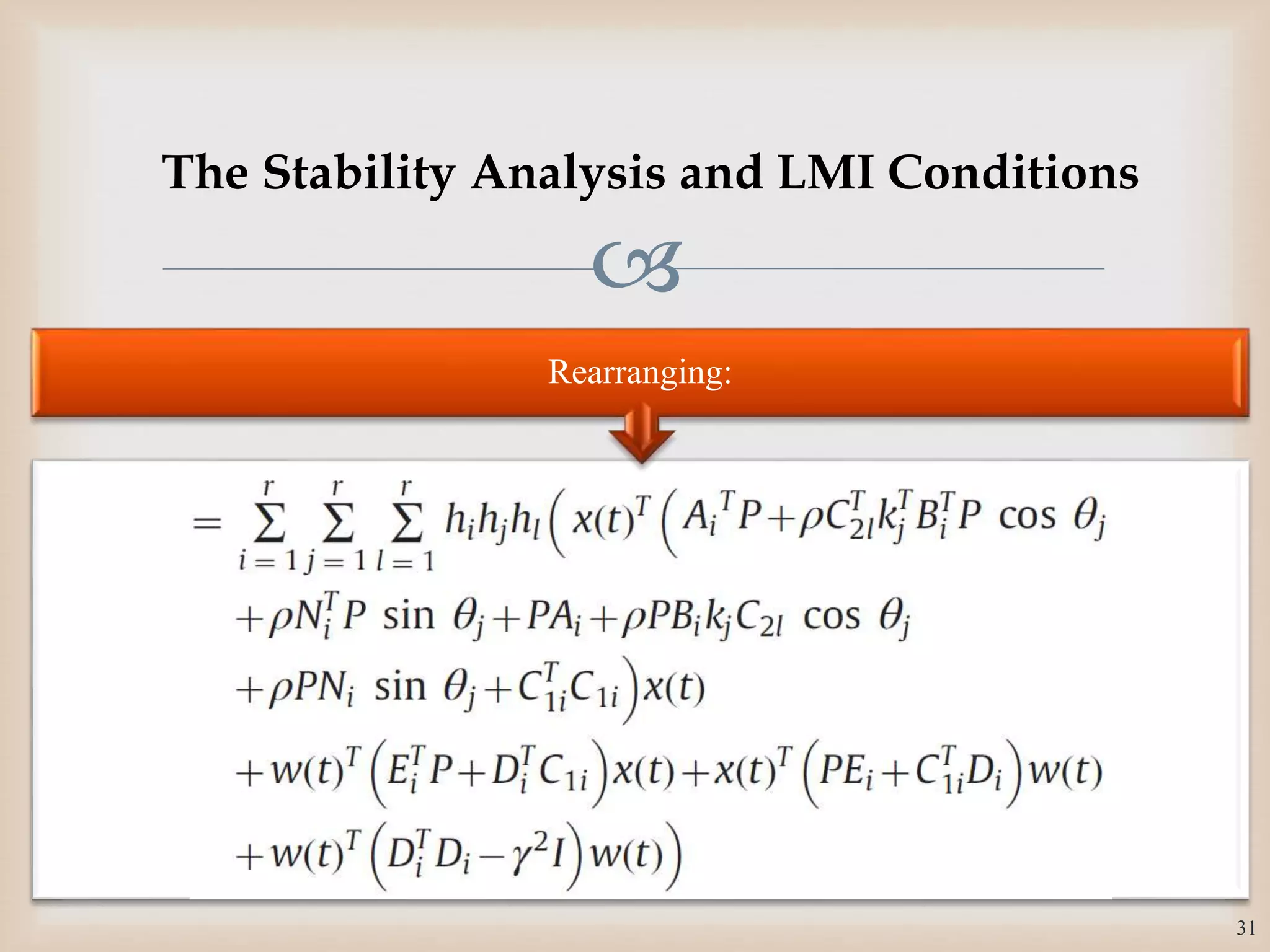
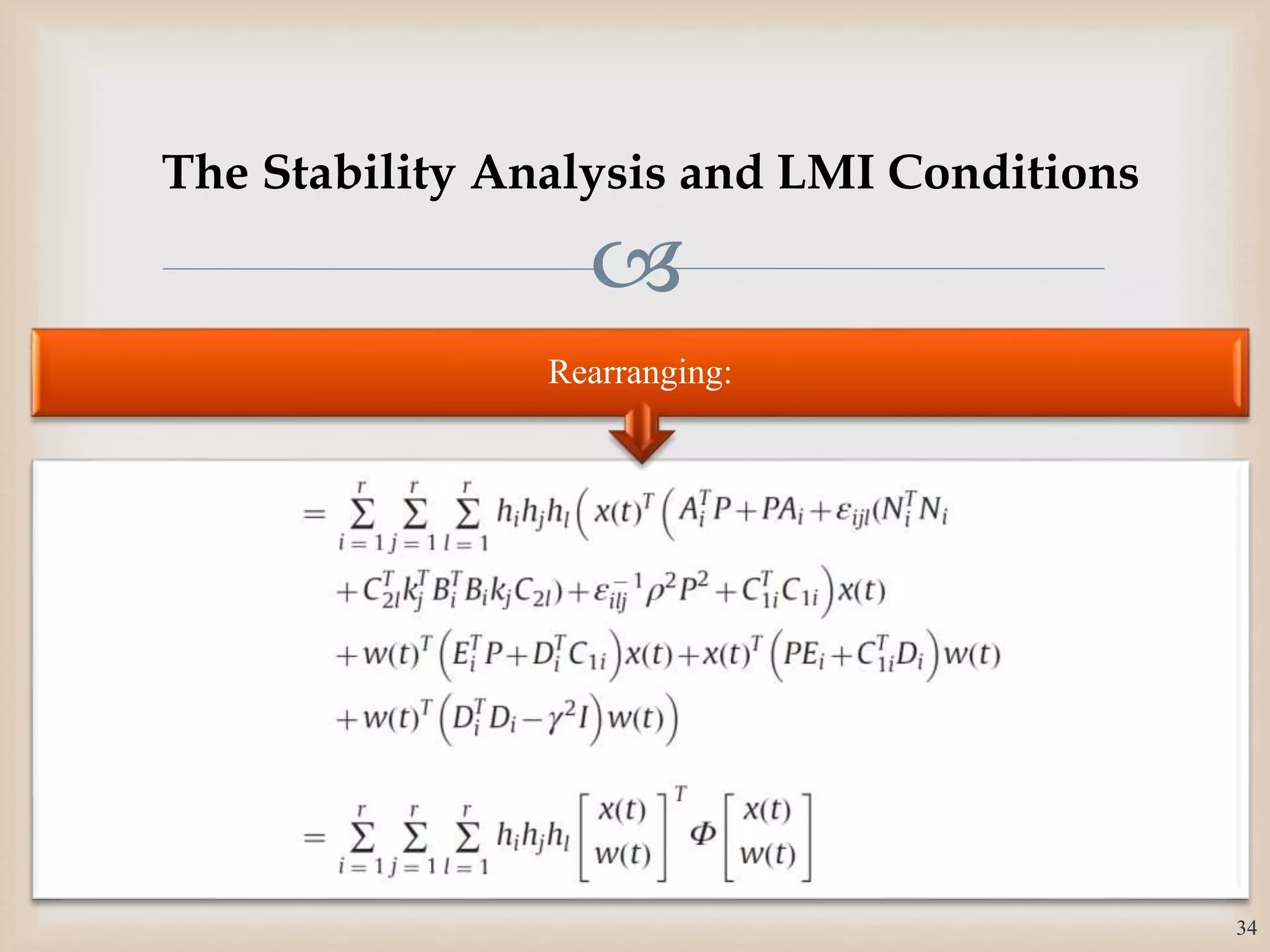
Rearranging:
31
The Stability Analysis and LMI Conditions

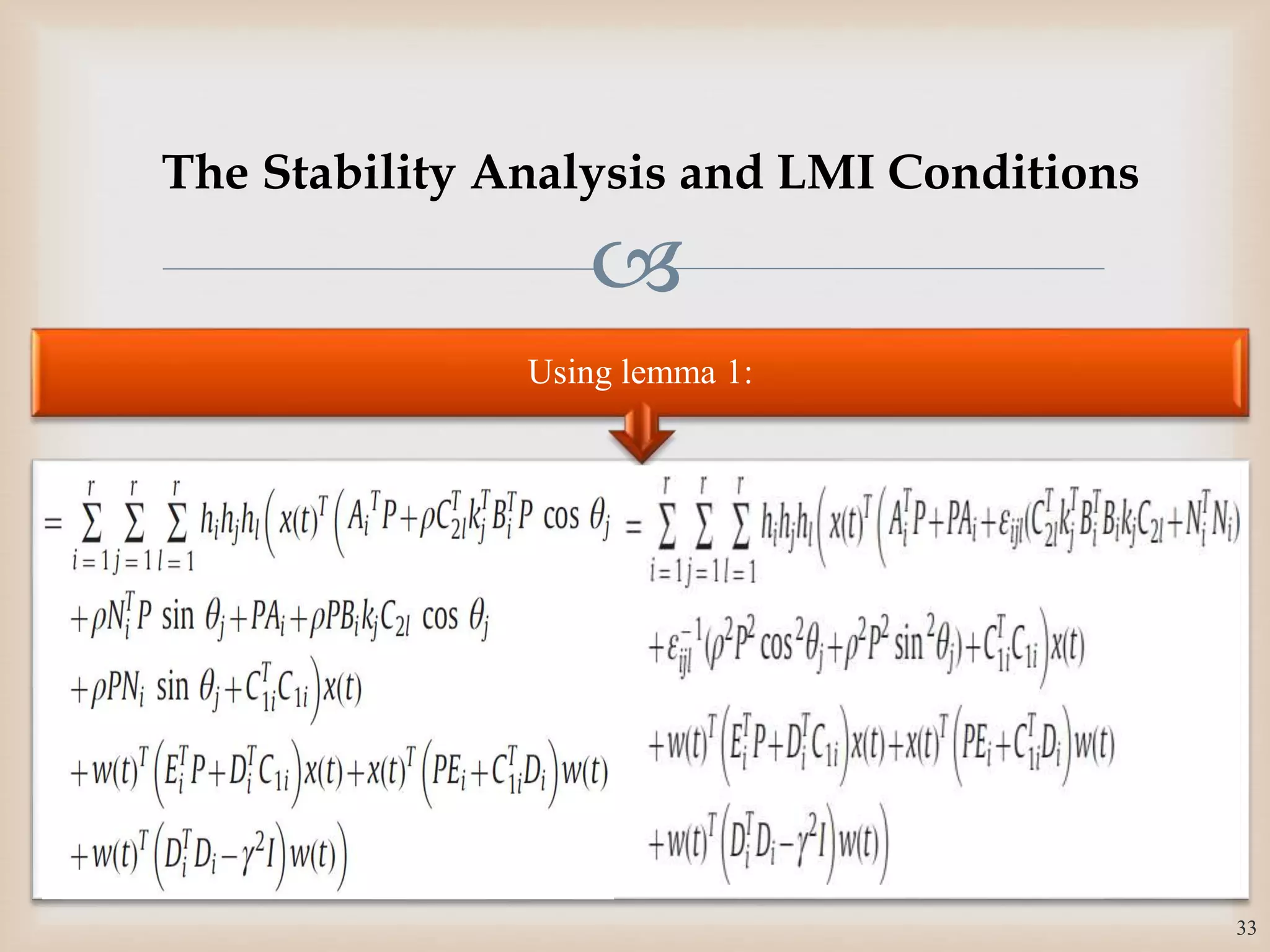
Lemma 1
For any two matrices 𝑿 and 𝒀 with appropriate dimensions, and 𝛆 > 𝟎, we
have:
𝑿 𝑻 𝒀 + 𝑿𝒀 𝑻 ≤ 𝜺𝑿 𝑻 𝑿 + 𝜺−𝟏 𝒀 𝑻 𝒀
32
The Stability Analysis and LMI Conditions

Using lemma 1:
33
The Stability Analysis and LMI Conditions

Rearranging:
34
The Stability Analysis and LMI Conditions

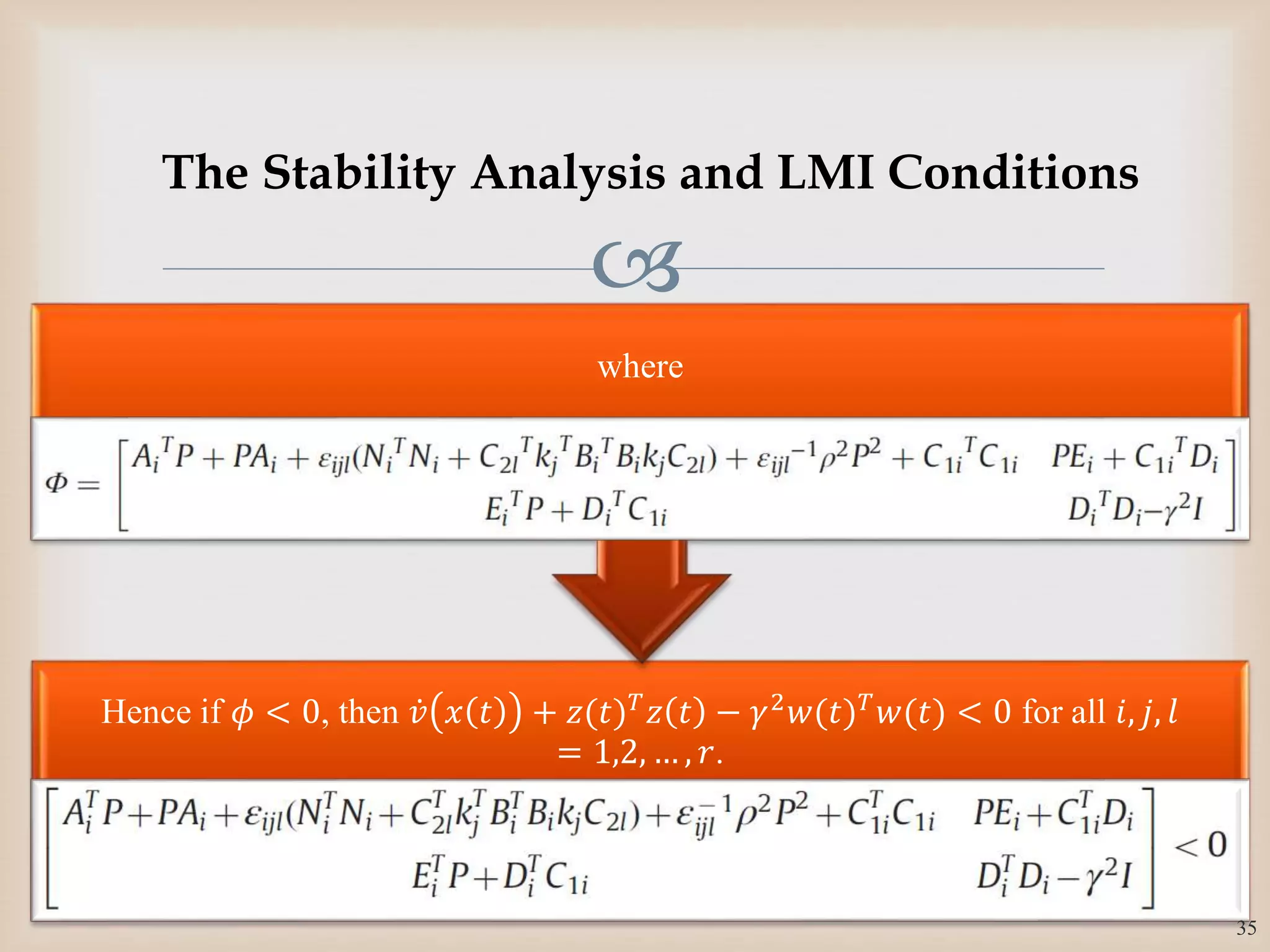
Hence if 𝜙 < 0, then 𝑣 𝑥 𝑡 + 𝑧(𝑡) 𝑇 𝑧 𝑡 − 𝛾2 𝑤(𝑡) 𝑇 𝑤(𝑡) < 0 for all 𝑖, 𝑗, 𝑙
= 1,2, … , 𝑟.
where
35
The Stability Analysis and LMI Conditions

The previous matrix inequality is quadratic matrix inequality (QMI).
The Schur complement is used to transform the QMI to LMI:
36
The Stability Analysis and LMI Conditions

The previous matrix inequality is bilinear matrix inequality (BMI),
because of the product of two terms 𝜌 and 𝑃 which is bilinear.
To transform to LMI, we define a new variable M = 𝜌𝑃:
37
The Stability Analysis and LMI Conditions

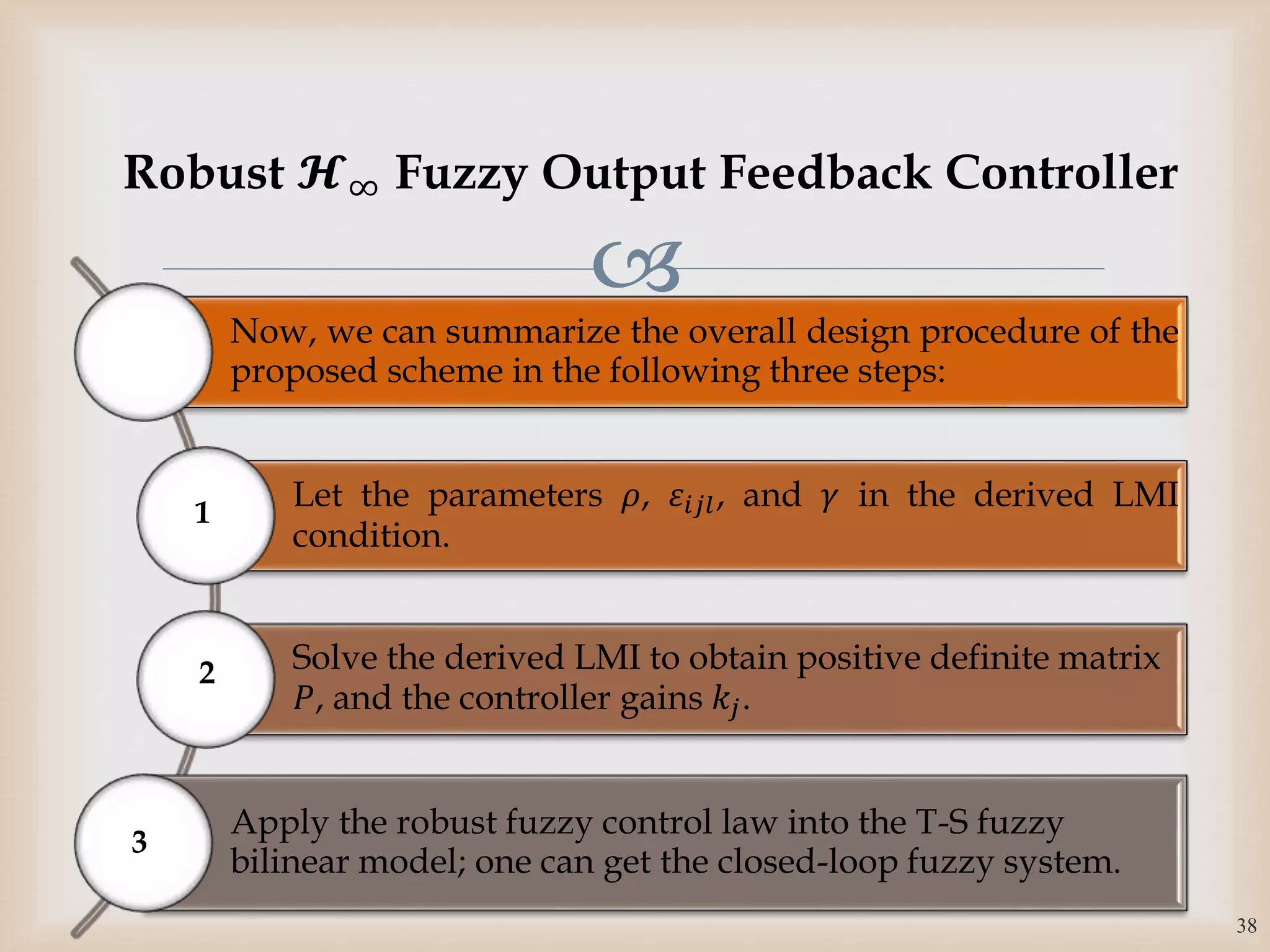
Now, we can summarize the overall design procedure of the
proposed scheme in the following three steps:
Let the parameters 𝜌, 𝜀𝑖𝑗𝑙, and 𝛾 in the derived LMI
condition.
Solve the derived LMI to obtain positive definite matrix
𝑃, and the controller gains 𝑘𝑗.
Apply the robust fuzzy control law into the T-S fuzzy
bilinear model; one can get the closed-loop fuzzy system.
2
38
Robust 𝓗∞ Fuzzy Output Feedback Controller
3
1

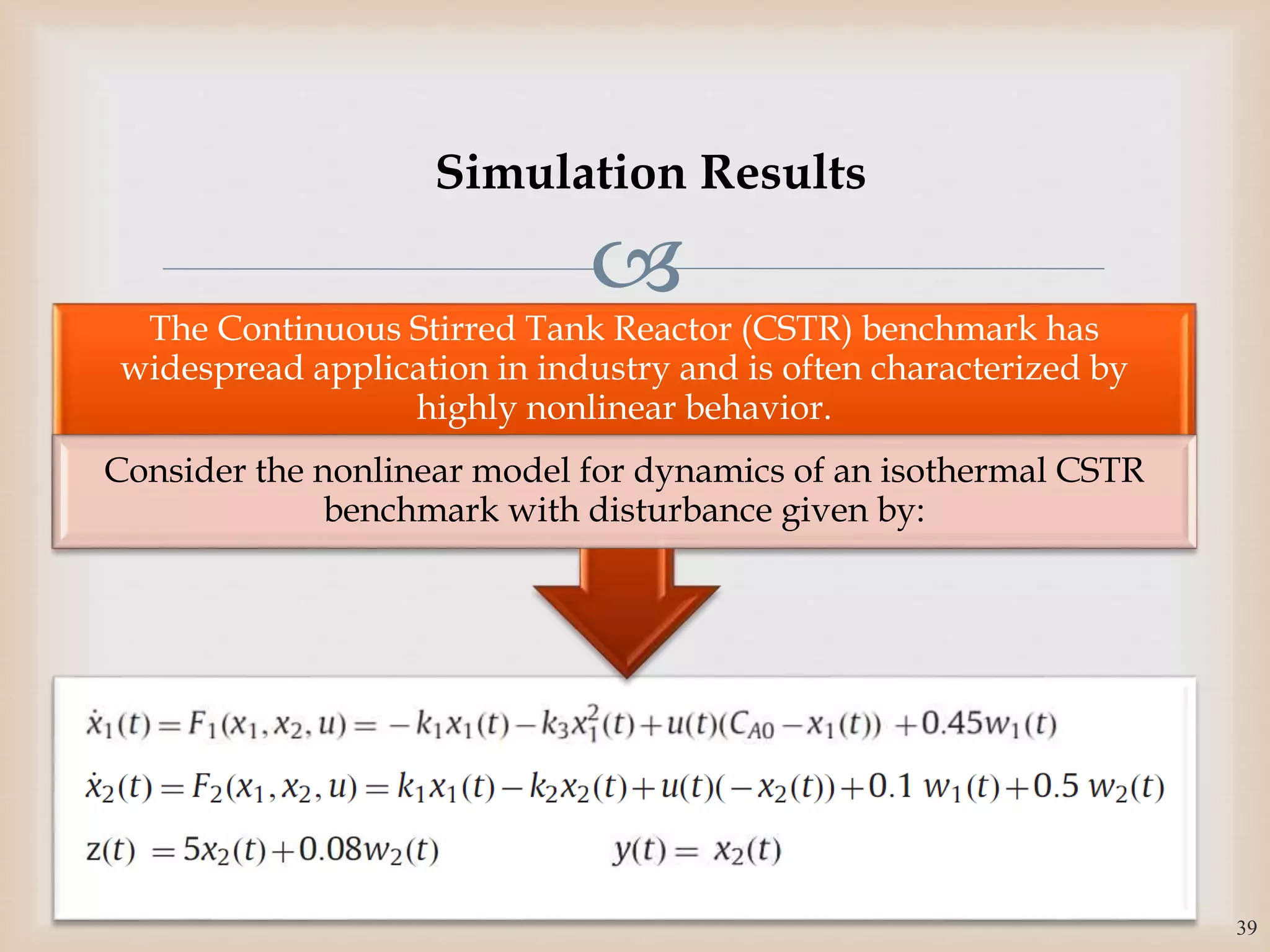
The Continuous Stirred Tank Reactor (CSTR) benchmark has
widespread application in industry and is often characterized by
highly nonlinear behavior.
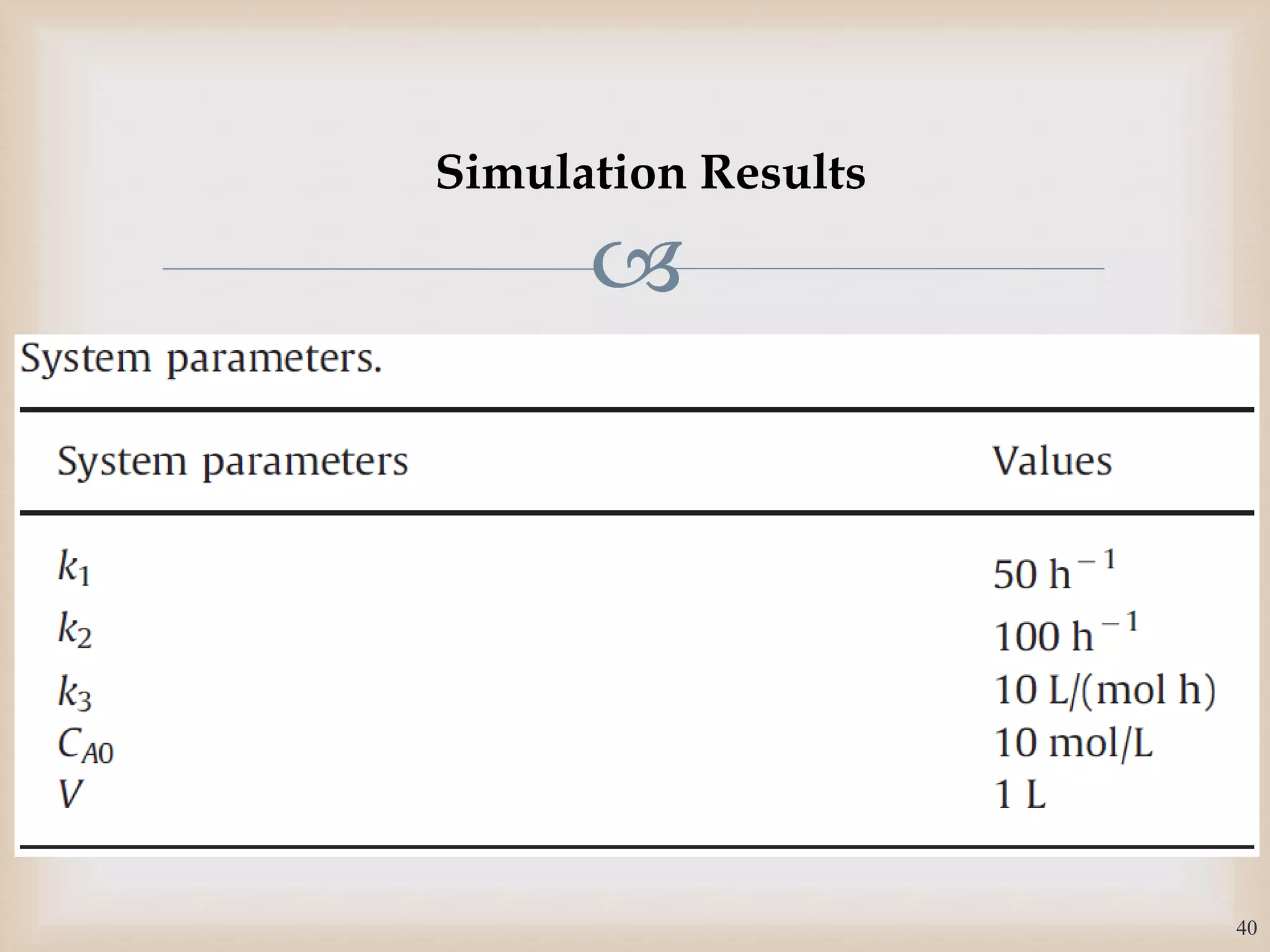
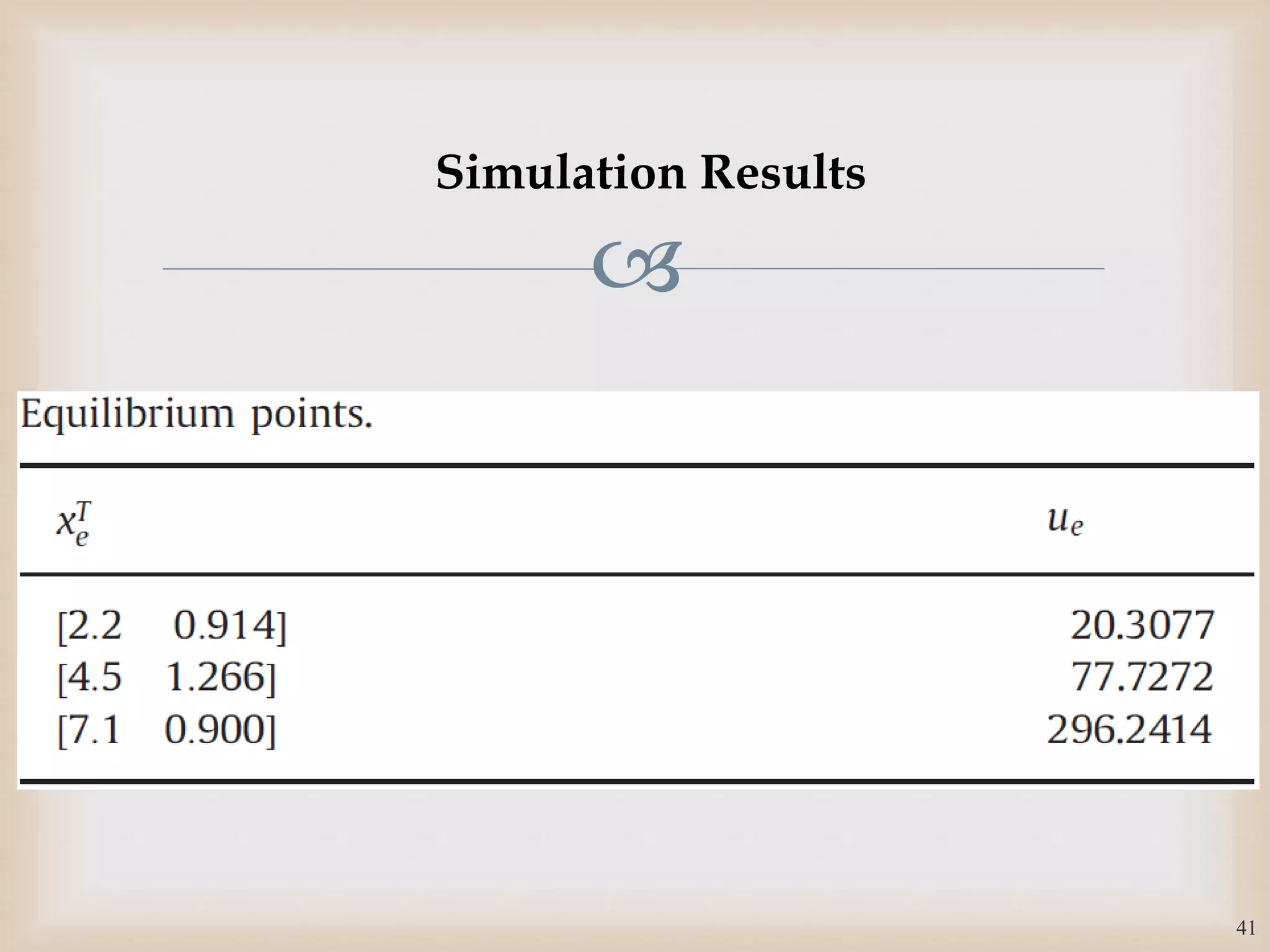
Consider the nonlinear model for dynamics of an isothermal CSTR
benchmark with disturbance given by:
39
Simulation Results

40
Simulation Results

41
Simulation Results

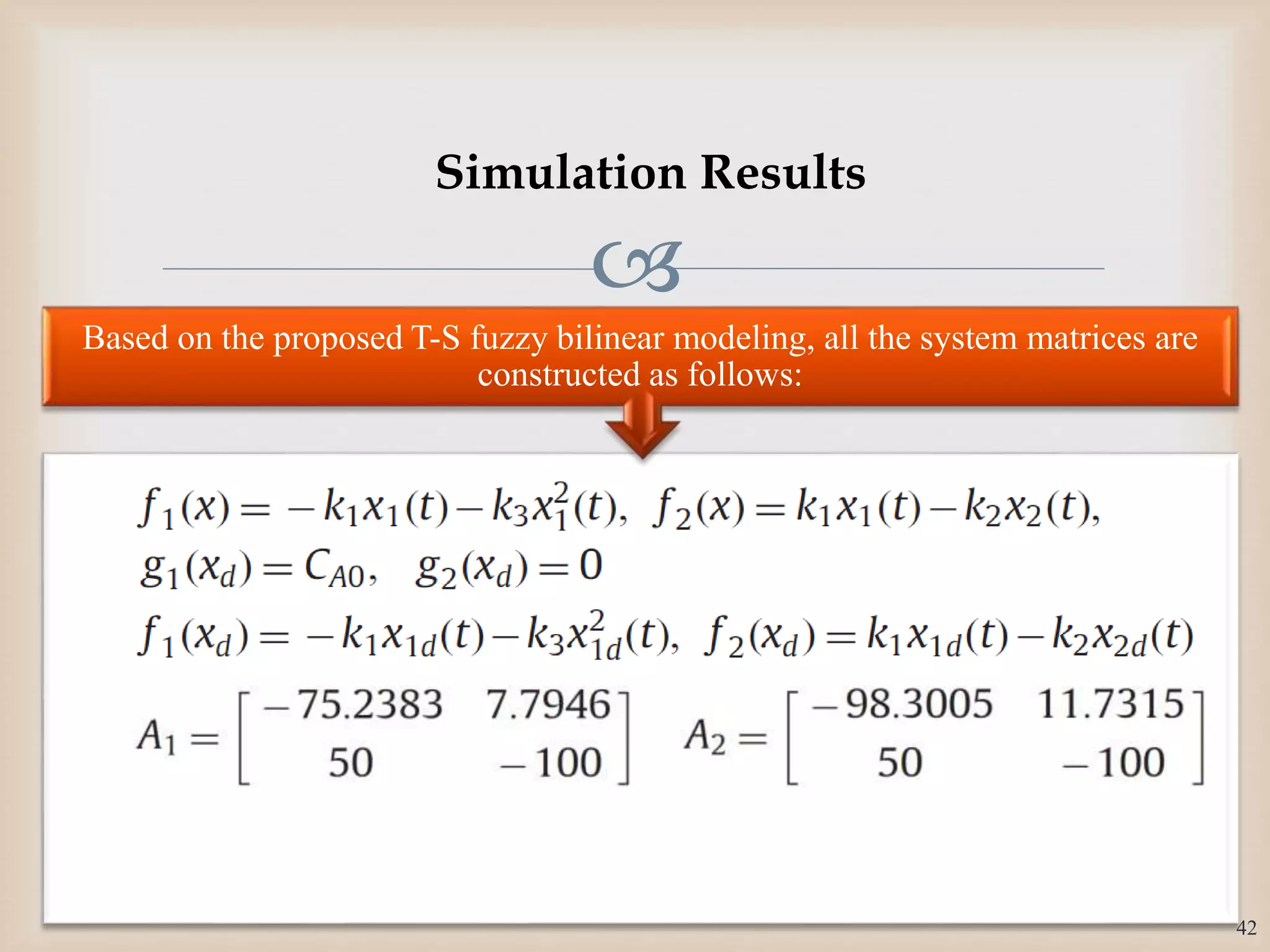
Based on the proposed T-S fuzzy bilinear modeling, all the system matrices are
constructed as follows:
42
Simulation Results

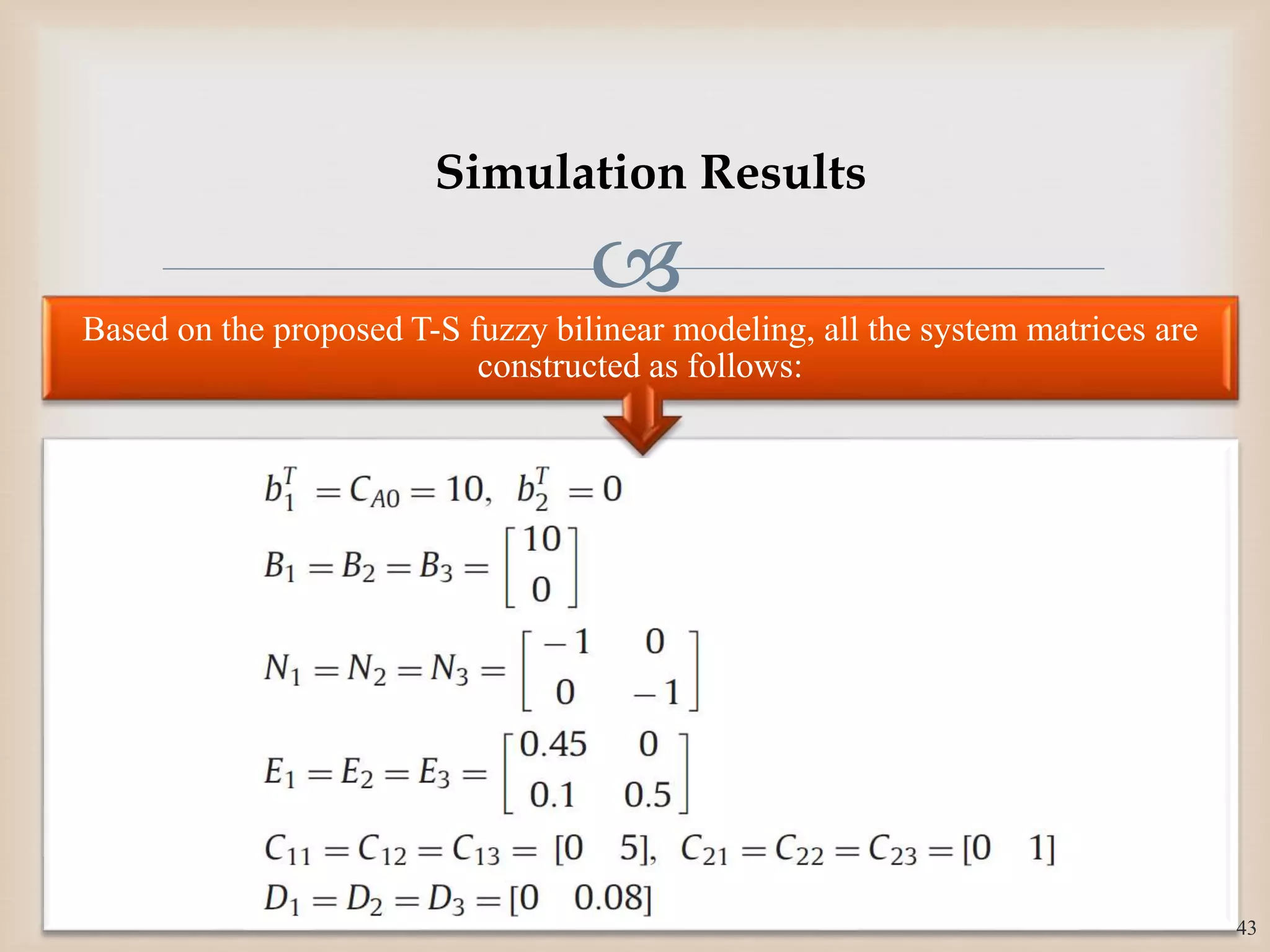
Based on the proposed T-S fuzzy bilinear modeling, all the system matrices are
constructed as follows:
43
Simulation Results
The proposed scheme design procedure is described in the
following steps:
Let the parameters 𝜌 = 0.1, 𝜀𝑖𝑗𝑙 = 1, and 𝛾 = 0.3 in the
LMI.
Solve the derived LMI, we obtain positive definite
matrix 𝑃 =
23.2530 −1.3946
−1.3946 19.2560
, and the controller
gains 𝑘1 = −4.3974, 𝑘2 = −5.5824, 𝑘3 = −5.1632.
Using all the data from the previous steps, we can
construct the fuzzy control law, and the initial condition is
chosen as 𝑥 0 = 3.1 1.5 𝑇.
2
44
3
1
Simulation Results

45
Simulation Results

46
Simulation Results

47
Simulation Results

48
Simulation Results

49
Simulation Results

50
Simulation Results

51
Simulation Results

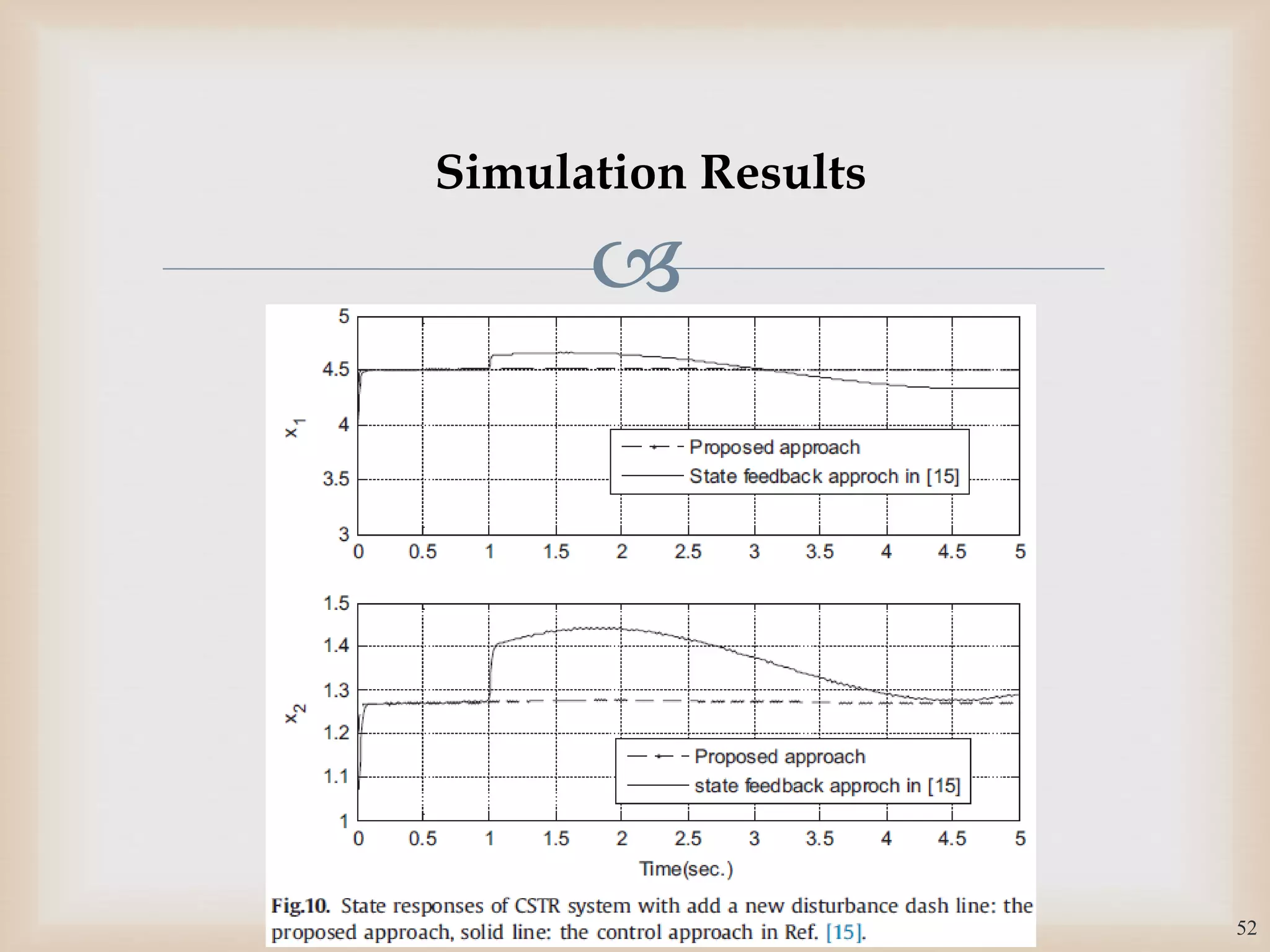
52
Simulation Results

References
1. M. Hamdy, I. Hamdan, “Robust Fuzzy Output Feedback Controller for
Affine Nonlinear Systems via T–S Fuzzy Bilinear Model: CSTR
Benchmarkˮ, 2015, ISA Transactions, In Press.
2. K. Tanaka, H. O. Wang, “Fuzzy Control Systems Design and Analysis
- A Linear Matrix Inequality Approachˮ, John Wiley & Sons, New
York, 2001.
3. T.H.S. Li, S.H. Tsai, “T-S Fuzzy Bilinear Model and Fuzzy Controller
Design for a Class Nonlinear Systemsˮ, 2007, IEEE Transactions on
Fuzzy Systems, 15(3), pp. 494-506.
4. M. Hamdy, I. Hamdan, “A New Calculation Method of Feedback
Controller Gain for Bilinear Paper-Making Process with Disturbanceˮ,
2014, J. Process Control, 24, pp. 1402-1411.
53

Robust Fuzzy Output Feedback Controller for Affine Nonlinear Systems via T–S Fuzzy Bilinear Model - CSTR Benchmark

  • 1.
    Robust Fuzzy OutputFeedback Controller for Affine Nonlinear Systems via T–S Fuzzy Bilinear Model: CSTR Benchmark By M. Hamdy, I. Hamdan Presentation by Mostafa Shokrian Zeini
  • 2.
     Important Questions: - Whatis a T-S fuzzy bilinear model? And why do we have to use bilinear model of systems? - How to design a robust fuzzy controller based on PDC for stabilizing the T-S fuzzy bilinear model with disturbance? - Why do we use an output feedback controller instead of a state feedback one? - What are the conditions on the control parameters and how to derive them? 2
  • 3.
     The T-S fuzzymodel is a popular adopted fuzzy model. - it has good capability to describe a nonlinear system. - it can accurately approximate the given nonlinear systems with fewer rules than other types of fuzzy models. Because 3 T-S Fuzzy Bilinear Model
  • 4.
     However • Most ofthe existing results focus on the stability analysis and synthesis based on T-S fuzzy model with linear local model. when a nonlinear system cannot be adequately approximated by linear model, but bilinear model, we have to use another modelling approach. 4 T-S Fuzzy Bilinear Model
  • 5.
     A bilinear systemis expressed as follows: 𝑥 = 𝐴𝑥 + 𝐵 + 𝑁𝑥 𝑢(𝑡) bilinear systems involve products of state and control. means that they are linear in state and linear in control, but not jointly linear in state and control. Obviously 5 T-S Fuzzy Bilinear Model Which
  • 6.
     Bilinear systems naturallyrepresent many physical and biological processes. a bilinear model can obviously represent the dynamics of a nonlinear system more accurately than a linear one. Also 6 T-S Fuzzy Bilinear Model
  • 7.
     Robust stabilization forcontinuous-time fuzzy bilinear system with disturbance Robust stabilization for continuous-time fuzzy bilinear system with time-delay only in the state Robust 𝓗∞ fuzzy control for a class of uncertain discrete fuzzy bilinear system Robust 𝓗∞ fuzzy control for a class of uncertain discrete fuzzy bilinear system with time-delay only in the state 7 T-S Fuzzy Bilinear Model and Fuzzy Controller Design
  • 8.
     All the resultswere obtained based on either state feedback controller or observer-based controller. 8 T-S Fuzzy Bilinear Model and Fuzzy Controller Design
  • 9.
     in many practicalcontrol problems, the physical state variable of systems is partially or fully unavailable for measurement Since the state variable is not accessible for sensing devices and transducers are not available or very expensive: 9 Output Feedback Controller
  • 10.
     In such cases,the scheme of output feedback controller is very important and must be used when the system states are not completely available for feedback. 10 Output Feedback Controller
  • 11.
     T-S Fuzzy BilinearModel The T-S fuzzy bilinear model has been constructed for approximating the behaviour nonlinear systems with disturbance in the neighborhood of the desired equilibrium or desired operating point 𝑥 𝑑. Consider a class of nonlinear system affine in the input variables: 𝑥 𝑡 = 𝑓 𝑥 𝑡 , 𝑢 𝑡 = 𝐹 𝑥 𝑡 + 𝐺 𝑥 𝑡 𝑢 𝑡 + 𝑁𝑥 𝑡 𝑢 𝑡 + 𝐸𝑤(𝑡) 11
  • 12.
     The following conditionshould be satisfied: 𝐹 𝑥 𝑡 + 𝐺 𝑥 𝑡 𝑢 𝑡 ≅ 𝐴𝑥 𝑡 + 𝐵𝑢(𝑡) 𝑥 𝑡 = 𝐴𝑥 𝑡 + 𝐵𝑢 𝑡 + 𝑁𝑥 𝑡 𝑢 𝑡 + 𝐸𝑤(𝑡) From above, the values of the matrices 𝑁 and 𝐸 are used as the same values. 12 T-S Fuzzy Bilinear Model 𝒙 𝒕 = 𝒇 𝒙 𝒕 , 𝒖 𝒕 = 𝑭 𝒙 𝒕 + 𝑮 𝒙 𝒕 𝒖 𝒕 + 𝑵𝒙 𝒕 𝒖 𝒕 + 𝑬𝒘(𝒕)
  • 13.
     Let 𝑎𝑖 𝑇 be the𝑖th row of the matrix 𝐴 and 𝑓𝑖 be the 𝑖th component of 𝐹: 𝑓𝑖 𝑥 𝑡 ≅ 𝑎𝑖 𝑇 𝑥 𝑡 , 𝑖 = 1,2, … , 𝑛 The matrix 𝐵 has been deduced as the same value from affine nonlinear system. The matrix 𝐴 has been changed in each desired equilibrium point. Thus, constant matrices 𝐴 and 𝐵 should be find such that in a neighborhood of 𝑥 𝑑: 𝐹 𝑥 = 𝐴𝑥 , 𝐹 𝑥 𝑑 = 𝐴𝑥 𝑑 ; 𝐺 𝑥 𝑢 𝑡 = 𝐵𝑢 𝑡 , 𝐺 𝑥 𝑑 = 𝐵 13 T-S Fuzzy Bilinear Model 𝒙 𝒕 = 𝒇 𝒙 𝒕 , 𝒖 𝒕 = 𝑭 𝒙 𝒕 + 𝑮 𝒙 𝒕 𝒖 𝒕 + 𝑵𝒙 𝒕 𝒖 𝒕 + 𝑬𝒘(𝒕) 𝒙 𝒕 = 𝑨𝒙 𝒕 + 𝑩𝒖 𝒕 + 𝑵𝒙 𝒕 𝒖 𝒕 + 𝑬𝒘(𝒕)
  • 14.
     From the aboveequations: 𝛻𝑥 𝑇 𝑓𝑖 𝑥 𝑑 ≅ 𝑎𝑖 𝑇 Expanding the left-hand side of 𝑓𝑖 𝑥 𝑡 ≅ 𝑎𝑖 𝑇 𝑥 𝑡 and neglecting h.o.t.: 𝑓𝑖 𝑥 𝑑 + 𝛻𝑥 𝑇 𝑓𝑖 𝑥 𝑑 (𝑥 − 𝑥 𝑑) ≅ 𝑎𝑖 𝑇 𝑥 𝑡 At the operating point: 𝑓𝑖 𝑥 𝑑 ≅ 𝑎𝑖 𝑇 𝑥 𝑑 , 𝑖 = 1,2, … , 𝑛 14 T-S Fuzzy Bilinear Model 𝒙 𝒕 = 𝒇 𝒙 𝒕 , 𝒖 𝒕 = 𝑭 𝒙 𝒕 + 𝑮 𝒙 𝒕 𝒖 𝒕 + 𝑵𝒙 𝒕 𝒖 𝒕 + 𝑬𝒘(𝒕) 𝒙 𝒕 = 𝑨𝒙 𝒕 + 𝑩𝒖 𝒕 + 𝑵𝒙 𝒕 𝒖 𝒕 + 𝑬𝒘(𝒕)
  • 15.
     𝜕𝐽 𝜕𝑎 𝑖 = 𝑎𝑖− 𝛻𝑥 𝑓𝑖 𝑥 𝑑 + 𝜆𝑥 𝑑 = 0 𝜕𝐽 𝜕𝜆 = 𝑎𝑖 𝑇 𝑥 𝑑 − 𝑓𝑖 𝑥 𝑑 = 0 One can reformulate the objective as a convex constrained optimization problem: 𝐽 = 1 2 𝛻𝑥 𝑓𝑖 𝑥 𝑑 − 𝑎𝑖 2 2 + 𝜆(𝑎𝑖 𝑇 𝑥 𝑑 − 𝑓𝑖 𝑥 𝑑 ) One should determine 𝑎𝑖 𝑇 such that 𝑥 𝑡 , 𝑢(𝑡) is “close to” 𝑥 𝑑 in the neighborhood of 𝑥 𝑑. Consider the following performance index: 𝐸 = 1 2 𝛻𝑥 𝑇 𝑓𝑖 𝑥 𝑑 − 𝑎𝑖 2 2 15 T-S Fuzzy Bilinear Model 𝒙 𝒕 = 𝒇 𝒙 𝒕 , 𝒖 𝒕 = 𝑭 𝒙 𝒕 + 𝑮 𝒙 𝒕 𝒖 𝒕 + 𝑵𝒙 𝒕 𝒖 𝒕 + 𝑬𝒘(𝒕) 𝒙 𝒕 = 𝑨𝒙 𝒕 + 𝑩𝒖 𝒕 + 𝑵𝒙 𝒕 𝒖 𝒕 + 𝑬𝒘(𝒕)
  • 16.
     Substituting 𝜆 into(∗): 𝑎𝑖 𝑇 = 𝛻𝑥 𝑇 𝑓𝑖 𝑥 𝑑 + 𝑓 𝑖 𝑥 𝑑 −𝛻 𝑥 𝑇 𝑓 𝑖 𝑥 𝑑 𝑥 𝑑 𝑥 𝑑 2 𝑥 𝑑 𝑇 Pre-multiplying (∗) by 𝑥 𝑑 𝑇 and substituting (∗∗) into the resulting equation yield: 𝜆 = 𝑥 𝑑 𝑇 𝛻 𝑥 𝑓 𝑖 𝑥 𝑑 −𝑥 𝑑 𝑇 𝑎 𝑖 𝑥 𝑑 2 = 𝑥 𝑑 𝑇 𝛻 𝑥 𝑓 𝑖 𝑥 𝑑 −𝑓𝑖 𝑇 𝑥 𝑑 𝑥 𝑑 2 𝜕𝐽 𝜕𝑎 𝑖 = 𝑎𝑖 − 𝛻𝑥 𝑓𝑖 𝑥 𝑑 + 𝜆𝑥 𝑑 = 0 (∗) 𝜕𝐽 𝜕𝜆 = 𝑎𝑖 𝑇 𝑥 𝑑 − 𝑓𝑖 𝑥 𝑑 = 0 (∗∗) 16 T-S Fuzzy Bilinear Model 𝒙 𝒕 = 𝒇 𝒙 𝒕 , 𝒖 𝒕 = 𝑭 𝒙 𝒕 + 𝑮 𝒙 𝒕 𝒖 𝒕 + 𝑵𝒙 𝒕 𝒖 𝒕 + 𝑬𝒘(𝒕) 𝒙 𝒕 = 𝑨𝒙 𝒕 + 𝑩𝒖 𝒕 + 𝑵𝒙 𝒕 𝒖 𝒕 + 𝑬𝒘(𝒕)
  • 17.
     This completes theconstruction of matrices 𝐴, 𝐵, 𝑁, and 𝐸 in each desired equilibrium point for T-S fuzzy bilinear model from affine nonlinear system with disturbance. 17 T-S Fuzzy Bilinear Model 𝒙 𝒕 = 𝒇 𝒙 𝒕 , 𝒖 𝒕 = 𝑭 𝒙 𝒕 + 𝑮 𝒙 𝒕 𝒖 𝒕 + 𝑵𝒙 𝒕 𝒖 𝒕 + 𝑬𝒘(𝒕) 𝒙 𝒕 = 𝑨𝒙 𝒕 + 𝑩𝒖 𝒕 + 𝑵𝒙 𝒕 𝒖 𝒕 + 𝑬𝒘(𝒕)
  • 18.
     Let’s derive theT-S fuzzy bilinear model: Plant rule i: IF 𝑠1 𝑡 is 𝑀1𝑖, and … … and 𝑠 𝑣 𝑡 is 𝑀𝑣𝑖 , THEN 18 T-S Fuzzy Bilinear Model
  • 19.
     By using singletonfuzzifier, product inference and center-average defuzzifier, then: the T-S fuzzy bilinear model is described by the following global model: 19 T-S Fuzzy Bilinear Model
  • 20.
  • 21.
     Control rule 𝑖: IF𝑠1 𝑡 is 𝑀1𝑖, and … … and 𝑠 𝑣 𝑡 is 𝑀𝑣𝑖 THEN 𝑢 𝑡 = 𝜌𝑘𝑖 𝑦(𝑡) 1 + (𝑘𝑖 𝑦(𝑡))2 The fuzzy controller is designed to stabilize the T-S fuzzy bilinear model with disturbances. The 𝑖th rule of the robust fuzzy output feedback controller: 21 Robust Fuzzy Controller Design Based on PDC
  • 22.
     The overall T-Sfuzzy controller can be formulated as follows: 22 Robust Fuzzy Controller Design Based on PDC
  • 23.
     𝜃𝑖 ∈ [− 𝜋 2 , 𝜋 2 ],𝑘𝑖 ∈ 𝑅 is a scalar to be determined by LMI conditions and 𝜌 > 0 is an arbitrary designed scalar, 𝑖 = 1,2, … , 𝑟. where 23 Robust Fuzzy Controller Design Based on PDC
  • 24.
     Rearranging the previousequation: The closed-loop fuzzy system: 24 Robust Fuzzy Controller Design Based on PDC
  • 25.
     We introduce thefollowing performance criterion with its control objectives: 𝐽 = 0 ∞ 𝑧(𝑡) 𝑇 𝑧 𝑡 − 𝛾2 𝑤(𝑡) 𝑇 𝑤(𝑡) 𝑑𝑡 When 𝑤 𝑡 = 0, the resulting of the closed-loop system is asymptotically stable. For 𝛾 > 0, and 𝑥 0 = 0, the controlled output 𝑧 𝑡 of the closed-loop system satisfies 𝑧(𝑡) 2 < 𝛾 𝑤(𝑡) 2 for all non- zero 𝑤 𝑡 ∈ 𝐿2[0, ∞]. i 25 Robust 𝓗∞ Fuzzy Output Feedback Controller ii
  • 26.
  • 27.
     The Stability Analysisand LMI Conditions The proposed control law should be designed such that to guarantee the asymptotic stability of the closed- loop system. The following stability analysis is carried out to determine the LMI conditions on control parameters. 27 So
  • 28.
     The time derivativeof 𝑣 𝑥 𝑡 becomes: 𝑣 𝑥 𝑡 = 𝑥 𝑡 𝑇 𝑃𝑥 𝑡 + 𝑥 𝑡 𝑇 𝑃 𝑥(𝑡) We consider the following Lyapunov function candidate: 𝑣 𝑥 𝑡 = 𝑥 𝑡 𝑇 𝑃𝑥(𝑡) 28 The Stability Analysis and LMI Conditions
  • 29.
     By substituting theclosed-loop system into the previous equation: 29 The Stability Analysis and LMI Conditions
  • 30.
     The 𝓗∞ performancelevel implies that: 30 The Stability Analysis and LMI Conditions
  • 31.
  • 32.
     Lemma 1 For anytwo matrices 𝑿 and 𝒀 with appropriate dimensions, and 𝛆 > 𝟎, we have: 𝑿 𝑻 𝒀 + 𝑿𝒀 𝑻 ≤ 𝜺𝑿 𝑻 𝑿 + 𝜺−𝟏 𝒀 𝑻 𝒀 32 The Stability Analysis and LMI Conditions
  • 33.
     Using lemma 1: 33 TheStability Analysis and LMI Conditions
  • 34.
  • 35.
     Hence if 𝜙< 0, then 𝑣 𝑥 𝑡 + 𝑧(𝑡) 𝑇 𝑧 𝑡 − 𝛾2 𝑤(𝑡) 𝑇 𝑤(𝑡) < 0 for all 𝑖, 𝑗, 𝑙 = 1,2, … , 𝑟. where 35 The Stability Analysis and LMI Conditions
  • 36.
     The previous matrixinequality is quadratic matrix inequality (QMI). The Schur complement is used to transform the QMI to LMI: 36 The Stability Analysis and LMI Conditions
  • 37.
     The previous matrixinequality is bilinear matrix inequality (BMI), because of the product of two terms 𝜌 and 𝑃 which is bilinear. To transform to LMI, we define a new variable M = 𝜌𝑃: 37 The Stability Analysis and LMI Conditions
  • 38.
     Now, we cansummarize the overall design procedure of the proposed scheme in the following three steps: Let the parameters 𝜌, 𝜀𝑖𝑗𝑙, and 𝛾 in the derived LMI condition. Solve the derived LMI to obtain positive definite matrix 𝑃, and the controller gains 𝑘𝑗. Apply the robust fuzzy control law into the T-S fuzzy bilinear model; one can get the closed-loop fuzzy system. 2 38 Robust 𝓗∞ Fuzzy Output Feedback Controller 3 1
  • 39.
     The Continuous StirredTank Reactor (CSTR) benchmark has widespread application in industry and is often characterized by highly nonlinear behavior. Consider the nonlinear model for dynamics of an isothermal CSTR benchmark with disturbance given by: 39 Simulation Results
  • 40.
  • 41.
  • 42.
     Based on theproposed T-S fuzzy bilinear modeling, all the system matrices are constructed as follows: 42 Simulation Results
  • 43.
     Based on theproposed T-S fuzzy bilinear modeling, all the system matrices are constructed as follows: 43 Simulation Results
  • 44.
    The proposed schemedesign procedure is described in the following steps: Let the parameters 𝜌 = 0.1, 𝜀𝑖𝑗𝑙 = 1, and 𝛾 = 0.3 in the LMI. Solve the derived LMI, we obtain positive definite matrix 𝑃 = 23.2530 −1.3946 −1.3946 19.2560 , and the controller gains 𝑘1 = −4.3974, 𝑘2 = −5.5824, 𝑘3 = −5.1632. Using all the data from the previous steps, we can construct the fuzzy control law, and the initial condition is chosen as 𝑥 0 = 3.1 1.5 𝑇. 2 44 3 1 Simulation Results
  • 45.
  • 46.
  • 47.
  • 48.
  • 49.
  • 50.
  • 51.
  • 52.
  • 53.
     References 1. M. Hamdy,I. Hamdan, “Robust Fuzzy Output Feedback Controller for Affine Nonlinear Systems via T–S Fuzzy Bilinear Model: CSTR Benchmarkˮ, 2015, ISA Transactions, In Press. 2. K. Tanaka, H. O. Wang, “Fuzzy Control Systems Design and Analysis - A Linear Matrix Inequality Approachˮ, John Wiley & Sons, New York, 2001. 3. T.H.S. Li, S.H. Tsai, “T-S Fuzzy Bilinear Model and Fuzzy Controller Design for a Class Nonlinear Systemsˮ, 2007, IEEE Transactions on Fuzzy Systems, 15(3), pp. 494-506. 4. M. Hamdy, I. Hamdan, “A New Calculation Method of Feedback Controller Gain for Bilinear Paper-Making Process with Disturbanceˮ, 2014, J. Process Control, 24, pp. 1402-1411. 53