International Research Journal of Engineering and Technology (IRJET) e-ISSN: 2395-0056
Volume: 05 Issue: 03 | Mar-2018 www.irjet.net p-ISSN: 2395-0072
© 2018, IRJET | Impact Factor value: 6.171 | ISO 9001:2008 Certified Journal | Page 1787
EXPLOSIVE ORDINANACE DISPOSAL ROBOT
Preeti C. Patil1, Shraddha A. Zore2, Mayur V. Narayane3
123Department Of Electronics Engineering, Dr Babasaheb Ambedkar College of Engineering and Research,
Wanadongri, Nagpur,441110
---------------------------------------------------------------------***---------------------------------------------------------------------
Abstract - This paper presents the wireless bomb disposal
robot which will help to improve defence of our nation from
terrorist, suicide bombers and other such activities. Wireless
control of robots is becoming popular and so are mobile
handsets. In this paper we describe the control of arobotusing
an Android mobile. We use Bluetooth as the wireless interface
between the mobile and the robot. The robot that we have
designed is guided by controls that take input from a human
and perform certain actions based on these inputs. We have
designed it in certain way that it can serve the purpose of an
explosive detection kit or device keeping in focus certain
constituents that the explosive is made up of. The central idea
behind this robot is to provide a line of defence to a bomb
disposal squad against the life-threatening risk, facedbythem
in the event of an explosion. It provides the squad a safe
distance to dispose a bomb, which he normally has to do with
his bare hands.
Key Words: Android Mobile, Bluetooth module, DC
motor, Detection sensors, Android application, Wi-Fi
Camera.
1.INTRODUCTION
The word robot was derived from Czech word robata which
means “a forced labourer” then later a well-known Russian
science fiction writer Isaac Asimov coinedthewordrobotics.
From there on various developments are being successfully
done till date in the field of robotics in the form of
manipulators, humanoids, micro robots etc. as the trend of
the industry is moving from the current state of automation
to robotization. Thus, the robot technology is advancing
rapidly. The robot that we have made is a command control
robot which takes the input from the user and performs the
required action. We have used sensors that can detect
certain constituents of the explosive so that a separate
detection device is not required. We have also used a Wi-Fi
based wireless camera for visual feedback. Thus, we have
designed this robot as an assistant to the bomb disposal
squads.
1.1 Goals
The main goal of the project is to provide safety to the bomb
disposal squad by providing an extra line of defence.
1.2 Objectives
· Provide a user-friendly androidmonitoring andcontrolling
application for analysis of a suspicious packet (or bomb).
· Allow the user to manipulate the packet using the robotic
arm.
· To provide visual feedback from the site of the packet.
· To provide an on-board detection mechanism.
2. BLOCK DIAGRAM
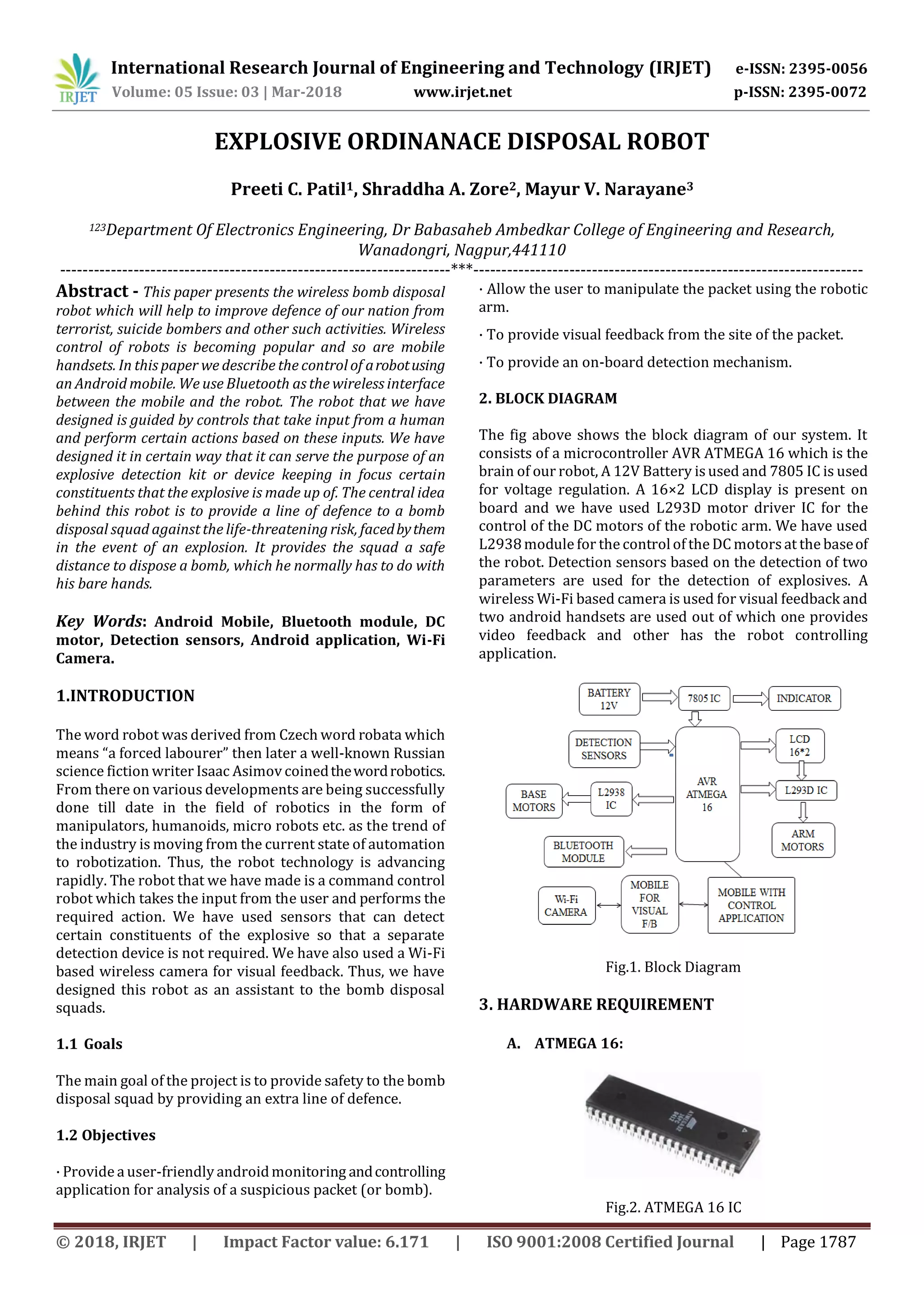
The fig above shows the block diagram of our system. It
consists of a microcontroller AVR ATMEGA 16 which is the
brain of our robot, A 12V Battery is used and 7805 IC is used
for voltage regulation. A 16×2 LCD display is present on
board and we have used L293D motor driver IC for the
control of the DC motors of the robotic arm. We have used
L2938module for the controlof the DC motorsat the baseof
the robot. Detection sensors based on the detection of two
parameters are used for the detection of explosives. A
wireless Wi-Fi based camera is used for visual feedback and
two android handsets are used out of which one provides
video feedback and other has the robot controlling
application.
Fig.1. Block Diagram
3. HARDWARE REQUIREMENT
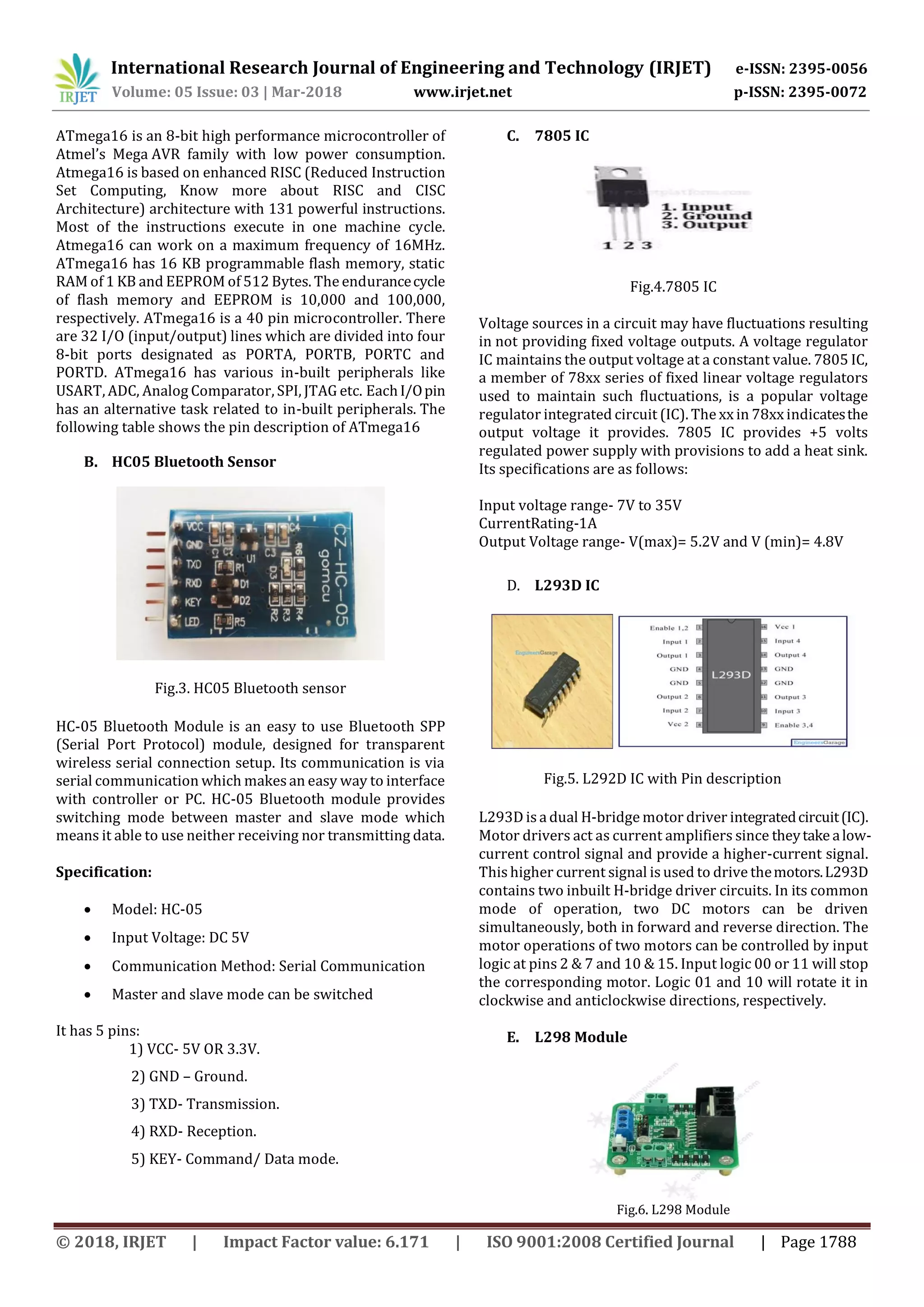
A. ATMEGA 16:
Fig.2. ATMEGA 16 IC
International Research Journal of Engineering and Technology (IRJET) e-ISSN: 2395-0056
Volume: 05 Issue: 03 | Mar-2018 www.irjet.net p-ISSN: 2395-0072
© 2018, IRJET | Impact Factor value: 6.171 | ISO 9001:2008 Certified Journal | Page 1788
ATmega16 is an 8-bit high performance microcontroller of
Atmel’s Mega AVR family with low power consumption.
Atmega16 is based on enhanced RISC (Reduced Instruction
Set Computing, Know more about RISC and CISC
Architecture) architecture with 131 powerful instructions.
Most of the instructions execute in one machine cycle.
Atmega16 can work on a maximum frequency of 16MHz.
ATmega16 has 16 KB programmable flash memory, static
RAM of 1 KB and EEPROM of 512 Bytes. The endurancecycle
of flash memory and EEPROM is 10,000 and 100,000,
respectively. ATmega16 is a 40 pin microcontroller. There
are 32 I/O (input/output) lines which are divided into four
8-bit ports designated as PORTA, PORTB, PORTC and
PORTD. ATmega16 has various in-built peripherals like
USART, ADC, Analog Comparator, SPI, JTAG etc. EachI/Opin
has an alternative task related to in-built peripherals. The
following table shows the pin description of ATmega16
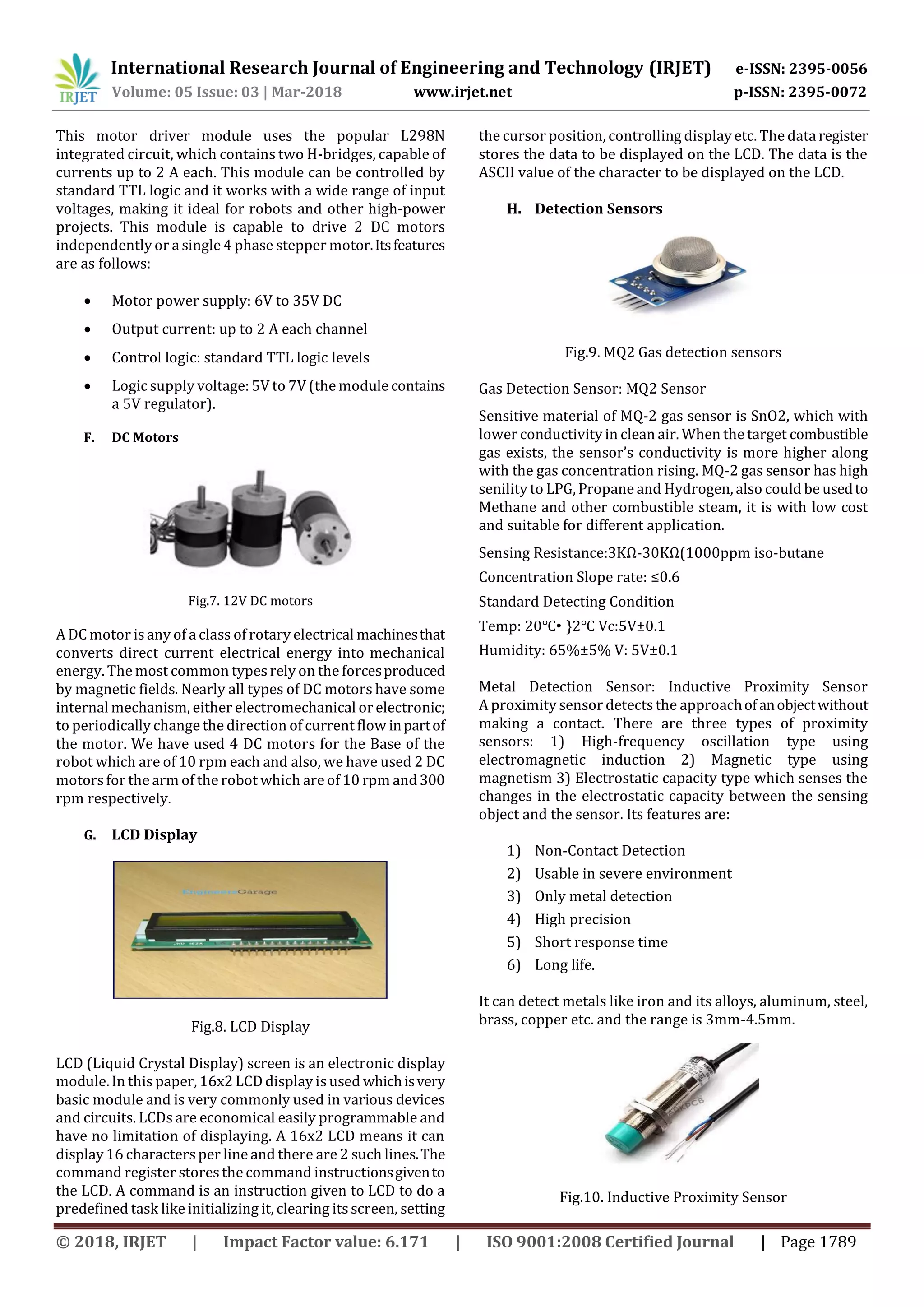
B. HC05 Bluetooth Sensor
Fig.3. HC05 Bluetooth sensor
HC-05 Bluetooth Module is an easy to use Bluetooth SPP
(Serial Port Protocol) module, designed for transparent
wireless serial connection setup. Its communication is via
serial communication which makesan easy way to interface
with controller or PC. HC-05 Bluetooth module provides
switching mode between master and slave mode which
means it able to use neither receiving nor transmitting data.
Specification:
 Model: HC-05
 Input Voltage: DC 5V
 Communication Method: Serial Communication
 Master and slave mode can be switched
It has 5 pins:
1) VCC- 5V OR 3.3V.
2) GND – Ground.
3) TXD- Transmission.
4) RXD- Reception.
5) KEY- Command/ Data mode.
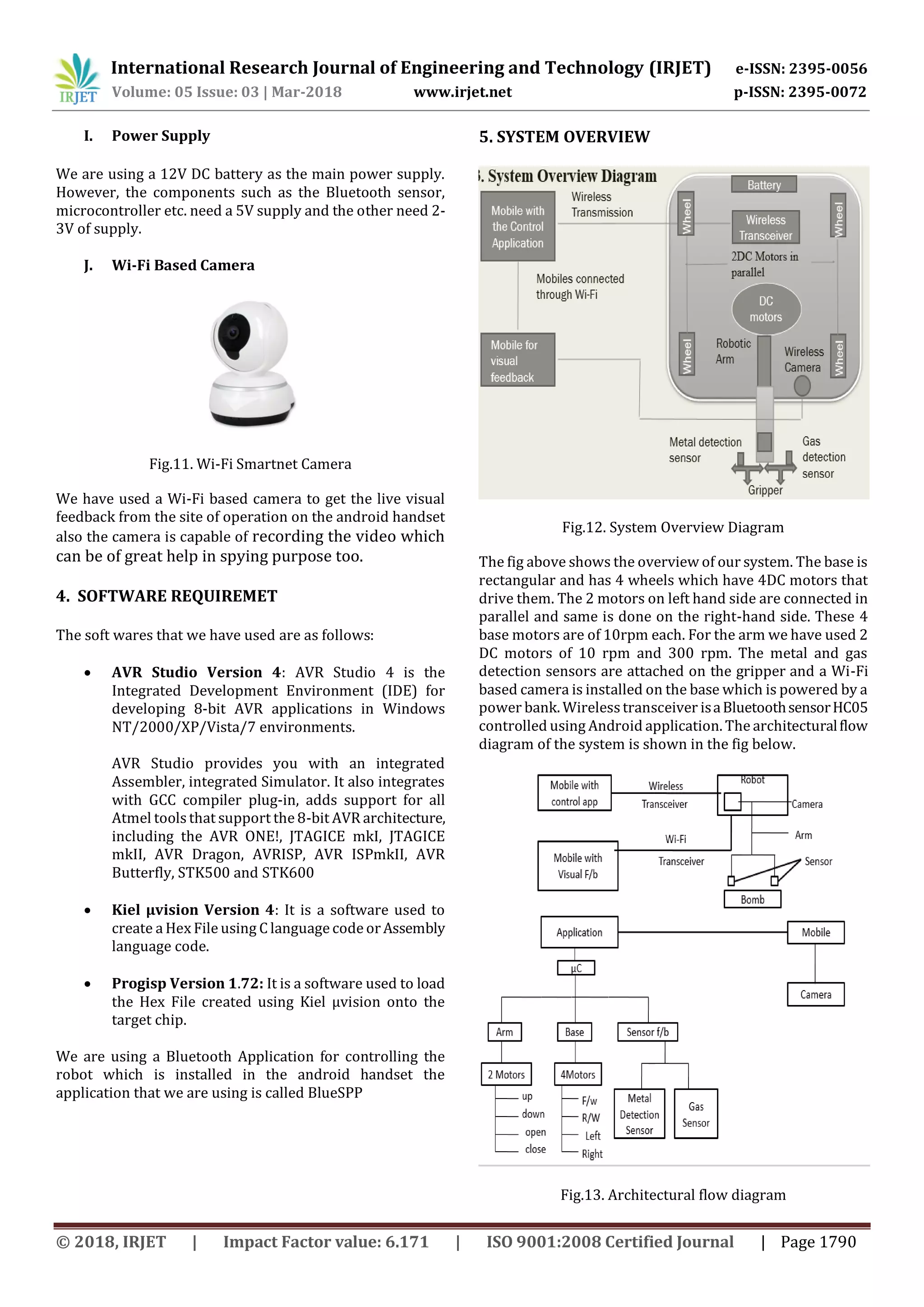
C. 7805 IC
Fig.4.7805 IC
Voltage sources in a circuit may have fluctuations resulting
in not providing fixed voltage outputs. A voltage regulator
IC maintains the output voltage at a constant value. 7805 IC,
a member of 78xx series of fixed linear voltage regulators
used to maintain such fluctuations, is a popular voltage
regulator integrated circuit (IC). The xx in 78xx indicatesthe
output voltage it provides. 7805 IC provides +5 volts
regulated power supply with provisions to add a heat sink.
Its specifications are as follows:
Input voltage range- 7V to 35V
CurrentRating-1A
Output Voltage range- V(max)= 5.2V and V (min)= 4.8V
D. L293D IC
E. L298 Module
Fig.6. L298 Module
Fig.5. L292D IC with Pin description
L293D is a dual H-bridge motor driver integratedcircuit(IC).
Motor drivers act as current amplifiers since theytake alow-
current control signal and provide a higher-current signal.
This higher current signal is used to drive themotors.L293D
contains two inbuilt H-bridge driver circuits. In its common
mode of operation, two DC motors can be driven
simultaneously, both in forward and reverse direction. The
motor operations of two motors can be controlled by input
logic at pins 2 & 7 and 10 & 15. Input logic 00 or 11 will stop
the corresponding motor. Logic 01 and 10 will rotate it in
clockwise and anticlockwise directions, respectively.
International Research Journal of Engineering and Technology (IRJET) e-ISSN: 2395-0056
Volume: 05 Issue: 03 | Mar-2018 www.irjet.net p-ISSN: 2395-0072
© 2018, IRJET | Impact Factor value: 6.171 | ISO 9001:2008 Certified Journal | Page 1789
This motor driver module uses the popular L298N
integrated circuit, which contains two H-bridges, capable of
currents up to 2 A each. This module can be controlled by
standard TTL logic and it works with a wide range of input
voltages, making it ideal for robots and other high-power
projects. This module is capable to drive 2 DC motors
independently or a single 4 phase stepper motor.Itsfeatures
are as follows:
 Motor power supply: 6V to 35V DC
 Output current: up to 2 A each channel
 Control logic: standard TTL logic levels
 Logic supply voltage: 5V to 7V (the module contains
a 5V regulator).
F. DC Motors
Fig.7. 12V DC motors
A DC motor is any of a class of rotary electrical machinesthat
converts direct current electrical energy into mechanical
energy. The most common types rely on the forcesproduced
by magnetic fields. Nearly all types of DC motors have some
internal mechanism, either electromechanical orelectronic;
to periodically change the direction of current flow inpartof
the motor. We have used 4 DC motors for the Base of the
robot which are of 10 rpm each and also, we have used 2 DC
motors for the arm of the robot which are of 10 rpm and300
rpm respectively.
G. LCD Display
Fig.8. LCD Display
LCD (Liquid Crystal Display) screen is an electronic display
module. In this paper, 16x2 LCD display is used whichisvery
basic module and is very commonly used in various devices
and circuits. LCDs are economical easily programmable and
have no limitation of displaying. A 16x2 LCD means it can
display 16 characters per line and there are 2 such lines.The
command register stores the command instructionsgivento
the LCD. A command is an instruction given to LCD to do a
predefined task like initializing it, clearing its screen, setting
the cursor position, controlling display etc. The data register
stores the data to be displayed on the LCD. The data is the
ASCII value of the character to be displayed on the LCD.
H. Detection Sensors
Fig.9. MQ2 Gas detection sensors
Gas Detection Sensor: MQ2 Sensor
Sensitive material of MQ-2 gas sensor is SnO2, which with
lower conductivity in clean air. When the target combustible
gas exists, the sensor’s conductivity is more higher along
with the gas concentration rising. MQ-2 gas sensor has high
senility to LPG, Propane and Hydrogen, also could be usedto
Methane and other combustible steam, it is with low cost
and suitable for different application.
Sensing Resistance:3KΩ-30KΩ(1000ppm iso-butane
Concentration Slope rate: ≤0.6
Standard Detecting Condition
Temp: 20℃•}2℃ Vc:5V±0.1
Humidity: 65%±5% V: 5V±0.1
Metal Detection Sensor: Inductive Proximity Sensor
A proximity sensor detects the approachofanobjectwithout
making a contact. There are three types of proximity
sensors: 1) High-frequency oscillation type using
electromagnetic induction 2) Magnetic type using
magnetism 3) Electrostatic capacity type which senses the
changes in the electrostatic capacity between the sensing
object and the sensor. Its features are:
1) Non-Contact Detection
2) Usable in severe environment
3) Only metal detection
4) High precision
5) Short response time
6) Long life.
It can detect metals like iron and its alloys, aluminum, steel,
brass, copper etc. and the range is 3mm-4.5mm.
Fig.10. Inductive Proximity Sensor
International Research Journal of Engineering and Technology (IRJET) e-ISSN: 2395-0056
Volume: 05 Issue: 03 | Mar-2018 www.irjet.net p-ISSN: 2395-0072
© 2018, IRJET | Impact Factor value: 6.171 | ISO 9001:2008 Certified Journal | Page 1790
I. Power Supply
We are using a 12V DC battery as the main power supply.
However, the components such as the Bluetooth sensor,
microcontroller etc. need a 5V supply and the other need 2-
3V of supply.
J. Wi-Fi Based Camera
Fig.11. Wi-Fi Smartnet Camera
We have used a Wi-Fi based camera to get the live visual
feedback from the site of operation on the android handset
also the camera is capable of recording the video which
can be of great help in spying purpose too.
4. SOFTWARE REQUIREMET
The soft wares that we have used are as follows:
 AVR Studio Version 4: AVR Studio 4 is the
Integrated Development Environment (IDE) for
developing 8-bit AVR applications in Windows
NT/2000/XP/Vista/7 environments.
AVR Studio provides you with an integrated
Assembler, integrated Simulator. It also integrates
with GCC compiler plug-in, adds support for all
Atmel tools that support the 8-bit AVR architecture,
including the AVR ONE!, JTAGICE mkI, JTAGICE
mkII, AVR Dragon, AVRISP, AVR ISPmkII, AVR
Butterfly, STK500 and STK600
 Kiel µvision Version 4: It is a software used to
create a Hex File using C language code orAssembly
language code.
 Progisp Version 1.72: It is a software used to load
the Hex File created using Kiel µvision onto the
target chip.
We are using a Bluetooth Application for controlling the
robot which is installed in the android handset the
application that we are using is called BlueSPP
5. SYSTEM OVERVIEW
Fig.12. System Overview Diagram
The fig above shows the overview of our system. The base is
rectangular and has 4 wheels which have 4DC motors that
drive them. The 2 motors on left hand side are connected in
parallel and same is done on the right-hand side. These 4
base motors are of 10rpm each. For the arm we have used 2
DC motors of 10 rpm and 300 rpm. The metal and gas
detection sensors are attached on the gripper and a Wi-Fi
based camera is installed on the base which is powered by a
power bank. Wirelesstransceiver isaBluetoothsensorHC05
controlled using Android application. The architecturalflow
diagram of the system is shown in the fig below.
Fig.13. Architectural flow diagram
International Research Journal of Engineering and Technology (IRJET) e-ISSN: 2395-0056
Volume: 05 Issue: 03 | Mar-2018 www.irjet.net p-ISSN: 2395-0072
© 2018, IRJET | Impact Factor value: 6.171 | ISO 9001:2008 Certified Journal | Page 1791
6. DESIGNING STEPS & WORKING
1. Designing: The steps involved in designing the
overall system is shown as below:
Fig.14. Designing Steps
2. Working: When the robot reaches the bomb site it
first analyses the suspicious packet. The sensors
attached on the gripper of the robotic arm detect
whether an explosive is present or not. Whenever an
explosive is detected the sensors give signal to the
buzzer and it blows. This signal can be viewed
through camera and further action towardsdisposing
the explosive can be taken. The working is shown in
the fig below.
Fig.15.Working
7. RESULT
In this way, we have implemented a robotic bomb disposal
system wireless controlled by an android device. We have
controlled the various movements of robot as well as bomb
disposal system by sending different commands from
android device through Bluetooth model. We have used
metal detection and gas detection sensors considering in
mind the detection of those explosives that are made up of
typical gases or those which give out or release some gases
as well as those explosives which use ferrous metals in
packaging or are made up of metals such as iron, copper etc.
The results can be seen in Fig.
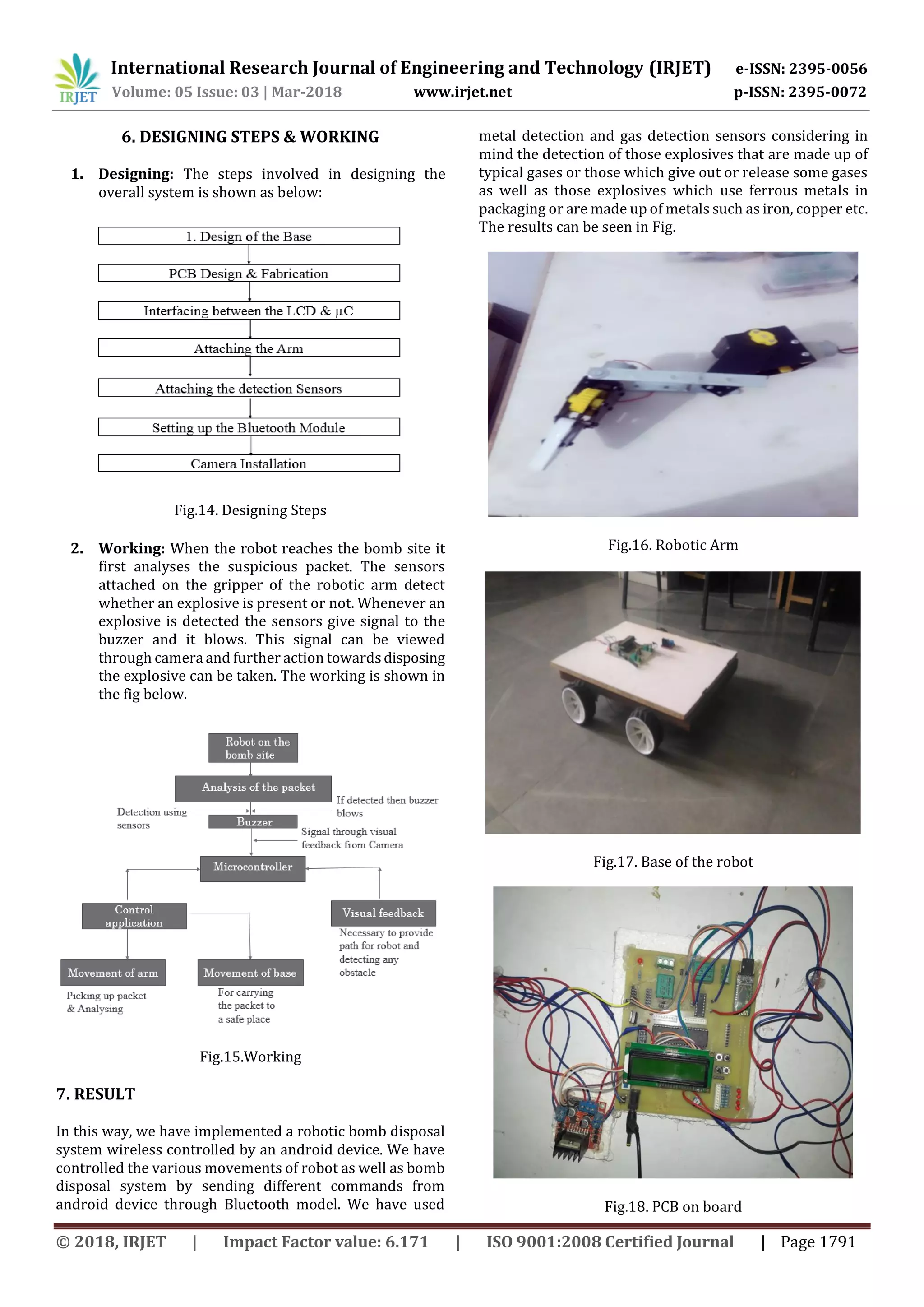
Fig.16. Robotic Arm
Fig.17. Base of the robot
Fig.18. PCB on board
International Research Journal of Engineering and Technology (IRJET) e-ISSN: 2395-0056
Volume: 05 Issue: 03 | Mar-2018 www.irjet.net p-ISSN: 2395-0072
© 2018, IRJET | Impact Factor value: 6.171 | ISO 9001:2008 Certified Journal | Page 1792
Fig.19. Complete view of the EOD
8. CONCLUSION
The Wireless Bomb Disposal Robot has been designed in
such a way that it can cater to the needsof the bombdisposal
squad, the military, the police and also forthepersonnelwho
handle radioactive materials. It has countless applications
and can be used in different environmentsandscenarios.For
instance, at one place it can be used by the bomb disposal
squad, while at another instance it can be used for handling
mines. While another application is to provide up to date
information in a hostage situation. The major advantages of
this robot are:
· It can be altered to suit the needs of the user
· It can be controlled remotely.
· It has video feedback.
· It has its own power supply.
· It has a detection mechanism using sensor hencenoneedof
separate detection mechanism.
9. ACKNOWLEDGEMENT
We are deeply indebted, and we would like to express our
sincere thanks to our project guides Mrs. Pradnya Morey
mam and Dr. S N Nagtode for providing usan opportunity to
do this work. Our special gratitude to Prof. Mrs. M.R. Patil
(HOD, Department of ElectronicsEngineering, DBACER.)for
her guidance, constant encouragement and whole-hearted
support. Finally, I would liketo expressmy sincere thanksto
all the staff members of EN Department for their valuable
guidance & support.
10. APPLICATIONS
We will design it as an assistant robot to the bomb disposal
squad but there are several other applications of this robot.
It can be used by:
 Police: In hostage situations
 Military: For reconnaissance missions
 Fire Fighters: To provide video feedback of the site
for further analysis.
 Nuclear fighters: For handling hazardous or
radioactive materials.
11. FUTURE SCOPE
The system that we have built is a working prototype of a
robot, which should be compact, fast and accurate. This
prototype may not have the features and reliability of the
original design. It is only being developed to ensure that the
design is feasible, not impractical and can be implemented
on a much larger scale in a more efficient way.
Hence the future enhancementsmay includeamuchsmaller,
faster, and more reliable machine. It may have the ability to
handle a much wider range of objects and the ability to
manoeuvre them to much safer places. Some of these
enhancements are described below.
· Compact Design
· Quick Movement
· Improved Reliability
· Removable Gripper/Multi-Gripper Robotic Arm
· Artificial Intelligence
· Night Vision Camera
12. REFERENCES
1). Shamyl bin Mansoor [1] Department of Computer
Engineering, Sir Syed University of Engineering and
Technology, Karachi, IEEE conference on “Wireless bomb
disposal robot” volume: 11 [2]
2). Jackrin Suthkorn from Department of Mechanical
Engineering, Johns HopkinsUniversity,Baltimore,Maryland,
IEEE conference on “Automatic Self-replicating robotic
system” volume:6
3). Mr. Ranjeet P. Rajmane1, Miss. Yogita Y. Patil2, Miss.
Shital K. Supugade3 E&TC Department DACOE, KARAD.
International Journal of Advanced Research in Electronics
and Communication Engineering (IJARECE) Volume 5, Issue
3.
4). Matthew W. Carey (RBE/ECE), Eric M. Kurtz (RBE),
Joshua D. Matte (ME), Timothy D. Perrault (RBE), Worcester
Polytechnic Institute. Novel EOD Robot Design with a
Dexterous Gripper and Intuitive Teleoperation
5). Tse TIJ Dept. of Mech. Eng., Nat. Cheng Kung University.,
Tainan, Taiwan Hsu, Ms. Lin, R.X. IEEE conference on
“Development of a mobile robot for visually guidedhandling
of material” volume:3.
6). Robotics by James L. Fuller Published by: Prentice Hall
Publication.
7). 1 Shinde Pushpa, 2 Davane Rahul., 3 Patil Poonam.
Department of Electronics and telecommunication Anna
Saheb Dange College of Engineering and Technology, Ashta
Wireless Bomb Disposal Robot, International Research
Journal of Engineering and Technology (IRJET)e-ISSN:2395
-0056 Volume: 03 Issue: 04.

IRJET- Explosive Ordinanace Disposal Robot

  • 1.
    International Research Journalof Engineering and Technology (IRJET) e-ISSN: 2395-0056 Volume: 05 Issue: 03 | Mar-2018 www.irjet.net p-ISSN: 2395-0072 © 2018, IRJET | Impact Factor value: 6.171 | ISO 9001:2008 Certified Journal | Page 1787 EXPLOSIVE ORDINANACE DISPOSAL ROBOT Preeti C. Patil1, Shraddha A. Zore2, Mayur V. Narayane3 123Department Of Electronics Engineering, Dr Babasaheb Ambedkar College of Engineering and Research, Wanadongri, Nagpur,441110 ---------------------------------------------------------------------***--------------------------------------------------------------------- Abstract - This paper presents the wireless bomb disposal robot which will help to improve defence of our nation from terrorist, suicide bombers and other such activities. Wireless control of robots is becoming popular and so are mobile handsets. In this paper we describe the control of arobotusing an Android mobile. We use Bluetooth as the wireless interface between the mobile and the robot. The robot that we have designed is guided by controls that take input from a human and perform certain actions based on these inputs. We have designed it in certain way that it can serve the purpose of an explosive detection kit or device keeping in focus certain constituents that the explosive is made up of. The central idea behind this robot is to provide a line of defence to a bomb disposal squad against the life-threatening risk, facedbythem in the event of an explosion. It provides the squad a safe distance to dispose a bomb, which he normally has to do with his bare hands. Key Words: Android Mobile, Bluetooth module, DC motor, Detection sensors, Android application, Wi-Fi Camera. 1.INTRODUCTION The word robot was derived from Czech word robata which means “a forced labourer” then later a well-known Russian science fiction writer Isaac Asimov coinedthewordrobotics. From there on various developments are being successfully done till date in the field of robotics in the form of manipulators, humanoids, micro robots etc. as the trend of the industry is moving from the current state of automation to robotization. Thus, the robot technology is advancing rapidly. The robot that we have made is a command control robot which takes the input from the user and performs the required action. We have used sensors that can detect certain constituents of the explosive so that a separate detection device is not required. We have also used a Wi-Fi based wireless camera for visual feedback. Thus, we have designed this robot as an assistant to the bomb disposal squads. 1.1 Goals The main goal of the project is to provide safety to the bomb disposal squad by providing an extra line of defence. 1.2 Objectives · Provide a user-friendly androidmonitoring andcontrolling application for analysis of a suspicious packet (or bomb). · Allow the user to manipulate the packet using the robotic arm. · To provide visual feedback from the site of the packet. · To provide an on-board detection mechanism. 2. BLOCK DIAGRAM The fig above shows the block diagram of our system. It consists of a microcontroller AVR ATMEGA 16 which is the brain of our robot, A 12V Battery is used and 7805 IC is used for voltage regulation. A 16×2 LCD display is present on board and we have used L293D motor driver IC for the control of the DC motors of the robotic arm. We have used L2938module for the controlof the DC motorsat the baseof the robot. Detection sensors based on the detection of two parameters are used for the detection of explosives. A wireless Wi-Fi based camera is used for visual feedback and two android handsets are used out of which one provides video feedback and other has the robot controlling application. Fig.1. Block Diagram 3. HARDWARE REQUIREMENT A. ATMEGA 16: Fig.2. ATMEGA 16 IC
  • 2.
    International Research Journalof Engineering and Technology (IRJET) e-ISSN: 2395-0056 Volume: 05 Issue: 03 | Mar-2018 www.irjet.net p-ISSN: 2395-0072 © 2018, IRJET | Impact Factor value: 6.171 | ISO 9001:2008 Certified Journal | Page 1788 ATmega16 is an 8-bit high performance microcontroller of Atmel’s Mega AVR family with low power consumption. Atmega16 is based on enhanced RISC (Reduced Instruction Set Computing, Know more about RISC and CISC Architecture) architecture with 131 powerful instructions. Most of the instructions execute in one machine cycle. Atmega16 can work on a maximum frequency of 16MHz. ATmega16 has 16 KB programmable flash memory, static RAM of 1 KB and EEPROM of 512 Bytes. The endurancecycle of flash memory and EEPROM is 10,000 and 100,000, respectively. ATmega16 is a 40 pin microcontroller. There are 32 I/O (input/output) lines which are divided into four 8-bit ports designated as PORTA, PORTB, PORTC and PORTD. ATmega16 has various in-built peripherals like USART, ADC, Analog Comparator, SPI, JTAG etc. EachI/Opin has an alternative task related to in-built peripherals. The following table shows the pin description of ATmega16 B. HC05 Bluetooth Sensor Fig.3. HC05 Bluetooth sensor HC-05 Bluetooth Module is an easy to use Bluetooth SPP (Serial Port Protocol) module, designed for transparent wireless serial connection setup. Its communication is via serial communication which makesan easy way to interface with controller or PC. HC-05 Bluetooth module provides switching mode between master and slave mode which means it able to use neither receiving nor transmitting data. Specification:  Model: HC-05  Input Voltage: DC 5V  Communication Method: Serial Communication  Master and slave mode can be switched It has 5 pins: 1) VCC- 5V OR 3.3V. 2) GND – Ground. 3) TXD- Transmission. 4) RXD- Reception. 5) KEY- Command/ Data mode. C. 7805 IC Fig.4.7805 IC Voltage sources in a circuit may have fluctuations resulting in not providing fixed voltage outputs. A voltage regulator IC maintains the output voltage at a constant value. 7805 IC, a member of 78xx series of fixed linear voltage regulators used to maintain such fluctuations, is a popular voltage regulator integrated circuit (IC). The xx in 78xx indicatesthe output voltage it provides. 7805 IC provides +5 volts regulated power supply with provisions to add a heat sink. Its specifications are as follows: Input voltage range- 7V to 35V CurrentRating-1A Output Voltage range- V(max)= 5.2V and V (min)= 4.8V D. L293D IC E. L298 Module Fig.6. L298 Module Fig.5. L292D IC with Pin description L293D is a dual H-bridge motor driver integratedcircuit(IC). Motor drivers act as current amplifiers since theytake alow- current control signal and provide a higher-current signal. This higher current signal is used to drive themotors.L293D contains two inbuilt H-bridge driver circuits. In its common mode of operation, two DC motors can be driven simultaneously, both in forward and reverse direction. The motor operations of two motors can be controlled by input logic at pins 2 & 7 and 10 & 15. Input logic 00 or 11 will stop the corresponding motor. Logic 01 and 10 will rotate it in clockwise and anticlockwise directions, respectively.
  • 3.
    International Research Journalof Engineering and Technology (IRJET) e-ISSN: 2395-0056 Volume: 05 Issue: 03 | Mar-2018 www.irjet.net p-ISSN: 2395-0072 © 2018, IRJET | Impact Factor value: 6.171 | ISO 9001:2008 Certified Journal | Page 1789 This motor driver module uses the popular L298N integrated circuit, which contains two H-bridges, capable of currents up to 2 A each. This module can be controlled by standard TTL logic and it works with a wide range of input voltages, making it ideal for robots and other high-power projects. This module is capable to drive 2 DC motors independently or a single 4 phase stepper motor.Itsfeatures are as follows:  Motor power supply: 6V to 35V DC  Output current: up to 2 A each channel  Control logic: standard TTL logic levels  Logic supply voltage: 5V to 7V (the module contains a 5V regulator). F. DC Motors Fig.7. 12V DC motors A DC motor is any of a class of rotary electrical machinesthat converts direct current electrical energy into mechanical energy. The most common types rely on the forcesproduced by magnetic fields. Nearly all types of DC motors have some internal mechanism, either electromechanical orelectronic; to periodically change the direction of current flow inpartof the motor. We have used 4 DC motors for the Base of the robot which are of 10 rpm each and also, we have used 2 DC motors for the arm of the robot which are of 10 rpm and300 rpm respectively. G. LCD Display Fig.8. LCD Display LCD (Liquid Crystal Display) screen is an electronic display module. In this paper, 16x2 LCD display is used whichisvery basic module and is very commonly used in various devices and circuits. LCDs are economical easily programmable and have no limitation of displaying. A 16x2 LCD means it can display 16 characters per line and there are 2 such lines.The command register stores the command instructionsgivento the LCD. A command is an instruction given to LCD to do a predefined task like initializing it, clearing its screen, setting the cursor position, controlling display etc. The data register stores the data to be displayed on the LCD. The data is the ASCII value of the character to be displayed on the LCD. H. Detection Sensors Fig.9. MQ2 Gas detection sensors Gas Detection Sensor: MQ2 Sensor Sensitive material of MQ-2 gas sensor is SnO2, which with lower conductivity in clean air. When the target combustible gas exists, the sensor’s conductivity is more higher along with the gas concentration rising. MQ-2 gas sensor has high senility to LPG, Propane and Hydrogen, also could be usedto Methane and other combustible steam, it is with low cost and suitable for different application. Sensing Resistance:3KΩ-30KΩ(1000ppm iso-butane Concentration Slope rate: ≤0.6 Standard Detecting Condition Temp: 20℃•}2℃ Vc:5V±0.1 Humidity: 65%±5% V: 5V±0.1 Metal Detection Sensor: Inductive Proximity Sensor A proximity sensor detects the approachofanobjectwithout making a contact. There are three types of proximity sensors: 1) High-frequency oscillation type using electromagnetic induction 2) Magnetic type using magnetism 3) Electrostatic capacity type which senses the changes in the electrostatic capacity between the sensing object and the sensor. Its features are: 1) Non-Contact Detection 2) Usable in severe environment 3) Only metal detection 4) High precision 5) Short response time 6) Long life. It can detect metals like iron and its alloys, aluminum, steel, brass, copper etc. and the range is 3mm-4.5mm. Fig.10. Inductive Proximity Sensor
  • 4.
    International Research Journalof Engineering and Technology (IRJET) e-ISSN: 2395-0056 Volume: 05 Issue: 03 | Mar-2018 www.irjet.net p-ISSN: 2395-0072 © 2018, IRJET | Impact Factor value: 6.171 | ISO 9001:2008 Certified Journal | Page 1790 I. Power Supply We are using a 12V DC battery as the main power supply. However, the components such as the Bluetooth sensor, microcontroller etc. need a 5V supply and the other need 2- 3V of supply. J. Wi-Fi Based Camera Fig.11. Wi-Fi Smartnet Camera We have used a Wi-Fi based camera to get the live visual feedback from the site of operation on the android handset also the camera is capable of recording the video which can be of great help in spying purpose too. 4. SOFTWARE REQUIREMET The soft wares that we have used are as follows:  AVR Studio Version 4: AVR Studio 4 is the Integrated Development Environment (IDE) for developing 8-bit AVR applications in Windows NT/2000/XP/Vista/7 environments. AVR Studio provides you with an integrated Assembler, integrated Simulator. It also integrates with GCC compiler plug-in, adds support for all Atmel tools that support the 8-bit AVR architecture, including the AVR ONE!, JTAGICE mkI, JTAGICE mkII, AVR Dragon, AVRISP, AVR ISPmkII, AVR Butterfly, STK500 and STK600  Kiel µvision Version 4: It is a software used to create a Hex File using C language code orAssembly language code.  Progisp Version 1.72: It is a software used to load the Hex File created using Kiel µvision onto the target chip. We are using a Bluetooth Application for controlling the robot which is installed in the android handset the application that we are using is called BlueSPP 5. SYSTEM OVERVIEW Fig.12. System Overview Diagram The fig above shows the overview of our system. The base is rectangular and has 4 wheels which have 4DC motors that drive them. The 2 motors on left hand side are connected in parallel and same is done on the right-hand side. These 4 base motors are of 10rpm each. For the arm we have used 2 DC motors of 10 rpm and 300 rpm. The metal and gas detection sensors are attached on the gripper and a Wi-Fi based camera is installed on the base which is powered by a power bank. Wirelesstransceiver isaBluetoothsensorHC05 controlled using Android application. The architecturalflow diagram of the system is shown in the fig below. Fig.13. Architectural flow diagram
  • 5.
    International Research Journalof Engineering and Technology (IRJET) e-ISSN: 2395-0056 Volume: 05 Issue: 03 | Mar-2018 www.irjet.net p-ISSN: 2395-0072 © 2018, IRJET | Impact Factor value: 6.171 | ISO 9001:2008 Certified Journal | Page 1791 6. DESIGNING STEPS & WORKING 1. Designing: The steps involved in designing the overall system is shown as below: Fig.14. Designing Steps 2. Working: When the robot reaches the bomb site it first analyses the suspicious packet. The sensors attached on the gripper of the robotic arm detect whether an explosive is present or not. Whenever an explosive is detected the sensors give signal to the buzzer and it blows. This signal can be viewed through camera and further action towardsdisposing the explosive can be taken. The working is shown in the fig below. Fig.15.Working 7. RESULT In this way, we have implemented a robotic bomb disposal system wireless controlled by an android device. We have controlled the various movements of robot as well as bomb disposal system by sending different commands from android device through Bluetooth model. We have used metal detection and gas detection sensors considering in mind the detection of those explosives that are made up of typical gases or those which give out or release some gases as well as those explosives which use ferrous metals in packaging or are made up of metals such as iron, copper etc. The results can be seen in Fig. Fig.16. Robotic Arm Fig.17. Base of the robot Fig.18. PCB on board
  • 6.
    International Research Journalof Engineering and Technology (IRJET) e-ISSN: 2395-0056 Volume: 05 Issue: 03 | Mar-2018 www.irjet.net p-ISSN: 2395-0072 © 2018, IRJET | Impact Factor value: 6.171 | ISO 9001:2008 Certified Journal | Page 1792 Fig.19. Complete view of the EOD 8. CONCLUSION The Wireless Bomb Disposal Robot has been designed in such a way that it can cater to the needsof the bombdisposal squad, the military, the police and also forthepersonnelwho handle radioactive materials. It has countless applications and can be used in different environmentsandscenarios.For instance, at one place it can be used by the bomb disposal squad, while at another instance it can be used for handling mines. While another application is to provide up to date information in a hostage situation. The major advantages of this robot are: · It can be altered to suit the needs of the user · It can be controlled remotely. · It has video feedback. · It has its own power supply. · It has a detection mechanism using sensor hencenoneedof separate detection mechanism. 9. ACKNOWLEDGEMENT We are deeply indebted, and we would like to express our sincere thanks to our project guides Mrs. Pradnya Morey mam and Dr. S N Nagtode for providing usan opportunity to do this work. Our special gratitude to Prof. Mrs. M.R. Patil (HOD, Department of ElectronicsEngineering, DBACER.)for her guidance, constant encouragement and whole-hearted support. Finally, I would liketo expressmy sincere thanksto all the staff members of EN Department for their valuable guidance & support. 10. APPLICATIONS We will design it as an assistant robot to the bomb disposal squad but there are several other applications of this robot. It can be used by:  Police: In hostage situations  Military: For reconnaissance missions  Fire Fighters: To provide video feedback of the site for further analysis.  Nuclear fighters: For handling hazardous or radioactive materials. 11. FUTURE SCOPE The system that we have built is a working prototype of a robot, which should be compact, fast and accurate. This prototype may not have the features and reliability of the original design. It is only being developed to ensure that the design is feasible, not impractical and can be implemented on a much larger scale in a more efficient way. Hence the future enhancementsmay includeamuchsmaller, faster, and more reliable machine. It may have the ability to handle a much wider range of objects and the ability to manoeuvre them to much safer places. Some of these enhancements are described below. · Compact Design · Quick Movement · Improved Reliability · Removable Gripper/Multi-Gripper Robotic Arm · Artificial Intelligence · Night Vision Camera 12. REFERENCES 1). Shamyl bin Mansoor [1] Department of Computer Engineering, Sir Syed University of Engineering and Technology, Karachi, IEEE conference on “Wireless bomb disposal robot” volume: 11 [2] 2). Jackrin Suthkorn from Department of Mechanical Engineering, Johns HopkinsUniversity,Baltimore,Maryland, IEEE conference on “Automatic Self-replicating robotic system” volume:6 3). Mr. Ranjeet P. Rajmane1, Miss. Yogita Y. Patil2, Miss. Shital K. Supugade3 E&TC Department DACOE, KARAD. International Journal of Advanced Research in Electronics and Communication Engineering (IJARECE) Volume 5, Issue 3. 4). Matthew W. Carey (RBE/ECE), Eric M. Kurtz (RBE), Joshua D. Matte (ME), Timothy D. Perrault (RBE), Worcester Polytechnic Institute. Novel EOD Robot Design with a Dexterous Gripper and Intuitive Teleoperation 5). Tse TIJ Dept. of Mech. Eng., Nat. Cheng Kung University., Tainan, Taiwan Hsu, Ms. Lin, R.X. IEEE conference on “Development of a mobile robot for visually guidedhandling of material” volume:3. 6). Robotics by James L. Fuller Published by: Prentice Hall Publication. 7). 1 Shinde Pushpa, 2 Davane Rahul., 3 Patil Poonam. Department of Electronics and telecommunication Anna Saheb Dange College of Engineering and Technology, Ashta Wireless Bomb Disposal Robot, International Research Journal of Engineering and Technology (IRJET)e-ISSN:2395 -0056 Volume: 03 Issue: 04.