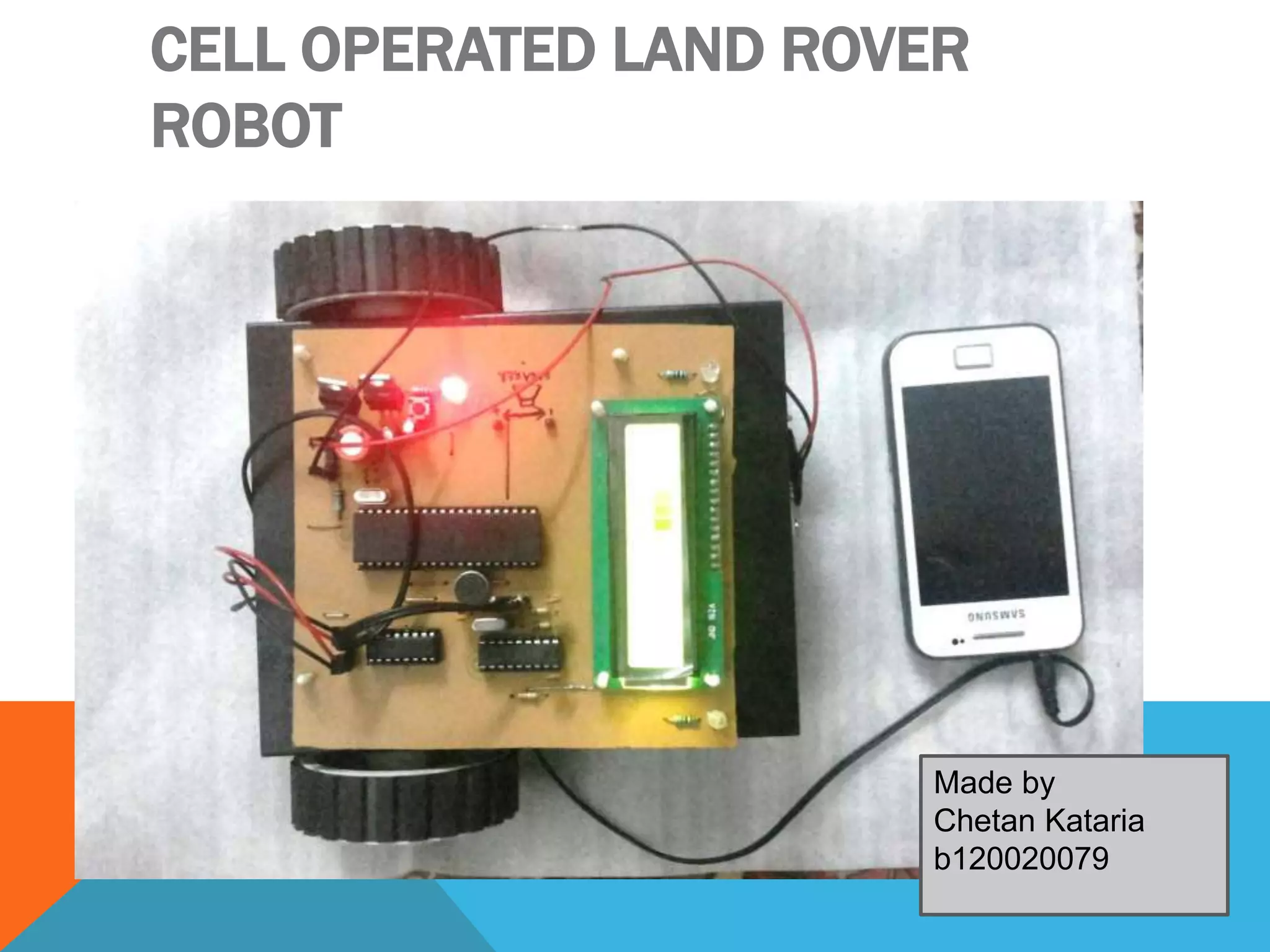
CELL OPERATED LAND ROVER
ROBOT
Made by
Chetan Kataria
b120020079
LEARNING OUTCOMES DURING
TRAINING
What is embedded system and its uses?
Embedded technology is software or
hardware that is hidden embedded in a large
device or system. It typically refers to a fixed
function device, as compared with a PC,
which runs general purpose application.
Embedded technology is nothing new. It all
around us and has been for years.
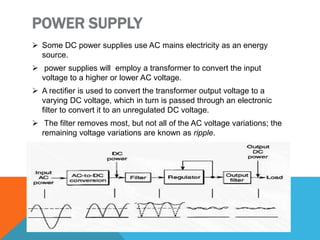
POWER SUPPLY
 Some DC power supplies use AC mains electricity as an energy
source.
 power supplies will employ a transformer to convert the input
voltage to a higher or lower AC voltage.
 A rectifier is used to convert the transformer output voltage to a
varying DC voltage, which in turn is passed through an electronic
filter to convert it to an unregulated DC voltage.
 The filter removes most, but not all of the AC voltage variations; the
remaining voltage variations are known as ripple.
MICROCONTROLLER AND ITS
INTERFACING
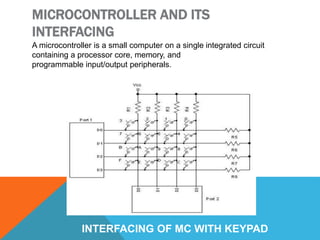
A microcontroller is a small computer on a single integrated circuit
containing a processor core, memory, and
programmable input/output peripherals.
INTERFACING OF MC WITH KEYPAD
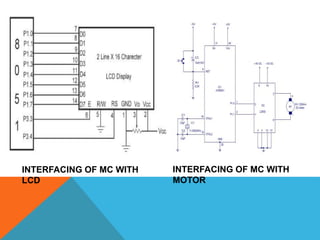
INTERFACING OF MC WITH
LCD
INTERFACING OF MC WITH
MOTOR
ROBOTICS AND ITS TYPES
A robot is an automatic mechanical device often resembling a
human or animal. Modern robots are usually an electro-mechanical
machine guided by a computer program or electronic circuitry.
Types-
 Mobile robots
 Rolling robots
 Walking robots
 Stationary robots
 Autonomous robots
 Remote control robots
INTRODUCTION
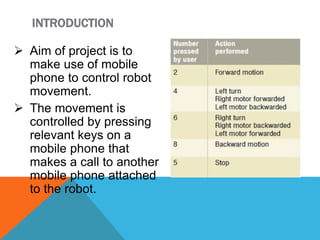
 Aim of project is to
make use of mobile
phone to control robot
movement.
 The movement is
controlled by pressing
relevant keys on a
mobile phone that
makes a call to another
mobile phone attached
to the robot.
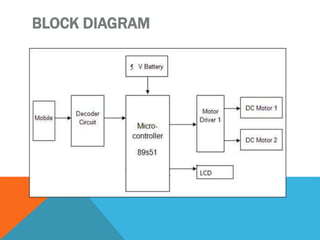
BLOCK DIAGRAM
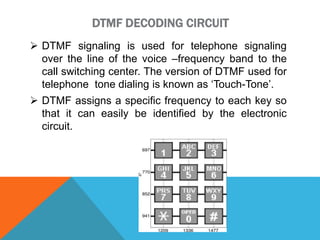
DTMF DECODING CIRCUIT
 DTMF signaling is used for telephone signaling
over the line of the voice –frequency band to the
call switching center. The version of DTMF used for
telephone tone dialing is known as ‘Touch-Tone’.
 DTMF assigns a specific frequency to each key so
that it can easily be identified by the electronic
circuit.
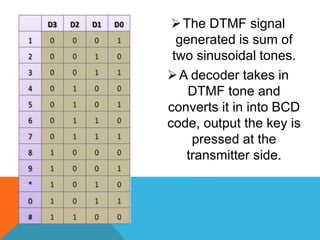
The DTMF signal
generated is sum of
two sinusoidal tones.
A decoder takes in
DTMF tone and
converts it in into BCD
code, output the key is
pressed at the
transmitter side.
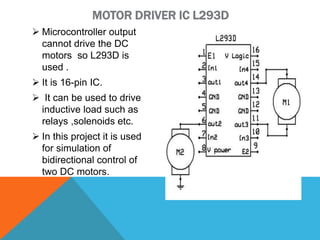
MOTOR DRIVER IC L293D
 Microcontroller output
cannot drive the DC
motors so L293D is
used .
 It is 16-pin IC.
 It can be used to drive
inductive load such as
relays ,solenoids etc.
 In this project it is used
for simulation of
bidirectional control of
two DC motors.
MICROCONTROLLER
 AT89S52 is a 8 bit microcontroller and
belong to Atmel’s 8051 family.
 It has 8KB of flash programmable and
erasable read only memory(PEROM)
and 256 bytes of RAM.
 It can be programmed or erased to a
maximum of 1000 times.
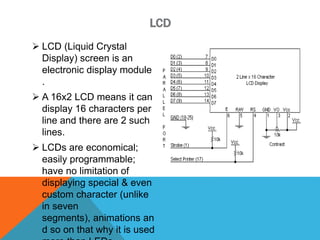
LCD
 LCD (Liquid Crystal
Display) screen is an
electronic display module
.
 A 16x2 LCD means it can
display 16 characters per
line and there are 2 such
lines.
 LCDs are economical;
easily programmable;
have no limitation of
displaying special & even
custom character (unlike
in seven
segments), animations an
d so on that why it is used
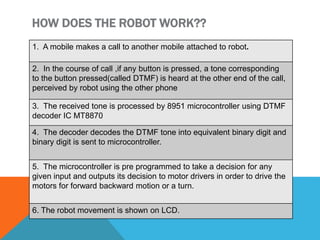
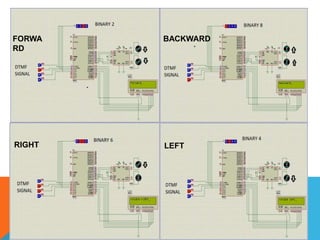
HOW DOES THE ROBOT WORK??
1. A mobile makes a call to another mobile attached to robot.
2. In the course of call ,if any button is pressed, a tone corresponding
to the button pressed(called DTMF) is heard at the other end of the call,
perceived by robot using the other phone
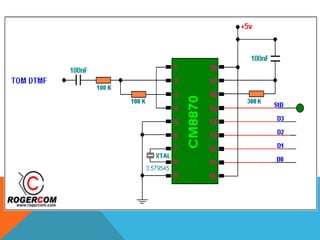
3. The received tone is processed by 8951 microcontroller using DTMF
decoder IC MT8870
4. The decoder decodes the DTMF tone into equivalent binary digit and
binary digit is sent to microcontroller.
5. The microcontroller is pre programmed to take a decision for any
given input and outputs its decision to motor drivers in order to drive the
motors for forward backward motion or a turn.
6. The robot movement is shown on LCD.
FORWA
RD
BACKWARD
RIGHT LEFT
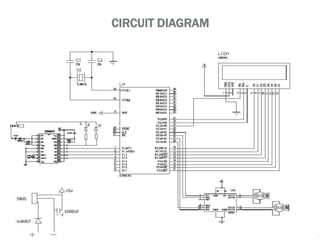
CIRCUIT DIAGRAM
The advantages are:
• Wireless control
• Surveillance System.
• Vehicle Navigation with
use of 3G technology.
• Takes in use of the
mobile technology which
is almost available
everywhere.
• This wireless device has
no boundation of range
and can be controlled as
far as network of cell
phone
The disadvantages are:
• Cell phone bill.
• Mobile batteries drain out
early so charging
problem.
• Not flexible with all cell
phones as only a
particular ,cell phone
whose earpiece is
attached can only be
used.
ADVANTAGES AND DISADVANTAGES
APPLICATION
 Scientific :
Remote control vehicles have various Scientific uses
including hazardous environments, working in the deep
ocean and space exploration.
 Search and Rescue :
it can be used in search and rescue in the United States.
 Recreation and Hobby :
Small scale remote control vehicles have long been
popular among hobbyists. These remote controlled
vehicles span a wide range in terms of price and
sophistication. These include on-road cars, off-road
trucks, boats, airplanes, and even helicopters.
FUTURE SCOPE
1.IR Sensors:
IR sensors can be used to automatically detect & avoid
obstacles if the robot goes beyond line of sight. This avoids
damage to the vehicle if we are maneuvering it from a distant
place.
2.Password Protection:
Project can be modified in order to password protect the robot so
that it can be operated only if correct password is entered. Either
cell phone should be password protected or necessary
modification should be made in the assembly language code.
3.Alarm Phone Dialer:
By replacing DTMF Decoder IC MT8870 by a DTMF Transceiver
IC’ MT8880 , DTMF tones can be generated from the robot. So,
a project called Alarm Phone Dialer! can be built which will
generate necessary alarms for something that is desired to be
monitored (usually by triggering a relay).
THANK YOU

Cell operated land rover robot

  • 1.
    CELL OPERATED LANDROVER ROBOT Made by Chetan Kataria b120020079
  • 2.
    LEARNING OUTCOMES DURING TRAINING Whatis embedded system and its uses? Embedded technology is software or hardware that is hidden embedded in a large device or system. It typically refers to a fixed function device, as compared with a PC, which runs general purpose application. Embedded technology is nothing new. It all around us and has been for years.
  • 3.
    POWER SUPPLY  SomeDC power supplies use AC mains electricity as an energy source.  power supplies will employ a transformer to convert the input voltage to a higher or lower AC voltage.  A rectifier is used to convert the transformer output voltage to a varying DC voltage, which in turn is passed through an electronic filter to convert it to an unregulated DC voltage.  The filter removes most, but not all of the AC voltage variations; the remaining voltage variations are known as ripple.
  • 4.
    MICROCONTROLLER AND ITS INTERFACING Amicrocontroller is a small computer on a single integrated circuit containing a processor core, memory, and programmable input/output peripherals. INTERFACING OF MC WITH KEYPAD
  • 5.
    INTERFACING OF MCWITH LCD INTERFACING OF MC WITH MOTOR
  • 6.
    ROBOTICS AND ITSTYPES A robot is an automatic mechanical device often resembling a human or animal. Modern robots are usually an electro-mechanical machine guided by a computer program or electronic circuitry. Types-  Mobile robots  Rolling robots  Walking robots  Stationary robots  Autonomous robots  Remote control robots
  • 7.
    INTRODUCTION  Aim ofproject is to make use of mobile phone to control robot movement.  The movement is controlled by pressing relevant keys on a mobile phone that makes a call to another mobile phone attached to the robot.
  • 8.
  • 9.
    DTMF DECODING CIRCUIT DTMF signaling is used for telephone signaling over the line of the voice –frequency band to the call switching center. The version of DTMF used for telephone tone dialing is known as ‘Touch-Tone’.  DTMF assigns a specific frequency to each key so that it can easily be identified by the electronic circuit.
  • 10.
    The DTMF signal generatedis sum of two sinusoidal tones. A decoder takes in DTMF tone and converts it in into BCD code, output the key is pressed at the transmitter side.
  • 12.
    MOTOR DRIVER ICL293D  Microcontroller output cannot drive the DC motors so L293D is used .  It is 16-pin IC.  It can be used to drive inductive load such as relays ,solenoids etc.  In this project it is used for simulation of bidirectional control of two DC motors.
  • 13.
    MICROCONTROLLER  AT89S52 isa 8 bit microcontroller and belong to Atmel’s 8051 family.  It has 8KB of flash programmable and erasable read only memory(PEROM) and 256 bytes of RAM.  It can be programmed or erased to a maximum of 1000 times.
  • 14.
    LCD  LCD (LiquidCrystal Display) screen is an electronic display module .  A 16x2 LCD means it can display 16 characters per line and there are 2 such lines.  LCDs are economical; easily programmable; have no limitation of displaying special & even custom character (unlike in seven segments), animations an d so on that why it is used
  • 15.
    HOW DOES THEROBOT WORK?? 1. A mobile makes a call to another mobile attached to robot. 2. In the course of call ,if any button is pressed, a tone corresponding to the button pressed(called DTMF) is heard at the other end of the call, perceived by robot using the other phone 3. The received tone is processed by 8951 microcontroller using DTMF decoder IC MT8870 4. The decoder decodes the DTMF tone into equivalent binary digit and binary digit is sent to microcontroller. 5. The microcontroller is pre programmed to take a decision for any given input and outputs its decision to motor drivers in order to drive the motors for forward backward motion or a turn. 6. The robot movement is shown on LCD.
  • 16.
  • 17.
  • 18.
    The advantages are: •Wireless control • Surveillance System. • Vehicle Navigation with use of 3G technology. • Takes in use of the mobile technology which is almost available everywhere. • This wireless device has no boundation of range and can be controlled as far as network of cell phone The disadvantages are: • Cell phone bill. • Mobile batteries drain out early so charging problem. • Not flexible with all cell phones as only a particular ,cell phone whose earpiece is attached can only be used. ADVANTAGES AND DISADVANTAGES
  • 19.
    APPLICATION  Scientific : Remotecontrol vehicles have various Scientific uses including hazardous environments, working in the deep ocean and space exploration.  Search and Rescue : it can be used in search and rescue in the United States.  Recreation and Hobby : Small scale remote control vehicles have long been popular among hobbyists. These remote controlled vehicles span a wide range in terms of price and sophistication. These include on-road cars, off-road trucks, boats, airplanes, and even helicopters.
  • 20.
    FUTURE SCOPE 1.IR Sensors: IRsensors can be used to automatically detect & avoid obstacles if the robot goes beyond line of sight. This avoids damage to the vehicle if we are maneuvering it from a distant place. 2.Password Protection: Project can be modified in order to password protect the robot so that it can be operated only if correct password is entered. Either cell phone should be password protected or necessary modification should be made in the assembly language code. 3.Alarm Phone Dialer: By replacing DTMF Decoder IC MT8870 by a DTMF Transceiver IC’ MT8880 , DTMF tones can be generated from the robot. So, a project called Alarm Phone Dialer! can be built which will generate necessary alarms for something that is desired to be monitored (usually by triggering a relay).
  • 21.