RIVER VALLEY STUDY GUIDE Answer Key
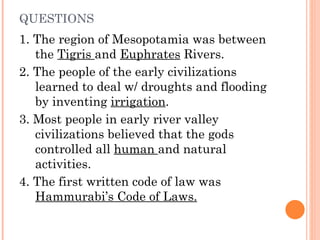
QUESTIONS 1. The region of Mesopotamia was between the  Tigris  and  Euphrates  Rivers.  2. The people of the early civilizations learned to deal w/ droughts and flooding by inventing  irrigation . 3. Most people in early river valley civilizations believed that the gods controlled all  human  and natural activities. 4. The first written code of law was  Hammurabi’s Code of Laws.
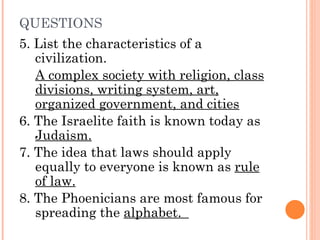
QUESTIONS 5. List the characteristics of a civilization.  A complex society with religion, class divisions, writing system, art, organized government, and cities 6. The Israelite faith is known today as  Judaism. 7. The idea that laws should apply equally to everyone is known as  rule of law. 8. The Phoenicians are most famous for spreading the  alphabet.
QUESTIONS 9.The people of the early river valley civilizations used the rivers for a variety of purposes. List at least five. They used the rivers for irrigation, travel, trade, drinking, bathing, and many other purposes.  10. Why was the geography of Egypt so important in its development as a major center of trade? How did geography help protect the Egyptians?  The Nile River made it easy for Egyptians to travel within the kingdom, while the Med. Sea allows them to travel with other civilizations. The deserts , cataracts, and delta also served as a barrier to prevent enemies from invading with an army.
QUESTIONS  11.What are some of the irrigation techniques the different civilizations used? List examples.  They used techniques including dams, canals, ditches, levees, and shadoofs(Egypt.) 12.  Siddhartha Gautama  was the founder of Buddhism.  13.  The caste system  determined a person’s job, social group, and marriage. 14. Which religion used the Eightfold Path to stop suffering?  Buddhism
QUESTIONS 15. What are the Four Noble Truths, and who uses them?  Four Noble Truths – Buddhism Life is full of suffering People suffer because they desire worldly things, and self-satisfaction The way to end suffering to stop desiring The only way to stop desiring things to follow the Eightfold Path 16. The Golden Age of India was during the  Gupta Empire.
QUESTIONS 17.  Taoism  encouraged people to lead a simple life and live close to nature.  18. Qin Shi Huang Di  united China and based his rule on the ideas of Legalism. 19. List the products that China exported(sent out) on the Silk Road.  Cinnamon, silk, copper, gold, and ginger 20. The Zhou kings claimed this gave them the right to rule.  Mandate of Heaven 21. What was a nickname for the Yellow River?  China’s Joy and China’s Sorrow
QUESTIONS 22.Draw the social pyramid of China.  Land-owning aristocrats   Farmers(90% of China’s pop.) Merchants, trader, bankers 23. This philosophy taught that people would do well if everyone did his/her duty to the family and government.  Confucianism 24. Why did the Chinese worship their ancestors?  They thought their ancestors could protect them, watch them to guide their family descendants, and punish them if they did something wrong.
QUESTIONS 25. Describe the Silk Road.  A large network of trade routes that stretched over 4,000 miles from China to Southwest Asia.  Some of the main items traded by the Chinese included silk, tea, and spices. 26. What helped ideas spread around the world?  Trade 27. Contributions Sumerians  – wheel, plow, sailboat, # system based on 60, cuneiform, 360 day calendar Egyptians - shadoof, papyrus, hieroglyphics, # system based on 10, mummification, adv. in mathematics, 365 day calendar Shang  – silk, jade, bronze, oracle bones Harappa - 1 st  planned cities, sanitation system, 1 st  to grow cotton
RIVER VALLEY CHART (#29) Mesopotamia Tigris and Euphrates River Valleys wheel, plow, sailboat, # system based on 60, cuneiform, irrigation, 1 st  code of laws Egypt Nile River Valley papyrus, advances in medicine, pyramids, # system based on 10, shadoof, hieroglyphics, theocracy, pharaohs Harappa Indus River Valley 1 st  to grow cotton, 1 st  planned cities, sanitation(plumbing)  Shang Huang He River Valley silk, jade, bronze, oracle bones, ancestor worship

River Valley Study Guide

  • 1.
    RIVER VALLEY STUDYGUIDE Answer Key
  • 2.
    QUESTIONS 1. Theregion of Mesopotamia was between the Tigris and Euphrates Rivers. 2. The people of the early civilizations learned to deal w/ droughts and flooding by inventing irrigation . 3. Most people in early river valley civilizations believed that the gods controlled all human and natural activities. 4. The first written code of law was Hammurabi’s Code of Laws.
  • 3.
    QUESTIONS 5. Listthe characteristics of a civilization. A complex society with religion, class divisions, writing system, art, organized government, and cities 6. The Israelite faith is known today as Judaism. 7. The idea that laws should apply equally to everyone is known as rule of law. 8. The Phoenicians are most famous for spreading the alphabet.
  • 4.
    QUESTIONS 9.The peopleof the early river valley civilizations used the rivers for a variety of purposes. List at least five. They used the rivers for irrigation, travel, trade, drinking, bathing, and many other purposes. 10. Why was the geography of Egypt so important in its development as a major center of trade? How did geography help protect the Egyptians? The Nile River made it easy for Egyptians to travel within the kingdom, while the Med. Sea allows them to travel with other civilizations. The deserts , cataracts, and delta also served as a barrier to prevent enemies from invading with an army.
  • 5.
    QUESTIONS 11.Whatare some of the irrigation techniques the different civilizations used? List examples. They used techniques including dams, canals, ditches, levees, and shadoofs(Egypt.) 12. Siddhartha Gautama was the founder of Buddhism. 13. The caste system determined a person’s job, social group, and marriage. 14. Which religion used the Eightfold Path to stop suffering? Buddhism
  • 6.
    QUESTIONS 15. Whatare the Four Noble Truths, and who uses them? Four Noble Truths – Buddhism Life is full of suffering People suffer because they desire worldly things, and self-satisfaction The way to end suffering to stop desiring The only way to stop desiring things to follow the Eightfold Path 16. The Golden Age of India was during the Gupta Empire.
  • 7.
    QUESTIONS 17. Taoism encouraged people to lead a simple life and live close to nature. 18. Qin Shi Huang Di united China and based his rule on the ideas of Legalism. 19. List the products that China exported(sent out) on the Silk Road. Cinnamon, silk, copper, gold, and ginger 20. The Zhou kings claimed this gave them the right to rule. Mandate of Heaven 21. What was a nickname for the Yellow River? China’s Joy and China’s Sorrow
  • 8.
    QUESTIONS 22.Draw thesocial pyramid of China. Land-owning aristocrats Farmers(90% of China’s pop.) Merchants, trader, bankers 23. This philosophy taught that people would do well if everyone did his/her duty to the family and government. Confucianism 24. Why did the Chinese worship their ancestors? They thought their ancestors could protect them, watch them to guide their family descendants, and punish them if they did something wrong.
  • 9.
    QUESTIONS 25. Describethe Silk Road. A large network of trade routes that stretched over 4,000 miles from China to Southwest Asia. Some of the main items traded by the Chinese included silk, tea, and spices. 26. What helped ideas spread around the world? Trade 27. Contributions Sumerians – wheel, plow, sailboat, # system based on 60, cuneiform, 360 day calendar Egyptians - shadoof, papyrus, hieroglyphics, # system based on 10, mummification, adv. in mathematics, 365 day calendar Shang – silk, jade, bronze, oracle bones Harappa - 1 st planned cities, sanitation system, 1 st to grow cotton
  • 10.
    RIVER VALLEY CHART(#29) Mesopotamia Tigris and Euphrates River Valleys wheel, plow, sailboat, # system based on 60, cuneiform, irrigation, 1 st code of laws Egypt Nile River Valley papyrus, advances in medicine, pyramids, # system based on 10, shadoof, hieroglyphics, theocracy, pharaohs Harappa Indus River Valley 1 st to grow cotton, 1 st planned cities, sanitation(plumbing) Shang Huang He River Valley silk, jade, bronze, oracle bones, ancestor worship