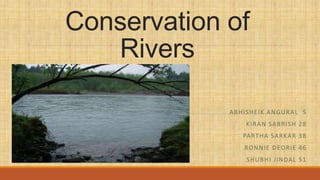
Conservation of
Rivers
ABHISHEIK ANGURAL 5
KIRAN SABRISH 28
PARTHA SARKAR 38
RONNIE DEORIE 46
SHUBHI JINDAL 51
Agenda
Why conserve rivers?
Present scenario
Causes of river pollution
Common Pool Resources
Stakeholder Analysis
Property Rights
Satluj river – A case study
Cooum river – A case study
Proposed solution
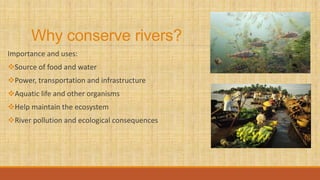
Why conserve rivers?
Importance and uses:
Source of food and water
Power, transportation and infrastructure
Aquatic life and other organisms
Help maintain the ecosystem
River pollution and ecological consequences
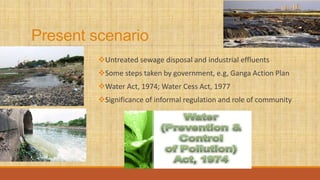
Present scenario
Untreated sewage disposal and industrial effluents
Some steps taken by government, e.g, Ganga Action Plan
Water Act, 1974; Water Cess Act, 1977
Significance of informal regulation and role of community
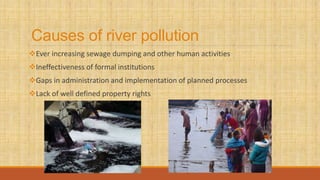
Causes of river pollution
Ever increasing sewage dumping and other human activities
Ineffectiveness of formal institutions
Gaps in administration and implementation of planned processes
Lack of well defined property rights
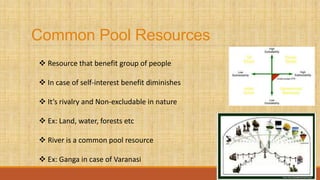
Common Pool Resources
 Resource that benefit group of people
 In case of self-interest benefit diminishes
 It’s rivalry and Non-excludable in nature
 Ex: Land, water, forests etc
 River is a common pool resource
 Ex: Ganga in case of Varanasi
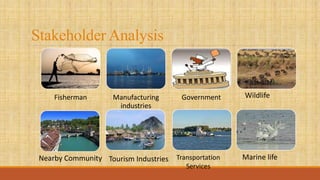
Stakeholder Analysis
Fisherman Manufacturing
industries
Government Wildlife
Tourism IndustriesNearby Community Transportation
Services
Marine life
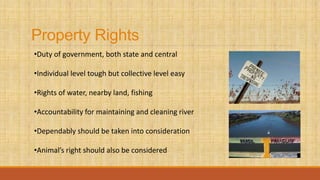
Property Rights
•Duty of government, both state and central
•Individual level tough but collective level easy
•Rights of water, nearby land, fishing
•Accountability for maintaining and cleaning river
•Dependably should be taken into consideration
•Animal’s right should also be considered
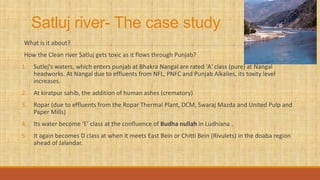
Satluj river- The case study
What is it about?
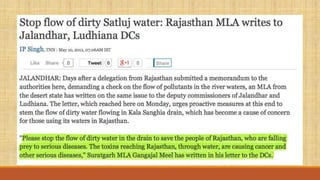
How the Clean river Satluj gets toxic as it flows through Punjab?
1. Sutlej's waters, which enters punjab at Bhakra Nangal are rated 'A' class (pure) at Nangal
headworks. At Nangal due to effluents from NFL, PNFC and Punjab Alkalies, its toxity level
increases.
2. At kiratpur sahib, the addition of human ashes (crematory)
3. Ropar (due to effluents from the Ropar Thermal Plant, DCM, Swaraj Mazda and United Pulp and
Paper Mills)
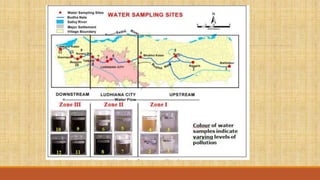
4. Its water become ‘E’ class at the confluence of Budha nullah in Ludhiana .
5. It again becomes D class at when it meets East Bein or Chitti Bein (Rivulets) in the doaba region
ahead of Jalandar.
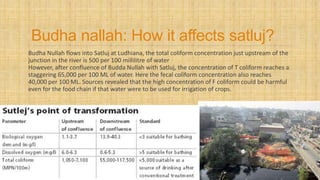
Budha nallah: How it affects satluj?
Budha Nullah flows into Satluj at Ludhiana, the total coliform concentration just upstream of the
junction in the river is 500 per 100 millilitre of water
However, after confluence of Budda Nullah with Satluj, the concentration of T coliform reaches a
staggering 65,000 per 100 ML of water. Here the fecal coliform concentration also reaches
40,000 per 100 ML. Sources revealed that the high concentration of F coliform could be harmful
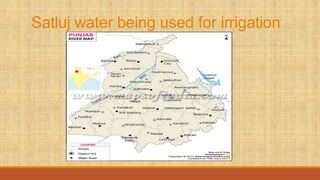
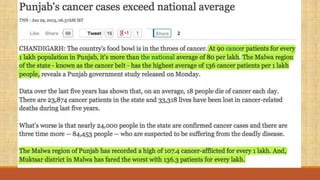
even for the food chain if that water were to be used for irrigation of crops.
Satluj water being used for irrigation
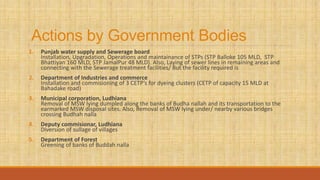
Actions by Government Bodies
1. Punjab water supply and Sewerage board
Installation, Upgradation, Operations and maintainance of STPs (STP Balloke 105 MLD, STP
Bhattiyan 160 MLD, STP JamalPur 48 MLD). Also, Laying of sewer lines in remaining areas and
connecting with the Sewerage treatment facilities/ But the facility required is
2. Department of Industries and commerce
Installation and commisioning of 3 CETP’s for dyeing clusters (CETP of capacity 15 MLD at
Bahadake road)
3. Municipal corporation, Ludhiana
Removal of MSW lying dumpled along the banks of Budha nallah and its transportation to the
earmarked MSW disposal sites. Also, Removal of MSW lying under/ nearby various bridges
crossing Budhah nalla
4. Deputy commisionar, Ludhiana
Diversion of sullage of villages
5. Department of Forest
Greening of banks of Buddah nalla
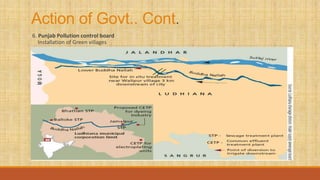
Action of Govt.. Cont.
6. Punjab Pollution control board
Installation of Green villages
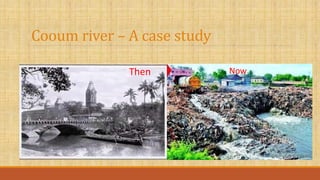
Cooum river – A case study
Then Now
Why this Case study?
• The most polluted river of India - report by Businessinsider.uk
• Aquatic organisms can’t survive even if after diluting the water 10 times
• Now “Cooum Crocodile” can be seen only in Museums
• Perfect example Common Pool Resource(CPR)
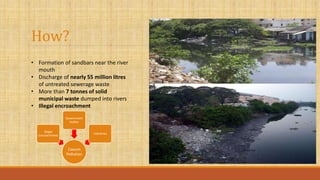
How?
Cooum
Pollution
Illegal
Encroachment
Government
bodies
Industries
• Formation of sandbars near the river
mouth
• Discharge of nearly 55 million litres
of untreated sewerage waste
• More than 7 tonnes of solid
municipal waste dumped into rivers
• Illegal encroachment
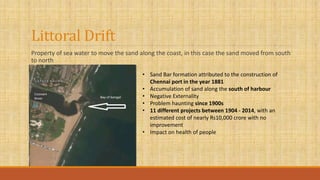
Littoral Drift
Property of sea water to move the sand along the coast, in this case the sand moved from south
to north
• Sand Bar formation attributed to the construction of
Chennai port in the year 1881
• Accumulation of sand along the south of harbour
• Negative Externality
• Problem haunting since 1900s
• 11 different projects between 1904 - 2014, with an
estimated cost of nearly Rs10,000 crore with no
improvement
• Impact on health of people
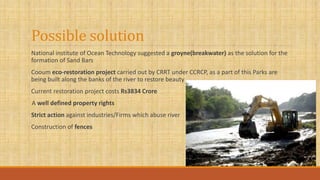
Possible solution
National institute of Ocean Technology suggested a groyne(breakwater) as the solution for the
formation of Sand Bars
Cooum eco-restoration project carried out by CRRT under CCRCP, as a part of this Parks are
being built along the banks of the river to restore beauty
Current restoration project costs Rs3834 Crore
A well defined property rights
Strict action against industries/Firms which abuse river
Construction of fences
8 Principles of Managing Commons-
Elinor Ostrom
 Define clear group boundaries.
 Match rules governing use of common goods to local needs and conditions.
 Ensure that those affected by the rules can participate in modifying the
rules.
 Make sure the rule-making rights of community members are respected by
outside authorities.
 Develop a system, carried out by community members, for monitoring
members’ behaviour.
Continued
Use graduated sanctions for rule violators.
Provide accessible, low-cost means for dispute resolution.
Build responsibility for governing the common resource in nested tiers from
the lowest level up to the entire interconnected system.
References
http://en.wikipedia.org/wiki/Cooum_River
http://timesofindia.indiatimes.com/city/chennai/Tamil-Nadu-budget-Govt-
allocates-Rs-3834-crore-for-Cooum-restoration/articleshow/30336705.cms
http://www.chennairivers.gov.in/Cooum-Restoration/about_cooum_river.html
http://www.brighthub.com/environment/science-
environmental/articles/122016.aspx
http://en.wikipedia.org/wiki/Longshore_drift
http://www.onthecommons.org/magazine/elinor-ostroms-8-principles-
managing-commmons
References cont..
http://manuscript.sciknow.org/uploads/jecr/pub/jecr_1362336412.pdf
http://www.sikhnet.com/news/river-pollution-punjab-clean-plan
http://www.downtoearth.org.in/dte/userfiles/images/Annexure-R-2.pdf
http://en.wikipedia.org/wiki/Buddha_Nullah
http://timesofindia.indiatimes.com/city/chandigarh/Clean-Satluj-gets-toxic-as-it-flows-through-
Punjab-PPCB-report/articleshow/37421104.cms
http://www.sciknow.org/article/detail/id/229
http://www.ncbi.nlm.nih.gov/pubmed/12968726
THANK YOU

River Pollution In India

Editor's Notes

  • #10 So, we will be tracking the journey of satluj through punjab. NFL> National Fertilizers limited, PNFC> punjab national fertilizers and chemical limited , Punjab Alkalies and chemical limited. DCM Engineering Ltd. 3. Buddha Nullah  is a seasonal water stream, which runs through the Malwa region of Punjab, India, and after passing through highly populated Ludhiana district, it drains into Sutlej River. Kiratpur> Rupnagar district of Punjab.
  • #11 Coliform bacteria are a commonly used bacterial indicator of sanitary quality of foods and water Total cofiform, Fecal coliform and E.coliform are the indicators of drinking water quality. Ludhiana city has about 250 large and medium scale units and 41,116 small scale units. Electroplating, heat treatment, cycle manufacturing, hosiery, machine parts, vegetable oils, dyeing process and chemical industries are the major categories. Nearly 22,000 industrial units of different categories are a major source of pollution.
  • #12 Twelve number of water samples spatially located in three different zones, zone I (upstream), Zone II (in the city) and zone III (downstream) were collected. The samples were analyzed for quality parameters such as pH, EC(Electrical conductivity) , BOD(Biochemical oxygen demand), COD(Chemical Oxygen demand), TS(, TDS(Total dissolved solids), TSS, Ni, Cd and Pb COD> TO indirectly measure the number of organic compounds in water. Biochemical oxygen demand> Biochemical oxygen demand (BOD) is the amount of dissolved oxygen needed by aerobic biological organisms in a body of water to break down organic material present in a given water sample at certain temperature over a specific time period. The term also refers to a chemical procedure for determining this amount.
  • #13 I know this water pollution is surely killing the marine life (52 species of the fish found immediately downstream of buddha nallah junction with sutluj have all gone extinct) BUT sutluj is the major source of irrigation for the malwa region and due to this these toxins are also entering our food system that too in the quantity which is way higher than the prescribed limit. It is the different toxics from this water apart from killing the marine life with this water is also entering our food chain when this water is used for irrigation. I am not saying that heavy use of pesticide and fertilizer is also not an important factor for the rising number of cancer patients.
  • #16 MLD> Million litres per day. CETP> Common effuluent treatment plant, Sullage> waste water from Households MSW> Muncipal solid waste
  • #17 Green bridge filters help in reducing the suspended solids by filtration process, reducing Chemical Oxygen Demand (COD)/ Biochemical Oxygen Demand (BOD) by aerobic degradation
  • #23 Dos & don’ts