By:
Krutika Bellary
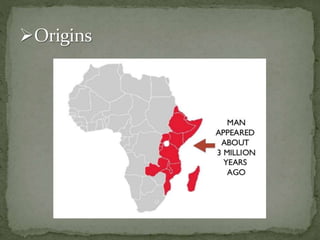
 The oldest human
footprints in the world
were unearthed at
Laetoli, near Olduvai
Gorge, in Tanzinia.
These footprints led
Owen Lovejoy to
conclude that even
these early hominids
Lucy - is one of the oldest
and most complete
skeletons of human
ancestry, which was
discovered by Don
Johansson in Ethiopia's
Afar Triangle.
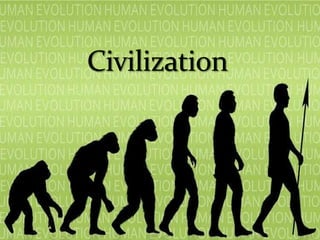
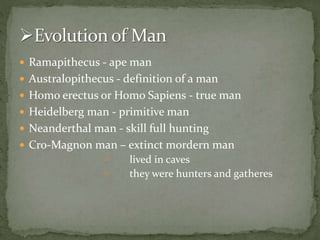
 Ramapithecus - ape man
 Australopithecus - definition of a man
 Homo erectus or Homo Sapiens - true man
 Heidelberg man - primitive man
 Neanderthal man - skill full hunting
 Cro-Magnon man – extinct mordern man
 lived in caves
 they were hunters and gatheres
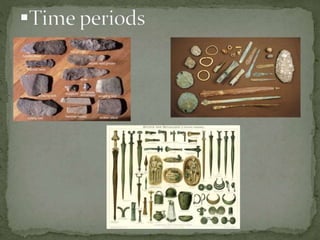
 The pre-historic period was divided into –
1. Paleolithic age
2. Neolithic age
3. Chalcolithic age
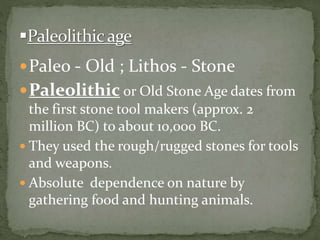
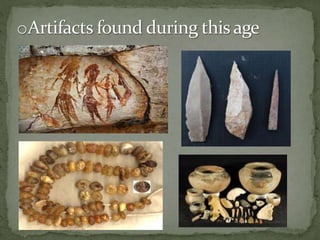
Paleo - Old ; Lithos - Stone
Paleolithic or Old Stone Age dates from
the first stone tool makers (approx. 2
million BC) to about 10,000 BC.
 They used the rough/rugged stones for tools
and weapons.
 Absolute dependence on nature by
gathering food and hunting animals.
 Discovered fire from stones for cooking,
warmth and protection from animals.
 Extremely nomadic way of life (moving from
place to place to hunt).
 Developed simple tools from stone, bone or
wood.
 Invented clothing.
 Cave paintings and religious rituals.
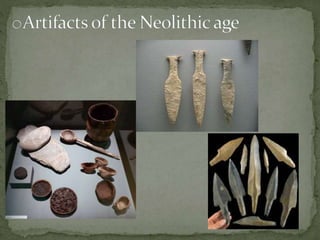
 Neo – New ; Lithos - Stone
 This period began in Ireland with the arrival of the
first farmers around 3500 BC.
 Organized farming methods and crops and
animals.
 New house types.
 New crafts .
 Burials rituals – megalithic (great stones).
 They used polished and bladed stones.
 More sedentary life (stayed in fixed places able to
build cities).
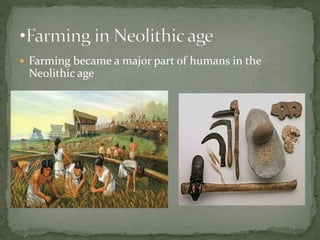
 Farming became a major part of humans in the
Neolithic age
 Also known as the “ Copper Age” began at around 4500BC
 This age was the age of metals.
 The discovery of which was a milestone in the growth of
civilization
 The use of copper was at large, but later it was also mixed
other metals that were discovers during that time which
resulted in the discovery of bronze.
 Indus Valley Civilization is the best example in the
civilization of copper age.
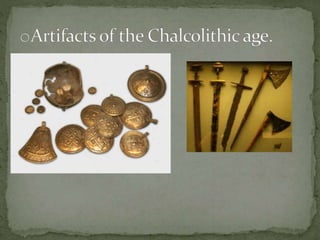
 The metal was mainly used to make axes, swords,
spearheads, etc. used for hunting and farming.
Indus Valley Civilization
The Indus
Valley Region:
 Indus civilization is also called Indus valley civilization or Harappa
civilization.
 It was not discovered until the 1920’s.
 These settlements were established along the Indus River some 5000
years ago.
 These were one of the world's earliest major urban settlements.
 The Indus civilization is known to have comprised two large cities,
Harappa and Mohenjo-Daro, and more than 100 towns and villages,
often of relatively small size but well planned and walled.
 Trade and Agriculture were the major sources of their
income.
 Harappa to have been far larger than once thought, perhaps
supporting a population of 50,000 at certain periods
These cities were
well planned with
wide streets, public
and private wells,
drains, bathing
platforms and
reservoirs. One of
its most well-known
structures is
the Great Bath of
Mohenjo Daro .
People in the Indus Valley
played board games like this,
moving pieces between
squares.
Maze puzzles and dice games
were enjoyed by children and
adults.
 The period of new civilization is divided into three
phases – Ancient Age
Medieval Age
Modern Age
 The growth of kingdoms, steel weapons,
writings, politics, military, money, etc. were
the foundations of the new civilization.
 Literacy rate was on the rise with the
expansion of Rome.
 Roman empire showed how governing could
help the new civilization.
 In India, Indus Valley Civilization marks the beginning
of the ancient civilization.
 In early vedic period, the social order in ancient India
enabled members to smoothly climb the ladder of life.
 The religion of the Indian origin was very simple and
its contributions are evidently high.
 The four stages in an individuals life were
- Bhramacharya
- Grihastha
- Vanaprastha and
- Sanyasa.
 There was also division of classes called “
Varnashrama Dharma”.
 The classes were
- Brahmin: the one who parts knowledge.
- Kshatriyas: the ones defending the society.
- Vaisyas: were farmers.
- Sudras: the traders
• This social order did not imply any
discrimination such as big or small, high or low
in its constituents.
 The complete life concept called “Chaturvida
Purushartha” marked out the Indian society
globally.
 These fourfold objectives of life are-
- Dharma: the universal law
- Artha: the wealth
- Kama: the desire
- Moksha: the salvation
• The later vedic period saw the formation of powerful
kingdoms like panchala, kosala, maghada, etc.
• During this period, mauryas and guptas in the north;
satavahans, pallavas and cholas in the south of India
realized the importance education and established
universities like Nalanda, Ujjain, Sarnatha, Ajantha
and Taxasila.
• Great scientists like Aryabhatta, Virahamihira,
Brahmaguptha and others flourished during this
period.
• Establishments like institutions, health-care centers,
trade links, etc. were major achievements seen in the
ancient age.
 It starts with the fall of the Roman Empire and
establishment of the Muslim rule in India.
 India was under the Muslim rule for over 600years.
 Hinduism and Islam were however in the opposed and
influenced movements like Sufi among Muslims and
Bhakti among the Hindus.
 The unity of these two civilizations developed art called
“The Indo-Muslim Art”.
 Taj Mahal, Qutub Minar, Red Fort, etc. are the examples of
such art.
 The medieval age formulated and reformulated the socio-
economic order to meet the challenges of the changing
times.
 Scientific inventions and technological revolution is
evident in the modern historic period.
 Invention of microscope and telescope led to the
discovery of other many things.
 Advancement in the field of agriculture industry and
communication was a major support for the progress
of the civilization.
 Science and civilization textbook- Madan Lal Malpani
V.Prabhakaraiah
Saraswati Rao
 Acadamics.triton.edu.com

Evolution of civilization

  • 1.
  • 4.
     The oldesthuman footprints in the world were unearthed at Laetoli, near Olduvai Gorge, in Tanzinia. These footprints led Owen Lovejoy to conclude that even these early hominids
  • 5.
    Lucy - isone of the oldest and most complete skeletons of human ancestry, which was discovered by Don Johansson in Ethiopia's Afar Triangle.
  • 6.
     Ramapithecus -ape man  Australopithecus - definition of a man  Homo erectus or Homo Sapiens - true man  Heidelberg man - primitive man  Neanderthal man - skill full hunting  Cro-Magnon man – extinct mordern man  lived in caves  they were hunters and gatheres
  • 9.
     The pre-historicperiod was divided into – 1. Paleolithic age 2. Neolithic age 3. Chalcolithic age
  • 10.
    Paleo - Old; Lithos - Stone Paleolithic or Old Stone Age dates from the first stone tool makers (approx. 2 million BC) to about 10,000 BC.  They used the rough/rugged stones for tools and weapons.  Absolute dependence on nature by gathering food and hunting animals.
  • 11.
     Discovered firefrom stones for cooking, warmth and protection from animals.  Extremely nomadic way of life (moving from place to place to hunt).  Developed simple tools from stone, bone or wood.  Invented clothing.  Cave paintings and religious rituals.
  • 13.
     Neo –New ; Lithos - Stone  This period began in Ireland with the arrival of the first farmers around 3500 BC.  Organized farming methods and crops and animals.  New house types.  New crafts .  Burials rituals – megalithic (great stones).  They used polished and bladed stones.  More sedentary life (stayed in fixed places able to build cities).
  • 14.
     Farming becamea major part of humans in the Neolithic age
  • 18.
     Also knownas the “ Copper Age” began at around 4500BC  This age was the age of metals.  The discovery of which was a milestone in the growth of civilization  The use of copper was at large, but later it was also mixed other metals that were discovers during that time which resulted in the discovery of bronze.  Indus Valley Civilization is the best example in the civilization of copper age.  The metal was mainly used to make axes, swords, spearheads, etc. used for hunting and farming.
  • 20.
  • 21.
  • 22.
     Indus civilizationis also called Indus valley civilization or Harappa civilization.  It was not discovered until the 1920’s.  These settlements were established along the Indus River some 5000 years ago.  These were one of the world's earliest major urban settlements.  The Indus civilization is known to have comprised two large cities, Harappa and Mohenjo-Daro, and more than 100 towns and villages, often of relatively small size but well planned and walled.  Trade and Agriculture were the major sources of their income.  Harappa to have been far larger than once thought, perhaps supporting a population of 50,000 at certain periods
  • 23.
    These cities were wellplanned with wide streets, public and private wells, drains, bathing platforms and reservoirs. One of its most well-known structures is the Great Bath of Mohenjo Daro .
  • 24.
    People in theIndus Valley played board games like this, moving pieces between squares. Maze puzzles and dice games were enjoyed by children and adults.
  • 27.
     The periodof new civilization is divided into three phases – Ancient Age Medieval Age Modern Age
  • 28.
     The growthof kingdoms, steel weapons, writings, politics, military, money, etc. were the foundations of the new civilization.  Literacy rate was on the rise with the expansion of Rome.  Roman empire showed how governing could help the new civilization.
  • 29.
     In India,Indus Valley Civilization marks the beginning of the ancient civilization.  In early vedic period, the social order in ancient India enabled members to smoothly climb the ladder of life.  The religion of the Indian origin was very simple and its contributions are evidently high.  The four stages in an individuals life were - Bhramacharya - Grihastha - Vanaprastha and - Sanyasa.
  • 30.
     There wasalso division of classes called “ Varnashrama Dharma”.  The classes were - Brahmin: the one who parts knowledge. - Kshatriyas: the ones defending the society. - Vaisyas: were farmers. - Sudras: the traders • This social order did not imply any discrimination such as big or small, high or low in its constituents.
  • 31.
     The completelife concept called “Chaturvida Purushartha” marked out the Indian society globally.  These fourfold objectives of life are- - Dharma: the universal law - Artha: the wealth - Kama: the desire - Moksha: the salvation
  • 32.
    • The latervedic period saw the formation of powerful kingdoms like panchala, kosala, maghada, etc. • During this period, mauryas and guptas in the north; satavahans, pallavas and cholas in the south of India realized the importance education and established universities like Nalanda, Ujjain, Sarnatha, Ajantha and Taxasila. • Great scientists like Aryabhatta, Virahamihira, Brahmaguptha and others flourished during this period. • Establishments like institutions, health-care centers, trade links, etc. were major achievements seen in the ancient age.
  • 33.
     It startswith the fall of the Roman Empire and establishment of the Muslim rule in India.  India was under the Muslim rule for over 600years.  Hinduism and Islam were however in the opposed and influenced movements like Sufi among Muslims and Bhakti among the Hindus.  The unity of these two civilizations developed art called “The Indo-Muslim Art”.  Taj Mahal, Qutub Minar, Red Fort, etc. are the examples of such art.  The medieval age formulated and reformulated the socio- economic order to meet the challenges of the changing times.
  • 35.
     Scientific inventionsand technological revolution is evident in the modern historic period.  Invention of microscope and telescope led to the discovery of other many things.  Advancement in the field of agriculture industry and communication was a major support for the progress of the civilization.
  • 36.
     Science andcivilization textbook- Madan Lal Malpani V.Prabhakaraiah Saraswati Rao  Acadamics.triton.edu.com