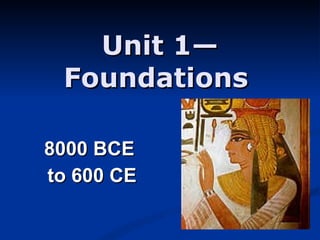
Unit 1:  Foundations  8000 BCE  to 600 CE
Prehistory Prehistoric or Prehistory refers to the time before the advancement of writing.
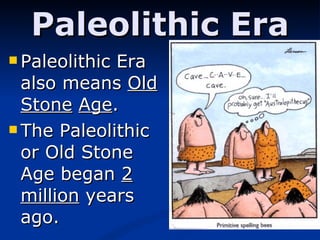
Paleolithic Era Paleolithic Era also means  Old   Stone   Age . The Paleolithic or Old Stone Age began  2 million  years ago.
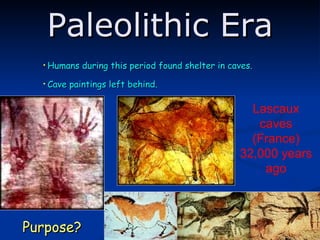
Humans during this period found shelter in caves. Cave paintings left behind.  Purpose? Lascaux caves (France) 32,000 years ago Paleolithic Era
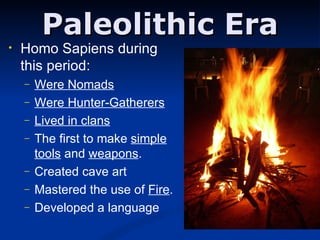
Paleolithic Era Homo Sapiens during this period: Were Nomads Were Hunter-Gatherers Lived in clans The first to make  simple   tools  and  weapons . Created cave art Mastered the use of  Fire . Developed a language
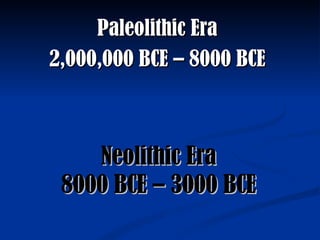
Neolithic Era 8000 BCE – 3000 BCE Paleolithic Era 2,000,000 BCE – 8000 BCE
AP World History begins at about 8,000 BC when village life began in the New Stone Age. . .  Also known as the  Neolithic Revolution .   NEW  STONE AGE
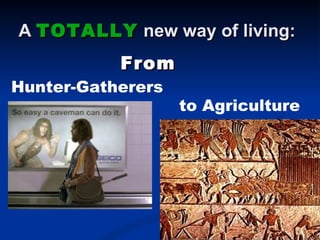
A  TOTALLY  new way of living:   From  Hunter-Gatherers to Agriculture
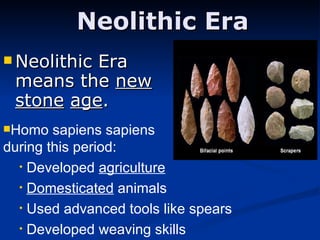
Neolithic Era Neolithic Era means the  new   stone   age . Homo sapiens sapiens  during this period: Developed  agriculture Domesticated  animals Used advanced tools like spears Developed weaving skills
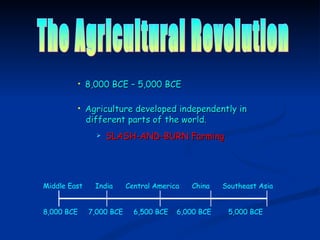
The Agricultural Revolution 8,000 BCE – 5,000 BCE Agriculture developed independently in   different parts of the world. SLASH-AND-BURN Farming Middle East  India  Central America  China  Southeast Asia 8,000 BCE  7,000 BCE  6,500 BCE  6,000 BCE  5,000 BCE
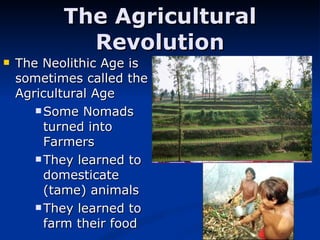
The Agricultural Revolution The Neolithic Age is sometimes called the Agricultural Age Some Nomads turned into Farmers They learned to domesticate (tame) animals  They learned to farm their food
INVENTION OF AGRICULTURE Mesopotamians first to engage in agriculture  Around 8000 BCE Cereal crops Wheat Barley  Herd animals Sheep Goats Woman probably first farmer Grain-collecting then noticed that stored wild grain could be grown on purpose
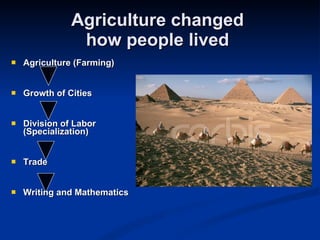
Agriculture changed  how people lived  Agriculture (Farming) Growth of Cities Division of Labor (Specialization) Trade Writing and Mathematics
Nomadic vs. Agricultural Societies Hunter/Gatherers vs. Farmers More Free Time vs. Constant Work Temporary Shelter vs. Long-term Homes Small Groups vs. Larger Groups Public Land vs. Private Land
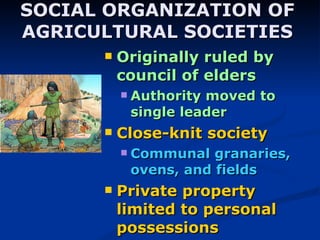
SOCIAL ORGANIZATION OF AGRICULTURAL SOCIETIES Originally ruled by council of elders Authority moved to single leader Close-knit society Communal granaries, ovens, and fields Private property limited to personal possessions
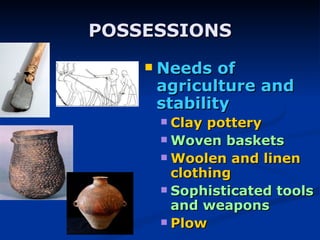
POSSESSIONS Needs of agriculture and stability Clay pottery Woven baskets Woolen and linen clothing Sophisticated tools and weapons Plow
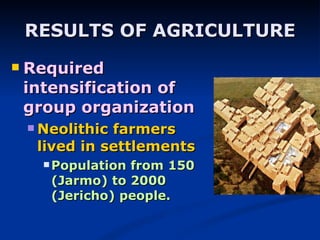
RESULTS OF AGRICULTURE Required intensification of group organization Neolithic farmers lived in settlements Population from 150 (Jarmo) to 2000 (Jericho) people.
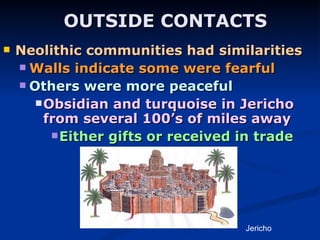
OUTSIDE CONTACTS Neolithic communities had similarities   Walls indicate some were fearful Others were more peaceful Obsidian and turquoise in Jericho from several 100’s of miles away Either gifts or received in trade Jericho
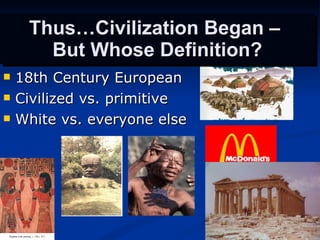
Thus…Civilization Began –  But Whose Definition? 18th Century European Civilized vs. primitive White vs. everyone else
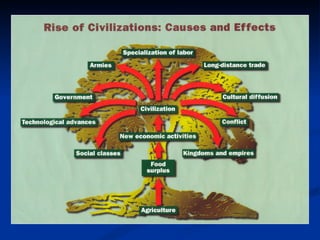
What contributes to the Development of a Civilization? Specialization of labor is the key If everyone has to farm to have enough food, a great civilization won’t develop. If there is a surplus of food, others are free to build, invent, create tools, create art, and build institutions.
What does it mean to be civilized? Historians have determined 6- 9  characteristics of civilization: Cities as administrative centers Political System based on territory Job specialization  Social classes Monumental Building Writing/Record Keeping Long-distance trade Advances in science and art Complex religions
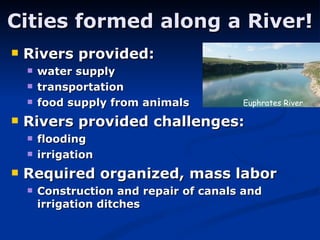
Cities formed along a River! Rivers provided: water supply  transportation  food supply from animals   Rivers provided challenges: flooding irrigation   Required organized, mass labor Construction and repair of canals and irrigation ditches Euphrates River
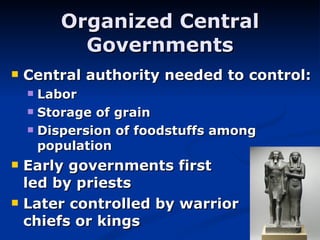
Organized Central Governments Central authority needed to control: Labor Storage of grain Dispersion of foodstuffs among population Early governments first      led by priests Later controlled by warrior    chiefs or kings
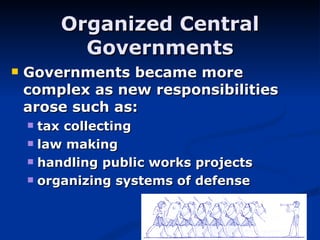
Organized Central Governments Governments became more complex as new responsibilities arose such as: tax collecting law making handling public works projects organizing systems of defense
Complex Religions Generally polytheistic Many gods represented natural forces Others controlled human activities Priests and worshippers tried to gain gods’ favor through complex rituals and sacrifice Directed by unquestionable ruling class of priests King regarded as a god or as a god’s agent
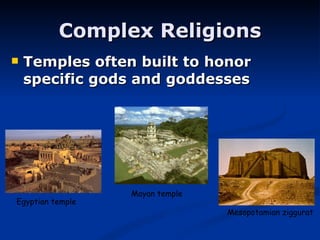
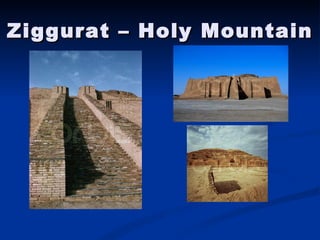
Complex Religions Temples often built to honor specific gods and goddesses Egyptian temple Mesopotamian ziggurat Mayan temple
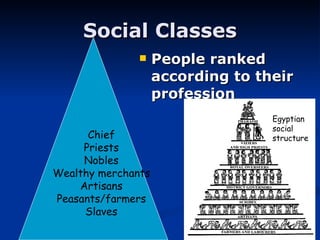
Social Classes People ranked according to their profession Egyptian social structure Chief Priests Nobles Wealthy merchants Artisans Peasants/farmers Slaves
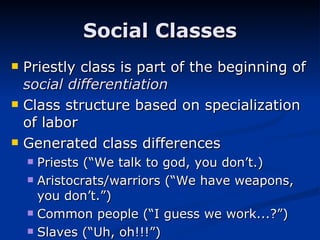
Priestly class is part of the beginning of  social differentiation Class structure based on specialization of labor Generated class differences Priests (“We talk to god, you don’t.) Aristocrats/warriors (“We have weapons, you don’t.”) Common people (“I guess we work...?”) Slaves (“Uh, oh!!!”) Social Classes
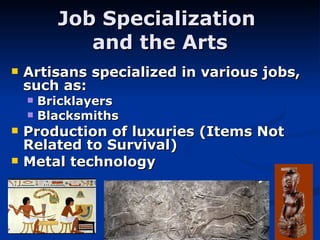
Job Specialization  and the Arts Artisans specialized in various jobs, such as: Bricklayers Blacksmiths Production of luxuries (Items Not Related to Survival) Metal technology
Created great architecture and art monumental architecture pyramids, ziggurats, big cities huge temples and associated structures to fill the needs of a god-oriented state under the control of the priestly class Job Specialization  and the Arts
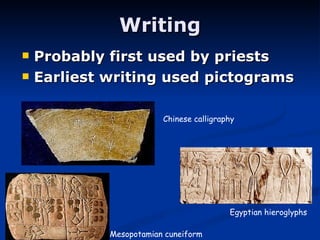
Writing Probably first used by priests Earliest writing used pictograms Mesopotamian cuneiform Egyptian hieroglyphs Chinese calligraphy
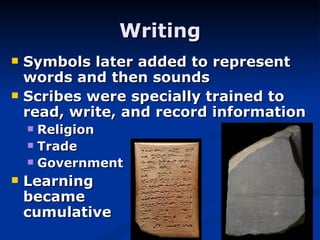
Writing Symbols later added to represent words and then sounds Scribes were specially trained to read, write, and record information Religion Trade Government Learning    became    cumulative
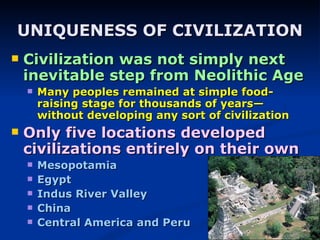
UNIQUENESS OF CIVILIZATION Civilization was not simply next inevitable step from Neolithic Age Many peoples remained at simple food-raising stage for thousands of years—without developing any sort of civilization Only five locations developed civilizations entirely on their own Mesopotamia Egypt Indus River Valley China Central America and Peru
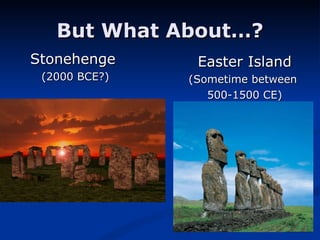
But What About…? Easter Island (Sometime between  500-1500 CE) Stonehenge  (2000 BCE?)
 
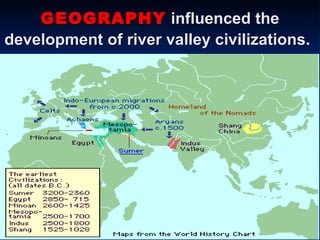
GEOGRAPHY  influenced the development of river valley civilizations.
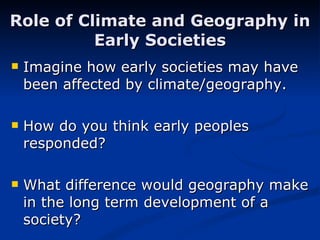
Role of Climate and Geography in Early Societies Imagine how early societies may have been affected by climate/geography. How do you think early peoples responded?  What difference would geography make in the long term development of a society?
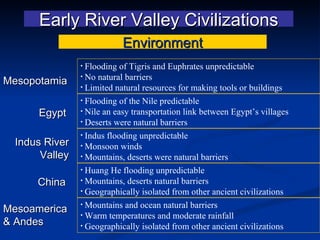
Early River Valley Civilizations Flooding of Tigris and Euphrates unpredictable No natural barriers Limited natural resources for making tools or buildings Environment Mesopotamia Egypt Indus River Valley China Flooding of the Nile predictable Nile an easy transportation link between Egypt’s villages Deserts were natural barriers Indus flooding unpredictable Monsoon winds Mountains, deserts were natural barriers Huang He flooding unpredictable Mountains, deserts natural barriers Geographically isolated from other ancient civilizations Mountains and ocean natural barriers Warm temperatures and moderate rainfall Geographically isolated from other ancient civilizations Mesoamerica & Andes
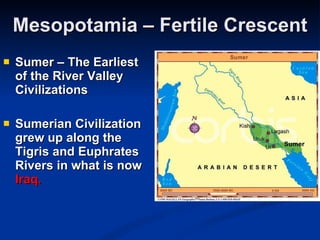
Mesopotamia – Fertile Crescent Sumer – The Earliest of the River Valley Civilizations Sumerian Civilization grew up along the Tigris and Euphrates Rivers in what is now  Iraq.
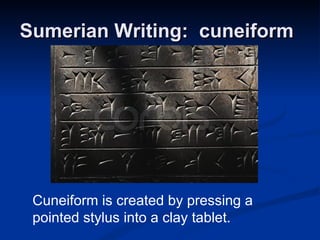
Sumerian Writing:  cuneiform   Cuneiform is created by pressing a pointed stylus into a clay tablet.
Ziggurat – Holy Mountain
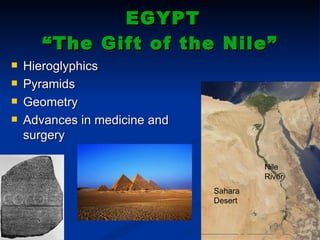
EGYPT “The Gift of the Nile” Nile River Sahara Desert Hieroglyphics Pyramids Geometry Advances in medicine and surgery
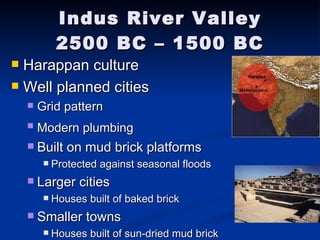
Indus River Valley 2500 BC – 1500 BC Harappan culture  Well planned cities Grid pattern Modern plumbing   Built on mud brick platforms Protected against seasonal floods Larger cities Houses built of baked brick Smaller towns Houses built of sun-dried mud brick
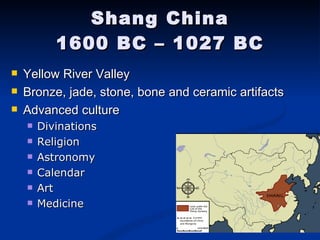
Shang China 1600 BC – 1027 BC Yellow River Valley Bronze, jade, stone, bone and ceramic artifacts  Advanced culture Divinations Religion Astronomy Calendar Art Medicine
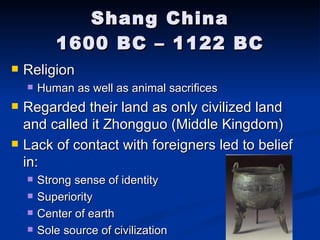
Shang China 1600 BC – 1122 BC Religion Human as well as animal sacrifices Regarded their land as only civilized land and called it Zhongguo (Middle Kingdom) Lack of contact with foreigners led to belief in: Strong sense of identity Superiority Center of earth Sole source of civilization
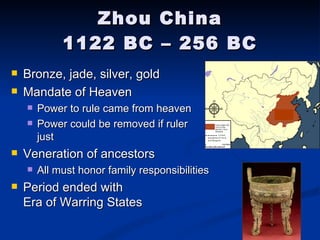
Zhou China 1122 BC – 256 BC Bronze, jade, silver, gold Mandate of Heaven Power to rule came from heaven Power could be removed if ruler    not just Veneration of ancestors All must honor family responsibilities Period ended with    Era of Warring States
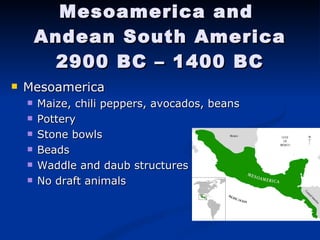
Mesoamerica and  Andean South America 2900 BC – 1400 BC Mesoamerica Maize, chili peppers, avocados, beans Pottery Stone bowls Beads Waddle and daub structures No draft animals
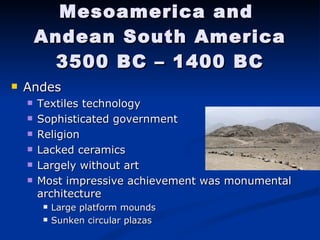
Mesoamerica and  Andean South America 3500 BC – 1400 BC Andes Textiles technology  Sophisticated government Religion  Lacked ceramics Largely without art Most impressive achievement was monumental architecture Large platform mounds  Sunken circular plazas
Civilization A civilization is built on what is required of men, not on that which is provided for them. Antoine De Saint-Exupery  1900-1944, French Writer   Increased means and increased leisure are the two civilizers of man. Benjamin   Disraeli  1804-1881, British Statesman Prime Minister To be able to fill leisure intelligently is the last product of civilization. Toynbee, Arnold 1852-1883, British Economic Historian and Reformer
Civilization Cities that served as administrative centers Political system based on control or defined territory rather than on connections of kinship Significant number of people engaged in specialized, non-food-producing activities Status distinctions, usually linked to accumulation of substantial wealth by some groups Monumental building System for keeping permanent records Long distance trade Major advances in science and arts
Civilization "All peoples from small bands of hunters and gatherers to farmers and factory workers live in societies. All societies produce cultures: combinations of the ideas, objects, and patterns of behavior that result from human social interaction. But not all societies and cultures generate the surplus production that permits the levels of specialization, scale, and complexity that distinguish civilizations from other social organizations. All people are capable of building civilizations, but many have lacked the resource base, historical circumstance, or, quite simply, the motivation of doing so.“ Peter Stearns   on culture vs. civilization
The Classical Age  (500 BCE – 600 CE) Some civilizations gained enough territory and power (iron weapons, etc) to become an empire.  The rulers of these empires constructed extensive networks of roads and promoted urbanization. Religious and philosophical systems become more complex.
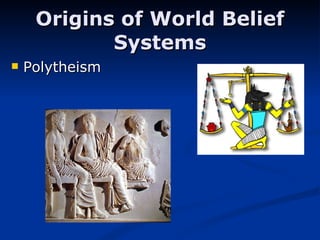
Origins of World Belief Systems Polytheism
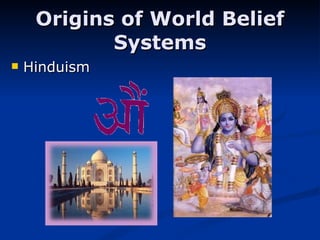
Origins of World Belief Systems Hinduism
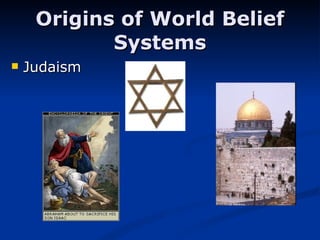
Origins of World Belief Systems Judaism
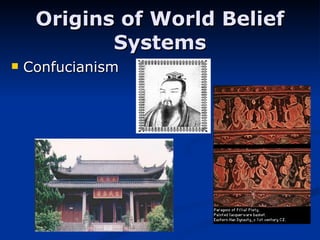
Origins of World Belief Systems Confucianism
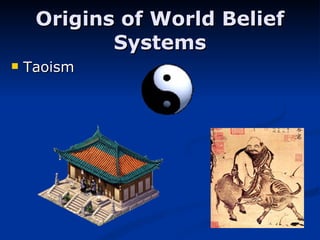
Origins of World Belief Systems Taoism
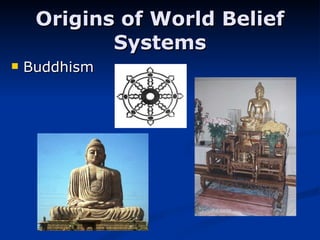
Origins of World Belief Systems Buddhism
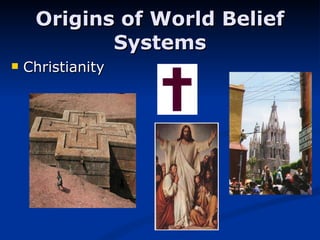
Origins of World Belief Systems Christianity
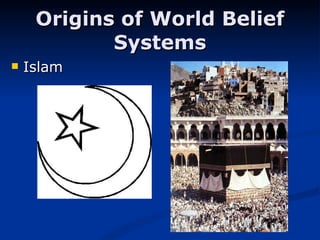
Origins of World Belief Systems Islam
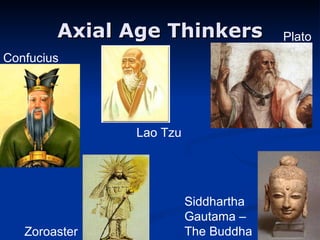
The Axial Age  (800 BCE – 300 BCE) At the beginning of the Classical Age several thinkers came along who changed history.
Axial Age Thinkers Confucius Plato Zoroaster Siddhartha Gautama – The Buddha Lao Tzu
Classical Greece
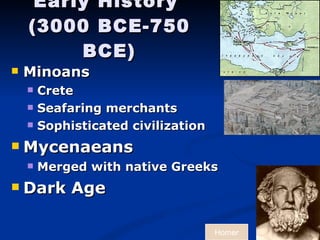
Early History   (3000 BCE-750 BCE) Minoans  Crete Seafaring merchants Sophisticated civilization Mycenaeans Merged with native Greeks Dark Age  Homer
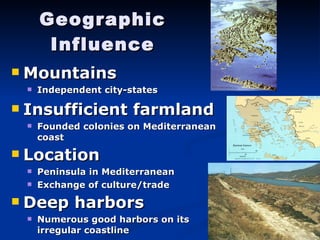
Geographic Influence Mountains Independent city-states Insufficient farmland Founded colonies on Mediterranean coast Location Peninsula in Mediterranean Exchange of culture/trade Deep harbors Numerous good harbors on its irregular coastline
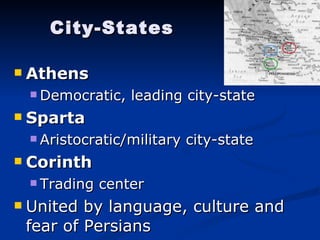
City-States Athens Democratic, leading city-state Sparta Aristocratic/military city-state Corinth Trading center United by language, culture and fear of Persians
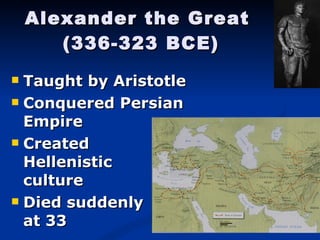
Alexander the Great  ( 336-323 BCE) Taught by Aristotle Conquered Persian Empire Created  Hellenistic  culture Died suddenly  at 33
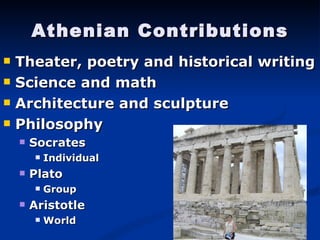
Athenian Contributions Theater, poetry and historical writing Science and math Architecture and sculpture Philosophy Socrates Individual Plato Group Aristotle World
Classical Rome
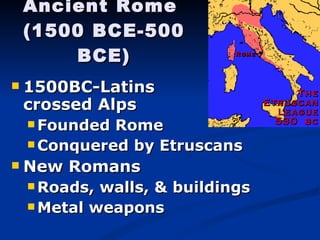
Ancient Rome  (1500 BCE-500 BCE) 1500BC-Latins    crossed Alps   Founded Rome  Conquered by Etruscans New Romans Roads, walls, & buildings Metal weapons
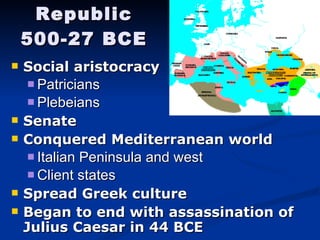
Republic 500-27 BCE Social aristocracy Patricians Plebeians Senate Conquered Mediterranean world Italian Peninsula and west Client states Spread Greek culture  Began to end with assassination of Julius Caesar in 44 BCE
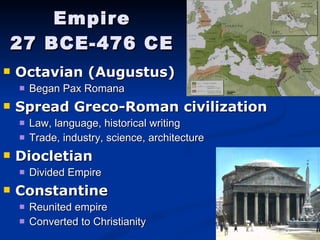
Empire 27 BCE-476 CE Octavian (Augustus)   Began Pax Romana Spread Greco-Roman civilization Law, language, historical writing Trade, industry, science, architecture Diocletian Divided Empire Constantine Reunited empire Converted to Christianity
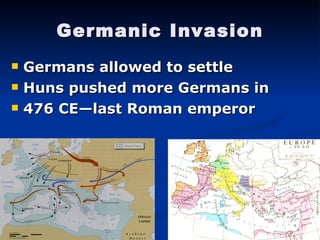
Germanic Invasion Germans allowed to settle Huns pushed more Germans in 476 CE—last Roman emperor
 
Classical China
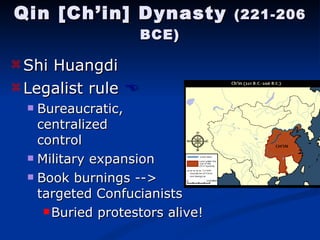
Qin [Ch’in] Dynasty  (221-206 BCE) Shi Huangdi  Legalist rule    Bureaucratic,    centralized    control Military expansion Book burnings -->    targeted Confucianists Buried protestors alive!
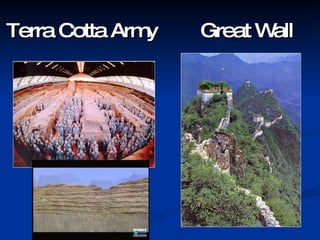
Terra Cotta Army Great Wall
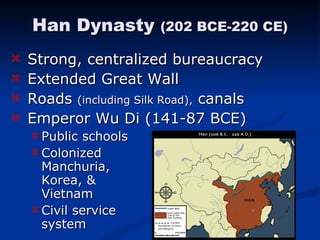
Strong, centralized bureaucracy Extended Great Wall Roads  (including Silk Road),  canals Emperor Wu Di (141-87 BCE) Public schools Colonized    Manchuria,  Korea, &    Vietnam Civil service    system Han Dynasty  (202 BCE-220 CE)
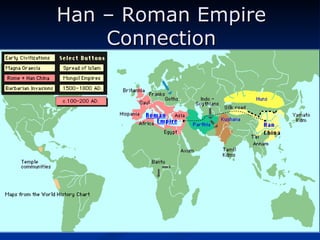
Han – Roman Empire Connection
Classical India
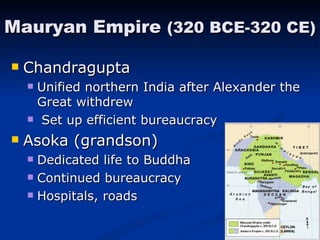
Mauryan Empire  (320 BCE-320 CE) Chandragupta  Unified northern India after Alexander the Great withdrew Set up efficient bureaucracy Asoka (grandson) Dedicated life to Buddha Continued bureaucracy Hospitals, roads
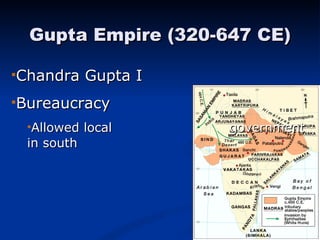
Gupta Empire (320-647 CE) Chandra Gupta I  Bureaucracy Allowed local    government in south
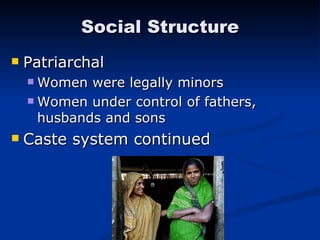
Social Structure Patriarchal Women were legally minors Women under control of fathers, husbands and sons Caste system continued
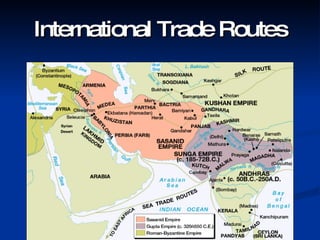
International Trade Routes
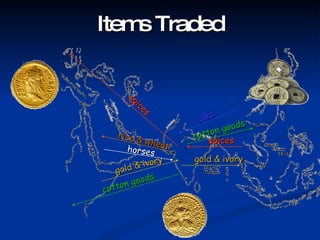
Items Traded spices spices gold & ivory gold & ivory rice & wheat horses cotton goods cotton goods silks
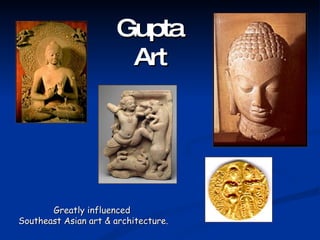
Gupta Art Greatly influenced  Southeast Asian art & architecture.
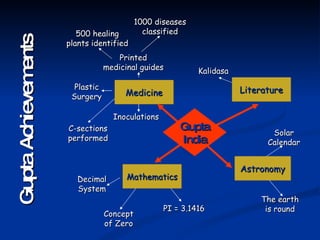
Medicine Literature Mathematics Astronomy Printed medicinal guides 1000 diseases classified Plastic Surgery C-sections performed Inoculations 500 healing plants identified Decimal System Concept of Zero PI = 3.1416 Kalidasa Solar Calendar The earth is round Gupta India Gupta Achievements
Classical Mesoamerica
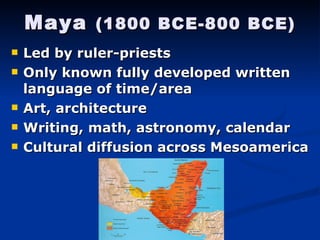
Maya  (1800 BCE-800 BCE) Led by ruler-priests Only known fully developed written language of time/area Art, architecture Writing, math, astronomy, calendar Cultural diffusion across Mesoamerica
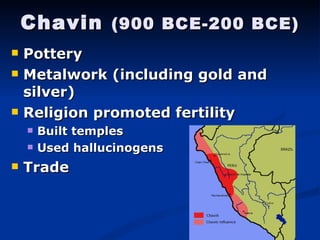
Chavin  (900 BCE-200 BCE) Pottery Metalwork (including gold and silver) Religion promoted fertility Built temples Used hallucinogens   Trade
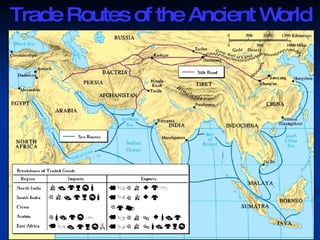
Trade Routes of the Ancient World
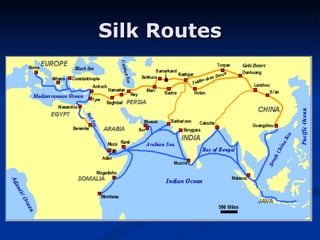
Silk Routes
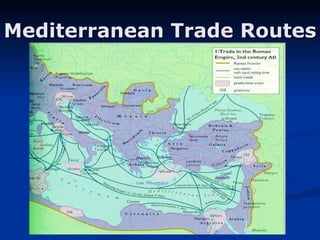
Mediterranean Trade Routes
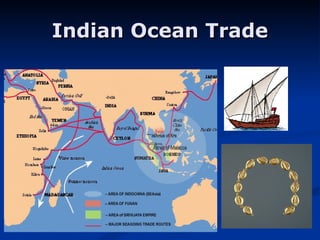
Indian Ocean Trade
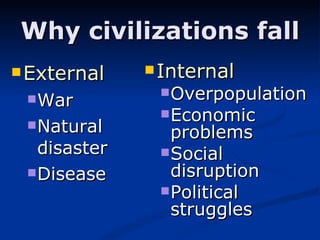
Why civilizations fall External War Natural disaster Disease Internal Overpopulation Economic problems Social disruption Political struggles
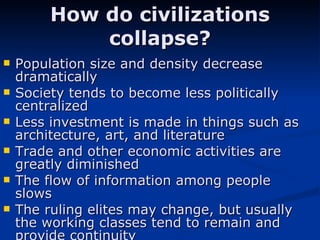
How do civilizations collapse? Population size and density decrease dramatically  Society tends to become less politically centralized  Less investment is made in things such as architecture, art, and literature  Trade and other economic activities are greatly diminished The flow of information among people slows The ruling elites may change, but usually the working classes tend to remain and provide continuity
Is it possible to prevent collapse? Every society must: answer basic biological needs of its members: food, drink, shelter, and medical care.  provide for production and distribution of goods and services (perhaps through division of labor, rules concerning property and trade, or ideas about role of work).  provide for reproduction of new members and consider laws and issues related to reproduction (regulation, marriageable age, number of children, and so on).  provide for training (education, apprenticeship, passing on of values) of individuals so that they can become functioning adults in society.  provide for maintenance of internal and external order (laws, courts, police, wars, diplomacy).  provide meaning and motivation to its members.
Unit 1—Foundations   8000 BCE  to 600 CE