The of Civilization
Prehistory - c. 2300 B.C.
What do archaeology and anthropology teach us about prehistoric humans?
What is a civilization, and how does one form?
r i
s
e
Archaeology and
Anthropology
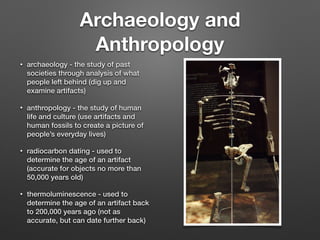
• archaeology - the study of past
societies through analysis of what
people left behind (dig up and
examine artifacts)
• anthropology - the study of human
life and culture (use artifacts and
human fossils to create a picture of
people’s everyday lives)
• radiocarbon dating - used to
determine the age of an artifact
(accurate for objects no more than
50,000 years old)
• thermoluminescence - used to
determine the age of an artifact back
to 200,000 years ago (not as
accurate, but can date further back)
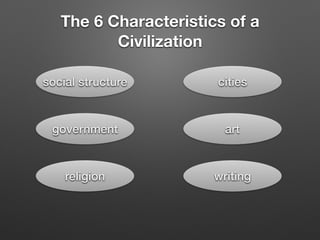
The 6 Characteristics of a
Civilization
social structure
government art
religion
cities
writing
Early Development
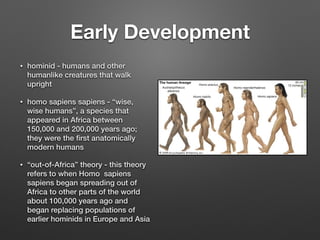
• hominid - humans and other
humanlike creatures that walk
upright
• homo sapiens sapiens - “wise,
wise humans”, a species that
appeared in Africa between
150,000 and 200,000 years ago;
they were the first anatomically
modern humans
• “out-of-Africa” theory - this theory
refers to when Homo sapiens
sapiens began spreading out of
Africa to other parts of the world
about 100,000 years ago and
began replacing populations of
earlier hominids in Europe and Asia
The Paleolithic Age
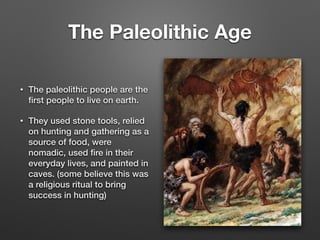
• The paleolithic people are the
first people to live on earth.
• They used stone tools, relied
on hunting and gathering as a
source of food, were
nomadic, used fire in their
everyday lives, and painted in
caves. (some believe this was
a religious ritual to bring
success in hunting)
Neolithic Peoples
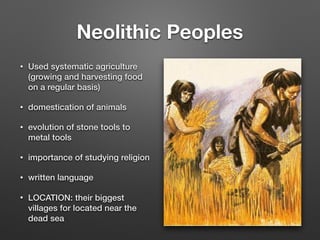
• Used systematic agriculture
(growing and harvesting food
on a regular basis)
• domestication of animals
• evolution of stone tools to
metal tools
• importance of studying religion
• written language
• LOCATION: their biggest
villages for located near the
dead sea
River Valley Civilizations
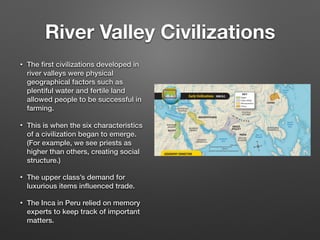
• The first civilizations developed in
river valleys were physical
geographical factors such as
plentiful water and fertile land
allowed people to be successful in
farming.
• This is when the six characteristics
of a civilization began to emerge.
(For example, we see priests as
higher than others, creating social
structure.)
• The upper class’s demand for
luxurious items influenced trade.
• The Inca in Peru relied on memory
experts to keep track of important
matters.
The Fertile Crescent /
Mesopotamia
• LOCATION: The valley between the Tigris and
Euphrates Rivers.
• Mesopotamia had rich soil and abundant crops.
• It had little rain, but because of its location, it was
enriched by thick layers of silt.
• Sometimes the Tigris and Euphrates Rivers would
overflow, so the people in the valley learned to
control the flooding by using irrigation and
drainage ditches.
• The Sumerians were the creators of the first
Mesopotamian civilization.
• They invented the arch and dome, discovered than
tin and copper make bronze, invented the wheel,
invented an advanced language (Cuneiform), and
made outstanding achievements in mathematics
and astronomy.
• They were polytheistic, or believed in many gods.
• The Mesopotamians were well known for their
metalwork.
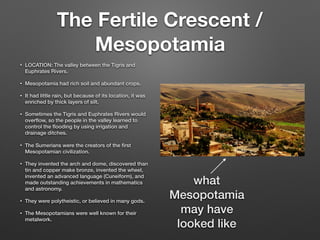
what
Mesopotamia
may have
looked like
The of Civilization
c.3100 B.C. - c.200 B.C.
How does geography affect the development of civilizations?
In what ways do civilizations influence each other?
s p
r e
a d
Egyptian Civilization
• The Egyptians praised the Nile River, the longest
river in the world, because of its ability to bring
them food and other riches.
• They used the Nile as a way to travel and trade.
• The Egyptians were polytheistic.
• They were the first dynasty.
• Ancient Egypt’s social class is a major part of
defining Egyptian society. (They had a Pharaoh at
the top of their social structure.)
• The Egyptians had arranged marriages; the
parents (mainly the father) chose who their
daughter would marry. Usually the person they
chose to marry their daughter was in the same
social class as their own family.
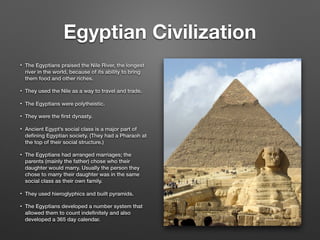
• They used hieroglyphics and built pyramids.
• The Egyptians developed a number system that
allowed them to count indefinitely and also
developed a 365 day calendar.
Peoples in the Eastern
Mediterranean
HITTITE
-domesticated animals for food and clothing
-iron weapons and tools (first Indo-Europeans to use iron)
THE PHOENICIANS
-lived along the eastern coast of the Mediterranean Sea
-TRADED and built ships
-best known for its alphabet, which was passed on to the
Greeks and from the Greek alphabet came to Roman alphabet
that we still use today
THE ISRAELITES
-Their religion (Judaism) influenced the religions of Christianity
and Islam.
-MONOTHEISTIC (believed in ONE God)
-The Israelites abided by the Ten commandments, which were
moral standards in their society.
-Jewish tradition may have impacted government.
THE MINOANS
-LOCATION: the Island of Crete
-wealthy empire (elaborate artifacts)
-based on trade
Indus Valley Civilization
• Features of India’s climate and geography:
a. Monsoons (seasonal wind pattern in Southern Asia that blows warm, moist air from the southwest
during the summer, bringing heavy rains and cold, dry air from the northeast during the winter)
b. Himalayas (the highest mountains in the world)
c. Indus and Ganges Rivers
d. Indus Valley
• LOCATION: by the Arabian Sea
• All houses contained a square courtyard surrounded but rooms.
• well-organized government
• wrote in sanskrit
• Three generations lived under the same roof.
• Extremely patriarchal (women were expected to burn themselves with their husbands if he died)
• The civilizations of the Indus Valley were very advanced.
The Shang
Dynasty
• ruled by an aristocracy
(wealth is based on land and
power is passed down
through generation)
• major concern was WAR
• royal family is the top of the
Shang society (social
structure)
• believed in supernatural
forces
• ancestor worship
• one of the longest in Chinese
history
• king was in charge
• silk is very important in Chinese
culture/trade
• What characterized China under
the Shang Dynasty? Aristocracy.
The Zhou
Dynasty
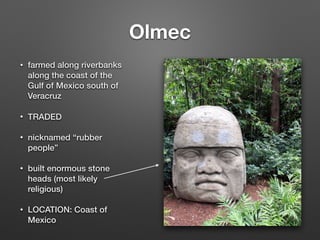
Olmec
• farmed along riverbanks
along the coast of the
Gulf of Mexico south of
Veracruz
• TRADED
• nicknamed “rubber
people”
• built enormous stone
heads (most likely
religious)
• LOCATION: Coast of
Mexico
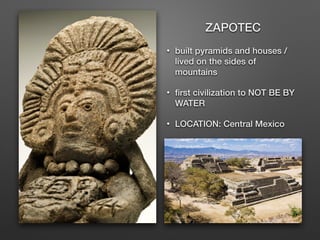
• built pyramids and houses /
lived on the sides of
mountains
• first civilization to NOT BE BY
WATER
• LOCATION: Central Mexico
ZAPOTEC
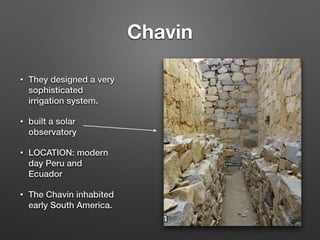
Chavin
• They designed a very
sophisticated
irrigation system.
• built a solar
observatory
• LOCATION: modern
day Peru and
Ecuador
• The Chavin inhabited
early South America.
HELPFUL STUDY SOURCES
• https://quizlet.com/149839289/history-quiz-ch-3-
sections-1-and-2-flash-cards/
• https://quizlet.com/147264896/history-test-1-flash-
cards/
Image Sources
• https://en.wikipedia.org/wiki/Lucy_(Australopithecus)
• https://www.thinglink.com/scene/486648772147806208
• https://www.pinterest.com/pin/330099847665035812/
• https://socialscienceshighlandssev.wordpress.com/page/2/
• https://www.thinglink.com/scene/661953007918776321
• http://www.7continentslist.com/mesopotamia-cradle-of-civilization.php
• https://en.wikipedia.org/wiki/Ancient_Egypt
• http://www.gogringo.com/the-olmec-civilization-of-mexico/
• http://www.123rf.com/photo_18973696_monte-alban--the-ruins-of-the-zapotec-civilization-in-oaxaca-
mexico.html
• http://news.nationalgeographic.com/news/2009/03/photogalleries/zapotec-missions/photo5.html
• http://www.joaoleitao.com/wp-content/uploads/2016/08/Chankillo-Chanquillo-Peru-18.jpg

Chapters 1 and 2 Summary

  • 1.
    The of Civilization Prehistory- c. 2300 B.C. What do archaeology and anthropology teach us about prehistoric humans? What is a civilization, and how does one form? r i s e
  • 2.
    Archaeology and Anthropology • archaeology- the study of past societies through analysis of what people left behind (dig up and examine artifacts) • anthropology - the study of human life and culture (use artifacts and human fossils to create a picture of people’s everyday lives) • radiocarbon dating - used to determine the age of an artifact (accurate for objects no more than 50,000 years old) • thermoluminescence - used to determine the age of an artifact back to 200,000 years ago (not as accurate, but can date further back)
  • 3.
    The 6 Characteristicsof a Civilization social structure government art religion cities writing
  • 4.
    Early Development • hominid- humans and other humanlike creatures that walk upright • homo sapiens sapiens - “wise, wise humans”, a species that appeared in Africa between 150,000 and 200,000 years ago; they were the first anatomically modern humans • “out-of-Africa” theory - this theory refers to when Homo sapiens sapiens began spreading out of Africa to other parts of the world about 100,000 years ago and began replacing populations of earlier hominids in Europe and Asia
  • 5.
    The Paleolithic Age •The paleolithic people are the first people to live on earth. • They used stone tools, relied on hunting and gathering as a source of food, were nomadic, used fire in their everyday lives, and painted in caves. (some believe this was a religious ritual to bring success in hunting)
  • 6.
    Neolithic Peoples • Usedsystematic agriculture (growing and harvesting food on a regular basis) • domestication of animals • evolution of stone tools to metal tools • importance of studying religion • written language • LOCATION: their biggest villages for located near the dead sea
  • 7.
    River Valley Civilizations •The first civilizations developed in river valleys were physical geographical factors such as plentiful water and fertile land allowed people to be successful in farming. • This is when the six characteristics of a civilization began to emerge. (For example, we see priests as higher than others, creating social structure.) • The upper class’s demand for luxurious items influenced trade. • The Inca in Peru relied on memory experts to keep track of important matters.
  • 8.
    The Fertile Crescent/ Mesopotamia • LOCATION: The valley between the Tigris and Euphrates Rivers. • Mesopotamia had rich soil and abundant crops. • It had little rain, but because of its location, it was enriched by thick layers of silt. • Sometimes the Tigris and Euphrates Rivers would overflow, so the people in the valley learned to control the flooding by using irrigation and drainage ditches. • The Sumerians were the creators of the first Mesopotamian civilization. • They invented the arch and dome, discovered than tin and copper make bronze, invented the wheel, invented an advanced language (Cuneiform), and made outstanding achievements in mathematics and astronomy. • They were polytheistic, or believed in many gods. • The Mesopotamians were well known for their metalwork. what Mesopotamia may have looked like
  • 9.
    The of Civilization c.3100B.C. - c.200 B.C. How does geography affect the development of civilizations? In what ways do civilizations influence each other? s p r e a d
  • 10.
    Egyptian Civilization • TheEgyptians praised the Nile River, the longest river in the world, because of its ability to bring them food and other riches. • They used the Nile as a way to travel and trade. • The Egyptians were polytheistic. • They were the first dynasty. • Ancient Egypt’s social class is a major part of defining Egyptian society. (They had a Pharaoh at the top of their social structure.) • The Egyptians had arranged marriages; the parents (mainly the father) chose who their daughter would marry. Usually the person they chose to marry their daughter was in the same social class as their own family. • They used hieroglyphics and built pyramids. • The Egyptians developed a number system that allowed them to count indefinitely and also developed a 365 day calendar.
  • 11.
    Peoples in theEastern Mediterranean HITTITE -domesticated animals for food and clothing -iron weapons and tools (first Indo-Europeans to use iron) THE PHOENICIANS -lived along the eastern coast of the Mediterranean Sea -TRADED and built ships -best known for its alphabet, which was passed on to the Greeks and from the Greek alphabet came to Roman alphabet that we still use today THE ISRAELITES -Their religion (Judaism) influenced the religions of Christianity and Islam. -MONOTHEISTIC (believed in ONE God) -The Israelites abided by the Ten commandments, which were moral standards in their society. -Jewish tradition may have impacted government. THE MINOANS -LOCATION: the Island of Crete -wealthy empire (elaborate artifacts) -based on trade
  • 12.
    Indus Valley Civilization •Features of India’s climate and geography: a. Monsoons (seasonal wind pattern in Southern Asia that blows warm, moist air from the southwest during the summer, bringing heavy rains and cold, dry air from the northeast during the winter) b. Himalayas (the highest mountains in the world) c. Indus and Ganges Rivers d. Indus Valley • LOCATION: by the Arabian Sea • All houses contained a square courtyard surrounded but rooms. • well-organized government • wrote in sanskrit • Three generations lived under the same roof. • Extremely patriarchal (women were expected to burn themselves with their husbands if he died) • The civilizations of the Indus Valley were very advanced.
  • 13.
    The Shang Dynasty • ruledby an aristocracy (wealth is based on land and power is passed down through generation) • major concern was WAR • royal family is the top of the Shang society (social structure) • believed in supernatural forces • ancestor worship • one of the longest in Chinese history • king was in charge • silk is very important in Chinese culture/trade • What characterized China under the Shang Dynasty? Aristocracy. The Zhou Dynasty
  • 14.
    Olmec • farmed alongriverbanks along the coast of the Gulf of Mexico south of Veracruz • TRADED • nicknamed “rubber people” • built enormous stone heads (most likely religious) • LOCATION: Coast of Mexico
  • 15.
    • built pyramidsand houses / lived on the sides of mountains • first civilization to NOT BE BY WATER • LOCATION: Central Mexico ZAPOTEC
  • 16.
    Chavin • They designeda very sophisticated irrigation system. • built a solar observatory • LOCATION: modern day Peru and Ecuador • The Chavin inhabited early South America.
  • 17.
    HELPFUL STUDY SOURCES •https://quizlet.com/149839289/history-quiz-ch-3- sections-1-and-2-flash-cards/ • https://quizlet.com/147264896/history-test-1-flash- cards/
  • 18.
    Image Sources • https://en.wikipedia.org/wiki/Lucy_(Australopithecus) •https://www.thinglink.com/scene/486648772147806208 • https://www.pinterest.com/pin/330099847665035812/ • https://socialscienceshighlandssev.wordpress.com/page/2/ • https://www.thinglink.com/scene/661953007918776321 • http://www.7continentslist.com/mesopotamia-cradle-of-civilization.php • https://en.wikipedia.org/wiki/Ancient_Egypt • http://www.gogringo.com/the-olmec-civilization-of-mexico/ • http://www.123rf.com/photo_18973696_monte-alban--the-ruins-of-the-zapotec-civilization-in-oaxaca- mexico.html • http://news.nationalgeographic.com/news/2009/03/photogalleries/zapotec-missions/photo5.html • http://www.joaoleitao.com/wp-content/uploads/2016/08/Chankillo-Chanquillo-Peru-18.jpg