1ESO. HISTORY
1. Ancient river civilizations
2. Ancient Egypt
2.1. The Nile
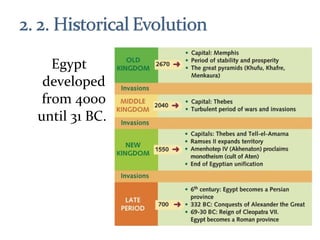
2.2. Historical evolution
2.3. Political power: the pharaohs
2.4. Egyptian society
2.5. Everyday life in ancient Egypt
2.6. Egyptian religion
2.7. Egyptian tombs
2.8. Egyptian art
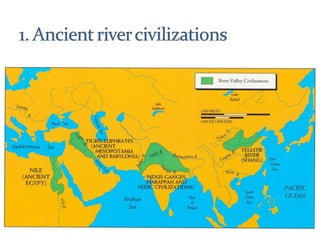
The first historical civilizations (those
that use writing) appeared on the banks of
large rivers (Tigris and Euphrates, Nile,
Indus and Huang He) around 3500 BC.
They appeared in very distinct places but
they share some characteristics:
 These rivers sometimes overflowed and
flooded the valleys, so the land produce
abundant harvest, which led population
growth.
 The villages developed into large urban
settlements.
 The need to organise life in the cities created
strong political power and hierarchical
societies.
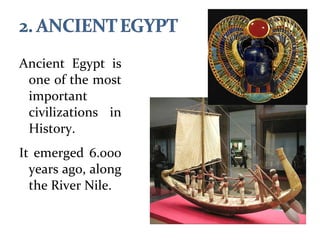
Ancient Egypt is
one of the most
important
civilizations in
History.
It emerged 6.000
years ago, along
the River Nile.
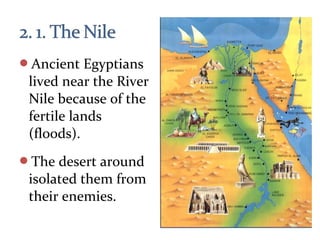
Ancient Egyptians
lived near the River
Nile because of the
fertile lands
(floods).
The desert around
isolated them from
their enemies.
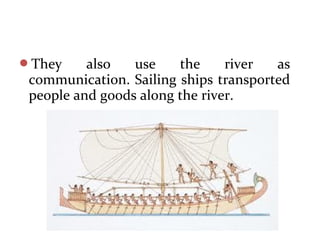
They also use the river as
communication. Sailing ships transported
people and goods along the river.
They had a god to
represent the River Nile
(Hati).
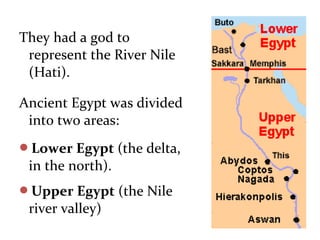
Ancient Egypt was divided
into two areas:
Lower Egypt (the delta,
in the north).
Upper Egypt (the Nile
river valley)
Egypt
developed
from 4000
until 31 BC.
Draw a timeline in you notebooks with the
historical evolution we’ve studied.
Egyptians called their king pharaoh.
He had absolute power  he controlled
everything: laws, land, trade, armies…
The pharaoh was a god:
 Nobody touched his body.
 Nobody could look at the pharaoh face.
 They believed that he had magical powers.
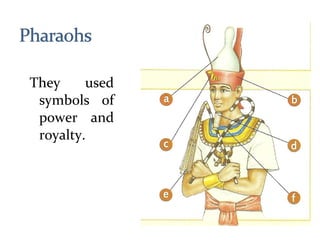
They used
symbols of
power and
royalty.
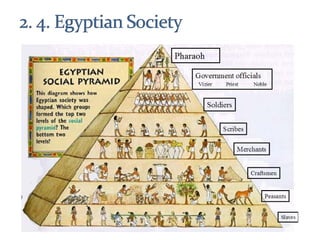
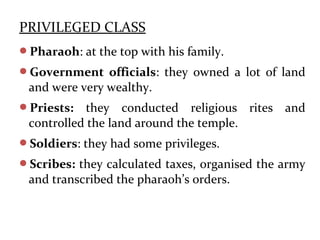
PRIVILEGED CLASS
Pharaoh: at the top with his family.
Government officials: they owned a lot of land
and were very wealthy.
Priests: they conducted religious rites and
controlled the land around the temple.
Soldiers: they had some privileges.
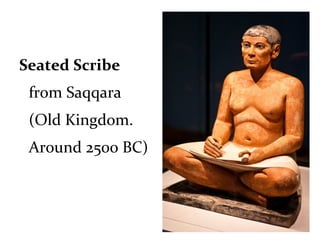
Scribes: they calculated taxes, organised the army
and transcribed the pharaoh’s orders.
Seated Scribe
from Saqqara
(Old Kingdom.
Around 2500 BC)
The COMMON PEOPLE (majority of the population)
Merchants: sold goods (textiles, perfumes,
wood…)
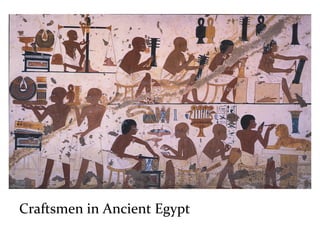
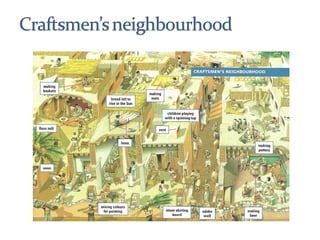
Craftsmen: they produced the things that
merchants sold (textiles, pottery, papyrus, etc.)
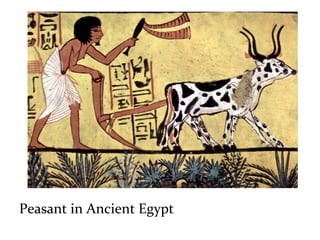
Peasants: they had to work the land belonged to
the pharaoh, the nobles and the temples. They also
helped build pyramids and temples without any
compensation.
Servants: free people who earned a low salary.
Slaves: no rights at all. They were war prisoners.
Craftsmen in Ancient Egypt
Peasant in Ancient Egypt
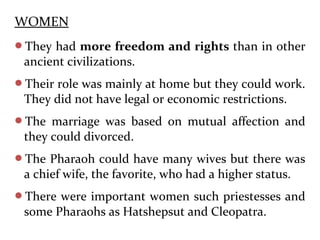
WOMEN
They had more freedom and rights than in other
ancient civilizations.
Their role was mainly at home but they could work.
They did not have legal or economic restrictions.
The marriage was based on mutual affection and
they could divorced.
The Pharaoh could have many wives but there was
a chief wife, the favorite, who had a higher status.
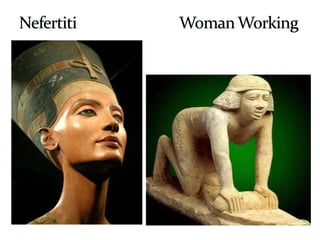
There were important women such priestesses and
some Pharaohs as Hatshepsut and Cleopatra.
Draw a diagram showing the different social groups of
Ancient Egypt.
Why were scribes part of the privileged class?
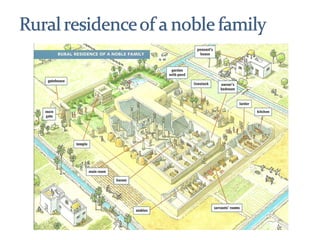
Wealthy people had residences made of
stone surrounded by high walls. These large
houses and many rooms and buildings.
There were few cities. The city was where
the pharaoh and the nobles lived, the cities
also attracted traders and craftsmen from all
over Egypt.
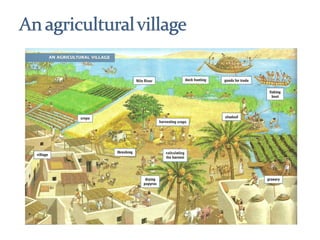
Most people in Ancient Egypt had a very
simple diet. Their staple foods were beer and
bread together with dried fish, lentils and peas.
They also ate fruit (figs and grapes) and used
honey and dates as natural sweeteners.
The wealthy had much more varied diets that
included meat and vegetables.
Egyptian clothing was also very simple.
Children were usually naked, women wore a
linen robe and men wore a cloth tied at the
waist with a belt.
The wealthy wore jewels, diadems…
How were the houses of the wealthy people
different form those of peasants?
Why do you think traders and craftsmen
settled in cities?
Draw a table and classify the foods in Ancient
Egypt according to the different social groups.
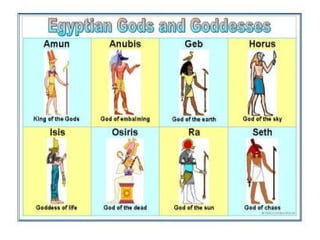
They were polytheistic.
They had a lot of gods:
Important gods: Ra (the Sun), Osiris (dead), Isis
(fertility), Horus (war), Anubis (underworld)…
Certain animals, such as the crocodile.
Natural features, e. g. River Nile.
People, such as the pharaoh.
• Each god had a temple, a feast day and rituals.
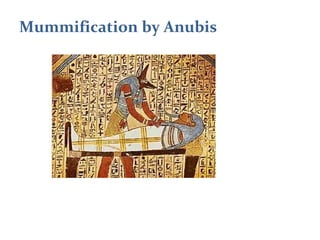
Mummification by Anubis
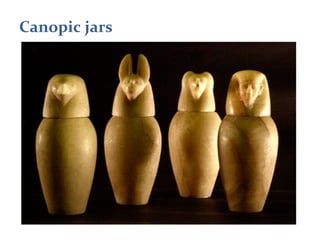
Canopic jars
Activities
Match the names with the
description:
Osiris
Isis
Horus
Anubis
Ra
Fertility
War
Underworld
Dead
Sun god
Put the following actions in chronological order:
•The dead presented themselves for the Judgement of
Osiris
•Offerings and statues were placed in the tombs of dead
•The body was mummified
•The soul passed into the afterlife.
ARCHITECTURE
Colossal size.
Made of stone.
There were two types of buildings:
Tombs.
Temples: homes of the gods.
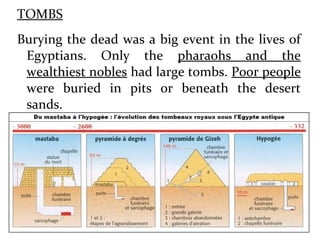
TOMBS
Burying the dead was a big event in the lives of
Egyptians. Only the pharaohs and the
wealthiest nobles had large tombs. Poor people
were buried in pits or beneath the desert
sands.
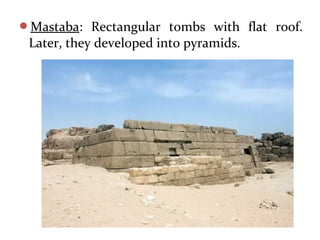
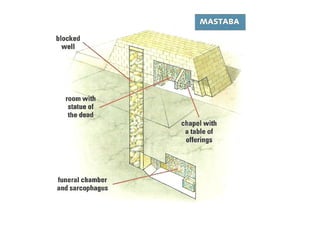
Mastaba: Rectangular tombs with flat roof.
Later, they developed into pyramids.
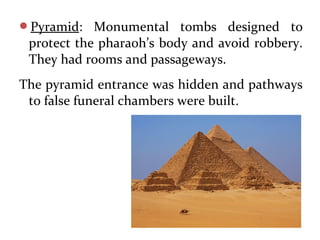
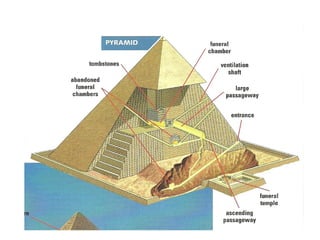
Pyramid: Monumental tombs designed to
protect the pharaoh’s body and avoid robbery.
They had rooms and passageways.
The pyramid entrance was hidden and pathways
to false funeral chambers were built.
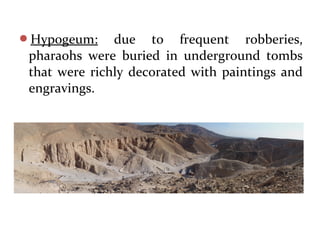
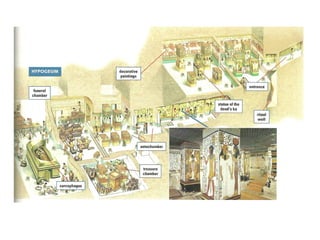
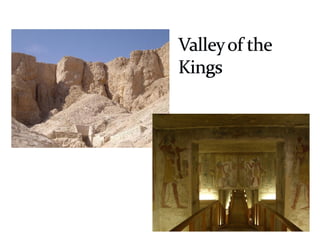
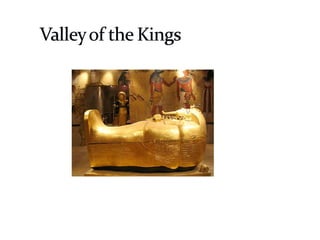
Hypogeum: due to frequent robberies,
pharaohs were buried in underground tombs
that were richly decorated with paintings and
engravings.
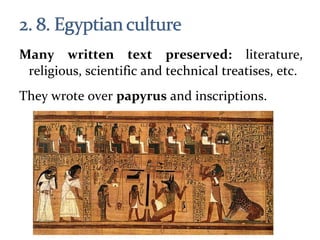
Many written text preserved: literature,
religious, scientific and technical treatises, etc.
They wrote over papyrus and inscriptions.
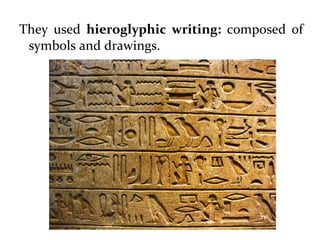
They used hieroglyphic writing: composed of
symbols and drawings.
They had elementary mathematics and geometry.
They had advance medicine for the times. They
had simple surgery and they could treat
fractures.
They also created a calendar that divided the year
in 365 days and every day had 24 hours.
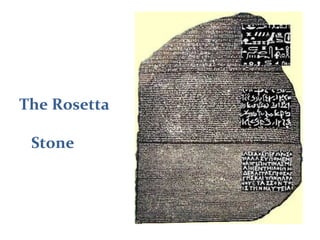
We can understand the hieroglyphic writing
thanks to the Rosetta Stone.
The Rosetta
Stone
http://www.hyperstaffs.info/work/history/nixon/versions/flashindex.html
http://www.historyonthenet.com/Egyptians/egyptiansmain.htm

Egypt

  • 1.
  • 2.
    1. Ancient rivercivilizations 2. Ancient Egypt 2.1. The Nile 2.2. Historical evolution 2.3. Political power: the pharaohs 2.4. Egyptian society 2.5. Everyday life in ancient Egypt 2.6. Egyptian religion 2.7. Egyptian tombs 2.8. Egyptian art
  • 5.
    The first historicalcivilizations (those that use writing) appeared on the banks of large rivers (Tigris and Euphrates, Nile, Indus and Huang He) around 3500 BC. They appeared in very distinct places but they share some characteristics:
  • 6.
     These riverssometimes overflowed and flooded the valleys, so the land produce abundant harvest, which led population growth.  The villages developed into large urban settlements.  The need to organise life in the cities created strong political power and hierarchical societies.
  • 7.
    Ancient Egypt is oneof the most important civilizations in History. It emerged 6.000 years ago, along the River Nile.
  • 8.
    Ancient Egyptians lived nearthe River Nile because of the fertile lands (floods). The desert around isolated them from their enemies.
  • 9.
    They also usethe river as communication. Sailing ships transported people and goods along the river.
  • 10.
    They had agod to represent the River Nile (Hati). Ancient Egypt was divided into two areas: Lower Egypt (the delta, in the north). Upper Egypt (the Nile river valley)
  • 11.
  • 12.
    Draw a timelinein you notebooks with the historical evolution we’ve studied.
  • 13.
    Egyptians called theirking pharaoh. He had absolute power  he controlled everything: laws, land, trade, armies… The pharaoh was a god:  Nobody touched his body.  Nobody could look at the pharaoh face.  They believed that he had magical powers.
  • 14.
  • 16.
    PRIVILEGED CLASS Pharaoh: atthe top with his family. Government officials: they owned a lot of land and were very wealthy. Priests: they conducted religious rites and controlled the land around the temple. Soldiers: they had some privileges. Scribes: they calculated taxes, organised the army and transcribed the pharaoh’s orders.
  • 17.
    Seated Scribe from Saqqara (OldKingdom. Around 2500 BC)
  • 18.
    The COMMON PEOPLE(majority of the population) Merchants: sold goods (textiles, perfumes, wood…) Craftsmen: they produced the things that merchants sold (textiles, pottery, papyrus, etc.) Peasants: they had to work the land belonged to the pharaoh, the nobles and the temples. They also helped build pyramids and temples without any compensation. Servants: free people who earned a low salary. Slaves: no rights at all. They were war prisoners.
  • 19.
  • 20.
  • 21.
    WOMEN They had morefreedom and rights than in other ancient civilizations. Their role was mainly at home but they could work. They did not have legal or economic restrictions. The marriage was based on mutual affection and they could divorced. The Pharaoh could have many wives but there was a chief wife, the favorite, who had a higher status. There were important women such priestesses and some Pharaohs as Hatshepsut and Cleopatra.
  • 23.
    Draw a diagramshowing the different social groups of Ancient Egypt. Why were scribes part of the privileged class?
  • 26.
    Wealthy people hadresidences made of stone surrounded by high walls. These large houses and many rooms and buildings. There were few cities. The city was where the pharaoh and the nobles lived, the cities also attracted traders and craftsmen from all over Egypt.
  • 29.
    Most people inAncient Egypt had a very simple diet. Their staple foods were beer and bread together with dried fish, lentils and peas. They also ate fruit (figs and grapes) and used honey and dates as natural sweeteners. The wealthy had much more varied diets that included meat and vegetables.
  • 30.
    Egyptian clothing wasalso very simple. Children were usually naked, women wore a linen robe and men wore a cloth tied at the waist with a belt. The wealthy wore jewels, diadems…
  • 31.
    How were thehouses of the wealthy people different form those of peasants? Why do you think traders and craftsmen settled in cities? Draw a table and classify the foods in Ancient Egypt according to the different social groups.
  • 32.
    They were polytheistic. Theyhad a lot of gods: Important gods: Ra (the Sun), Osiris (dead), Isis (fertility), Horus (war), Anubis (underworld)… Certain animals, such as the crocodile. Natural features, e. g. River Nile. People, such as the pharaoh. • Each god had a temple, a feast day and rituals.
  • 35.
  • 36.
  • 37.
    Activities Match the nameswith the description: Osiris Isis Horus Anubis Ra Fertility War Underworld Dead Sun god Put the following actions in chronological order: •The dead presented themselves for the Judgement of Osiris •Offerings and statues were placed in the tombs of dead •The body was mummified •The soul passed into the afterlife.
  • 38.
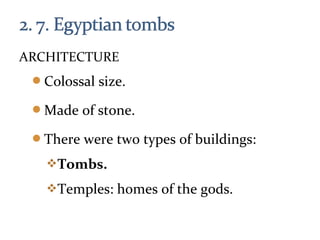
    ARCHITECTURE Colossal size. Made ofstone. There were two types of buildings: Tombs. Temples: homes of the gods.
  • 39.
    TOMBS Burying the deadwas a big event in the lives of Egyptians. Only the pharaohs and the wealthiest nobles had large tombs. Poor people were buried in pits or beneath the desert sands.
  • 40.
    Mastaba: Rectangular tombswith flat roof. Later, they developed into pyramids.
  • 42.
    Pyramid: Monumental tombsdesigned to protect the pharaoh’s body and avoid robbery. They had rooms and passageways. The pyramid entrance was hidden and pathways to false funeral chambers were built.
  • 44.
    Hypogeum: due tofrequent robberies, pharaohs were buried in underground tombs that were richly decorated with paintings and engravings.
  • 48.
    Many written textpreserved: literature, religious, scientific and technical treatises, etc. They wrote over papyrus and inscriptions.
  • 49.
    They used hieroglyphicwriting: composed of symbols and drawings.
  • 50.
    They had elementarymathematics and geometry. They had advance medicine for the times. They had simple surgery and they could treat fractures. They also created a calendar that divided the year in 365 days and every day had 24 hours. We can understand the hieroglyphic writing thanks to the Rosetta Stone.
  • 51.
  • 52.