Next 
World History: Ancient Civilizations Through the Renaissance 
Chapter 4 
Geography and Ancient Egypt 
The Big Idea 
The water, fertile soils, and protected setting of the Nile Valley allowed a 
great civilization to arise in Egypt around 3200 BC. 
Main Ideas 
• Egypt was called the gift of the Nile because the Nile River gave life to the desert. 
• Civilization developed along the Nile after people began farming in this region. 
• Strong kings unified all of Egypt. 
Copyright © by Houghton Mifflin Harcourt Publishing Company
World History: Ancient Civilizations Through the Renaissance 
Chapter 4 
Main Idea 1: Egypt was called the gift of the Nile because the Nile River gave life to 
the desert. 
• The Nile River brought life to Egypt and 
allowed it to thrive. 
• Biannual flooding of the Nile made farming 
Copyright © by Houghton Mifflin Harcourt Publishing Company 
Next 
Previous 
possible.
World History: Ancient Civilizations Through the Renaissance 
Chapter 4 
Features of the Nile 
• The Nile is the longest river in the world, with a 
Copyright © by Houghton Mifflin Harcourt Publishing Company 
Next 
Previous 
distance of over 4,000 miles. 
• Ancient Egypt included two regions, a southern and 
a northern region, that were given their names by 
their relation to the Nile. 
• At several points, the rough terrain caused 
cataracts, or rapids, to form. 
• The Nile divided into several branches, forming a 
delta, a triangular area of land made from soil 
deposited by a river.
World History: Ancient Civilizations Through the Renaissance 
Chapter 4 
The Floods of the Nile 
Copyright © by Houghton Mifflin Harcourt Publishing Company 
Next 
Previous 
• Little rain fell in the Egyptian desert, but the 
Nile flooded every year in the summer and 
fall. 
•The Nile’s flooding coated the land around it 
with a rich silt that made the soil ideal for 
farming. 
• Without the floods, people could never have 
farmed in Egypt.
World History: Ancient Civilizations Through the Renaissance 
Chapter 4 
Main Idea 2: Civilization developed along the Nile after people began farming in 
this region. 
Copyright © by Houghton Mifflin Harcourt Publishing Company 
Next 
Previous 
• The Nile provided both water and 
fertile soil for farming. 
• Egypt’s location offered another 
advantage because it had natural 
barriers that made it hard to invade.
World History: Ancient Civilizations Through the Renaissance 
Chapter 4 
Canals were built 
to carry water to 
fields of wheat, 
barley, fruits, and 
vegetables. 
Copyright © by Houghton Mifflin Harcourt Publishing Company 
Next 
Previous 
• The Nile allowed 
farmers to raise 
animals such as 
cattle and sheep. 
• The river also 
provided many 
types of fish to 
eat, and hunters 
trapped ducks 
and geese. 
• Natural barriers 
made Egypt hard to 
invade. 
• Desert in the west 
was too big and 
harsh to cross. 
• Mediterranean and 
Red Sea provided 
protection from 
invasion. 
• Cataracts in the 
Nile made it 
difficult to invade 
from the south. 
Nile Valley
World History: Ancient Civilizations Through the Renaissance 
Chapter 4 
Main Idea 3: Strong kings unified all of Egypt. 
• According to tradition, Menes rose to power in 
Copyright © by Houghton Mifflin Harcourt Publishing Company 
Next 
Previous 
Upper Egypt and unified the two kingdoms by 
taking control of Lower Egypt and by marrying a 
Lower Egyptian princess. 
• Menes was probably Egypt’s first pharaoh, the title 
used by the rulers of Egypt. 
• He also founded Egypt’s first dynasty, or series of 
rulers from the same family. 
• The First Dynasty lasted for about 200 years and 
extended Egyptian territory southward along the 
Nile.
World History: Ancient Civilizations Through the Renaissance 
Chapter 4 
The Old Kingdom 
The Big Idea 
Copyright © by Houghton Mifflin Harcourt Publishing Company 
Next 
Previous 
Egyptian government and religion were closely connected during the Old 
Kingdom. 
Main Ideas 
• In early Egyptian society, pharaohs ruled as gods and were at the top of the social 
structure. 
• Religion shaped Egyptian life. 
• The pyramids of Egypt were built as tombs for the pharaohs.
World History: Ancient Civilizations Through the Renaissance 
Chapter 4 
Main Idea 1: In early Egyptian society, pharaohs ruled as gods and were at the top of 
the social structure. 
• The Old Kingdom was a period in which the 
Copyright © by Houghton Mifflin Harcourt Publishing Company 
Next 
Previous 
Egyptians developed a system based on the 
belief that the pharaoh was both a king and 
a god. 
• As the population grew, social classes 
appeared. 
• Egypt began to trade goods with its 
neighbors.
World History: Ancient Civilizations Through the Renaissance 
Chapter 4 
Egyptian Society 
Copyright © by Houghton Mifflin Harcourt Publishing Company 
Next 
Previous 
Social classes 
–Pharaohs ruled Egypt as gods. 
–Many nobles, or people from rich and powerful 
families, were officials and priests who helped 
run the government. 
–Scribes and craftspeople wrote and produced 
goods. 
–Farmers, servants, and slaves made up most of 
Egyptian society.
World History: Ancient Civilizations Through the Renaissance 
Chapter 4 
The Egyptians 
had gods for 
nearly everything, 
including the sun, 
the sky, and the 
earth. These 
gods would often 
mix human and 
animal forms. 
Copyright © by Houghton Mifflin Harcourt Publishing Company 
Next 
Previous 
Egyptian religion 
focused on the 
afterlife, or life 
after death. 
They believed 
that when a 
person died, his 
or her ka left the 
body and became 
a spirit. 
- developed 
embalming to 
preserve 
bodies 
- bodies were 
specially 
treated and 
wrapped in 
cloth were 
called 
mummies. 
Main Idea 2: Religion shaped Egyptian life.
World History: Ancient Civilizations Through the Renaissance 
Chapter 4 
Main Idea 3: The pyramids of Egypt were built as tombs for the pharaohs. 
Copyright © by Houghton Mifflin Harcourt Publishing Company 
Next 
Previous 
Pyramids are 
huge stone tombs 
with four 
triangular sides 
The size and shape of 
the pyramids showed 
the importance of 
pharaohs. They were 
the people’s link to 
the gods, so the 
Egyptians wanted 
their spirits to be 
happy.
World History: Ancient Civilizations Through the Renaissance 
Chapter 4 
The Middle and New Kingdoms 
The Big Idea 
Copyright © by Houghton Mifflin Harcourt Publishing Company 
Next 
Previous 
During the Middle and New Kingdoms, order and greatness were restored in 
Egypt. 
Main Ideas 
• The Middle Kingdom was a period of stable government between periods of 
disorder. 
• In the New Kingdom, Egyptian trade and military power reached their peak, but 
Egypt’s greatness did not last. 
• Work and daily life were different for each of Egypt’s social classes.
World History: Ancient Civilizations Through the Renaissance 
Chapter 4 
Main Idea 2: In the New Kingdom, Egyptian trade and military power reached their 
peak, but Egypt’s greatness did not last. 
Copyright © by Houghton Mifflin Harcourt Publishing Company 
Next 
Previous 
• Fearing future invasions, the Egyptians took 
control of all possible invasion routes into 
the kingdom. 
• Egypt took over vast lands and was the 
leading military power in the area. 
• Egypt became rich because of the lands it 
conquered.
World History: Ancient Civilizations Through the Renaissance 
Chapter 4 
Growth and Effects of Trade 
Copyright © by Houghton Mifflin Harcourt Publishing Company 
Next 
Previous 
• Conquests brought traders into contact with 
distant lands, and trade routes, or paths 
followed by traders, developed. 
• Queen Hatshepsut encouraged trade and 
used the profits to support the arts and 
architecture. 
• Ramses the Great wanted to expand the 
empire which left it diminished.
World History: Ancient Civilizations Through the Renaissance 
Chapter 4 
Main Idea 3: Work and daily life were different for each of Egypt’s social 
classes. 
Copyright © by Houghton Mifflin Harcourt Publishing Company 
Next 
Previous 
• Family life was very important in Egyptian 
society, and most Egyptians lived in their 
own homes. 
–Women had many legal rights, including 
owning property, making contracts, and 
divorcing their husbands.
World History: Ancient Civilizations Through the Renaissance 
Chapter 4 
Copyright © by Houghton Mifflin Harcourt Publishing Company 
Next 
Previous 
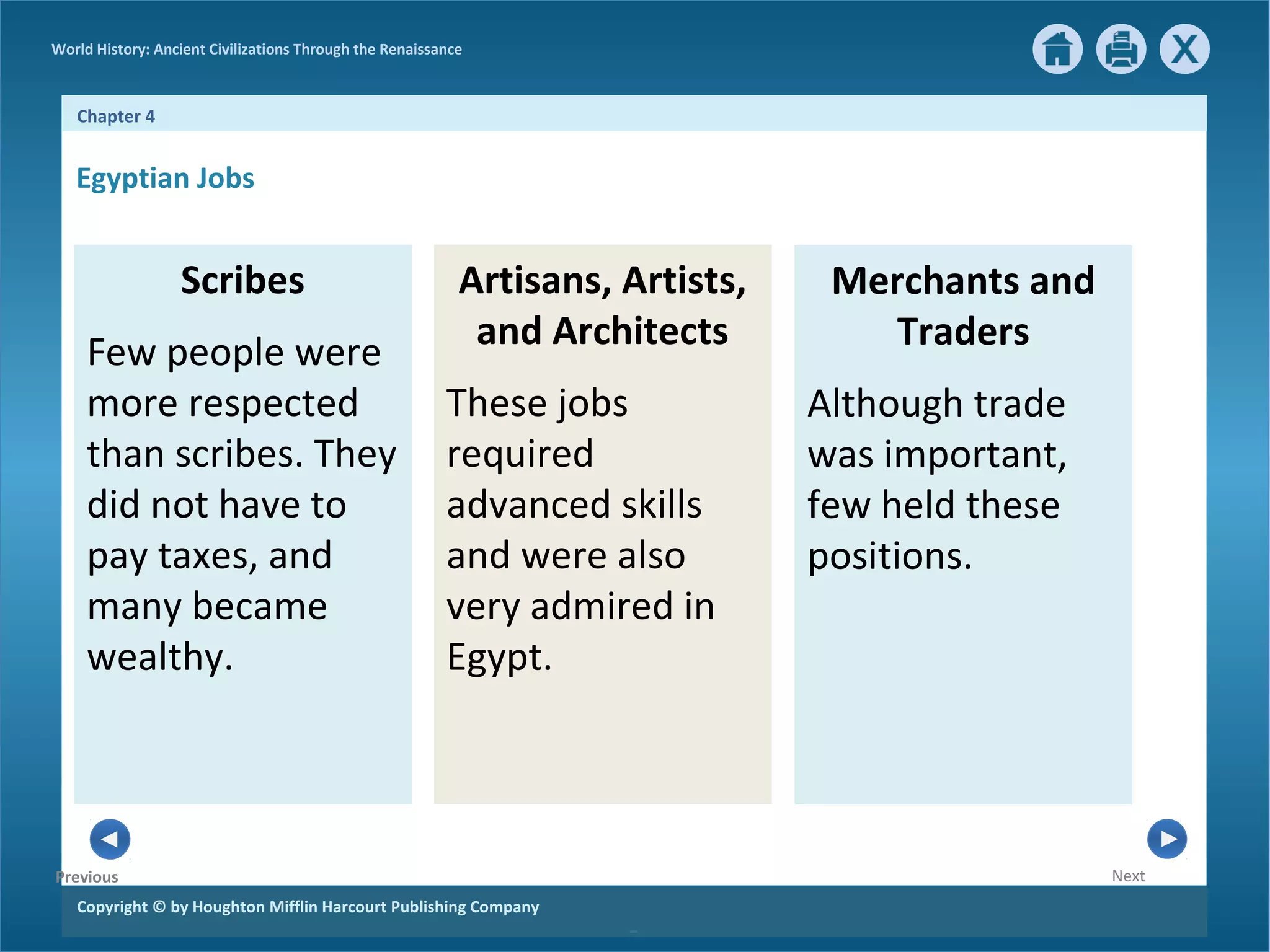
Scribes 
Few people were 
more respected 
than scribes. They 
did not have to 
pay taxes, and 
many became 
wealthy. 
Artisans, Artists, 
and Architects 
These jobs 
required 
advanced skills 
and were also 
very admired in 
Egypt. 
Merchants and 
Traders 
Although trade 
was important, 
few held these 
positions. 
Egyptian Jobs
World History: Ancient Civilizations Through the Renaissance 
Chapter 4 
Copyright © by Houghton Mifflin Harcourt Publishing Company 
Next 
Previous 
Soldiers 
Egypt created a 
permanent army 
that offered 
soldiers a chance 
to rise in social 
status and 
receive land as 
payment. 
Farmers and 
Other Peasants 
This group made 
up the vast 
majority of the 
population. They 
grew crops to 
support their 
families and to 
pay taxes. 
Slaves 
Slaves were 
usually criminals 
or prisoners. 
They had some 
legal rights. 
Additional Egyptian Jobs
World History: Ancient Civilizations Through the Renaissance 
Chapter 4 
Egyptian Achievements 
The Big Idea 
Copyright © by Houghton Mifflin Harcourt Publishing Company 
Next 
Previous 
The Egyptians made lasting achievements in writing, architecture, and art. 
Main Ideas 
• The Egyptians developed a writing system using hieroglyphics. 
• The Egyptians created magnificent temples, tombs, and 
works of art.
World History: Ancient Civilizations Through the Renaissance 
Chapter 4 
Main Idea 1: The Egyptians developed a writing system using hieroglyphics. 
• Hieroglyphics was the 
Egyptian writing system. 
• Egyptians learned to 
write hieroglyphics on 
papyrus, a long-lasting, 
paper like material made 
from reeds. 
Copyright © by Houghton Mifflin Harcourt Publishing Company 
Next 
Previous 
• Historians learned how to 
read hieroglyphics after 
discovering the Rosetta 
Stone, which was written 
in three languages. 
–Hieroglyphics 
–A later form of 
Egyptian 
–Greek
World History: Ancient Civilizations Through the Renaissance 
Chapter 4 
Ancient Kush 
The Big Idea 
The kingdom of Kush, which arose south of Egypt in a land called Nubia, 
developed an advanced civilization with a large trading network. 
Main Ideas 
Copyright © by Houghton Mifflin Harcourt Publishing Company 
Next 
Previous 
• The geography of early Nubia helped civilization develop there. 
• Kush and Egypt traded, but they also fought. 
• Later Kush became a trading power with a unique culture. 
• Both internal and external factors led to the decline of Kush.
World History: Ancient Civilizations Through the Renaissance 
Chapter 4 
Main Idea 1: The geography of early Nubia helped civilization develop there. 
• A group of people called the Kushites settled 
Copyright © by Houghton Mifflin Harcourt Publishing Company 
Next 
Previous 
in a region now called Nubia and 
established the first large kingdom in the 
interior of Africa. 
• The development of the Kushite civilization 
was greatly influenced by geography
World History: Ancient Civilizations Through the Renaissance 
Chapter 4 
• Ancient Nubia was fertile 
Copyright © by Houghton Mifflin Harcourt Publishing Company 
Next 
Previous 
due to annual flooding. 
• It was rich in valuable 
minerals that 
contributed to its wealth. 
–Gold 
–Copper 
–Stone 
• The capital city of Kerma 
was protected from 
invaders by the cataracts 
of the Nile River. 
Nubia
World History: Ancient Civilizations Through the Renaissance 
Chapter 4 
Main Idea 2: Kush and Egypt traded, but they also fought. 
Copyright © by Houghton Mifflin Harcourt Publishing Company 
Next 
Previous 
- Egypt and Kush 
traded with each 
other 
- relations between 
Kush and Egypt 
became hostile 
- Egypt feared that 
Kush would 
become too 
powerful, so it 
invaded and 
conquered Kush 
During a time of 
decline in Egypt, 
Kushite leaders 
regained control 
of Kush, 
becoming 
independent 
again.
World History: Ancient Civilizations Through the Renaissance 
Chapter 4 
Kush Regains Power 
Copyright © by Houghton Mifflin Harcourt Publishing Company 
Next 
Previous 
• Kush regained its 
strength and 
conquered Egypt 
under the 
direction of 
Kashta and his 
son Piankhi. 
• By 751 BC the 
Kushite king 
Kashta had 
conquered Upper 
Egypt. 
The Kushite 
Dynasty 
remained strong 
until the 
Assyrians drove 
them out of 
Egypt in the 670s 
BC.
World History: Ancient Civilizations Through the Renaissance 
Chapter 4 
Main Idea 3: Later Kush became a trading power with a unique culture. 
Copyright © by Houghton Mifflin Harcourt Publishing Company 
Next 
Previous 
Kush devoted 
itself to 
increasing 
agriculture and 
trade. Within a 
few centuries, it 
became a rich 
and powerful 
kingdom again. 
• Resources 
such as iron 
ore and wood 
for furnaces 
helped the 
industry grow 
quickly.
World History: Ancient Civilizations Through the Renaissance 
Chapter 4 
Kushite Culture 
Kushite culture 
was influenced 
by Egypt. They 
worshipped 
Egyptian gods, 
built pyramids, 
wore Egyptian 
clothing, and had 
rulers called 
pharaohs. 
Copyright © by Houghton Mifflin Harcourt Publishing Company 
Next 
Previous 
• They developed 
their own written 
language, called 
Meroitic. 
The women of Kush 
were expected to be 
as active in society 
as the men. Some 
rose to positions of 
authority and 
power, especially 
religious authority.
World History: Ancient Civilizations Through the Renaissance 
Chapter 4 
Main Idea 4: Both internal and external factors led to the decline of Kush. 
Copyright © by Houghton Mifflin Harcourt Publishing Company 
Next 
Previous 
Loss of Resources 
–Cattle overgrazed the land, leaving nothing to hold the soil 
down and allowing it to blow away. 
–Ironmakers used up the forests near Meroë. Military 
power declined when weapons were not produced. 
Trade Rivals 
–Merchants set up new trade routes that went around 
Kush, weakening its trade.

Ch.4 ancient egypt and kush

  • 1.
    Next World History:Ancient Civilizations Through the Renaissance Chapter 4 Geography and Ancient Egypt The Big Idea The water, fertile soils, and protected setting of the Nile Valley allowed a great civilization to arise in Egypt around 3200 BC. Main Ideas • Egypt was called the gift of the Nile because the Nile River gave life to the desert. • Civilization developed along the Nile after people began farming in this region. • Strong kings unified all of Egypt. Copyright © by Houghton Mifflin Harcourt Publishing Company
  • 2.
    World History: AncientCivilizations Through the Renaissance Chapter 4 Main Idea 1: Egypt was called the gift of the Nile because the Nile River gave life to the desert. • The Nile River brought life to Egypt and allowed it to thrive. • Biannual flooding of the Nile made farming Copyright © by Houghton Mifflin Harcourt Publishing Company Next Previous possible.
  • 3.
    World History: AncientCivilizations Through the Renaissance Chapter 4 Features of the Nile • The Nile is the longest river in the world, with a Copyright © by Houghton Mifflin Harcourt Publishing Company Next Previous distance of over 4,000 miles. • Ancient Egypt included two regions, a southern and a northern region, that were given their names by their relation to the Nile. • At several points, the rough terrain caused cataracts, or rapids, to form. • The Nile divided into several branches, forming a delta, a triangular area of land made from soil deposited by a river.
  • 4.
    World History: AncientCivilizations Through the Renaissance Chapter 4 The Floods of the Nile Copyright © by Houghton Mifflin Harcourt Publishing Company Next Previous • Little rain fell in the Egyptian desert, but the Nile flooded every year in the summer and fall. •The Nile’s flooding coated the land around it with a rich silt that made the soil ideal for farming. • Without the floods, people could never have farmed in Egypt.
  • 5.
    World History: AncientCivilizations Through the Renaissance Chapter 4 Main Idea 2: Civilization developed along the Nile after people began farming in this region. Copyright © by Houghton Mifflin Harcourt Publishing Company Next Previous • The Nile provided both water and fertile soil for farming. • Egypt’s location offered another advantage because it had natural barriers that made it hard to invade.
  • 6.
    World History: AncientCivilizations Through the Renaissance Chapter 4 Canals were built to carry water to fields of wheat, barley, fruits, and vegetables. Copyright © by Houghton Mifflin Harcourt Publishing Company Next Previous • The Nile allowed farmers to raise animals such as cattle and sheep. • The river also provided many types of fish to eat, and hunters trapped ducks and geese. • Natural barriers made Egypt hard to invade. • Desert in the west was too big and harsh to cross. • Mediterranean and Red Sea provided protection from invasion. • Cataracts in the Nile made it difficult to invade from the south. Nile Valley
  • 7.
    World History: AncientCivilizations Through the Renaissance Chapter 4 Main Idea 3: Strong kings unified all of Egypt. • According to tradition, Menes rose to power in Copyright © by Houghton Mifflin Harcourt Publishing Company Next Previous Upper Egypt and unified the two kingdoms by taking control of Lower Egypt and by marrying a Lower Egyptian princess. • Menes was probably Egypt’s first pharaoh, the title used by the rulers of Egypt. • He also founded Egypt’s first dynasty, or series of rulers from the same family. • The First Dynasty lasted for about 200 years and extended Egyptian territory southward along the Nile.
  • 8.
    World History: AncientCivilizations Through the Renaissance Chapter 4 The Old Kingdom The Big Idea Copyright © by Houghton Mifflin Harcourt Publishing Company Next Previous Egyptian government and religion were closely connected during the Old Kingdom. Main Ideas • In early Egyptian society, pharaohs ruled as gods and were at the top of the social structure. • Religion shaped Egyptian life. • The pyramids of Egypt were built as tombs for the pharaohs.
  • 9.
    World History: AncientCivilizations Through the Renaissance Chapter 4 Main Idea 1: In early Egyptian society, pharaohs ruled as gods and were at the top of the social structure. • The Old Kingdom was a period in which the Copyright © by Houghton Mifflin Harcourt Publishing Company Next Previous Egyptians developed a system based on the belief that the pharaoh was both a king and a god. • As the population grew, social classes appeared. • Egypt began to trade goods with its neighbors.
  • 10.
    World History: AncientCivilizations Through the Renaissance Chapter 4 Egyptian Society Copyright © by Houghton Mifflin Harcourt Publishing Company Next Previous Social classes –Pharaohs ruled Egypt as gods. –Many nobles, or people from rich and powerful families, were officials and priests who helped run the government. –Scribes and craftspeople wrote and produced goods. –Farmers, servants, and slaves made up most of Egyptian society.
  • 11.
    World History: AncientCivilizations Through the Renaissance Chapter 4 The Egyptians had gods for nearly everything, including the sun, the sky, and the earth. These gods would often mix human and animal forms. Copyright © by Houghton Mifflin Harcourt Publishing Company Next Previous Egyptian religion focused on the afterlife, or life after death. They believed that when a person died, his or her ka left the body and became a spirit. - developed embalming to preserve bodies - bodies were specially treated and wrapped in cloth were called mummies. Main Idea 2: Religion shaped Egyptian life.
  • 12.
    World History: AncientCivilizations Through the Renaissance Chapter 4 Main Idea 3: The pyramids of Egypt were built as tombs for the pharaohs. Copyright © by Houghton Mifflin Harcourt Publishing Company Next Previous Pyramids are huge stone tombs with four triangular sides The size and shape of the pyramids showed the importance of pharaohs. They were the people’s link to the gods, so the Egyptians wanted their spirits to be happy.
  • 13.
    World History: AncientCivilizations Through the Renaissance Chapter 4 The Middle and New Kingdoms The Big Idea Copyright © by Houghton Mifflin Harcourt Publishing Company Next Previous During the Middle and New Kingdoms, order and greatness were restored in Egypt. Main Ideas • The Middle Kingdom was a period of stable government between periods of disorder. • In the New Kingdom, Egyptian trade and military power reached their peak, but Egypt’s greatness did not last. • Work and daily life were different for each of Egypt’s social classes.
  • 14.
    World History: AncientCivilizations Through the Renaissance Chapter 4 Main Idea 2: In the New Kingdom, Egyptian trade and military power reached their peak, but Egypt’s greatness did not last. Copyright © by Houghton Mifflin Harcourt Publishing Company Next Previous • Fearing future invasions, the Egyptians took control of all possible invasion routes into the kingdom. • Egypt took over vast lands and was the leading military power in the area. • Egypt became rich because of the lands it conquered.
  • 15.
    World History: AncientCivilizations Through the Renaissance Chapter 4 Growth and Effects of Trade Copyright © by Houghton Mifflin Harcourt Publishing Company Next Previous • Conquests brought traders into contact with distant lands, and trade routes, or paths followed by traders, developed. • Queen Hatshepsut encouraged trade and used the profits to support the arts and architecture. • Ramses the Great wanted to expand the empire which left it diminished.
  • 16.
    World History: AncientCivilizations Through the Renaissance Chapter 4 Main Idea 3: Work and daily life were different for each of Egypt’s social classes. Copyright © by Houghton Mifflin Harcourt Publishing Company Next Previous • Family life was very important in Egyptian society, and most Egyptians lived in their own homes. –Women had many legal rights, including owning property, making contracts, and divorcing their husbands.
  • 17.
    World History: AncientCivilizations Through the Renaissance Chapter 4 Copyright © by Houghton Mifflin Harcourt Publishing Company Next Previous Scribes Few people were more respected than scribes. They did not have to pay taxes, and many became wealthy. Artisans, Artists, and Architects These jobs required advanced skills and were also very admired in Egypt. Merchants and Traders Although trade was important, few held these positions. Egyptian Jobs
  • 18.
    World History: AncientCivilizations Through the Renaissance Chapter 4 Copyright © by Houghton Mifflin Harcourt Publishing Company Next Previous Soldiers Egypt created a permanent army that offered soldiers a chance to rise in social status and receive land as payment. Farmers and Other Peasants This group made up the vast majority of the population. They grew crops to support their families and to pay taxes. Slaves Slaves were usually criminals or prisoners. They had some legal rights. Additional Egyptian Jobs
  • 19.
    World History: AncientCivilizations Through the Renaissance Chapter 4 Egyptian Achievements The Big Idea Copyright © by Houghton Mifflin Harcourt Publishing Company Next Previous The Egyptians made lasting achievements in writing, architecture, and art. Main Ideas • The Egyptians developed a writing system using hieroglyphics. • The Egyptians created magnificent temples, tombs, and works of art.
  • 20.
    World History: AncientCivilizations Through the Renaissance Chapter 4 Main Idea 1: The Egyptians developed a writing system using hieroglyphics. • Hieroglyphics was the Egyptian writing system. • Egyptians learned to write hieroglyphics on papyrus, a long-lasting, paper like material made from reeds. Copyright © by Houghton Mifflin Harcourt Publishing Company Next Previous • Historians learned how to read hieroglyphics after discovering the Rosetta Stone, which was written in three languages. –Hieroglyphics –A later form of Egyptian –Greek
  • 21.
    World History: AncientCivilizations Through the Renaissance Chapter 4 Ancient Kush The Big Idea The kingdom of Kush, which arose south of Egypt in a land called Nubia, developed an advanced civilization with a large trading network. Main Ideas Copyright © by Houghton Mifflin Harcourt Publishing Company Next Previous • The geography of early Nubia helped civilization develop there. • Kush and Egypt traded, but they also fought. • Later Kush became a trading power with a unique culture. • Both internal and external factors led to the decline of Kush.
  • 22.
    World History: AncientCivilizations Through the Renaissance Chapter 4 Main Idea 1: The geography of early Nubia helped civilization develop there. • A group of people called the Kushites settled Copyright © by Houghton Mifflin Harcourt Publishing Company Next Previous in a region now called Nubia and established the first large kingdom in the interior of Africa. • The development of the Kushite civilization was greatly influenced by geography
  • 23.
    World History: AncientCivilizations Through the Renaissance Chapter 4 • Ancient Nubia was fertile Copyright © by Houghton Mifflin Harcourt Publishing Company Next Previous due to annual flooding. • It was rich in valuable minerals that contributed to its wealth. –Gold –Copper –Stone • The capital city of Kerma was protected from invaders by the cataracts of the Nile River. Nubia
  • 24.
    World History: AncientCivilizations Through the Renaissance Chapter 4 Main Idea 2: Kush and Egypt traded, but they also fought. Copyright © by Houghton Mifflin Harcourt Publishing Company Next Previous - Egypt and Kush traded with each other - relations between Kush and Egypt became hostile - Egypt feared that Kush would become too powerful, so it invaded and conquered Kush During a time of decline in Egypt, Kushite leaders regained control of Kush, becoming independent again.
  • 25.
    World History: AncientCivilizations Through the Renaissance Chapter 4 Kush Regains Power Copyright © by Houghton Mifflin Harcourt Publishing Company Next Previous • Kush regained its strength and conquered Egypt under the direction of Kashta and his son Piankhi. • By 751 BC the Kushite king Kashta had conquered Upper Egypt. The Kushite Dynasty remained strong until the Assyrians drove them out of Egypt in the 670s BC.
  • 26.
    World History: AncientCivilizations Through the Renaissance Chapter 4 Main Idea 3: Later Kush became a trading power with a unique culture. Copyright © by Houghton Mifflin Harcourt Publishing Company Next Previous Kush devoted itself to increasing agriculture and trade. Within a few centuries, it became a rich and powerful kingdom again. • Resources such as iron ore and wood for furnaces helped the industry grow quickly.
  • 27.
    World History: AncientCivilizations Through the Renaissance Chapter 4 Kushite Culture Kushite culture was influenced by Egypt. They worshipped Egyptian gods, built pyramids, wore Egyptian clothing, and had rulers called pharaohs. Copyright © by Houghton Mifflin Harcourt Publishing Company Next Previous • They developed their own written language, called Meroitic. The women of Kush were expected to be as active in society as the men. Some rose to positions of authority and power, especially religious authority.
  • 28.
    World History: AncientCivilizations Through the Renaissance Chapter 4 Main Idea 4: Both internal and external factors led to the decline of Kush. Copyright © by Houghton Mifflin Harcourt Publishing Company Next Previous Loss of Resources –Cattle overgrazed the land, leaving nothing to hold the soil down and allowing it to blow away. –Ironmakers used up the forests near Meroë. Military power declined when weapons were not produced. Trade Rivals –Merchants set up new trade routes that went around Kush, weakening its trade.

Editor's Notes

  • #2 <number>
  • #9 <number>
  • #14 <number>
  • #22 <number>