Ancient River Valley
Civilizations
Mesopotamia
The Sumerians
Mesopotamia
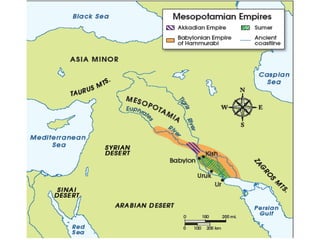
Location: “Meso” means ________ so Mesopotamia
means “land between the rivers” specifically the
______ and _________ rivers. The world’s
_______civilization developed here and is
called________. Sumer’s boundaries are the
_______ _____ to the south and the city-state of ____
in the north. The people who lived in Sumer were
called ___________ which means the black-headed
people.
“between”
Tigris Euphrates
oldest
Sumer
Persian Gulf Kish
Sumerians
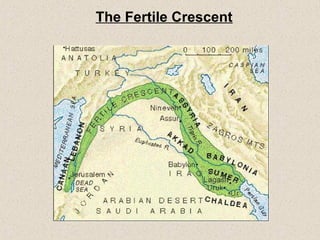
The Fertile Crescent
The Geography
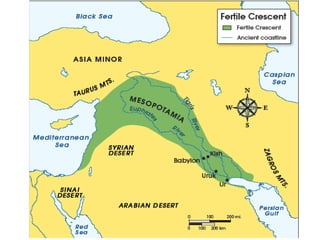
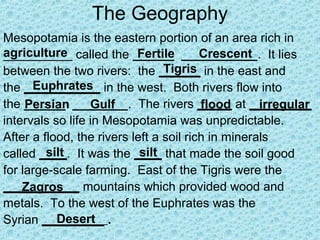
Mesopotamia is the eastern portion of an area rich in
__________ called the ______ ___________. It lies
between the two rivers: the ______ in the east and
the ___________ in the west. Both rivers flow into
the ______ ________. The rivers _____ at _________
intervals so life in Mesopotamia was unpredictable.
After a flood, the rivers left a soil rich in minerals
called ____. It was the ____ that made the soil good
for large-scale farming. East of the Tigris were the
___________ mountains which provided wood and
metals. To the west of the Euphrates was the
Syrian _________ .
agriculture Fertile Crescent
Tigris
Euphrates
Persian Gulf flood irregular
silt silt
Zagros
Desert
Advanced Cities
Around ______ B.C. Sumerians had built
cities. The most famous is ___ which was
excavated by British ___________ Leonard
________ in the 1920s and 30s. The
Sumerians in Ur lived in small box-like, ____
storey houses. The central feature of the city
was the large _______ which was a ______
to the gods.
3000
Ur
archaeologist
Wooley
one
Ziggurat temple
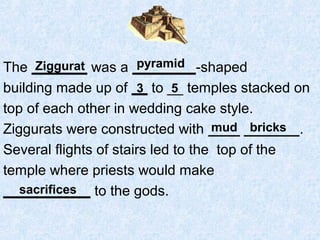
The _______ was a ________-shaped
building made up of __ to __ temples stacked on
top of each other in wedding cake style.
Ziggurats were constructed with ____ _______.
Several flights of stairs led to the top of the
temple where priests would make
___________ to the gods.
Ziggurat pyramid
3 5
mud bricks
sacrifices
Complex Institutions: Religion
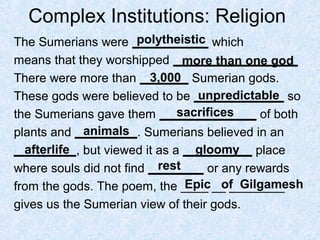
The Sumerians were ___________ which
means that they worshipped __________________
There were more than _______ Sumerian gods.
These gods were believed to be _____________ so
the Sumerians gave them ______________ of both
plants and _________. Sumerians believed in an
_________, but viewed it as a __________ place
where souls did not find ________ or any rewards
from the gods. The poem, the ____ __ ________
gives us the Sumerian view of their gods.
polytheistic
more than one god
3,000
unpredictable
sacrifices
animals
afterlife gloomy
rest
Epic of Gilgamesh
Q/A
• How might the geography attribute to their
negative view of the gods?
• Unpredictable flooding led to a view that
the gods were unpredictable!
Complex Institutions: Government
Sumerians organized themselves into _____
_____ which were ___________of each other.
Sumerians were ___ ______ politically. Each
city-state had its own___________. Historians
believe that governments were created to ____
_________ faced by the Sumerians. The
_______ _______ of the rivers required that the
Sumerians learn how to______ their
environment by developing a system of
irrigation and flood control.
city -
states independent
not united
government
solve
problems
irregular flooding
control
Government
________ were created to hold excess water
from the flooding, and _______ ditches were
dug to carry water into the ______. At first
_______ organized and directed the _______
projects and the _________ was their base of
operations serving as both a _______ and a
___________ building. The city-states were
often at ____ with each other so in times of
crisis a ________ commander would take
over the government.
Reservoirs
irrigation
fields
priests irrigation
Ziggurat
temple
government
war
military
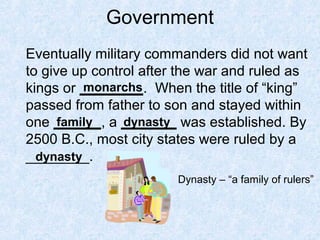
Government
Eventually military commanders did not want
to give up control after the war and ruled as
kings or ________. When the title of “king”
passed from father to son and stayed within
one ______, a _______ was established. By
2500 B.C., most city states were ruled by a
________.
monarchs
family dynasty
dynasty
Dynasty – “a family of rulers”
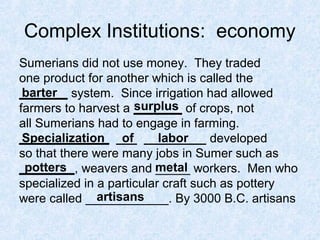
Complex Institutions: economy
Sumerians did not use money. They traded
one product for another which is called the
_______ system. Since irrigation had allowed
farmers to harvest a _______ of crops, not
all Sumerians had to engage in farming.
_____________ ___ _________ developed
so that there were many jobs in Sumer such as
________, weavers and _____ workers. Men who
specialized in a particular craft such as pottery
were called ____________. By 3000 B.C. artisans
barter
surplus
Specialization of labor
potters metal
artisans
Economy
began using ________ to craft tools,
weapons and artistic objects. The _______
Era gave way to the _______ _____ in
Mesopotamia. The specialization of labor
led to the formation of ___________. There
were four social classes.
bronze
Neolithic
Bronze Age
social classes
Socio-economic classes
Slaves
Lower class
Middle class
Upper class priests,
military commanders
monarchs
Wealthy merchants
Farmers and artisans
Conquered Peoples
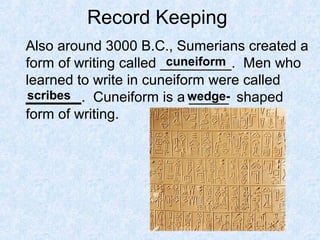
Record Keeping
Also around 3000 B.C., Sumerians created a
form of writing called _________. Men who
learned to write in cuneiform were called
_______. Cuneiform is a _____ shaped
form of writing.
cuneiform
scribes wedge-
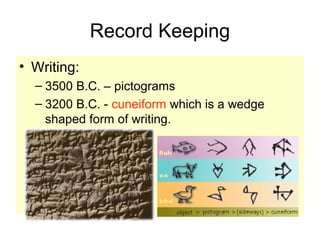
Record Keeping
• Writing:
– 3500 B.C. – pictograms
– 3200 B.C. - cuneiform which is a wedge
shaped form of writing.
Record Keeping
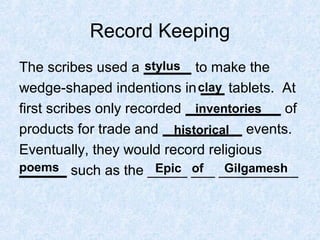
The scribes used a ______ to make the
wedge-shaped indentions in ___ tablets. At
first scribes only recorded ____________ of
products for trade and __________ events.
Eventually, they would record religious
______ such as the _____ ___ __________
stylus
clay
inventories
historical
poems Epic of Gilgamesh
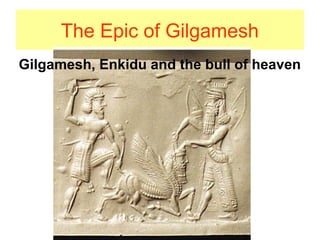
The Epic of Gilgamesh
Gilgamesh, Enkidu and the bull of heaven
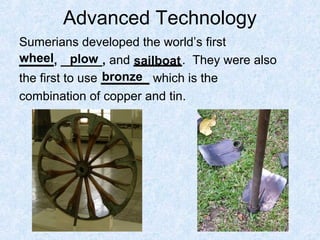
Advanced Technology
Sumerians developed the world’s first
_____, ______, and _______. They were also
the first to use _______ which is the
combination of copper and tin.
wheel plow sailboat
bronze
Epic of Gilgamesh Tablet I
1. Describe Gilgamesh’s appearance and
character. Is he loved by his people?
2. Describe Enkidu’s appearance and
character.
3.What do you think Enkidu and Gilgamesh
symbolize?
4.Do the Sumerians have a positive view of
“civilized man” based on your answer to
#3?
Tablets 2-6
1. Why do Gilgamesh and Enkidu decide to
leave Uruk?
2. What does the first adventure into the
Cedar Forest reveal about the character of
Gilgamesh?
3. At the end of Tablet 6, Anu is angry that
Gilgamesh and Enkidu have killed the Bull
of heaven. Whom do you think the gods
will choose to die for this crime? Explain.
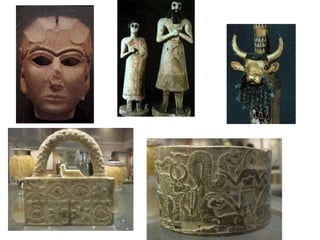
Development of Art
• Temples - the ziggurat
• Mudbrick and baked brick were used to
make massive architecture
• Statues of seated figures with
exaggerated heads
• Figurines made of metals like copper
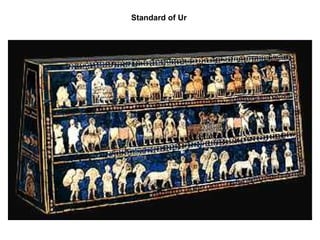
• Standard of Ur
Standard of Ur
The Akkadians
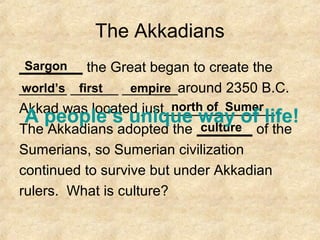
________ the Great began to create the
______ ______ _______around 2350 B.C.
Akkad was located just______________.
The Akkadians adopted the _______ of the
Sumerians, so Sumerian civilization
continued to survive but under Akkadian
rulers. What is culture?
Sargon
world’s first empire
north of Sumer
culture
A people’s unique way of life!
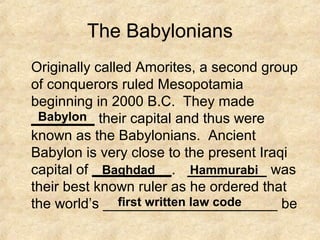
The Babylonians
Originally called Amorites, a second group
of conquerors ruled Mesopotamia
beginning in 2000 B.C. They made
________ their capital and thus were
known as the Babylonians. Ancient
Babylon is very close to the present Iraqi
capital of __________. __________ was
their best known ruler as he ordered that
the world’s ______________________ be
Babylon
Baghdad Hammurabi
first written law code
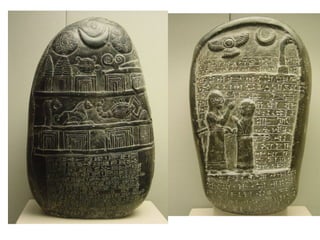
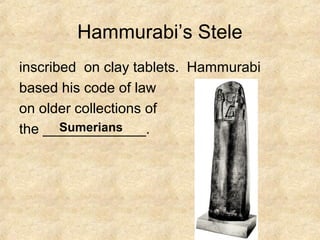
Hammurabi’s Stele
inscribed on clay tablets. Hammurabi
based his code of law
on older collections of
the _____________.Sumerians
Hammurabi’s Code
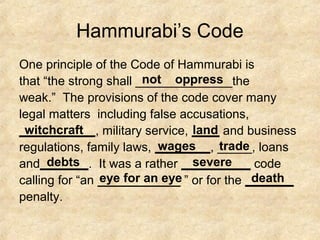
One principle of the Code of Hammurabi is
that “the strong shall ______________the
weak.” The provisions of the code cover many
legal matters including false accusations,
___________, military service, ____ and business
regulations, family laws, ________, _____, loans
and_______. It was a rather __________ code
calling for “an ____________ ” or for the _______
penalty.
not oppress
witchcraft land
wages trade
debts severe
eye for an eye death
Palestine
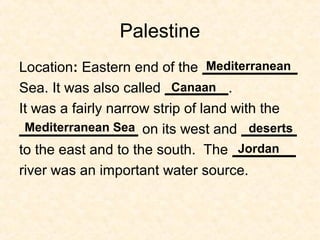
Location: Eastern end of the ____________
Sea. It was also called ________.
It was a fairly narrow strip of land with the
_______________ on its west and _______
to the east and to the south. The ________
river was an important water source.
Mediterranean
Canaan
Mediterranean Sea deserts
Jordan
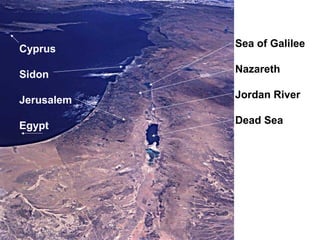
Sea of Galilee
Nazareth
Jordan River
Dead Sea
Cyprus
Sidon
Jerusalem
Egypt
A new religion: Judaism
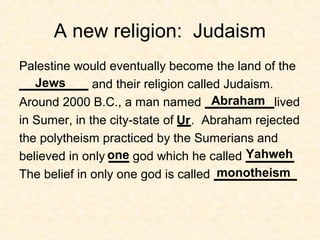
Palestine would eventually become the land of the
__________ and their religion called Judaism.
Around 2000 B.C., a man named __________lived
in Sumer, in the city-state of __. Abraham rejected
the polytheism practiced by the Sumerians and
believed in only ___ god which he called _______
The belief in only one god is called ____________
Jews
Abraham
Ur
one Yahweh
monotheism
Judaism continued
Abraham made an agreement or _________ with
Yahweh in which he would ______ Yahweh who
would in return provide ___________ for Abraham
and his descendants. Yahweh commanded
Abraham to move his family from Mesopotamia to
________. Thus the region known as ________
or Canaan became the __________________ to
the Hebrews (Jews).
covenant
obey
protection
Palestine Palestine
“Promised Land”
Hebrew Conception of GodHebrew Conception of God
God is _________ and is
___________ to nature. Nature is not to be
worshiped but is just part of God’s
___________
God is __________
God is ____________________.
He is supreme.
universal
superior
creation
eternal
subject to nothing
Key People, Terms and Events
______________: Patriarch and founder
___________: leader of the Hebrew Exodus
___________: flight of Hebrews from Egypt
_______: sacred book of Hebrews given to
Moses by Yahweh. It is the first five books
of the Hebrew Bible. It was written on a
______ and kept in an ornamental chest
called the _____ of the ________
Abraham
Moses
Exodus
Torah
scroll
ark covenant
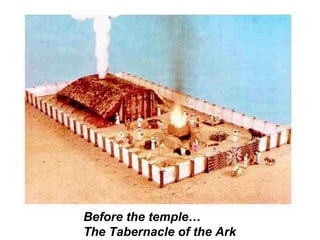
Before the temple…
The Tabernacle of the Ark
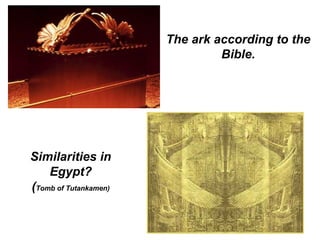
The ark according to the
Bible.
Similarities in
Egypt?
(Tomb of Tutankamen)
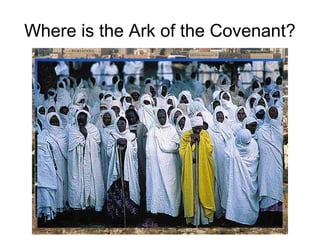
Where is the Ark of the Covenant?
Key People, terms and events
___________________: the basis of
Hebrew ____ and _________ law given to
Moses.
____________________: the emphasis on
a _______ code of conduct and the
worship of only one god.
Kingdom of ________: Around 1000 B.C.,
the Hebrews united into a kingdom ruled
by a man named Saul.
Ten Commandments
civil religious
Ethical Monotheism
moral
Israel
Kingdom of Israel
__________: King and author of many of the
poems in the book of Psalms
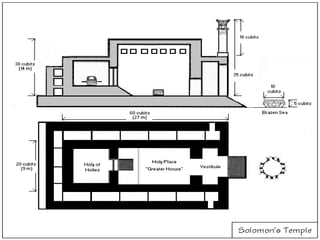
_________: King known for his great __________
and for building the first permanent house of
worship called _____________________.
____________: Jewish house of worship
________: By 922 B.C., the Hebrews had divided
into two Kingdoms. Judah was in the _________
part of Palestine. It survived longer than did
Israel which is why the Hebrews are now called
______ and their religion is called ___________.
____________ : capital city of __________and
most holy city of Judaism.
David
Solomon wisdom
Solomon’s Temple
Synagogue
Judah
southern
Jews Judaism
Jerusalem Judah
Kingdom of Israel
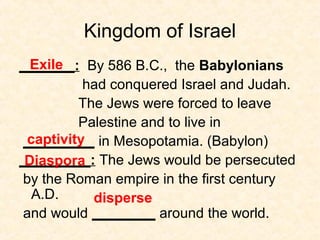
_______: By 586 B.C., the Babylonians
had conquered Israel and Judah.
The Jews were forced to leave
Palestine and to live in
_________ in Mesopotamia. (Babylon)
_________: The Jews would be persecuted
by the Roman empire in the first century
A.D.
and would ________ around the world.
Exile
captivity
Diaspora
disperse
The Assyrians
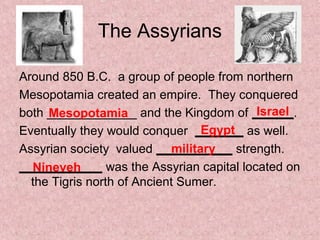
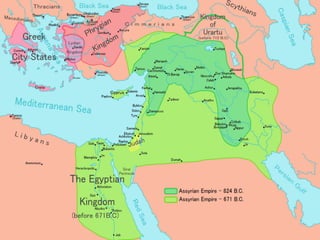
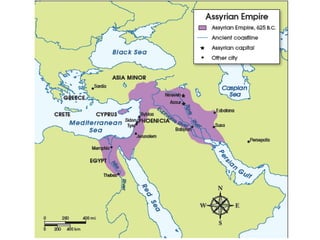
Around 850 B.C. a group of people from northern
Mesopotamia created an empire. They conquered
both _____________ and the Kingdom of ______.
Eventually they would conquer _______ as well.
Assyrian society valued ___________ strength.
____________ was the Assyrian capital located on
the Tigris north of Ancient Sumer.
Mesopotamia Israel
Egypt
military
Nineveh
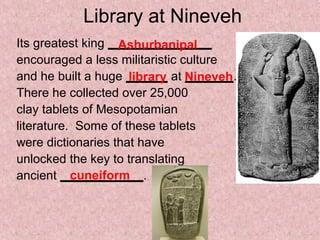
Library at Nineveh
Its greatest king _______________
encouraged a less militaristic culture
and he built a huge ______ at _______.
There he collected over 25,000
clay tablets of Mesopotamian
literature. Some of these tablets
were dictionaries that have
unlocked the key to translating
ancient ____________.
Ashurbanipal
library Nineveh
cuneiform
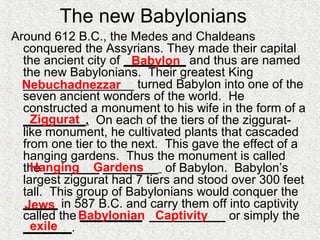
The new Babylonians
Around 612 B.C., the Medes and Chaldeans
conquered the Assyrians. They made their capital
the ancient city of _________ and thus are named
the new Babylonians. Their greatest King
________________ turned Babylon into one of the
seven ancient wonders of the world. He
constructed a monument to his wife in the form of a
_________. On each of the tiers of the ziggurat-
like monument, he cultivated plants that cascaded
from one tier to the next. This gave the effect of a
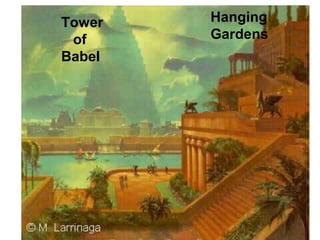
hanging gardens. Thus the monument is called
the ________ ________ of Babylon. Babylon’s
largest ziggurat had 7 tiers and stood over 300 feet
tall. This group of Babylonians would conquer the
_____ in 587 B.C. and carry them off into captivity
called the _________ ___________ or simply the
_______.
Babylon
Nebuchadnezzar
Ziggurat
Hanging Gardens
Jews
Babylonian Captivity
exile
Hanging
Gardens
Tower
of
Babel
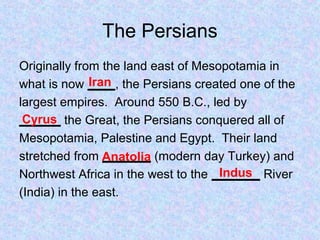
The Persians
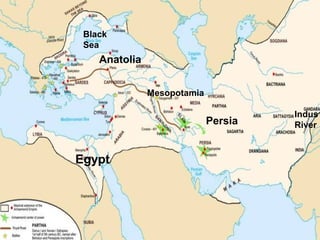
Originally from the land east of Mesopotamia in
what is now ____, the Persians created one of the
largest empires. Around 550 B.C., led by
______ the Great, the Persians conquered all of
Mesopotamia, Palestine and Egypt. Their land
stretched from _______ (modern day Turkey) and
Northwest Africa in the west to the _______ River
(India) in the east.
Iran
Cyrus
Anatolia
Indus
Egypt
Mesopotamia
Persia
Indus
River
Anatolia
Black
Sea
Persian Rule
The Persians were very _______ of the beliefs and
customs of conquered peoples. They allowed the
_______ to return to _________ where they rebuilt
their temple in Jerusalem. The Jews would live in
Palestine until they left in great numbers during the
________ occupation.
Their dispersal into Europe in the first century A.D.
is known as the _____________.
tolerant
Jews Palestine
Roman
Diaspora
Add to the bottom of your outline:
____________: non-elected, paid
government officials who work for the
emperor
_____________: polytheistic religion of
Persia: god of light vs god of evil;
concepts of judgment day, heaven &hell,
Avesta=sacred text
Bureaucracy
Zoroastrianism
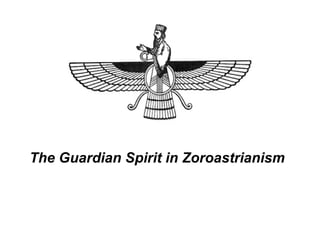
The Guardian Spirit in Zoroastrianism

Mesopotamia

  • 1.
  • 2.
    Mesopotamia Location: “Meso” means________ so Mesopotamia means “land between the rivers” specifically the ______ and _________ rivers. The world’s _______civilization developed here and is called________. Sumer’s boundaries are the _______ _____ to the south and the city-state of ____ in the north. The people who lived in Sumer were called ___________ which means the black-headed people. “between” Tigris Euphrates oldest Sumer Persian Gulf Kish Sumerians
  • 3.
  • 6.
    The Geography Mesopotamia isthe eastern portion of an area rich in __________ called the ______ ___________. It lies between the two rivers: the ______ in the east and the ___________ in the west. Both rivers flow into the ______ ________. The rivers _____ at _________ intervals so life in Mesopotamia was unpredictable. After a flood, the rivers left a soil rich in minerals called ____. It was the ____ that made the soil good for large-scale farming. East of the Tigris were the ___________ mountains which provided wood and metals. To the west of the Euphrates was the Syrian _________ . agriculture Fertile Crescent Tigris Euphrates Persian Gulf flood irregular silt silt Zagros Desert
  • 7.
    Advanced Cities Around ______B.C. Sumerians had built cities. The most famous is ___ which was excavated by British ___________ Leonard ________ in the 1920s and 30s. The Sumerians in Ur lived in small box-like, ____ storey houses. The central feature of the city was the large _______ which was a ______ to the gods. 3000 Ur archaeologist Wooley one Ziggurat temple
  • 8.
    The _______ wasa ________-shaped building made up of __ to __ temples stacked on top of each other in wedding cake style. Ziggurats were constructed with ____ _______. Several flights of stairs led to the top of the temple where priests would make ___________ to the gods. Ziggurat pyramid 3 5 mud bricks sacrifices
  • 9.
    Complex Institutions: Religion TheSumerians were ___________ which means that they worshipped __________________ There were more than _______ Sumerian gods. These gods were believed to be _____________ so the Sumerians gave them ______________ of both plants and _________. Sumerians believed in an _________, but viewed it as a __________ place where souls did not find ________ or any rewards from the gods. The poem, the ____ __ ________ gives us the Sumerian view of their gods. polytheistic more than one god 3,000 unpredictable sacrifices animals afterlife gloomy rest Epic of Gilgamesh
  • 10.
    Q/A • How mightthe geography attribute to their negative view of the gods? • Unpredictable flooding led to a view that the gods were unpredictable!
  • 11.
    Complex Institutions: Government Sumeriansorganized themselves into _____ _____ which were ___________of each other. Sumerians were ___ ______ politically. Each city-state had its own___________. Historians believe that governments were created to ____ _________ faced by the Sumerians. The _______ _______ of the rivers required that the Sumerians learn how to______ their environment by developing a system of irrigation and flood control. city - states independent not united government solve problems irregular flooding control
  • 12.
    Government ________ were createdto hold excess water from the flooding, and _______ ditches were dug to carry water into the ______. At first _______ organized and directed the _______ projects and the _________ was their base of operations serving as both a _______ and a ___________ building. The city-states were often at ____ with each other so in times of crisis a ________ commander would take over the government. Reservoirs irrigation fields priests irrigation Ziggurat temple government war military
  • 13.
    Government Eventually military commandersdid not want to give up control after the war and ruled as kings or ________. When the title of “king” passed from father to son and stayed within one ______, a _______ was established. By 2500 B.C., most city states were ruled by a ________. monarchs family dynasty dynasty Dynasty – “a family of rulers”
  • 14.
    Complex Institutions: economy Sumeriansdid not use money. They traded one product for another which is called the _______ system. Since irrigation had allowed farmers to harvest a _______ of crops, not all Sumerians had to engage in farming. _____________ ___ _________ developed so that there were many jobs in Sumer such as ________, weavers and _____ workers. Men who specialized in a particular craft such as pottery were called ____________. By 3000 B.C. artisans barter surplus Specialization of labor potters metal artisans
  • 15.
    Economy began using ________to craft tools, weapons and artistic objects. The _______ Era gave way to the _______ _____ in Mesopotamia. The specialization of labor led to the formation of ___________. There were four social classes. bronze Neolithic Bronze Age social classes
  • 16.
    Socio-economic classes Slaves Lower class Middleclass Upper class priests, military commanders monarchs Wealthy merchants Farmers and artisans Conquered Peoples
  • 17.
    Record Keeping Also around3000 B.C., Sumerians created a form of writing called _________. Men who learned to write in cuneiform were called _______. Cuneiform is a _____ shaped form of writing. cuneiform scribes wedge-
  • 18.
    Record Keeping • Writing: –3500 B.C. – pictograms – 3200 B.C. - cuneiform which is a wedge shaped form of writing.
  • 19.
    Record Keeping The scribesused a ______ to make the wedge-shaped indentions in ___ tablets. At first scribes only recorded ____________ of products for trade and __________ events. Eventually, they would record religious ______ such as the _____ ___ __________ stylus clay inventories historical poems Epic of Gilgamesh
  • 20.
    The Epic ofGilgamesh Gilgamesh, Enkidu and the bull of heaven
  • 21.
    Advanced Technology Sumerians developedthe world’s first _____, ______, and _______. They were also the first to use _______ which is the combination of copper and tin. wheel plow sailboat bronze
  • 22.
    Epic of GilgameshTablet I 1. Describe Gilgamesh’s appearance and character. Is he loved by his people? 2. Describe Enkidu’s appearance and character. 3.What do you think Enkidu and Gilgamesh symbolize? 4.Do the Sumerians have a positive view of “civilized man” based on your answer to #3?
  • 23.
    Tablets 2-6 1. Whydo Gilgamesh and Enkidu decide to leave Uruk? 2. What does the first adventure into the Cedar Forest reveal about the character of Gilgamesh? 3. At the end of Tablet 6, Anu is angry that Gilgamesh and Enkidu have killed the Bull of heaven. Whom do you think the gods will choose to die for this crime? Explain.
  • 24.
    Development of Art •Temples - the ziggurat • Mudbrick and baked brick were used to make massive architecture • Statues of seated figures with exaggerated heads • Figurines made of metals like copper • Standard of Ur
  • 27.
  • 28.
    The Akkadians ________ theGreat began to create the ______ ______ _______around 2350 B.C. Akkad was located just______________. The Akkadians adopted the _______ of the Sumerians, so Sumerian civilization continued to survive but under Akkadian rulers. What is culture? Sargon world’s first empire north of Sumer culture A people’s unique way of life!
  • 29.
    The Babylonians Originally calledAmorites, a second group of conquerors ruled Mesopotamia beginning in 2000 B.C. They made ________ their capital and thus were known as the Babylonians. Ancient Babylon is very close to the present Iraqi capital of __________. __________ was their best known ruler as he ordered that the world’s ______________________ be Babylon Baghdad Hammurabi first written law code
  • 30.
    Hammurabi’s Stele inscribed onclay tablets. Hammurabi based his code of law on older collections of the _____________.Sumerians
  • 31.
    Hammurabi’s Code One principleof the Code of Hammurabi is that “the strong shall ______________the weak.” The provisions of the code cover many legal matters including false accusations, ___________, military service, ____ and business regulations, family laws, ________, _____, loans and_______. It was a rather __________ code calling for “an ____________ ” or for the _______ penalty. not oppress witchcraft land wages trade debts severe eye for an eye death
  • 32.
    Palestine Location: Eastern endof the ____________ Sea. It was also called ________. It was a fairly narrow strip of land with the _______________ on its west and _______ to the east and to the south. The ________ river was an important water source. Mediterranean Canaan Mediterranean Sea deserts Jordan
  • 33.
    Sea of Galilee Nazareth JordanRiver Dead Sea Cyprus Sidon Jerusalem Egypt
  • 34.
    A new religion:Judaism Palestine would eventually become the land of the __________ and their religion called Judaism. Around 2000 B.C., a man named __________lived in Sumer, in the city-state of __. Abraham rejected the polytheism practiced by the Sumerians and believed in only ___ god which he called _______ The belief in only one god is called ____________ Jews Abraham Ur one Yahweh monotheism
  • 35.
    Judaism continued Abraham madean agreement or _________ with Yahweh in which he would ______ Yahweh who would in return provide ___________ for Abraham and his descendants. Yahweh commanded Abraham to move his family from Mesopotamia to ________. Thus the region known as ________ or Canaan became the __________________ to the Hebrews (Jews). covenant obey protection Palestine Palestine “Promised Land”
  • 36.
    Hebrew Conception ofGodHebrew Conception of God God is _________ and is ___________ to nature. Nature is not to be worshiped but is just part of God’s ___________ God is __________ God is ____________________. He is supreme. universal superior creation eternal subject to nothing
  • 37.
    Key People, Termsand Events ______________: Patriarch and founder ___________: leader of the Hebrew Exodus ___________: flight of Hebrews from Egypt _______: sacred book of Hebrews given to Moses by Yahweh. It is the first five books of the Hebrew Bible. It was written on a ______ and kept in an ornamental chest called the _____ of the ________ Abraham Moses Exodus Torah scroll ark covenant
  • 38.
    Before the temple… TheTabernacle of the Ark
  • 39.
    The ark accordingto the Bible. Similarities in Egypt? (Tomb of Tutankamen)
  • 40.
    Where is theArk of the Covenant?
  • 41.
    Key People, termsand events ___________________: the basis of Hebrew ____ and _________ law given to Moses. ____________________: the emphasis on a _______ code of conduct and the worship of only one god. Kingdom of ________: Around 1000 B.C., the Hebrews united into a kingdom ruled by a man named Saul. Ten Commandments civil religious Ethical Monotheism moral Israel
  • 42.
    Kingdom of Israel __________:King and author of many of the poems in the book of Psalms _________: King known for his great __________ and for building the first permanent house of worship called _____________________. ____________: Jewish house of worship ________: By 922 B.C., the Hebrews had divided into two Kingdoms. Judah was in the _________ part of Palestine. It survived longer than did Israel which is why the Hebrews are now called ______ and their religion is called ___________. ____________ : capital city of __________and most holy city of Judaism. David Solomon wisdom Solomon’s Temple Synagogue Judah southern Jews Judaism Jerusalem Judah
  • 44.
    Kingdom of Israel _______:By 586 B.C., the Babylonians had conquered Israel and Judah. The Jews were forced to leave Palestine and to live in _________ in Mesopotamia. (Babylon) _________: The Jews would be persecuted by the Roman empire in the first century A.D. and would ________ around the world. Exile captivity Diaspora disperse
  • 45.
    The Assyrians Around 850B.C. a group of people from northern Mesopotamia created an empire. They conquered both _____________ and the Kingdom of ______. Eventually they would conquer _______ as well. Assyrian society valued ___________ strength. ____________ was the Assyrian capital located on the Tigris north of Ancient Sumer. Mesopotamia Israel Egypt military Nineveh
  • 48.
    Library at Nineveh Itsgreatest king _______________ encouraged a less militaristic culture and he built a huge ______ at _______. There he collected over 25,000 clay tablets of Mesopotamian literature. Some of these tablets were dictionaries that have unlocked the key to translating ancient ____________. Ashurbanipal library Nineveh cuneiform
  • 49.
    The new Babylonians Around612 B.C., the Medes and Chaldeans conquered the Assyrians. They made their capital the ancient city of _________ and thus are named the new Babylonians. Their greatest King ________________ turned Babylon into one of the seven ancient wonders of the world. He constructed a monument to his wife in the form of a _________. On each of the tiers of the ziggurat- like monument, he cultivated plants that cascaded from one tier to the next. This gave the effect of a hanging gardens. Thus the monument is called the ________ ________ of Babylon. Babylon’s largest ziggurat had 7 tiers and stood over 300 feet tall. This group of Babylonians would conquer the _____ in 587 B.C. and carry them off into captivity called the _________ ___________ or simply the _______. Babylon Nebuchadnezzar Ziggurat Hanging Gardens Jews Babylonian Captivity exile
  • 50.
  • 51.
    The Persians Originally fromthe land east of Mesopotamia in what is now ____, the Persians created one of the largest empires. Around 550 B.C., led by ______ the Great, the Persians conquered all of Mesopotamia, Palestine and Egypt. Their land stretched from _______ (modern day Turkey) and Northwest Africa in the west to the _______ River (India) in the east. Iran Cyrus Anatolia Indus
  • 52.
  • 53.
    Persian Rule The Persianswere very _______ of the beliefs and customs of conquered peoples. They allowed the _______ to return to _________ where they rebuilt their temple in Jerusalem. The Jews would live in Palestine until they left in great numbers during the ________ occupation. Their dispersal into Europe in the first century A.D. is known as the _____________. tolerant Jews Palestine Roman Diaspora
  • 54.
    Add to thebottom of your outline: ____________: non-elected, paid government officials who work for the emperor _____________: polytheistic religion of Persia: god of light vs god of evil; concepts of judgment day, heaven &hell, Avesta=sacred text Bureaucracy Zoroastrianism
  • 55.
    The Guardian Spiritin Zoroastrianism

Editor's Notes

  • #3 Define Fertile Cresent
  • #19 Writing was first used to keep accounts of goods. Later it commemorated achievements of the kings. See the figurine on page 29.
  • #25 Go to Encarta and show the Standard of Ur