This document discusses Local Area Networks (LANs) and Virtual Local Area Networks (VLANs). It defines VLANs as a way to logically segment a LAN into separate broadcast domains even if devices are not physically close together. The document outlines several advantages of VLANs such as improved performance, easier administration of virtual workgroups, reduced costs, and increased security. It also describes how VLANs work by tagging frames with VLAN identifiers and using filtering databases to direct traffic to the appropriate VLANs.
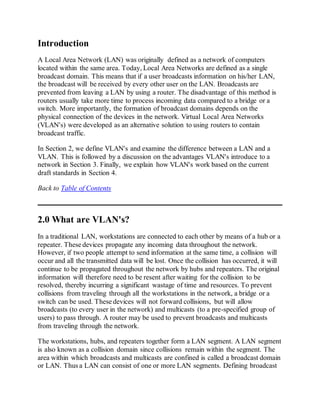
![and collision domains in a LAN depends on how the workstations, hubs, switches, and
routers are physically connected together. This means that everyone on a LAN must
be located in the same area (see Figure1).
VLAN's allow a network manager to logically segment a LAN into different broadcast
domains (see Figure2). Since this is a logical segmentation and not a physical one,
workstations do not have to be physically located together. Users on different floors
of the same building, or even in different buildings can now belong to the same LAN.
Why use VLAN's?
VLAN's offer a number of advantages over traditional LAN's. They are:
1) Performance
In networks where traffic consists of a high percentage of broadcasts and
multicasts, VLAN's can reduce the need to send such traffic to unnecessary
destinations. For example, in a broadcast domain consisting of 10 users, if the
broadcast traffic is intended only for 5 of the users, then placing those 5 users
on a separate VLAN can reduce traffic [ Passmore et al (3Com report)].
Compared to switches, routers require more processing of incoming traffic. As
the volume of traffic passing through the routers increases, so does the latency
in the routers, which results in reduced performance. The use of VLAN's
reduces the number of routers needed, since VLAN's create broadcast domains
using switches instead of routers.
2) Formation of Virtual Workgroups
Nowadays, it is common to find cross-functional product development teams
with members from different departments such as marketing, sales, accounting,
and research. These workgroups are usually formed for a short period of time.
During this period, communication between members of the workgroup will be
high. To contain broadcasts and multicasts within the workgroup, a VLAN can
be set up for them. With VLAN's it is easier to place members of a workgroup
together. Without VLAN's, the only way this would be possible is to physically
move all the members of the workgroup closer together.
However, virtual workgroups do not come without problems. Consider the
situation where one user of the workgroup is on the fourth floor of a building,
and the other workgroup members are on the second floor. Resources such as a](https://image.slidesharecdn.com/virtuallan-150322235444-conversion-gate01/85/Virtual-lan-2-320.jpg)
![printer would be located on the second floor, which would be inconvenient for
the lone fourth floor user.
Another problem with setting up virtual workgroups is the implementation of
centralized server farms, which are essentially collections of servers and major
resources for operating a network at a central location. The advantages here are
numerous, since it is more efficient and cost-effective to provide better
security, uninterrupted power supply, consolidated backup, and a proper
operating environment in a single area than if the major resources were
scattered in a building. Centralized server farms can cause problems when
setting up virtual workgroups if servers cannot be placed on more than one
VLAN. In such a case, the server would be placed on a single VLAN and all
other VLAN's trying to access the server would have to go through a router;
this can reduce performance [Netreference Inc. article].
3) Simplified Administration
Seventy percent of network costs are a result of adds, moves, and changes of
users in the network [ Buerger]. Every time a user is moved in a LAN,
recabling, new station addressing, and reconfiguration of hubs and routers
becomes necessary. Some of these tasks can be simplified with the use of
VLAN's. If a user is moved within a VLAN, reconfiguration of routers is
unnecessary. In addition, depending on the type of VLAN, other administrative
work can be reduced or eliminated [ Cisco white paper]. However the full
power of VLAN's will only really be felt when good management tools are
created which can allow network managers to drag and drop users into different
VLAN's or to set up aliases.
Despite this saving, VLAN's add a layer of administrative complexity, since it
now becomes necessary to manage virtual workgroups [ Passmore et al (3Com
report)].
4) Reduced Cost
VLAN's can be used to create broadcast domains which eliminate the need for
expensive routers.
5) Security
Periodically, sensitive data may be broadcast on a network. In such cases,
placing only those users who can have access to that data on a VLAN can
reduce the chances of an outsider gaining access to the data. VLAN's can also](https://image.slidesharecdn.com/virtuallan-150322235444-conversion-gate01/85/Virtual-lan-3-320.jpg)
![be used to control broadcast domains, set up firewalls, restrict access, and
inform the network manager of an intrusion [ Passmore et al (3Com report)].
How VLAN's work
When a LAN bridge receives data from a workstation, it tags the data with a VLAN
identifier indicating the VLAN from which the data came. This is called explicit
tagging. It is also possible to determine to which VLAN the data received belongs
using implicit tagging. In implicit tagging the data is not tagged, but the VLAN from
which the data came is determined based on other information like the port on which
the data arrived. Tagging can be based on the port from which it came, the source
Media Access Control (MAC) field, the source network address, or some other field
or combination of fields. VLAN's are classified based on the method used. To be able
to do the tagging of data using any of the methods, the bridge would have to keep an
updated database containing a mapping between VLAN's and whichever field is used
for tagging. For example, if tagging is by port, the database should indicate which
ports belong to which VLAN. This database is called a filtering database. Bridges
would have to be able to maintain this database and also to make sure that all the
bridges on the LAN have the same information in each of their databases. The bridge
determines where the data is to go next based on normal LAN operations. Once the
bridge determines where the data is to go, it now needs to determine whether the
VLAN identifier should be added to the data and sent. If the data is to go to a device
that knows about VLAN implementation (VLAN-aware), the VLAN identifier is
added to the data. If it is to go to a device that has no knowledge of VLAN
implementation (VLAN-unaware), the bridge sends the data without the VLAN
identifier.
In order to understand how VLAN's work, we need to look at the types of VLAN's,
the types of connections between devices on VLAN's, the filtering database which is
used to send traffic to the correct VLAN, and tagging, a process used to identify the
VLAN originating the data.
VLAN Standard: IEEE 802.1Q Draft Standard
There has been a recent move towards building a set of standards for VLAN products.
The Institute of Electrical and Electronic Engineers (IEEE) is currently working on a
draft standard 802.1Q for VLAN's. Up to this point, products have been proprietary,
implying that anyone wanting to install VLAN's would have to purchase all products
from the same vendor. Once the standards have been written and vendors create
products based on these standards, users will no longer be confined to purchasing
products from a single vendor. The major vendors have supported these standards and](https://image.slidesharecdn.com/virtuallan-150322235444-conversion-gate01/85/Virtual-lan-4-320.jpg)


![1) Trunk Link
All the devices connected to a trunk link, including workstations, must be
VLAN-aware. All frames on a trunk link must have a special header attached.
These special frames are called tagged frames (see Figure7).
2) Access Link
An access link connects a VLAN-unaware device to the port of a VLAN-aware
bridge. All frames on access links must be implicitly tagged (untagged)
(seeFigure8). The VLAN-unaware device can be a LAN segment with VLAN-
unaware workstations or it can be a number of LAN segments containing
VLAN-unaware devices (legacy LAN).
3) Hybrid Link
This is a combination of the previous two links. This is a link where both
VLAN-aware and VLAN-unaware devices are attached (see Figure9). A hybrid
link can have both tagged and untagged frames, but allthe frames for a specific
VLAN must be either tagged or untagged.
Frame Processing
A bridge on receiving data determines to which VLAN the data belongs either by
implicit or explicit tagging. In explicit tagging a tag header is added to the data. The
bridge also keeps track of VLAN members in a filtering database which it uses to
determine where the data is to be sent. Following is an explanation of the contents of
the filtering database and the format and purpose of the tag header [802.1Q].
1) Filtering Database
Membership information for a VLAN is stored in a filtering database. The
filtering database consists of the following types of entries:
i) Static Entries
Static information is added, modified, and deleted by management only.
Entries are not automatically removed after some time (ageing), but must
be explicitly removed by management. There are two types of static
entries:](https://image.slidesharecdn.com/virtuallan-150322235444-conversion-gate01/85/Virtual-lan-8-320.jpg)


