SCIENTIFIC WRITNG:
INTRODUCTION
Balamurugan Tangiisuran, PhD
Pusat Racun Negara
Universiti Sains Malaysia
bala@usm.my
@DrTangiisuran
Importance
Characteristics
Types & Steps
Summary & Questions
ScientificWriting: Content
 Writing – most common form of scientific
communication
 Scientific writing is technical writing by a
scientist and other experts, with an
audience of peers -- other scientists.
DEFINITION
Dixon N. Writing for publication: A guide for new authors. Int J Qual Health
Care. 2001;13
 Publication is the lifeblood of all forms of
science
– peer review
– dissemination
– collaboration
– easier access for cross disciplinary
knowledge
– archiving
Why Publish?
David Crook, Writing for Publications. Sussex RSDU
No publication =
 no projects
 no collaboration
 no funding
 no invitations to conferences
 no promotion
Why publish?
David Crook, Writing for Publications. Sussex RSDU
Examples
Walliman, N. (2001). Your research project: A step-by-step guide for the first-
time researcher. London, England: Sage Publications.
 Abstract
 Poster
 Original article
 Review article
 Editorial
 Case report
 Book chapter
 Handbook
• Textbook
• Thesis (Master or
Ph.D.)
• Letter to the Editor
• Lay writing
(targeted at a
general non-expert
audience)
Characteristics of SW
Hyland, K. &Salager-Meyer, F. Science writing. In Cronin, B. (ed) Annual
Review of Information Science and Technology. 2008; 42: 297-338
Clear
• Avoid unnecessary details
Simple
• Avoid vague or complicated sentences
• Avoid technical terms
• Jargon - when necessary for accuracy
Neutral
• Avoid assumption
• e.g. Everyone knows that ...) and unproven statements
(It can never be proved that ...)
Characteristics of SW
Hyland, K. &Salager-Meyer, F. Science writing. In Cronin, B. (ed) Annual
Review of Information Science and Technology. 2008; 42: 297-338
Conciseness and Cohesion
• Good flow
Structured logically
• Ideas and processes are expressed in a logical order
• Text is divided into sections with clear headings
Accurate
• Avoid ambiguous language
Characteristics of SW
Hyland, K. &Salager-Meyer, F. Science writing. In Cronin, B. (ed) Annual
Review of Information Science and Technology. 2008; 42: 297-338
Objective
• Statements and ideas are supported by
appropriate evidence
Valid
Reliable
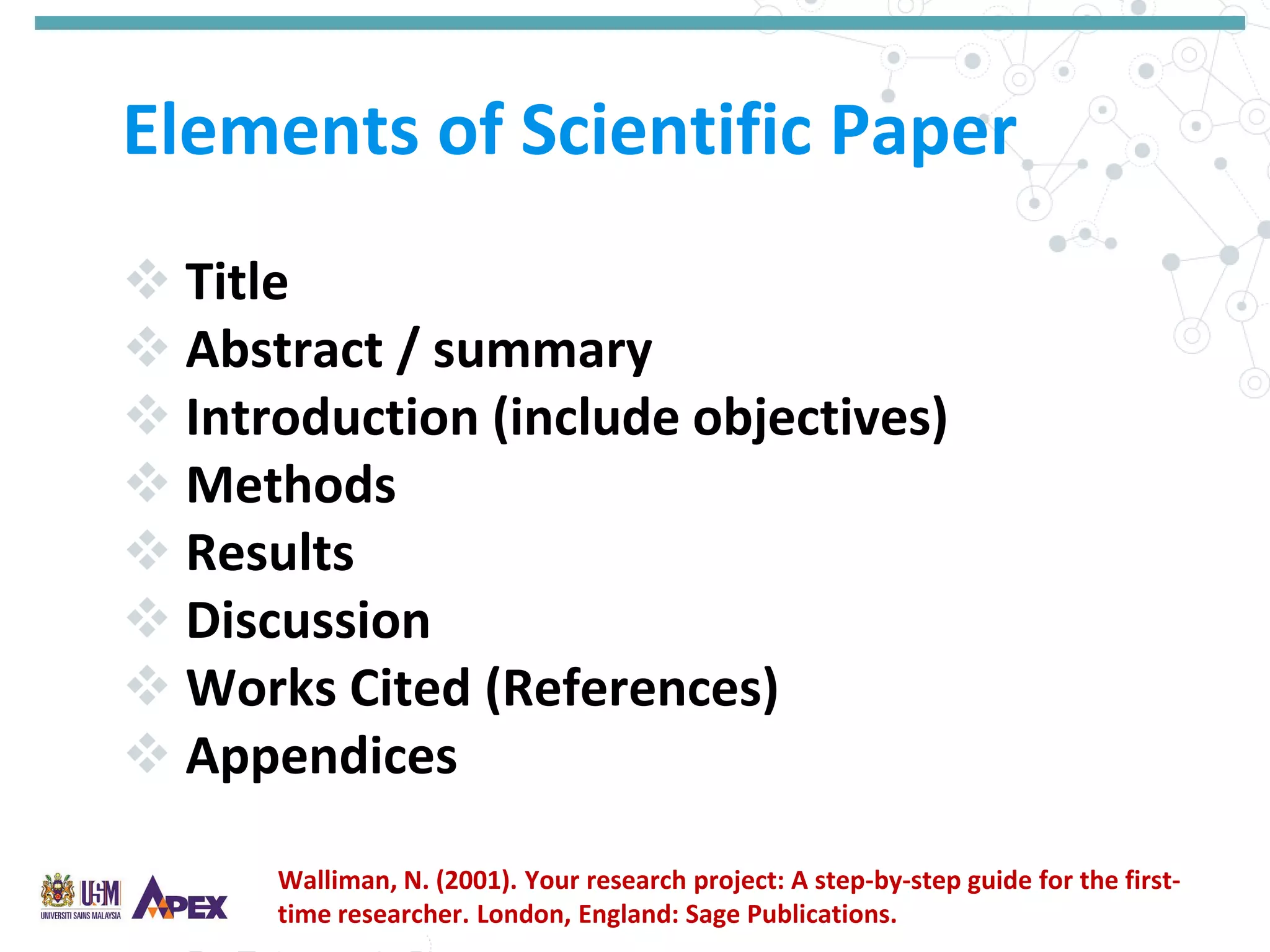
 Title
 Abstract / summary
 Introduction (include objectives)
 Methods
 Results
 Discussion
 Works Cited (References)
 Appendices
Elements of Scientific Paper
Walliman, N. (2001). Your research project: A step-by-step guide for the first-
time researcher. London, England: Sage Publications.
What is PEER REVIEW?
David Crook, Writing for Publications. Sussex RSDU
PEER REVIEW
PEER
REVIEW
someone works
in same area
and is judged to
hold similar
values and
standards
Assessment of
scientific idea
Determines
publication of
manuscript,
award grants,
etc.
 The significant of the work
 The logic by which the conclusion are
drawn
 The robustness of the study design
 The scholarship of the work
Peer reviewers Evaluate
Falkenberg LJ, Soranno PA. Reviewing Reviews: An evaluation of peer reviews
of journal article submissions
“…we know that the system of peer review
is biased, unjust, unaccountable,
incomplete, easily fixed, often insulting,
usually ignorant, occasionally foolish, and
frequently wrong.”
RICHARD HORTON, LANCET EDITOR
EE van der Wall. Peer review under review: room for improvement? Neth
Heart J. 2009; 17(5): 187
 When you read something you like, work
out why you like it
 If you do not like it, why not?
 It is never too late to learn about
grammar and punctuation
 Practice makes perfect
 Excellent books are available
Writing in General
 Start with Strunk W. ‘The element of
Style’ (1918)
 “vigorous writing is concise”
 “make definite assertions and avoid
tame, colourless, hesitating, non-
committal language”
LEARING TO WRITE
William Strunk Jr. The element of Style. Ithaca, N.Y.: W.P. Humphrey, 1918.
New York: Bartleby.com, 1999.
 Transitions between paragraphs
 Sentences in logical sequence
 Choose ‘good’ words over ‘bad’ words
 Learn to punctuate
 Vary sentence and paragraph lengths
Style Pointer
William Strunk Jr. The element of Style. Ithaca, N.Y.: W.P. Humphrey, 1918.
New York: Bartleby.com, 1999.
Omit needless words
William Strunk Jr. The element of Style. Ithaca, N.Y.: W.P. Humphrey, 1918.
New York: Bartleby.com, 1999.
Owing to the fact that since (because)
In spite of the fact that though (although)
Call your attention to the
fact that
remind you (notify you)
There was no doubt but
that
no doubt (doubtless)
This is the subject which this subject
The fact that I had arrived My arrival
 Punctuate to enhance meaning, enhance,
style, save space
 Understand commas, semi-colons,
colons, dashes, brackets
 Avoid!
 Read with your ears
 Good reference : Eats Shoots and Leaves
Punctuation
 Have something important , novel, or
interesting to report
 Choose a Journal with the right audience
 Write well – revise as often as necessary
Three Cardinal Rules
David Crook, Writing for Publications. Sussex RSDU
 Choose your journal with care
 Learn how to assess Impact factors
 Read the last few issues
 Get the instructions for Authors and go
though every line
 Master your word processor, especially
Styles
 Learn to use a reference manager
Writing a Paper
Walliman, N. (2001). Your research project: A step-by-step guide for the first-
time researcher. London, England: Sage Publications.
Steps of Scientific Writing
Plan your writing
Structuring written work
Grammar, spelling, and
vocabulary
Editing and Proofreading
Evidence, plagiarism,
referencing
Dr. Balamurugan Tangiisuran
@DrTangiisuran
Dr. Balamurugan Tangiisuran | PUSAT RACUN NEGARA
b.tangiisuran@gmail.com
@DrTangiisuran

Introduction to scientific writing

  • 1.
    SCIENTIFIC WRITNG: INTRODUCTION Balamurugan Tangiisuran,PhD Pusat Racun Negara Universiti Sains Malaysia bala@usm.my @DrTangiisuran
  • 2.
    Importance Characteristics Types & Steps Summary& Questions ScientificWriting: Content
  • 3.
     Writing –most common form of scientific communication  Scientific writing is technical writing by a scientist and other experts, with an audience of peers -- other scientists. DEFINITION Dixon N. Writing for publication: A guide for new authors. Int J Qual Health Care. 2001;13
  • 4.
     Publication isthe lifeblood of all forms of science – peer review – dissemination – collaboration – easier access for cross disciplinary knowledge – archiving Why Publish? David Crook, Writing for Publications. Sussex RSDU
  • 5.
    No publication = no projects  no collaboration  no funding  no invitations to conferences  no promotion Why publish? David Crook, Writing for Publications. Sussex RSDU
  • 6.
    Examples Walliman, N. (2001).Your research project: A step-by-step guide for the first- time researcher. London, England: Sage Publications.  Abstract  Poster  Original article  Review article  Editorial  Case report  Book chapter  Handbook • Textbook • Thesis (Master or Ph.D.) • Letter to the Editor • Lay writing (targeted at a general non-expert audience)
  • 7.
    Characteristics of SW Hyland,K. &Salager-Meyer, F. Science writing. In Cronin, B. (ed) Annual Review of Information Science and Technology. 2008; 42: 297-338 Clear • Avoid unnecessary details Simple • Avoid vague or complicated sentences • Avoid technical terms • Jargon - when necessary for accuracy Neutral • Avoid assumption • e.g. Everyone knows that ...) and unproven statements (It can never be proved that ...)
  • 8.
    Characteristics of SW Hyland,K. &Salager-Meyer, F. Science writing. In Cronin, B. (ed) Annual Review of Information Science and Technology. 2008; 42: 297-338 Conciseness and Cohesion • Good flow Structured logically • Ideas and processes are expressed in a logical order • Text is divided into sections with clear headings Accurate • Avoid ambiguous language
  • 9.
    Characteristics of SW Hyland,K. &Salager-Meyer, F. Science writing. In Cronin, B. (ed) Annual Review of Information Science and Technology. 2008; 42: 297-338 Objective • Statements and ideas are supported by appropriate evidence Valid Reliable
  • 10.
     Title  Abstract/ summary  Introduction (include objectives)  Methods  Results  Discussion  Works Cited (References)  Appendices Elements of Scientific Paper Walliman, N. (2001). Your research project: A step-by-step guide for the first- time researcher. London, England: Sage Publications.
  • 11.
    What is PEERREVIEW? David Crook, Writing for Publications. Sussex RSDU PEER REVIEW PEER REVIEW someone works in same area and is judged to hold similar values and standards Assessment of scientific idea Determines publication of manuscript, award grants, etc.
  • 12.
     The significantof the work  The logic by which the conclusion are drawn  The robustness of the study design  The scholarship of the work Peer reviewers Evaluate Falkenberg LJ, Soranno PA. Reviewing Reviews: An evaluation of peer reviews of journal article submissions
  • 13.
    “…we know thatthe system of peer review is biased, unjust, unaccountable, incomplete, easily fixed, often insulting, usually ignorant, occasionally foolish, and frequently wrong.” RICHARD HORTON, LANCET EDITOR EE van der Wall. Peer review under review: room for improvement? Neth Heart J. 2009; 17(5): 187
  • 14.
     When youread something you like, work out why you like it  If you do not like it, why not?  It is never too late to learn about grammar and punctuation  Practice makes perfect  Excellent books are available Writing in General
  • 15.
     Start withStrunk W. ‘The element of Style’ (1918)  “vigorous writing is concise”  “make definite assertions and avoid tame, colourless, hesitating, non- committal language” LEARING TO WRITE William Strunk Jr. The element of Style. Ithaca, N.Y.: W.P. Humphrey, 1918. New York: Bartleby.com, 1999.
  • 16.
     Transitions betweenparagraphs  Sentences in logical sequence  Choose ‘good’ words over ‘bad’ words  Learn to punctuate  Vary sentence and paragraph lengths Style Pointer William Strunk Jr. The element of Style. Ithaca, N.Y.: W.P. Humphrey, 1918. New York: Bartleby.com, 1999.
  • 17.
    Omit needless words WilliamStrunk Jr. The element of Style. Ithaca, N.Y.: W.P. Humphrey, 1918. New York: Bartleby.com, 1999. Owing to the fact that since (because) In spite of the fact that though (although) Call your attention to the fact that remind you (notify you) There was no doubt but that no doubt (doubtless) This is the subject which this subject The fact that I had arrived My arrival
  • 18.
     Punctuate toenhance meaning, enhance, style, save space  Understand commas, semi-colons, colons, dashes, brackets  Avoid!  Read with your ears  Good reference : Eats Shoots and Leaves Punctuation
  • 20.
     Have somethingimportant , novel, or interesting to report  Choose a Journal with the right audience  Write well – revise as often as necessary Three Cardinal Rules David Crook, Writing for Publications. Sussex RSDU
  • 21.
     Choose yourjournal with care  Learn how to assess Impact factors  Read the last few issues  Get the instructions for Authors and go though every line  Master your word processor, especially Styles  Learn to use a reference manager Writing a Paper Walliman, N. (2001). Your research project: A step-by-step guide for the first- time researcher. London, England: Sage Publications.
  • 22.
    Steps of ScientificWriting Plan your writing Structuring written work Grammar, spelling, and vocabulary Editing and Proofreading Evidence, plagiarism, referencing
  • 23.
    Dr. Balamurugan Tangiisuran @DrTangiisuran Dr.Balamurugan Tangiisuran | PUSAT RACUN NEGARA b.tangiisuran@gmail.com @DrTangiisuran