





HOW TO WRITE A SCIENTIFIC PAPER
FOR SOCIAL SCIENCES JOURNALS?
By
Prof. Dr. Zahid Anwar
Political Science Department
University of Peshawar, PAKISTAN
zauop@yahoo.com
The presenter is thankful to all those
who have helped in the preparation
of this presentation.
4/14/2015 zahid 2
OUTLINE OF THE PRESENTATION
• INTRODUCTION
• KNOWLEDGE & RESEARCH ARE TWINS IF NOT ONE
• WHAT IS KNOWLEDGE?
• WHAT IS RESEARCH?
• WHAT IS A RESEARCH PAPER?
• TYPES OF RESEARCH PAPERS?
• IMPORTANT STEPS IN WRITING A RESEARCH PAPER
• CITATION STYLES
• PLAGIARISM & SIMILARITY INDEX ISSUES
• CONCLUSION
4/14/2015 zahid 3
PRESENTATION OBJECTIVES
• To know about academic writing
• To explain few terms frequently used in research
in Social Sciences
• To comprehend techniques of writing research
papers for peer reviewed journals.
4/14/2015 zahid 4
KNOWLEDGE
• Knowledge is a familiarity with someone
or something, which can include facts,
information, descriptions, or skills
acquired through experience or
education. The theoretical or
practical understanding of a subject.
What is known in a particular field or
in total; facts and information.
4/14/2015 zahid 5
4/14/2015 6zahid
EDUCATION & PEDAGOGICS
4/14/2015 zahid 7
•Education is the process of receiving or giving
systematic instruction.
•The theory and practice of teaching.
.The act or process of imparting or acquiring general
knowledge, developing the powers of reasoning
and judgment.
•Pedagogics is the science or art of teaching.
•Pedagogy means teaching (the function or work of a
teacher)
4/14/2015 8zahid
RESEARCH
• Research is the systematic study of
materials/sources in order to establish
facts and reach new conclusions.
• It is an endeavour to discover new or
collect old facts by the scientific study
of a subject.
• Research is what we do when we have a
question or a problem we want to
resolve
4/14/2015 zahid 9
RESEARCH
• Research refers to a search for knowledge
• Research means a scientific and systematic
search
for pertinent information on a specific topic
• In fact, research is an art of scientific
investigation.
• The purpose of research is to discover answers to
questions through the application of scientific
procedures
4/14/2015 zahid 10
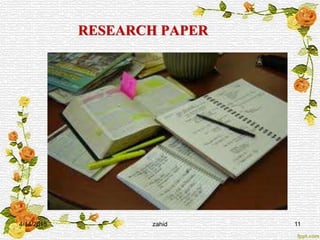
RESEARCH PAPER
4/14/2015 11zahid
RESEARCH PAPER
• Research paper is a paper written to
reflect a search that will present
information to support a point of
view on a particular topic.
P. Berge and C. Saffioti. Basic College Research
4/14/2015 zahid 12
PURPOSE & CONTEXT
OF A RESEARCH PAPER
• What is the purpose of your paper
• What is the context of your paper
• Text without context is a pretext
• A research paper analyzes a perspective
or argues a point.
4/14/2015 zahid 13
FURTHER EXPLANATION
•A research paper is an expanded essay that
presents your own interpretation or
evaluation or argument.
•A research paper involves surveying a field of
knowledge in order to find the best possible
information in that field.
4/14/2015 zahid 14
DIFFERENCE BETWEEN
ESSAY AND RESEARCH PAPER
• When you write an essay, you use
everything that you personally know and
have thought about a subject.
• When you write a research paper you build
upon what you know about the subject and
make a deliberate attempt to find out what
experts know.
4/14/2015 zahid 15
RESEARCH PAPER
• Research papers are original written works of
several typed pages in length, which use
information gathered through a search of other
sources to describe an event, explain a concept, or
argue a point.
• Each type of research paper has its own stylistic
traits and purposes.
• Two of the most common types of research papers
are the argumentative research paper and the
analytical research paper.
4/14/2015 zahid 16
Common Elements of Research
Papers
• There are two common traits all research papers
share. First, research papers include information
from other sources, which may be primary or
secondary sources.
• Second, research papers are original works.
Plagiarism, or the representation of someone else's
work as your own, is a serious offense.
• To avoid plagiarism, information from other
sources must be properly cited and all direct
quotations must be properly formatted.
4/14/2015 zahid 17
ARGUMENTATIVE RESEARCH PAPER
• An argumentative research paper presents two sides of an
issue and aims to persuade the reader that one side is more
correct than the other.
• In the introduction, you clearly state the issue and include a
thesis statement that informs the reader which side you
intend to argue for. In the body of the paper, you present the
two sides of the issue one at a time.
• Your explanation of each side should include both pros and
cons, and be supported by evidence from primary and
secondary sources.
• In the conclusion, you restate your thesis and explain why the
evidence you have provided in the body proves that your
viewpoint on the issue is the most valid.
4/14/2015 zahid 18
ANALYTICAL RESEARCH PAPER
• An analytical research paper presents several
points of view on an issue but, unlike an
argumentative research paper, does not aim to
persuade the reader that any side is more correct
than the rest.
• In the introduction, you clearly state the issue and
provide a very short summary of each point of
view you are going to examine.
4/14/2015 zahid 19
ANALYTICAL RESEARCH PAPER
• In the first section of the body, you provide a more
in-depth summary of each point of view.
• In the second section, you make a claim about how
the points of view presented interact, contradict
and/or support each other, followed by an analysis
that supports this claim using information from the
first section as evidence.
• In the conclusion, you summarize your findings
and may also choose to suggest avenues for further
research.
4/14/2015 zahid 20
OTHER TYPES OF RESEARCH PAPER
• Other types of research paper that you may come
across include critical analysis research papers,
descriptive research papers, expository research
papers, opinion research papers, exploratory
research papers and definition research papers.
• With any research paper, it is helpful to know the
requirements and structure of the type you are
using before you begin.
4/14/2015 zahid 21
MAJOR STEPS OR MEASURES
• A journey of a thousand miles begins with
a single step.
• A series of steps will lead you through
writing a research paper.
• These research writing measures represent
a movement through the research writing
process.
4/14/2015 zahid 22
TOPIC SELECTION
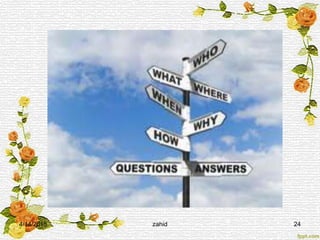
Think of the who, what, when, where
and why questions:
• WHY did you choose the topic? What interests
you about it? Do you have an opinion about the
issues involved?
• WHO are the information providers on this
topic? Who might publish information about it?
Who is affected by the topic? Do you know of
organizations or institutions affiliated with the
topic?
4/14/2015 zahid 23
4/14/2015 24zahid
• WHAT are the major questions for this topic? Is
there a debate about the topic? Are there a
range of issues and viewpoints to consider?
• WHERE is your topic important: at the local,
national or international level? Are there
specific places affected by the topic?
• WHEN is/was your topic important? Is it a
current event or an historical issue? Do you
want to compare your topic by time periods?
4/14/2015 zahid 25
ABSTRACT
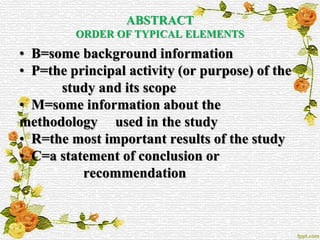
ORDER OF TYPICAL ELEMENTS
• B=some background information
• P=the principal activity (or purpose) of the
study and its scope
• M=some information about the
methodology used in the study
• R=the most important results of the study
• C=a statement of conclusion or
recommendation
4/14/2015 27zahid
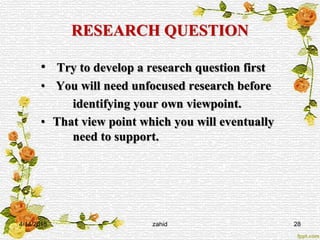
RESEARCH QUESTION
• Try to develop a research question first
• You will need unfocused research before
identifying your own viewpoint.
• That view point which you will eventually
need to support.
4/14/2015 zahid 28
4/14/2015 zahid 29
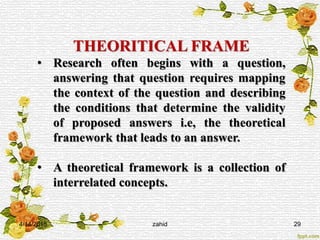
THEORITICAL FRAME
• Research often begins with a question,
answering that question requires mapping
the context of the question and describing
the conditions that determine the validity
of proposed answers i.e, the theoretical
framework that leads to an answer.
• A theoretical framework is a collection of
interrelated concepts.
4/14/2015 zahid 30
• A theoretical framework guides your
research, determining what things you will
measure, and what statistical relationships
you will look for.
• Theoretical frameworks provide the
organization for the study.
• A theoretical framework provides a broad
explanation of relationships that exists
between concepts.
4/14/2015 31zahid
HYPOTHESIS
• Hypothesis is the tentative solution to a
research problem
• Hypothesis is your proposed answer to
your research question, which you
finalize only after completing the
research.
4/14/2015 zahid 32
HYPOTHESIS II
• In a hypothesis you gather information
and evidence from appropriate, valid
sources to support your perspective
on a topic or stand on an issue.
• Developing a good working hypothesis is
an important research skill
4/14/2015 zahid 33
SYNERGY BETWEEN
RESEARCH QUESTION & HYPOTHESIS
• Hypothesis is not just your topic, but what
you're saying about your topic.
• once you've come up with the central
question, your hypothesis is an answer
to that question
• Hypothesis should be in the form of a
statement, not a question
4/14/2015 zahid 34
CONNECTION BETWEEN THE TWO
• Make sure your hypothesis covers exactly
the topic you want to talk about, no more
and no less.
• Shape your hypothesis to fit the question
you wish to answer
4/14/2015 zahid 35
TOPIC & METHODOLOGY
• In conducting research one needs
methodology
• Methodology is selected as per topic
• The point is, `your modus Vivendi shapes
your modus operandi`.
• It may be historical, analytical,
descriptive, experimental, case study so
on & so forth
4/14/2015 zahid 36
FINDING SOURCES
• We use sources to support our ideas in a
research paper.
• Many sources are now available in
electronic format.
• The trick is to find and then match
appropriate, valid sources to your own
ideas.
4/14/2015 zahid 37
MAJOR SOURCES
• Popular options:
• Library, computer (CDs, Databases),
knowledgeable people, internet, books,
magazines, newspapers, journals,
Indexes & Abstracts etc
4/14/2015 zahid 38
PRIMARY AND SECONDARY SOURCES
• Primary sources are original, first-hand
documents.
• Secondary sources are comments about
primary sources.
• One can use a combination of primary
and secondary sources to answer a
research question.
4/14/2015 zahid 39
4/14/2015 40zahid
Books
• There are many general reference books
that may be useful to your research in
a variety of ways.
• 1. General Encyclopedias (Britannica,
Americana, etc.)
• 2. Specialized Encyclopedias and
dictionaries
4/14/2015 zahid 41
4/14/2015 42zahid
LIMITATIONS OF A BOOK AS A SOURCE
• The important thing to remember here is
that, by the time a book is printed, the
information is at least a couple of
years old.
• So if you're doing research that requires
very recent information, a newspaper,
magazine, or journal is your better
choice.
4/14/2015 zahid 43
INTERNET
• The Internet can offer valuable
information in a quick, and easy way.
• You also have to be critical of what you
find, since anyone can post and even
change anything that's out there in
cyberspace
4/14/2015 zahid 44
LIMITATIONS
OF INTERNET AS A SOURCE
• Be sure that your internet information is
from a recognized source such as the
government, an agency that you are
sure is a credible source.
• 'Being a good writer is 3% talent, and
97% not being distracted by the
Internet'.
4/14/2015 zahid 45
HOW TO TAKE NOTES?
• Taking notes is an important part of
research paper
• Be sure when you take notes that you
write down the source that they are
from.
• You should not write the words down
exactly as they appear on the page,
unless you are putting them in
quotations.
4/14/2015 zahid 46
HOW TO TAKE NOTES? II
• Notes can be in one of the three forms:
summary, paraphrase or direct quotation
• When you summarize or paraphrase, you
record ideas as opposed to exact language;
the language is yours.
4/14/2015 47zahid
HOW TO TAKE NOTES? III
• Do not include your own ideas or
commentary in the body of the summary
or paraphrase.
• Your own ideas should come after the
summary or paraphrase
4/14/2015 zahid 48
DOCUMENTING YOUR SOURCES
• How to document sources?
• Help for preparing bibliographies and
footnotes can be found in:
• MLA handbook for writer of research
papers or
http://www.umuc.edu/library/libhow/
mla_examples.cfm
4/14/2015 zahid 49
DOCUMENTATION YOUR SOURCES
•Chicago / Turabian style:
http://www.chicagomanualofstyle.org/tools_citation
guide.html or
http://www.ubc.ca/okanagan/library/__shared/asset
s/chicago14394.pdf or
http://web.plattsburgh.edu/library/instruction/files/
chicago-turabian_guide.pdf
• Publication manual of the American
Psychological Association:
•http://www.landmark.edu/library/citation-
guides/landmark-college-citation-guides/apa-
citation-style-guide
4/14/2015 50zahid
CHICAGO MANUAL: SAMPLE CITATION
Book
One author
1. Michael Pollan, The Omnivore’s Dilemma: A Natural History of Four
Meals (New York: Penguin, 2006), 99–100.
2. Pollan, Omnivore’s Dilemma, 3.
Pollan, Michael. The Omnivore’s Dilemma: A Natural History of Four
Meals. New York: Penguin, 2006.
Two or more authors
1. Geoffrey C. Ward and Ken Burns, The War: An Intimate History, 1941–
1945 (New York: Knopf, 2007), 52.
2. Ward and Burns, War, 59–61.
Ward, Geoffrey C., and Ken Burns. The War: An Intimate History, 1941–
1945. New York: Knopf, 2007.
4/14/2015 51zahid
EVALUATING YOUR SOURCES
• Is the information presented objectively
from an unbiased viewpoint?
• Do the authors let you know their sources
of information?
• Do the authors let you know their
research methods as well as results?
• How Well does the Source answer the
Research Question?
• Is the writer field expert
4/14/2015 zahid 52
REORGANIZING YOUR NOTES
• Reorganizing your notes should enable
you to outline the major sections and
then the paragraphs of your research
paper
4/14/2015 zahid 53
BUILDING THE FIRST DRAFT
• Five points should be kept in mind
while writing the first draft:
• Start with a focused introduction
• Allow yourself to write a bad first draft
• Make a distinction between drafting and
editing
• Don't stick to your plan too closely
• Don't worry if you get stuck
4/14/2015 zahid 54
WHAT IS DRAFTING?
• Draft means rough copy of a writing.
• It is preliminary sketch from which final
copy is made.
• In drafting you are presenting your ideas
rather than refining your argument.
4/14/2015 zahid 55
WHAT IS PROOF READING?
• Proofreading is polishing and checking
over a draft to make sure that everything
is complete and correct ; spelling,
grammar, sentence structure,
punctuation so on & so forth
4/14/2015 zahid 56
WHAT IS EDITING?
4/14/2015 zahid 57
Editing is reviewing and changing a
document by making additions, deletions, or
other changes to conform to some agreed-
upon standard.
FINAL DRAFT
• After rereading, reorganizing
regrouping and proofreading you will
have a nice clean final draft
4/14/2015 zahid 58
PAPER INTRODUCTION INCLUDES
• In introduction state your topic, purpose,
reason, major points of your paper plan
and why readers should be interested in
your topic
4/14/2015 zahid 59
PAPER BODY INCLUDES
• Body – Here you present your arguments
to support your thesis statement. Begin
with a strong argument, then use a
stronger one, and end with the strongest
argument for your final point.
4/14/2015 zahid 60
PAPER CONCLUSION INCLUDES
• Conclusion - Restate your thesis.
Summarize your arguments. Explain why
you have come to this particular
conclusion.
4/14/2015 zahid 61
CRUX OF THE PROBLEM
• Your finished research paper should
present your own thinking backed up by
others' ideas and information.
4/14/2015 zahid 62
CONCLUSION
• Art is long and life is short. These slides
do not cover all aspects nevertheless it is
hoped that they have introduced you to
the major steps to be taken care of while
writing a research paper.
• Practice makes perfect. The taste of the
pudding is in the eating
4/14/2015 zahid 63
THANKS

How to write a scientific paper?

  • 1.
    HOW TO WRITEA SCIENTIFIC PAPER FOR SOCIAL SCIENCES JOURNALS? By Prof. Dr. Zahid Anwar Political Science Department University of Peshawar, PAKISTAN zauop@yahoo.com
  • 2.
    The presenter isthankful to all those who have helped in the preparation of this presentation. 4/14/2015 zahid 2
  • 3.
    OUTLINE OF THEPRESENTATION • INTRODUCTION • KNOWLEDGE & RESEARCH ARE TWINS IF NOT ONE • WHAT IS KNOWLEDGE? • WHAT IS RESEARCH? • WHAT IS A RESEARCH PAPER? • TYPES OF RESEARCH PAPERS? • IMPORTANT STEPS IN WRITING A RESEARCH PAPER • CITATION STYLES • PLAGIARISM & SIMILARITY INDEX ISSUES • CONCLUSION 4/14/2015 zahid 3
  • 4.
    PRESENTATION OBJECTIVES • Toknow about academic writing • To explain few terms frequently used in research in Social Sciences • To comprehend techniques of writing research papers for peer reviewed journals. 4/14/2015 zahid 4
  • 5.
    KNOWLEDGE • Knowledge isa familiarity with someone or something, which can include facts, information, descriptions, or skills acquired through experience or education. The theoretical or practical understanding of a subject. What is known in a particular field or in total; facts and information. 4/14/2015 zahid 5
  • 6.
  • 7.
    EDUCATION & PEDAGOGICS 4/14/2015zahid 7 •Education is the process of receiving or giving systematic instruction. •The theory and practice of teaching. .The act or process of imparting or acquiring general knowledge, developing the powers of reasoning and judgment. •Pedagogics is the science or art of teaching. •Pedagogy means teaching (the function or work of a teacher)
  • 8.
  • 9.
    RESEARCH • Research isthe systematic study of materials/sources in order to establish facts and reach new conclusions. • It is an endeavour to discover new or collect old facts by the scientific study of a subject. • Research is what we do when we have a question or a problem we want to resolve 4/14/2015 zahid 9
  • 10.
    RESEARCH • Research refersto a search for knowledge • Research means a scientific and systematic search for pertinent information on a specific topic • In fact, research is an art of scientific investigation. • The purpose of research is to discover answers to questions through the application of scientific procedures 4/14/2015 zahid 10
  • 11.
  • 12.
    RESEARCH PAPER • Researchpaper is a paper written to reflect a search that will present information to support a point of view on a particular topic. P. Berge and C. Saffioti. Basic College Research 4/14/2015 zahid 12
  • 13.
    PURPOSE & CONTEXT OFA RESEARCH PAPER • What is the purpose of your paper • What is the context of your paper • Text without context is a pretext • A research paper analyzes a perspective or argues a point. 4/14/2015 zahid 13
  • 14.
    FURTHER EXPLANATION •A researchpaper is an expanded essay that presents your own interpretation or evaluation or argument. •A research paper involves surveying a field of knowledge in order to find the best possible information in that field. 4/14/2015 zahid 14
  • 15.
    DIFFERENCE BETWEEN ESSAY ANDRESEARCH PAPER • When you write an essay, you use everything that you personally know and have thought about a subject. • When you write a research paper you build upon what you know about the subject and make a deliberate attempt to find out what experts know. 4/14/2015 zahid 15
  • 16.
    RESEARCH PAPER • Researchpapers are original written works of several typed pages in length, which use information gathered through a search of other sources to describe an event, explain a concept, or argue a point. • Each type of research paper has its own stylistic traits and purposes. • Two of the most common types of research papers are the argumentative research paper and the analytical research paper. 4/14/2015 zahid 16
  • 17.
    Common Elements ofResearch Papers • There are two common traits all research papers share. First, research papers include information from other sources, which may be primary or secondary sources. • Second, research papers are original works. Plagiarism, or the representation of someone else's work as your own, is a serious offense. • To avoid plagiarism, information from other sources must be properly cited and all direct quotations must be properly formatted. 4/14/2015 zahid 17
  • 18.
    ARGUMENTATIVE RESEARCH PAPER •An argumentative research paper presents two sides of an issue and aims to persuade the reader that one side is more correct than the other. • In the introduction, you clearly state the issue and include a thesis statement that informs the reader which side you intend to argue for. In the body of the paper, you present the two sides of the issue one at a time. • Your explanation of each side should include both pros and cons, and be supported by evidence from primary and secondary sources. • In the conclusion, you restate your thesis and explain why the evidence you have provided in the body proves that your viewpoint on the issue is the most valid. 4/14/2015 zahid 18
  • 19.
    ANALYTICAL RESEARCH PAPER •An analytical research paper presents several points of view on an issue but, unlike an argumentative research paper, does not aim to persuade the reader that any side is more correct than the rest. • In the introduction, you clearly state the issue and provide a very short summary of each point of view you are going to examine. 4/14/2015 zahid 19
  • 20.
    ANALYTICAL RESEARCH PAPER •In the first section of the body, you provide a more in-depth summary of each point of view. • In the second section, you make a claim about how the points of view presented interact, contradict and/or support each other, followed by an analysis that supports this claim using information from the first section as evidence. • In the conclusion, you summarize your findings and may also choose to suggest avenues for further research. 4/14/2015 zahid 20
  • 21.
    OTHER TYPES OFRESEARCH PAPER • Other types of research paper that you may come across include critical analysis research papers, descriptive research papers, expository research papers, opinion research papers, exploratory research papers and definition research papers. • With any research paper, it is helpful to know the requirements and structure of the type you are using before you begin. 4/14/2015 zahid 21
  • 22.
    MAJOR STEPS ORMEASURES • A journey of a thousand miles begins with a single step. • A series of steps will lead you through writing a research paper. • These research writing measures represent a movement through the research writing process. 4/14/2015 zahid 22
  • 23.
    TOPIC SELECTION Think ofthe who, what, when, where and why questions: • WHY did you choose the topic? What interests you about it? Do you have an opinion about the issues involved? • WHO are the information providers on this topic? Who might publish information about it? Who is affected by the topic? Do you know of organizations or institutions affiliated with the topic? 4/14/2015 zahid 23
  • 24.
  • 25.
    • WHAT arethe major questions for this topic? Is there a debate about the topic? Are there a range of issues and viewpoints to consider? • WHERE is your topic important: at the local, national or international level? Are there specific places affected by the topic? • WHEN is/was your topic important? Is it a current event or an historical issue? Do you want to compare your topic by time periods? 4/14/2015 zahid 25
  • 26.
    ABSTRACT ORDER OF TYPICALELEMENTS • B=some background information • P=the principal activity (or purpose) of the study and its scope • M=some information about the methodology used in the study • R=the most important results of the study • C=a statement of conclusion or recommendation
  • 27.
  • 28.
    RESEARCH QUESTION • Tryto develop a research question first • You will need unfocused research before identifying your own viewpoint. • That view point which you will eventually need to support. 4/14/2015 zahid 28
  • 29.
    4/14/2015 zahid 29 THEORITICALFRAME • Research often begins with a question, answering that question requires mapping the context of the question and describing the conditions that determine the validity of proposed answers i.e, the theoretical framework that leads to an answer. • A theoretical framework is a collection of interrelated concepts.
  • 30.
    4/14/2015 zahid 30 •A theoretical framework guides your research, determining what things you will measure, and what statistical relationships you will look for. • Theoretical frameworks provide the organization for the study. • A theoretical framework provides a broad explanation of relationships that exists between concepts.
  • 31.
  • 32.
    HYPOTHESIS • Hypothesis isthe tentative solution to a research problem • Hypothesis is your proposed answer to your research question, which you finalize only after completing the research. 4/14/2015 zahid 32
  • 33.
    HYPOTHESIS II • Ina hypothesis you gather information and evidence from appropriate, valid sources to support your perspective on a topic or stand on an issue. • Developing a good working hypothesis is an important research skill 4/14/2015 zahid 33
  • 34.
    SYNERGY BETWEEN RESEARCH QUESTION& HYPOTHESIS • Hypothesis is not just your topic, but what you're saying about your topic. • once you've come up with the central question, your hypothesis is an answer to that question • Hypothesis should be in the form of a statement, not a question 4/14/2015 zahid 34
  • 35.
    CONNECTION BETWEEN THETWO • Make sure your hypothesis covers exactly the topic you want to talk about, no more and no less. • Shape your hypothesis to fit the question you wish to answer 4/14/2015 zahid 35
  • 36.
    TOPIC & METHODOLOGY •In conducting research one needs methodology • Methodology is selected as per topic • The point is, `your modus Vivendi shapes your modus operandi`. • It may be historical, analytical, descriptive, experimental, case study so on & so forth 4/14/2015 zahid 36
  • 37.
    FINDING SOURCES • Weuse sources to support our ideas in a research paper. • Many sources are now available in electronic format. • The trick is to find and then match appropriate, valid sources to your own ideas. 4/14/2015 zahid 37
  • 38.
    MAJOR SOURCES • Popularoptions: • Library, computer (CDs, Databases), knowledgeable people, internet, books, magazines, newspapers, journals, Indexes & Abstracts etc 4/14/2015 zahid 38
  • 39.
    PRIMARY AND SECONDARYSOURCES • Primary sources are original, first-hand documents. • Secondary sources are comments about primary sources. • One can use a combination of primary and secondary sources to answer a research question. 4/14/2015 zahid 39
  • 40.
  • 41.
    Books • There aremany general reference books that may be useful to your research in a variety of ways. • 1. General Encyclopedias (Britannica, Americana, etc.) • 2. Specialized Encyclopedias and dictionaries 4/14/2015 zahid 41
  • 42.
  • 43.
    LIMITATIONS OF ABOOK AS A SOURCE • The important thing to remember here is that, by the time a book is printed, the information is at least a couple of years old. • So if you're doing research that requires very recent information, a newspaper, magazine, or journal is your better choice. 4/14/2015 zahid 43
  • 44.
    INTERNET • The Internetcan offer valuable information in a quick, and easy way. • You also have to be critical of what you find, since anyone can post and even change anything that's out there in cyberspace 4/14/2015 zahid 44
  • 45.
    LIMITATIONS OF INTERNET ASA SOURCE • Be sure that your internet information is from a recognized source such as the government, an agency that you are sure is a credible source. • 'Being a good writer is 3% talent, and 97% not being distracted by the Internet'. 4/14/2015 zahid 45
  • 46.
    HOW TO TAKENOTES? • Taking notes is an important part of research paper • Be sure when you take notes that you write down the source that they are from. • You should not write the words down exactly as they appear on the page, unless you are putting them in quotations. 4/14/2015 zahid 46
  • 47.
    HOW TO TAKENOTES? II • Notes can be in one of the three forms: summary, paraphrase or direct quotation • When you summarize or paraphrase, you record ideas as opposed to exact language; the language is yours. 4/14/2015 47zahid
  • 48.
    HOW TO TAKENOTES? III • Do not include your own ideas or commentary in the body of the summary or paraphrase. • Your own ideas should come after the summary or paraphrase 4/14/2015 zahid 48
  • 49.
    DOCUMENTING YOUR SOURCES •How to document sources? • Help for preparing bibliographies and footnotes can be found in: • MLA handbook for writer of research papers or http://www.umuc.edu/library/libhow/ mla_examples.cfm 4/14/2015 zahid 49
  • 50.
    DOCUMENTATION YOUR SOURCES •Chicago/ Turabian style: http://www.chicagomanualofstyle.org/tools_citation guide.html or http://www.ubc.ca/okanagan/library/__shared/asset s/chicago14394.pdf or http://web.plattsburgh.edu/library/instruction/files/ chicago-turabian_guide.pdf • Publication manual of the American Psychological Association: •http://www.landmark.edu/library/citation- guides/landmark-college-citation-guides/apa- citation-style-guide 4/14/2015 50zahid
  • 51.
    CHICAGO MANUAL: SAMPLECITATION Book One author 1. Michael Pollan, The Omnivore’s Dilemma: A Natural History of Four Meals (New York: Penguin, 2006), 99–100. 2. Pollan, Omnivore’s Dilemma, 3. Pollan, Michael. The Omnivore’s Dilemma: A Natural History of Four Meals. New York: Penguin, 2006. Two or more authors 1. Geoffrey C. Ward and Ken Burns, The War: An Intimate History, 1941– 1945 (New York: Knopf, 2007), 52. 2. Ward and Burns, War, 59–61. Ward, Geoffrey C., and Ken Burns. The War: An Intimate History, 1941– 1945. New York: Knopf, 2007. 4/14/2015 51zahid
  • 52.
    EVALUATING YOUR SOURCES •Is the information presented objectively from an unbiased viewpoint? • Do the authors let you know their sources of information? • Do the authors let you know their research methods as well as results? • How Well does the Source answer the Research Question? • Is the writer field expert 4/14/2015 zahid 52
  • 53.
    REORGANIZING YOUR NOTES •Reorganizing your notes should enable you to outline the major sections and then the paragraphs of your research paper 4/14/2015 zahid 53
  • 54.
    BUILDING THE FIRSTDRAFT • Five points should be kept in mind while writing the first draft: • Start with a focused introduction • Allow yourself to write a bad first draft • Make a distinction between drafting and editing • Don't stick to your plan too closely • Don't worry if you get stuck 4/14/2015 zahid 54
  • 55.
    WHAT IS DRAFTING? •Draft means rough copy of a writing. • It is preliminary sketch from which final copy is made. • In drafting you are presenting your ideas rather than refining your argument. 4/14/2015 zahid 55
  • 56.
    WHAT IS PROOFREADING? • Proofreading is polishing and checking over a draft to make sure that everything is complete and correct ; spelling, grammar, sentence structure, punctuation so on & so forth 4/14/2015 zahid 56
  • 57.
    WHAT IS EDITING? 4/14/2015zahid 57 Editing is reviewing and changing a document by making additions, deletions, or other changes to conform to some agreed- upon standard.
  • 58.
    FINAL DRAFT • Afterrereading, reorganizing regrouping and proofreading you will have a nice clean final draft 4/14/2015 zahid 58
  • 59.
    PAPER INTRODUCTION INCLUDES •In introduction state your topic, purpose, reason, major points of your paper plan and why readers should be interested in your topic 4/14/2015 zahid 59
  • 60.
    PAPER BODY INCLUDES •Body – Here you present your arguments to support your thesis statement. Begin with a strong argument, then use a stronger one, and end with the strongest argument for your final point. 4/14/2015 zahid 60
  • 61.
    PAPER CONCLUSION INCLUDES •Conclusion - Restate your thesis. Summarize your arguments. Explain why you have come to this particular conclusion. 4/14/2015 zahid 61
  • 62.
    CRUX OF THEPROBLEM • Your finished research paper should present your own thinking backed up by others' ideas and information. 4/14/2015 zahid 62
  • 63.
    CONCLUSION • Art islong and life is short. These slides do not cover all aspects nevertheless it is hoped that they have introduced you to the major steps to be taken care of while writing a research paper. • Practice makes perfect. The taste of the pudding is in the eating 4/14/2015 zahid 63
  • 64.

Editor's Notes

  • #4 STEP 1. CHOOSE A TOPIC STEP 2. FIND INFORMATION STEP 3. STATE YOUR THESIS STEP 4. MAKE A TENTATIVE OUTLINE STEP 5. ORGANIZE YOUR NOTES STEP 6. WRITE YOUR FIRST DRAFT STEP 7. REVISE YOUR OUTLINE AND DRAFT              STEP 8. TYPE FINAL PAPER
  • #10 Oxford Concise Dictionary
  • #11 Oxford Concise Dictionary