Mycorrhiza
Introduction, isolation, characterization,
screening, mass production, advantages and
application.
Presented by:
Sandeepkumar CH (UG14AGR1989)
MYCORRHIZA
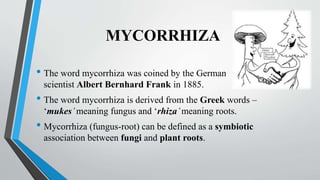
• The word mycorrhiza was coined by the German
scientist Albert Bernhard Frank in 1885.
• The word mycorrhiza is derived from the Greek words –
‘mukes’meaning fungus and ‘rhiza’meaning roots.
• Mycorrhiza (fungus-root) can be defined as a symbiotic
association between fungi and plant roots.
Importance
• 95% of all the world's plant species form mycorrhizal
relationships with fungi and that in the majority of cases the plant
would not survive without them.
• Present in 95% of plants (83% Dicots, 79% Monocots and 100%
Gymnosperms).
• Brassicaceae, Cyperaceae, and Juncaceae- do not have
mycorrhizal associations (10-20%).
• The Orchidaceae are notorious as a family in which the absence
of the correct mycorrhizae is fatal even to germinating seeds
Importance
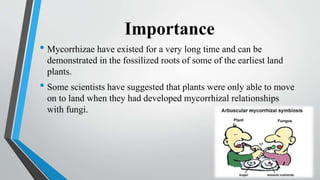
• Mycorrhizae have existed for a very long time and can be
demonstrated in the fossilized roots of some of the earliest land
plants.
• Some scientists have suggested that plants were only able to move
on to land when they had developed mycorrhizal relationships
with fungi.
Classification of mycorrhiza
Based on tropic level by A.B. Frank
• Ectotropic Mycorrhiza
• Endotropic Mycorrhiza
Based on morphological and anatomical feature
• Ectomycorrhiza
• Endomycorrhiza
• Ectendomycorrhiza
Broadly classified into (Mark)
• Ectomycorrhiza (EcM)
• Endomycorrhiza (AM / VAM)
• Ectendomycorrhiza
• Monotropoid mycorrhiza
• Arbutoid mycorrhiza
• Orchid mycorrhiza
• Ericoid mycorrhiza
Ectomycorrhiza or ectotrophic
mycorrhiza (EcM)
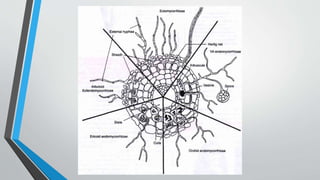
• Ectomycorrhizas, or EM, are typically formed between the roots
of around 10% of plant families, mostly woody plants including
the birch, dipterocarp, eucalyptus, oak, pine, deodar and rose
families , orchids, and fungi belonging to the Basidiomycota,
Ascomycota and Zygomycota.
• Commonly associated with trans temperate forest trees.
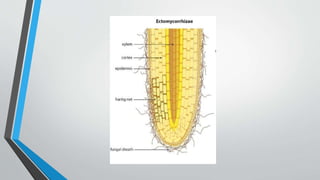
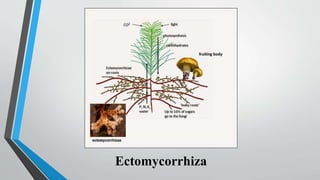
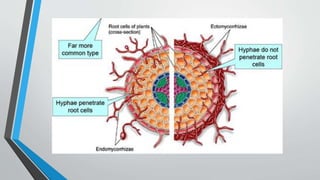
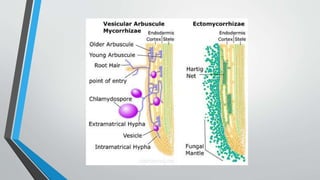
• Ectomycorrhizal fungi form a sheath or mantle around the root,
and hyphae emanate through the soil increasing the surface area.
• The fungus grows within the root cell wall but never penetrates the
cell interior.
• It grows between the cells of the cortex to form Hartig net.
• The Hartig net present outside the endodermis and meristematic
zones is the site for nutrient exchange.
• Colonization of root tips induces marked changes in the host
root morphology.
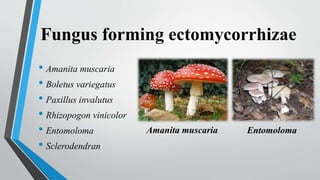
Fungus forming ectomycorrhizae
• Amanita muscaria
• Boletus variegatus
• Paxillus invalutus
• Rhizopogon vinicolor
• Entomoloma
• Sclerodendran
Amanita muscaria Entomoloma
Ectomycorrhiza
Advantages of ectomycorrhiza
• Extensive multibranching hyphae increases the water holding
capacity of plants.
• Increase the tolerance to drought, high soil temperature, organic
and inorganic soil toxins, extremes of soil acidity to sulphur and
aluminium.
• Deter infection of feeder roots by some rot pathogens.
• Enhance the uptake of many nutrients. (P, Cu, Zn through Hartig
net)
• Disease control through barrier effect, competitive exclusion.
• Play a key role in afforestation.
Endomycorrhiza or endotrophic
mycorrhiza
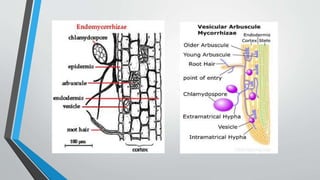
• Arbuscular mycorrhizae (often called AM) are the most common
and widespread of all mycorrhizae and are found in as many as
85%-90% of the world's plant species.
• Commonly associated with agricultural, horticulture crops in
addition to tropical trees.
• The external hyphal mantle or sheath is absent or scanty. The
fungal hyphae enters inside the root cortex and penetrates the
cortical cells.
• This is not a destructive parasitic association but endomycorrhiza
are present at certain times as a part of normal root development.
• AM fungi penetrate the cell walls of root cells.
• They grow between the cell wall and cell membrane forming
arbuscules.
• VAM fungi produce vesicles for lipid storage.
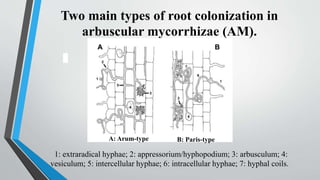
Two main types of root colonization in
arbuscular mycorrhizae (AM).
1: extraradical hyphae; 2: appressorium/hyphopodium; 3: arbusculum; 4:
vesiculum; 5: intercellular hyphae; 6: intracellular hyphae; 7: hyphal coils.
A: Arum-type B: Paris-type
Two main types of root colonization in
arbuscular mycorrhizae (AM).
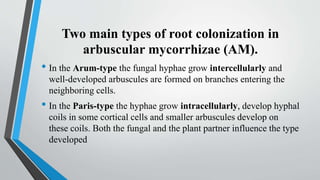
• In the Arum-type the fungal hyphae grow intercellularly and
well-developed arbuscules are formed on branches entering the
neighboring cells.
• In the Paris-type the hyphae grow intracellularly, develop hyphal
coils in some cortical cells and smaller arbuscules develop on
these coils. Both the fungal and the plant partner influence the type
developed
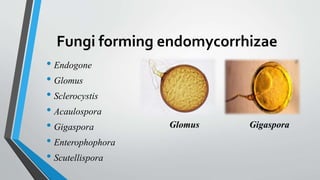
Fungi forming endomycorrhizae
• Endogone
• Glomus
• Sclerocystis
• Acaulospora
• Gigaspora
• Enterophophora
• Scutellispora
GigasporaGlomus
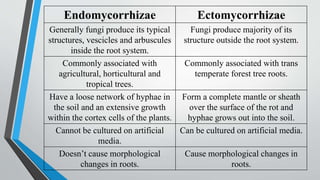
Endomycorrhizae Ectomycorrhizae
Generally fungi produce its typical
structures, vescicles and arbuscules
inside the root system.
Fungi produce majority of its
structure outside the root system.
Commonly associated with
agricultural, horticultural and
tropical trees.
Commonly associated with trans
temperate forest tree roots.
Have a loose network of hyphae in
the soil and an extensive growth
within the cortex cells of the plants.
Form a complete mantle or sheath
over the surface of the rot and
hyphae grows out into the soil.
Cannot be cultured on artificial
media.
Can be cultured on artificial media.
Doesn’t cause morphological
changes in roots.
Cause morphological changes in
roots.
Ectendomycorrhiza
• They share the features of both ecto- and endomycorrhiza.
• They have less developed hyphal mantle.
• The hyphae within the host penetrate its cells and grow within.
• These are found in both angiosperms and gymnosperms.
• Fungus associated are Ascomycetes.
• Hosts are Eucalyptus, Salix, Alnus etc.
Monotropoid mycorrhiza
• The family Monotropaceae, which includes achlorophyllous
plants, develop the association.
• These plants entirely depend upon the fungus for
carbon and energy.
• Sheath, inter- and intracellular hyphae and peg-like haustoria
are present.
Monotropa sp.
Arbutoid mycorrhiza
• These are found in the family Ericaceae.
• The fungi penetrate into the cortical cells forming extensive coils
of hyphae.
• The mycosymbionts are Basidiomycetes.
• Sheath, inter- and coiled intercellular hyphae are present.
Orchid mycorrhiza
• At some point of time all Orchids are infected by orchidaceous
mycorrhiza – Basidiomycota.
• Orchids germinate only after infection by mycorrhiza. Ex:
Rhizoctonia sp.
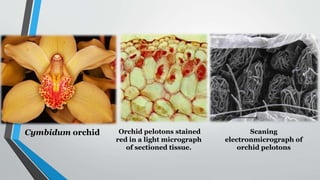
• Within cells, hyphae form coils called pelotons which greatly
increase the interfacial surface area between orchid and fungus.
Cymbidum orchid Orchid pelotons stained
red in a light micrograph
of sectioned tissue.
Scaning
electronmicrograph of
orchid pelotons
Ericoid mycorrhiza
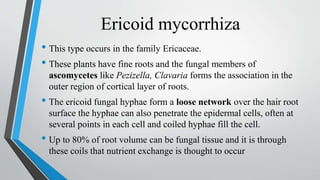
• This type occurs in the family Ericaceae.
• These plants have fine roots and the fungal members of
ascomycetes like Pezizella, Clavaria forms the association in the
outer region of cortical layer of roots.
• The ericoid fungal hyphae form a loose network over the hair root
surface the hyphae can also penetrate the epidermal cells, often at
several points in each cell and coiled hyphae fill the cell.
• Up to 80% of root volume can be fungal tissue and it is through
these coils that nutrient exchange is thought to occur
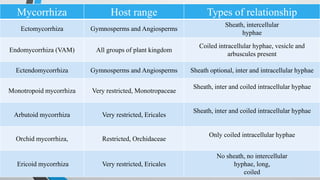
Mycorrhiza Host range Types of relationship
Ectomycorrhiza Gymnosperms and Angiosperms
Sheath, intercellular
hyphae
Endomycorrhiza (VAM) All groups of plant kingdom
Coiled intracellular hyphae, vesicle and
arbuscules present
Ectendomycorrhiza Gymnosperms and Angiosperms Sheath optional, inter and intracellular hyphae
Monotropoid mycorrhiza Very restricted, Monotropaceae
Sheath, inter and coiled intracellular hyphae
Arbutoid mycorrhiza Very restricted, Ericales
Sheath, inter and coiled intracellular hyphae
Orchid mycorrhiza, Restricted, Orchidaceae
Only coiled intracellular hyphae
Ericoid mycorrhiza Very restricted, Ericales
No sheath, no intercellular
hyphae, long,
coiled
Isolation of Vesicular-Arbuscular
Mycorrhizal (VAM) spores from the soil
A. Sieving method
Requirements
• Soil sample
• 500 ml beaker
• Sieves of 710 µm, 250 µm, 75 µm and 45 µm.
• Bunsen burner
Procedure
• Take 200 ml water in 500 ml beaker.
• Heat the water to 40-50˚ C.
• Add 50 g of soil and mix well to form a suspension.
• Allow the heavier particles to settle down.
• Decant most of the suspension through a 710 µm sieve to remove
large organic matter and roots.
Procedure
• Add 200 ml of water to the suspension.
• Decant the suspension through 710 µm sieve.
• Decant this through 250 µm, 75 µm and 45 µm sieves
consequently.
• Collect the residue on the 45 µm sieve.
• Wash the residues well with water and collect the spore.
B. Floatation method
Requirements
•Soil sample
•Sucrose solutions (20, 40 and 60 %)
•Blender
•Fine sieve
•Centrifuge
•Centrifuge tube (50 ml)
Procedure
• Collect fresh soil samples from the field, mix them well and weigh
20 g soil.
• Transfer the soil into a blender.
• Blend it at high speed for 1-2 minutes so that the spores attached
to the soil particles or roots may become free.
• Filter the contents through a fine sieve and wash with strong
stream of water.
• Pour 10 ml of 20% sucrose into a centrifuge tube followed by the
same amount of 40% and 60% sucrose into the bottom of the tube.
Procedure
• Take 10-15 ml of blended sieving and add onto the surface of 20%
sucrose layer.
• Centrifuge the contents for 3 minutes at 3000 rpm. Thereafter,
remove the debris which accumulate at the interfaces of 20-40%
and 40-60% of sucrose.
• Gently wash the spores present on fine sieve with a strong stream
of water so that sucrose should be removed.
• Collect the spores and observe under microscope.
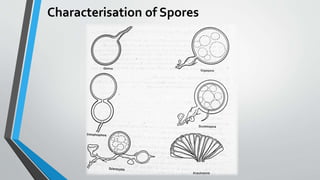
Characterisation of Spores
Mass Production : Problems and
prospects
• Being obligate symbionts AM fungi could be mass produced only
in the presence of living roots.
• Since AM fungal associations are universal and have been reported
in almost all terrestrial plants, these can be reproduced on a wide
range of host plants.
• There are several techniques reported for mass production of AM
inoculum.
a. In vivo culture
• AM fungi are grown on roots of green house plants and chopped
mycorrhizal roots, often mixed with growth media containing
hyphae and spores, are used as source of inoculum.
• Soil could be replaced by inert substances such as vermiculite,
perlite, sand or a mixture of these for crude inoculum
production.
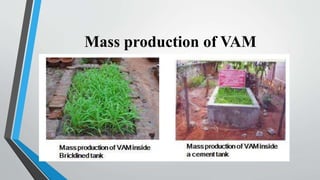
Mass production of VAM
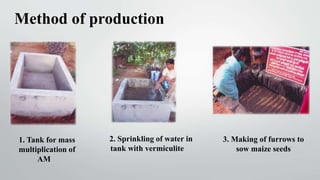
1. Tank for mass
multiplication of
AM
2. Sprinkling of water in
tank with vermiculite
3. Making of furrows to
sow maize seeds
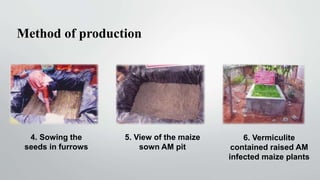
Method of production
4. Sowing the
seeds in furrows
5. View of the maize
sown AM pit
6. Vermiculite
contained raised AM
infected maize plants
•
b. In vitro/ axenic culture techniques
•i) Solution culture
•ii) Aeroponic culture
•iii) Root organ culture
i) Solution culture
• Involves growing infected roots in aqueous medium enriched with
mineral nutrients required for the growth of the roots under
controlled biotic and abiotic conditions.
ii) Aeroponic culture
Involves applying a fine mist of nutrient solutions to colonized roots
for AM fungal inoculum production.
iii) Root organ culture
• Use of a modified agar medium (MS rooting medium)/ liquid
medium for creation of increased amount of roots from callus
tissue and these roots are infected by AM spores or by surface
sterilized root bits obtained from mycorrhizal plant.
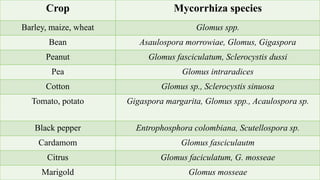
Crop Mycorrhiza species
Barley, maize, wheat Glomus spp.
Bean Asaulospora morrowiae, Glomus, Gigaspora
Peanut Glomus fasciculatum, Sclerocystis dussi
Pea Glomus intraradices
Cotton Glomus sp., Sclerocystis sinuosa
Tomato, potato Gigaspora margarita, Glomus spp., Acaulospora sp.
Black pepper Entrophosphora colombiana, Scutellospora sp.
Cardamom Glomus fasciculautm
Citrus Glomus faciculatum, G. mosseae
Marigold Glomus mosseae
Benefits of mycorrhiza
• Produce more vigorous and healthy plants.
• Increase plant establishment and survival at seedling or
transplanting.
• Enhance flowering and fruiting.
• Increase yields and crop quality.
• Improve drought tolerance, allowing watering reduction.
Benefits of mycorrhiza
• Optimize fertilizers use, especially Phosphorus.
• Increase tolerance to soil salinity.
• Reduce disease occurrence.
• Contribute to maintain soil quality and nutrient cycling.
• Contribute to control soil erosion.
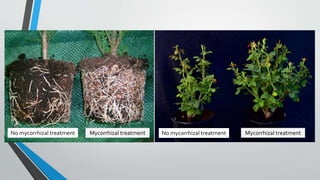
No mycorrhizal treatment Mycorrhizal treatment No mycorrhizal treatment Mycorrhizal treatment
Application of VAM fungi
•Nursery application
100 g bulk inoculum is sufficient for one m2. The inoculum should
be applied a 2-3 cm below the soil at the time of sowing. The
seeds/cuttings should be sown/planted above the VAM inoculum to
cause infection.
Application of VAM fungi
•For polythene bag raised crops
5 to 10 g bulk inoculum is sufficient for each packet. Mix 10 kg of
inoculum with 1000 kg of sand potting mixture and pack the potting
mixture in polythene bag before sowing.
Application of VAM fungi
•For out-planting
20 g of VAM inoculum is required per seedling. Apply inoculum at the
time of planting.
•For existing trees
200 g VAM inoculum is required for inoculating one tree. Apply inoculum
near the root surface at the time of fertilizer application.
Few mycorrhizal products available
commercially
REFERENCES
• Applied Microbiology – Moshrafuddin Ahmed & S K Basumatary
• Experiments in Microbiology, Plant Pathology and Biotechnology
– K R Aneja
• Practical Microbiology – R C Dubey and D K Maheshwari
• Bioinoculants – A Step Towards Sustainable Agriculture – R P Gupta,
Anu Kalia & Shammi Kapoor
• Biofertilizer Technology - S S Sandhu
REFERENCES
Internet
• http://elte.prompt.hu/sites/default/files/tananyagok/StructureOfPlantsAn
dFungi/ch08s05.html
• http://www.davidmoore.org.uk/assets/mostly_mycology/diane_howarth
/monotropoid.html
• http://www.mycosym.com/EN/MycorrhizaEN.html
• https://www.google.co.in/search?q=ECTOMYCORRHIZA&dcr=0&so
urce=lnms&tbm=isch&sa=X&ved=0ahUKEwj_666P0ofZAhVMRY8K
HUOEDw0Q_AUICigB&biw=1366&bih=588#imgrc=b-
WD_IuzKXNP2M:
Presented by
• Sandeep KumarCH
• UG14AGR1989
• College ofAgriculture, University of Agricultural Sciences, Raichur.
THANK YOU

Mycorrhiza

  • 2.
    Mycorrhiza Introduction, isolation, characterization, screening,mass production, advantages and application. Presented by: Sandeepkumar CH (UG14AGR1989)
  • 3.
    MYCORRHIZA • The wordmycorrhiza was coined by the German scientist Albert Bernhard Frank in 1885. • The word mycorrhiza is derived from the Greek words – ‘mukes’meaning fungus and ‘rhiza’meaning roots. • Mycorrhiza (fungus-root) can be defined as a symbiotic association between fungi and plant roots.
  • 4.
    Importance • 95% ofall the world's plant species form mycorrhizal relationships with fungi and that in the majority of cases the plant would not survive without them. • Present in 95% of plants (83% Dicots, 79% Monocots and 100% Gymnosperms). • Brassicaceae, Cyperaceae, and Juncaceae- do not have mycorrhizal associations (10-20%). • The Orchidaceae are notorious as a family in which the absence of the correct mycorrhizae is fatal even to germinating seeds
  • 5.
    Importance • Mycorrhizae haveexisted for a very long time and can be demonstrated in the fossilized roots of some of the earliest land plants. • Some scientists have suggested that plants were only able to move on to land when they had developed mycorrhizal relationships with fungi.
  • 6.
    Classification of mycorrhiza Basedon tropic level by A.B. Frank • Ectotropic Mycorrhiza • Endotropic Mycorrhiza Based on morphological and anatomical feature • Ectomycorrhiza • Endomycorrhiza • Ectendomycorrhiza
  • 7.
    Broadly classified into(Mark) • Ectomycorrhiza (EcM) • Endomycorrhiza (AM / VAM) • Ectendomycorrhiza • Monotropoid mycorrhiza • Arbutoid mycorrhiza • Orchid mycorrhiza • Ericoid mycorrhiza
  • 8.
    Ectomycorrhiza or ectotrophic mycorrhiza(EcM) • Ectomycorrhizas, or EM, are typically formed between the roots of around 10% of plant families, mostly woody plants including the birch, dipterocarp, eucalyptus, oak, pine, deodar and rose families , orchids, and fungi belonging to the Basidiomycota, Ascomycota and Zygomycota. • Commonly associated with trans temperate forest trees.
  • 9.
    • Ectomycorrhizal fungiform a sheath or mantle around the root, and hyphae emanate through the soil increasing the surface area. • The fungus grows within the root cell wall but never penetrates the cell interior. • It grows between the cells of the cortex to form Hartig net. • The Hartig net present outside the endodermis and meristematic zones is the site for nutrient exchange. • Colonization of root tips induces marked changes in the host root morphology.
  • 10.
    Fungus forming ectomycorrhizae •Amanita muscaria • Boletus variegatus • Paxillus invalutus • Rhizopogon vinicolor • Entomoloma • Sclerodendran Amanita muscaria Entomoloma
  • 12.
  • 13.
    Advantages of ectomycorrhiza •Extensive multibranching hyphae increases the water holding capacity of plants. • Increase the tolerance to drought, high soil temperature, organic and inorganic soil toxins, extremes of soil acidity to sulphur and aluminium. • Deter infection of feeder roots by some rot pathogens. • Enhance the uptake of many nutrients. (P, Cu, Zn through Hartig net) • Disease control through barrier effect, competitive exclusion. • Play a key role in afforestation.
  • 14.
    Endomycorrhiza or endotrophic mycorrhiza •Arbuscular mycorrhizae (often called AM) are the most common and widespread of all mycorrhizae and are found in as many as 85%-90% of the world's plant species. • Commonly associated with agricultural, horticulture crops in addition to tropical trees.
  • 15.
    • The externalhyphal mantle or sheath is absent or scanty. The fungal hyphae enters inside the root cortex and penetrates the cortical cells. • This is not a destructive parasitic association but endomycorrhiza are present at certain times as a part of normal root development. • AM fungi penetrate the cell walls of root cells. • They grow between the cell wall and cell membrane forming arbuscules. • VAM fungi produce vesicles for lipid storage.
  • 16.
    Two main typesof root colonization in arbuscular mycorrhizae (AM). 1: extraradical hyphae; 2: appressorium/hyphopodium; 3: arbusculum; 4: vesiculum; 5: intercellular hyphae; 6: intracellular hyphae; 7: hyphal coils. A: Arum-type B: Paris-type
  • 17.
    Two main typesof root colonization in arbuscular mycorrhizae (AM). • In the Arum-type the fungal hyphae grow intercellularly and well-developed arbuscules are formed on branches entering the neighboring cells. • In the Paris-type the hyphae grow intracellularly, develop hyphal coils in some cortical cells and smaller arbuscules develop on these coils. Both the fungal and the plant partner influence the type developed
  • 18.
    Fungi forming endomycorrhizae •Endogone • Glomus • Sclerocystis • Acaulospora • Gigaspora • Enterophophora • Scutellispora GigasporaGlomus
  • 20.
    Endomycorrhizae Ectomycorrhizae Generally fungiproduce its typical structures, vescicles and arbuscules inside the root system. Fungi produce majority of its structure outside the root system. Commonly associated with agricultural, horticultural and tropical trees. Commonly associated with trans temperate forest tree roots. Have a loose network of hyphae in the soil and an extensive growth within the cortex cells of the plants. Form a complete mantle or sheath over the surface of the rot and hyphae grows out into the soil. Cannot be cultured on artificial media. Can be cultured on artificial media. Doesn’t cause morphological changes in roots. Cause morphological changes in roots.
  • 23.
    Ectendomycorrhiza • They sharethe features of both ecto- and endomycorrhiza. • They have less developed hyphal mantle. • The hyphae within the host penetrate its cells and grow within. • These are found in both angiosperms and gymnosperms. • Fungus associated are Ascomycetes. • Hosts are Eucalyptus, Salix, Alnus etc.
  • 24.
    Monotropoid mycorrhiza • Thefamily Monotropaceae, which includes achlorophyllous plants, develop the association. • These plants entirely depend upon the fungus for carbon and energy. • Sheath, inter- and intracellular hyphae and peg-like haustoria are present. Monotropa sp.
  • 25.
    Arbutoid mycorrhiza • Theseare found in the family Ericaceae. • The fungi penetrate into the cortical cells forming extensive coils of hyphae. • The mycosymbionts are Basidiomycetes. • Sheath, inter- and coiled intercellular hyphae are present.
  • 26.
    Orchid mycorrhiza • Atsome point of time all Orchids are infected by orchidaceous mycorrhiza – Basidiomycota. • Orchids germinate only after infection by mycorrhiza. Ex: Rhizoctonia sp. • Within cells, hyphae form coils called pelotons which greatly increase the interfacial surface area between orchid and fungus.
  • 27.
    Cymbidum orchid Orchidpelotons stained red in a light micrograph of sectioned tissue. Scaning electronmicrograph of orchid pelotons
  • 28.
    Ericoid mycorrhiza • Thistype occurs in the family Ericaceae. • These plants have fine roots and the fungal members of ascomycetes like Pezizella, Clavaria forms the association in the outer region of cortical layer of roots. • The ericoid fungal hyphae form a loose network over the hair root surface the hyphae can also penetrate the epidermal cells, often at several points in each cell and coiled hyphae fill the cell. • Up to 80% of root volume can be fungal tissue and it is through these coils that nutrient exchange is thought to occur
  • 30.
    Mycorrhiza Host rangeTypes of relationship Ectomycorrhiza Gymnosperms and Angiosperms Sheath, intercellular hyphae Endomycorrhiza (VAM) All groups of plant kingdom Coiled intracellular hyphae, vesicle and arbuscules present Ectendomycorrhiza Gymnosperms and Angiosperms Sheath optional, inter and intracellular hyphae Monotropoid mycorrhiza Very restricted, Monotropaceae Sheath, inter and coiled intracellular hyphae Arbutoid mycorrhiza Very restricted, Ericales Sheath, inter and coiled intracellular hyphae Orchid mycorrhiza, Restricted, Orchidaceae Only coiled intracellular hyphae Ericoid mycorrhiza Very restricted, Ericales No sheath, no intercellular hyphae, long, coiled
  • 31.
    Isolation of Vesicular-Arbuscular Mycorrhizal(VAM) spores from the soil A. Sieving method Requirements • Soil sample • 500 ml beaker • Sieves of 710 µm, 250 µm, 75 µm and 45 µm. • Bunsen burner
  • 32.
    Procedure • Take 200ml water in 500 ml beaker. • Heat the water to 40-50˚ C. • Add 50 g of soil and mix well to form a suspension. • Allow the heavier particles to settle down. • Decant most of the suspension through a 710 µm sieve to remove large organic matter and roots.
  • 33.
    Procedure • Add 200ml of water to the suspension. • Decant the suspension through 710 µm sieve. • Decant this through 250 µm, 75 µm and 45 µm sieves consequently. • Collect the residue on the 45 µm sieve. • Wash the residues well with water and collect the spore.
  • 34.
    B. Floatation method Requirements •Soilsample •Sucrose solutions (20, 40 and 60 %) •Blender •Fine sieve •Centrifuge •Centrifuge tube (50 ml)
  • 35.
    Procedure • Collect freshsoil samples from the field, mix them well and weigh 20 g soil. • Transfer the soil into a blender. • Blend it at high speed for 1-2 minutes so that the spores attached to the soil particles or roots may become free. • Filter the contents through a fine sieve and wash with strong stream of water. • Pour 10 ml of 20% sucrose into a centrifuge tube followed by the same amount of 40% and 60% sucrose into the bottom of the tube.
  • 36.
    Procedure • Take 10-15ml of blended sieving and add onto the surface of 20% sucrose layer. • Centrifuge the contents for 3 minutes at 3000 rpm. Thereafter, remove the debris which accumulate at the interfaces of 20-40% and 40-60% of sucrose. • Gently wash the spores present on fine sieve with a strong stream of water so that sucrose should be removed. • Collect the spores and observe under microscope.
  • 37.
  • 38.
    Mass Production :Problems and prospects • Being obligate symbionts AM fungi could be mass produced only in the presence of living roots. • Since AM fungal associations are universal and have been reported in almost all terrestrial plants, these can be reproduced on a wide range of host plants. • There are several techniques reported for mass production of AM inoculum.
  • 39.
    a. In vivoculture • AM fungi are grown on roots of green house plants and chopped mycorrhizal roots, often mixed with growth media containing hyphae and spores, are used as source of inoculum. • Soil could be replaced by inert substances such as vermiculite, perlite, sand or a mixture of these for crude inoculum production.
  • 40.
  • 41.
    1. Tank formass multiplication of AM 2. Sprinkling of water in tank with vermiculite 3. Making of furrows to sow maize seeds Method of production
  • 42.
    Method of production 4.Sowing the seeds in furrows 5. View of the maize sown AM pit 6. Vermiculite contained raised AM infected maize plants •
  • 43.
    b. In vitro/axenic culture techniques •i) Solution culture •ii) Aeroponic culture •iii) Root organ culture
  • 44.
    i) Solution culture •Involves growing infected roots in aqueous medium enriched with mineral nutrients required for the growth of the roots under controlled biotic and abiotic conditions.
  • 45.
    ii) Aeroponic culture Involvesapplying a fine mist of nutrient solutions to colonized roots for AM fungal inoculum production.
  • 46.
    iii) Root organculture • Use of a modified agar medium (MS rooting medium)/ liquid medium for creation of increased amount of roots from callus tissue and these roots are infected by AM spores or by surface sterilized root bits obtained from mycorrhizal plant.
  • 47.
    Crop Mycorrhiza species Barley,maize, wheat Glomus spp. Bean Asaulospora morrowiae, Glomus, Gigaspora Peanut Glomus fasciculatum, Sclerocystis dussi Pea Glomus intraradices Cotton Glomus sp., Sclerocystis sinuosa Tomato, potato Gigaspora margarita, Glomus spp., Acaulospora sp. Black pepper Entrophosphora colombiana, Scutellospora sp. Cardamom Glomus fasciculautm Citrus Glomus faciculatum, G. mosseae Marigold Glomus mosseae
  • 48.
    Benefits of mycorrhiza •Produce more vigorous and healthy plants. • Increase plant establishment and survival at seedling or transplanting. • Enhance flowering and fruiting. • Increase yields and crop quality. • Improve drought tolerance, allowing watering reduction.
  • 49.
    Benefits of mycorrhiza •Optimize fertilizers use, especially Phosphorus. • Increase tolerance to soil salinity. • Reduce disease occurrence. • Contribute to maintain soil quality and nutrient cycling. • Contribute to control soil erosion.
  • 50.
    No mycorrhizal treatmentMycorrhizal treatment No mycorrhizal treatment Mycorrhizal treatment
  • 51.
    Application of VAMfungi •Nursery application 100 g bulk inoculum is sufficient for one m2. The inoculum should be applied a 2-3 cm below the soil at the time of sowing. The seeds/cuttings should be sown/planted above the VAM inoculum to cause infection.
  • 52.
    Application of VAMfungi •For polythene bag raised crops 5 to 10 g bulk inoculum is sufficient for each packet. Mix 10 kg of inoculum with 1000 kg of sand potting mixture and pack the potting mixture in polythene bag before sowing.
  • 53.
    Application of VAMfungi •For out-planting 20 g of VAM inoculum is required per seedling. Apply inoculum at the time of planting. •For existing trees 200 g VAM inoculum is required for inoculating one tree. Apply inoculum near the root surface at the time of fertilizer application.
  • 54.
    Few mycorrhizal productsavailable commercially
  • 55.
    REFERENCES • Applied Microbiology– Moshrafuddin Ahmed & S K Basumatary • Experiments in Microbiology, Plant Pathology and Biotechnology – K R Aneja • Practical Microbiology – R C Dubey and D K Maheshwari • Bioinoculants – A Step Towards Sustainable Agriculture – R P Gupta, Anu Kalia & Shammi Kapoor • Biofertilizer Technology - S S Sandhu
  • 56.
    REFERENCES Internet • http://elte.prompt.hu/sites/default/files/tananyagok/StructureOfPlantsAn dFungi/ch08s05.html • http://www.davidmoore.org.uk/assets/mostly_mycology/diane_howarth /monotropoid.html •http://www.mycosym.com/EN/MycorrhizaEN.html • https://www.google.co.in/search?q=ECTOMYCORRHIZA&dcr=0&so urce=lnms&tbm=isch&sa=X&ved=0ahUKEwj_666P0ofZAhVMRY8K HUOEDw0Q_AUICigB&biw=1366&bih=588#imgrc=b- WD_IuzKXNP2M:
  • 57.
    Presented by • SandeepKumarCH • UG14AGR1989 • College ofAgriculture, University of Agricultural Sciences, Raichur.
  • 58.