By
Subhananthini jeyamurugan
Roll no 18py17
I M.Sc., Microbiology
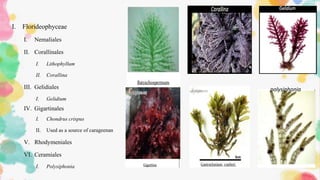
I. Florideophyceae
I. Nemaliales
II. Corallinales
I. Lithophyllum
II. Corallina
III. Gelidiales
I. Gelidium
IV. Gigartinales
I. Chondrus crispus
II. Used as a source of carageenan
V. Rhodymeniales
VI. Ceramiales
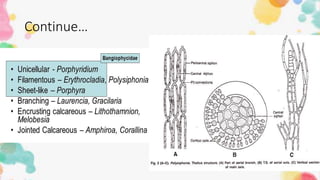
I. Polysiphonia
polysiphonia
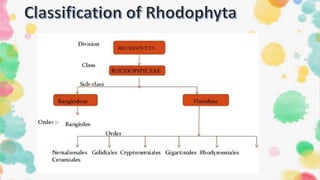
Division : Rhodophycophyta
class : Rhodophyceae
sub-class : Florideae
order : Gelidiales
Family : Gelidiaceae
Genus : Gelidium
Species : cartilagineum
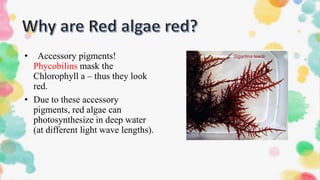
• Accessory pigments!
Phycobilins mask the
Chlorophyll a – thus they look
red.
• Due to these accessory
pigments, red algae can
photosynthesize in deep water
(at different light wave lengths).
Floridean starch is a type of a storage glucan found in red algae (also known as rhodophytes), in which it is
usually the primary sink for fixed carbon from photosynthesis. Floridean starch is stored as grains outside the
chloroplast
• Thallus – cylindrical or flattened
• It is stiff and cartilaginous and often pinnately branched.
• In many species branch lets bend away from the main axis
• The thallus is based primarily upon the uniaxial type of construction.
• It possess the single apical cell at the apex of each branch.
• The apical cell forms a single axial filament of the adult portion.
• The axial filament, one or two posterior to the apical cell cut off four primary pericentral cells.
• And then each of these cells form a short branched lateral filament.
• The tips of these lateral filaments adhere to each other and form pesudoparenchymatous tissue that
makes the surface of the thallus.
Continue…
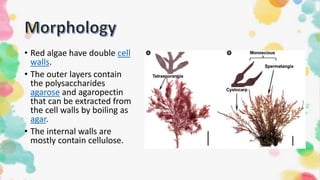
• Red algae have double cell
walls.
• The outer layers contain
the polysaccharides
agarose and agaropectin
that can be extracted from
the cell walls by boiling as
agar.
• The internal walls are
mostly contain cellulose.
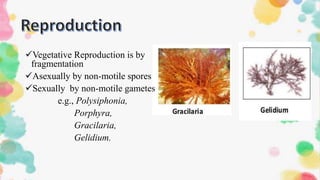
Vegetative Reproduction is by
fragmentation
Asexually by non-motile spores
Sexually by non-motile gametes
e.g., Polysiphonia,
Porphyra,
Gracilaria,
Gelidium.
sexual
Asexual
In majority of class it takes place by fragmentation.
In sexual reproduction of the gametophytes takes place by neutral spores,
mono spores and polyspores.
• neutral spores develop in ordinary cells of thallus.
• monospores develop in sporangia.
• polyspores are formed in larger number in the sporangium.
Continue…
• The asexual reproduction of the sporophytes takes place by
tetra spores formed in tetrads in the tetra sporangia (Tetra
sporangia produce tetra spores via meiosis)e.g., Polysiponia.
• Paraspore borne inside parasporangia in greater numbers.
• During the development of tetraspores reduction division
takes place.
• In the development of paraspores there is no reduction
division.
•The sexual reproduction is always in Oogamous. The
oogamy is a special type.
• Male structure is called the Spematangia developing non-
motile spermatia ( male gametes) in them.
• Female structure is called the procarp. It has a
carpogonium bearing a receptive structure is called
trichogyne.
•The egg develops in the basal swollen part of carpogonium.
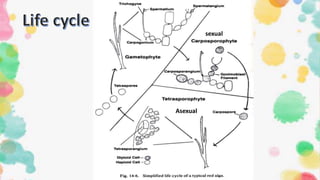
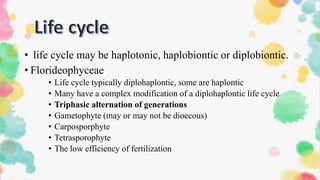
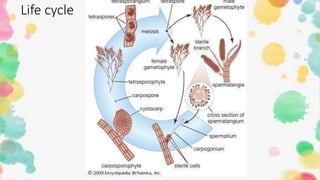
• life cycle may be haplotonic, haplobiontic or diplobiontic.
• Florideophyceae
• Life cycle typically diplohaplontic, some are haplontic
• Many have a complex modification of a diplohaplontic life cycle
• Triphasic alternation of generations
• Gametophyte (may or may not be dioecous)
• Carposporphyte
• Tetrasporophyte
• The low efficiency of fertilization
Life cycle
Continue…
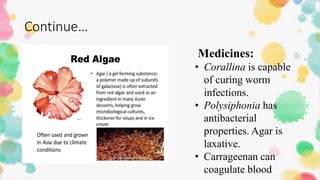
Medicines:
• Corallina is capable
of curing worm
infections.
• Polysiphonia has
antibacterial
properties. Agar is
laxative.
• Carrageenan can
coagulate blood
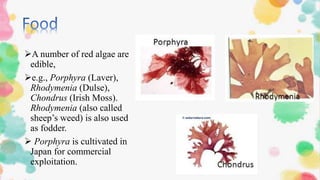
A number of red algae are
edible,
e.g., Porphyra (Laver),
Rhodymenia (Dulse),
Chondrus (Irish Moss).
Rhodymenia (also called
sheep’s weed) is also used
as fodder.
 Porphyra is cultivated in
Japan for commercial
exploitation.
• Some red tides are associated with
the production of natural toxins,
depletion of dissolves oxygen or
other harmful algal blooms.
• The most conspicuous effects of
these kind of red tides are the
associates wildlife moralities of
marine and coastal species of fish,
birds, marine mammals and other
organisms.
Rhodophyta
Rhodophyta

Rhodophyta

  • 1.
    By Subhananthini jeyamurugan Roll no18py17 I M.Sc., Microbiology
  • 3.
    I. Florideophyceae I. Nemaliales II.Corallinales I. Lithophyllum II. Corallina III. Gelidiales I. Gelidium IV. Gigartinales I. Chondrus crispus II. Used as a source of carageenan V. Rhodymeniales VI. Ceramiales I. Polysiphonia polysiphonia
  • 4.
    Division : Rhodophycophyta class: Rhodophyceae sub-class : Florideae order : Gelidiales Family : Gelidiaceae Genus : Gelidium Species : cartilagineum
  • 5.
    • Accessory pigments! Phycobilinsmask the Chlorophyll a – thus they look red. • Due to these accessory pigments, red algae can photosynthesize in deep water (at different light wave lengths).
  • 6.
    Floridean starch isa type of a storage glucan found in red algae (also known as rhodophytes), in which it is usually the primary sink for fixed carbon from photosynthesis. Floridean starch is stored as grains outside the chloroplast
  • 8.
    • Thallus –cylindrical or flattened • It is stiff and cartilaginous and often pinnately branched. • In many species branch lets bend away from the main axis • The thallus is based primarily upon the uniaxial type of construction. • It possess the single apical cell at the apex of each branch. • The apical cell forms a single axial filament of the adult portion. • The axial filament, one or two posterior to the apical cell cut off four primary pericentral cells. • And then each of these cells form a short branched lateral filament. • The tips of these lateral filaments adhere to each other and form pesudoparenchymatous tissue that makes the surface of the thallus.
  • 10.
  • 11.
    • Red algaehave double cell walls. • The outer layers contain the polysaccharides agarose and agaropectin that can be extracted from the cell walls by boiling as agar. • The internal walls are mostly contain cellulose.
  • 12.
    Vegetative Reproduction isby fragmentation Asexually by non-motile spores Sexually by non-motile gametes e.g., Polysiphonia, Porphyra, Gracilaria, Gelidium.
  • 13.
  • 14.
    In majority ofclass it takes place by fragmentation. In sexual reproduction of the gametophytes takes place by neutral spores, mono spores and polyspores. • neutral spores develop in ordinary cells of thallus. • monospores develop in sporangia. • polyspores are formed in larger number in the sporangium.
  • 15.
    Continue… • The asexualreproduction of the sporophytes takes place by tetra spores formed in tetrads in the tetra sporangia (Tetra sporangia produce tetra spores via meiosis)e.g., Polysiponia. • Paraspore borne inside parasporangia in greater numbers. • During the development of tetraspores reduction division takes place. • In the development of paraspores there is no reduction division.
  • 16.
    •The sexual reproductionis always in Oogamous. The oogamy is a special type. • Male structure is called the Spematangia developing non- motile spermatia ( male gametes) in them. • Female structure is called the procarp. It has a carpogonium bearing a receptive structure is called trichogyne. •The egg develops in the basal swollen part of carpogonium.
  • 17.
    • life cyclemay be haplotonic, haplobiontic or diplobiontic. • Florideophyceae • Life cycle typically diplohaplontic, some are haplontic • Many have a complex modification of a diplohaplontic life cycle • Triphasic alternation of generations • Gametophyte (may or may not be dioecous) • Carposporphyte • Tetrasporophyte • The low efficiency of fertilization
  • 18.
  • 20.
    Continue… Medicines: • Corallina iscapable of curing worm infections. • Polysiphonia has antibacterial properties. Agar is laxative. • Carrageenan can coagulate blood
  • 21.
    A number ofred algae are edible, e.g., Porphyra (Laver), Rhodymenia (Dulse), Chondrus (Irish Moss). Rhodymenia (also called sheep’s weed) is also used as fodder.  Porphyra is cultivated in Japan for commercial exploitation.
  • 23.
    • Some redtides are associated with the production of natural toxins, depletion of dissolves oxygen or other harmful algal blooms. • The most conspicuous effects of these kind of red tides are the associates wildlife moralities of marine and coastal species of fish, birds, marine mammals and other organisms.