





Ms. ULFAT AMIN
P.G PEDIATRIC NURSING
DIPLOMA IN NURSING
ADMINISTRATION
Epidural: Administering
medication, into the
epidural space, which lies
just outside the
subarachnoid space
where cerebrospinal fluid
(CSF) flows. The drug
diffuses slowly into the
subarachnoid space of
the spinal canal and then
into the CSF.
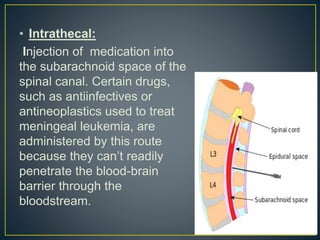
• Intrathecal:
Injection of medication into
the subarachnoid space of the
spinal canal. Certain drugs,
such as antiinfectives or
antineoplastics used to treat
meningeal leukemia, are
administered by this route
because they can’t readily
penetrate the blood-brain
barrier through the
bloodstream.
• Analgesia is usually given via this route.
• Epidural analgesia helps manage acute or
chronic pain, including moderate to severe
postoperative pain.
• It’s especially useful in patients with cancer or
degenerative joint disease.
• This procedure works well because opioid
receptors are located along the entire spinal
• Cesarean section
• Genitourinary procedures
• Lower extremity procedures
• Procedures of uterus or perineum
• Best choice for those who dint tolerate general
anesthesia
• Gloves
• Infusion pump and compatible tubing
• 20-gauge needleless adapter
• Filter needle (per agency policy)
• Syringe
• Antiseptic swab
• Sterile gauze pad
• Tape
• Label (for injection port)
• Equipment for vital signs and pulse oximetry
• Verify the doctor’s order.
• Perform hand hygiene.
• Confirm the patient’s identity.
• Perform a comprehensive pain assessment using
techniques that are appropriate for the patient’s
age, condition, and ability to understand.
• Explain the procedure and its possible
complications to the patient.
• Take written consent.
• Put on gloves
• Position the patient in the knee-chest position,
or have him sit on the edge of the bed and lean
over a bedside table while the catheter is being
inserted.
• After the anesthesiologist aspirates the device to
make sure cerebrospinal fluid or blood isn’t
present, help him connect the infusion tubing to
the epidural catheter.
• Bridge-tape all connection sites, and apply
an EPIDURAL INFUSION label to the
catheter, infusion tubing and infusion pump
and start the infusion.
• Remove and discard your gloves, perform
hand hygiene.
• Measure the external catheter length with
a tape measure to serve as a baseline for
comparison to assess for catheter
migration.
• Clean the insertion site with povidone-iodine
solution, and then allow it to dry completely.
• Place a chlorhexidine-impregnated sponge
dressing around the insertion site to reduce the
risk for central nervous system infection.
• Secure the catheter to the skin with sterile tape,
as needed.
• Place a transparent semipermeable dressing over
the chlorhexidine- impregnated sponge dressing.
• Label the dressing with the date, the time,
and your initials.
• Discard all used supplies in the appropriate
receptacle.
• Tell the patient to report any pain
immediately.
• If ordered, place the patient on a pulse
oximeter or cardiac monitor for the first 24
hours after beginning the infusion.
• Perform hand hygiene.
• Document the procedure.
• Assess the patient’s vital signs, oxygen
saturation level, sedation level (if an opioid is
being administered), and pain status hourly for
the first 24 hours, and then every 4 hours
thereafter.
• Monitor the patient closely for signs of infection,
such as back pain, tenderness, erythema,
swelling, drainage, fever, malaise, neck stiffness,
progressive numbness, or motor block
• Routinely assess for catheter migration by measuring
external
catheter length; catheter migration may cause inadequate
pain control or an increase in adverse effects.
• Routine dressing changes on short-term catheters aren’t
recommended because of the risk of dislodgement and
infection.
• Semipermeable transparent dressings are commonly
used for epidural catheters and should be changed every
7 days.
• Change administration tubing every 48 hours and the
epidural solution every 24 hours.
• Keep in mind that drugs given epidurally diffuse slowly
and may cause adverse effects, including excessive
sedation, up to 12 hours after epidural infusion has been
discontinued.
• The patient should always have a peripheral IV catheter
(either continuous infusion or saline lock) open to allow
immediate administration of emergency drugs
• Infection
• Epidural hematoma, and
• Catheter migration.
• Infection is treated with antibiotics.
• Insertion site hematomas should be observed and any
increase in size reported to the doctor.
• Catheter migration occurs when the epidural catheter
migrates out of the epidural space toward the skin.
THANK YOU

Epidural administration

  • 1.
    Ms. ULFAT AMIN P.GPEDIATRIC NURSING DIPLOMA IN NURSING ADMINISTRATION
  • 2.
    Epidural: Administering medication, intothe epidural space, which lies just outside the subarachnoid space where cerebrospinal fluid (CSF) flows. The drug diffuses slowly into the subarachnoid space of the spinal canal and then into the CSF.
  • 3.
    • Intrathecal: Injection ofmedication into the subarachnoid space of the spinal canal. Certain drugs, such as antiinfectives or antineoplastics used to treat meningeal leukemia, are administered by this route because they can’t readily penetrate the blood-brain barrier through the bloodstream.
  • 4.
    • Analgesia isusually given via this route. • Epidural analgesia helps manage acute or chronic pain, including moderate to severe postoperative pain. • It’s especially useful in patients with cancer or degenerative joint disease. • This procedure works well because opioid receptors are located along the entire spinal
  • 5.
    • Cesarean section •Genitourinary procedures • Lower extremity procedures • Procedures of uterus or perineum • Best choice for those who dint tolerate general anesthesia
  • 6.
    • Gloves • Infusionpump and compatible tubing • 20-gauge needleless adapter • Filter needle (per agency policy) • Syringe • Antiseptic swab • Sterile gauze pad • Tape • Label (for injection port) • Equipment for vital signs and pulse oximetry
  • 7.
    • Verify thedoctor’s order. • Perform hand hygiene. • Confirm the patient’s identity. • Perform a comprehensive pain assessment using techniques that are appropriate for the patient’s age, condition, and ability to understand. • Explain the procedure and its possible complications to the patient. • Take written consent.
  • 8.
    • Put ongloves • Position the patient in the knee-chest position, or have him sit on the edge of the bed and lean over a bedside table while the catheter is being inserted. • After the anesthesiologist aspirates the device to make sure cerebrospinal fluid or blood isn’t present, help him connect the infusion tubing to the epidural catheter.
  • 9.
    • Bridge-tape allconnection sites, and apply an EPIDURAL INFUSION label to the catheter, infusion tubing and infusion pump and start the infusion. • Remove and discard your gloves, perform hand hygiene. • Measure the external catheter length with a tape measure to serve as a baseline for comparison to assess for catheter migration.
  • 10.
    • Clean theinsertion site with povidone-iodine solution, and then allow it to dry completely. • Place a chlorhexidine-impregnated sponge dressing around the insertion site to reduce the risk for central nervous system infection. • Secure the catheter to the skin with sterile tape, as needed. • Place a transparent semipermeable dressing over the chlorhexidine- impregnated sponge dressing.
  • 11.
    • Label thedressing with the date, the time, and your initials. • Discard all used supplies in the appropriate receptacle. • Tell the patient to report any pain immediately.
  • 12.
    • If ordered,place the patient on a pulse oximeter or cardiac monitor for the first 24 hours after beginning the infusion. • Perform hand hygiene. • Document the procedure.
  • 13.
    • Assess thepatient’s vital signs, oxygen saturation level, sedation level (if an opioid is being administered), and pain status hourly for the first 24 hours, and then every 4 hours thereafter. • Monitor the patient closely for signs of infection, such as back pain, tenderness, erythema, swelling, drainage, fever, malaise, neck stiffness, progressive numbness, or motor block
  • 14.
    • Routinely assessfor catheter migration by measuring external catheter length; catheter migration may cause inadequate pain control or an increase in adverse effects. • Routine dressing changes on short-term catheters aren’t recommended because of the risk of dislodgement and infection. • Semipermeable transparent dressings are commonly used for epidural catheters and should be changed every 7 days.
  • 15.
    • Change administrationtubing every 48 hours and the epidural solution every 24 hours. • Keep in mind that drugs given epidurally diffuse slowly and may cause adverse effects, including excessive sedation, up to 12 hours after epidural infusion has been discontinued. • The patient should always have a peripheral IV catheter (either continuous infusion or saline lock) open to allow immediate administration of emergency drugs
  • 16.
    • Infection • Epiduralhematoma, and • Catheter migration. • Infection is treated with antibiotics. • Insertion site hematomas should be observed and any increase in size reported to the doctor. • Catheter migration occurs when the epidural catheter migrates out of the epidural space toward the skin.
  • 17.