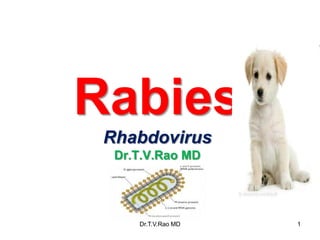
Rabies
Rhabdovirus
Dr.T.V.Rao MD
Dr.T.V.Rao MD 1
Early Rabies
• It has been recognized in India since
the Vedic period (1500–500 BC) and
is described in the ancient Indian
scripture Atharvaveda,
• Rabies is endemic in India, a vast
country with a population exceeding
1.02 billion and a land area of 3.2
million km.
Dr.T.V.Rao MD 2
Dr.T.V.Rao MD 3
Rabies widely spread in Asia and
Africa
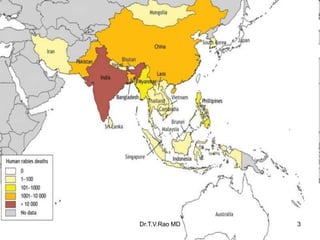
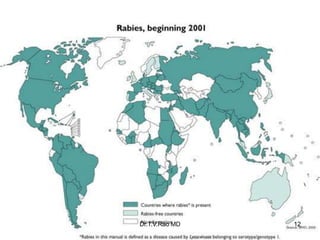
• Rabies is widely distributed across the
globe. More than 55 000 people die of
rabies each year. About 95% of human
deaths occur in Asia and Africa.
• Most human deaths follow a bite from an
infected dog. Between 30% to 60% of the
victims of dog bites are children under the
age of 15.
Dr.T.V.Rao MD 4
What is Rabies
• Rabies is a zoonotic disease (a disease that is
transmitted to humans from animals) that is
caused by a virus. Rabies infects domestic and
wild animals, and is spread to people through
close contact with infected saliva (via bites or
scratches). The disease is present on nearly
every continent of the world but most human
deaths occur in Asia and Africa (more than
95%). Once symptoms of the disease develop,
rabies is fatal.
Dr.T.V.Rao MD 5
6
Rabies
• Rhabdovirus family; genus Lyssavirus
• Enveloped, bullet-shaped virions
• Slow, progressive zoonotic disease
• Primary reservoirs are wild mammals;
it can be spread by both wild and
domestic mammals by bites,
scratches, and inhalation of droplets
Dr.T.V.Rao MD 6
Rhabdovirus
• A Bullet shaped virus/ Enveloped
• Contains ss RNA virus
• Rhabdoviridae – infects
mammals.
• Important virus
Lyssa virus- Rabies virus
Lyssa means Rage.
Dr.T.V.Rao MD 7
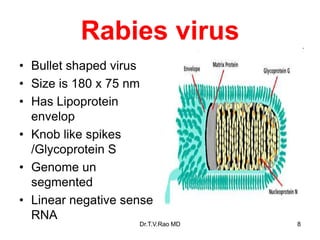
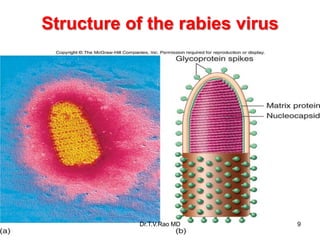
Rabies virus
• Bullet shaped virus
• Size is 180 x 75 nm
• Has Lipoprotein
envelop
• Knob like spikes
/Glycoprotein S
• Genome un
segmented
• Linear negative sense
RNA
Dr.T.V.Rao MD 8
Structure of the rabies virus
9
Insert figure 25.8
Structure of rabies virus
Dr.T.V.Rao MD 9
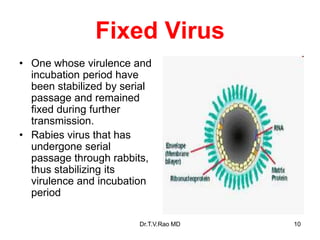
Fixed Virus
• One whose virulence and
incubation period have
been stabilized by serial
passage and remained
fixed during further
transmission.
• Rabies virus that has
undergone serial
passage through rabbits,
thus stabilizing its
virulence and incubation
period
Dr.T.V.Rao MD 10
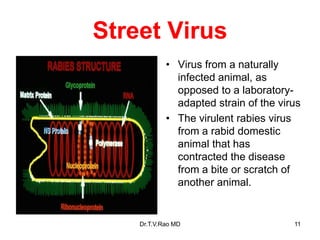
Street Virus
• Virus from a naturally
infected animal, as
opposed to a laboratory-
adapted strain of the virus
• The virulent rabies virus
from a rabid domestic
animal that has
contracted the disease
from a bite or scratch of
another animal.
Dr.T.V.Rao MD 11
Dr.T.V.Rao MD 12
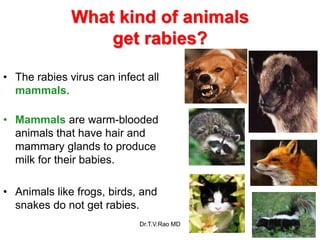
Any mammal can get rabies.
• Raccoons, skunks, foxes
and bats
• Dogs, cats, cattle and
ferrets
• Humans Dr.T.V.Rao MD 13
What kind of animals
get rabies?
• The rabies virus can infect all
mammals.
• Mammals are warm-blooded
animals that have hair and
mammary glands to produce
milk for their babies.
• Animals like frogs, birds, and
snakes do not get rabies.
Dr.T.V.Rao MD 14
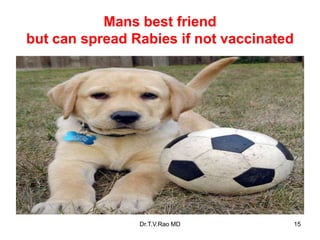
Mans best friend
but can spread Rabies if not vaccinated
Dr.T.V.Rao MD 15
Resistance
• The virus is sensitive to
Ethanol
Iodine
Soap / Detergents
Ether, Chloroform, Acetone
Destroyed at 500 c in 1 hour
at 600 c in 5 minutes.
Dr.T.V.Rao MD 16
Antigenic properties
• Surface spikes
composed of
Glycoprotein G
• Produces
Pathogenicity by
binding to Acetyl
choline receptors in
the neural tissue
• Stimulate T
lymphocytes
Cytotoxic effect. Dr.T.V.Rao MD 17
Rabies
• Mad Dog biting Humans lead to Rabies.
• Latin Rabhas means Frenzy.
• Hydrophobia Fear of Water, Saliva of
Rabid dogs
• Pasture’s success – Vaccination
Fixed virus from Rabbit injected into
Joseph Meister
Injected 13 injection of the cord vaccine.
Dr.T.V.Rao MD 18
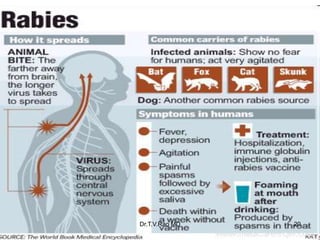
Transmission
• Abrasions or scratches on skin.
• Mucous membrane exposed to saliva.
• Most frequently via deep penetrating bite
wounds.
• Other routes.
Inhalation in bat infected caves.
Ingestion of dead /infected animal meat
Corneal transplantation
Dr.T.V.Rao MD 19
Dr.T.V.Rao MD 20
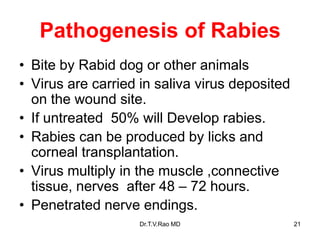
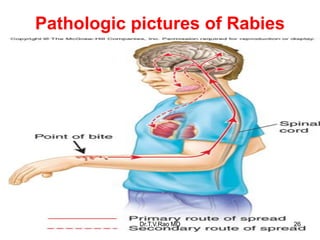
Pathogenesis of Rabies
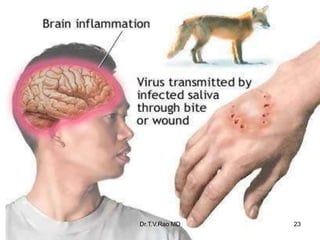
• Bite by Rabid dog or other animals
• Virus are carried in saliva virus deposited
on the wound site.
• If untreated 50% will Develop rabies.
• Rabies can be produced by licks and
corneal transplantation.
• Virus multiply in the muscle ,connective
tissue, nerves after 48 – 72 hours.
• Penetrated nerve endings.
Dr.T.V.Rao MD 21
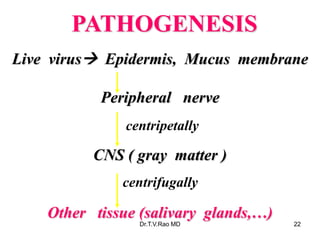
PATHOGENESIS
Live virus Epidermis, Mucus membrane
Peripheral nerve
CNS ( gray matter )
Other tissue (salivary glands,…)
centripetally
centrifugally
Dr.T.V.Rao MD 22
Dr.T.V.Rao MD 23
Dr.T.V.Rao MD 24
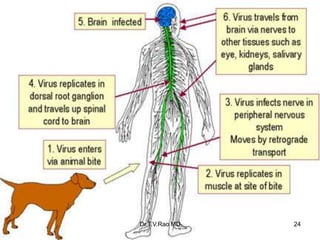
Spread of Virus
• From Brain virus spread to
Salivary glands,
Conjunctival cell released
into tears
Kidney
Lactating glands and Milk
after pregnancy
Dr.T.V.Rao MD 25
Pathologic pictures of Rabies
26
Dr.T.V.Rao MD 26
Dr.T.V.Rao MD 27
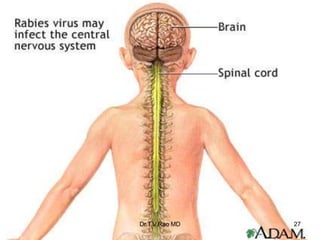
Pathogenesis
• Virus travels through axoplasam toward
the spinal cord, at the rate of 3 mm/hour,
• Towards the brain
• Spread from brain centrifugally to various
parts of the body.
• Multiplies in the salivary glands and shed
in the saliva.
• Cornea, facial tissues skin.
Dr.T.V.Rao MD 28
Pathogenesis
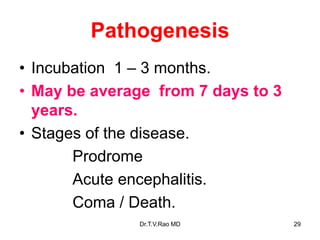
• Incubation 1 – 3 months.
• May be average from 7 days to 3
years.
• Stages of the disease.
Prodrome
Acute encephalitis.
Coma / Death.
Dr.T.V.Rao MD 29
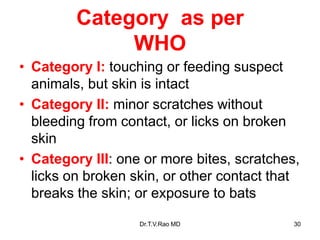
Category as per
WHO
• Category I: touching or feeding suspect
animals, but skin is intact
• Category II: minor scratches without
bleeding from contact, or licks on broken
skin
• Category III: one or more bites, scratches,
licks on broken skin, or other contact that
breaks the skin; or exposure to bats
Dr.T.V.Rao MD 30
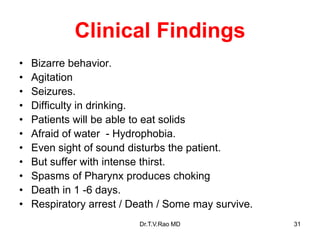
Clinical Findings
• Bizarre behavior.
• Agitation
• Seizures.
• Difficulty in drinking.
• Patients will be able to eat solids
• Afraid of water - Hydrophobia.
• Even sight of sound disturbs the patient.
• But suffer with intense thirst.
• Spasms of Pharynx produces choking
• Death in 1 -6 days.
• Respiratory arrest / Death / Some may survive.
Dr.T.V.Rao MD 31
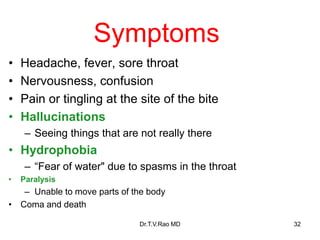
• Headache, fever, sore throat
• Nervousness, confusion
• Pain or tingling at the site of the bite
• Hallucinations
– Seeing things that are not really there
• Hydrophobia
– “Fear of water" due to spasms in the throat
• Paralysis
– Unable to move parts of the body
• Coma and death
Symptoms
Dr.T.V.Rao MD 32
CLINICAL MANIFESTATIONS
1 – Non specific prodrome
2 – Acute neurologic encephalitis
Acute encephalitis
Profound dysfunction of brainstem
3 – Coma
4 - Death ( Rare cases  recovery )
Dr.T.V.Rao MD 33
CLINICAL MANIFESTATIONS
1 – Non specific prodrome
1 - 2 days  1 week
Fever, headache, sore throat
Anorexia, nausea, vomiting,
Agitation, depression
Parenthesis or fasciculation's at or
Around the site of inoculation of
virus.
Dr.T.V.Rao MD 34
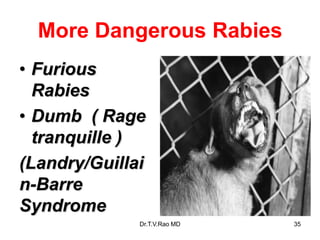
More Dangerous Rabies
• Furious
Rabies
• Dumb ( Rage
tranquille )
(Landry/Guillai
n-Barre
Syndrome
Dr.T.V.Rao MD 35
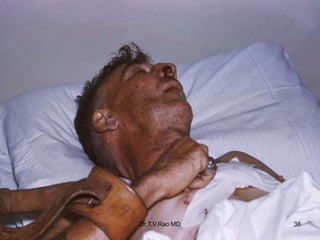
Acute Neurologic Encephalitis
• 1 – 2 days to < 1 week
• Excessive motor activity, Excitation,
Agitation
• Confusion, Hallucinations, Delirium,
• Bizarre aberrations of thought, Seizures,
• Muscle spasms, Meningismus,
• Opisthotonic posturing
• Mental aberration ( Lucid period  coma )
• Hypersalivation, Aphasia, Pharyngeal spasms
• Incordination, Hyperactivity
Dr.T.V.Rao MD 36
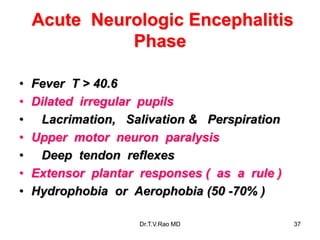
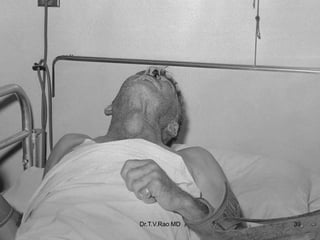
Acute Neurologic Encephalitis
Phase
• Fever T > 40.6
• Dilated irregular pupils
• Lacrimation, Salivation & Perspiration
• Upper motor neuron paralysis
• Deep tendon reflexes
• Extensor plantar responses ( as a rule )
• Hydrophobia or Aerophobia (50 -70% )
Dr.T.V.Rao MD 37
Dr.T.V.Rao MD 38
Dr.T.V.Rao MD 39
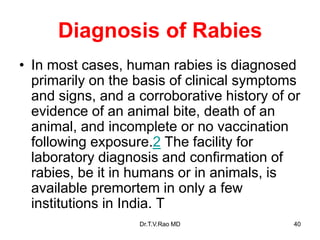
Diagnosis of Rabies
• In most cases, human rabies is diagnosed
primarily on the basis of clinical symptoms
and signs, and a corroborative history of or
evidence of an animal bite, death of an
animal, and incomplete or no vaccination
following exposure.2 The facility for
laboratory diagnosis and confirmation of
rabies, be it in humans or in animals, is
available premortem in only a few
institutions in India. T
Dr.T.V.Rao MD 40
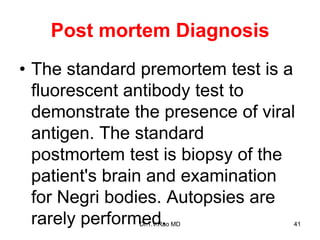
Post mortem Diagnosis
• The standard premortem test is a
fluorescent antibody test to
demonstrate the presence of viral
antigen. The standard
postmortem test is biopsy of the
patient's brain and examination
for Negri bodies. Autopsies are
rarely performed.
Dr.T.V.Rao MD 41
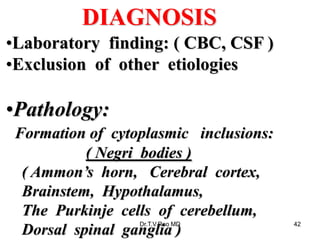
DIAGNOSIS
•Laboratory finding: ( CBC, CSF )
•Exclusion of other etiologies
•Pathology:
Formation of cytoplasmic inclusions:
( Negri bodies )
( Ammon’s horn, Cerebral cortex,
Brainstem, Hypothalamus,
The Purkinje cells of cerebellum,
Dorsal spinal ganglia )
Dr.T.V.Rao MD 42
Laboratory Diagnosis
• Survival possible.
• Clinical differentiation other cases of Encephalitis.
• Post mortem Diagnosis by
By demonstration of Negri bodies.
Isolation of virus fro Mice brain
inoculation.
tissue culture on culture lines
W 138, BHK,
PCR emerging method.
IF methods corneal impression method.
Dr.T.V.Rao MD 43
Diagnostic methods
• Antigen detection by specific Immuno
fluorescence.
Ante-mortem - Conjunctival,skin biopsy
from nape of neck.
Postmortem impression from surfaces of
salivary glands Hippocampus,
Histological examination
ELISA specific antibody detection.
PCR
Dr.T.V.Rao MD 44
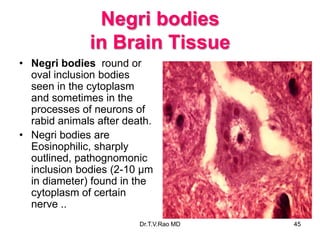
Negri bodies
in Brain Tissue
• Negri bodies round or
oval inclusion bodies
seen in the cytoplasm
and sometimes in the
processes of neurons of
rabid animals after death.
• Negri bodies are
Eosinophilic, sharply
outlined, pathognomonic
inclusion bodies (2-10 µm
in diameter) found in the
cytoplasm of certain
nerve ..
Dr.T.V.Rao MD 45
Methods in Diagnosis
• The reference method for diagnosing rabies is
by performing PCR or viral culture on brain
samples taken after death. The diagnosis can
also be reliably made from skin samples taken
before death. It is also possible to make the
diagnosis from saliva, urine and cerebrospinal
fluid samples, but this is not as sensitive.
Inclusion bodies called Negri bodies are 100%
diagnostic for rabies infection, but found only in
20% of cases.
Dr.T.V.Rao MD 46
DIFFERENTIAL DIAGNOSIS
Other viral encephalitis
Hysteria reaction to animal bite
Landry/Guillan-barre syndrome
Poliomyelitis
Allergic encephalomyelitis ( rabies vaccine )
Dr.T.V.Rao MD 47
PREVENTION
Preexposure Prophylaxis
Postexposure Prophylaxis
Dr.T.V.Rao MD 48
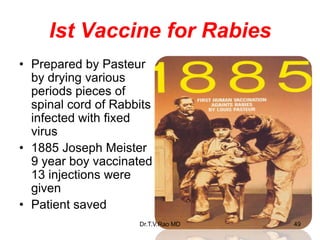
Ist Vaccine for Rabies
• Prepared by Pasteur
by drying various
periods pieces of
spinal cord of Rabbits
infected with fixed
virus
• 1885 Joseph Meister
9 year boy vaccinated
13 injections were
given
• Patient saved
Dr.T.V.Rao MD 49
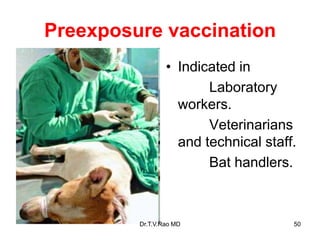
Preexposure vaccination
• Indicated in
Laboratory
workers.
Veterinarians
and technical staff.
Bat handlers.
Dr.T.V.Rao MD 50
Prophylaxis
• Before exposure to infection
In Veterinary surgeons animal handlers.
Specific Prophylaxis
After exposure to Dog bite.
Local treatment
Cauterization,
Scrub with Soap and clean.
Use cetavalon, tincture of Iodine
Antirabic serum don't suture
Dr.T.V.Rao MD 51
Post exposure vaccination
• Anti Rabies vaccines are given when
person is
1 Bitten
2 Scratched
3 Licked
By Rabid animal
animal to be kept for 10 days ?
Dr.T.V.Rao MD 52
Vaccines
• Semple vaccine
Contain 5 % suspension. Of infected
Sheep brain, ( Infected with fixed virus )
Inactivated with Phenol at 370c
Vaccines available after inactivation with
Beta propiolactone Used in India
Vaccine contains Nucleic capsid antigen,
Small quantities of Glycoprotein G
Used in Developed countries Neural
complications.
Dr.T.V.Rao MD 53
Neural Vaccines
• Class I slight risk
• Class II Moderate risk
• Class III Great risk
• Neural vaccines may cause
Neuroparlytic complications,
Laundry’s type ascending
paralysis
Dr.T.V.Rao MD 54
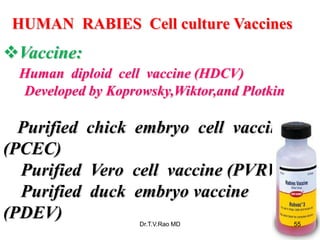
HUMAN RABIES Cell culture Vaccines
Vaccine:
Human diploid cell vaccine (HDCV)
Developed by Koprowsky,Wiktor,and Plotkin
Purified chick embryo cell vaccine
(PCEC)
Purified Vero cell vaccine (PVRV)
Purified duck embryo vaccine
(PDEV) Dr.T.V.Rao MD 55
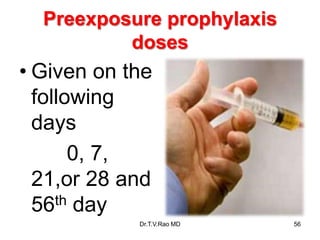
Preexposure prophylaxis
doses
• Given on the
following
days
0, 7,
21,or 28 and
56th day
Dr.T.V.Rao MD 56
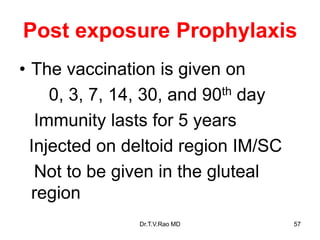
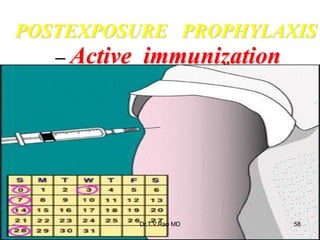
Post exposure Prophylaxis
• The vaccination is given on
0, 3, 7, 14, 30, and 90th day
Immunity lasts for 5 years
Injected on deltoid region IM/SC
Not to be given in the gluteal
region
Dr.T.V.Rao MD 57
POSTEXPOSURE PROPHYLAXIS
– Active immunization
Dr.T.V.Rao MD 58
Cell culture Vaccines in
India
1 Human diploid
cell vaccine.
2 Purified chick
embryo cell
vaccine
3.Purified Vero cell
vaccine
Dr.T.V.Rao MD 59
Human Diploid Cell
Vaccine
• Koprowsky, Viktor, Plokin
• Inactivated in Betaproprionate.
• No serious side effects.
• Human Diploid cell vaccines
purified .
• Sub Unit vaccines in
progress/developed.
Dr.T.V.Rao MD 60
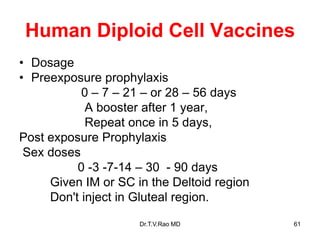
Human Diploid Cell Vaccines
• Dosage
• Preexposure prophylaxis
0 – 7 – 21 – or 28 – 56 days
A booster after 1 year,
Repeat once in 5 days,
Post exposure Prophylaxis
Sex doses
0 -3 -7-14 – 30 - 90 days
Given IM or SC in the Deltoid region
Don't inject in Gluteal region.
Dr.T.V.Rao MD 61
Passive Immunization
• Human Rabies Immunoglobulin HRIG
• High Risk bitten on face and neck
• Given a dose of 20 IU /Kg wt
• Half at the site of bite and rest IM
route.
• Active immunization should be
initiated with passive immunization.
Dr.T.V.Rao MD 62
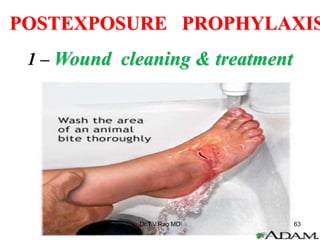
POSTEXPOSURE PROPHYLAXIS
1 – Wound cleaning & treatment
Dr.T.V.Rao MD 63
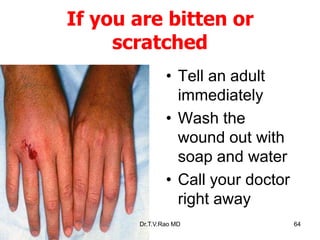
• Tell an adult
immediately
• Wash the
wound out with
soap and water
• Call your doctor
right away
If you are bitten or
scratched
Dr.T.V.Rao MD 64
Dr.T.V.Rao MD 65
Dr.T.V.Rao MD 66
Epidemiology
• No Danger of Nursing Rabies patients but
do take precautions
• Any animal bite can cause Rabies except
Mice
• BATS in caves in spread he disease by
respiratory disease.
• India around 30,000 die with Rabies.
• Vaccination of the Dogs and Licensing of
the Dogs
Dr.T.V.Rao MD 67
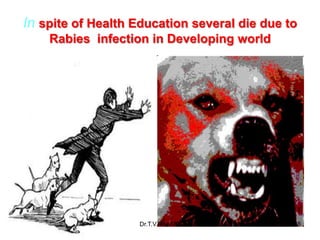
In spite of Health Education several die due to
Rabies infection in Developing world
Dr.T.V.Rao MD 68
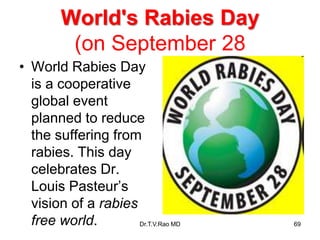
World's Rabies Day
(on September 28
• World Rabies Day
is a cooperative
global event
planned to reduce
the suffering from
rabies. This day
celebrates Dr.
Louis Pasteur’s
vision of a rabies
free world. Dr.T.V.Rao MD 69
• Programme Created by Dr.T.V.Rao MD
for Medical and Paramedical Students
in the Developing World
• Email
• doctortvrao@gmail.com
Dr.T.V.Rao MD 70

rhabdoviruses-teaching-120915213700-phpapp02.pdf

  • 1.
  • 2.
    Early Rabies • Ithas been recognized in India since the Vedic period (1500–500 BC) and is described in the ancient Indian scripture Atharvaveda, • Rabies is endemic in India, a vast country with a population exceeding 1.02 billion and a land area of 3.2 million km. Dr.T.V.Rao MD 2
  • 3.
  • 4.
    Rabies widely spreadin Asia and Africa • Rabies is widely distributed across the globe. More than 55 000 people die of rabies each year. About 95% of human deaths occur in Asia and Africa. • Most human deaths follow a bite from an infected dog. Between 30% to 60% of the victims of dog bites are children under the age of 15. Dr.T.V.Rao MD 4
  • 5.
    What is Rabies •Rabies is a zoonotic disease (a disease that is transmitted to humans from animals) that is caused by a virus. Rabies infects domestic and wild animals, and is spread to people through close contact with infected saliva (via bites or scratches). The disease is present on nearly every continent of the world but most human deaths occur in Asia and Africa (more than 95%). Once symptoms of the disease develop, rabies is fatal. Dr.T.V.Rao MD 5
  • 6.
    6 Rabies • Rhabdovirus family;genus Lyssavirus • Enveloped, bullet-shaped virions • Slow, progressive zoonotic disease • Primary reservoirs are wild mammals; it can be spread by both wild and domestic mammals by bites, scratches, and inhalation of droplets Dr.T.V.Rao MD 6
  • 7.
    Rhabdovirus • A Bulletshaped virus/ Enveloped • Contains ss RNA virus • Rhabdoviridae – infects mammals. • Important virus Lyssa virus- Rabies virus Lyssa means Rage. Dr.T.V.Rao MD 7
  • 8.
    Rabies virus • Bulletshaped virus • Size is 180 x 75 nm • Has Lipoprotein envelop • Knob like spikes /Glycoprotein S • Genome un segmented • Linear negative sense RNA Dr.T.V.Rao MD 8
  • 9.
    Structure of therabies virus 9 Insert figure 25.8 Structure of rabies virus Dr.T.V.Rao MD 9
  • 10.
    Fixed Virus • Onewhose virulence and incubation period have been stabilized by serial passage and remained fixed during further transmission. • Rabies virus that has undergone serial passage through rabbits, thus stabilizing its virulence and incubation period Dr.T.V.Rao MD 10
  • 11.
    Street Virus • Virusfrom a naturally infected animal, as opposed to a laboratory- adapted strain of the virus • The virulent rabies virus from a rabid domestic animal that has contracted the disease from a bite or scratch of another animal. Dr.T.V.Rao MD 11
  • 12.
  • 13.
    Any mammal canget rabies. • Raccoons, skunks, foxes and bats • Dogs, cats, cattle and ferrets • Humans Dr.T.V.Rao MD 13
  • 14.
    What kind ofanimals get rabies? • The rabies virus can infect all mammals. • Mammals are warm-blooded animals that have hair and mammary glands to produce milk for their babies. • Animals like frogs, birds, and snakes do not get rabies. Dr.T.V.Rao MD 14
  • 15.
    Mans best friend butcan spread Rabies if not vaccinated Dr.T.V.Rao MD 15
  • 16.
    Resistance • The virusis sensitive to Ethanol Iodine Soap / Detergents Ether, Chloroform, Acetone Destroyed at 500 c in 1 hour at 600 c in 5 minutes. Dr.T.V.Rao MD 16
  • 17.
    Antigenic properties • Surfacespikes composed of Glycoprotein G • Produces Pathogenicity by binding to Acetyl choline receptors in the neural tissue • Stimulate T lymphocytes Cytotoxic effect. Dr.T.V.Rao MD 17
  • 18.
    Rabies • Mad Dogbiting Humans lead to Rabies. • Latin Rabhas means Frenzy. • Hydrophobia Fear of Water, Saliva of Rabid dogs • Pasture’s success – Vaccination Fixed virus from Rabbit injected into Joseph Meister Injected 13 injection of the cord vaccine. Dr.T.V.Rao MD 18
  • 19.
    Transmission • Abrasions orscratches on skin. • Mucous membrane exposed to saliva. • Most frequently via deep penetrating bite wounds. • Other routes. Inhalation in bat infected caves. Ingestion of dead /infected animal meat Corneal transplantation Dr.T.V.Rao MD 19
  • 20.
  • 21.
    Pathogenesis of Rabies •Bite by Rabid dog or other animals • Virus are carried in saliva virus deposited on the wound site. • If untreated 50% will Develop rabies. • Rabies can be produced by licks and corneal transplantation. • Virus multiply in the muscle ,connective tissue, nerves after 48 – 72 hours. • Penetrated nerve endings. Dr.T.V.Rao MD 21
  • 22.
    PATHOGENESIS Live virus Epidermis,Mucus membrane Peripheral nerve CNS ( gray matter ) Other tissue (salivary glands,…) centripetally centrifugally Dr.T.V.Rao MD 22
  • 23.
  • 24.
  • 25.
    Spread of Virus •From Brain virus spread to Salivary glands, Conjunctival cell released into tears Kidney Lactating glands and Milk after pregnancy Dr.T.V.Rao MD 25
  • 26.
    Pathologic pictures ofRabies 26 Dr.T.V.Rao MD 26
  • 27.
  • 28.
    Pathogenesis • Virus travelsthrough axoplasam toward the spinal cord, at the rate of 3 mm/hour, • Towards the brain • Spread from brain centrifugally to various parts of the body. • Multiplies in the salivary glands and shed in the saliva. • Cornea, facial tissues skin. Dr.T.V.Rao MD 28
  • 29.
    Pathogenesis • Incubation 1– 3 months. • May be average from 7 days to 3 years. • Stages of the disease. Prodrome Acute encephalitis. Coma / Death. Dr.T.V.Rao MD 29
  • 30.
    Category as per WHO •Category I: touching or feeding suspect animals, but skin is intact • Category II: minor scratches without bleeding from contact, or licks on broken skin • Category III: one or more bites, scratches, licks on broken skin, or other contact that breaks the skin; or exposure to bats Dr.T.V.Rao MD 30
  • 31.
    Clinical Findings • Bizarrebehavior. • Agitation • Seizures. • Difficulty in drinking. • Patients will be able to eat solids • Afraid of water - Hydrophobia. • Even sight of sound disturbs the patient. • But suffer with intense thirst. • Spasms of Pharynx produces choking • Death in 1 -6 days. • Respiratory arrest / Death / Some may survive. Dr.T.V.Rao MD 31
  • 32.
    • Headache, fever,sore throat • Nervousness, confusion • Pain or tingling at the site of the bite • Hallucinations – Seeing things that are not really there • Hydrophobia – “Fear of water" due to spasms in the throat • Paralysis – Unable to move parts of the body • Coma and death Symptoms Dr.T.V.Rao MD 32
  • 33.
    CLINICAL MANIFESTATIONS 1 –Non specific prodrome 2 – Acute neurologic encephalitis Acute encephalitis Profound dysfunction of brainstem 3 – Coma 4 - Death ( Rare cases  recovery ) Dr.T.V.Rao MD 33
  • 34.
    CLINICAL MANIFESTATIONS 1 –Non specific prodrome 1 - 2 days  1 week Fever, headache, sore throat Anorexia, nausea, vomiting, Agitation, depression Parenthesis or fasciculation's at or Around the site of inoculation of virus. Dr.T.V.Rao MD 34
  • 35.
    More Dangerous Rabies •Furious Rabies • Dumb ( Rage tranquille ) (Landry/Guillai n-Barre Syndrome Dr.T.V.Rao MD 35
  • 36.
    Acute Neurologic Encephalitis •1 – 2 days to < 1 week • Excessive motor activity, Excitation, Agitation • Confusion, Hallucinations, Delirium, • Bizarre aberrations of thought, Seizures, • Muscle spasms, Meningismus, • Opisthotonic posturing • Mental aberration ( Lucid period  coma ) • Hypersalivation, Aphasia, Pharyngeal spasms • Incordination, Hyperactivity Dr.T.V.Rao MD 36
  • 37.
    Acute Neurologic Encephalitis Phase •Fever T > 40.6 • Dilated irregular pupils • Lacrimation, Salivation & Perspiration • Upper motor neuron paralysis • Deep tendon reflexes • Extensor plantar responses ( as a rule ) • Hydrophobia or Aerophobia (50 -70% ) Dr.T.V.Rao MD 37
  • 38.
  • 39.
  • 40.
    Diagnosis of Rabies •In most cases, human rabies is diagnosed primarily on the basis of clinical symptoms and signs, and a corroborative history of or evidence of an animal bite, death of an animal, and incomplete or no vaccination following exposure.2 The facility for laboratory diagnosis and confirmation of rabies, be it in humans or in animals, is available premortem in only a few institutions in India. T Dr.T.V.Rao MD 40
  • 41.
    Post mortem Diagnosis •The standard premortem test is a fluorescent antibody test to demonstrate the presence of viral antigen. The standard postmortem test is biopsy of the patient's brain and examination for Negri bodies. Autopsies are rarely performed. Dr.T.V.Rao MD 41
  • 42.
    DIAGNOSIS •Laboratory finding: (CBC, CSF ) •Exclusion of other etiologies •Pathology: Formation of cytoplasmic inclusions: ( Negri bodies ) ( Ammon’s horn, Cerebral cortex, Brainstem, Hypothalamus, The Purkinje cells of cerebellum, Dorsal spinal ganglia ) Dr.T.V.Rao MD 42
  • 43.
    Laboratory Diagnosis • Survivalpossible. • Clinical differentiation other cases of Encephalitis. • Post mortem Diagnosis by By demonstration of Negri bodies. Isolation of virus fro Mice brain inoculation. tissue culture on culture lines W 138, BHK, PCR emerging method. IF methods corneal impression method. Dr.T.V.Rao MD 43
  • 44.
    Diagnostic methods • Antigendetection by specific Immuno fluorescence. Ante-mortem - Conjunctival,skin biopsy from nape of neck. Postmortem impression from surfaces of salivary glands Hippocampus, Histological examination ELISA specific antibody detection. PCR Dr.T.V.Rao MD 44
  • 45.
    Negri bodies in BrainTissue • Negri bodies round or oval inclusion bodies seen in the cytoplasm and sometimes in the processes of neurons of rabid animals after death. • Negri bodies are Eosinophilic, sharply outlined, pathognomonic inclusion bodies (2-10 µm in diameter) found in the cytoplasm of certain nerve .. Dr.T.V.Rao MD 45
  • 46.
    Methods in Diagnosis •The reference method for diagnosing rabies is by performing PCR or viral culture on brain samples taken after death. The diagnosis can also be reliably made from skin samples taken before death. It is also possible to make the diagnosis from saliva, urine and cerebrospinal fluid samples, but this is not as sensitive. Inclusion bodies called Negri bodies are 100% diagnostic for rabies infection, but found only in 20% of cases. Dr.T.V.Rao MD 46
  • 47.
    DIFFERENTIAL DIAGNOSIS Other viralencephalitis Hysteria reaction to animal bite Landry/Guillan-barre syndrome Poliomyelitis Allergic encephalomyelitis ( rabies vaccine ) Dr.T.V.Rao MD 47
  • 48.
  • 49.
    Ist Vaccine forRabies • Prepared by Pasteur by drying various periods pieces of spinal cord of Rabbits infected with fixed virus • 1885 Joseph Meister 9 year boy vaccinated 13 injections were given • Patient saved Dr.T.V.Rao MD 49
  • 50.
    Preexposure vaccination • Indicatedin Laboratory workers. Veterinarians and technical staff. Bat handlers. Dr.T.V.Rao MD 50
  • 51.
    Prophylaxis • Before exposureto infection In Veterinary surgeons animal handlers. Specific Prophylaxis After exposure to Dog bite. Local treatment Cauterization, Scrub with Soap and clean. Use cetavalon, tincture of Iodine Antirabic serum don't suture Dr.T.V.Rao MD 51
  • 52.
    Post exposure vaccination •Anti Rabies vaccines are given when person is 1 Bitten 2 Scratched 3 Licked By Rabid animal animal to be kept for 10 days ? Dr.T.V.Rao MD 52
  • 53.
    Vaccines • Semple vaccine Contain5 % suspension. Of infected Sheep brain, ( Infected with fixed virus ) Inactivated with Phenol at 370c Vaccines available after inactivation with Beta propiolactone Used in India Vaccine contains Nucleic capsid antigen, Small quantities of Glycoprotein G Used in Developed countries Neural complications. Dr.T.V.Rao MD 53
  • 54.
    Neural Vaccines • ClassI slight risk • Class II Moderate risk • Class III Great risk • Neural vaccines may cause Neuroparlytic complications, Laundry’s type ascending paralysis Dr.T.V.Rao MD 54
  • 55.
    HUMAN RABIES Cellculture Vaccines Vaccine: Human diploid cell vaccine (HDCV) Developed by Koprowsky,Wiktor,and Plotkin Purified chick embryo cell vaccine (PCEC) Purified Vero cell vaccine (PVRV) Purified duck embryo vaccine (PDEV) Dr.T.V.Rao MD 55
  • 56.
    Preexposure prophylaxis doses • Givenon the following days 0, 7, 21,or 28 and 56th day Dr.T.V.Rao MD 56
  • 57.
    Post exposure Prophylaxis •The vaccination is given on 0, 3, 7, 14, 30, and 90th day Immunity lasts for 5 years Injected on deltoid region IM/SC Not to be given in the gluteal region Dr.T.V.Rao MD 57
  • 58.
    POSTEXPOSURE PROPHYLAXIS – Activeimmunization Dr.T.V.Rao MD 58
  • 59.
    Cell culture Vaccinesin India 1 Human diploid cell vaccine. 2 Purified chick embryo cell vaccine 3.Purified Vero cell vaccine Dr.T.V.Rao MD 59
  • 60.
    Human Diploid Cell Vaccine •Koprowsky, Viktor, Plokin • Inactivated in Betaproprionate. • No serious side effects. • Human Diploid cell vaccines purified . • Sub Unit vaccines in progress/developed. Dr.T.V.Rao MD 60
  • 61.
    Human Diploid CellVaccines • Dosage • Preexposure prophylaxis 0 – 7 – 21 – or 28 – 56 days A booster after 1 year, Repeat once in 5 days, Post exposure Prophylaxis Sex doses 0 -3 -7-14 – 30 - 90 days Given IM or SC in the Deltoid region Don't inject in Gluteal region. Dr.T.V.Rao MD 61
  • 62.
    Passive Immunization • HumanRabies Immunoglobulin HRIG • High Risk bitten on face and neck • Given a dose of 20 IU /Kg wt • Half at the site of bite and rest IM route. • Active immunization should be initiated with passive immunization. Dr.T.V.Rao MD 62
  • 63.
    POSTEXPOSURE PROPHYLAXIS 1 –Wound cleaning & treatment Dr.T.V.Rao MD 63
  • 64.
    • Tell anadult immediately • Wash the wound out with soap and water • Call your doctor right away If you are bitten or scratched Dr.T.V.Rao MD 64
  • 65.
  • 66.
  • 67.
    Epidemiology • No Dangerof Nursing Rabies patients but do take precautions • Any animal bite can cause Rabies except Mice • BATS in caves in spread he disease by respiratory disease. • India around 30,000 die with Rabies. • Vaccination of the Dogs and Licensing of the Dogs Dr.T.V.Rao MD 67
  • 68.
    In spite ofHealth Education several die due to Rabies infection in Developing world Dr.T.V.Rao MD 68
  • 69.
    World's Rabies Day (onSeptember 28 • World Rabies Day is a cooperative global event planned to reduce the suffering from rabies. This day celebrates Dr. Louis Pasteur’s vision of a rabies free world. Dr.T.V.Rao MD 69
  • 70.
    • Programme Createdby Dr.T.V.Rao MD for Medical and Paramedical Students in the Developing World • Email • doctortvrao@gmail.com Dr.T.V.Rao MD 70