BY- MOHIT MAYOOR KASHYAP
CUJ/I/2013/IWEM/007
INTRODUCTION
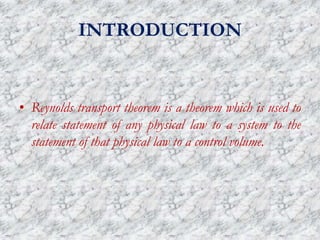
• Reynolds transport theorem is a theorem which is used to
relate statement of any physical law to a system to the
statement of that physical law to a control volume.
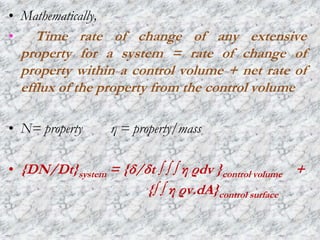
• Mathematically,
• Time rate of change of any extensive
property for a system = rate of change of
property within a control volume + net rate of
efflux of the property from the control volume
• N= property η = property/mass
• {DN/Dt}system = {δ/δt ∫ ∫ ∫ η ρdv }control volume +
{∫ ∫ η ρv.dA}control surface
IMPORTANT POINTS
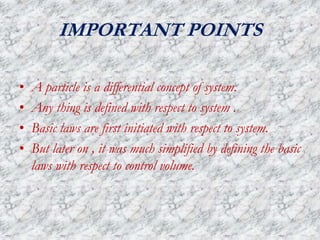
• A particle is a differential concept of system.
• Any thing is defined with respect to system .
• Basic laws are first initiated with respect to system.
• But later on , it was much simplified by defining the basic
laws with respect to control volume.
• SYSTEM- some amount of mass and boundary.
• Mass and boundary are the important characteristics of
the system.
surroundingMass system
boundary
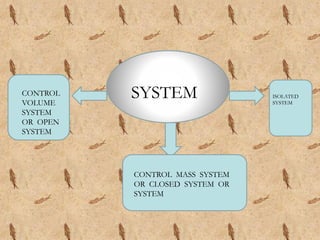
SYSTEM
CONTROL MASS SYSTEM
OR CLOSED SYSTEM OR
SYSTEM
CONTROL
VOLUME
SYSTEM
OR OPEN
SYSTEM
ISOLATED
SYSTEM
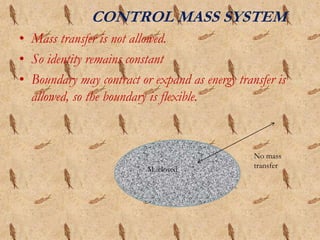
CONTROL MASS SYSTEM
• Mass transfer is not allowed.
• So identity remains constant
• Boundary may contract or expand as energy transfer is
allowed, so the boundary is flexible.
M closed
No mass
transfer
CONTROL VOLUME SYSTEM
• Also known as open system.
• In this kind of system mass and energy transfer both take
place , so identity is lost.
• Boundary is rigid.
ISOLATED SYSTEM
• No mass transfer and no energy transfer.
• It is isolated from the surrounding.
• Let us take an example of conservation of mass in fluid flow.
• e.g. for system :-{ dm/dt = 0 } rate of change of
mass within a system is zero i.e. mass remains
constant inside the system.
• For control volume- continuity equation states
that the net rate of increase in mass in the
control volume + net rate of mass efflux from
the control volume = 0
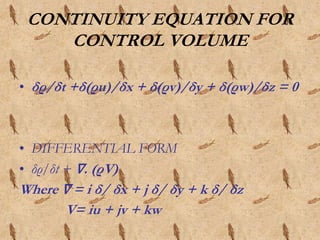
CONTINUITY EQUATION FOR
CONTROL VOLUME
• δρ/δt +δ(ρu)/δx + δ(ρv)/δy + δ(ρw)/δz = 0
• DIFFERENTIAL FORM
• δρ/δt + ∇. (ρV)
Where ∇ = i δ/ δx + j δ/ δy + k δ/ δz
V= iu + jv + kw
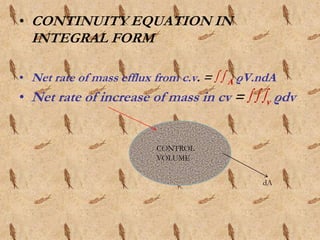
• CONTINUITY EQUATION IN
INTEGRAL FORM
• Net rate of mass efflux from c.v. = ∫ ∫ A ρV.ndA
• Net rate of increase of mass in cv = ∫ ∫ ∫v ρdv
CONTROL
VOLUME
dA
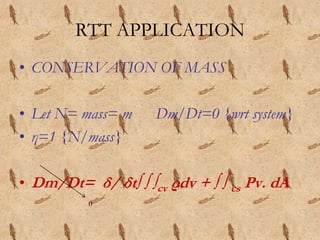
RTT APPLICATION
• CONSERVATION OF MASS
• Let N= mass= m Dm/Dt=0 {wrt system}
• η=1 {N/mass}
• Dm/Dt= δ/ δt∫ ∫ ∫cv ρdv + ∫ ∫ cs Ρv. dA
0
• CUJ/I/2103/IWEM/007
• THANKS

Reynolds transport theorem

  • 1.
    BY- MOHIT MAYOORKASHYAP CUJ/I/2013/IWEM/007
  • 2.
    INTRODUCTION • Reynolds transporttheorem is a theorem which is used to relate statement of any physical law to a system to the statement of that physical law to a control volume.
  • 3.
    • Mathematically, • Timerate of change of any extensive property for a system = rate of change of property within a control volume + net rate of efflux of the property from the control volume • N= property η = property/mass • {DN/Dt}system = {δ/δt ∫ ∫ ∫ η ρdv }control volume + {∫ ∫ η ρv.dA}control surface
  • 4.
    IMPORTANT POINTS • Aparticle is a differential concept of system. • Any thing is defined with respect to system . • Basic laws are first initiated with respect to system. • But later on , it was much simplified by defining the basic laws with respect to control volume.
  • 6.
    • SYSTEM- someamount of mass and boundary. • Mass and boundary are the important characteristics of the system. surroundingMass system boundary
  • 7.
    SYSTEM CONTROL MASS SYSTEM ORCLOSED SYSTEM OR SYSTEM CONTROL VOLUME SYSTEM OR OPEN SYSTEM ISOLATED SYSTEM
  • 8.
    CONTROL MASS SYSTEM •Mass transfer is not allowed. • So identity remains constant • Boundary may contract or expand as energy transfer is allowed, so the boundary is flexible. M closed No mass transfer
  • 9.
    CONTROL VOLUME SYSTEM •Also known as open system. • In this kind of system mass and energy transfer both take place , so identity is lost. • Boundary is rigid.
  • 10.
    ISOLATED SYSTEM • Nomass transfer and no energy transfer. • It is isolated from the surrounding.
  • 11.
    • Let ustake an example of conservation of mass in fluid flow. • e.g. for system :-{ dm/dt = 0 } rate of change of mass within a system is zero i.e. mass remains constant inside the system. • For control volume- continuity equation states that the net rate of increase in mass in the control volume + net rate of mass efflux from the control volume = 0
  • 12.
    CONTINUITY EQUATION FOR CONTROLVOLUME • δρ/δt +δ(ρu)/δx + δ(ρv)/δy + δ(ρw)/δz = 0 • DIFFERENTIAL FORM • δρ/δt + ∇. (ρV) Where ∇ = i δ/ δx + j δ/ δy + k δ/ δz V= iu + jv + kw
  • 13.
    • CONTINUITY EQUATIONIN INTEGRAL FORM • Net rate of mass efflux from c.v. = ∫ ∫ A ρV.ndA • Net rate of increase of mass in cv = ∫ ∫ ∫v ρdv CONTROL VOLUME dA
  • 14.
    RTT APPLICATION • CONSERVATIONOF MASS • Let N= mass= m Dm/Dt=0 {wrt system} • η=1 {N/mass} • Dm/Dt= δ/ δt∫ ∫ ∫cv ρdv + ∫ ∫ cs Ρv. dA 0
  • 15.