The UNIVERSITY of NORTH CAROLINA at CHAPEL HILL
Computational Fluid
Dynamics
MOHAN REDDY GADE
11D41A0382
MECHANICAL-B
B-tECH fINAL YEAR
The UNIVERSITY of NORTH CAROLINA at CHAPEL HILL
Why use CFD?
- Analysis and Design
• Simulation-based design instead of “build & test”
– More cost effectively and more rapidly than with
experiments
– CFD solution provides high-fidelity database for
interrogation of flow field
• Simulation of physical fluid phenomena that are
difficult to be measured by experiments
– Hazards (e.g., explosions, radiation, pollution)
– Physics (e.g., weather prediction, planetary boundary
layer, stellar evolution)
- Knowledge and exploration of flow physic
2
The UNIVERSITY of NORTH CAROLINA at CHAPEL HILL
APPLICATIONS:
– Aerospace
– Appliances
– Automotive
– Biomedical
– Chemical Processing
– HVAC&R
– Hydraulics
– Marine
– Oil & Gas
– Power Generation
– Sports
3
The UNIVERSITY of NORTH CAROLINA at CHAPEL HILL
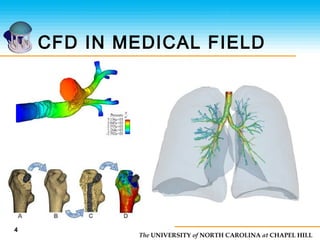
CFD IN MEDICAL FIELD
4
The UNIVERSITY of NORTH CAROLINA at CHAPEL HILL
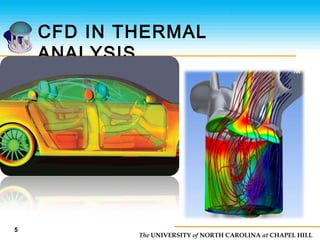
CFD IN THERMAL
ANALYSIS
5
The UNIVERSITY of NORTH CAROLINA at CHAPEL HILL
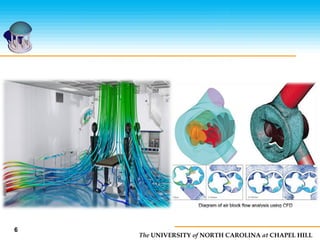
6
The UNIVERSITY of NORTH CAROLINA at CHAPEL HILL
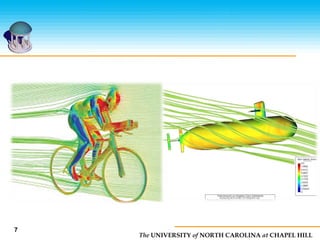
7
The UNIVERSITY of NORTH CAROLINA at CHAPEL HILL
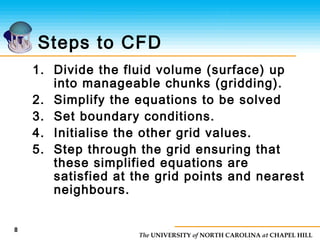
Steps to CFD
1. Divide the fluid volume (surface) up
into manageable chunks (gridding).
2. Simplify the equations to be solved
3. Set boundary conditions.
4. Initialise the other grid values.
5. Step through the grid ensuring that
these simplified equations are
satisfied at the grid points and nearest
neighbours.
8
The UNIVERSITY of NORTH CAROLINA at CHAPEL HILL
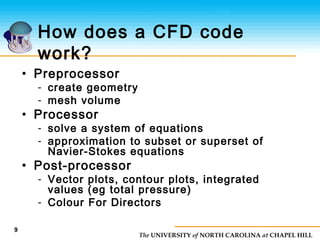
How does a CFD code
work?
• Preprocessor
- create geometry
- mesh volume
• Processor
- solve a system of equations
- approximation to subset or superset of
Navier-Stokes equations
• Post-processor
- Vector plots, contour plots, integrated
values (eg total pressure)
- Colour For Directors
9
The UNIVERSITY of NORTH CAROLINA at CHAPEL HILL
10
Overview
• Understanding the Navier-Stokes
equations
- Derivation (following [Griebel 1998])
- Intuition
• Solving the Navier-Stokes equations
- Basic approaches
- Boundary conditions
• Tracking the free surface
The UNIVERSITY of NORTH CAROLINA at CHAPEL HILL
11
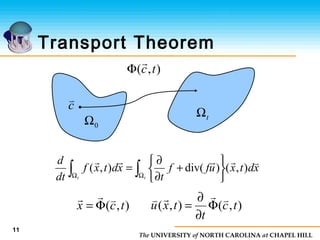
Transport Theorem
xdtxuff
t
xdtxf
dt
d
t t

),()div(),(∫ ∫Ω Ω






+
∂
∂
=
),(),( tc
t
txu

Φ
∂
∂
=),( tcx

Φ=
c

0Ω
),( tc

Φ
tΩ
The UNIVERSITY of NORTH CAROLINA at CHAPEL HILL
12
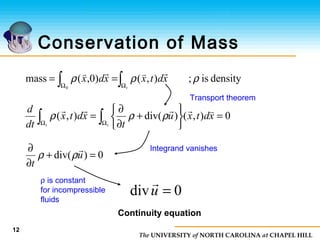
Conservation of Mass
densityis;),()0,(mass
0
ρρρ ∫∫ ΩΩ
==
t
xdtxxdx

0),()div(),( =






+
∂
∂
=∫ ∫Ω Ω
xdtxu
t
xdtx
dt
d
t t

ρρρ
0)div( =+
∂
∂
u
t

ρρ
Transport theorem
0div =u

Integrand vanishes
ρ is constant
for incompressible
fluids
Continuity equation
The UNIVERSITY of NORTH CAROLINA at CHAPEL HILL
13
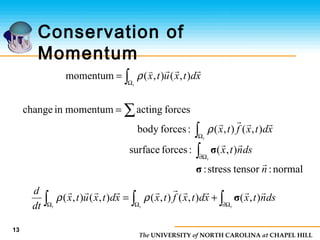
Conservation of
Momentum
∫Ω
=
t
xdtxutx

),(),(momentum ρ
∑= forcesactingmomentuminchange
∫Ωt
xdtxftx

),(),(:forcesbody ρ
∫Ω∂ t
dsntx

),(:forcessurface σ
∫∫∫ Ω∂ΩΩ
+=
ttt
dsntxxdtxftxxdtxutx
dt
d 
),(),(),(),(),( σρρ
normal:tensorstress: n

σ
The UNIVERSITY of NORTH CAROLINA at CHAPEL HILL
14
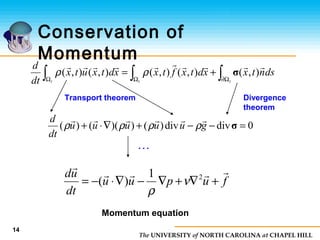
Conservation of
Momentum
0divdiv)())(()( =−−+∇⋅+ σguuuuu
dt
d 
ρρρρ
Transport theorem Divergence
theorem
fupuu
dt
ud 

+∇+∇−∇⋅−= 21
)( ν
ρ
Momentum equation
…
∫∫∫ Ω∂ΩΩ
+=
ttt
dsntxxdtxftxxdtxutx
dt
d 
),(),(),(),(),( σρρ
The UNIVERSITY of NORTH CAROLINA at CHAPEL HILL
15
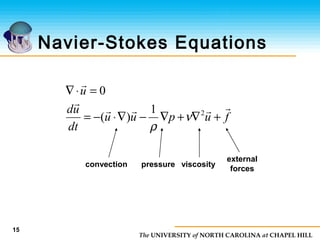
Navier-Stokes Equations
fupuu
dt
ud
u



+∇+∇−∇⋅−=
=⋅∇
21
)(
0
ν
ρ
convection viscosity
external
forces
pressure
The UNIVERSITY of NORTH CAROLINA at CHAPEL HILL
16
Solving the equations
Basic Approach
1. Create a tentative velocity field.
a. Finite differences
b. Semi-Lagrangian method (Stable Fluids [Stam
1999])
2. Ensure that the velocity field is
divergence free:
a. Adjust pressure and update velocities
b. Projection method
The UNIVERSITY of NORTH CAROLINA at CHAPEL HILL
17
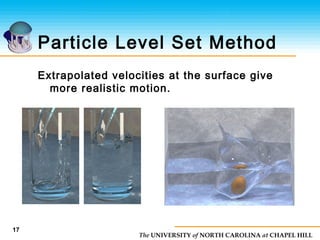
Particle Level Set Method
Extrapolated velocities at the surface give
more realistic motion.
The UNIVERSITY of NORTH CAROLINA at CHAPEL HILL
ADVANTAGES OF CFD:
• COST & TIME SAVE.
• CAPACITY TO STUDY BEYOND LIMITS.
• ACCURACY FOR COMPLEX MODEL ANALYSIS.
• EASY TO HANDLE.
• MINIMAL ERROR SOFTWARE.
• MULTI APPLICATIONS IN VARIOUS FIELDS.
• HIGHER EFFICIENCY.
18
The UNIVERSITY of NORTH CAROLINA at CHAPEL HILL
LIMITATIONS OF CFD
• DIFFICULT TO HANDLE
TURBULENCE FLOW.
• DECREASE ABILITY TO
UNDERSTAND PROBLEM .
• TOO TECHNOLOGICAL
RELIABILITY.
19
The UNIVERSITY of NORTH CAROLINA at CHAPEL HILL
20

MOHAN PPT

  • 1.
    The UNIVERSITY ofNORTH CAROLINA at CHAPEL HILL Computational Fluid Dynamics MOHAN REDDY GADE 11D41A0382 MECHANICAL-B B-tECH fINAL YEAR
  • 2.
    The UNIVERSITY ofNORTH CAROLINA at CHAPEL HILL Why use CFD? - Analysis and Design • Simulation-based design instead of “build & test” – More cost effectively and more rapidly than with experiments – CFD solution provides high-fidelity database for interrogation of flow field • Simulation of physical fluid phenomena that are difficult to be measured by experiments – Hazards (e.g., explosions, radiation, pollution) – Physics (e.g., weather prediction, planetary boundary layer, stellar evolution) - Knowledge and exploration of flow physic 2
  • 3.
    The UNIVERSITY ofNORTH CAROLINA at CHAPEL HILL APPLICATIONS: – Aerospace – Appliances – Automotive – Biomedical – Chemical Processing – HVAC&R – Hydraulics – Marine – Oil & Gas – Power Generation – Sports 3
  • 4.
    The UNIVERSITY ofNORTH CAROLINA at CHAPEL HILL CFD IN MEDICAL FIELD 4
  • 5.
    The UNIVERSITY ofNORTH CAROLINA at CHAPEL HILL CFD IN THERMAL ANALYSIS 5
  • 6.
    The UNIVERSITY ofNORTH CAROLINA at CHAPEL HILL 6
  • 7.
    The UNIVERSITY ofNORTH CAROLINA at CHAPEL HILL 7
  • 8.
    The UNIVERSITY ofNORTH CAROLINA at CHAPEL HILL Steps to CFD 1. Divide the fluid volume (surface) up into manageable chunks (gridding). 2. Simplify the equations to be solved 3. Set boundary conditions. 4. Initialise the other grid values. 5. Step through the grid ensuring that these simplified equations are satisfied at the grid points and nearest neighbours. 8
  • 9.
    The UNIVERSITY ofNORTH CAROLINA at CHAPEL HILL How does a CFD code work? • Preprocessor - create geometry - mesh volume • Processor - solve a system of equations - approximation to subset or superset of Navier-Stokes equations • Post-processor - Vector plots, contour plots, integrated values (eg total pressure) - Colour For Directors 9
  • 10.
    The UNIVERSITY ofNORTH CAROLINA at CHAPEL HILL 10 Overview • Understanding the Navier-Stokes equations - Derivation (following [Griebel 1998]) - Intuition • Solving the Navier-Stokes equations - Basic approaches - Boundary conditions • Tracking the free surface
  • 11.
    The UNIVERSITY ofNORTH CAROLINA at CHAPEL HILL 11 Transport Theorem xdtxuff t xdtxf dt d t t  ),()div(),(∫ ∫Ω Ω       + ∂ ∂ = ),(),( tc t txu  Φ ∂ ∂ =),( tcx  Φ= c  0Ω ),( tc  Φ tΩ
  • 12.
    The UNIVERSITY ofNORTH CAROLINA at CHAPEL HILL 12 Conservation of Mass densityis;),()0,(mass 0 ρρρ ∫∫ ΩΩ == t xdtxxdx  0),()div(),( =       + ∂ ∂ =∫ ∫Ω Ω xdtxu t xdtx dt d t t  ρρρ 0)div( =+ ∂ ∂ u t  ρρ Transport theorem 0div =u  Integrand vanishes ρ is constant for incompressible fluids Continuity equation
  • 13.
    The UNIVERSITY ofNORTH CAROLINA at CHAPEL HILL 13 Conservation of Momentum ∫Ω = t xdtxutx  ),(),(momentum ρ ∑= forcesactingmomentuminchange ∫Ωt xdtxftx  ),(),(:forcesbody ρ ∫Ω∂ t dsntx  ),(:forcessurface σ ∫∫∫ Ω∂ΩΩ += ttt dsntxxdtxftxxdtxutx dt d  ),(),(),(),(),( σρρ normal:tensorstress: n  σ
  • 14.
    The UNIVERSITY ofNORTH CAROLINA at CHAPEL HILL 14 Conservation of Momentum 0divdiv)())(()( =−−+∇⋅+ σguuuuu dt d  ρρρρ Transport theorem Divergence theorem fupuu dt ud   +∇+∇−∇⋅−= 21 )( ν ρ Momentum equation … ∫∫∫ Ω∂ΩΩ += ttt dsntxxdtxftxxdtxutx dt d  ),(),(),(),(),( σρρ
  • 15.
    The UNIVERSITY ofNORTH CAROLINA at CHAPEL HILL 15 Navier-Stokes Equations fupuu dt ud u    +∇+∇−∇⋅−= =⋅∇ 21 )( 0 ν ρ convection viscosity external forces pressure
  • 16.
    The UNIVERSITY ofNORTH CAROLINA at CHAPEL HILL 16 Solving the equations Basic Approach 1. Create a tentative velocity field. a. Finite differences b. Semi-Lagrangian method (Stable Fluids [Stam 1999]) 2. Ensure that the velocity field is divergence free: a. Adjust pressure and update velocities b. Projection method
  • 17.
    The UNIVERSITY ofNORTH CAROLINA at CHAPEL HILL 17 Particle Level Set Method Extrapolated velocities at the surface give more realistic motion.
  • 18.
    The UNIVERSITY ofNORTH CAROLINA at CHAPEL HILL ADVANTAGES OF CFD: • COST & TIME SAVE. • CAPACITY TO STUDY BEYOND LIMITS. • ACCURACY FOR COMPLEX MODEL ANALYSIS. • EASY TO HANDLE. • MINIMAL ERROR SOFTWARE. • MULTI APPLICATIONS IN VARIOUS FIELDS. • HIGHER EFFICIENCY. 18
  • 19.
    The UNIVERSITY ofNORTH CAROLINA at CHAPEL HILL LIMITATIONS OF CFD • DIFFICULT TO HANDLE TURBULENCE FLOW. • DECREASE ABILITY TO UNDERSTAND PROBLEM . • TOO TECHNOLOGICAL RELIABILITY. 19
  • 20.
    The UNIVERSITY ofNORTH CAROLINA at CHAPEL HILL 20