Presented by :MTUTH
Fifth year pharmacy
Group four student's
4/2/2023 1
4/2/2023 2
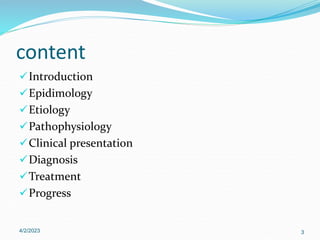
content
Introduction
Epidimology
Etiology
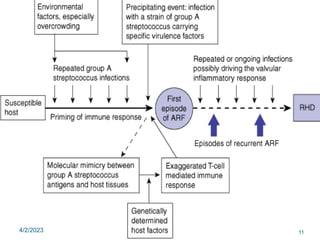
Pathophysiology
Clinical presentation
Diagnosis
Treatment
Progress
4/2/2023 3
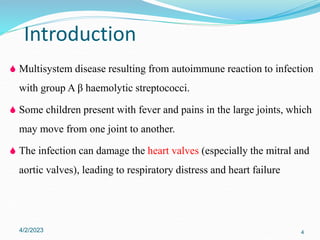
 Multisystem disease resulting from autoimmune reaction to infection
with group A β haemolytic streptococci.
 Some children present with fever and pains in the large joints, which
may move from one joint to another.
 The infection can damage the heart valves (especially the mitral and
aortic valves), leading to respiratory distress and heart failure
4/2/2023 4
Introduction
 Children with mild disease may have only a heart
murmur.
 Severe disease can present with fever, fast or difficult
breathing and lethargy.
 The child may have chest pain or fainting.
 Those that present with heart failure have a rapid
heart rate, respiratory distress and an enlarged liver.
5
Epidemiology
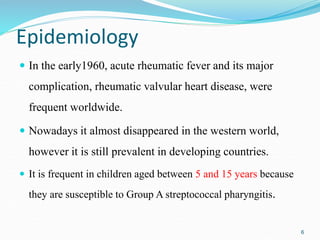
 In the early1960, acute rheumatic fever and its major
complication, rheumatic valvular heart disease, were
frequent worldwide.
 Nowadays it almost disappeared in the western world,
however it is still prevalent in developing countries.
 It is frequent in children aged between 5 and 15 years because
they are susceptible to Group A streptococcal pharyngitis.
6
♣ Approximately 20% of all sore throats are due to Group A
streptococcal and only few (0.5 to 3%) develop acute rheumatic
fever.
♣ The risk depends on the host factors (age, genetic predisposition
and carriers), if untreated, and the streptococcal strain (M type).
♣ Streptococcal skin infection does not result in acute rheumatic
fever.
4/2/2023 7
♣ Major risk factor for the frequent occurrence of acute
rheumatic fever in developing countries are
 Climate (high temperature)
 poverty
 crowding
 poor housing conditions and
 inadequate health services (Shaper 1972).
♣
4/2/2023 8
Cytotoxicity theory-states the enzyme streptolysin O is
directly toxic to cardiac cells, but, its unable to explain the
substantial period (10-21 days) to develop ARF from GAS
pharyngitis.
Immune-mediated pathogenesis- molecular mimicry resulting
immunologic cross-reactivity between cardiac antigenic
epitopes and GAS cellular and extra cellular epitopes
4/2/2023 9
Pathogenesis
Antibodies to cardiac valve tissue cross-react with the N acetyl
glucosamine of group A streptococcal, and that these antibodies
may be responsible for
 valvular damage,
 muscle and pericardium (pancarditis),
 joint synovium (arthritis),
 nervous tissue (sydneham chorea),
 skin (erythema marginatum) and
 subcutaneous tissue (subcutaneous nodule).
4/2/2023 10
4/2/2023 11
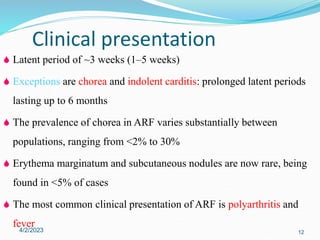
 Latent period of ~3 weeks (1–5 weeks)
 Exceptions are chorea and indolent carditis: prolonged latent periods
lasting up to 6 months
 The prevalence of chorea in ARF varies substantially between
populations, ranging from <2% to 30%
 Erythema marginatum and subcutaneous nodules are now rare, being
found in <5% of cases
 The most common clinical presentation of ARF is polyarthritis and
fever
4/2/2023 12
Clinical presentation
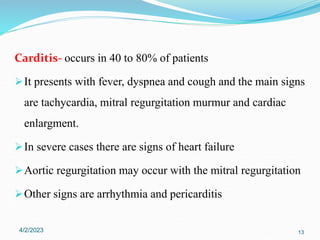
Carditis- occurs in 40 to 80% of patients
It presents with fever, dyspnea and cough and the main signs
are tachycardia, mitral regurgitation murmur and cardiac
enlargment.
In severe cases there are signs of heart failure
Aortic regurgitation may occur with the mitral regurgitation
Other signs are arrhythmia and pericarditis
4/2/2023 13
Arthritis is the commonest manifestation
It is migratory and involves several larger joints (knee, ankle,
elbow and wrist)
The affected joint is swollen, red warm and exquisitely tender.
These signs disappear within 24 hours if anti-inflammatory drug
(salicylates,NSAIDs)is given.
It may resolve completely without any residual sequel.
4/2/2023 14
Chorea: in 10-15% of patient
♣ is purposeless jerky, repetitive movements particularly
involving the hands and face.
♣ Early manifestations are emotional liability (easily induced
crying and inattention) and deterioration in handwriting.
♣ Occurs at the same time or following other features. It
usually occurs several months after the sore throat.
4/2/2023 15
Erythema marginatum – is a serpiginious rash over the
chest and trunk
 It disappears in hours or days.
Subcutaneous nodule – is small painless nodules which
occur more frequently on the
 extensor surface of large joints (elbow, wrist and knee)
and spine.
Other minor manifestations are fever and arthralgia.
16
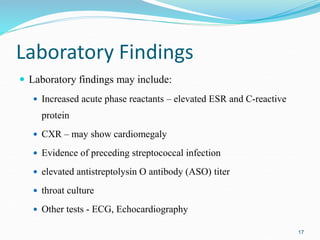
Laboratory Findings
 Laboratory findings may include:
 Increased acute phase reactants – elevated ESR and C-reactive
protein
 CXR – may show cardiomegaly
 Evidence of preceding streptococcal infection
 elevated antistreptolysin O antibody (ASO) titer
 throat culture
 Other tests - ECG, Echocardiography
17
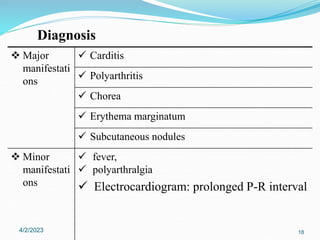
 Major
manifestati
ons
 Carditis
 Polyarthritis
 Chorea
 Erythema marginatum
 Subcutaneous nodules
 Minor
manifestati
ons
 fever,
 polyarthralgia
 Electrocardiogram: prolonged P-R interval
4/2/2023 18
Diagnosis
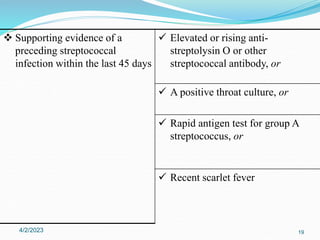
 Supporting evidence of a
preceding streptococcal
infection within the last 45 days
 Elevated or rising anti-
streptolysin O or other
streptococcal antibody, or
 A positive throat culture, or
 Rapid antigen test for group A
streptococcus, or
 Recent scarlet fever
4/2/2023 19
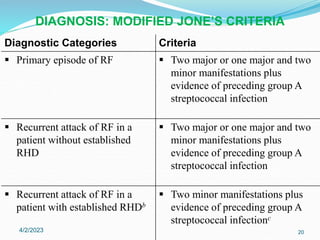
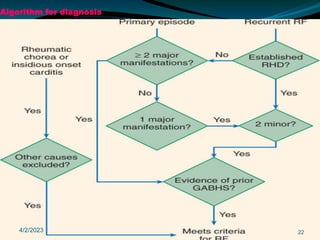
Diagnostic Categories Criteria
 Primary episode of RF  Two major or one major and two
minor manifestations plus
evidence of preceding group A
streptococcal infection
 Recurrent attack of RF in a
patient without established
RHD
 Two major or one major and two
minor manifestations plus
evidence of preceding group A
streptococcal infection
 Recurrent attack of RF in a
patient with established RHDb
 Two minor manifestations plus
evidence of preceding group A
streptococcal infectionc
DIAGNOSIS: MODIFIED JONE’S CRITERIA
4/2/2023 20
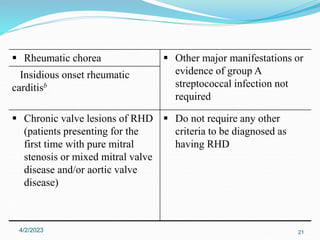
 Rheumatic chorea  Other major manifestations or
evidence of group A
streptococcal infection not
required
Insidious onset rheumatic
carditisb
 Chronic valve lesions of RHD
(patients presenting for the
first time with pure mitral
stenosis or mixed mitral valve
disease and/or aortic valve
disease)
 Do not require any other
criteria to be diagnosed as
having RHD
4/2/2023 21
4/2/2023 22
Algorithm for diagnosis
Treatment of ARF
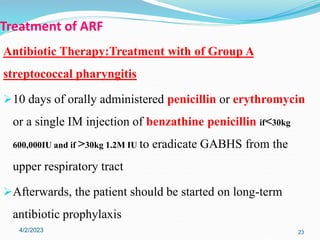
Antibiotic Therapy:Treatment with of Group A
streptococcal pharyngitis
10 days of orally administered penicillin or erythromycin
or a single IM injection of benzathine penicillin if<30kg
600,000IU and if >30kg 1.2M IU to eradicate GABHS from the
upper respiratory tract
Afterwards, the patient should be started on long-term
antibiotic prophylaxis
4/2/2023 23
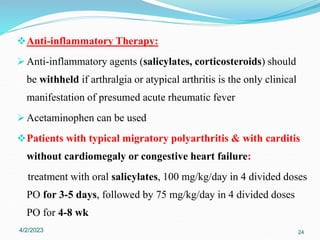
Anti-inflammatory Therapy:
 Anti-inflammatory agents (salicylates, corticosteroids) should
be withheld if arthralgia or atypical arthritis is the only clinical
manifestation of presumed acute rheumatic fever
 Acetaminophen can be used
Patients with typical migratory polyarthritis & with carditis
without cardiomegaly or congestive heart failure:
treatment with oral salicylates, 100 mg/kg/day in 4 divided doses
PO for 3-5 days, followed by 75 mg/kg/day in 4 divided doses
PO for 4-8 wk
4/2/2023 24
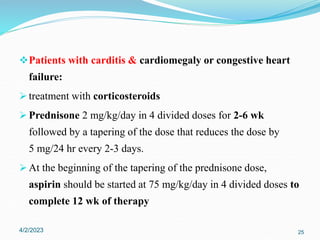
Patients with carditis & cardiomegaly or congestive heart
failure:
 treatment with corticosteroids
 Prednisone 2 mg/kg/day in 4 divided doses for 2-6 wk
followed by a tapering of the dose that reduces the dose by
5 mg/24 hr every 2-3 days.
 At the beginning of the tapering of the prednisone dose,
aspirin should be started at 75 mg/kg/day in 4 divided doses to
complete 12 wk of therapy
4/2/2023 25
Supportive therapies for patients with moderate to severe
carditis include digoxin, fluid & salt restriction, diuretics
& oxygen
The cardiac toxicity of digoxin is enhanced with
myocarditis
4/2/2023 26
Sydenham Chorea
Occurs after the resolution of the acute phase of the disease
Anti-inflammatory agents are usually not indicated
Sedatives: phenobarbital (16-32 mg every 6-8 hr PO) is the
drug of choice
If phenobarbital is ineffective, then haloperidol (0.01-
0.03 mg/kg/24 hr divided bid PO) or chlorpromazine
(0.5 mg/kg every 4-6 hr PO) should be initiated
Long-term antibiotic prophylaxis
4/2/2023 27
PREVENTION
 PRIMARY-10 days course of amoxicillin or single i.m. injection
of Benzathine penicillin.; Early (within 1 week) treatment of
streptococcal pharyngitis to prevent an initial attack of acute
rheumatic fever.
 SECONDARY-Prevent recurrences so as to reduce the damage to
heart valves and the risk of chronic rheumatic heart disease.
 Indicated for children who have had acute rheumatic fever or have
rheumatic heart disease.
 Monthly single i.m. benzathine penicillinor daily oral penicillin
4/2/2023 28
Complications
 Recurrence of rheumatic fever
 Chronic rheumatic valvular heart disease
 Infective endocarditis
 Arrhythmia
 Stroke ( Thromboembolic )
 Heart failure
29
Prognosis
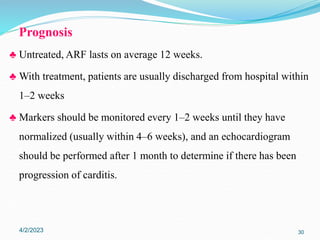
♣ Untreated, ARF lasts on average 12 weeks.
♣ With treatment, patients are usually discharged from hospital within
1–2 weeks
♣ Markers should be monitored every 1–2 weeks until they have
normalized (usually within 4–6 weeks), and an echocardiogram
should be performed after 1 month to determine if there has been
progression of carditis.
4/2/2023 30
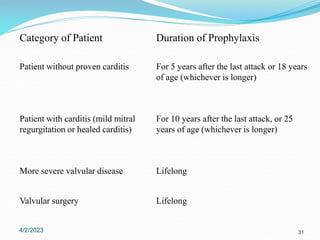
Category of Patient Duration of Prophylaxis
Patient without proven carditis For 5 years after the last attack or 18 years
of age (whichever is longer)
Patient with carditis (mild mitral
regurgitation or healed carditis)
For 10 years after the last attack, or 25
years of age (whichever is longer)
More severe valvular disease Lifelong
Valvular surgery Lifelong
4/2/2023 31
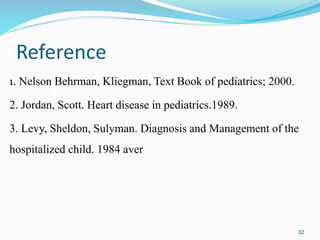
Reference
1. Nelson Behrman, Kliegman, Text Book of pediatrics; 2000.
2. Jordan, Scott. Heart disease in pediatrics.1989.
3. Levy, Sheldon, Sulyman. Diagnosis and Management of the
hospitalized child. 1984 aver
32
4/2/2023 33

Pediatric Acute rheumatic fever.ppt

  • 1.
    Presented by :MTUTH Fifthyear pharmacy Group four student's 4/2/2023 1
  • 2.
  • 3.
  • 4.
     Multisystem diseaseresulting from autoimmune reaction to infection with group A β haemolytic streptococci.  Some children present with fever and pains in the large joints, which may move from one joint to another.  The infection can damage the heart valves (especially the mitral and aortic valves), leading to respiratory distress and heart failure 4/2/2023 4 Introduction
  • 5.
     Children withmild disease may have only a heart murmur.  Severe disease can present with fever, fast or difficult breathing and lethargy.  The child may have chest pain or fainting.  Those that present with heart failure have a rapid heart rate, respiratory distress and an enlarged liver. 5
  • 6.
    Epidemiology  In theearly1960, acute rheumatic fever and its major complication, rheumatic valvular heart disease, were frequent worldwide.  Nowadays it almost disappeared in the western world, however it is still prevalent in developing countries.  It is frequent in children aged between 5 and 15 years because they are susceptible to Group A streptococcal pharyngitis. 6
  • 7.
    ♣ Approximately 20%of all sore throats are due to Group A streptococcal and only few (0.5 to 3%) develop acute rheumatic fever. ♣ The risk depends on the host factors (age, genetic predisposition and carriers), if untreated, and the streptococcal strain (M type). ♣ Streptococcal skin infection does not result in acute rheumatic fever. 4/2/2023 7
  • 8.
    ♣ Major riskfactor for the frequent occurrence of acute rheumatic fever in developing countries are  Climate (high temperature)  poverty  crowding  poor housing conditions and  inadequate health services (Shaper 1972). ♣ 4/2/2023 8
  • 9.
    Cytotoxicity theory-states theenzyme streptolysin O is directly toxic to cardiac cells, but, its unable to explain the substantial period (10-21 days) to develop ARF from GAS pharyngitis. Immune-mediated pathogenesis- molecular mimicry resulting immunologic cross-reactivity between cardiac antigenic epitopes and GAS cellular and extra cellular epitopes 4/2/2023 9 Pathogenesis
  • 10.
    Antibodies to cardiacvalve tissue cross-react with the N acetyl glucosamine of group A streptococcal, and that these antibodies may be responsible for  valvular damage,  muscle and pericardium (pancarditis),  joint synovium (arthritis),  nervous tissue (sydneham chorea),  skin (erythema marginatum) and  subcutaneous tissue (subcutaneous nodule). 4/2/2023 10
  • 11.
  • 12.
     Latent periodof ~3 weeks (1–5 weeks)  Exceptions are chorea and indolent carditis: prolonged latent periods lasting up to 6 months  The prevalence of chorea in ARF varies substantially between populations, ranging from <2% to 30%  Erythema marginatum and subcutaneous nodules are now rare, being found in <5% of cases  The most common clinical presentation of ARF is polyarthritis and fever 4/2/2023 12 Clinical presentation
  • 13.
    Carditis- occurs in40 to 80% of patients It presents with fever, dyspnea and cough and the main signs are tachycardia, mitral regurgitation murmur and cardiac enlargment. In severe cases there are signs of heart failure Aortic regurgitation may occur with the mitral regurgitation Other signs are arrhythmia and pericarditis 4/2/2023 13
  • 14.
    Arthritis is thecommonest manifestation It is migratory and involves several larger joints (knee, ankle, elbow and wrist) The affected joint is swollen, red warm and exquisitely tender. These signs disappear within 24 hours if anti-inflammatory drug (salicylates,NSAIDs)is given. It may resolve completely without any residual sequel. 4/2/2023 14
  • 15.
    Chorea: in 10-15%of patient ♣ is purposeless jerky, repetitive movements particularly involving the hands and face. ♣ Early manifestations are emotional liability (easily induced crying and inattention) and deterioration in handwriting. ♣ Occurs at the same time or following other features. It usually occurs several months after the sore throat. 4/2/2023 15
  • 16.
    Erythema marginatum –is a serpiginious rash over the chest and trunk  It disappears in hours or days. Subcutaneous nodule – is small painless nodules which occur more frequently on the  extensor surface of large joints (elbow, wrist and knee) and spine. Other minor manifestations are fever and arthralgia. 16
  • 17.
    Laboratory Findings  Laboratoryfindings may include:  Increased acute phase reactants – elevated ESR and C-reactive protein  CXR – may show cardiomegaly  Evidence of preceding streptococcal infection  elevated antistreptolysin O antibody (ASO) titer  throat culture  Other tests - ECG, Echocardiography 17
  • 18.
     Major manifestati ons  Carditis Polyarthritis  Chorea  Erythema marginatum  Subcutaneous nodules  Minor manifestati ons  fever,  polyarthralgia  Electrocardiogram: prolonged P-R interval 4/2/2023 18 Diagnosis
  • 19.
     Supporting evidenceof a preceding streptococcal infection within the last 45 days  Elevated or rising anti- streptolysin O or other streptococcal antibody, or  A positive throat culture, or  Rapid antigen test for group A streptococcus, or  Recent scarlet fever 4/2/2023 19
  • 20.
    Diagnostic Categories Criteria Primary episode of RF  Two major or one major and two minor manifestations plus evidence of preceding group A streptococcal infection  Recurrent attack of RF in a patient without established RHD  Two major or one major and two minor manifestations plus evidence of preceding group A streptococcal infection  Recurrent attack of RF in a patient with established RHDb  Two minor manifestations plus evidence of preceding group A streptococcal infectionc DIAGNOSIS: MODIFIED JONE’S CRITERIA 4/2/2023 20
  • 21.
     Rheumatic chorea Other major manifestations or evidence of group A streptococcal infection not required Insidious onset rheumatic carditisb  Chronic valve lesions of RHD (patients presenting for the first time with pure mitral stenosis or mixed mitral valve disease and/or aortic valve disease)  Do not require any other criteria to be diagnosed as having RHD 4/2/2023 21
  • 22.
  • 23.
    Treatment of ARF AntibioticTherapy:Treatment with of Group A streptococcal pharyngitis 10 days of orally administered penicillin or erythromycin or a single IM injection of benzathine penicillin if<30kg 600,000IU and if >30kg 1.2M IU to eradicate GABHS from the upper respiratory tract Afterwards, the patient should be started on long-term antibiotic prophylaxis 4/2/2023 23
  • 24.
    Anti-inflammatory Therapy:  Anti-inflammatoryagents (salicylates, corticosteroids) should be withheld if arthralgia or atypical arthritis is the only clinical manifestation of presumed acute rheumatic fever  Acetaminophen can be used Patients with typical migratory polyarthritis & with carditis without cardiomegaly or congestive heart failure: treatment with oral salicylates, 100 mg/kg/day in 4 divided doses PO for 3-5 days, followed by 75 mg/kg/day in 4 divided doses PO for 4-8 wk 4/2/2023 24
  • 25.
    Patients with carditis& cardiomegaly or congestive heart failure:  treatment with corticosteroids  Prednisone 2 mg/kg/day in 4 divided doses for 2-6 wk followed by a tapering of the dose that reduces the dose by 5 mg/24 hr every 2-3 days.  At the beginning of the tapering of the prednisone dose, aspirin should be started at 75 mg/kg/day in 4 divided doses to complete 12 wk of therapy 4/2/2023 25
  • 26.
    Supportive therapies forpatients with moderate to severe carditis include digoxin, fluid & salt restriction, diuretics & oxygen The cardiac toxicity of digoxin is enhanced with myocarditis 4/2/2023 26
  • 27.
    Sydenham Chorea Occurs afterthe resolution of the acute phase of the disease Anti-inflammatory agents are usually not indicated Sedatives: phenobarbital (16-32 mg every 6-8 hr PO) is the drug of choice If phenobarbital is ineffective, then haloperidol (0.01- 0.03 mg/kg/24 hr divided bid PO) or chlorpromazine (0.5 mg/kg every 4-6 hr PO) should be initiated Long-term antibiotic prophylaxis 4/2/2023 27
  • 28.
    PREVENTION  PRIMARY-10 dayscourse of amoxicillin or single i.m. injection of Benzathine penicillin.; Early (within 1 week) treatment of streptococcal pharyngitis to prevent an initial attack of acute rheumatic fever.  SECONDARY-Prevent recurrences so as to reduce the damage to heart valves and the risk of chronic rheumatic heart disease.  Indicated for children who have had acute rheumatic fever or have rheumatic heart disease.  Monthly single i.m. benzathine penicillinor daily oral penicillin 4/2/2023 28
  • 29.
    Complications  Recurrence ofrheumatic fever  Chronic rheumatic valvular heart disease  Infective endocarditis  Arrhythmia  Stroke ( Thromboembolic )  Heart failure 29
  • 30.
    Prognosis ♣ Untreated, ARFlasts on average 12 weeks. ♣ With treatment, patients are usually discharged from hospital within 1–2 weeks ♣ Markers should be monitored every 1–2 weeks until they have normalized (usually within 4–6 weeks), and an echocardiogram should be performed after 1 month to determine if there has been progression of carditis. 4/2/2023 30
  • 31.
    Category of PatientDuration of Prophylaxis Patient without proven carditis For 5 years after the last attack or 18 years of age (whichever is longer) Patient with carditis (mild mitral regurgitation or healed carditis) For 10 years after the last attack, or 25 years of age (whichever is longer) More severe valvular disease Lifelong Valvular surgery Lifelong 4/2/2023 31
  • 32.
    Reference 1. Nelson Behrman,Kliegman, Text Book of pediatrics; 2000. 2. Jordan, Scott. Heart disease in pediatrics.1989. 3. Levy, Sheldon, Sulyman. Diagnosis and Management of the hospitalized child. 1984 aver 32
  • 33.