GLOBAL I CIVILIZATIONS!
Final Exam Review
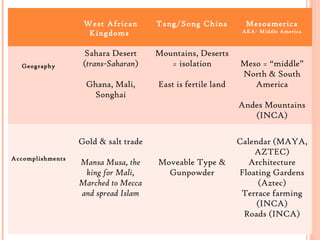
West African
Kingdoms
Tang/Song China Mesoamerica
AKA- Middle America
Geography
Sahara Desert
(trans-Saharan)
Ghana, Mali,
Songhai
Mountains, Deserts
= isolation
East is fertile land
Meso = “middle”
North & South
America
Andes Mountains
(INCA)
Accomplishments
Gold & salt trade
Mansa Musa, the
king for Mali,
Marched to Mecca
and spread Islam
Moveable Type &
Gunpowder
Calendar (MAYA,
AZTEC)
Architecture
Floating Gardens
(Aztec)
Terrace farming
(INCA)
Roads (INCA)
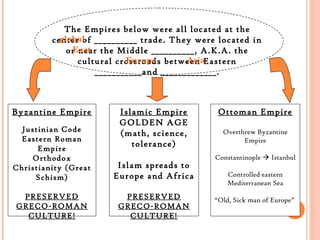
Byzantine Empire
Justinian Code
Eastern Roman
Empire
Orthodox
Christianity (Great
Schism)
PRESERVED
GRECO-ROMAN
CULTURE!
Islamic Empire
GOLDEN AGE
(math, science,
tolerance)
Islam spreads to
Europe and Africa
PRESERVED
GRECO-ROMAN
CULTURE!
Ottoman Empire
Overthrew Byzantine
Empire
Constantinople  Istanbul
Controlled eastern
Mediterranean Sea
“Old, Sick man of Europe”
The Empires below were all located at the
center of __________ trade. They were located in
or near the Middle __________, A.K.A. the
cultural crossroads between Eastern
___________and _____________.
global
East
Europe Asia
Causes:
NO CENTRAL GOVERNMENT (fall of Rome)
Feudalism: political system based on
ownership of land and loyalty
Manorialism: economic system – barter
economy, self-sufficient, based on agriculture 
isolation & little trading outside of manor
Most powerful institution = CATHOLIC
CHURCH!
Gothic architecture; art glorified God
Crusades = increased trade with Middle East
Bubonic plague is epidemic
EUROPEAN MIDDLE AGES ~ 500-1300
CE
 Japanese Feudalism:
Causes:
NO STRONG CENTRAL GOVERNMENT
Tokugawa Shogunate: powerful shogun
oversaw traditional era with golden age
Samurai: powerful warriors(Bushido Code)
Similar to European feudalism
EUROPE AFTER THE FALL OF ROME:
MIDDLE AGES  RENAISSANCE/
REFORMATION
RENAISSANCE
 Commercial Revolution (guilds,
capitalism, trade  Renaissance
 Humanism:
Curiosity about life in the present (not
life after death like in the Middle Ages)
Emphasis on the achievements of the
individual
Examined worldly subjects
“Questioning spirit” question authority
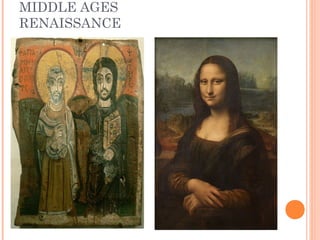
 Art & Architecture: return to Greco-Roman
styles, life-like portrayal, ordinary (secular)
topics
MIDDLE AGES
RENAISSANCE
POLITICAL/RELIGIOUS CHANGE:
REFORMATION
 Reformation: Period when Europeans broke
away from the Roman Catholic Church and
formed new Christian churches
 Causes:
 Renaissance
 Strong Monarchs
 Problems in the Church (indulgences!)
 Reformers:
 Martin Luther (95 Theses)
 John Calvin
 Impact:
 Shatters/ends religious unity in Western Europe
PRINTING PRESS
 Invention of wooden movable type in China
 Johann Gutenberg used this idea to create the
printing press (metal moveable type)
 Allowed printer to produce hundreds of copies
 BIBLE was first full book printed
Impact:
 Books became more available ~ cheaper
and easier to make!
Literacy increased ~ books were available
and more people learned to read and write!
Ideas spread rapidly ~ people had access
to new knowledge and Bibles increased the
spread of religious ideas
PRINTING PRESS
 Invention of wooden movable type in China
 Johann Gutenberg used this idea to create the
printing press (metal moveable type)
 Allowed printer to produce hundreds of copies
 BIBLE was first full book printed
Impact:
 Books became more available ~ cheaper
and easier to make!
Literacy increased ~ books were available
and more people learned to read and write!
Ideas spread rapidly ~ people had access
to new knowledge and Bibles increased the
spread of religious ideas

Review Unit 4 Global I Civilizations

  • 1.
  • 2.
    West African Kingdoms Tang/Song ChinaMesoamerica AKA- Middle America Geography Sahara Desert (trans-Saharan) Ghana, Mali, Songhai Mountains, Deserts = isolation East is fertile land Meso = “middle” North & South America Andes Mountains (INCA) Accomplishments Gold & salt trade Mansa Musa, the king for Mali, Marched to Mecca and spread Islam Moveable Type & Gunpowder Calendar (MAYA, AZTEC) Architecture Floating Gardens (Aztec) Terrace farming (INCA) Roads (INCA)
  • 3.
    Byzantine Empire Justinian Code EasternRoman Empire Orthodox Christianity (Great Schism) PRESERVED GRECO-ROMAN CULTURE! Islamic Empire GOLDEN AGE (math, science, tolerance) Islam spreads to Europe and Africa PRESERVED GRECO-ROMAN CULTURE! Ottoman Empire Overthrew Byzantine Empire Constantinople  Istanbul Controlled eastern Mediterranean Sea “Old, Sick man of Europe” The Empires below were all located at the center of __________ trade. They were located in or near the Middle __________, A.K.A. the cultural crossroads between Eastern ___________and _____________. global East Europe Asia
  • 4.
    Causes: NO CENTRAL GOVERNMENT(fall of Rome) Feudalism: political system based on ownership of land and loyalty Manorialism: economic system – barter economy, self-sufficient, based on agriculture  isolation & little trading outside of manor Most powerful institution = CATHOLIC CHURCH! Gothic architecture; art glorified God Crusades = increased trade with Middle East Bubonic plague is epidemic EUROPEAN MIDDLE AGES ~ 500-1300 CE
  • 5.
     Japanese Feudalism: Causes: NOSTRONG CENTRAL GOVERNMENT Tokugawa Shogunate: powerful shogun oversaw traditional era with golden age Samurai: powerful warriors(Bushido Code) Similar to European feudalism EUROPE AFTER THE FALL OF ROME: MIDDLE AGES  RENAISSANCE/ REFORMATION
  • 6.
    RENAISSANCE  Commercial Revolution(guilds, capitalism, trade  Renaissance  Humanism: Curiosity about life in the present (not life after death like in the Middle Ages) Emphasis on the achievements of the individual Examined worldly subjects “Questioning spirit” question authority  Art & Architecture: return to Greco-Roman styles, life-like portrayal, ordinary (secular) topics
  • 7.
  • 8.
    POLITICAL/RELIGIOUS CHANGE: REFORMATION  Reformation:Period when Europeans broke away from the Roman Catholic Church and formed new Christian churches  Causes:  Renaissance  Strong Monarchs  Problems in the Church (indulgences!)  Reformers:  Martin Luther (95 Theses)  John Calvin  Impact:  Shatters/ends religious unity in Western Europe
  • 9.
    PRINTING PRESS  Inventionof wooden movable type in China  Johann Gutenberg used this idea to create the printing press (metal moveable type)  Allowed printer to produce hundreds of copies  BIBLE was first full book printed Impact:  Books became more available ~ cheaper and easier to make! Literacy increased ~ books were available and more people learned to read and write! Ideas spread rapidly ~ people had access to new knowledge and Bibles increased the spread of religious ideas
  • 10.
    PRINTING PRESS  Inventionof wooden movable type in China  Johann Gutenberg used this idea to create the printing press (metal moveable type)  Allowed printer to produce hundreds of copies  BIBLE was first full book printed Impact:  Books became more available ~ cheaper and easier to make! Literacy increased ~ books were available and more people learned to read and write! Ideas spread rapidly ~ people had access to new knowledge and Bibles increased the spread of religious ideas