The Age of Exploration Chapter 2: pg. 32-51
EUROPEANS SET SAIL In section one, we’ll see … How economic changes in Europe make it possible to explore How the Renaissance gives sailors the knowledge and experience they need How a new attitude makes people ready for adventure How trade with China and Muslim states gives Europeans a reason to explore
Vocabulary terms for this section Write these down at the top of the page, and we’ll define them as we get to them … Capital Joint-stock companies Astrolabe Monopoly Caravel Also write down, as we get to them, who these people are Prince Henry Bartolomeu Dias
The Commercial Revolution strikes The Black Death strikes Kills 30 million people Changes many things, including the economy New developments Capital Joint-stock companies “ Money can do much; it should be held in high regard. It turns a tramp into a respected and honorable man … the more money a man has, the more worthy he becomes, while the man who is penniless cannot call himself his own master. Money makes hard things easy.” Juan Ruiz
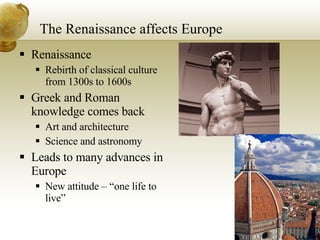
The Renaissance affects Europe Renaissance Rebirth of classical culture from 1300s to 1600s Greek and Roman knowledge comes back Art and architecture Science and astronomy Leads to many advances in Europe New attitude – “one life to live”
The Renaissance applied to sailing Applying Greek and Roman knowledge Astronomy The astrolabe Constellations Geography – latitude and longitude Longitude – log-line and hourglass Latitude – cross-staff Attitude and economy Attitude: man can do anything, including explore Economy: joint-stock companies mean adventures won’t bankrupt you
Trade with Africa and Asia Riches through trade Africa – gold, ivory, salt, slaves Asia – silk, spices Too expensive! Overland from China Monopoly by Venice Too dangerous! Turks in power Threats from bandits Big question from Spain and Portugal: Why not manage the trade routes ourselves?
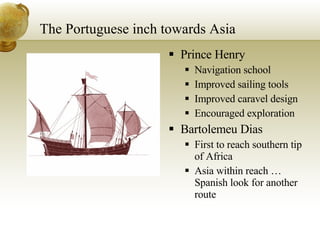
The Portuguese inch towards Asia Prince Henry Navigation school Improved sailing tools Improved caravel design Encouraged exploration Bartolemeu Dias First to reach southern tip of Africa Asia within reach … Spanish look for another route
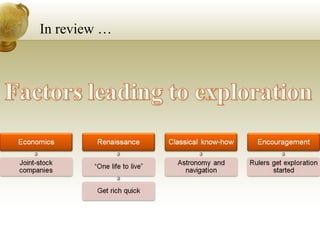
In review …

The Age Of Exploration

  • 1.
    The Age ofExploration Chapter 2: pg. 32-51
  • 2.
    EUROPEANS SET SAILIn section one, we’ll see … How economic changes in Europe make it possible to explore How the Renaissance gives sailors the knowledge and experience they need How a new attitude makes people ready for adventure How trade with China and Muslim states gives Europeans a reason to explore
  • 3.
    Vocabulary terms forthis section Write these down at the top of the page, and we’ll define them as we get to them … Capital Joint-stock companies Astrolabe Monopoly Caravel Also write down, as we get to them, who these people are Prince Henry Bartolomeu Dias
  • 4.
    The Commercial Revolutionstrikes The Black Death strikes Kills 30 million people Changes many things, including the economy New developments Capital Joint-stock companies “ Money can do much; it should be held in high regard. It turns a tramp into a respected and honorable man … the more money a man has, the more worthy he becomes, while the man who is penniless cannot call himself his own master. Money makes hard things easy.” Juan Ruiz
  • 5.
    The Renaissance affectsEurope Renaissance Rebirth of classical culture from 1300s to 1600s Greek and Roman knowledge comes back Art and architecture Science and astronomy Leads to many advances in Europe New attitude – “one life to live”
  • 6.
    The Renaissance appliedto sailing Applying Greek and Roman knowledge Astronomy The astrolabe Constellations Geography – latitude and longitude Longitude – log-line and hourglass Latitude – cross-staff Attitude and economy Attitude: man can do anything, including explore Economy: joint-stock companies mean adventures won’t bankrupt you
  • 7.
    Trade with Africaand Asia Riches through trade Africa – gold, ivory, salt, slaves Asia – silk, spices Too expensive! Overland from China Monopoly by Venice Too dangerous! Turks in power Threats from bandits Big question from Spain and Portugal: Why not manage the trade routes ourselves?
  • 8.
    The Portuguese inchtowards Asia Prince Henry Navigation school Improved sailing tools Improved caravel design Encouraged exploration Bartolemeu Dias First to reach southern tip of Africa Asia within reach … Spanish look for another route
  • 9.