Mongol Conquests and Empire
   1200s - 1300s

Mongol Conquests and Empire

          1200s - 1300s
“The greatest happiness is to scatter your
  enemy, to see his cities reduced to ashes, to
  see those who love him shrouded in tears,
  and to carry off his wives and daughters.”
                           Temujin
                            (a.k.a. Chinggis Khan)
                             (a.k.a. Genghis Khan)
Generally speaking, the
             Mongols:
• Had few technological breakthroughs
• Spread no new religions
• Wrote few books and plays
• Brought no new crops or agricultural
  methods
• Left few artifacts and buildings
• Didn’t hold on to an empire very long
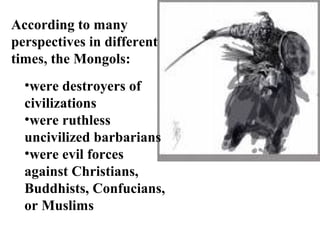
According to many
perspectives in different
times, the Mongols:
  •were destroyers of
  civilizations
  •were ruthless
  uncivilized barbarians
  •were evil forces
  against Christians,
  Buddhists, Confucians,
  or Muslims
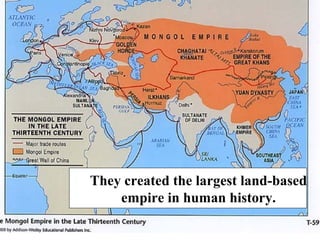
They created the largest land-based
    empire in human history.
Central Asian
  Nomads


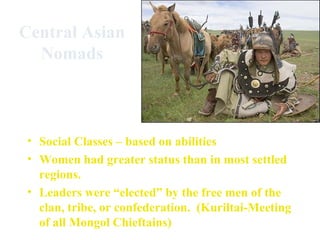
 • Social Classes – based on abilities
 • Women had greater status than in most settled
   regions.
 • Leaders were “elected” by the free men of the
   clan, tribe, or confederation. (Kuriltai-Meeting
   of all Mongol Chieftains)
Conquests
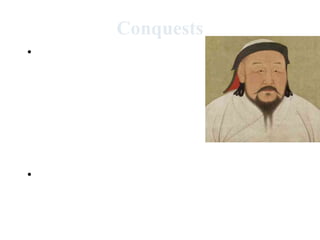
• Under the leadership of
  Chinggis Khan, the
  combination of Mongol
  discipline, technology,
  strategy, and ruthlessness
  helped the Mongols take
  control of Central Asia, then
  Northern China.
• By Chinggis Khan’s death in
  1220s, Mongol armies had
  moved west into the Islamic
  lands and Central Europe.
Conquests
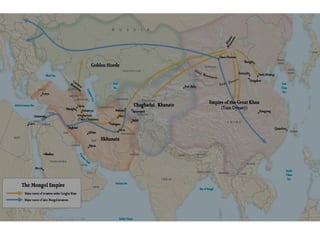
• After Chinggis Khan’s death, the
  Mongol Empire was divided in four
  parts controlled by 3 sons and a
  grandson.

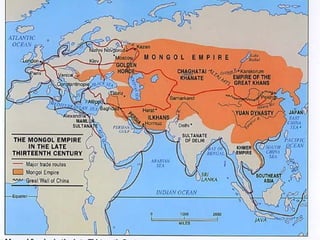
•   Khanate of the Golden Horde
•   Ilkanate
•   Djagatai (Chagtai)
•   Khanate of the Great Khan (and
    Yuan dynasty)
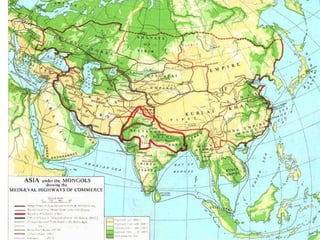
THE MONGOL EMPIREs
• Each KHANATE or kingdom then
  worked to add territory and tributary
  states to the empire which continued
  under later Mongol leaders.

• Mongol control eventually spread into
  Western Europe, the Middle East, North
  Africa and all of China.

• The ruling class who survived often
  continued to control aspects of their
  territory under the “supervision” of
  Mongol rulers.
IMPACT of the MONGOLS
•   A period of “peace” and stability in
    many areas of Eurasia led to economic
    and social development (100 years?).

      A.K.A. The MONGOL PEACE
Trade
Mongol rulers . . .
• ordered construction of roads and
  BRIDGES, and extended the Grand Canal
  in China
• set up post offices/trading posts
• protected merchants, gave them a higher
  status and set up merchant associations
• allowed an “exchange of food, tools, goods,
  and ideas [that] was unprecedented.”
Religious & Cultural Tolerance
• Mongol rulers offered tax benefits to all
  religious leaders
• Muslims were brought to China to help
  with administration & Christians & Jews
  worked in other posts of the Mongol
  governments
• There was some cultural exchange (&
  some religious conversion)
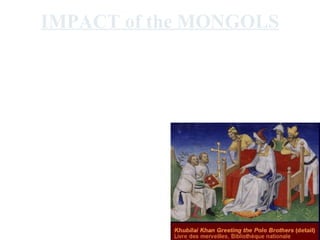
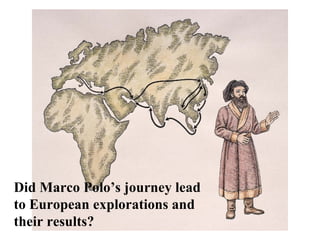
Did Marco Polo’s journey lead
to European explorations and
their results?
Also
The Mongols made an impact by . . .
• adapting the use of gunpowder,
   improving it, and spreading its use.

•   spreading the Bubonic Plague (the
    Black Death)

•   Creating a situation in which new
    groups could take control of territories
    after the Mongols retreated (Ottoman
    Turks)

Lecture mongolconquests

  • 1.
    Mongol Conquests andEmpire 1200s - 1300s Mongol Conquests and Empire 1200s - 1300s
  • 2.
    “The greatest happinessis to scatter your enemy, to see his cities reduced to ashes, to see those who love him shrouded in tears, and to carry off his wives and daughters.” Temujin (a.k.a. Chinggis Khan) (a.k.a. Genghis Khan)
  • 3.
    Generally speaking, the Mongols: • Had few technological breakthroughs • Spread no new religions • Wrote few books and plays • Brought no new crops or agricultural methods • Left few artifacts and buildings • Didn’t hold on to an empire very long
  • 4.
    According to many perspectivesin different times, the Mongols: •were destroyers of civilizations •were ruthless uncivilized barbarians •were evil forces against Christians, Buddhists, Confucians, or Muslims
  • 5.
    They created thelargest land-based empire in human history.
  • 6.
    Central Asian Nomads • Social Classes – based on abilities • Women had greater status than in most settled regions. • Leaders were “elected” by the free men of the clan, tribe, or confederation. (Kuriltai-Meeting of all Mongol Chieftains)
  • 7.
    Conquests • Under theleadership of Chinggis Khan, the combination of Mongol discipline, technology, strategy, and ruthlessness helped the Mongols take control of Central Asia, then Northern China. • By Chinggis Khan’s death in 1220s, Mongol armies had moved west into the Islamic lands and Central Europe.
  • 9.
    Conquests • After ChinggisKhan’s death, the Mongol Empire was divided in four parts controlled by 3 sons and a grandson. • Khanate of the Golden Horde • Ilkanate • Djagatai (Chagtai) • Khanate of the Great Khan (and Yuan dynasty)
  • 11.
    THE MONGOL EMPIREs •Each KHANATE or kingdom then worked to add territory and tributary states to the empire which continued under later Mongol leaders. • Mongol control eventually spread into Western Europe, the Middle East, North Africa and all of China. • The ruling class who survived often continued to control aspects of their territory under the “supervision” of Mongol rulers.
  • 12.
    IMPACT of theMONGOLS • A period of “peace” and stability in many areas of Eurasia led to economic and social development (100 years?). A.K.A. The MONGOL PEACE
  • 13.
    Trade Mongol rulers .. . • ordered construction of roads and BRIDGES, and extended the Grand Canal in China • set up post offices/trading posts • protected merchants, gave them a higher status and set up merchant associations • allowed an “exchange of food, tools, goods, and ideas [that] was unprecedented.”
  • 15.
    Religious & CulturalTolerance • Mongol rulers offered tax benefits to all religious leaders • Muslims were brought to China to help with administration & Christians & Jews worked in other posts of the Mongol governments • There was some cultural exchange (& some religious conversion)
  • 16.
    Did Marco Polo’sjourney lead to European explorations and their results?
  • 17.
    Also The Mongols madean impact by . . . • adapting the use of gunpowder, improving it, and spreading its use. • spreading the Bubonic Plague (the Black Death) • Creating a situation in which new groups could take control of territories after the Mongols retreated (Ottoman Turks)