Causes
ļ‚ž Agrarian Revolution =
more food!
ļ‚ž Population explosion
ļ‚ž Began in Great Britain
o Land (rivers, island)
o Labor (people to work)
o Capital ($ & investment)
Effects
ļ‚ž New Social Class
Structure
MIDDLE CLASS
ļ‚ž Urbanization
ļ‚ž Bad working conditions
ļ‚ž Better transportation
ļ‚ž Higher standard of living
ļ‚ž Imperialism
Industrial Revolution:
production of goods shifted
from using hand tools to
using power-driven machines
and from human and animal
power to steam power
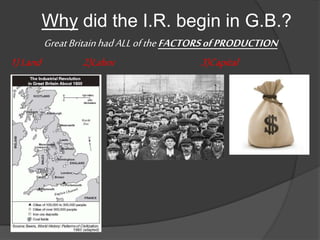
Why did the I.R. begin in G.B.?
GreatBritainhadALLoftheFACTORSofPRODUCTION
1)Land 2)Labor 3)Capital
Competing economic theories
Capitalism
(AKA: Market Economy, Free
Market, Private Enterprise)
Economy governed by natural
forces of supply and
demand
Laissez Faire – government is
NOT involved; ā€œLet it beā€
Concentrated on interests of
individual/ private
ownership
Adam Smith - author of
Wealth of Nations
Socialism
(AKA: Marxism, communism,
state-run)
Farms & businesses belong to
all people (not individuals)
Concentrated on the interests
of society
Karl Marx and Friedrich Engels,
The Communist Manifesto
history is a class struggle
proletariat (working
class) vs. bourgeoisie
wealth & power shared
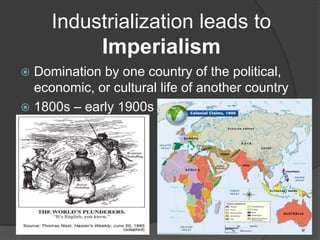
Industrialization leads to
Imperialism
ļ‚ž Domination by one country of the political,
economic, or cultural life of another country
ļ‚ž 1800s – early 1900s
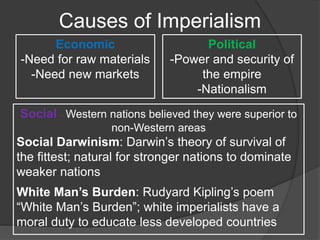
Causes of Imperialism
Economic
-Need for raw materials
-Need new markets
Political
-Power and security of
the empire
-Nationalism
Social – Western nations believed they were superior to
non-Western areas
Social Darwinism: Darwin’s theory of survival of
the fittest; natural for stronger nations to dominate
weaker nations
White Man’s Burden: Rudyard Kipling’s poem
ā€œWhite Man’s Burdenā€; white imperialists have a
moral duty to educate less developed countries
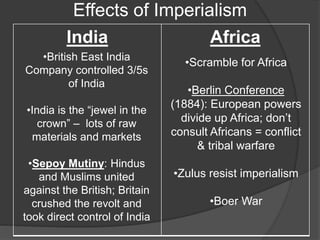
Effects of Imperialism
India Africa
•British East India
Company controlled 3/5s
of India
•India is the ā€œjewel in the
crownā€ – lots of raw
materials and markets
•Sepoy Mutiny: Hindus
and Muslims united
against the British; Britain
crushed the revolt and
took direct control of India
•Scramble for Africa
•Berlin Conference
(1884): European powers
divide up Africa; don’t
consult Africans = conflict
& tribal warfare
•Zulus resist imperialism
•Boer War
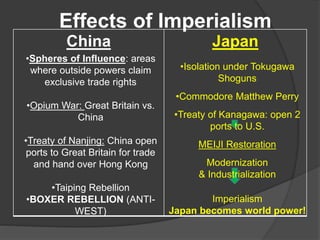
Effects of Imperialism
China Japan
•Spheres of Influence: areas
where outside powers claim
exclusive trade rights
•Opium War: Great Britain vs.
China
•Treaty of Nanjing: China open
ports to Great Britain for trade
and hand over Hong Kong
•Taiping Rebellion
•BOXER REBELLION (ANTI-
WEST)
•Isolation under Tokugawa
Shoguns
•Commodore Matthew Perry
•Treaty of Kanagawa: open 2
ports to U.S.
MEIJI Restoration
Modernization
& Industrialization
Imperialism
Japan becomes world power!

8 Industrialization to Imperialism

  • 2.
    Causes ļ‚ž Agrarian Revolution= more food! ļ‚ž Population explosion ļ‚ž Began in Great Britain o Land (rivers, island) o Labor (people to work) o Capital ($ & investment) Effects ļ‚ž New Social Class Structure MIDDLE CLASS ļ‚ž Urbanization ļ‚ž Bad working conditions ļ‚ž Better transportation ļ‚ž Higher standard of living ļ‚ž Imperialism Industrial Revolution: production of goods shifted from using hand tools to using power-driven machines and from human and animal power to steam power
  • 3.
    Why did theI.R. begin in G.B.? GreatBritainhadALLoftheFACTORSofPRODUCTION 1)Land 2)Labor 3)Capital
  • 4.
    Competing economic theories Capitalism (AKA:Market Economy, Free Market, Private Enterprise) Economy governed by natural forces of supply and demand Laissez Faire – government is NOT involved; ā€œLet it beā€ Concentrated on interests of individual/ private ownership Adam Smith - author of Wealth of Nations Socialism (AKA: Marxism, communism, state-run) Farms & businesses belong to all people (not individuals) Concentrated on the interests of society Karl Marx and Friedrich Engels, The Communist Manifesto history is a class struggle proletariat (working class) vs. bourgeoisie wealth & power shared
  • 5.
    Industrialization leads to Imperialism ļ‚žDomination by one country of the political, economic, or cultural life of another country ļ‚ž 1800s – early 1900s
  • 6.
    Causes of Imperialism Economic -Needfor raw materials -Need new markets Political -Power and security of the empire -Nationalism Social – Western nations believed they were superior to non-Western areas Social Darwinism: Darwin’s theory of survival of the fittest; natural for stronger nations to dominate weaker nations White Man’s Burden: Rudyard Kipling’s poem ā€œWhite Man’s Burdenā€; white imperialists have a moral duty to educate less developed countries
  • 7.
    Effects of Imperialism IndiaAfrica •British East India Company controlled 3/5s of India •India is the ā€œjewel in the crownā€ – lots of raw materials and markets •Sepoy Mutiny: Hindus and Muslims united against the British; Britain crushed the revolt and took direct control of India •Scramble for Africa •Berlin Conference (1884): European powers divide up Africa; don’t consult Africans = conflict & tribal warfare •Zulus resist imperialism •Boer War
  • 8.
    Effects of Imperialism ChinaJapan •Spheres of Influence: areas where outside powers claim exclusive trade rights •Opium War: Great Britain vs. China •Treaty of Nanjing: China open ports to Great Britain for trade and hand over Hong Kong •Taiping Rebellion •BOXER REBELLION (ANTI- WEST) •Isolation under Tokugawa Shoguns •Commodore Matthew Perry •Treaty of Kanagawa: open 2 ports to U.S. MEIJI Restoration Modernization & Industrialization Imperialism Japan becomes world power!